Mythical yeti ‘could be descended from ancient polar bear’

20131018-125734.jpg

20131018-125744.jpg

A British geneticist said Thursday he may have solved the mystery of the yeti, after matching DNA from two animals said to be the mythical beast to an ancient polar bear.
“We have found an exact genetic match between two samples from the Himalayas and the ancient polar bear,” said Bryan Sykes, emeritus professor at Oxford University

There have for centuries been legends about hairy, ape-like creatures, also known as “migoi” in the Himalayas, “bigfoot” in North America and “almasty” in the Caucasus mountains.

The myth was given credence when explorer Eric Shipton returned from his 1951 expedition to Everest with photographs of giant footprints in the snow.

Eyewitness accounts have since fuelled speculation that the creatures may be related to humans, but Sykes believes they are likely to be bear hybrids.

A reported sighting of the famous Abominable Snowman.

He made a global appeal last year for samples from suspected Yeti sightings and received about 70, of which 27 gave good DNA results. These were then compared with other animals’ genomes stored on a database.

Two hair samples came up trumps — one from a beast shot in the Kashmiri region of Ladakh 40 years ago and the other found in Bhutan a decade ago.

“In the Himalayas, I found the usual sorts of bears and other creatures amongst the collection,” Sykes told BBC radio, ahead of the broadcast of a TV programme about his findings.

“But the particularly interesting ones are the ones whose genetic fingerprints are linked not to the brown bears or any other modern bears, (but) to an ancient polar bear.”

The DNA from the Himalayan samples was a 100 percent match with a sample from a polar bear jawbone found in Svalbard in Norway, dating back between 40,000 and 120,000 years.

Brown bears and polar bears are closely related as species and are known to interbreed when their territories overlap, according to Sykes.

“This is an exciting and completely unexpected result that gave us all a surprise,” he said in a statement, adding: “There’s more work to be done on interpreting the results.

“I don’t think it means there are ancient polar bears wandering around the Himalayas. But… it could mean there is a sub-species of brown bear in the High Himalayas descended from the bear that was the ancestor of the polar bear.

“Or it could mean there has been more recent hybridisation between the brown bear and the descendent of the ancient polar bear.”

A breast cancer drug holds hope for patients with pancreatic cancer

Source: YahooNews

A breast cancer drug holds hope for patients with pancreatic cancer, one of the deadliest cancers.

A breast cancer drug can double two-year survival rates of patients with pancreatic cancer, trial results have shown.

Nab-paclitaxel, marketed as Abraxane, also increased the proportion of patients still alive after one year by 59 per cent.

It is already approved for women with spreading breast cancer who have run out of other options.

Pancreatic cancer is one of the deadliest cancers, killing 80 per cent of patients within a year.

The disease claimed the life of Hollywood star Patrick Swayze.

Data from the MPACT (Metastatic Pancreatic Adenocarcinoma Clinical Trial) study showed significant improvements when patients were treated with Abraxane in combination with standard chemotherapy.

Average survival increased from 6.7 months to 8.5 months. One year survival rates rose from 22 per cent to 35 per cent and at two years they doubled from 4 per cent to 9 per cent.

The results are published in the New England Journal of Medicine.

“Today’s news represents a major step-forward in the treatment of advanced pancreatic cancer,” said consultant oncologist Dr Harpreet Wasan, from Hammersmith Hospital in London, who runs a pancreatic cancer research program.

“The prognosis for these patients is exceptionally poor and, unlike many other cancers, current treatment options are limited. Based on this data, nab-paclitaxel offers patients a major new advance.”

Ali Stunt, founder and chief executive of the charity Pancreatic Cancer Action, said: “Pancreatic cancer is lagging behind other cancers in terms of treatments that extend survival, but nab-paclitaxel has the potential to offer hope to patients with this deadly disease.”

Abraxane’s manufacturer Celgene has applied to the European Medicines Agency (EMA) for a licence to use the drug to treat advanced pancreatic cancer.

Malaysia must back off threats: Independent Senator Nick Xenophon

Source: News

Independent Senator Nick Xenophon has called on the government to press Malaysia to back off threats against students who attend an event featuring opposition leader Anwar Ibrahim this weekend.

Senator Xenophon said the level of paranoia from the Malaysian government was just extraordinary.

“The Australian government needs to make it absolutely clear to the Malaysian government as a matter of urgency some time on Friday that these threats are completely unacceptable,” he told ABC’s 730 on Thursday.

“These students have a right to attend this forum involving Malaysia’s opposition leader without any fear of retribution.”

Mr Ibrahim, a longtime opponent of the Malaysian government who was jailed for nine years on trumped up sodomy charges, will speak at the Adelaide Festival of Ideas on Saturday.

But Malaysian students in Australia had been warned against attending.

An email from the student adviser at the Malaysian consulate in Sydney reportedly told Malaysian scholarship students to stay away.

“I wouldn’t hesitate to take stern action to those scholars who are involved. You know really well what you have signed into,” the email said, according to ABC television.

Senator Xenophon, who was barred from entering Malaysia in February and is now banned from returning there, said Mr Ibrahim was an impressive figure who had been jailed, victimised and defamed by the Malaysian government.

“There needs to be a guarantees by the Malaysian government that this threat will be withdrawn and there will be no consequences,” he said.

Emergency fire warnings issued as three major fires burn across NSW near Newcastle, Blue Mountains and Southern Highlands

Plumes of smoke can be seen from a fire near Heatherbrae which has forced the closure of Williamtown Airport in Newcastle.

A HOME is ablaze, a regional airport is closed and authorities are warning of a serious threat to life as bushfires burn across NSW.

In the Southern Highlands, south-west of Sydney, a fire at the village of Balmoral, in Wingecarribee, was moving very quickly.

Rural Fire Service spokesman Joel Kursawe says there are reports one house is on fire.

“They’re saying that one house is already alight, that could be because the house was alight and it’s spread, or not, we don’t know,” he told reporters.

“It’s all happened very quickly.”

Attempts to waterbomb in Lithgow were being hindered by 90km winds, Mr Kursawe said, which were also capable of carrying embers up to six kilometres.

“The problem is when you’ve got aircraft over fires like that with (those) winds, a lot of the time they’re just getting knocked around in the sky,” Mr Kursawe told journalists at RFS headquarters in Sydney.

RURAL FIRE SERVICE MAP OF CURRENT FIRES AND INCIDENTS

Homes at Clarence, Dargan, Doctors Gap and Hartley are expected to come under threat from the fire, which has already burnt more than 1000 hectares of bushland.

Two evacuation centres have been set up at Lithgow Workers Club and Mt Tomah Botanic Gardens.

Meanwhile, more than 130 firefighters are fighting the blaze near Port Stephens.

“Some of the pictures we’re getting from up there, it’s just incredible,” Mr Kursawe said.

“It’s just a mass smoke cloud over the whole town.”

The fire at Balmoral Village was approaching the township of Yanderra and residents were being urged to move towards Bargo.

A total fire ban remains in place for several areas of the state with temperatures of 34C forecast.

It was nudging 34C in Sydney at 1pm (AEDT) with gusty winds.

The Heatherbrae bushfire near Williamtown Airport in Newcastle. Picture: Twitter
Of most concern to firefighters are three fires.

In the Blue Mountains west of Sydney, near Lithgow, more than 100 firefighters are battling a massive blaze that is skirting the village of Oaky Park and spotting into Clarence.

A new fire had also broken out at Springwood.

RFS deputy commissioner Rob Rogers tweeted: “lithgow fire becoming unpredictable. Residents please take extreme care. Very serious danger to life today”.

A Blue Mountains resident said the RFS had just knocked on his door warning the fire was approaching.

“The sky is very dark with the sun burning orange through the dark smoke,” the resident told ABC radio.

Bells Line of Road has been closed between Lithgow and Bell in both directions.

The Darling Causeway is closed northbound at the Great Western Highway in Mount Victoria.

NSW National Parks and Wildlife Service has closed additional areas of the Blue Mountains National Park because of the threat.

Blue Mountains Regional Manager Geoff Luscombe said all tracks and trails in the Grose Valley, as well as lookouts along the Bells Line of Road, are now closed as a precautionary measure.

“With a very high fire danger rating there’s always a chance that the Lithgow fire could enter the park and if that happens we don’t want people walking in there,” he said.

Residents who hadn’t already evacuated before noon were advised to take shelter in their homes.

And at Port Stephens, north of Newcastle, Williamtown Airport was closed about midday and all flights in and out were suspended because of a bushfire burning nearby.

Passengers are advised to not come to the airport and to contact their airline for flight details.

Smoke from the Port Stephens fires, not far from where four homes were lost on Sunday, was visible from the Newcastle CBD.

The dramatic scene at Williamtown Airport, Newcastle. Picture: Twitter @WynRichards
Similar conditions on Sunday resulted in six homes being lost to fires at Port Stephens, north of Newcastle, and near Kempsey on the north coast.

The airport was closed after a fire burning near Heatherbrae breached containment lines fanned by gusty winds, the RFS said.

Properties around Tomago Road, Cabbage Tree Road, Barrie Close, and Williamtown Drive may also come under threat, the RFS warns.

Smoke from the fire is visible from the Newcastle CBD.

In the Blue Mountains region, residents of Clarence and Oaky Park have been urged to seek shelter and protect themselves from flying embers, with properties there expected to be threatened.

Those who had planned to leave their homes in a bushfire should have left by noon (AEDT), NSW Fire Commissioner Shane Fitzsimmons said.

Conditions were worsening with winds expected to reach up to 95km/h.

“History will show, too many lives are lost when people flee at the last minute,” he said.

The fire broke out near an army range on Wednesday afternoon, with explosions and detonations making it too dangerous to send in firefighters and aircraft.

Mr Fitzsimmons says the fire would take some time to control given the sweltering conditions and its geographic location.

It’s expected to skirt to the northeast of Lithgow and head into the mountains as the winds pick up.

Conditions were worsening this afternoon with winds expected to reach up to 95km/h.

If the high winds do fan the blaze, it could disrupt the Western rail line through the area, Mr Fitzsimmons said.

A 367-hectare bushfire is also burning 15km east of Singleton, in the Hunter Valley, but is being controlled.


Lund University cancer researchers have discovered the path used by exosomes to enter cancer cells

Source: Healthcare

Cancer cells’ communication path blocked

Lund University cancer researchers have discovered the path used by exosomes to enter cancer cells, where they stimulate malignant tumour development. They have also succeeded in blocking the uptake route in experimental model systems, preventing the exosomes from activating cancer cells.

VIDEO STORY
The Lund University research team has looked at how cancer cells communicate with surrounding cells and how this encourages the development of malignant tumours. The idea is to try and inhibit tumours by disrupting this communication. The focus of their research is ‘exosomes’, small virus-like particles that serve as ‘transport packages’ for genetic material and proteins transmitted between cells.
The importance of exosomes in the tumour microenvironment has been demonstrated within the field in recent years, as it has been shown that tumour development is halted if the production of exosomes inside the cancer cell is stopped.

“However, it is very difficult to achieve this in a clinical situation with patients. A major question in the field recently has therefore been the uptake path into the cell. How do the exosomes get into the recipient cells? That is what our discovery is about”, says Mattias Belting, research group leader and Professor of Clinical Oncology at Lund University.

The Lund researchers’ discovery is the exosomes’ journey from the sender cell to the receiver cell and how the receiver cell captures and internalizes the exosomes. They have also found a way to block the path to uptake in the receiver cell.

“When we block the path into the cell, we also block the functional effects of the exosomes. This means that the entry route now appears to be a very interesting focus point for future cancer treatments”, says Mattias Belting.
In the current study, the Lund researchers have shown that heparan sulfate proteoglycans – proteins with one or several long sugar chains connected to them – serve as receptors of exosomes and carry them into the cell. It is the proteoglycans’ sugar chains, heparan sulfate, that capture the exosomes at the surface of the cell.
“Previous studies have shown that heparan sulfate plays a role in the cells’ uptake of different viruses, such as HIV and the herpes simplex virus. In this way, the mechanism by which exosomes enter cells resembles the spread of viral infections”, says Helena Christianson, doctoral student in Belting’s research team and first author of the study.

Earlier this year, Mattias Belting and his colleagues published an article in PNAS that showed how they had managed to isolate exosomes in a blood sample from brain tumour patients. The analysis suggested that the content of the exosomes closely reflected the properties of the tumour in a unique way.

“Research on exosomes is exciting and relatively new. There is significant potential for exosomes as biomarkers and treatment targets of various cancers as we learn more about them”, says Mattias Belting.

Study:
Cancer cell exosomes depend on cell-surface heparan sulfate proteoglycans for their internalization and functional activity

Authors: Helena C. Christianson, Katrin J. Svensson, Toin H. van Kuppevelt, Jin-Ping Li and Mattias Belting
PNAS

Contact:
Mattias Belting, Professor of Clinical Oncology at Lund University, consultant at Skåne University Hospital
+46 733 507473

Independent Senator for South Australia, Nick Xenophon, has called on Qantas Chairman Leigh Clifford to step aside until overseas authorities

Source: NickXenophon

Qantas chairman must step aside pending investigations Independent Senator for South Australia, Nick Xenophon, has called on Qantas Chairman Leigh Clifford to step aside until overseas authorities, including the UK Serious Fraud Office, the Financial Conduct Authority (UK), the US Department of Justice and the US Securities Exchange Commission, have completed their investigations into the activities of Barclays Plc, at the time Mr Clifford was a director.

Independent Senator for South Australia, Nick Xenophon, has called on Qantas Chairman Leigh Clifford to step aside until overseas authorities, including the UK Serious Fraud Office, the Financial Conduct Authority (UK), the US Department of Justice and the US Securities Exchange Commission, have completed their investigations into the activities of Barclays Plc, at the time Mr Clifford was a director.

Barclays, and a number of its officers, are being investigated for an ‘advisory fee’ of $500 million that was allegedly paid to facilitate a transaction with Qatar Holding LLC for a £9.2 billion injection of capital in 2008. Mr Clifford was a director of Barclays at the time the alleged payments occurred, as reported in the Australian Financial Review today.

The US investigations are examining whether payments made by Barclays to third parties have breached the US Foreign Corrupt Practices Act.

Last year, Qantas non-executive director Corinne Namblard resigned, as a result of a corruption investigation in Italy relating to allegations of bid rigging and document fraud for a company of which she was an officer.

“When Ms Namblard stood down, Mr Clifford said the Qantas board ‘appreciated her sentiments’ that she did not want the media coverage of the Italian investigation to impact on Qantas,” Nick said. “Perhaps Mr Clifford should consider these very comments in light of his own circumstances.”

“Mr Clifford needs to explain to Qantas shareholders what he knew about those ‘advisory payments’ and explain what involvement, if any, he had in authorising them,” Nick said.

“The duties of a director in the UK are as onerous in the UK as they are in Australia,” Nick said. “As a director of Barclays, Mr Clifford should have known about all the payments associated with the Qatar capital raising.”

As reported in the Australian Financial Review, the UK Financial Conduct Authority fined Barclays $84 million just last month for not disclosing the secret fees.

“If the ‘advisory fees’ were above board, why weren’t they disclosed to Barclays shareholders?” Nick asked. “They should have been disclosed as relevant information.”

“The question also needs to be asked if the transaction would have been facilitated if not for these ‘advisory fees’.”

“What did Mr Clifford actually know about this murky deal?”

Mr Clifford is due to face Qantas shareholders at its AGM in Brisbane this Friday.

‘Raiders of the Lost Ark’ redux? Ancient golden tablet owned by Holocaust survivor from LI sparks international battle

Source: newsday

20131016-102253.jpg

Ostensibly, it’s a run-of-the-mill family dispute over a father’s will.

But the case, listed as Matter of Flamenbaum, Deceased, mixes elements of “Raiders of the Lost Ark” with the Holocaust, sibling rivalry, ancient Assyrian history and obscure legal concepts.

The seven judges of New York’s highest court heard arguments in the case Tuesday, trying to make sense of who rightfully owns a credit-card-sized piece of gold that had been missing for decades and now could be worth millions of dollars.

The estate of Holocaust survivor Riven Flamenbaum of Great Neck is appealing an order requiring it to return an ancient gold tablet to the Vorderasiatisches Museum in Berlin.

The 9.5-ounce, inscribed tablet was excavated about 100 years ago by German archaeologists who found it in the foundation of the Ishtar Temple, a ziggurat in the Assyrian city of Ashtur, in what is now northern Iraq. Court documents said the tablet dates to the reign of King Tukulti-Ninurta I of Assyria (1243-1207 BC), making it more than 3,200 years old. The inscription describes the building of the temple complex.

It was put on display in the Vorderasiatisches Museum in Berlin in 1934. But when the museum’s artifacts were inventoried in 1945, at the end of World War II, the tablet was missing.

Flamenbaum died in 2003; in 2006, amid a dispute about the estate, his son, Israel Flamenbaum, informed the museum that the estate had possession of the gold tablet. The museum filed suit to regain possession and the case has been in court since.

A lower court found for the estate, but a midlevel court overturned it, ruling for the museum. The Court of Appeals typically takes four to six weeks to decide a case.

Hannah Flamenbaum, one of Riven’s daughters and the executor of the estate, said her father, an Auschwitz survivor, traded Red Cross packages for silver and gold pieces with Russian soldiers at the end of the war.

“It was either for two packs of cigarettes or a piece of salami,” Hannah Flamenbaum said outside the courtroom Tuesday, repeating what she called the family lore. “My father, in his nature, probably traded for it. He was a peddler.”

Riven Flamenbaum, a native of Poland, moved to New York around 1949 and ran a liquor store. He kept what he called his “coin collection” either on a mantel or in a little red wallet. Hannah said he brought the tablet to Christie’s, the famed auction house, in 1954, but they told him he had a forgery. She said they never thought much about it until Riven died at age 92. Israel Flamenbaum filed objections to Hannah’s accounting of the estate and notified the Berlin museum about the tablet, according to court documents.

Hannah and a sister maintain that the museum’s claim on the artifact is barred by a legal doctrine known as laches. Plainly stated, it means that the museum gave up its claim to the tablet because it “failed to exercise reasonable diligence to locate” it for more than six decades.

Steven Schlesinger, the lawyer representing the estate, said any claim by the museum is complicated by the passage of so much time and Riven Flamenbaum’s death. Schlesinger said the tablet, which is being held in a safe-deposit box, has been said to be worth $10 million, but no one knows the true value.

Raymond Dowd, attorney for the museum, countered that until Vorderasiatisches received Israel Flamenbaum’s letter, it had no idea of the tablet’s whereabouts.”Did the museum have an obligation to seek it out,” Chief Judge Jonathan Lippman asked.

“No,” Dowd replied.

“Is it really fair for your client to sit around 60 years and wait until [Riven Flamenbaum] is dead, and then come in and sue?” Judge Robert Smith probed at another point.

Dowd said many scholars had written about the missing piece, so it was known in the research world.

“Obviously, Israel Flamenbaum knew about it,” Dowd said. “He wrote the museum and said item VA994 is in my family’s possession.

An international group of scientists from Australia and Canada are getting closer to a new treatment for prostate cancer

Source: ACRF

Cancer researchers find prostate cancer “Achilles Heel” and move closer to a new treatment.

An international group of scientists from Australia and Canada are getting closer to a new treatment for prostate cancer that works by starving tumours of an essential nutrient.

Dr Jeff Holst from Sydney’s Centenary Institute, and his colleagues from Adelaide, Brisbane and Vancouver have shown they can slow the growth of prostate cancer by stopping the protein ‘leucine’ from being pumped into tumour cells.

Leucine is involved in cell division and making proteins. It ‘feeds’ cell growth by being pumped through ‘protein pumps’ on the surface of our cells.

In 2011, Dr Holst and his colleagues showed that prostate cancer cells have more ‘protein pumps’ on their surface compared with normal cells. These pumps are allowing the cancer cell to take in more leucine, thereby stimulating overactive cell division.

In a follow-up study, recently published in the Journal of the National Cancer Institute, Dr Holst and his team were able to successfully block the leucine pumps with targeted chemical compounds. As a result, they inhibited the activity of more than 100 genes which contribute to prostate cancer growth and spread.

“There are currently no drugs that target these leucine nutrient pumps, but we are working on that.” Said Dr Holst.

“We are confident we will have new compounds available for testing in the clinic in the next few years.”

Interestingly, our bodies can’t make leucine. It is an essential nutrient which comes from our diet and is transported into cells by these specialised protein pumps.

Dr Holst said, “A lot of cancers, such as prostate cancer, are actually western diseases. Really there are very low incidence rates in Asia and Africa. But when Asian or African men migrate to the US, studies have shown that they get prostate cancer at the same rate as the Caucasian American population.”

“Western diets, high in red meat and dairy products, are correlated with prostate cancer. Interestingly these foods are also high in leucine. So we are looking at how changing diet affects how cancer cells grow—and we can now investigate this impact right down to the genetic and molecular level.”

Dr Holst and his team have suggested that other solid cancers, such as melanoma and breast cancer may well be amenable to the same approach.

No related posts.

Discovery of a lifetime: giant 5-metre, serpent-like oarfish found by snorkeller

Source: SMH

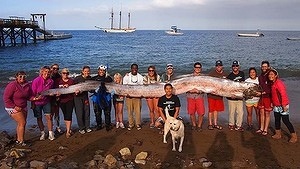
20131016-100347.jpg
The silvery fish was found in the waters of Toyon Bay. The oarfish is the longest bony fish in the ocean. Photo: AP

A marine science instructor snorkelling off the southern California coast spotted something out of a fantasy novel: the silvery carcass of an 18-foot-long (five metre), serpent-like oarfish.

Jasmine Santana of the Catalina Island Marine Institute needed more than 15 helpers to drag the giant sea creature with eyes the size of half dollars to shore on Sunday.

Staffers at the institute are calling it the discovery of a lifetime.

“We’ve never seen a fish this big,” said Mark Waddington, senior captain of the Tole Mour, CIMI’s sail training ship. “The last oarfish we saw was three feet (90 centimetres) long.”

Because oarfish dive more than 3000 feet deep (914 metres), sightings of the creatures are rare and they are largely unstudied, according to CIMI.

The obscure fish apparently died of natural causes. Tissue samples and video footage were sent to be studied by biologists at the University of California, Santa Barbara.

Santana spotted something shimmering about 30 feet deep (nine metres) while snorkelling during a staff trip in Toyon Bay at Santa Catalina Island, about two dozen miles from the mainland.

“She said, ‘I have to drag this thing out of here or nobody will believe me,'” Waddington said.

After she dragged the carcass by the tail for more than 75 feet (23 metres), staffers waded in and helped her bring it to shore.

The carcass was on display on Tuesday for 5th, 6th, and 7th grade students studying at CIMI. It will be buried in the sand until it decomposes and then its skeleton will be reconstituted for display, Waddington said.

The oarfish, which can grow to more than 50 feet (15 metres), is a deep-water pelagic fish — the longest bony fish in the world, according to CIMI.
They are likely responsible for sea serpent legends throughout history.

Rogue kangarooo on the hop at Melbourne Airport

Source: News

20131016-095908.jpg

A rogue kangaroo has hopped into a chemist at Melbourne Airport.

The bizarre customer was discovered in the domestic terminal – much to the amusement of travellers.

Police are on site.

It is not the first time airport staff have been caught off guard by a wayward kangaroo.

One sneaked into the multi-storey car park of the airport in January this year. A similar incident occurred in October last year.

More to come.