Has Today Tonight presenter Helen Kapalos put her foot in it again?

Source: News

Today Tonight presenter Helen Kapalos suffered through a TV presenter's nightmare in June. Picture: Supplied

Today Tonight presenter Helen Kapalos suffered through a TV presenter’s nightmare in June. Picture: Supplied

HAS Channel Seven presenter Helen Kapalos stuffed up again?

After she was let go by Channel Ten last year, Ms Kapalos agreed to appear as a “reporter” in a mock current affairs show called Tomorrow Whenever.

Ironically, both the short film and its title are blatant parodies of Today Tonight, where Ms Kapalos now works.

In the film, Ms Kapalos pretends to report on Senate legislation subsidising caravans in Australians’ back yards to house asylum seekers.

She interviews a human rights advocate, a bogan couple, a group of refugees and a parody of former Greens leader Bob Brown.

Caravans for Refugees

The mockery is merciless. “Bob Green”, the fake Greens Senator, is in love with a tree in his back yard. He tells Ms Kapalos she “should see the size of its trunk”. The human rights activist has crafted an Islamic prayer mat with an in-built compass to find Mecca, and the bogan couple really, really hates Collingwood.

The fake current affairs report was the brainchild of Adrian Cappola, the owner of Aussie caravan brand Elite Caravans. Hence the plot involving subsidised caravans for asylum seekers.

Ms Kapalos wrote a blog post about the film in January. She was impressed by the concept.

“There are some emails that jump through the page and hit you in the solar plexus,” she said. “It was like that when I first heard from Jim Shomos, a film director whose words fired up my synapses and tickled my funny bone at the same time.

“I had never even met the guy so I was impressed he had the balls to connect in such a direct and entertaining manner.”

Obviously, she realised the subject of asylum seekers could be controversial.

“The issue of asylum seekers has become, with good reason, one of Australia’s most pressing social debates, with a frustrating dictum of boundaries and conditions attached,” she said. “I was happy just for a day not to see it treated as a political handball.”

Ms Kapalos experienced every news presenter’s worst nightmare in June when she was caught on air with no script or autocue. She stumbled disastrously over her words in a cringe-worthy 90 seconds of television.

At least she was trying to make people laugh this time.

A Sydney GP who was hit in the groin by a ski-lift at Perisher has been awarded more than a million dollars in damages

Source: SMH

Kirrawee doctor Ghita Nair-Smith suffered serious injuries after being struck from behind by the handrail of a chair lift while she and a friend were waiting to travel to a ski-run on July 18, 2003. She remained painfully straddled on the armrest and was eventually pulled into her seat by a friend.

The 54-year-old doctor said she noticed the safety bar had not been raised and was threatening to knock them over as the chair turned the bullwheel of the lift. She said the lift operator grabbed the safety bar at the last minute, causing it to move out of alignment and wedge between her legs.

Perisher claimed the lift operator raised the safety bar in a safe and timely manner, but that Dr Nair-Smith and her friend unnecessarily panicked and she moved out of alignment with the designated loading point.

A judge found in the GP’s favour in July, ruling the ski operator was negligent and had breached its duty of care.

Justice Robert Beech-Jones ordered both parties agree on a damages sum but had to intervene when they came up with wildly different calculations. He awarded Dr Nair-Smith $1,192,597.50 last week, excluding interest.

The court heard the collision damaged ligaments around Dr Nair-Smith’s groin and lower back, causing her significant ongoing pain and, as a consequence of that, a psychiatric pain disorder. This had restricted her functioning, including her ability to work full time, participate in recreational activities, travel and have sex.

Included in the sum was $50 a week for a cleaner for the rest of her life, $235,032 for seven hours of domestic assistance a week provided by her family, $13,576 for equipment such as a special mattress and a kitchen renovation and $975 per week – or $325,000 – for the one-and-a-half days a week she can no longer work.

Justice Beech-Jones rejected some aspects of Dr Nair-Smith’s case, including that she had post-traumatic stress disorder or that she needed specialised pain-relieving injections.
Perisher disputed that all of the expenses were due to the accident, arguing the GP had underlying injuries, including a persistent knee injury from a previous skiing accident and lower back pain.

Justice Beech-Jones has ordered both parties to prepare interest calculations and legal costs.

‘Germany owes Greece WWII reparation’

Source: Presstv

Greece has announced that Germany must pay reparations for damages inflicted on the Greeks during World War II, a report says.

According to a report published by the New York Times on October 5, a group of Greek lawmakers stated in an 80-page report that Berlin owed reparations for those Greeks who died during the world war.

In the report it was mentioned that Germany also owes a large unpaid loan Athens was forced to give the Nazi state.

Greek Prime Minister Antonis Samaras says he has handed the report over to Greece’s Legal Council of State, which is to decide on the future of the case.

Athens has not yet released the total amount it believes Berlin owes. However, the figure discussed most often as the amount Germany must pay is USD 220 billion, half of the total debt Greece has.

In April, a panel set up by the Greek Finance Ministry said that Germany had to pay more than 160 billion euros in reparations to Greece.

Following the announcement, the German daily Der Spiegel said that Berlin should pay 108 billion euros for the reconstruction of its damaged infrastructure following the war.

Reports also said that Germany owed Greece 54 billion euros in loans it received during 1942 and 1944.

In July, German Finance Minister Wolfgang Schaubl said his country had to “examine exactly what happened in Greece.”

Experts believe that if Germany pays Greece what it allegedly owes, it would significantly improve the country’s likelihood of surviving the spiraling crisis and its crippling debt.

Greece has been dependent on bailout funds from international rescue loans approved by the troika of international creditors – the European Commission, the International Monetary Fund and the European Central Bank – since May 2010.

Greek Finance Ministry unveils draft budget 2014

Greek Finance Ministry unveiled the draft Budget 2014 on Monday. In the ambitious draft, Athens predicts recession at 4% from 4.6% originally foreseen. A much better figure when compared to 6.5% of 2012. Deputy finance Minister, Christos Staikouras who presented the draft budget, said that the primary surplus will be at 380 million euro in 2013 and 2.8 billion euro in 2014.

Staikouras gave also the official rate of unemployment at 27% and said that it will drop to 26% in 2014.

“The 2014 budget will also foresee a primary surplus of 2.8 billion euros (1.5 percent of GDP), compared to about 300 million euros this year.

The draft budget might also give a better idea of the fiscal gap that Greece faces next year. The Finance Ministry believes it will be about 600 million euros, whereas the troika expects it to be as much as 3 billion euros.

The final version of the budget is due to be submitted to Parliament at the end of November and could contain a number of changes compared to the draft due to be issued on Monday.” (ekathimerini)

While the government claims that there would be no additional austerity measures, the big question is where the 2.8 billion euro surplus will come from – especially the moment that the government hardly proceeds to expenditure cuts.

A not-so-secret present is being currently wrapped by the technocrats of the Greek finance ministry. With love to the Greek taxpayer: tax hikes to income from rent, tax hikes for free lancers and small enterprises, abolishing tax breaks and stricter taxes for farmers.

As of 1.1.2014 the new taxation system that will go into effect will abolish also the tax free amount of 5,000 euro for annual income.

Nevertheless the budget 2014 has to be approved by the Troika – business as usual….

PS What? the European Union claims as “poor” those with annual income of 7.500 euro? In Greece, they tax also the very poor… Of course. If they don’t cut expenditure, there is no other way than “Taxes and more Taxes”.

«Η παρουσία της Κρήτης στο έργο του Νίκου Καζαντζάκη»

Source: KRITIKA_EPIKAIRA

Στο πλαίσιο του εορτασμού των 100 χρόνων από την Ένωση της Κρήτης με την Ελλάδα, ο Δήμος Αρχανών-Αστερουσίων και το Μουσείο Νίκου Καζαντζάκη συνδιοργανώνουν ημερίδα με θέμα «Η παρουσία της Κρήτης στο έργο του Νίκου Καζαντζάκη».

Η ημερίδα θα διεξαχθεί στην αίθουσα εκδηλώσεων του Μουσείου στη Μυρτιά, την Τετάρτη, 9 Οκτωβρίου 2013, στις 7.00 το απόγευμα, και το πρόγραμμά της διαρθρώνεται σε δύο μέρη.

Στο πρώτο μέρος, τέσσερις ομιλητές θα πραγματευτούν τη σχέση του Νίκου Καζαντζάκη με σημαντικές πτυχές της Ιστορίας της Κρήτης, και συγκεκριμένα:

– Ελπινίκη Νικολουδάκη-Σουρή, «Ο Νίκος Καζαντζάκης στα εκατόχρονα της Ένωσης: προσωπικά βιώματα και ιστορική μνήμη»,

– Ελένη Κωβαίου, «Νίκος Καζαντζάκης και Μινωικός Πολιτισμός»,

– Μάνος Χαλκιαδάκης, «Ο Νίκος Καζαντζάκης και η Κρητική Πολιτεία, 1898-1913» και,

– Ben Petre, «Η πρόσληψη του πρώιμου έργου του Νίκου Καζαντζάκη από το κοινό του Ηρακλείου».

Στο δεύτερο μέρος, ο Γιάννης Κασσωτάκης στο τραγούδι και η Λίλυ Δάκα στο πιάνο, θα ερμηνεύσουν τραγούδια σε κείμενα του Νίκου Καζαντζάκη και μουσική του Μάνου Χατζιδάκι.

Sydney Roosters defeat Manly Sea Eagles 26-18 to win epic NRL Grand Final

Source: News

NRL GF

Jamie Lyon is tackled without the ball by Mitchell Aubusson, resulting in a Manly penalty try.

THERE was controversy, there were spectacular tries and in the end there was only one winner as the Roosters stormed back from a 10-point deficit to beat the Manly Sea Eagles 26-18 in an epic NRL Grand Final.

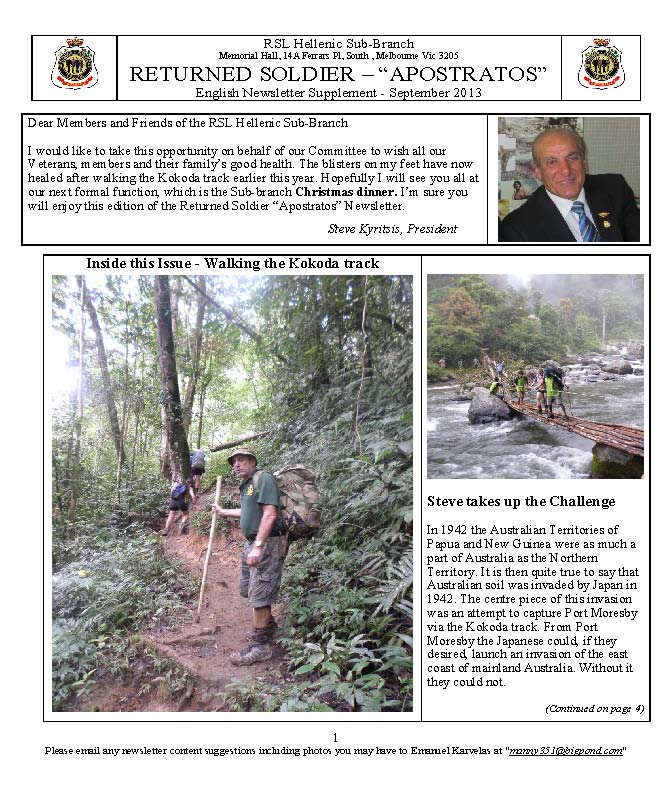
RETURNED SOLDIER RSL Hellenic Sub-Branch Newsletter Sep 2013

RETURNED SOLDIER RSL Hellenic Sub-Branch Newsletter Sep2013

RETURNED SOLDIER RSL Hellenic Sub-Branch Newsletter Sep2013_Page_1

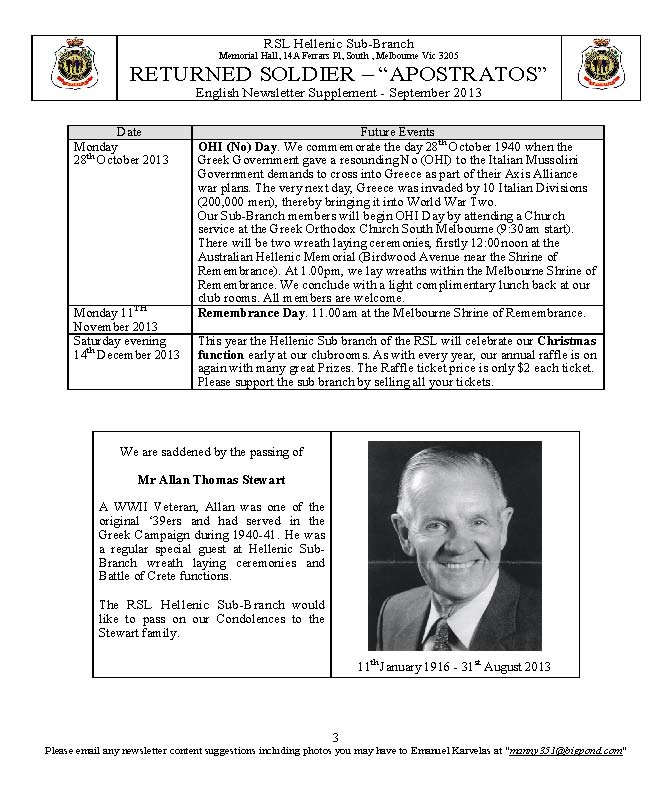
RETURNED SOLDIER RSL Hellenic Sub-Branch Newsletter Sep2013_Page_2

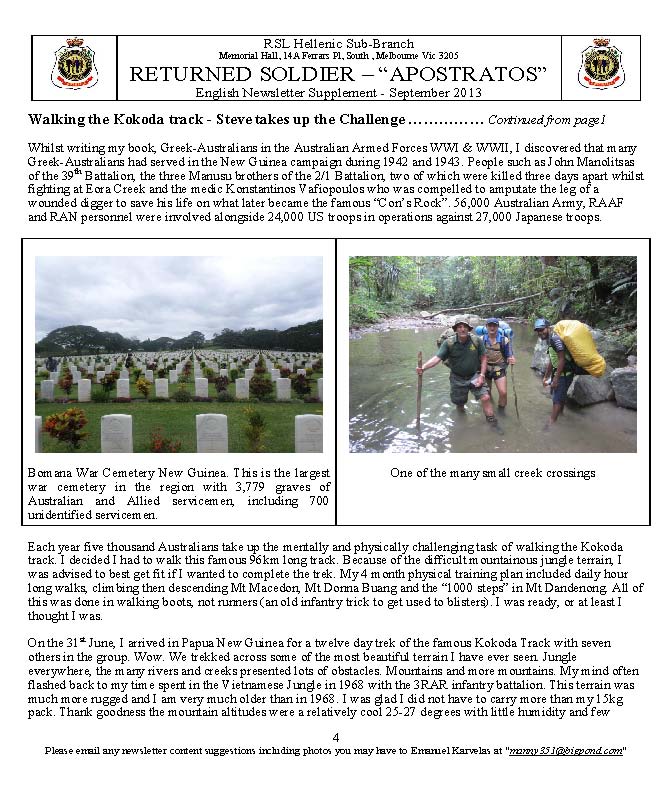
RETURNED SOLDIER RSL Hellenic Sub-Branch Newsletter Sep2013_Page_3

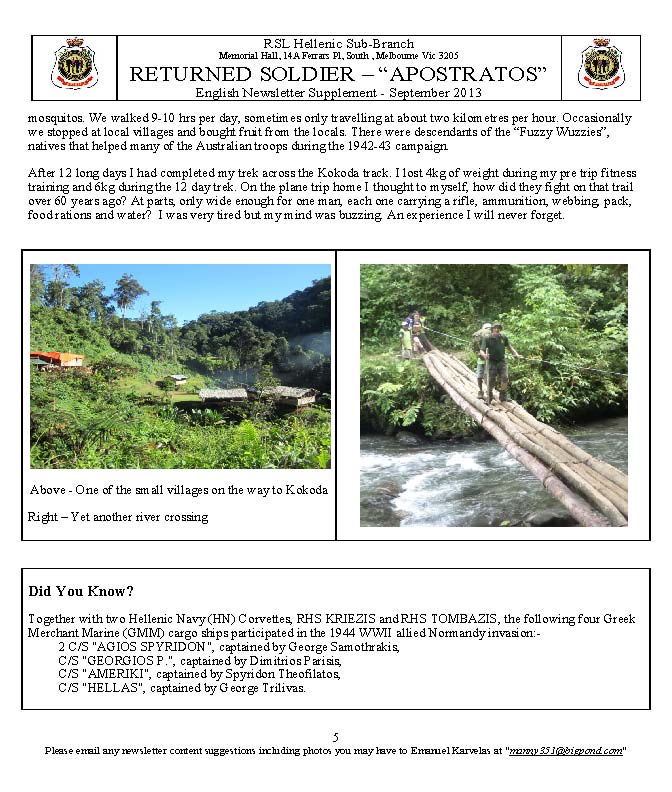
RETURNED SOLDIER RSL Hellenic Sub-Branch Newsletter Sep2013_Page_4

RETURNED SOLDIER RSL Hellenic Sub-Branch Newsletter Sep2013_Page_5

RETURNED SOLDIER RSL Hellenic Sub-Branch Newsletter Sep2013_Page_6

Έλληνας έφτιαξε το καλύτερο κοκτέιλ του κόσμου

Source: ΑΜΠΕ

Με ποια συστατικά μπορεί να φτιαχτεί το καλύτερο κοκτέιλ του κόσμου; Την απάντηση στο παραπάνω ερώτημα έδωσε ο Παναγιώτης Γκοβάτσος, ο οποίος χρησιμοποίησε λικέρ, βότκα, αλλά και γεύσεις και αρώματα που θυμίζουν Ελλάδα για να δημιουργήσει ένα κοκτέιλ που απέσπασε το πρώτο βραβείο στον Παγκόσμιο Διαγωνισμό Κοκτέιλ.
Ο λόγος για το κοκτέιλ “Skyfall ΙΙ”, με το οποίο ο Παναγιώτης Γκοβάτσος εντυπωσίασε τους κριτές του 39ου Παγκόσμιου Διαγωνισμού Κοκτέιλ της Διεθνούς Ένωσης Bartenders και απέσπασε το χρυσό μετάλλιο ανάμεσα στους συμμετέχοντες από 56 χώρες όλου του κόσμου.

“Το ποτό που αιχμαλωτίζει όλα τα αρώματα της φύσης, από φρούτα και βότανα μέχρι μπαχαρικά, αποτελεί την καλύτερη επιλογή. Η νέα τάση της εποχής, που πραγματικά όμως αξίζει, είναι η χρήση σπιτικών – παραδοσιακών λικέρ, βοτάνων, μπαχαρικών και φρέσκων αρωμάτων, που μπορούν να αναδείξουν χυμούς, να δημιουργήσουν δροσιστικά κοκτέιλ”, εξηγεί στο ΑΠΕ – ΜΠΕ ο Παναγιώτης Γκοβάτσος.

“Για αυτόν ακριβώς το λόγο, το κοκτέιλ που επέλεξα για τον Παγκόσμιο Διαγωνισμό βασιζόταν σε αρώματα και γεύσεις που θυμίζουν Ελλάδα. Βασικό συστατικό, είναι το λικέρ ιβίσκου που αναδύει ένα υπέροχο άρωμα που σε συνδυασμό με τη βότκα που χρησιμοποίησα χαρίζουν μια αρμονία γεύσεων, αρωμάτων και χρώματος”, προσθέτει.

Η δημιουργία του συγκεκριμένου κοκτέιλ δεν ήταν καθόλου εύκολη, καθώς για να καταλήξει ο Παναγιώτης Γκοβάτσος στην τελική συνταγή έκανε περισσότερους από 50 διαφορετικούς συνδυασμούς, «αλχημείες και πειράματα», όπως χαρακτηριστικά λέει.

Το κοκτέιλ αποτελεί εξέλιξη του “Skyfall”, με το οποίο ο ίδιος κέρδισε την πρώτη θέση στον 18ο Πανελλήνιο Διαγωνισμό Κοκτέιλ τον περασμένο Φεβρουάριο. “Το Skyfall που κέρδισε την πρώτη θέση στο Πανελλήνιο, ήθελα να το πίνουν και να αφήνει μία ξεχωριστή γεύση και υφή. Το Skyfall II, που είναι η εξέλιξη του πρώτου, αποτελεί την απόλυτη αποκορύφωση χρωμάτων και γεύσεων. Η μοναδική πολυπλοκότητα τόσων γεύσεων κερδίζει και τους πιο απαιτητικούς ουρανίσκους”, επισημαίνει ο κ. Γκοβάτσος.

Η επιλογή του ονόματος για τα κοκτέιλ που εντυπωσίασαν στον ελληνικό και στο διεθνή διαγωνισμό δεν είναι τυχαία, αλλά παραπέμπει στην ομότιτλη ταινία του Τζέιμς Μποντ και το τραγούδι της Αντέλ. Ευχή του είναι οι δημιουργίες του να παραμείνουν κλασικής αξίας και να αντέξουν στη δοκιμασία του χρόνου, όπως και οι ταινίες του Τζέιμς Μποντ.

Ο Παναγιώτης Γκοβάτσος γεννήθηκε στην Καλιφόρνια των ΗΠΑ, αλλά σε μικρή ηλικία ήρθε με την οικογένειά του στη Μονεμβασιά, όπου ζει και εργάζεται μέχρι σήμερα.

Στην ηλικία των 16 ετών ξεκίνησε να δουλεύει ως βοηθός σερβιτόρου και στη συνέχεια ως μπάρμαν, οπότε και κατέληξε, όπως λέει, “ότι το πάθος και το μεράκι μου, θέλω να το κάνω επάγγελμα”.

Με τη συμμετοχή του στον Παγκόσμιο Διαγωνισμό ο Παναγιώτης Γκοβάτσος εκπροσώπησε την Ελληνική Ένωση Μπάρμεν, αφού προηγουμένως είχε κερδίσει την πρώτη θέση στον Πανελλήνιο Διαγωνισμό. “Είμαι ένα άτομο που μ’ αρέσουν οι προκλήσεις, η εξέλιξη και η επαγγελματική καταξίωση στο χώρο μου. Το να συμμετάσχεις σε ένα Διαγωνισμό και πόσο μάλλον Παγκόσμιο, είναι μια πρόκληση. Διάβασμα, σεμινάρια, προπόνηση, τεστ, ήταν μέσα στην καθημερινότητα μου. Αμέσως μετά την πρώτη θέση στον Πανελλήνιο Διαγωνισμό, ξεκίνησα να ψάχνω για τα ιδανικά και ιδιαίτερα υλικά που θα χρησιμοποιούσα”, θυμάται.

Στόχος του και μετά την παγκόσμια πρωτιά, όπως λέει ο ίδιος, είναι να συνεχίσει να φτιάχνει ποτά και κοκτέιλς που θα μετατρέπονται σε αναμνήσεις. “Δεν υπάρχει μεγαλύτερη ευτυχία, αλλά και επιτυχία από ένα χαμόγελο. Αυτή είναι και η μαγεία της δουλειάς αυτής. Δεν υπάρχει κάτι καλύτερο από την προσωπική επαφή. Να συζητήσεις, να ακούσεις τον άλλον και να προσπαθήσεις να τον ανεβάσεις ψυχολογικά στο λίγο χρόνο που έχει”, τονίζει.

O 39ος Παγκόσμιος Διαγωνισμός Κοκτέιλ ήταν μέρος του 62ου ετήσιου συνεδρίου που διοργάνωσε η Διεθνής Ένωσης Barternders και φιλοξενήθηκε στην Πράγα τον περασμένο Αύγουστο. Το εξαήμερο συνέδριο περιελάμβανε την ετήσια γενική συνέλευση της Διεθνούς Ένωσης Bartenders με περισσότερες από 60 χώρες μέλη, workshops και masterclasses, με θέματα τις νέες τάσεις παγκοσμίως στα κοκτέιλ και τα αλκοολούχα ποτά, καθώς και τρεις διαγωνισμούς: Classic cocktail, Flairtending (free style) και non alcoholic.

H Ελληνική Ένωση Μπάρμεν έλαβε μέρος και στις τρεις κατηγορίες με τους Παναγιώτη Γκοβάτσο στο Classic cocktail, τον Κωνσταντίνο Φραντζή, ο οποίος κατέλαβε την 21η θέση στο Flairtending (free style) και τον Παναγιώτη Πάλλη στο non alcoholic.

Η συνταγή του κοκτέιλ “Skyfall II”, που απέσπασε το πρώτο βραβείο, είναι η εξής:
* 4.0 cl Grey Goose La Poire
* 3.0 cl Giffard Pampl’ Hibiscus
* 4.0 cl Finest Call Passion Fruit Puree
* 2.0 cl Monin Pink Graprfruit Juice
* 3.0 cl Lime Juice, Fresh
* 3.0 cl Perrier

Γαρνιτούρα: Blueberry, cranberry, grapefruit, passion fruit, pineapple leaf, carrot, turnip, chili pepper and mint leaf. Μέθοδος: Shake.

6,000-Year-Old Wine Found In Greece; Ancient Samples May Be Oldest Unearthed In Europe

Sourc: TheHuffington

Conventional wisdom agrees that a fine wine generally gets better with age — good news for the 6,200-year-old wine samples unearthed in Greece, huh?

Researchers working at an ongoing dig site in northern Greece recently announced that the final results of residue analysis from ancient ceramics showed evidence of wine dating back to 4200 B.C., according to the Greek Reporter. The excavation, located at a prehistoric settlement known as Dikili Tash, is situated 1.2 miles from the ancient city of Philippi and has been inhabited since 6500 B.C., according to the researchers’ website.

The analysis was not conducted on liquid wine, though. The passing millennia have erased nearly all tangible evidence of the drink, Dimitra Malamidou, a co-director of the most recent excavation, told The Huffington Post in an email.

“All [that] is left from the liquid part is the residue in the surface of the ceramic vases,” she said. “Recent residue analysis on ceramics attested [to] the presence of tartaric acid, indicating fermentation.”

Malamidou is part of a joint Greek-French excavation that began in 2008. The team recently wrapped up excavation of a neolithic house from around 4500 B.C. This is where they found wine traces in the form of “some thousands of carbonized grape pips together with the skins indicating grape pressing,” Malamidou said.

Radiocarbon dating was used to pinpoint the age of the finds.

Dikili Tash researchers believe they have found the oldest known traces of wine in Europe. Previous studies have unearthed a 6,100-year-old Armenian winery, as well as traces of a 9,000-year-old Chinese alcohol made from rice, honey and fruit.

“The find is highly significant for the European prehistory, because it is for the moment the oldest indication for vinification in Europe,” Malamidou said. “The historical meaning of our discovery is important for the Aegean and the European prehistory, as it gives evidence of early developments of the agricultural and diet practices, affecting social processes.”

The societal changes that may have been influenced by the consumption of alcoholic beverages is currently an issue of debate among researchers, Malamidou said. Evidence of wine during this early time period will “shed new light” on these discussions, she said.

As Germans Push Austerity, Greeks Press Back

Source: nytimes

Angelos Tzortzinis for The New York Times

Giannis Syngelakis at a mass grave in Amiras, Greece, for local men killed by the Nazis.

Residents of Amiras gathered for a Mass for victims of the Nazis.

Mr. Syngelakis, who was 7 then, still wants payback. And in pursuing a demand for reparations from Germany, he reflects a growing movement here, fueled not just by historical grievances but also by deep resentment among his countrymen over Germany’s current power to dictate budget austerity to the fiscally crippled Greek government.

Germany may now be Greece’s stern banker now, say those who are seeking reparations, but before it goes too far down that road, it should pay off its own debts to Greece.

“Maybe some of us have not paid our taxes,” Mr. Syngelakis said, standing beside the olive tree where his father died 70 years ago. “But that is nothing compared to what they did.”

It is not just aging victims of the Nazi occupation who are demanding a full accounting. Prime Minister Antonis Samaras’s government has compiled an 80-page report on reparations and a huge, never-repaid loan the nation was forced to make under Nazi occupation from 1941 to 1945.

Mr. Samaras has sent the report to Greece’s Legal Council of State, the agency that would build a legal case or handle settlement negotiations. But whether the government will press the issue with Germany remains unclear.

Some political analysts are doubtful that Athens will be willing to take on the Germans, who have provided more to the country’s bailout package than any other European nation.

Others, however, believe that the claims — particularly over the forced loan — could be an important bargaining chip in the months ahead as Greece and its creditors are expected to discuss ways to ease its enormous debt burden. Few here think it was an accident that details of the report were leaked to the Greek newspaper Real News on Sept. 22, the day that Germans went to the polls to hand a victory to Germany’s tough-talking chancellor, Angela Merkel.

“I can see a situation where it is politically difficult for the Germans to ease the terms for us,” said one high-ranking Greek official, who did not want his name used because he was not authorized to speak on the issue. “So instead, they agree to pay back the occupation loan. Maybe it is easier to sell that to the German public.”

So far, the Germans have given little indication that they are so inclined. During his latest visit to Athens in July, Germany’s finance minister, Wolfgang Schäuble, said, “We must examine exactly what happened in Greece.” But he insisted that Greece had waived its rights on the issue long ago.

The call for reparations has elicited an emotional outpouring in Greece, where six years of brutal recession and harsh austerity measures have left many Greeks hostile toward Germany. Rarely does a week go by without another report in the news about, as one newspaper put it in a headline, “What Germany Owes Us.”

The main opposition party, Syriza, has seized on the issue as well, with its leader, Alexis Tsipras, barnstorming across the country promising action to enthusiastic applause.

Estimates of how much money is at stake vary wildly. The government report does not cite a total. The figure most often discussed is $220 billion, an estimate for infrastructure damage alone put forward by Manolis Glezos, a member of Parliament and a former resistance fighter who is pressing for reparations. That amount equals about half the country’s debt.

Some members of the National Council on Reparations, an advocacy group, are calling for more than $677 billion to cover stolen artifacts, damage to the economy and to the infrastructure, as well as the bank loan and individual claims.

Even the figure for the bank loan is in dispute. The loan was made in Greek drachmas at a time of hyperinflation 70 years ago. Translating that into today’s currency is difficult, and the question of how much interest should be assessed is subject to debate. One conservative estimate by a former finance minister puts the debt from the loan at only $24 billion.

It is not hard to see why the issue is so attractive to many Greeks. It offers, if nothing else, a chance to take Germany down a peg. The last six years have hit Greek pride hard. Some here feel that the country’s officials are merely puppets these days, imposing whatever solutions the country’s creditors — the International Monetary Fund, the European Union and the European Central Bank — come up with.

Experts say that the German occupation of Greece was brutal. Germany requisitioned food from Greece even as Greeks went hungry. By the end of the war, about 300,000 had starved to death. Greece also had an active resistance movement, which prompted frequent and horrific reprisals like the one that occurred here in Amiras, a small village in Crete. Some historians believe that 1,500 villages were singled out for such reprisals.

Giannis Syngelakis among photographs of the local Nazi victims. His father was among those killed by German soldiers in 1943 as part of a reprisal for an attack on an outpost.

After the war, experts say, Greece got little in reparations. But few countries did. The Allies concentrated on rebuilding Germany, not wanting to once again impose crushing reparations bills as they did after World War I, an important factor, they believed, in bringing about World War II. Some German property was divvied up, but many claims were simply put off until East and West Germany might be reunited.

When that moment arrived, the world’s landscape had changed significantly. By then, the European Union was in place, Germany was contributing more to the bloc’s budget than it was getting back, and, some experts say, the books were closed. (Germany has paid huge reparations to Israel in the name of the Jewish people at large, and the German government, German companies and a number of other institutions established a multibillion-dollar fund to compensate those forced to perform labor during Nazi internment.)

Yet some groups in Greece have long felt that Germany still owes victims like Mr. Syngelakis. And others, now looking back, believe that Germany was let off the hook back then and should be more generous now in Greece’s hour of need.

A few individual cases have made their way through the Greek courts, including one representing the victims of a massacre in Distomo in 1944. Germans rampaged through the village gutting pregnant women, bayoneting babies and setting homes on fire, witnesses have said. Lawyers for Distomo won a judgment of $38 million in Greece. But the Greek government has never given permission to lay claim to German property in Greece as a way of collecting on the debt.

Christina Stamoulis, whose father was a lawyer on that case, said that many older people in Greece had only recently started talking about what happened in the war, in some cases because older Germans had arrived in their villages with their grandchildren wanting forgiveness.

“O.K., apologize,” Ms. Stamoulis said. “But we are expecting actions, too.”

Experts say that Germany is highly unlikely to want to revisit issues of reparations with Greece, since other countries would be likely to make similar claims. But some believe that Greece might have a shot at getting repayment on the bank loan.

“What is unusual about that loan is that there is a written agreement,” said Katerina Kralova, the author of “In the Shadow of Occupation: The Greek-German Relations During the Period 1940-2010.” “In other countries, the Germans just took the money.”

Asked about the 80-page report, officials of the Greek Foreign Ministry said that Greece had no intention of mingling war claims with the current financial situation. But, they said, its reparations claims are still valid. “The issue has been brought forward repeatedly, as per the international laws, both on a political and on a diplomatic level, on a bilateral basis, in a direct and utterly documented way, among partners, friends and allies,” said one official, who declined to be named as is common practice here.

For those who survived the Amiras massacre, a crushing poverty set in. Mr. Syngelakis said his mother sometimes scrounged for edible weeds to feed her children. He did not have shoes until he was a teenager.

“Back then, they destroyed us with guns,” Mr. Syngelakis said, the anger still clear. “Today, they do it financially.”