Earth Hour Is a Colossal Waste of Time—And Energy

Source: Slate

Plus, it ignores how electricity has been a boon for humanity.

142198193

The Eiffel Tower is seen after the lights are turned off during Earth Hour 2012 in Paris.
Photo by Antoine Antoniol/Getty Images

On the evening of March 23, 1.3 billion people will go without light at 8:30—and at 9:30, and at 10:30, and for the rest of the night—just like every other night of the year. With no access to electricity, darkness after sunset is a constant reality for these people.

At the same time, another 1 billion people will participate in “Earth Hour” by turning off their lights from 8:30-9:30.

The organizers say that they are providing a way to demonstrate one’s desire to “do something” about global warming. But the reality is that Earth Hour teaches all the wrong lessens, and it actually increases CO2 emissions. Its vain symbolism reveals exactly what is wrong with today’s feel-good environment.

Earth Hour teaches us that tackling global warming is easy. Yet, by switching off the lights, all we are doing is making it harder to see.

Notice that you have not been asked to switch off anything really inconvenient, like your heating or air-conditioning, television, computer, mobile phone, or any of the myriad technologies that depend on affordable, plentiful energy electricity and make modern life possible. If switching off the lights for one hour per year really were beneficial, why would we not do it for the other 8,759?

Hypothetically, switching off the lights for an hour would cut CO2 emissions from power plants around the world. But, even if everyone in the entire world cut all residential lighting, and this translated entirely into CO2 reduction, it would be the equivalent of China pausing its CO2 emissions for less than four minutes. In fact, Earth Hour will cause emissions to increase.

As the United Kingdom’s National Grid operators have found, a small decline in electricity consumption does not translate into less energy being pumped into the grid, and therefore will not reduce emissions. Moreover, during Earth Hour, any significant drop in electricity demand will entail a reduction in CO2 emissions during the hour, but it will be offset by the surge from firing up coal or gas stations to restore electricity supplies afterward.

And the cozy candles that many participants will light, which seem so natural and environmentally friendly, are still fossil fuels—and almost 100 times less efficient than incandescent light bulbs. Using one candle for each switched-off bulb cancels out even the theoretical CO2 reduction; using two candles means that you emit more CO2.

Electricity has given humanity huge benefits. Almost 3 billion people still burn dung, twigs, and other traditional fuels indoors to cook and keep warm, generating noxious fumes that kill an estimated 2 million people each year, mostly women and children. Likewise, just 100 years ago, the average American family spent six hours each week during cold months shoveling six tons of coal into the furnace (not to mention cleaning the coal dust from carpets, furniture, curtains, and bedclothes). In the developed world today, electric stoves and heaters have banished indoor air pollution.

Similarly, electricity has allowed us to mechanize much of our world, ending most backbreaking work. The washing machine liberated women from spending endless hours carrying water and beating clothing on scrub boards. The refrigerator made it possible for almost everyone to eat more fruits and vegetables, and to stop eating rotten food, which is the main reason why the most prevalent cancer for men in the United States in 1930, stomach cancer, is the least prevalent now.

Electricity has allowed us to irrigate fields and synthesize fertilizer from air. The light that it powers has enabled us to have active, productive lives past sunset. The electricity that people in rich countries consume is, on average, equivalent to the energy of 56 servants helping them. Even people in Sub-Saharan Africa have electricity equivalent to about three servants. They need more of it, not less.

This is relevant not only for the world’s poor. Because of rising energy prices from green subsidies, 800,000 German households can no longer pay their electricity bills. In the United Kingdom, there are now more than 5 million fuel-poor people, and the country’s electricity regulator now publicly worries that environmental targets could lead to blackouts in less than nine months.

Today, we produce only a small fraction of the energy that we need from solar and wind—0.7 percent from wind and just 0.1 percent from solar. These technologies currently are too expensive. They are also unreliable (we still have no idea what to do when the wind is not blowing). Even with optimistic assumptions, the International Energy Agency estimates that, by 2035, we will produce just 2.4 percent of our energy from wind and 0.8 percent from solar.

To green the world’s energy, we should abandon the old-fashioned policy of subsidizing unreliable solar and wind—a policy that has failed for 20 years, and that will fail for the next 22. Instead, we should focus on inventing new, more efficient green technologies to outcompete fossil fuels.

If we really want a sustainable future for all of humanity and our planet, we shouldn’t plunge ourselves back into darkness. Tackling climate change by turning off the lights and eating dinner by candlelight smacks of the “let them eat cake” approach to the world’s problems that appeals only to well-electrified, comfortable elites.

Focusing on green R&D might not feel as good as participating in a global gabfest with flashlights and good intentions, but it is a much brighter idea.

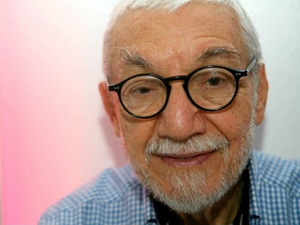
Jorge Mario Bergoglio of Argentina was elected in a surprise choice to be the new leader of the troubled Roman Catholic Church

VATICAN CITY – Jorge Mario Bergoglio of Argentina was elected in a surprise choice to be the new leader of the troubled Roman Catholic Church on Wednesday, taking the name Francis I and becoming the first non-European pontiff in nearly 1,300 years.

Pope Francis, 76, appeared on the central balcony of St. Peter’s Basilica just over an hour after white smoke poured from a chimney on the roof of the Sistine Chapel to signal 115 cardinal electors had chosen him to lead the world’s 1.2 billion Roman Catholics.

“Pray for me,” the new pontiff, dressed in the white robes of a pope for the first time, urged the crowd, smiling warmly.

The choice of Bergoglio, who is the first Latin American and first Jesuit pope, was announced by French cardinal Jean-Louis Tauran with the Latin words “Annuntio vobis gaudium magnum. Habemus Papam” (“I announce to you a great joy. We have a pope.”)

Francis has became the 266th pontiff in the Church’s 2,000-year history at a time of great crisis, with the church under fire over a child sex abuse scandal and torn by infighting in the Vatican bureaucracy.

Jubilant Argentines poured into churches, some crying and praying, after the announcement at the Vatican. “This is a blessing for Argentina,” one woman shouted on a Buenos Aires street.

“I hope he changes all the luxury that exists in the Vatican, that he steers the church in a more humble direction, something closer to the gospel,” said Jorge Andres Lobato, a 73-year-old retired state prosecutor.

JESUIT ORDER

Although a conservative, Francis is seen as a reformer and was not among the small group of frontrunners identified before the election. The Jesuit order to which he belongs was founded in the 16th century to serve the pope. It is best known for its work in education and the intellectual prowess of its members.

Bergoglio is known as a humble man who leads an austere and sober life without ostentation, travelling by public transport and living in a small apartment outside Buenos Aires.

He is a moderate who is willing to challenge powerful interests and is deeply concerned about the social inequalities in Argentina and elsewhere in Latin America. He has had a sometimes difficult relationship with President Cristina Fernandez and her late husband and predecessor Nestor Kirchner.

Francis has spoken out strongly against gay marriage, denouncing it in 2010 as “an attempt to destroy God’s plan”.

He was born into a middle-class family of seven, his father an Italian immigrant railway worker and his mother a housewife.

Replacing Pope Benedict, who resigned last month, he overturned one of the main assumptions before the election, that the new pope would be relatively young.

Bergoglio is the oldest of most of the possible candidates and was barely mentioned in feverish speculation about the top contenders before the conclave.

He is the first non-European pope since Syrian-born Gregory III in the eighth century, and the third successive non-Italian pontiff.

The Vatican said his inaugural mass would be held on March 19.

U.S. President Barack Obama said the election of Francis “speaks to the strength and vitality of a region that is increasingly shaping our world.”

“PRAY FOR BENEDICT”

In brief remarks from the balcony of St. Peter’s, Francis called on the faithful to pray for Benedict and said the Church was setting off on a “journey of fraternity, of love, of trust.”

It seemed the cardinal electors “went to the end of the world” to find him, he said.

The Vatican said Francis would visit Benedict soon at his temporary home in the summer papal residence outside Rome.

Thousands of people sheltering from heavy rain under a sea of umbrellas had occupied the square all day to await the decision and the crowd swelled as soon as the white smoke emerged.

They cheered wildly and raced towards the basilica as the smoke billowed from a narrow makeshift chimney and St Peter’s bells rang.

The tens of thousands in the square cheered even more loudly when Francis appeared, the first pontiff to take that name. “Viva il Papa (pope),” they chanted.

The election was enthusiastically welcomed in Latin America. “I am happy because another European pope would be like eating the same bread every day,” said Mexico City cab driver Martin Rodriguez.

“We’re happy because we have a new pope and because the choice of a Latin American shows that the Church is opening, is now focused on the entire Church. It’s not just a church only focused on Europe,” said Leonardo Steiner, general secretary of the national conference of Brazilian bishops.

Frontrunners at the conclave had included Brazilian Odilo Scherer, and Italy’s Angelo Scola, who would have returned the papacy to traditional Italian hands after 35 years of the German Benedict XVI and Polish John Paul II.

The decision by cardinal electors sequestered in a secret conclave in the Sistine Chapel came sooner than many experts expected because there were several frontrunners before the vote to replace Pope Benedict.

The cardinals faced a thorny task in finding a leader capable of overcoming crises caused by priestly child abuse and a leak of secret papal documents that uncovered corruption and rivalry inside the Church government or Curia.

Francis will head a Church also shaken by rivalry from other churches, the advance of secularism, especially in its European heartland, and allegations of scandal at the Vatican bank.

The series of crises is thought to have contributed to Benedict’s decision to become the first pontiff in 600 years to abdicate.

RIVAL TO RATZINGER IN 2005

Bergoglio was a moderate rival candidate at the 2005 conclave to the conservative Cardinal Joseph Ratzinger, who went on to become Benedict.

Italian media say he impressed cardinals in pre-conclave meetings where they discussed the Church’s problems.

Reserved and humble, Francis does not fit the profile of an active preacher that many cardinals had previously said they were seeking. He studied chemistry before joining the priesthood nearly a decade after losing a lung to respiratory illness.

“He’s very humble, I heard that in Buenos Aires he used to take public transport, have an apartment and cook for himself. The fact that he chose the name Francis means a lot. It means we will have a humble, simple pope close to the poor people. But it was a big surprise,” said Jules Charette, 54, a Canadian lawyer in St. Peter’s Square.

Bands from the Italian armed forces and the Vatican’s own Swiss guard army paraded in front of the basilica before the new pope appeared.

The secret conclave began on Tuesday night with a first ballot and four ballots were held on Wednesday. Francis obtained the required two thirds majority in the fifth ballot.

Following a split ballot when they were first shut away amid the chapel’s Renaissance splendour on Tuesday evening, the cardinal electors held a first full day of deliberations on Wednesday. Black smoke rose after the morning session to signal no decision.

The previous four popes were all elected within two or three days.

Seven ballots have been required on average over the last nine conclaves. Benedict was clear frontrunner in 2005 and elected after only four ballots.

In preparatory meetings before the conclave, the cardinals seemed divided between those who believe the new pontiff must be a strong manager to get the dysfunctional bureaucracy under control and others who are looking more for a proven pastoral figure to revitalise their faith across the globe.

Apart from Brazil’s Scherer and Italy’s Scola, a host of other candidates from numerous nations had also been mentioned as potential popes – including U.S. cardinals Timothy Dolan and Sean O’Malley, Canada’s Marc Ouellet and Argentina’s Leonardo Sandri.

But the frontrunners list never mentioned Bergoglio.

20130314-103344.jpg

Australian research brings hope to cancer kids

Source: News

When Sydney woman Maria Rossi learned her baby girl had blood cancer, the only thing she wanted to hear was high percentage odds that little Mia would pull through.

“We kept asking, what are her chances? And you just want to hear that number,” she remembered on Tuesday.

“Any number that is higher gives you more hope.”

Now, thanks to an Australian-led medical trial published on Tuesday, more families will be presented with odds that give them belief.

As recently as the 1990s, as few as a third of children with high-risk Acute Lymphoblastic Leukaemia (ALL) recovered from the illness.

But research initiated at the Sydney Children’s Hospital Randwick and The Children’s Hospital at Westmead, and detailed in the journal Leukaemia on Tuesday, has boosted the survival rate for those children to 75 per cent.

Scientists at the Children’s Cancer Institute Australia (CCIA) developed a way to test for the slightest trace of diseased cells in the bone marrow of children with ALL – including among patients who appeared to be responding well to treatment – to identify possible relapses months or years in advance.

Children at a high risk of relapsing were then treated with an intensive chemotherapy protocol.

Glenn Marshall, director of the Kids Cancer Centre at Sydney Children’s Hospital Randwick, said 1000 children had been involved in the research in Australia, New Zealand and the Netherlands.

“Approximately 30 to 40 children in those countries would not be alive today if we didn’t have our trial, because the cure rate for those high-risk patients compared to the 90s has doubled,” he told reporters on Tuesday.

Deputy CCIA director Murray Norris said doctors had previously relied on slides under a microscope to determine whether cancer was in remission.

“You’re lucky if you can pick up one leukaemia cell amongst 20 or 50 normal cells,” he said.

“What we developed was a molecular genetic test, essentially it was based on taking a DNA fingerprint of the child’s leukaemia.”

The Minimal Residual Disease testing could pick out the equivalent of one leukaemia cell from up to a million normal cells, he said.

Maria Rossi credits the research with saving her daughter’s life.

Today, Mia Yule needs to visit a hospital for check-ups only every four weeks.

The rest of the month, the bouncy six-year-old is busy going to school, playing soccer, and even doing kung-fu.

“I really hope Dr Marshall makes other kids better,” Mia told reporters.

Her mum said she felt “blessed”.

“We went through treatment with other families who weren’t so lucky,” she said.

“I think it was one in three of them who didn’t make it, so we feel very excited by the news today that they’re continuing to make progress to give every child the chance to live a life.”

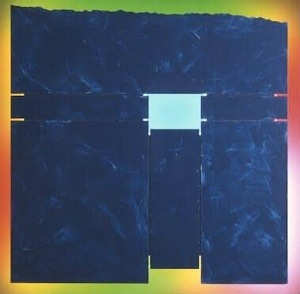
Renowned Greek American artist Stephen Antonakos debuts new works at the Konrad Fischer Galerie Berlin

20130312-115852.jpg

20130312-115902.jpg

Stephen Antonakos’ new works in gold and marble is on display – for the first time ever – at the renowned Konrad Fischer Galerie Berlin in Germany.

The exhibit, which opened on March 8, is called Four Directions and will run until April 20.

A Greek American artist, Antonakos’ work has been exhibited internationally for five decades in over 250 group shows and 100 solo shows, including a major retrospective in Greece and the United States in 2007. More than 50 of his large scale public works have been installed in the U.S., Europe, and Japan.

A pioneer in the field of neon light, his sculptures can be found at museums in New York, Chicago, Seattle, Tacoma, Denver, Amherst and Atlanta.

Born in a mountain village in Laconia, Greece, Antonakos immigrated to the United States with his parents when he was just a baby. He grew up in New York and began painting and working with neon in the late 1950s.

His work is related to Minimalism in its intention to be seen as “real things in real space in the here and now”. He has a particular interest in bringing the architecture and the space of the site into the viewer’s experience

Since the early 1960s Antonakos’ geometric forms in neon have been exhibited in his Canvases, Panels, Walls, Rooms, and outdoor Public Installations. Throughout, the interaction of light and space has been central. A formalist, but not a didactic one, he calls his work “real things in real spaces”.

The Konrad Fischer Galerie Berlin has reconstructed a classic neon Wall from 1977. This work is titled Fragments of a Circle and it’s 3m by 5m and exemplifies how the work’s engagement with the proportions of the room is as crucial as the internal relations of its elements. This is visible also in the exhibition’s second and third Directions.

Begun in 2011, framed works of gold leaf on Mylar and Tyvek – whether cut or crumpled – may be seen as further rich explorations of reflected light within a determined space. No less than the two brand-new gold leaf Volumes, these radiant planes are not images, but objects.

Another, even newer material for Antonakos is the white marble of “Interlock 1”. Deeply incised with incomplete circles and squares that hold light and shadow, this work sits on the floor and leans on the wall, manifesting both the consistency of the artist’s concerns and their great visual and material variety.

The World’s Biggest Public Companies

Source: Forbes

Rank Company Country Sales Profits Assets Market Value
1

Exxon Mobil

United States $433.5 B $41.1 B $331.1 B $407.4 B
2

JPMorgan Chase

United States $110.8 B $19 B $2,265.8 B $170.1 B
3

General Electric

United States $147.3 B $14.2 B $717.2 B $213.7 B
4

Royal Dutch Shell

Netherlands $470.2 B $30.9 B $340.5 B $227.6 B
5

ICBC

China $82.6 B $25.1 B $2,039.1 B $237.4 B
6

HSBC Holdings

United Kingdom $102 B $16.2 B $2,550 B $164.3 B
7

PetroChina

China $310.1 B $20.6 B $304.7 B $294.7 B
8

Berkshire Hathaway

United States $143.7 B $10.3 B $392.6 B $202.2 B
9

Wells Fargo

United States $87.6 B $15.9 B $1,313.9 B $178.7 B
10

Petrobras-Petróleo Brasil

Brazil $145.9 B $20.1 B $319.4 B $180 B
11

BP

United Kingdom $375.5 B $25.7 B $292.5 B $147.4 B
12

Chevron

United States $236.3 B $26.9 B $209.5 B $218 B
13

China Construction Bank

China $68.7 B $20.5 B $1,637.8 B $201.9 B
14

Citigroup

United States $102.6 B $11.1 B $1,873.9 B $107.5 B
15

Gazprom

Russia $117.6 B $31.7 B $302.6 B $159.8 B
16

Wal-Mart Stores

United States $447 B $15.7 B $193.4 B $208.4 B
17

Volkswagen Group

Germany $221.9 B $21.5 B $328.7 B $79.5 B
18

Total

France $216.2 B $15.9 B $213 B $132.4 B
19

Agricultural Bank of China

China $62.4 B $14.4 B $1,563.9 B $154.8 B
20

BNP Paribas

France $119 B $7.9 B $2,539.1 B $61.5 B
21

Bank of China

China $60.8 B $15.8 B $1,583.7 B $129.1 B
22

Apple

United States $127.8 B $33 B $138.7 B $546 B
23

Banco Santander

Spain $109.6 B $6.9 B $1,624.7 B $75.6 B
24

Sinopec-China Petroleum

China $391.4 B $11.6 B $179.8 B $104.2 B
25

Toyota Motor

Japan $228.5 B $4.9 B $358.3 B $147.9 B
26

Samsung Electronics

South Korea $142.4 B $11.5 B $133.7 B $162 B
27

ConocoPhillips

United States $230.9 B $12.4 B $153.2 B $98.8 B
28

Vodafone

United Kingdom $73.5 B $12.8 B $239.2 B $131.2 B
29

ENI

Italy $143.2 B $8.9 B $178.7 B $97.6 B
30

Itaú Unibanco Holding

Brazil $75.5 B $7.4 B $426.4 B $91.2 B
31

China Mobile

Hong Kong-China $81.7 B $19.5 B $151.2 B $216.5 B
32

IBM

United States $106.9 B $15.9 B $116.4 B $238.7 B
33

AT&T

United States $126.7 B $3.9 B $270.3 B $187.3 B
34

Pfizer

United States $67.4 B $10 B $188 B $165.4 B
35

Procter & Gamble

United States $85.1 B $10.1 B $134.3 B $185.2 B
36

Mitsubishi UFJ Financial

Japan $53.3 B $7 B $2,478.8 B $74.5 B
37

Daimler

Germany $138 B $7.3 B $188.7 B $66.3 B
38

American Intl Group

United States $64.2 B $17.8 B $555.8 B $50.3 B
39

ING Group

Netherlands $139 B $7.5 B $1,653 B $35.8 B
40

Nestlé

Switzerland $89.2 B $10.1 B $119.4 B $205.4 B
41

Statoil

Norway $111.6 B $13.1 B $127.8 B $89 B
42

Microsoft

United States $72.1 B $23.5 B $112.2 B $273.5 B
43

Banco Bradesco

Brazil $79.8 B $5.9 B $397.1 B $65.3 B
44

Ford Motor

United States $136.3 B $20.2 B $178.3 B $47.5 B
45

Nippon Telegraph & Tel

Japan $124 B $6.1 B $226.6 B $60.8 B
45

AXA Group

France $132.8 B $5.6 B $947.8 B $40.6 B
47

Commonwealth Bank

Australia $49.5 B $6.9 B $713.7 B $81.6 B
47

GDF Suez

France $117.5 B $5.2 B $275.2 B $58.3 B
49

BHP Billiton

Australia $71.7 B $23.6 B $102.9 B $187.5 B
50

Allianz

Germany $134.4 B $3.3 B $832.8 B $56.3 B
50

Siemens

Germany $98.4 B $8.2 B $135.6 B $92 B
52

Deutsche Bank

Germany $65.7 B $5.4 B $2,809.4 B $47.3 B
53

Barclays

United Kingdom $66.3 B $4.7 B $2,425.2 B $49.1 B
54

Banco do Brasil

Brazil $72.4 B $6.5 B $516.3 B $45.9 B
55

MetLife

United States $70.3 B $7 B $799.6 B $40.7 B
56

Vale

Brazil $55.4 B $20.3 B $127.6 B $126.8 B
57

Telefónica

Spain $81.4 B $7 B $159.9 B $75.6 B
57

Johnson & Johnson

United States $65 B $9.7 B $113.6 B $178.8 B
59

Westpac Banking Group

Australia $44.1 B $7.2 B $651.7 B $67.5 B
59

Honda Motor

Japan $107.5 B $6.4 B $137.7 B $70.8 B
61

BMW Group

Germany $95.8 B $6.8 B $160 B $61.2 B
62

Novartis

Switzerland $58.6 B $9.1 B $117.5 B $150.4 B
63

General Motors

United States $150.3 B $9.2 B $144.6 B $40 B
64

Sumitomo Mitsui Financial

Japan $45.9 B $5.7 B $1,654.9 B $47.8 B
65

China Life Insurance

China $56 B $5.1 B $214.1 B $76.5 B
66

Verizon Communications

United States $110.9 B $2.4 B $230.5 B $112.2 B
67

Hewlett-Packard

United States $125 B $5.9 B $126.6 B $48.4 B
68

Lukoil

Russia $111.4 B $10.4 B $90.6 B $55.3 B
69

Rio Tinto

United Kingdom $60.5 B $5.8 B $119.5 B $110.2 B
70

Royal Bank of Canada

Canada $35.9 B $4.7 B $812.7 B $84.4 B
71

Rosneft

Russia $59.2 B $11.3 B $106 B $79.6 B
71

UBS

Switzerland $43.7 B $4.5 B $1,508.7 B $54.2 B
73

EDF

France $84.6 B $3.9 B $297.5 B $45.7 B
74

BASF

Germany $95.2 B $8 B $78.7 B $82.2 B
75

ENEL

Italy $103.2 B $5.4 B $220.4 B $35.4 B
76

National Australia Bank

Australia $38.2 B $5 B $730.4 B $56.3 B
77

Goldman Sachs Group

United States $36.8 B $4.4 B $923.2 B $63.5 B
78

Sanofi

France $43.2 B $7.4 B $125.3 B $103.3 B
79

ANZ

Australia $34.7 B $5.2 B $577.2 B $62.6 B
80

Merck & Co

United States $48 B $6.3 B $105.1 B $115.8 B
81

Comcast

United States $55.8 B $4.2 B $157.8 B $79.8 B
82

TD Bank

Canada $27.7 B $5.8 B $771.5 B $76.1 B
83

Bank of America

United States $115.1 B $1.4 B $2,129 B $105.2 B
83

BBVA-Banco Bilbao Vizcaya

Spain $46.7 B $3.9 B $767.7 B $43.1 B
85

Nissan Motor

Japan $105.5 B $3.8 B $128.7 B $48.1 B
85

Intel

United States $54 B $12.9 B $71.1 B $138.5 B
87

Coca-Cola

United States $46.5 B $8.6 B $80 B $158.8 B
88

PepsiCo

United States $66.5 B $6.4 B $72.9 B $101.3 B
88

Saudi Basic Industries

Saudi Arabia $50.6 B $7.8 B $88.6 B $84.4 B
90

Sberbank

Russia $31.8 B $6 B $282.4 B $74 B
91

Cisco Systems

United States $44.8 B $7 B $89.3 B $107.9 B
92

Bank of Nova Scotia

Canada $27.3 B $5.3 B $635.2 B $62.2 B
93

Anheuser-Busch InBev

Belgium $39 B $5.9 B $112.4 B $115.3 B
94

Société Générale

France $98.6 B $3.3 B $1,531.1 B $25.8 B
95

Mitsubishi Corp

Japan $62.6 B $5.6 B $136.6 B $39.7 B
96

Hyundai Motor

South Korea $70.3 B $6.9 B $94.5 B $43.6 B
97

Zurich Financial Services

Switzerland $53 B $3.5 B $365.6 B $39 B
98

Mizuho Financial

Japan $32.2 B $5 B $1,934.4 B $40.6 B
99

Glencore International

Switzerland $179.6 B $3.9 B $85.2 B $45.9 B
100

Ping An Insurance Group

China $42.2 B $3 B $362.8 B $55 B

The World’s Youngest Billionaires: 29 Under 40

Source: Forbes

There are 1,426 billionaires in the world this year. They are the wealthiest of the wealthy. But only 29 members of this elite list are under 40 years old, with that exciting combination of money and youth.

Those 29 have a total of $119 billion between them. Ten come from the technology sector, including four from social networking giant Facebook. Eleven come from the United States, the rest from countries abroad. Five are newcomers to the billionaire ranks. Read the full list below.

These 29 billionaires are all under 40 years old.

No. 1: Dustin Moskovitz
Age: 28
Net Worth: $3.8 billion
Moskovitz, Mark Zuckerberg‘s former roommate, no longer works at Facebook, the social networking giant that he co-founded. A signee of Bill Gates‘ and Warren Buffett’s Giving Pledge, Moskovitz bikes to work, flies commercial, and pitches his own tent at Burning Man.

No. 2: Mark Zuckerberg
Age: 28
Net Worth: $13.3 billion
Few CEOs of any age are under more media scrutiny than Zuckerberg (who’s only 8 days older than Moskovitz). Since taking Facebook public in May 2012, and getting married days later, the hoodie-wearing founder has seen his net worth rise and fall with every fluctuation of the stock price.

No. 3: Albert von Thurn und Taxis
Age: 29
Net Worth: $1.5 billion
Albert von Thurn und Taxis first appeared in Forbes’ billionaire rankings at age 8 but officially inherited his fortune in 2001 on his 18th birthday. The eligible bachelor is also a race car driver and tours with a German auto-racing league.

No. 4: Scott Duncan
Age: 30
Net Worth: $5.1 billion
Duncan is the youngest of the four children who inherited the massive fortune of late energy pipeline entrepreneur Dan Duncan, founder of Enterprise Products Partners. Today the company owns more than 50,000 miles of natural gas, oil, and petrochemical pipelines.

No. 5: Eduardo Saverin
Age: 30
Net Worth: $2.2 billion
Facebook co-founder Saverin renounced his United States citizenship in 2011, news of which broke days before the company’s IPO and drew accusations of tax evasion. Saverin, immortalized in The Social Network as Mark Zuckerberg’s onetime best friend, settled a lengthy legal battle with Facebook, apparently receiving a 5% stake. A Brazilian citizen, he now resides in Singapore and invests in startups.

No. 6: Huiyan Yang
Age: 31
Net Worth: $5.7 billion
Yang, the daughter of the founder of real estate developer Country Garden Holdings, is once again China’s richest woman. Her father transferred his stake to the Ohio State grad before the company’s IPO in 2007.

No. 7: Fahd Hariri
Age: 32
Net Worth: $1.35 billion
Hariri is the youngest son of slain Lebanese Prime Minister Rafik Hariri. He graduated from the Ecole Spéciale d’Architecture de Paris in 2004. While still a student, he ran an interior design studio on the outskirts of the city, and sold furniture to clients in Saudi Arabia.

No. 8: Marie Besnier Beauvalot
Age: 32
Net Worth: $1.5 billion
Marie, along with siblings Emmanuel, 42, and Jean-Michel, 45, inherited French dairy giant Lactalis, producers of popular Président brie among hundreds of other cheese, milk and yogurt brands.

No. 9: Sean Parker
Age: 33
Net Worth: $2 billion
Parker is revamping his much hyped start-up, Airtime, with the hopes that the video chat site will have the impact of his other Web companies. At 19, Parker skipped college to disrupt the recording industry with music swapping site Napster. He served as Facebook’s first president at age 24.

No. 10: Ayman Hariri
Age: 34
Net Worth: $1.35 billion
Hariri is the son of slain Lebanese Prime Minister Rafik Hariri. He’s involved in running Saudi Oger, one of Saudi Arabia’s biggest construction companies, and the source of the Hariri family fortune.

No. 11: Yvonne Bauer
Age: 35
Net Worth: $2.4 billion
Bauer owns 85% of her family’s publishing empire. She is the fifth generation of the family to run the Bauer Media Group, which was founded in 1875. It publishes 570 magazines in 16 countries.

No. 12: Yoshikazu Tanaka
Age: 36
Net Worth: $1.8 billion
Founder and CEO of social-network game site operator Gree, Tanaka has faced stiff competition this year from archrival DeNA and a game initiative by NTT DoCoMo, the giant cellphone carrier. To get back on track, Tanaka moved to partner with Yahoo Japan and went on a buying spree.

No. 13: Maxim Nogotkov
Age: 36
Net Worth: $1.3 billion
Nogotkov got his start selling computer programs while in school and later began selling cordless phones. He dropped out of college in order to have more time to focus on building his business. He later founded cell phone retailer Svyaznoy.

No. 14: Alejandro Santo Domingo Davila
Age: 36
Net Worth: $11.7 billion
A Harvard history grad, Domingo Davila is the eldest son from his jet-setting beer magnate father’s second marriage. Now a managing director at a New York-based investment advisory firm, Alejandro sits on the board of the Metropolitan Museum of Art in New York.

No. 15: Jack Dorsey
Age: 36
Net Worth: $1.1 billion
Dorsey made a name for himself as a cofounder and leader of 140-character microblogging company Twitter, but most of his fortune is derived from his stake in mobile payment company Square. The New York University dropout is a certified masseur known for his eclectic interests, which include, among other things, punk music and clothes.

No. 16: Serra Sabanci
Age: 37
Net Worth: $1.3 billion
Sabanci is the daughter of Ozdemir Sabanci who was assassinated in 1996, and a board member of the large conglomerate Sabanci Holding.

No. 17: Nicholas Woodman
Age: 37
Net Worth: $1.3 billion
GoPro founder and CEO Nick Woodman built the first camera prototypes in his bedroom with his mom’s sewing machine and a drill. GoPro came out with its first camera, a 35-millimeter waterproof film version, in 2004. Today, the camera shoots full video in cinema quality HD, allowing anyone from professional surfer Kelly Slater to amateur snowboarders to capture their adventures.

No. 18: Chase Coleman
Age: 37
Net Worth: $1.4 billion
The hottest young money manager on the planet, Coleman cooled off a touch in 2012, but his Tiger Global hedge fund extended its impressive winning streak, finishing a third straight year with a net return in excess of 20%.

No. 19: Ryan Kavanaugh
Age: 38
Net Worth: $1 billion
Ryan Kavanaugh joins the billionaire ranks for the first time this year thanks to his movie studio, Relativity. Kavanaugh is making money by hitting singles and doubles like the recent Safe Haven, which cost $25 million to make and has grossed more than $50 million at the box office.

No. 20: Andrey Verevskiy
Age: 38
Net Worth: $1 billion
Verevskiy started trading in grain when he was 19 and founded Kernel Holding a decade later, growing it into Ukraine’s largest sunflower oil producer. Last year, Verevskiy was elected to Ukraine’s Parliament.

No. 21: John Arnold
Age: 38
Net Worth: $2.8 billion
Arnold shocked the hedge fund world in May 2012 when he announced he was calling it a career at age 38. Arnold and his wife Laura, who are signatories of the Giving Pledge, plan to devote much of their time to philanthropy. The couple have already given away more than $1.2 billion.

No. 22: Gary Fegel
Age: 39
Net Worth: $1 billion
Gary Fegel attained billionaire status in May 2011 in the wake of Glencore’s IPO. After earning his MBA from the University of St. Gallen, Fegel joined the alumina and aluminum department at the commodities titan in 2001.

No. 23: Kostyantin Zhevago
Age: 39
Net Worth: $1.5 billion
Son of a mining engineer, Kostyantin Zhevago took over Poltava Iron Ore, the largest exporter of pellets in CIS, at the age of twenty two, and in 2007 he took his mining company Ferrexpo public. An avid soccer fan, Zhevago owns FC Vorska football.

No 24: Dan Gertler
Age: 39
Net Worth: $2.2 billion
An emerging face of irresponsible capitalism in Africa, Dan Gertler took his family’s fortune in diamonds and invested it in mining assets in the Democratic Republic of Congo. While in his 20s, he became a friend of Joseph Kabila, who then ran the military and is now the DRC’s president.

No. 25: Ana Luia de Mattos Barretto Villela
Age: 39
Net Worth: $1.15 billion
Ana Lucia de Mattos Barretto Villela belongs to one of Brazil’s oldest and most distinguished banking families. She is one of the largest individual shareholders of a holding company that controls Unibanco Holding S.A., one of Brazil’s largest banks.

No. 26: Lee Seo-Hyun
Age: 39
Net Worth: $1 billion
She is the youngest daughter of Samsung Chairman Lee Kun-Hee. A graduate of the Parsons School of Design, she is vice president of the luxury goods and fashion division of Cheil Industries (part of the Samsung Group), as well as a vice president at Cheil Worldwide, Korea’s largest advertising firm.

No. 27: Fang Wei
Age: 39
Net Worth: $1.5 billion
Fang Wei is best known for buying turnaround situations, especially those in the steel industry. Fangda Group now has more than 30,000 employees across more than 10 provinces in China.

No. 28: Sergey Brin
Age: 39
Net Worth: $22.8 billion
The Google cofounder is now director of special projects at the Mountain View, Calif. search giant, leaving his counterpart Larry Page to handle most day-to-day operations. Brin oversees the company’s foray into hardware and futuristic endeavors like driverless cars and augmented reality spectacles known as Google Glass.

No. 29: Larry Page
Age: 39
Net Worth: $23 billion
Google’s cofounder and CEO since April 2011, Page saw the company through the $50 billion revenue milestone in 2012. The stock rose nearly 30% in the past year, adding more than $4 billion to Page’s net worth.

An earlier version of this article incorrectly stated that there are 23 billionaires under 40 years old on the Forbes Billionaires list. It has been updated to reflect the change.

The World’s Billionaries List – Full 2013

Source: Forbes

Net Worth Calculated March 2013
.

Rank Name Net Worth Age Source Country of Citizenship
1

Carlos Slim Helu & family

$73 B 73 telecom Mexico
2

Bill Gates

$67 B 57 Microsoft United States
3

Amancio Ortega

$57 B 76 Zara Spain
4

Warren Buffett

$53.5 B 82 Berkshire Hathaway United States
5

Larry Ellison

$43 B 68 Oracle United States
6

Charles Koch

$34 B 77 diversified United States
6

David Koch

$34 B 72 diversified United States
8

Li Ka-shing

$31 B 84 diversified Hong Kong
9

Liliane Bettencourt & family

$30 B 90 L’Oreal France
10

Bernard Arnault & family

$29 B 64 LVMH France
11

Christy Walton & family

$28.2 B 58 Wal-Mart United States
12

Stefan Persson

$28 B 65 H&M Sweden
13

Michael Bloomberg

$27 B 71 Bloomberg LP United States
14

Jim Walton

$26.7 B 65 Wal-Mart United States
15

Sheldon Adelson

$26.5 B 79 casinos United States
16

Alice Walton

$26.3 B 63 Wal-Mart United States
17

S. Robson Walton

$26.1 B 69 Wal-Mart United States
18

Karl Albrecht

$26 B 93 Aldi Germany
19

Jeff Bezos

$25.2 B 49 Amazon.com United States
20

Larry Page

$23 B 39 Google United States
21

Sergey Brin

$22.8 B 39 Google United States
22

Mukesh Ambani

$21.5 B 55 petrochemicals, oil & gas India
23

Michele Ferrero & family

$20.4 B 87 chocolates Italy
24

Lee Shau Kee

$20.3 B 85 diversified Hong Kong
24

David Thomson & family

$20.3 B 55 media Canada
26

Prince Alwaleed Bin Talal Alsaud

$20 B 58 investments Saudi Arabia
26

Carl Icahn

$20 B 77 leveraged buyouts United States
26

Thomas & Raymond Kwok & family

$20 B real estate Hong Kong
29

Dieter Schwarz

$19.5 B 73 retail Germany
30

George Soros

$19.2 B 82 hedge funds United States
31

Theo Albrecht, Jr. & family

$18.9 B 62 Aldi, Trader Joe’s Germany
32

Alberto Bailleres Gonzalez & family

$18.2 B 81 mining Mexico
33

Jorge Paulo Lemann

$17.8 B 73 beer Brazil
34

Alisher Usmanov

$17.6 B 59 steel, telecom, investments Russia
35

Iris Fontbona & family

$17.4 B 70 mining Chile
36

Forrest Mars, Jr.

$17 B 81 candy United States
36

Jacqueline Mars

$17 B 73 candy United States
36

John Mars

$17 B 76 candy United States
36

Georgina Rinehart

$17 B 59 mining Australia
40

German Larrea Mota Velasco & family

$16.7 B 59 mining Mexico
41

Mikhail Fridman

$16.5 B 48 oil, banking, telecom Russia
41

Lakshmi Mittal

$16.5 B 62 steel India
43

Aliko Dangote

$16.1 B 55 cement, sugar, flour Nigeria
44

Len Blavatnik

$16 B 55 diversified United States
44

Cheng Yu-tung

$16 B 87 diversified Hong Kong
46

Joseph Safra

$15.9 B 74 banking Brazil
47

Rinat Akhmetov

$15.4 B 46 steel, coal Ukraine
47

Leonid Mikhelson

$15.4 B 57 gas, chemicals Russia
49

Leonardo Del Vecchio

$15.3 B 77 eyeglasses Italy
49

Michael Dell

$15.3 B 48 Dell United States
51

Steve Ballmer

$15.2 B 56 Microsoft United States
52

Viktor Vekselberg

$15.1 B 55 oil, metals Russia
53

Paul Allen

$15 B 60 Microsoft, investments United States
53

Francois Pinault & family

$15 B 76 retail France
55

Vagit Alekperov

$14.8 B 62 Lukoil Russia
56

Phil Knight

$14.4 B 75 Nike United States
56

Andrey Melnichenko

$14.4 B 41 coal, fertilizers Russia
58

Dhanin Chearavanont & family

$14.3 B 73 food Thailand
58

Susanne Klatten

$14.3 B 50 BMW, pharmaceuticals Germany
58

Vladimir Potanin

$14.3 B 52 metals Russia
61

Michael Otto & family

$14.2 B 69 retail, real estate Germany
62

Vladimir Lisin

$14.1 B 56 steel, transport Russia
62

Gennady Timchenko

$14.1 B 60 oil & gas Russia
64

Luis Carlos Sarmiento

$13.9 B 80 banking Colombia
65

Mohammed Al Amoudi

$13.5 B 68 oil, diversified Saudi Arabia
66

Tadashi Yanai & family

$13.3 B 64 retail Japan
66

Mark Zuckerberg

$13.3 B 28 Facebook United States
68

Henry Sy & family

$13.2 B 88 diversified Philippines
69

Donald Bren

$13 B 80 real estate United States
69

Serge Dassault & family

$13 B 87 aviation France
69

Lee Kun-Hee

$13 B 71 Samsung South Korea
69

Mikhail Prokhorov

$13 B 47 investments Russia
73

Alexey Mordashov

$12.8 B 47 steel, investments Russia
74

Antonio Ermirio de Moraes & family

$12.7 B 84 diversified Brazil
74

Abigail Johnson

$12.7 B 51 money management United States
76

Ray Dalio

$12.5 B 63 hedge funds United States
76

Robert Kuok

$12.5 B 89 diversified Malaysia
78

Miuccia Prada

$12.4 B 63 Prada Italy
79

Ronald Perelman

$12.2 B 70 leveraged buyouts United States
80

Anne Cox Chambers

$12 B 93 media United States
81

Stefan Quandt

$11.9 B 46 BMW Germany
82

Ananda Krishnan

$11.7 B 74 telecoms Malaysia
82

Alejandro Santo Domingo Davila

$11.7 B 36 beer Colombia
82

James Simons

$11.7 B 74 hedge funds United States
82

Charoen Sirivadhanabhakdi

$11.7 B 68 drinks Thailand
86

Zong Qinghou

$11.6 B 67 beverages China
87

Dirce Navarro De Camargo & family

$11.5 B construction Brazil
87

John Fredriksen

$11.5 B 68 shipping Cyprus
89

Gerald Cavendish Grosvenor & family

$11.4 B 61 real estate United Kingdom
90

Harold Hamm

$11.3 B 67 oil & gas United States
91

Rupert Murdoch

$11.2 B 81 News Corp United States
91

John Paulson

$11.2 B 57 hedge funds United States
91

Azim Premji

$11.2 B 67 software India
94

Ernesto Bertarelli & family

$11 B 47 biotech, investments Switzerland
94

Charlene de Carvalho-Heineken

$11 B 58 Heineken Netherlands
94

Hans Rausing

$11 B 86 packaging Sweden
94

Jack Taylor & family

$11 B 90 Enterprise Rent-A-Car United States
98

Lui Che Woo

$10.7 B 83 gaming Hong Kong
98

Laurene Powell Jobs & family

$10.7 B 49 Apple, Disney United States
100

Eike Batista

$10.6 B 56 mining, oil Brazil

http://www.forbes.com/billionaires/list/#page:1_sort:0_direction:asc_search:_filter:All%20industries_filter:All%20countries_filter:All%20states

The first healed dinosaur wound discovered

Source: nationalgeographic

An illustration of a dinosaur biting an Edmontosaurus.

Tyrannosaurus rex goes after a duckbilled dinosaur in this artist’s conception.

Illustration courtesy Robert DePalma

A fossilized scar.

The scar. Photograph courtesy Robert DePalma

A scar on the face of a duckbill dinosaur received after a close encounter with a Tyrannosaurus rex is the first clear case of a healed dinosaur wound, scientists say.

The finding, detailed in the current issue of the journal Cretaceous Research, also reveals that the healing properties of dinosaur skin were likely very similar to that of modern reptiles.

The lucky dinosaur was an adult Edmontosaurus annectens, a species of duckbill dinosaur that lived in what is today the Hell Creek region of South Dakota about 65 to 67 million years ago. (Explore a prehistoric time line.)

A teardrop-shaped patch of fossilized skin about 5 by 5 inches (12 by 14 centimeters) that was discovered with the creature’s bones and is thought to have come from above its right eye, includes an oval-shaped section that is incongruous with the surrounding skin. (Related: “‘Dinosaur Mummy’ Found; Have Intact Skin, Tissue.”)

Bruce Rothschild, a professor of medicine at the University of Kansas and Northeast Ohio Medical University, said the first time he laid eyes on it, it was “quite clear” to him that he was looking at an old wound.

“That was unequivocal,” said Rothschild, who is a co-author of the new study.

A Terrible Attacker

The skull of the scarred Edmontosaurus also showed signs of trauma, and from the size and shape of the marks on the bone, Rothschild and fellow co-author Robert DePalma, a paleontologist at the Palm Beach Museum of Natural History in Florida, speculate the creature was attacked by a T. rex.

It’s likely, though still unproven, that both the skin wound and the skull injury were sustained during the same attack, the scientists say. The wound “was large enough to have been a claw or a tooth,” Rothschild said.

Rothschild and DePalma also compared the dinosaur wound to healed wounds on modern reptiles, including iguanas, and found the scar patterns to be nearly identical.

It isn’t surprising that the wounds would be similar, said paleontologist David Burnham of the University of Kansas Biodiversity Institute, since dinosaurs and lizards are distant cousins.

“That’s kind of what we would expect,” said Burnham, who was not involved in the study. “It’s what makes evolution work—that we can depend on this.”

Dog-Eat-Dog

Phil Bell, a paleontologist with the Pipestone Creek Dinosaur Initiative in Canada who also was not involved in the research, called the Edmontosaurus fossil “a really nicely preserved animal with a very obvious scar.”

He’s not convinced, however, that it was caused by a predator attack. The size of the scar is relatively small, Bell said, and would also be consistent with the skin being pierced in some other accident such as a fall.

“But certainly the marks that you see on the skull, those are [more consistent] with Tyrannosaur-bitten bones,” he added.

Prior to the discovery, scientists knew of one other case of a dinosaur wound. But in that instance, it was an unhealed wound that scientists think was inflicted by scavengers after the creature was already dead.

It’s very likely that this particular Edmontosaurus wasn’t the only dinosaur to sport scars, whether from battle wounds or accidents, Bell added.

“I would imagine just about every dinosaur walking around had similar scars,” he said. (Read about “Extreme Dinosaurs” in National Geographic magazine.)

“Tigers and lions have scarred noses, and great white sharks have got dings on their noses and nips taken out of their fins. It’s a dog-eat-dog world out there, and [Edmontosaurus was] unfortunately in the line of fire from some pretty big and nasty predators … This one was just lucky to get away.”

Mysterious Escape

Just how Edmontosaurus survived a T. rex attack is still unclear. “Escape from a T. rex is something that we wouldn’t think would happen,” Burnham said.

Duckbill dinosaurs, also known as Hadrosaurs, were not without defenses. Edmontosaurus, for example, grew up to 30 feet (9 meters) in length, and could swipe its hefty tail or kick its legs to fell predators.

Furthermore, they were fast. “Hadrosaurs like Edmontosaurus had very powerful [running] muscles, which would have made them difficult to catch once they’d taken flight,” Bell said.

Duckbills were also herd animals, so maybe this one escaped with help from neighbors. Or perhaps the T. rex that attacked it was young. “There’s something surrounding this case that we don’t know yet,” Burnham said.

Figuring out the details of the story is part of what makes paleontology exciting, he added. “We construct past lives. We can go back into a day in the life of this animal and talk about an attack and [about] it getting away. That’s pretty cool.”


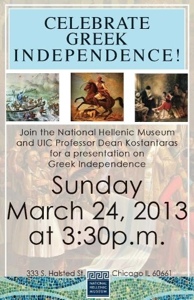
Greek Independence Day on the 24/3/13 at 3:30 pm at the Hellenic National Museum

20130312-113025.jpg

THE INTERNATIONAL WOMEN’S DAY MESSAGE OF DR.OLGA SARANTOPOULOS

GRIECHISCHE GESELLSCHAFT IN ÖSTERREICH
ΕΛΛΗΝΙΚΗ ΕΤΑΙΡΕΙΑ ΑΥΣΤΡΙΑΣ

​Vienna, 8th March 2013
​ ​
​THE INTERNATIONAL WOMEN’S DAY MESSAGE OF DR.OLGA SARANTOPOULOS

The March 8, International Women’s Day reminds us that the battle for fundamental social rights are everyone’s concern. It is the special day to honor the woman’s contribution in every facet of human activity, especially in the maintenance of the family institution and therefore social cohesion.

The woman above all a symbol of motherhood, guarantor of balance at home, is now a full member of a global society with equal advances in the field of economy, politics, science, the arts. The multi-layered nature of woman’s activity makes her an integral part of every human group and yet mainstay of effort for improvement and advancement.

The Woman of the Greek Diaspora is such a shining example, as she carries the burden of creating and maintaining the edifice of Hellenism in every corner of the Earth where Greeks are living. With sacrifice and bravery she faced and faces every challenge and is leading every effort to keep the Greek spirit alive.

In the current situation where values ​are affected and the global community is again in search of those ideals that will bring back into the foreground the human being, the International Women’s Day marks the need to return to the principles of solidarity, respect of human creativity .

Our world is still divided in parts in which women are still struggling for equal opportunities in education, work, decent living. And it is the duty of us all to think and finally to act,
to convince people of the countries, politicians, religious leaders, that a society is in equilibrium only when all members share equal the right to justice, peace, democracy.

The 8th of March is a day of honor to the mother, the wife, the career woman, but also a reminder that the struggle continues until in the entire world, women of every race, every nationality, whereever they come from, enjoy equal opportunities in life, education, health.

Dr.Olga Sarantopoulos
f.Secretary of the World Council of Hellenes Abroad
President of the Hellenic Society of Austria
1070 Vienna-Austria, Tel. +43 1 5268014, o.sarantopoulos@gmail.com

—————————————————-

GRIECHISCHE GESELLSCHAFT IN ÖSTERREICH ΕΛΛΗΝΙΚΗ ΕΤΑΙΡΕΙΑ ΑΥΣΤΡΙΑΣ

​Βιέννη,08.03.2013
​​ ​

ΜΗΝΥΜΑ ΔΡ. ΟΛΓΑΣ ΣΑΡΑΝΤΟΠΟΥΛΟΥ
ΓΙΑ ΤΗΝ ΠΑΓΚΟΣΜΙΑΣ ΗΜΕΡΑ ΤΗΣ ΓΥΝΑΙΚΑΣ

Η 8η Μαρτίου, Παγκόσμια Ημέρα της Γυναίκας υπενθυμίζει ότι η μάχη για την κατάκτηση θεμελιωδών κοινωνικών δικαιωμάτων είναι υπόθεση όλων μας. Είναι η ξεχωριστή μέρα που τιμούμε την γυναικεία προσφορά σε κάθε έκφανση της ανθρώπινης δραστηριότητας, ιδιαίτερα στην διατήρηση του θεσμού της οικογένειας και κατά συνέπεια της κοινωνικής συνοχής.

Η γυναίκα, πάνω από όλα σύμβολο της μητρότητας, εγγυητής της ισορροπίας στην οικογενειακή εστία, είναι σήμερα και ισότιμο μέλος μιας παγκόσμιας κοινωνίας με ισάξιες κατακτήσεις στον χώρο της οικονομίας, της πολιτικής, των επιστημών, των τεχνών. Η πολύ-επίπεδη φύση της γυναικείας δραστηριότητας την καθιστά αναπόσπαστο κομμάτι κάθε ανθρώπινης ομάδας και συνάμα στυλοβάτη της προσπάθειας για την βελτίωση και ανέλιξη της.

Η Ελληνίδα της Διασποράς είναι ένα τέτοιο λαμπρό παράδειγμα καθώς φέρει το βάρος της δημιουργίας και διατήρησης του οικοδομήματος του Ελληνισμού σε κάθε γωνιά της γης όπου υπάρχουν Έλληνες. Με αυτοθυσία και γενναιότητα αντιμετώπισε και αντιμετωπίζει κάθε πρόκληση, είναι μπροστάρης σε κάθε προσπάθεια να κρατήσουμε την Ελληνική ψυχή ζωντανή.

Στην σημερινή πραγματικότητα όπου οι αξίες πλήττονται και η παγκόσμια κοινότητα βρίσκεται και πάλι σε αναζήτηση εκείνων των ιδανικών που θα βάλουν και πάλι σε πρώτο πλάνο τον άνθρωπο, η Παγκόσμια Ημέρα της Γυναίκας σηματοδοτεί την ανάγκη επιστροφής στις αρχές της κοινωνικής αλληλεγγύης, του σεβασμού της ανθρώπινης δημιουργικότητας.

Ο κόσμος μας ακόμη και σήμερα μοιρασμένος σε μέρη που η γυναίκα εξακολουθεί να αγωνίζεται για ίσες ευκαιρίες στην εκπαίδευση, στην εργασία, στην αξιοπρεπή διαβίωση, είναι καθήκον όλων μας να προβληματιστούμε και επιτέλους να δράσουμε.

Να πείσουμε τους πολίτες των χωρών, τους πολιτικούς, τους θρησκευτικούς ηγέτες, ότι μια κοινωνία βρίσκεται σε ισορροπία μονάχα όταν όλα τα μέλη της μοιράζονται με ίσους όρους το δικαίωμα στην ισονομία, την ειρήνη, την Δημοκρατία.

Η 8η Μαρτίου είναι ημέρα τιμής στην μητέρα, την σύζυγο, την γυναίκα καριέρας, αλλά είναι και μια υπενθύμιση ότι η μάχη για την κατάκτηση της ισότητας συνεχίζεται μέχρι που σε ολόκληρο των κόσμο οι γυναίκες κάθε φυλής, κάθε εθνικότητας από όπου και να προέρχονται, να απολαμβάνουν ίσες ευκαιρίες στην ζωή, την παιδεία, την υγεία.

Δρ. Όλγα Σαραντοπούλου
τ.Γραμματέας Συμβουλίου Αποδήμου Ελληνισμού
Πρόεδρος Ελληνικής Εταιρείας Αυστρίας

1070 Vienna-Austria, Tel. +43 1 5268014, o.sarantopoulos@gmail.com