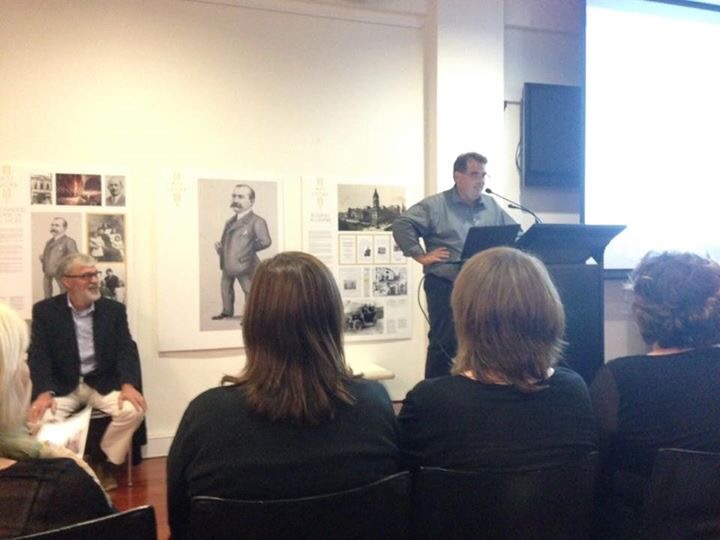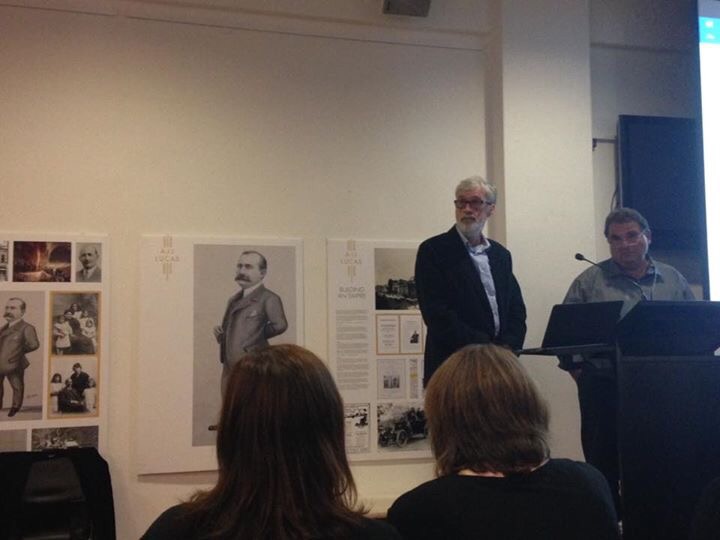
Greek Community Annual Anzac Day lecture by Tom Tsamouras and former NT Minister and MP Peter Toyne


Greek Community Annual Anzac Day lecture by Tom Tsamouras and former NT Minister and MP Peter Toyne. 

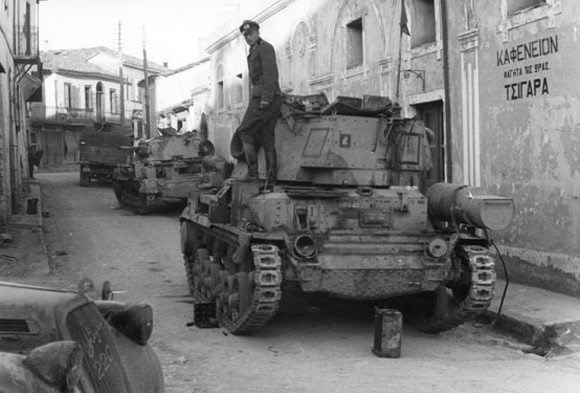
The Battle of Vevi and the Lost Anzacs. The Anzacs were reformed for the second and last time in history for the first Battle in Greece in WW2 facing the advancing Nazi military machine 76 years ago

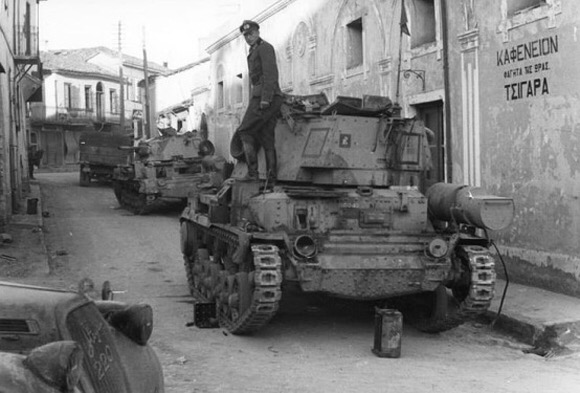
The first action during the Second World War on Greek soil between the German and Hellenic forces was on the little village of Vevi in the municipality of Florina. 


This began on 11th April 1941 and marked the first of numerous clashes during which Hellenic and ANZAC forces fought side by side! After the “Battle of Vevi”, a small number of soldiers from the two Australian battalions that fought there, were reported missing in action and their bodies have never been found. 

Information by locals to Australian Brigadier Keith Rossi in 1981 about the possible grave site of these missing men has led to many people from Greece and Australia researching about the possible grave site of their remains. Tom Tsamouras, a school teacher from Newcastle and Peter Toyne, former MP from the NT, are two researches who have spent years trying to locate the resting place of these men.

Η μεγαλύτερη απάτη της Εθνικής τράπεζας – Πως έκλεψε 6.960 τόνους χρυσού και την ακίνητη περιουσία των Ελλήνων της Ανατολής


Από το 1904 που δημιουργήθηκε η τράπεζα μέχρι το 1922 που έγινε η καταστροφή της Σμύρνης είχε περυσυλλέξει η τράπεζα αυτή το 90% του πλούτου των Ελλήνων του Λεβάντε. Αλεξάνδρεια, Ιεροσόλυμα, Μυτιλήνη, Θεσσαλονίκη, Σμύρνη , Κωνσταντινούπολη. 

Είχε υποκαταστήματα παντού. Επίσης υποκατάστημα στο Βερολίνο στη Γερμανία. Σε αυτά τα 19 χρόνια η Μικρασιατική Καταστροφή ήταν δημιούργημα των Χαζάρων. Δέν είναι ώρα να το αναλύσουμε ιστορικά. 

Να θυμάστε όμως πως ο Ελληνισμός της Ιωνίας είχε παρουσία στο χώρο αυτό πάνω από 5000 χρόνια. Η Τροία ήταν Ελληνικός χώρος και η Περσία ήταν Ελληνικός χώρος. Έτσι λοιπόν ένας πολιτισμός που ήταν στον χώρο αυτό για χιλιάδες χρόνια ξεριζώθηκε με εκείνη την κατάπτυστη συνθήκη μέσα σε διάστημα 2 η 3 ετών. 

Σκοπός “να ιδιοποιηθούμε” αυτό το τεράστιο απόθεμα χρυσού και τον πλούτο των Ελλήνων της Μεσογείου οι οποίοι άν ενθυμίστε την εποχή εκείνη ήταν η πλουσιοτέρα ομάδα σε όλο τον πλανήτη .

Να σκεφτείτε ότι μόνον το υποκατάστημα της Αιγύπτου δήλωνε κέρδη ετησίως από ένα έως ενάμιση εκατομμύρια χρυσά Γαλλικά Φράγκα από ένα υποκατάστημα. 

Η ευρύτερη περιοχή της Σμύρνης είχε 5800 εργοστάσια Ελληνικής ιδιοκτησίας. Την ίδια στιγμή στην Ελλάδα υπήρχαν μόνο 450. Όταν με διαταγή του Μπέη της Σμύρνης οι Τσετσένοι άρχισαν να σφάζουν τους Έλληνες πήγαν όλοι και κατέθεσαν τους τίτλους ιδιοκτησίας των εργοστασίων τους και των σπιτιών τους και των περιουσιών τους στην τράπεζα της Ανατολής διότι προβαλλόταν πάντα ως Ελληνική τράπεζα διότι και η Εθνική εθεωρούντο Ελληνική τράπεζα. 

Δεν ήξερε κανένας ότι την εποχή εκείνη η τράπεζα εκείνη ανήκει στους Χαζάρους. Εθνική Τράπεζα της Ελλάδος λεγόταν τυπικά “της Ελλάδος ” ασχέτως αν το βγάλαμε πριν από 2-3 χρόνια. Επειδή η Ανατολή ήταν θυγατρική της Εθνικής οι Έλληνες υπενόησαν πως και αυτό Ελληνικό Ίδρυμα είναι. να σκεφτείτε ότι σήμερα ακόμα η Εθνική τράπεζα συλλέγει τεράστια ποσά από τίτλους ιδιοκτησιών των Ελλήνων της Σμύρνης. 

Διότι δεν βρέθηκε ποτέ ο κάτοχος επειδή ή σφαγιάσθηκε από τους Τσετσένους ή βρίσκετε στο βυθό του Αιγαίου μαζί με τις μετοχές της Ανατολής. Όταν αποφάσισε το 1931-2 να πουληθεί η τράπεζα της Ανατολής. Ήταν αδύνατον να βρεθεί πλειοψηφικό πακέτο μετοχών για να γίνει γενική συνέλευση. 

Προσπάθησαν 4 φορές να κάνουν γενική συνέλευση για να πωληθεί δήθεν η Τράπεζα της Ανατολής στην Εθνική Τράπεζα και δεν μπορούσαν να κάνουν συνέλευση επειδή ήσαν λιγότεροι από το 46% όλες οι άλλες μετοχές είχαν εξαφανιστεί. Δεν θέλω να σας πω τι έχει γίνει ιστορικά έκτοτε. 

Ούτε τα 600 δις έχουν να κάνουν με την τράπεζα της Ανατολής που εχει καταθέσει ο Αρτέμης Σώρρας για την εξαγορά του Ελληνικού Χρέους. Αυτή είναι η πραγματική ιστορία. 

Η ιστορία που διδάσκεστε εσείς είναι η ιστορία που θέλουν οι Χαζάροι να ξέρετε. Όταν λοιπόν το 1932 υποτίθεται πως απορρόφησε η Εθνική την Τράπεζα της Ανατολής υπήρχε ένα κεφάλαιο το οποίο ήταν κεφάλαιο εφεδρικό που ήταν γύρω στα 580 εκατομμύρια χρυσά Γαλλικά Φράγκα. 

Το κάθε ένα χρυσό Γαλλικό Φράγκο ζυγίζει 8 γραμμάρια, άρα τα 580.000.000 χρυσά Γαλλικά Φράγκα ζυγίζουν (580.000.000 x 8γρ = 4.640.000.000γρ = 4.640.000 κιλά) 4.640 τόνους χρυσού. Αυτό σύμφωνα με το συμβόλαιο πωλήσεως δεν μετεβιβάσθει στην Εθνική . 

Κατετέθει σε έναν αλληλόχρεο λογαριασμό με επιτόκιο 7,25% και θα διαμοιραζόταν ισσοπόσως στους μετόχους οι οποίοι χάριν ευκολίας συμφώνησαν να πάρουν άλλο ποσό 150 δραχμές έναντι της κάθε μετοχής μέχρις ότου γίνει η εκκαθάριση. Επομένως να θυμάστε δύο πράγματα. Το αποθεματικό κεφάλαιο δεν μεταβιβάσθει διά του συμβολαίου προς την Εθνική. 

Προσετέθει δε στο αποθεματικό όλα εκείνα τα κεφάλαια χρήσεων ’32, ’33, ’34, ’35 και ’36. Το ποσόν το οποίον έφτασε τον Δεκέμβριο του ’36 υπήρχαν κατατεθιμένα στην Εθνική Τράπεζα 870 εκατομμύρια χρυσά Γαλλικά φράγκα από την τράπεζα της Ανατολής. Σύνολο 6.960 τόνοι χρυσού.

Αυτήν την ποσότητα χρυσού την πλήρωσαν οι Έλληνες της Μ. Ασίας, 4.000.000 με την ζωή τους και 2.000.000 ξεριζωμένοι πρόσφυγες από τις πατρογονικές εστίες τους.

Και τότε αλλά και έως σήμερα ειδικός όρος στο άρθρο 26 του καταστατικού της Εθνικής μόνιμος αντιπρόεδρος με δικαίωμα εκτελεστού (δηλαδή ασκεί διοίκηση) είναι ο εκάστοτε Αρχιεπίσκοπος Αθηνών και Πάσης Ελλάδος. Για το αίμα των θυμάτων ποιος θα λογοδοτήσει;;;

Athens to Host 1st Ministerial Conference of ‘Ancient Civilizations Forum’


Athens, on April 24, will host the first ministerial conference of the member states that comprise the Ancient Civilizations Forum (ACF Forum), with the participation of foreign ministers of ten countries (GC10), namely Greece, China, Bolivia, Egypt, India, Iraq, Iran, Italy, Mexico and Peru. 

The formation of the GC-10 (Great Civilizations) was an initiative of the Greek Foreign Ministry and involves ten member states with the longest cultural history.

The conference is taking place upon the initiative of Greek Foreign Minister Nikos Kotzias and his Chinese counterpart, Wang Yi and will mark the forum’s official launch.


The forum’s main objective is to bring together representatives of countries, which – although in various geographical regions – are considered “cradles of ancient cultures”, a Foreign Ministry announcement said.

Through a broad agenda of joint actions, the forum aims to “transform” culture into a source of power and a fundamental tool for introducing a contemporary, multifaceted foreign policy. 

The forum will also highlight the economic prospects of cultural synergies among nations.

Greek Paganism legally recognized as ‘known religion’ in Greece

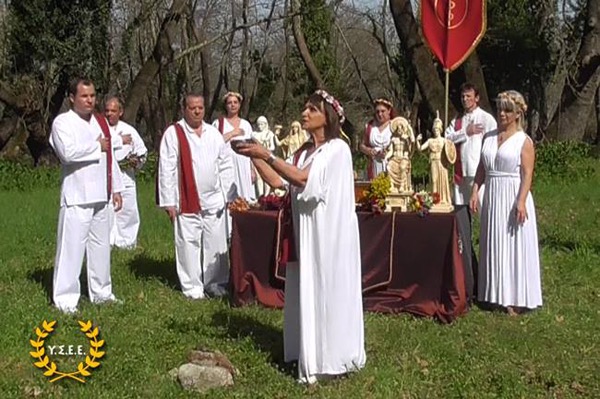
On April 9th, the Supreme Council of Ethnic Hellenes (YSEE), a religious organization working to restore the indigenous religion of Greece, put out a statement saying Greek polytheism has received legal status in Greece. 

Prior to this, Greek Pagans did not have religious freedoms such as the ability to buy land to create houses of worship nor could Pagan clergy perform marriage ceremonies.

Yesterday the Secretary of the Supreme council of Ethnic Hellenes (YSEE) announced that after more than twenty years of struggle, the Greek state has finally recognized the Hellenic Religion as a ‘Known Religion’ according to paragraph 17 – the only form of recognition for a religion in Greece. The mentioned paragraph includes the permission to build a temple as well as the right of public exercise of any recognized religion.

The recognition of Hellenic Religion as a ‘Known Religion’ is only the first step towards a general recognition of Hellenism. Now the YSEE at Athens is still waiting for recognition as a religious statutory body in Greece. The Supreme Council of Ethnic Hellenes will approach the European Court of Human Rights in Strasbourg if the state leaves them no other choice, said its Secretary.

Unlike the United States, Greece does not have a blanket freedom of religion law built into its legal system. It is instead governed by the Organization of the Legal Forms of Religious Communities and their Organizations in Greece. 

As of now, only six religions outside the Greek Orthodox faith are recognized as ‘known religions.’ And, even those practices that achieve this status often face an uphill battle in exercising their rights. For example, Muslims in Athens have fought for over 10 years to build a mosque, and have so far been unsuccessful.

The recognition of the Greek religion came after it was rejected in 2015. According to the YSEE, the rejection demonstrated that the Greek government, “…has yet to get rid of its byzantine and medieval whims and […] unable to respect with dignity its own laws.”

“It has rejected by intermediate on of its court of First Instance the motion signed by hundreds of Ethnikoi Hellenes to obtain recognition as a statutory corporation of religious character for their ancestral, indigenous, and historically continuous to our day despite cruel persecutions by Christianity.”

YSEE is currently registered as a non-profit organization and, as explained on its website, has been on the front lines in the on-going battle for religious community recognition.

The Wild Hunt spoke with Mr. Vlassis Rassias, the General Secretary of the Supreme Council of Ethnikoi Hellenes, about what it means for the Ethnic Hellenic Pagans in Greece and what the next steps are in achieving religious right in Greece.

TWH: If this is the first step towards a general recognition of Hellenism, what is the next step?

Vlassis Rassias: This was recognition of our Religion as such, by the official authorities of the Greek Ministry of Education and Religious Matters. To their credit, they gave us official permission for a place of worship in Athens, thus promoting the Hellenic Ethnic Religion to the status of a “known religion” in Greece, according to article 3 of the Constitution. 

The next step for us is the recognition of the official organization of the Hellenic Ethnic Religion (The Supreme Council of Ethnikoi Hellenes, YSEE) as a statutory corporation of religious character, according to the relatively recent law 4301/2014, something that is so far absurdly rejected by the Greek courts, which resist our very name, and more particularly the term “Ethnic”, although the official authorities of the state have already accepted us under our proper title Hellenic Ethnic Religion. We have a rather strange situation here, exactly what our ancient ancestors were calling “tragelafos” (“τραγέλαφος”).

TWH: How was YSEE informed that the Hellenic religion is now a known religion?

VR: We received the official reply of the official authorities of the Greek Ministry of Education and Religious Matters, in response to an application of ours that we had submitted together with the requested big number of state documents, certifying the appropriateness of our place of worship, concerning its legality, fire safety, sanitation, and such. The above mentioned reply was also notified to various competent authorities, as the Ministry of Interior, the Registry Office, and such.

TWH: What is gained by being recognized as a religious statutory body?

VR: We are now under the protection of the law, to the same degree as the other 5 – 6 non-christian religions that are already classified as “known religions” in our country. We can henceforth register our children at the Registry Office as belonging to the Hellenic Ethnic Religion, and we shall perform hellenic wedding rituals with full legal value. We still remain though a Non-profit Organization, not a religious statutory body. As a religious statutory body, that is what for the time being is denied to us, we will function more properly in the matters that concern our Religion and, of course, we won’t pay every year the 500 – 1000 euros chargeable since 2011 by the indebted Greek State on all the Non-profit Organizations.

TWH: Was YSEE responsible for this change in status? What did you do to bring this about?

VR: This and all the future attainments of the goals of the Hellenic Ethnic Religion, is and will be the outcome of the uninterrupted, strategic, collective and devoted struggle of our organization that this June celebrates the 20 years of its operation under its present name. A decade before YSEE’s foundation we were operating through “Diipetes” (“Διιπετές”), a now defunct quarterly journal for the moral defense and restoration of our Religion.

 * * *

Mr. Rassias says YSEE will be celebrating their religion’s legal recognition during their annual celebration of Charisia-Aphrodesia, which is a religious observance in honor of Aphrodite and the Charities, on April 22nd.

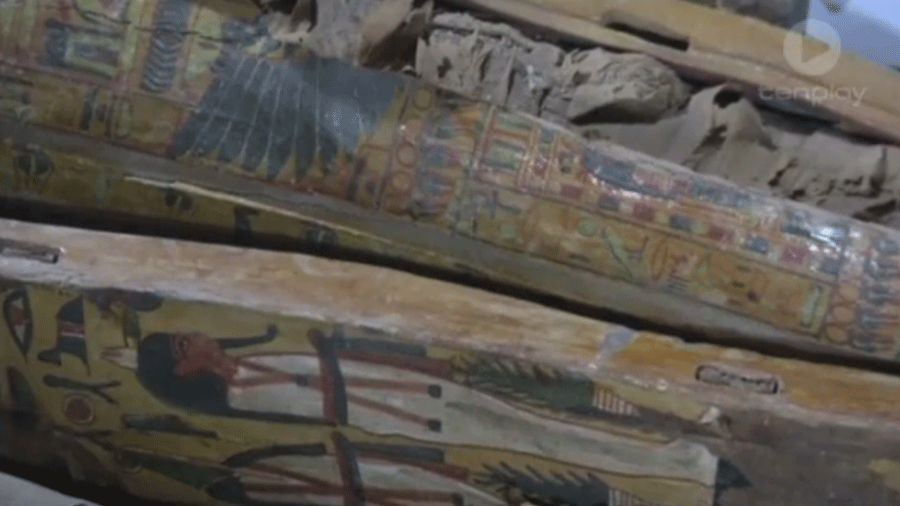
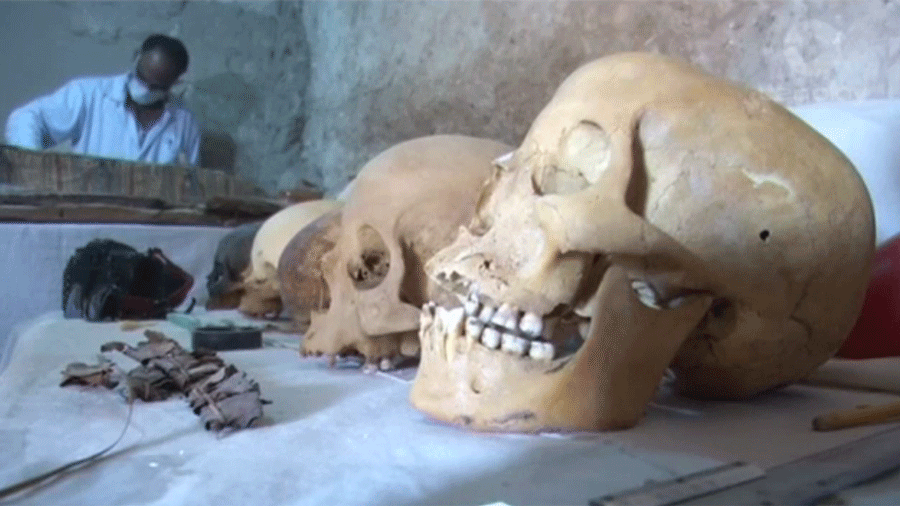
Ancient Egyptian mummies discovered in tomb near Luxor

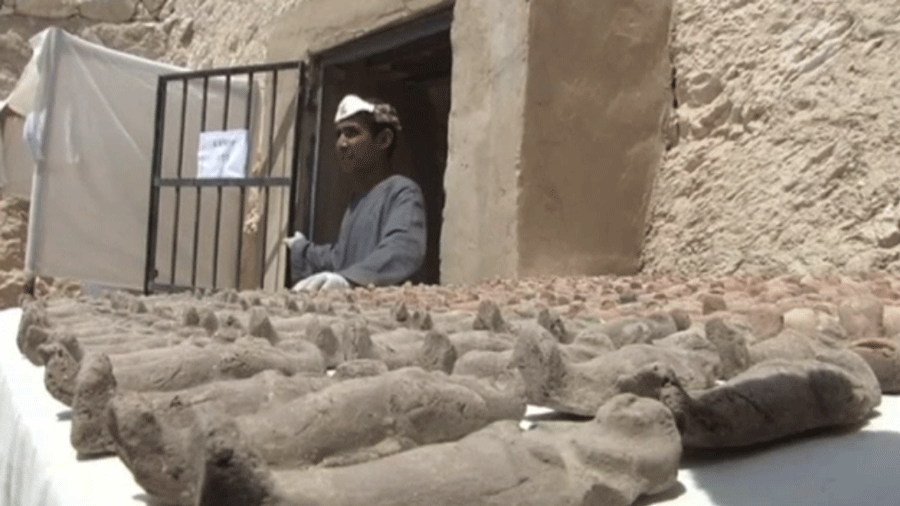
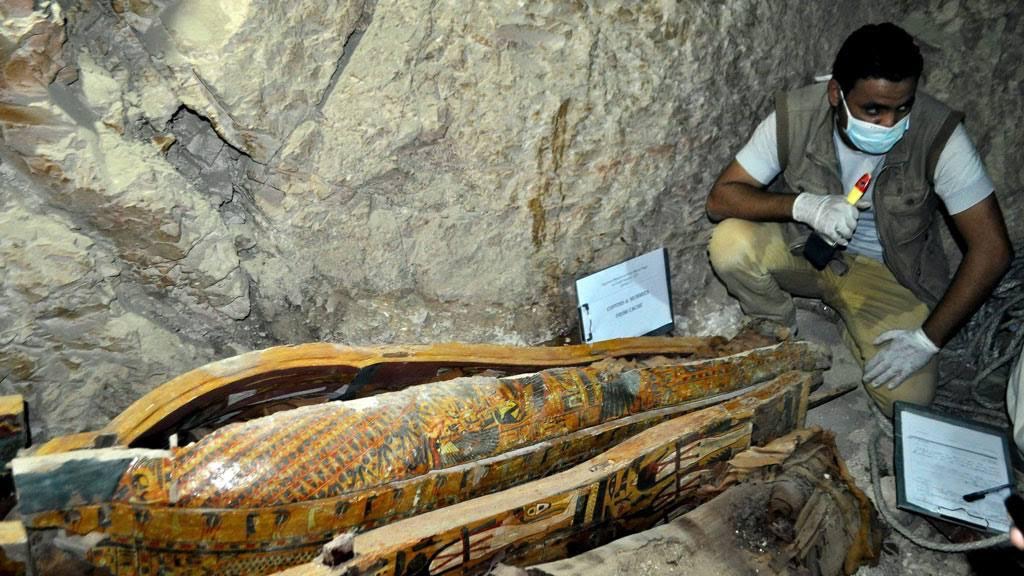
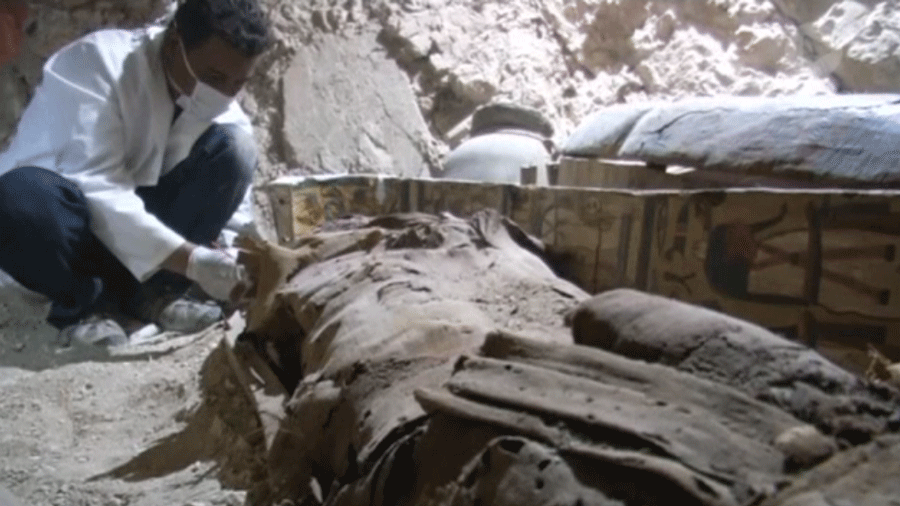
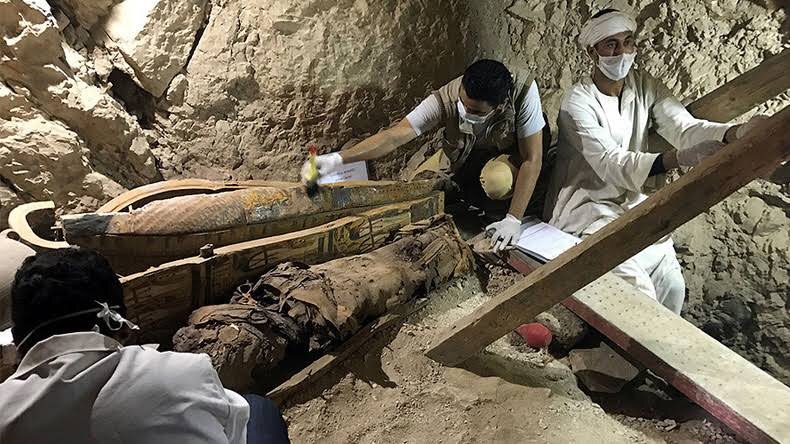
Egyptian archaeologists have discovered several mummies, 10 colourful sarcophagi, and more than 1000 funeral statues in an ancient tomb.

The discovery was made on the west bank of the Nile River in Luxor, near the Valley of the Kings. 

The Antiquities Ministry said the tomb was constructed for Userhat, a judge who lived during the New Kingdom period, from approximately 1500 to 1000 BC.

The tomb contained an open courtyard which lead into two halls, one which held four coffins, and the other housing six.

“There are 10 coffins and eight mummies. The excavation is ongoing,” Mostafa Waziri, the head of the archaeological mission, told AFP.

Waziri said the tomb has been opened to hold more mummies during the 21st Dynasty approximately 3000 years ago, to protect them during a time of tomb-robbing.


Inside one of the rooms, archaeologists found a vast collection of figurines and masks.

“It was a surprise how much was being displayed inside the tomb,” Egypt’s antiquities minister Khaled el-Enany told reporters.

“We found a large number of Ushabti(figurines), more than 1000 of them,” he said.

The coffins were well-preserved, and were found to be painted in red, blue, black, green, and yellow.

Another room inside the ancient tomb was discovered, and is yet to be excavated.

“There is evidence and traces that new mummies could be discovered in the future,” Nevine el-Aref, spokeswoman for the antiquities ministry said.

ISIS Gunmen Attack Historic St. Catherine Greek Orthodox Monastery in Egypt 

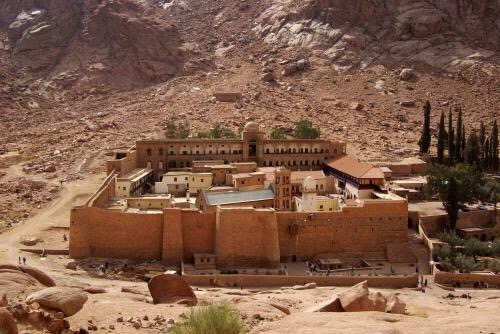
One of the world’s most important Christian sites came under gun attack. The Greek Orthodox Monastery of St. Catherine, built over 1,500 years ago is one of Christianity’s holiest sites.

Gunmen opened fire on an Egyptian police checkpoint near the monastery killing one policeman and wounding four others. The gunmen then retreated and did not reach the monastery compound, which is heavily fortified and guarded by Egyptian police and security forces.

ISIS claimed responsibility for the attack via its news agency.

The attack on the monastery comes just over a week after suicide bombers attacked two Coptic Christian churches in the Nile Delta city of Tanta and the coastal city of Alexandria, killing 45 people on Palm Sunday. 

According to the officials, the gunmen were shooting from an elevated hilltop overlooking the police checkpoint just outside the monastery, which is located in a remote desert and mountainous area in the southern part of the Sinai Peninsula, where, according to scripture, God spoke to the prophet Moses from a burning bush.

The Greek Orthodox monastery was a popular destination, primarily for Orthodox Christian pilgrims, but was closed to the public for security reasons in 2015, leaving only the monks and clergy inside the compound.

According to Orthodox Christian history, in the early 4th century, St. Helena, mother of Constantine the Great, built the Chapel of the Burning Bush at the site where Moses is supposed to have seen the miracle.

The fortified walls were built around the chapel by the Byzantine emperor Justinian (who also commissioned the Hagia Sophia) starting in 527. The Church of the Transfiguration was completed by Justinian’s workers in the 560s, around the time of his death.

In 2002, the area centering on St. Catherine’s Monastery was declared a World Heritage Site by UNESCO because of Mt. Sinai’s importance in three major world religions (Judaism, Christianity and Islam), the natural environment of the area and St. Catherine’s historic architecture and art.


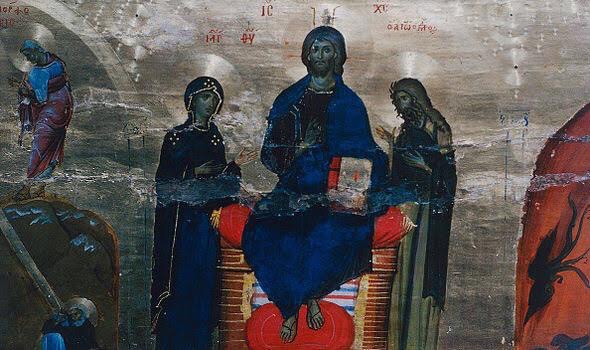
In 628 AD, a delegation from St. Catherine’s Monastery came to Prophet Muhammed and requested his protection. He responded by granting them a charter of rights, which I reproduce below in its entirety. St. Catherine’s Monastery is located at the foot of Mt. Sinai and is the world’s oldest monastery. It possess a huge collection of Christian manuscripts, second only to the Vatican, and is a world heritage site. It also boasts the oldest collection of Christian icons. It is a treasure house of Christian history that has remained safe for 1,400 years under Muslim protection.

The Promise to St. Catherine:

“This is a message from Muhammad ibn Abdullah, as a covenant to those who adopt Christianity, near and far, we are with them.

Verily I, the servants, the helpers, and my followers defend them, because Christians are my citizens; and by Allah! I hold out against anything that displeases them.

No compulsion is to be on them. Neither are their judges to be removed from their jobs nor their monks from their monasteries. No one is to destroy a house of their religion, to damage it, or to carry anything from it to the Muslims’ houses.

Should anyone take any of these, he would spoil God’s covenant and disobey His Prophet. Verily, they are my allies and have my secure charter against all that they hate.

No one is to force them to travel or to oblige them to fight. The Muslims are to fight for them. If a female Christian is married to a Muslim, it is not to take place without her approval. She is not to be prevented from visiting her church to pray. Their churches are to be respected. They are neither to be prevented from repairing them nor the sacredness of their covenants.

No one of the nation (Muslims) is to disobey the covenant till the Last Day (end of the world).”

The Missing Australian Soldiers from the Battle of Vevi


Former NT Minister Peter Toyne and Historian Tom Tsamouras will present a lecture entitled ‘The Missing Australian Soldiers from the Battle of Vevi’, on Thursday 20 April, at 7:00pm, at the Ithacan Philanthropic Society as a part of the Greek History and Culture Seminars, offered by the Greek Community of Melbourne.

The first action during the Second World War on Greek soil between the German and Hellenic forces was on the little village of Vevi in the municipality of Florina. This began on 11th April 1941 and marked the first of numerous clashes during which Hellenic and ANZAC forces fought side by side! After the “Battle of Vevi”, a small number of soldiers from the two Australian battalions that fought there, were reported missing in action and their bodies have never been found. Information by locals to Australian Brigadier Keith Rossi in 1981 about the possible grave site of these missing men has led to many people from Greece and Australia researching about the possible grave site of their remains. Tom Tsamouras, a school teacher from Newcastle and Peter Toyne, former MP from the NT, are two researches who have spent years trying to locate the resting place of these men.

Tom Tsamouras was born in Karditsa, Greece in 1962 and migrated with his family to Australia in 1969. He was educated at Hamilton Primary and Merewether High school in Newcastle and graduated from the University of Newcastle in 1983 with a Bachelor of Arts degree. In 1984 he completed a Graduate Diploma in Education through the University of Sydney and in 1986 graduated from the University of New England with a Master of Letters degree. Between 1987 and 1990 he worked in Greece teaching English as a second language. In 1992 he was appointed at Muswellbrook High School as an English/History teacher and in 1993 he transferred to Maitland High School where he teaches English to this day. In 1997 he also joined the network of Symban World Radio and produced a variety of weekly radio programmes in the Greek language until 2012. Today he lives in Newcastle with his wife Irene and three children Alexandra, George and Madeline.

Peter Toyne was born in Melbourne and early career there included 5 years of scientific research into the origins of breast cancer and then a ten year secondary teaching career. He moved to the Northern Territory in 1980 and took up various educational and community development roles in the Central Australian region over the next 16 years- all this time based in bush communities. Some of the significant projects in which he played a prominent role were the establishment of the Warlpiri Media Association, Warlukurlangu Artists, the Tanami Network, Open learning based secondary education, Indigenous adult education, development of Teaching courses through Bachelor College, and numerous smaller enterprises. In 1996 He was elected to the NT Parliament as the Member for Stuart and served for 10 years as opposition spokesperson for education. When the Labor government assumed power in 2001 he became the Attorney General and Justice Minister and later took on the additional responsibility as Minister for Health and Minister for Central Australia. He retired from politics in 2006 and now balances family life, and an active career as an artist and architectural glass designer.

When: Thursday, 20 April 2017, 7:00pm

Where: Ithacan Philanthropic Society (Level 2, 329 Elizabeth St, Melbourne)

Ο κίονας που διερράγη και ανεφλέγη διά του Αγίου Φωτός (1579)


Το Μεγάλο Σάββατο του 1579, σύμφωνα με τα εκκλησιαστικά χρονικά της πόλης των Ιεροσολύμων, οι Τούρκοι κυβερνήτες απαγόρευσαν στον Έλληνα πατριάρχη και στους ορθοδόξους πιστούς να εισέλθουν στον Ναό της Αναστάσεως για την καθιερωμένη τελετή του Αγίου Φωτός.
Τα συγγράμματα που αναφέρονται στο γεγονός δεν προσδιορίζουν το ακριβές έτος. Αναφέρουν, όμως, ότι την περίοδο εκείνη πατριάρχης Ιεροσολύμων ήταν ο Σωφρόνιος, ενώ πατριάρχες Κων/πόλεως, Αλεξανδρείας και Αντιοχείας ήταν αντιστοίχως ο Ιερεμίας, ο Σιλβέστρος και ο Ιωακείμ· τέλος, σουλτάνος της οθωμανικής αυτοκρατορίας ήταν ο Μουράτ Γ΄.2

Αν ανατρέξουμε στους επίσημους καταλόγους (ή στις ιστοσελίδες) των τεσσάρων αυτών Πατριαρχείων, διαπιστώνουμε πως οι τέσσερις ελληνορθόδοξοι πατριάρχες πράγματι διετέλεσαν τα καθήκοντά τους στο δεύτερο μισό του 16ου αιώνα· και αν εξετάσουμε την ακριβή περίοδο πατριαρχίας του καθενός, και την αντίστοιχη περίοδο βασιλείας του σουλτάνου Μουράτ Γ΄, προκύπτει ότι το μοναδικό έτος που συνέπεσε η διοίκηση των πέντε αντρών είναι το 1579.3
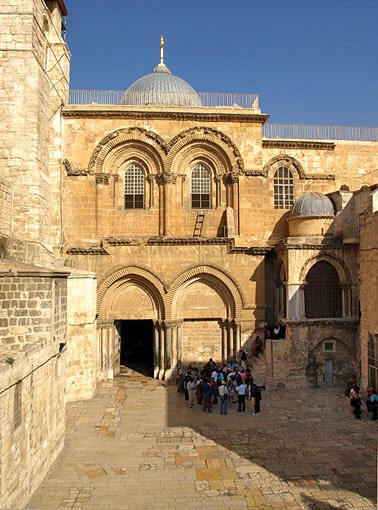

Το προαύλιο και η είσοδος του Ναού της Αναστάσεως.

Σύμφωνα με τις γραπτές πηγές, το Μεγάλο Σάββατο εκείνης της χρονιάς, μια ομάδα Τούρκων στρατιωτών, ύστερα από διαμεσολάβηση των Αρμενίων, απαγόρευσε τη διέλευση των ορθοδόξων στον Ναό της Αναστάσεως. Το πλήθος των πιστών παρέμεινε στο προαύλιο του ναού καθ’ όλη τη διάρκεια της ημέρας, αλλά ακόμη και μετά τη δύση του ηλίου.

Ο Πατριάρχης Σωφρόνιος Δ΄, που διήνυε το πρώτο έτος της πατριαρχίας του, ανέλαβε για πρώτη φορά να φέρει εις πέρας την πιο σημαντική τελετή τoυ έτους, όμως, οι Τούρκοι τού στέρησαν το νόμιμο δικαίωμα.

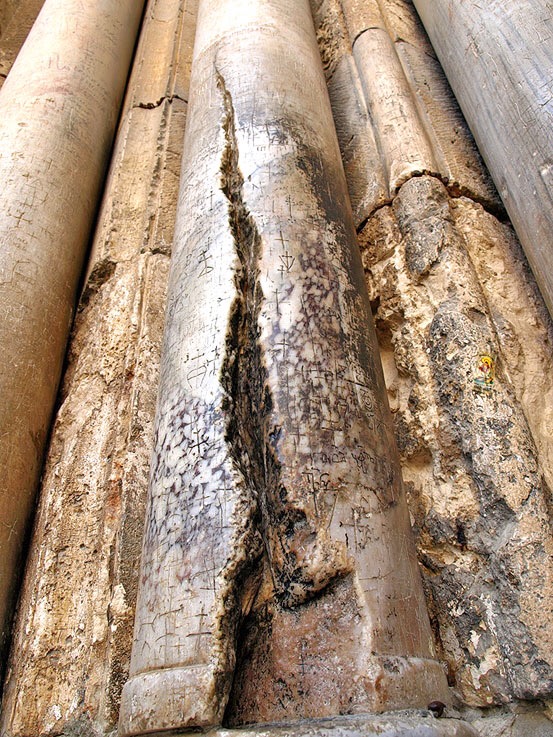
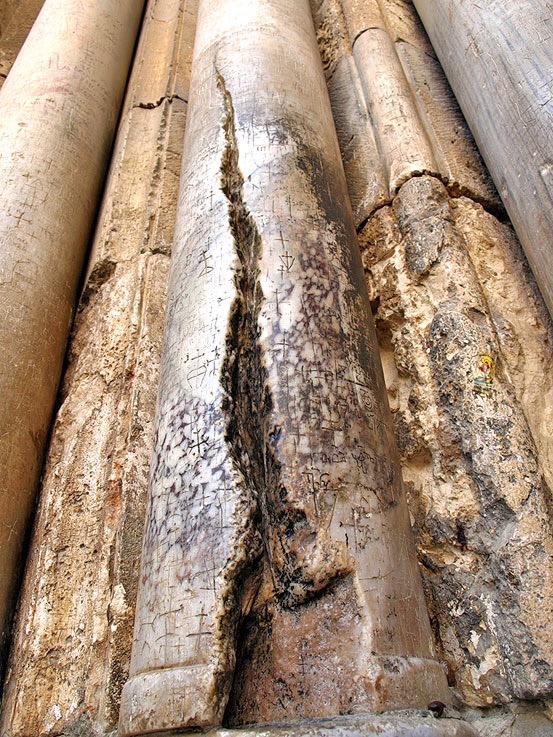
Ο πατριάρχης στεκόταν προσευχόμενος στο αριστερό μέρος της πύλης του ναού, πλησίον ενός κίονα. Και ξαφνικά, ενώ είχε ήδη πέσει η νύχτα, ο κίονας διερράγη και το Άγιο Φως ξεπήδησε από το εσωτερικό του.

Ο πατριάρχης άναψε αμέσως τη λαμπάδα του και μεταλαμπάδευσε το Άγιο Φως στους πιστούς. Μέσα σε λίγα λεπτά, η ιερή φλόγα εξαπλώθηκε σε όλους τους παρευρισκόμενους και το προαύλιο του ναού φωτίστηκε. Οι έκπληκτοι Τούρκοι φρουροί άνοιξαν τότε τις πύλες του ναού και ο πατριάρχης, μαζί με το πλήθος των ορθοδόξων, κατευθύνθηκαν πανηγυρικά προς τον Πανάγιο Τάφο.

Τα γεγονότα εκείνης της ημέρας καταγράφονται σε όλα τα αποκαλούμενα Προσκυνητάρια Ιεροσολύμων, που είναι οδηγοί για τους προσκυνητές των Αγίων Τόπων. 

Το αρχαιότερο απ’ αυτά τα Προσκυνητάρια, στο οποίο αναφέρεται η διάρρηξη του κίονα, περιέχεται σε ένα πολύτιμο χειρόγραφο που βρίσκεται στη Βιβλιοθήκη του Μονάχου. 

Πρόκειται για τον κώδικα Monacensis Graec. 346,4 ο οποίος περιέχει το Προσκυνητάριο του ιερομόναχου Ανανία. Το χειρόγραφο, γραμμένο από τον Κρητικό ιερομόναχο Ακάκιο το 1634, είναι αντίγραφο του αρχικού έργου του ιερομόναχου Ανανία το οποίο εγράφη το 1608, δηλαδή 29 έτη μετά το θαύμα που περιγράφει. Αυτό σημαίνει πως ο Ανανίας είχε τη δυνατότητα να συλλέξει στοιχεία για το θαύμα από ανθρώπους που βίωσαν τα γεγονότα.
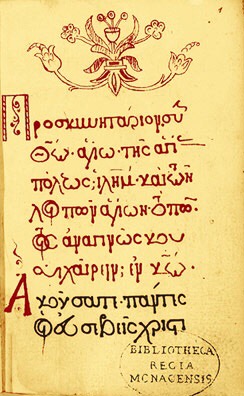
Τo πρώτο φύλλο του κώδικα Gr . 346 της Βιβλιοθήκης του Μονάχου, με τίτλο «Προσκυνητάριον συν Θεώ αγίω της αγίας πόλεως Ιερουσαλήμ και των λοιπών αγίων τόπων».

Το χειρόγραφο της Βιβλιοθήκης του Μονάχου εκδόθηκε για πρώτη φορά το 1890 από τον Παπαδόπουλο-Κεραμέα στην Αγία Πετρούπολη,5 με ταυτόχρονη ρωσική μετάφραση. Σύμφωνα με την καταγραφή του Κρητικού Ακάκιου, ο ιερομόναχος Ανανίας διηγείται με ανορθόγραφο τρόπο τα εξής:

«Έξω δε της Αγίας Πόρτας, πλησίον εις το δυτικόν μέρος, είναι γ΄ κολόναις μαρμαρέναις, και από την μεσινήν κολόναν, λέγουν, ότι ευγήκεν το Άγιον Φως τον παλαιόν καιρόν. Και είναι σχισμένη καμπόσον και φαίνεται έως την σήμερον. Και αυτό το θαύμα το έδειξεν ο θεός τοιουτοτρόπως, επειδή λέγουν, ότι εις τον καιρόν εκείνον δεν άφησαν, εκείνοι οπού όριζαν τον πατριάρχην, να σέβουν [εισέλθουν] μέσα να κάμουν την εορτήν της Λαμπράς, κατά την συνήθειαν. 

Ο δε πατριάρχης εστάθη έξω με τον λαόν εις την αυλήν Μεγάλω Σαββάτω βραδί λυπημένοι. Και εκρατούσαν και τα κηρία εις τα χέρια τους. Και ο πατριάρχης έστεκε πλησίον εις τον θρόνον της αγίας Ελένης, εις μίαν κολόναν κοντά. 

Και τότε λέγουν ότι ευγήκε το Άγιον Φως απ’ εκείνην την κολόναν οπού είπαμεν πως είναι σχισμένη καμπόσον, και υπήγε απάνω εις την κολόνα οπού έστεκεν ο πατριάρχης πλησίον. Και τότε άναψε τα κηρία οπού εκράτει ο πατριάρχης και απεκήνα άναψε και ο λαός από τας χείρας του πατριάρχου κατά την συνήθειαν. 

Τότε λέγει όταν ίδαν αυτό το θαύμα εκείνοι οπού όριζαν, άνοιξαν την αγίαν πόρταν και εσέβηκεν [εισήλθε] ο πατριάρχης με τον λαόν και έκαμαν την εορτήν, κατά το έθος».
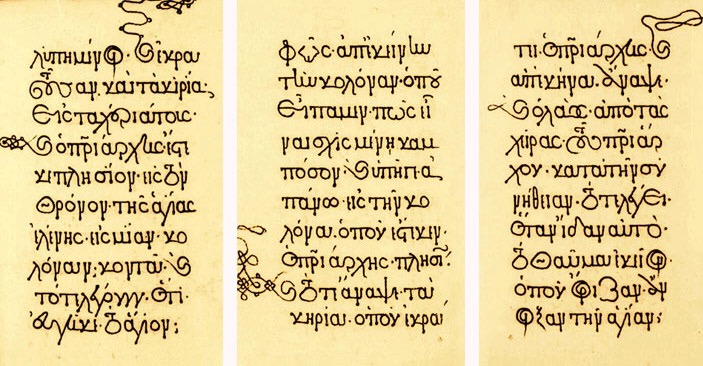
 

Η διήγηση του μοναχού Ανανία περί του κίονα που σχίσθηκε στον κώδικα Monacenis Gr. 346, 1634 μ.Χ. Εικονίζονται τα φύλλα 85a, 85b, 86a . Μόναχο, Bayerische Staatsbibliothek.

Η ίδια διήγηση, με κάποιες επιπλέον πληροφορίες, περιλαμβάνεται σε πολλά Προσκυνητάρια της Ιερουσαλήμ που εκδόθηκαν τους επόμενους αιώνες. 

Η αρχαιότερη έκδοση αυτών των προσκυνηματικών οδηγών συναντάται στη Βιέννη, το 1749, με τίτλο Προσκυνητάριον της αγίας πόλεως Ιερουσαλήμ, γραμμένη από τον αρχιμανδρίτη και φύλακα του αγίου Τάφου, Συμεών. 

Στο έργο επιβεβαιώνεται ότι το σχίσιμο και η ανάφλεξη του κίονα έλαβαν χώρα την ώρα που έπεφτε η νύχτα. Γράφει ο αρχιμανδρίτης Συμεών:

«Τότε ο πατριάρχης εστάθη έξω εις την αυλήν της εκκλησίας, τω αγίω και μεγάλω σαββάτω, με τον λαόν προς εσπέραν, μετά μεγάλης λύπης δεόμενοι του Κυρίου ολοψύχως. 

Και ο πατριάρχης ανέβη εις τον θρόνον της Αγίας Ελένης πλησίον μιας κωλώνας, προσευχομένου δε του πατριάρχου μετά του λαού. Ω της φιλανθρωπίας σου Δέσποτα, εσχίσθη μία κωλώνα και ευγήκε το Άγιο φως έξω, και έδραμεν ο πατριάρχης και άναψε τα κηρία οπού εβάσταζεν εις τας χείρας του, και από τας χείρας αυτού άναψε τα κηρία ο λαός εις αγιασμόν αυτού» (Συμεών, Προσκυνητάριον Αγίας Πόλεως Ιερουσαλήμ, Βιέννη 1749, σ. 19).
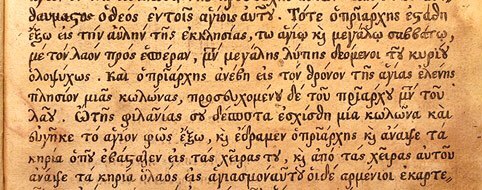

H αναφορά περί του κίονα που σχίσθηκε στο Προσκυνητάριον του Συμεών (Βιέννη, 1749), σ. 19.

Η έκδοση της Βιέννης αναφέρει και ένα ακόμη γεγονός, που σχετίζεται με έναν Άραβα εμίρη, ονόματι Τουνόμ, ο οποίος την ώρα του θαύματος βρισκόταν στην αυλή του Ναού. 

Όταν αντίκρισε την ανάφλεξη του κίονα συνειδητοποίησε την αυθεντικότητα του θαύματος και ομολόγησε στους ομοθρήσκους του τη δύναμη του Ιησού Χριστού. 

Αφού διαπληκτίστηκε μαζί τους, η ομολογία του αυτή στάθηκε αιτία να διαταχθεί η εκτέλεσή του και εν συνεχεία να παραδοθεί το σώμα του στην πυρά.6 Σήμερα θεωρείται επισήμως άγιος μάρτυρας της Ορθοδοξίας, η μνήμη του γιορτάζεται στις 18 Απριλίου και τα λείψανά του βρίσκονται στη μονή της Μεγάλης Παναγίας των Ιεροσολύμων.
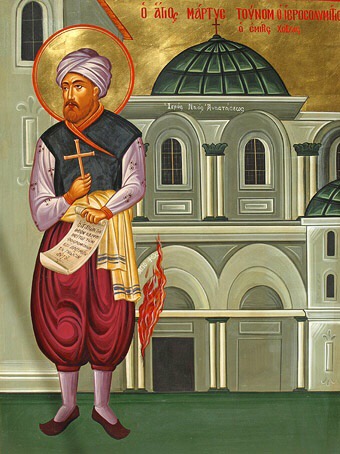

Ο άγιος μάρτυρας Τουνόμ και στο βάθος ο κίονας που ανεφλέγη, σε εικόνα που βρίσκεται στη μονή της Μεγάλης Παναγιάς των Ιεροσολύμων.

Σε διάφορες ιστοσελίδες που υπάρχουν στο διαδίκτυο συναντάται η πληροφορία ότι ο κίονας διερράγη και ανεφλέγη το Μεγάλο Σάββατο του 1579 (ή του 1549), αφού πρώτα χτυπήθηκε από κεραυνό.

Η συγκεκριμένη πληροφορία καταγράφηκε για πρώτη φορά από τον Μολδαβό μοναχό Παρθένιο Αγκέεβ,7 ο οποίος επισκέφθηκε την Ιερουσαλήμ το 1845. Στον δεύτερο τόμο του Χρονικού του, ο μοναχός Παρθένιος αναφέρει τα εξής:

«Αυτός ο κίονας τιμάται από τους Ορθόδοξους καθώς και από τους μη Ορθόδοξους, ακόμη και από τους Αρμένιους. Θα ήθελα να γράψω κάτι σχετικά με αυτό το περιστατικό, για το πως οι Ανατολικοί Ορθόδοξοι χριστιανοί ομοφώνως μιλούν γι’ αυτό και οι ίδιοι Τούρκοι το επιβεβαιώνουν. 

Σε έναν τοίχο υπάρχει μια μαρμάρινη επιγραφή και λένε ότι αυτό το περιστατικό είναι γραμμένο σε αυτή· αλλά δεν μπορέσαμε να το διαβάσουμε επειδή είναι γραμμένο με συριακά γράμματα, στην αραβική γλώσσα. Έτσι, μόνο άκουσα γι’ αυτό και δεν το διάβασα».

Και συνεχίζει λίγο πιο κάτω περιγράφοντας το θαύμα:

«Είχε περάσει ήδη μισή ώρα και περισσότερο, και ακόμη δεν είχε εμφανιστεί το Άγιο Φως. Η ημέρα ήταν καθαρή και όμορφη. Ο πατριάρχης καθόταν στη δεξιά πλευρά. Και ξαφνικά, έπεσε ένα κεραυνός και στην αριστερή πλευρά ο μεσαίος κίονας σχίστηκε και από τη ρωγμή εξήλθε μια φωτιά. Ο πατριάρχης σήκωσε και άναψε τις λαμπάδες του και όλοι οι Ορθόδοξοι άναψαν από τις δικές του».

Ο μοναχός Παρθένιος αναφέρει ότι η συγκεκριμένη ιστορία ήταν χαραγμένη σε μαρμάρινη πλάκα, γραμμένη στην αραβική γλώσσα. Δεν μπορούσε, όμως, να διαβάσει τη διήγηση διότι δεν γνώριζε αραβικά. Απλώς, άκουσε την ιστορία. Κατά συνέπεια, η πληροφορία για τον κατερχόμενο κεραυνό δεν μπορεί να θεωρηθεί απολύτως αξιόπιστη· χωρίς αυτό να σημαίνει ότι είναι αναξιόπιστο το σύνολο της διήγησης. Επιπλέον, η πληροφορία περί του κεραυνού δεν συναντάται σε κάποιο προγενέστερο κείμενο ή χειρόγραφο.

Παρόλα αυτά, η αναφορά του Μολδαβού μοναχού είναι ιδιαίτερα σημαντική διότι επιβεβαιώνει ότι το σχίσιμο και η ανάφλεξη του κίονα ήταν καταγεγραμμένα σε μαρμάρινη επιγραφή με συριακά γράμματα.

Αυτό που έχει σημασία είναι ότι, είτε χτυπήθηκε ο κίονας από κεραυνό είτε διερράγη και ανεφλέγη μόνος του, και στις δύο περιπτώσεις πρόκειται περί θαύματος, διότι ο πατριάρχης που στεκόταν δίπλα του, άναψε τις λαμπάδες του από τη φωτιά που παράχθηκε.

Εάν όμως μια φωτιά ή μια ηλεκτρική εκκένωση διαπέρασαν τον κίονα με τόσο μεγάλη ένταση πριν από 430 χρόνια, τότε τα ίχνη τους πρέπει να είναι ακόμη ορατά. Η ρωγμή μοιάζει πράγματι να είναι καμένη και διαβρωμένη από τη φωτιά· κατά πόσο, όμως, αυτά τα ίχνη της διάβρωσης μπορούν να εξακριβωθούν και να πιστοποιηθούν επιστημονικά;

Το Πάσχα του 2008, η ρωγμή του κίονα αποτέλεσε αντικείμενο μελέτης του Αντρέι Βολκόβ. Ο Ρώσος φυσικός απέστειλε υψηλής ανάλυσης φωτογραφίες της ρωγμής σε έναν συμπατριώτη του ειδικό επιστήμονα, τον καθηγητή Εβγκένι Μιχάηλοβιτς Μορόζοβ,9 ο οποίος θεωρείται ένας από τους κορυφαίους ερευνητές στον κόσμο στο επιστημονικό πεδίο της Μηχανικής των Θραύσεων (Fracture Mechanics) και της Φυσικής της Αντοχής των Υλικών (Physics of Strength of Materials).

Η Μηχανική των Θραύσεων είναι η επιστήμη που ασχολείται με τη μελέτη των θραύσεων και του σχηματισμού ρωγμών στα υλικά. Χρησιμοποιεί μεθόδους αναλυτικής μηχανικής για να υπολογίσει τη δύναμη που ασκείται κατά τον σχηματισμό μιας ρωγμής, καθώς και πειραματικές μεθόδους που υπολογίζουν την αντοχή ενός υλικού στη θραύση και τη ρηγμάτωσή του.
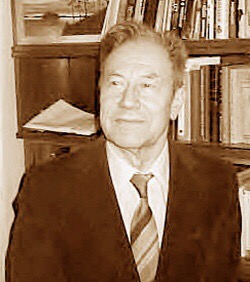
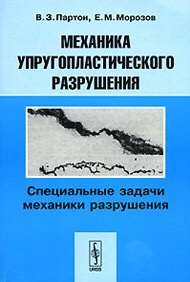
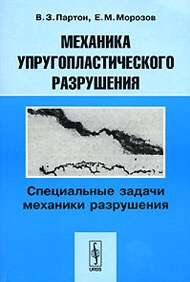
Ο καθηγητής Εβγκένι Μορόζοβ και το τελευταίο επιστημονικό σύγγραμμά του, με τίτλο Ελαστοπλαστική Μηχανική των Θραύσεων, το οποίο παρουσιάζει τα αποτελέσματα της σύγχρονης εργαστηριακής έρευνας σχετικά με την θεωρία των ρωγμών και εξετάζει ζητήματα συμπεριφοράς των σωμάτων που έχουν υποστεί ρωγμές – από τα κριτήρια ανάπτυξής τους μέχρι πιο περίπλοκα προβλήματα της Μηχανικής των Θραύσεων.

Ο καθηγητής Εβγκένι Μορόζοβ, αφού εξέτασε αναλυτικά τις φωτογραφίες της ρωγμής, κατέληξε στο συμπέρασμα ότι αυτή θα μπορούσε να παραχθεί μόνο ως αποτέλεσμα ηλεκτρικής εκκένωσης!

Ο Αντρέι Βολκόβ, ο οποίος συνεργάστηκε με τον Εβγκένι Μορόζοβ για το συγκεκριμένο ζήτημα, αναφέρει τα εξής σε συνέντευξή του στην εφημερίδα Βέρα:

Вот это совпадение, что именно на Пасху, когда Огонь не сошёл, появилась трещина, – разве не чудо? Можно, конечно, усомниться, мол, всё было подстроено и трещину на колонне сделали искусственным путём. Мы обратились за консультацией к Евгению Михайловичу Морозову – он ведущий специалист в области механики разрушения не только в России, но и в мире, автор более 800 научных работ по этой теме. Евгений Михайлович исследовал предоставленные ему подробные снимки трещины и однозначно заключил, что она могла появиться только в результате электрического разряда, такова её структура. О чём это говорит? Что подделать трещину никак не могли: это ж какой электрогенератор нужно иметь, да ещё в XVI веке, когда о существовании электричества понятия не имели!11 

«Αυτή η σύμπτωση, ότι το Πάσχα ακριβώς, όταν δεν κατήλθε το Φως, εμφανίστηκε η ρωγμή – δεν είναι ένα θαύμα; Βεβαίως, μπορεί να πει κανείς, ότι όλα ήταν στημένα και ότι η ρωγμή στον κίονα είχε παραχθεί με τεχνητό τρόπο. Απευθυνθήκαμε για πληροφορίες στον Εβγκένι Μιχάηλοβιτς Μορόζοβ που είναι κορυφαίος ειδικός στον τομέα της Μηχανικής των Θραύσεων όχι μόνο στη Ρωσία, αλλά και σε ολόκληρο τον κόσμο, και έχει γράψει πάνω από 800 επιστημονικά συγγράμματα για το θέμα αυτό. Ο Εβγκένι Μιχάηλοβιτς εξέτασε τις αναλυτικές φωτογραφίες της ρωγμής και δήλωσε ρητά ότι αυτή μπορούσε να εμφανιστεί μόνο ως αποτέλεσμα ηλεκτρικής εκκένωσης, τέτοια είναι η δομή της. Τι σημαίνει αυτό; Ότι ήταν πλήρως αδύνατον να κατασκευάσει κανείς τη ρωγμή αυτή: φανταστείτε, πόσο δυνατό μετασχηματιστή θα έπρεπε να είχε κανείς, και ιδίως τον 16ο αιώνα, όταν οι άνθρωποι δεν είχαν ιδέα για την ύπαρξη της ηλεκτρικής ενέργειας!»

Η επιστημονική άποψη του Εβγκένι Μορόζοβ έχει αναμφισβήτητα μεγάλη βαρύτητα. Ήθελα να έχω όμως και μία δεύτερη γνώμη επί του θέματος. Γι’ αυτό, αποτάθηκα σε έναν από τους κορυφαίους Έλληνες επιστήμονες του κλάδου της Μηχανικής των Θραύσεων, τον καθηγητή του Πανεπιστημίου Αθηνών, Γεώργιο Α. Παπαδόπουλο,12 στον οποίο απέστειλα αναλυτικές φωτογραφίες της ρωγμής.
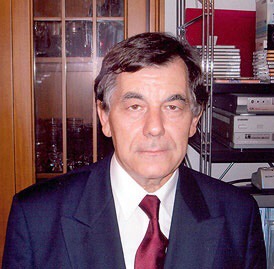
Ο καθηγητής Γεώργιος Α. Παπαδόπουλος.

Ο καθηγητής Παπαδόπουλος, αφού εξέτασε τις φωτογραφίες, αποφάνθηκε ότι η ρωγμή του κίονα παράχθηκε πράγματι από μία ηλεκτρική εκκένωση, η οποία εκδηλώθηκε ταυτοχρόνως με ένα σεισμικό κύμα που είχε κατεύθυνση από κάτω προς τα πάνω!

Αυτή τη συνδυασμένη καταπόνηση του κίονα –ηλεκτρική εκκένωση+σεισμικό κύμα– την θεωρεί ανεξήγητη και γι’ αυτό καταλήγει στο συμπέρασμα ότι «θα μπορούσε κανείς να ομιλεί περί θαύματος και μόνο»!

Από πού προήλθε η εκκένωση, επιστημονικώς, παραμένει άγνωστο.

Ο καθηγητής Παπαδόπουλος, σε απαντητική του επιστολή, μετά από σχετικό αίτημά μου μέσω email, αναφέρει τα εξής:

 «Αγαπητέ κύριε Σκαρλακίδη,

Σας ευχαριστώ για το e-mail σας την 31/1/2010. Πιστεύω να βοηθήσω στο αξιόλογο έργο σας. Επί 35 έτη ασχολούμαι με την Πειραματική Μηχανική των Θραύσεων στο Εργαστήριο Αντοχής των Υλικών του ΕΜΠ και πιστεύω ότι εκεί που δεν υπάρχει επιστημονική εξήγηση υπάρχει Θαύμα.

Δεν έχω κανένα λόγο να αμφισβητήσω το χειρόγραφο της βιβλιοθήκης του Μονάχου του έτους 1634 όπου αναφέρεται ο θαυματουργικός τρόπος σχισίματος του κίονα καθώς και τα επακόλουθα· δηλαδή το ότι ο Έλληνας πατριάρχης άναψε τη δάδα του από το Φως αυτό. Ένα θαύμα δεν νομίζω ότι είναι δυνατόν να αμφισβητηθεί και μάλιστα όταν υπάρχουν σχετικές μαρτυρίες, όπως αναφέρετε.

Παρατηρώντας από τις φωτογραφίες τη ρωγμή θα μπορούσαμε να συμπεράνουμε ότι είναι αποτέλεσμα μιας μικτής καταπόνησης. Συνδυασμός ηλεκτρικής εκκένωσης (πιθανώς ισχυρός κεραυνός) και ισχυρής σεισμικής δόνησης. Η ηλεκτρική εκκένωση, λόγω υψηλής στιγμιαίας θερμοκρασίας, ψαθυροποίησε το υλικό του κίονα κατά μήκος μιας στενής ζώνης (γενέτειρας). Το επιφανειακό σεισμικό κύμα καταπόνησε τον κίονα σε στρεπτική ταλάντωση (κόπωση). Η ταυτόχρονη αυτή καταπόνηση είχε σαν αποτέλεσμα να ξεκινήσει η ρωγμή από τη βάση του κίονα προς τα επάνω με ζικ-ζακ πορεία (όπως φαίνεται στη φωτογραφία η πορεία της ρωγμής δεν είναι ευθύγραμμη) κατά μήκος της ψαθυροποιημένης από την ηλεκτρική εκκένωση ζώνης. Εάν πράγματι συνέβησαν τα ανωτέρω, ανεξήγητο παραμένει κατά την άποψή μου η ταυτόχρονη αυτή μικτή (συνδυασμένη) καταπόνηση του κίονα.

Επομένως, θα μπορούσε κανείς να ομιλεί περί θαύματος και μόνο.

Αγαπητέ κύριε Σκαρλακίδη σας συγχαίρω για την προσπάθειά σας και σας εύχομαι ολόψυχα καλή επιτυχία.

Με εκτίμηση,

Γεώργιος Παπαδόπουλος

Καθηγητής Μηχανικής

Εργαστήριο Αντοχής των Υλικών

Εθνικό Μετσόβειο Πολυτεχνείο
Με το θαυμαστό γεγονός του κίονα που διερράγη και ανεφλέγη ολοκληρώνεται το μακρύ οδοιπορικό μας στο πέρασμα των αιώνων, σχετικά με το θαύμα του Αγίου Φωτός.

Το ταξίδι μας ξεκίνησε περί το έτος 330 περίπου, με την αναφορά της ανάφλεξης της κανδήλας που τοποθετήθηκε στον Τάφο του Χριστού από τον Άγιο Γρηγόριο τον Φωτιστή, και ολοκληρώθηκε στο έτος 1579, με το γεγονός που μόλις εξετάσαμε.

Παρατέθηκαν συνολικά 45 μαρτυρίες, που ο καθένας μπορεί να τις αξιολογήσει κατά τη δική του κρίση. Εξετάζοντας συνοπτικά αυτές τις μαρτυρίες, αξίζει να επισημάνουμε τρία ιδιαίτερα χαρακτηριστικά.

Σε όλες τις διηγήσεις υπάρχει μία κοινή παράμετρος: η αναφορά περί ενός φωτός ή μιας φλόγας-φωτιάς ή μιας αστραπής, η οποία κατέρχεται από τον ουρανό ενώπιον του πλήθους, σε μια εποχή που δεν υπάρχει ούτε ηλεκτρισμός ούτε η δυνατότητα τεχνητής αναπαραγωγής ενός τέτοιου φαινομένου!

Το δεύτερο σημαντικό χαρακτηριστικό είναι η ανάφλεξη της ακοίμητης κανδήλας και η φωταγώγηση ενός άδειου, σκοτεινού και σφραγισμένου Τάφου! Γεγονός που λάμβανε χώρα επί τουλάχιστον έξι αιώνες. Η φωταγώγηση του εσωτερικού του Τάφου δεν πραγματοποιόταν βεβαίως μόνο από τη λάμψη της ακοίμητης κανδήλας, αλλά κυρίως από το Φως που αναδυόταν από το ίδιο το πέτρωμα στο οποίο αποτέθηκε το σώμα του Ιησού.

Το τρίτο σημαντικό χαρακτηριστικό που αναφέρεται σε πολλές διηγήσεις είναι ο συγχρονισμός των δύο ανωτέρω φαινομένων –δηλαδή, η κάθοδος του ουρανίου Φωτός και η ταυτόχρονη ανάφλεξη της κανδήλας και φωταγώγηση του εσωτερικού του Τάφου. Συγχρονισμός που θα μπορούσε να επιτευχθεί μόνο με θεϊκή επενέργεια.

Έχει ήδη αναφερθεί ότι στο παρόν σύγγραμμα δεν περιλαμβάνονται μαρτυρίες μετά το 1579 (αν και υπάρχουν πολλές), αλλά ούτε και νεότερες, αφενός επειδή θα υπάρξει κορεσμός στοιχείων, αφετέρου επειδή για κάτι τέτοιο απαιτείται πολύ μεγάλος χώρος. Επιπλέον, η δομή του συγγράμματος είναι καθαρά ιστορική και ο προσανατολισμός στραμμένος αποκλειστικά στους πρώτους αιώνες που καταγράφεται το θαύμα.

Παρ’ όλα αυτά, κρίθηκε αναγκαίο να συμπεριληφθούν έντεκα νεότερες μαρτυρίες οι οποίες παρουσιάζουν ιδιαίτερο ενδιαφέρον.

Οι δύο πρώτες προέρχονται από δύο αυτόπτες μάρτυρες: τον Μολδαβό μοναχό Παρθένιο (1846) και τον Άγγλο αρχαιολόγο Ουόρεν ο οποίος βίωσε το θαύμα τέσσερις συνεχόμενες χρονιές, την περίοδο 1867-1870. Με αυτές τις δύο διηγήσεις ο συνολικός αριθμός των ιστορικών μαρτυριών ανέρχεται στον αριθμό 45.

Οι επόμενες επτά μαρτυρίες προέρχονται από πέντε Έλληνες πατριάρχες και δύο επισκόπους, οι οποίοι υπήρξαν επικεφαλής της τελετής και περιγράφουν το θαύμα όπως ακριβώς το βίωσαν μέσα στον άγιο Τάφο. Κατ’ αυτόν τον τρόπο θα έχουμε μια πιο ολοκληρωμένη εικόνα για το τι ακριβώς συμβαίνει μέσα στο ίδιο το μνημείο τη στιγμή που εμφανίζεται το Άγιο Φως.

Μια δέκατη νεότερη μαρτυρία, που επίσης παρουσιάζει εξαιρετικό ενδιαφέρον, προέρχεται από τον μοναδικό άνθρωπο που βίωσε το θαύμα μέσα στον Τάφο, χωρίς όμως να έχει δικαίωμα για κάτι τέτοιο. Πρόκειται για τον Έλληνα μοναχό Μητροφάνη ο οποίος, το Μεγάλο Σάββατο του 1926, κρύφτηκε στην οροφή του αγίου Τάφου με σκοπό να βιώσει το θαύμα από κοντά.

Η ενδέκατη και τελευταία νεότερη μαρτυρία είναι του γράφοντος και αφορά στο Μεγάλο Σάββατο του 2008. Ας ξεκινήσουμε με αυτή την προσωπική μαρτυρία.
Παραπομπές:

1. Στο Προσκυνητάριον της αγίας πόλεως Ιερουσαλήμ και πάσης Παλαιστίνης (σ. 49) που εκδόθηκε το 1787 στη Βιέννη, από τον Χρύσανθο Προύσσης, αναφέρεται ότι το γεγονός έγινε: «εις τον καιρόν του μακαριοτάτου αοιδήμου κυρίου Σωφρονίου Πατριάρχου Ιεροσολύμων, Ιερεμίου Πατριάρχου Κωνσταντινουπόλεως, Σιλβέστρου Πατριάρχου Αλεξανδρείας, και Ιωακείμ Αντιοχείας, επί της βασιλείας του Σουλτάν Μουράτ».

2. Ο Τούρκος σουλτάνος Μουράτ Γ΄ (Sultan Mourad Khan ΙΙΙ) κυβέρνησε την περίοδο 1574-1595, ο Ιεροσολύμων Σωφρόνιος Δ΄ πατριαρχεύει την περίοδο 1579-1608, ο Κωνσταντινουπόλεως Ιερεμίας Β΄ την περίοδο 1572-1579, ο Αλεξανδρείας Σίλβεστρος την περίοδο 1569-1590 και ο Αντιοχείας Ιωακείμ Δ΄ την περίοδο 1553-1592. Το μοναδικό κοινό έτος είναι το 1579. 3. G. Zuallardo, Il devotissimo viaggio, Ρώμη 1587, σ. 204.

4. Το χειρόγραφο καταλαμβάνει τον αριθμό 346 στον κατάλογο του Ignaz Hardt, Catalogus codicum manuscriptorum graecorum bibliothecae regiae Bavaricae, τ. 3, Μόναχο 1812, σ. 547-48.

5. Προσκυνητάριον της Ιερουσαλήμ και των λοιπών αγίων τόπων, 1608-1634, επιμ. Α. Παπαδόπουλος–Κεραμεύς, σ. 17.

6. Σχετικά με τον Άραβα εμίρη, στην έκδοση της Βιέννης αναφέρονται τα εξής: «Είναι και τινά καρφία καρφωμένα εις την γην, έμπροσθεν εις το κατόφλοιον της αγίας πόρτας από τον καιρόν εκείνον εις την μνήμην του γενομένου θαύματος, τα οποία λέγουν να έμπιξεν ένας εμίρις, όστις βλέπωντας εκείνο το εξαίσιον θαύμα επίστευσεν ευθύς εις τον Χριστόν, και φωνάζωντας μία είναι η πίστις των χριστιανών, και έμπιξε τα καρφία εκείνα ένα προς ένα εις την πέτραν, ωσάν εις κηρί μαλακόν, και ούτος εμαρτύρησεν υπό πυρός κατακαείς» (Συμεών, Προσκυνητάριον Αγίας Πόλεως Ιερουσαλήμ, Βιέννη 1749, σ. 20).

Το περιστατικό με τα καρφιά αναφέρεται εν συντομία και στο χειρόγραφο του Μονάχου, ως εξής: «Ευρίσκονται δε κάποια καρφία εμπηγμένα κάτω εις την γην έμπροσθα εις την αγίαν πόρταν. Λέγουσιν ότι τα έμπηξαν απ’ εκείνον τον καιρόν» (φ. 87α).

7. Ο μοναχός Παρθένιος γεννήθηκε στο Ιάσιο της Μολδαβίας (σήμερα Ρουμανίας) το 1807.

8. Μετάφρ. από την έκδοση Monk Parthenius, “Holy Week and Pascha in Jerusalem,” Orthodox Life, τόμ. 34, 2 (1984), Νέα Υόρκη, Jordanville. Βλ. επίσης Κ. Μηλιαράς, Άγιον Φως, σελ. 17.

9. Ο Εβγκένι Μορόζοβ (Евгений Михайлович Морозов), γεννηθείς το 1927, είναι Διδάκτωρ Τεχνικών Επιστημών και καθηγητής «Φυσικής της Αντοχής» (Physics of Strength) στο Ινστιτούτο Φυσικής Μηχανικής της Μόσχας. Έχει δημιουργήσει μαθηματικές εξισώσεις, προγράμματα σε Η/Υ (CAE), και έχει αναπτύξει ειδικές θεωρίες σχετικά με τα χαρακτηριστικά της αντίστασης των υλικών στον σχηματισμό ρωγμών και με τα όρια της αντοχής τους. Η ακαδημαϊκή και ερευνητική του σταδιοδρομία άρχισε το 1951 και, μετά από πολλές διακρίσεις και βραβεύσεις, συνεχίζεται μέχρι σήμερα.

10. To σύγγραμμα εγράφη από τον Μορόζοβ και τον Βλαντιμίρ Πάρτον (Vladimir Parton) και έχει τον ρωσικό τίτλο “Механика упругопластического разрушения. Специальные задачи механики разрушения” («Elastoplastic Fracture Mechanics. Special problems of Fracture Mechanics».

11. Eφημερίδα Βέρα, 21 Απριλίου 2009.

12. Ο Γεώργιος Α. Παπαδόπουλος είναι καθηγητής Μηχανικής των Υλικών στο Εθνικό Μετσόβειο Πολυτεχνείο και συγγραφέας αρκετών συγγραμμάτων και επιστημονικών άρθρων στον πεδίο της Μηχανικής των Θραύσεων. Βλ. G.A. Papadopoulos, Fracture Mechanics: The Experimental Method of Caustics and the Det.- criterion of Fracture, Λονδίνο 1993. Βλ. επίσης Γ.Α. Παπαδόπουλος, Πειραματική Μηχανική των Θραύσεων (Οπτικές Μέθοδοι Ανάλυσης των Τάσεων), εκδόσεις Κλειδάριθμος.

Source: skarlakidis.gr

Will Turkey drive the Greeks ‘into the sea’ again?

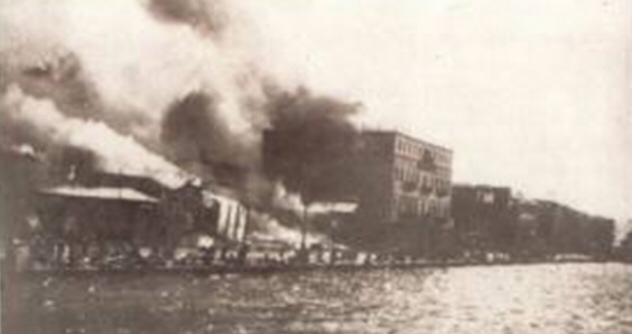
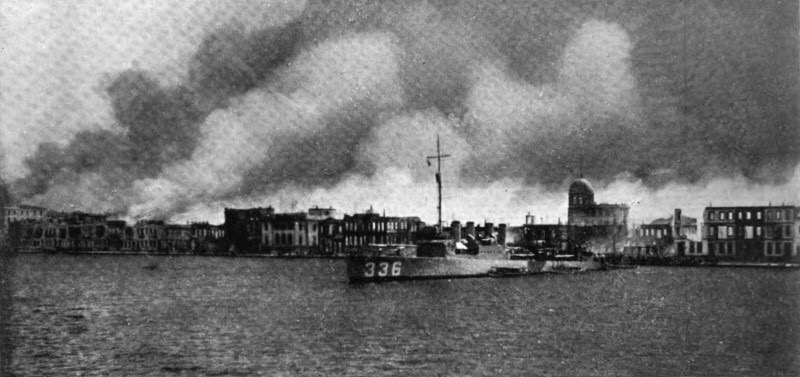
The Great Fire of Smyrna, that drove the Greek population into the sea.

Tension is running high between Greece and Turkey. The cause? Turkish Chief of the General Staff Gen. Hulusi Akar paid a visit to Imia, a pair of two small, uninhabited Greek islets in the Aegean Sea, on January 29. He was accompanied by the commanders of the Turkish land, naval and air forces.

Imia – which Turkey calls “Kardak” – was a subject of yet another crisis in 1996 that brought Greece and Turkey to the brink of war. Although armed conflict was ultimately averted, Turkey still claims that the islands are Turkish, even though the islands in the Aegean are historically and legally Greek.

Greek President Prokopios Pavlopoulos and Deputy Foreign Minister Ioannis Amanatidis have criticized Akar’s recent visit to the Greek island, describing it as a “serious violation” and a “show for Turkey’s domestic audience.”

Since then, Turkish government officials and politicians have continued to bring the issue of Kardak to the attention of the Turkish public in a tone that calls on Greece to “know its place.” 

The latest Turkish political leader who offered his opinions on the issue was Devlet Bahçeli, chairman of Turkey’s Nationalist Movement Party, the third-largest party in Turkey’s parliament.

“If the Greeks want to fall in the sea again, the Turkish nation is ready,” Bahceli said in his parliamentary speech on February 28.

Bahceli was referring to incidents that occurred in September 1922, when the armed forces of Greece – together with Christian residents of the city of Smyrna, on the Aegean shore in Ottoman Turkey – were literally thrown into the sea by Turkish forces. The current Turkish name of that city is Izmir.

Smyrna: A Historical Background

Christians in Turkey and the rest of the Middle East are often thought of as immigrants or communities that have always been minorities in the region. But nothing could be further from the truth.

Asia Minor and Smyrna have enormous importance for Christianity. The Metropolis of Smyrna, an ecclesiastical territory (diocese) of the Ecumenical Patriarchate of Constantinople, retained its ecclesiastical autonomy until 1922. Smyrna was also one of the Seven Churches spoken of by St. John in the biblical book of Revelation. Janene Keeth, a scholar of Christian education, wrote that “Smyrna has been described as the most beautiful of the seven cities. Presumably, this church was founded during Paul’s ministry in Ephesus (Acts 19:10).”

Greek culture has never been some foreign way of life in Anatolia. On the contrary, the region was predominantly Greek before Turkic people began to invade it in the 11th century.

According to the International Dictionary of Historic Places: Southern Europe, ancient Greeks were the ones “who raised Smyrna to heights of power and glory in the seventh century B.C. Smyrna passed into the hands of the Christianized, Greek-speaking Byzantine realm following the formal division of the Roman Empire.”

Smyrna was ruled by Christians for centuries. The Eastern Roman (or Byzantine) Empire fought fierce defense wars against Arabic, Seljuk and Ottoman Islamic armies. Riding from the steppes of Central Asia, the Seljuk Turks targeted Asia Minor by combining their long-held “tradition of invasion” with newfound Islamic zeal. The Islamic invasion of Asia Minor was completed by the Ottomans.

During the Middle Ages, Smyrna was the scene of many struggles, the fiercest of which was directed by Timur against the Christians. Timur – historically known as Tamerlane – a Turco-Mongol conqueror, stormed and sacked Smyrna in 1402 (then held by the Knights of St. John, who had recaptured it from the Ottoman Turks in 1344). A mass beheading was carried out in Smyrna by Timur’s soldiers. The city was then captured by the Ottomans in 1424.

The 1922 Great Fire of Smyrna

The events surrounding the Greek landing at Smyrna in 1919 and the great fire in the city in 1922 could be better understood if analyzed as part of the systematic campaign against Christians by Ottoman Turkey.

During World War I, the decaying Ottoman Empire adopted a policy that many scholars have called “the forced Turkification of Asia Minor.” Author George Makredes described the period as follows:

Imagine a life where it’s a crime to celebrate or reveal your ethnic heritage; where the law requires you to abandon your ways and culture and meld invisibly into one indistinguishable mass with the majority, or suffer the consequences. And woe to anyone caught reading, speaking, dressing as, or playing music of another culture.

Welcome to Asia Minor during the early part of the 20th century. It was during this grim period when over 1.5 million Armenians were systematically exterminated. Whether you were an Armenian man, woman or infant, you were fair game to be cut down on sight, per order of the state. Unarmed and powerless, Greeks witnessed this horror, terrorized with the fear that they were next.

What they feared soon became a reality.

Greeks also fell victim to the same Ottoman campaign of systematic extermination of Christians before, during and after World War I (1914–1923). According to the Greek Genocide Research Center, atrocities against Greek people during that period “included massacres, forced deportations and death marches, summary expulsions, boycotts, rape, forced conversion to Islam, conscription into labor battalions, arbitrary executions, and destruction of Christian Orthodox cultural, historical and religious monuments.”

At the end of World War I and with the Armistice of Mudros that ended the Ottoman front in the war, the allies launched a series of peace talks that focused on the future of the Ottoman Empire. According to James Marketos, an American Hellenic Institute board member,

By 1919, the allied winners of World War I – England, France, Italy and the U.S. – were still arguing over how to divide up the defunct Ottoman Empire, which had sided with Germany. In May that year, the Greek army was permitted to land at Smyrna and establish an administrative zone.

Scholars Evangelia Boubougiatzi, Ifigenia Vamvakidou and Argyris Kyridis write in Greeks’ Identities in Smyrna, 19th – 20th Century Local and Global Parameters that “In that society, Greeks had the dominant position, both in a demographic and economic level.” Smyrna was also one of the centers of Greek enlightenment culture, with several schools erected, such as the Evangelical School and the Philological Gymnasium.

“From ancient times, and through the Roman, Byzantine and Ottoman ages, the city remained essentially Greek,” Marketos said. “The later centuries saw the advent of Armenian, Turkish, Jewish, European and American influences, but through it all, the predominant spirit remained Greek.”

But this ended when Turkish military forces attempted to take back Smyrna from Greek administration on September 9, 1922.The military attacks against the Greeks and Armenians of Smyrna began with looting, rape and murder.
Marketos wrote,

They started in the Armenian quarter and then spread through the Greek portion of the city. This drove even more people to the narrow seafront. Then, on September 13, a fire started in the Armenian part of the city. A strong breeze blew the fire away from the Turkish quarter and quickly spread it to the rest of the city, driving still more horrified thousands of Greeks and Armenians to the harbor where they were now trapped between the raging flames at their backs and the harbor in front. And still the Allied warships watched as the refugees on the seafront were subjected to unspeakable atrocities by Turkish soldiers and residents.

After four days, the fire burned itself out. Beautiful Smyrna lay in ruins. Thousands of Greeks and Armenians had perished, either in the fire, or through slaughter in one form or another, or through simple exposure. Hundreds of thousands of others were eventually evacuated. But either way, the 20th century’s first holocaust effectively ended the Christian presence in Asia Minor.

And all the while, Allied warships, pledged to neutrality, watched from their anchorages as an immense humanitarian tragedy rapidly unfolded a few hundred yards away.

Sadly, this dark page of history remains mostly forgotten or ignored. Only a handful of scholars have shed light on and exposed the persecution of Christians in Smyrna in 1922. One is Lou Ureneck, Boston University professor and journalist, who penned The Great Fire: One American’s Mission to Rescue Victims of the 20th Century’s First Genocide. In it, he described the harrowing story of an American Methodist minister – Asa Kent Jennings – and an American naval officer – Arthur J. Hepburn – who helped rescue more than 250,000 Christian refugees during the burning of Smyrna by Turkish forces.

“A half a million people, packed into a narrow strip of pavement, maybe a mile and a half, two miles long, as a giant fire comes at them, basically pushing them into the sea,” Ureneck said in an interview with the Bostonia magazine. “And many of them did jump into the sea, either trying to swim to ships, or committing suicide, or their clothes and packages had caught on fire.”

Turkish soldiers burned and plundered Smyrna’s Christian neighborhoods, murdering defenseless residents. According to the statistics of the church, of the 459 bishops, metropolitans and clergy of Smyrna, some 347 were murdered in an atrocities manner. Scholar Speros Vryonis reported that among them was Chrysostomos, the last metropolitan of Smyrna.

Men, women and children – none were spared. Turkish soldiers forced Greek men to join labor battalions. Some were sent on death marches to the interior. The “lucky” ones were able to flee their homes in the city to seek shelter in Greece and other states.

Ureneck wrote,

This was no ordinary city fire. Huge even by the standards of history’s giant fires, it would reduce to ashes the richest and most cosmopolitan city in the Ottoman Empire. The fire would ultimately claim an even more infamous distinction. It was the last violent episode in a 10-year holocaust that had killed 3 million people – Armenians, Greeks and Assyrians, all Christian minorities – on the Turkish subcontinent between 1912 and 1922.

Before it burned itself out, the fire would destroy 13,100 buildings – homes, hospitals, school, warehouses, businesses, churches and factories – and cause $250 million in damage, billions of dollars in today’s terms. Only the Turkish and small Jewish quarters of the city and a few patches at the perimeter would remain unburned. The number of dead would never be firmly established, though some would place it on this night in the tens of thousands.

Due to the persecution of the Christians, Anatolia was almost completely cleansed of its Christian population by the time the Turkish republic was founded in 1923.

Journalist Ioanna Zikakou wrote that “the great fire of Smyrna was the peak of the Asia Minor catastrophe, bringing an end to the 3,000-year Greek presence on Anatolia’s Aegean shore and shifting the population ratio between Muslims and non-Muslims.”

But discrimination against the tiny minorities of Greeks, Armenians, Assyrians/Syriacs and Jews who remained has continued up until the present day.

In addition, the Turkish government has been trying to cover up its role in the fire and the slaughter of Greek and Armenian Christians. For decades, the Turkish official state ideology has glorified September 1922. “We have buried the Greeks in the sea” is a common and proudly used expression in Turkey.

“If they [the Greeks] want to fall into the sea again – if they feel like being chased after again – they are welcome. The Turkish nation is ready and has the faith to do it again. Someone must explain to the Greek government what happened in 1921 and 1922. If there is no one to explain it to them, we know how to stick like a bullet on the Aegean, rain from the sky like a blessed victory, and teach history to the couriers of ahl al-salib [the people of the cross] all over again,” the MHP leader, Bahceli, said in his parliamentary speech.

Even 95 years after the unspeakable crime committed in Smyrna, many Turks – including state authorities, politicians and academics – not only distort the facts surrounding the fire and other genocidal attacks against Ottoman Christians, but they also take pride in and attempt to justify them. And some openly threaten Greece with a repeat of the atrocities that the Turks perpetrated on hundreds of thousands of innocent people.

Uzay Bulut is is a Turkish journalist and political analyst based in Washington, D.C. This article was first published by the Philos Project, a hub positive Christian engagement in the Middle East. 

A Eulogy for Dawson, New Mexico Where Greek Miners Worked and Died

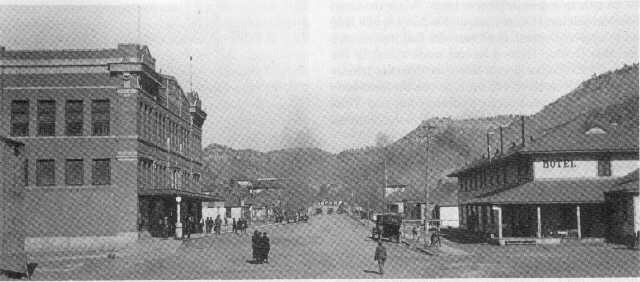
Rubble is all that marks what was once Dawson, NM. As such, there is too little there to even call it a “ghost town.” Yet, what does remain aside from the odd mound of debris is the town’s cemetery, known both as Dawson Cemetery and Evergreen Cemetery.

Two terrible events led to the cemetery, not the town, being listed in 1992 on the National Register of Historical Places. Today, the Dawson Cemetery can be found at (approximately) four miles Northwest of junction US 64 and Dawson Road. The Dawson Cemetery is as much a part of Greek-American history as it is American labor movement or the history of New Mexico.

By 1869, coal had been discovered on the land that would become Dawson. After a series of owners, the Phelps-Dodge Corporation (PD) bought the area’s mines in 1906. To its credit, PD spared no expense in their efforts to make Dawson a model mining community. In time “the company built spacious homes for its miners, supplied with water from the company’s water system. They also built a four-story brick building which housed PD’s Mercantile Department Store, which sold virtually anything the townfolk might need: food, clothing, shoes, hardware, furniture, drugs, jewelry, baked goods and ice from its own plant.

A modern hospital was built which maintained a staff of five doctors and was complete with a laboratory, surgery, and X-ray equipment. For leisure, the miners enjoyed the use of the company-built movie theater, swimming pool, bowling alley, baseball park, pool hall, golf course, lodge hall, and even an opera house. PD also supported two churches, one Catholic and one Protestant.

Children attended either the Central Elementary School in Downtown Dawson or the Douglas Elementary School on Captain Hill. A large high school building was built that eventually employed 40 teachers, and their athletic teams won many state championships. The company also built a steam-powered electric plant, which powered not only Dawson, but also the nearby towns of Walsenburg, Colorado, and Raton. Providing good-paying jobs for the residents, the extra features of the company town helped keep the employment stable, and under the new management Dawson’s population grew quickly to 3,500 (legendsofamerica.com).” All seemed well and the town grew into approximately 9,000 residents supporting ten coal mines.

Then, on October 22, 1913, an incorrectly set dynamite charge resulted in an enormous explosion in Stag Canon Mine No. 2 that set a tongue of fire one hundred feet out of the tunnel mouth. It was later determined that the explosion was caused by a dynamite charge set off while the mine was in general operation, igniting coal dust in the mine. This was in violation of mining safety laws. Rescue efforts were well-organized and exhaustive, but only a few miners could be rescued. Two hundred and sixty three died in the second-worst mining disaster in American history. Only the December 6, 1907, Monongah Mining disaster was worse. In that underground explosion, 362 workers were killed in a in a Monongah, WV mine.

Of the Dawson 1913 catastrophe worker casualties tolled, 146 were Italians, 35 Greeks, and two rescuers. Despite the fact that they were specially equipped ‘helmet-men’ outfitted with airtanks during their rescue effort James Lurdi and William Poisa inexplicably died. The 35 identified dead Greek miners were: Amargiotu, John; Anastasakis, John; Andres, John; Andres, Pavlo; Andrios, Thelfno; Anezakis, Milos; Anezakis, Stilen; Arkotas, Nick; Bouzakis, Nick; Castenagus, Magus; Colonintres, John; Cotrules, George; Cotrules, Mak; Fanarakis, Michael; Gelas, George; Iconome, Demetrius; Katis, Gust; Ladis, Vassilias; Lopakis, Magus; Magglis, Vassos; Makris, Cost; Makris, George; Michelei, Agostino; Mifinigan, Tones; Minotatis, Emm; Nicolocci, Nick; Papas, Cost; Papas, Nakis; Papas, Strat; Paperi, Mike; Parashas, Manon; Pino, Kros; Sexot, John; Stavakis, Polikronis and Vidalakis, Antonios.

The Phelps-Dodge Corporation paid for all funeral costs for all the victims. In addition the company gave each widow $1,000 dead benefit and $200 to each child.

Given the technological advancements of the 1913-era a Pathe newsreel of the Dawson disaster toured the nation. A 17-minute silent film held by the Prelinger Archives on the Dawson disaster can be seen on YouTube. It is difficult to assess the Prelinger footage, since it seems to be the victim of an array of editorial cuttings. Sources suggest that this newsreel may in fact be a reenactment. It seems likely, then, that the helmeted mine rescue units, seen so prominently in this newsreel, arrived several days after the actual disaster (Salt Lake Tribune October 25, 1913).

Then, on February 8, 1923, yet another explosive disaster struck the Dawson mines in which 123 men died. At the time of that disaster, women who had run in 1913 to the mines to see about their husbands’ safety in 1923 ran to learn of their sons’ safety. From 1880 to 1910, mine accidents claimed thousands of fatalities all across the United States. Annual mining deaths had numbered more than 1,000 a year, during the early part of the 20th century. In addition to deaths, many thousands more miners were injured (an average of 21,351 injuries per year between 1991 and 1999). For the 1923 The Dawson Cemetery Inscriptions and Other Vital Records I can only find the following Greek individuals identified Nick Arvas; Evangelos P. Chiboukis, Evangelos P.; Scopelitis, Criss; Scopelitis; and Paul Stamos among the dead (chuckspeed.com/Dawson_Association/Dawson_Cemetery.pdf).

As anyone visiting can see, prominent in the center of the Dawson Cemetery is a large section of white trefoil crosses composed solely of the collective graves of miners killed both in 1913 and 1923. With so many miners coming from other countries, these tragedies were truly international incidents. In recognition of the importance of this overall site, the cemetery has been placed on the National Register of Historic Places.

In 2013, Greeks in New Mexico observed the “100 Year Anniversary Day of Remembrance” for all who perished in the mine explosions in Dawson. A coalition from Albuquerque St George Greek Orthodox Church and St Elias the Prophet of Santa Fe held memorial services first at the individual churches and then graveside services at the Dawson Cemetery. Greek-American event organizers such as Georgia Maryol and Nicolette Psyllas-Panagopoulos sought to alert the general New Mexican public about this day of observance to much success. Other events included the October 20th commemorative observance at the Raton Museum shared by historians and miner’s descendants.

Then, in 2014, the YouTube video “The Dawson Mines – 100 Years” was aired. The focus of that documentary is on the six Greek miners who died in the tragedy who were all from the village of Volada on the island of Karpathos: Vasilios Manglis, Polihronis Stavrakis, Alex Kritikos, Costas Makris, George Makris, Vasilios Ladis. Ladis had arrived in Dawson only two weeks before the 1913 disaster. This film was produced for the Pan-Karpathian Foundation’s 2014 annual ‘Mnimosino’ memorial service.

Clearly, the Dawson Cemetery is a part of Greek-American history as well as the American labor movement. Therefore, the Dawson Cemetery historical marker must be added to the ever growing list of Greek-American monuments and historic sites.

It is exactly in this manner that we are collectively creating a Greek-American Historical Commons, one location, one person, one event at a time.

Source: Thenationalherald