Peter Mac researchers reveal new treatment option on the horizon for women with lethal form of ovarian cancer

Media Release

Researchers from Melbourne’s Peter MacCallum Cancer Centre have revealed a potential new treatment option for some women with the most lethal form of ovarian cancer, using a class of therapies already clinically approved to treat blood cancer.

Senior author of the study, Professor David Bowtell, says the findings, published this morning in Proceedings of the National Academy of Sciences, reveal that in a subset of women with high-grade serous carcinomas, the growth of their cancer is dependent on the activity of the BRCA1 gene.

‘In women with high-grade serous ovarian cancer, ten to 20 per cent of cases are driven by amplification of the Cyclin E1 gene, and about 20 per cent of patients have mutations that inactivate BRCA1 or BRCA2 genes — recently it has been shown that BRCA1 mutations and Cyclin E1 gene amplification rarely occur in the same patient.

‘By screening tens of thousands of genes, we found that cancers with Cyclin E1 amplification were particularly dependent on an in-tact BRCA1 gene — if the tumour has amplified Cyclin E1 and also mutation of BRCA1, then the cancer cells can not survive.’

Lead author, Dr Dariush Etemadmoghadam (pictured) says researchers sought to exploit the dependency of Cyclin E1 amplified cancers on BRCA1 to develop a new therapeutic approach for these tumours.

‘Recent research has shown a class of drugs known as proteasome inhibitors — approved to treat multiple myeloma in humans — are very effective at inhibiting the pathway involving BRCA1 and our laboratory experiments confirmed these drugs are effective for treating Cyclin E1 amplified tumours.

Professor Bowtell says there is great need for new therapeutic approaches for women whose ovarian cancer has Cyclin E1 amplification.

‘Women in this subset generally have poor response to standard treatment and reduced survival rates, so we are hopeful this new approach can be tested in a clinical trial in the near future.

‘We now know ovarian cancer is a very diverse disease, analogous to a Russian babushka doll — it looks like one doll until you take it apart and find layer after layer — but we’re confident when we have finally separated this cancer into all its molecular groups, we will have a much better chance of improving survival for all women.’

Queensland scientists researchers uncovers breast cancer switch

Source: Ninemsn.com

Queensland scientists have identified a genetic “switch” which indicates whether breast cancer is aggressive and likely to spread.

The discovery may provide a clearer prognosis for breast cancer patients and pave the way for new treatments.

Teams from QIMR Berghofer Medical Research Institute and the Institute of Molecular Bioscience (UQ) have found a particular RNA (Ribonucleic acid) molecule goes missing in aggressive cancers.

QIMR Berghofer’s Dr Nicole Cloonan says the discovery will make it easier to identify aggressive tumours.

“Essentially, this particular gene fragment, or microRNA, normally acts like an emergency brake in our genetic program, ensuring our cells continue to reproduce normally,” Dr Cloonan explained.

“But we’ve identified that this “emergency brake” fails in invasive, aggressive tumours. Its sudden absence in cancer tests would be a clear marker that a tumour is likely to spread.

“And we know that primary breast cancer rarely kills; it is those aggressive tumours that spread, or metastasise, which result in poor outcomes.”

Breast cancer is the most common cancer in Australian women.

Survival largely depends on the timing of diagnosis. If the cancer is limited to the breast, 96 per cent of patients will be alive five years after diagnosis, according Cancer Council Australia.

Dr Cloonan says, although the research focused on breast cancer, it has wider implications.

It is clear the microRNA is also missing in aggressive liver, stomach, brain and skin cancers, she said.

“What we’ve uncovered seems to be a common cellular process which could be a new drug target,” Dr Cloonan said.

Scientists discover a “tumor-prone” cell that can lead to brain cancer

Source: beaker.sanfordburnham.org

A new study has revealed a rare cell type that gives rise to a type of brain cancer called medulloblastoma.

The unusual cells, called “nestin-expressing progenitors” (NEPs), are more efficient at generating medulloblastoma than other brain cells.

The research, published in Nature Neuroscience and conducted by Sanford-Burnham researchers in collaboration with scientists at Fox Chase Cancer Center, provides critical insight into how normal cells transform into tumors and may yield new approaches for targeting brain tumors. Medulloblastoma is an aggressive tumor that is located in the cerebellum, and accounts for 18 percent of all pediatric tumors.

Medulloblastoma is thought to arise during development of the cerebellum, from cells called granule neuron precursors (GNPs) that reside in the external granule layer (EGL) on the outside of the cerebellum.

Until now, most scientists believed that GNPs were the only cells that could give rise to medulloblastoma.

The study team, co-led by Robert Wechsler-Reya, Ph.D., of Sanford-Burnham, and Zeng-jie Yang, Ph.D, of Fox Chase Cancer Center, used genetically engineered mice to identify a new cell type in the EGL—NEPs. Like GNPs, NEPs are committed to generating granule neurons—very small neurons that make up 75 percent of all brain cells.

But unlike GNPs, NEPs have high levels of a protein called nestin, which is commonly found only in stem cells. The presence of nestin suggested that NEPs might be more primitive than GNPs, and like stem cells, more capable of long-term growth and survival.

“Another major difference between NEPs and GNPs is that the DNA repair mechanisms of NEPs are less active,” said Wechsler-Reya. “Since DNA repair protects cells from becoming cancerous, we speculated that NEPs might be more likely than GNPs to give rise to brain tumors.” To directly compare the tumor-forming ability of NEPs and GNPs, the researchers performed a series of transplantation experiments, using NEPs and GNPs carrying a cancer-causing mutation.

When they transplanted large numbers of cells, both NEPs and GNPs gave rise to tumors. But when they transplanted very few cells, GNPs did not cause tumors, whereas NEPs were still capable of doing so.

These results confirmed that NEPs have an increased capacity to form tumors. “Identifying the cells that can give rise to medulloblastoma allows us to compare tumor cells to their normal counterparts, so that key differences and vulnerabilities of tumor cells can be identified.

Our study describes a novel ‘tumor-prone’ cell population that may provide new insights into the mechanisms of cancer development. By studying these cells, we may find new approaches to targeting brain cancer,” Wechsler-Reya said. About Medulloblastoma Medulloblastoma is the most common malignant brain tumor, affecting about 500 children in the United States annually. Current treatment options for medulloblastoma include aggressive surgery, radiation, and chemotherapy.

Today, over two-thirds of children are successfully treated. However, survivors generally suffer long-term side effects such as cognitive and developmental disabilities due to the aggressive treatment, and in many cases the tumor reappears within a few years after treatment. Li P, Du F, Yuelling LW, Lin T, Muradimova RE, Tricarico R, Wang J, Enikolopov G, Bellacosa A, Wechsler-Reya RJ, & Yang ZJ (2013). A population of Nestin-expressing progenitors in the cerebellum exhibits increased tumorigenicity.

Eurovision 2014: Αυτά είναι τα επικρατέστερα ονόματα για την Ελληνική συμμετοχή!

20131112-101752.jpg

Στην δημοσιότητα βγήκαν τα επικρατέστερα ονόματα της ελληνικής συμμετοχής για τον φετινό διαγωνισμό της Eurovision στην Κοπεγχάγη.

Σύμφωνα με ρεπορτάζ της εκπομπής «Μελέτησέ το» τα ονόματα που θα διαγωνιστούν είναι ο Λούκας Γιώρκας, ο Μύρωνας Στρατής, οι Wedding Singers, ο Κώστας Μαρτάκης με τον Νίκο Ζωιδάκη και η Κρυσταλλία.

Incredible skeletal remains of Catholic saints discovered by Art historian Paul Koudounaris

Source: DailyMail.uk

Art historian Paul Koudounaris hunted them down in secret Catholic vaults

Said to be remains of Catholic martyrs dug up from Roman catacombs
They were sent to churches to replace relics destroyed in Reformation
Some took up to five years to decorate in gold, silver and gemstones
But none were actually canonised, so many have been stripped of honours

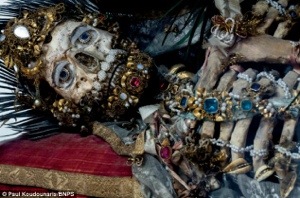
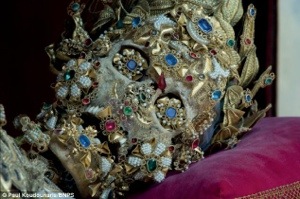
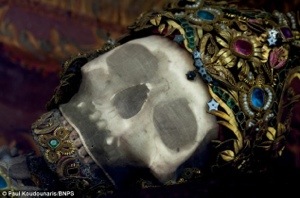
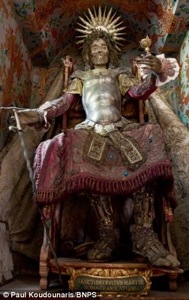
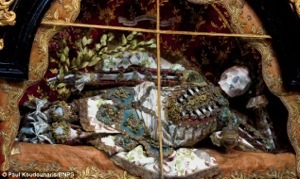
A relic hunter dubbed ‘Indiana Bones’ has lifted the lid on a macabre collection of 400-year-old jewel-encrusted skeletons unearthed in churches across Europe.

Art historian Paul Koudounaris hunted down and photographed dozens of gruesome skeletons in some of the world’s most secretive religious establishments.

Incredibly, some of the skeletons, said to be the remains of early Christian martyrs, were even found hidden away in lock-ups and containers.

20131110-111801.jpg

St Valerius in Weyarn: Art historian Paul Koudounaris hunted down and photographed dozens of gruesome skeletons in some of the world’s most secretive religious establishments

St Albertus and St Felix: Incredibly, some of the skeletons, said to be the remains of early Christian martyrs, were even found hidden away in lock-ups and containers

They are now the subject of a new book, which sheds light on the forgotten ornamented relics for the first time.
Thousands of skeletons were dug up from Roman catacombs in the 16th century and installed in towns around Germany, Austria and Switzerland on the orders of the Vatican.

Laughing in the face of death: Revealed, a poignant treasure trove of memorabilia from the trenches
They were sent to Catholic churches and religious houses to replace the relics destroyed in the wake of the Protestant Reformation in the 1500s.

St Benedictus: Thousands of skeletons were dug up from Roman catacombs in the 16th century and installed in towns around Germany, Austria and Switzerland on the orders of the Vatican

Spooky: St Deodatus in Rheinau, Switzerland (left) and St Valentinus in Waldsassen (right). The skeletons were sent to Catholic churches and religious houses to replace the relics destroyed in the wake of the Protestant Reformation in the 1500s

St Getreu in Ursberg, Germany: Mistaken for the remains of early Christian martyrs, the morbid relics, known as the Catacomb Saints, became shrines reminding of the spiritual treasures of the afterlife
Mistaken for the remains of early Christian martyrs, the morbid relics, known as the Catacomb Saints, became shrines reminding of the spiritual treasures of the afterlife.
They were also symbols of the Catholic Church’s newly found strength in previously Protestant areas.

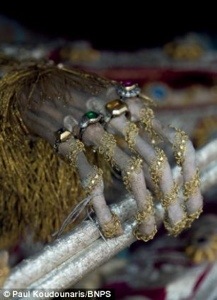
Each one was painstakingly decorated in thousands of pounds worth of gold, silver and gems by devoted followers before being displayed in church niches.
Some took up to five years to decorate.

St Friedrich at the Benedictine abbey in Melk, Austria: They were also symbols of the Catholic Church’s newly found strength in previously Protestant areas

Long dead: The hand of St Valentin in Bad Schussenreid, Germany (left) and St Munditia, in the church of St Peter in Munich (right). By the 19th century they had become morbid reminders of an embarrassing past and many were stripped of their honours and discarded
They were renamed as saints, although none of them qualified for the title under the strict rules of the Catholic church which require saints to have been canonised.

But by the 19th century they had become morbid reminders of an embarrassing past and many were stripped of their honours and discarded.
Mr Koudounaris’ new book, Heavenly Bodies: Cult Treasures and Spectacular Saints from the Catacombs, is the first time the skeletons have appeared in print.

Mr Koudounaris, from Los Angeles, said: ‘I was working on another book looking into charnel houses when I came across the existence of these skeletons.

‘As I discovered more about them I had this feeling that it was my duty to tell their fascinating story.

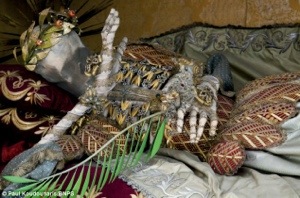
Lounging louche: aSt Vincentus’ ribs are exposed beneath a web of golden leaves In Stams, Austria. Mr Koudounaris’ new book, Heavenly Bodies: Cult Treasures and Spectacular Saints from the Catacombs, is the first time the skeletons have appeared in print

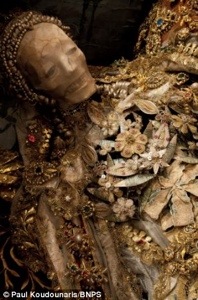
Adorned: St Luciana (right) arrived at the convent in Heiligkreuztal, Germany and was prepared for display by the nuns in Ennetach. The identity of the skull on the left is unknown
‘After they were found in the Roman catacombs the Vatican authorities would sign certificates identifying them as martyrs then they put the bones in boxes and sent them northwards.
‘The skeletons would then be dressed and decorated in jewels, gold and silver, mostly by nuns.

‘They had to be handled by those who had taken a sacred vow to the church – these were believed to be martyrs and they couldn’t have just anyone handling them.

‘They were symbols of the faith triamphant and were made saints in the municipalities.

‘One of the reasons they were so important was not for their spiritual merit, which was pretty dubious, but for their social importance.

‘They were thought to be miraculous and really solidified people’s bond with a town. This reaffirmed the prestige of the town itself.’

He added: ‘It’s impossible to put a modern-day value on the skeletons.’

Heavenly Bodies: Cult Treasures and Spectacular Saints from the Catacombs is published by Thames and Hudson and costs 18.95 pounds.

20131110-111945.jpg

20131110-111953.jpg

20131110-112000.jpg

20131110-112007.jpg

20131110-112013.jpg

20131110-112020.jpg

20131110-112026.jpg

Δύο παγκόσμια Ρεκόρ Guinness από τις Kosmocar-Volkswagen, EKO & Driving Academy

Source: highoctane.gr

Δύο παγκόσμια Ρεκόρ Guinness από τις Kosmocar-Volkswagen, EKO & Driving Academy. Οι τρεις ελληνικές εταιρίες συνεργάστηκαν και πέτυχαν σε πραγματικές συνθήκες οδήγησης, παγκόσμιο ρεκόρ χαμηλής κατανάλωσης, διασχίζοντας 9 ηπειρωτικά διαμερίσματα της Ελλάδας και πάνω από 1.577 χλμ εθνικού και επαρχιακού οδικού δικτύου.

Στις 16-18 Οκτωβρίου 2013 η Kosmocar – Volkswagen διέθεσε στους εξειδικευμένους εκπαιδευτές στην οικονομική οδήγηση της Driving Academy, 2 αυτοκίνητα ένα Volkswagen Polo 1.2 TDI BlueMotion και ένα Volkswagen Golf 1.4 TSI 140PS με Ενεργό Σύστημα Διαχείρισης Κυλίνδρων (ACT), τα οποία ανεφοδίασε αντίστοιχα η ΕΚΟ με τα εξελιγμένα καύσιμά της ΕΚΟ Diesel Ekonomy και ΕΚΟ 95 Εkonomy. Τα ρεκόρ;

Guinness World Record χαμηλότερης κατανάλωσης καυσίμου για αυτοκίνητα Diesel – Ο γύρος της Ελλάδας:

Η πρώτη ομάδα είχε το Volkswagen Polo 1.2 TDI BlueMotion με οδηγούς τους εκπαιδευτές της Driving Academy, Δημήτρη Χατζητόλιο και Νικόλα Παπαπάσχο, εφοδιασμένο με ΕΚΟ Diesel Ekonomy και κάλυψε την απόσταση των 1.577 χιλιομέτρων με συνολική κατανάλωση diesel 46,75lt, που αντιστοιχεί σε μέση κατανάλωση 2,96 lt/100 km. Στην επιτυχία αυτή συνέβαλαν εξίσου η νέα τεχνολογία TDI και BlueMotion της Volkswagen, οι πλέον σύγχρονες τεχνικές οικονομικής οδήγησης της Driving Academy, που διδάσκει σε πάνω από 1000 οδηγούς κάθε χρόνο και βέβαια τα εξελιγμένα καύσιμα τελευταίας τεχνολογίας Ekonomy, που έφεραν την επανάσταση στα ελληνικά δεδομένα επιτυγχάνοντας ιδιαίτερα χαμηλές καταναλώσεις. Η αφετηρία ήταν η πόλη της Αλεξανδρούπολης με τερματισμό την Κόρινθο και έκταση σε όλο το εθνικό και επαρχιακό εθνικό δίκτυο.

Η δεύτερη ομάδα οδήγησε το Volkswagen Golf 1.4 TSI 140PS – ACT, με οδηγούς τους εκπαιδευτές Θωμά Παπαπάσχο και Γιάννη Τσιγκρή, εφοδιασμένο με EKO 95 Ekonomy, και κάλυψε την απόσταση των 1.592 χιλιομέτρων με συνολική κατανάλωση βενζίνης 54,52lt, που αντιστοιχεί σε μέση κατανάλωση 3,42 lt/100 km. Εδώ βέβαια σημαντικό ρόλο έπαιξαν η τεχνολογία TSI και Ενεργού Συστήματος Διαχείρισης Κυλίνδρων της VW, η εξαιρετική εφαρμογή των πρακτικών οικονομικής οδήγησης της Driving Academy και φυσικά, το εξελιγμένο καύσιμο ΕΚΟ 95 Ekonomy ένα καύσιμο που με τη βελτιωμένη σύνθεσή του, μειώνει αποτελεσματικά την Τα δύο πληρώματα επιτηρούνταν σε όλη τη διάρκεια της διαδρομής από εξειδικευμένους συνεργάτες του Οργανισμού Guinness World Records, του ΚΑΠΕ, της Ελληνικής Αστυνομίας και άλλων δημόσιων φορέων. Στο τέλος της διαδρομής πιστοποιήθηκαν οι μετρήσεις ανεφοδιασμού των αυτοκινήτων, η χιλιομετρική απόσταση που κάλυψε κάθε αυτοκίνητο αλλά και η ακρίβεια των στοιχείων μέσα από τις αυστηρές προδιαγραφές και οδηγίες του οργανισμού Guinness World Records. Ο οργανισμός, αφού αξιολόγησε όλα τα δεδομένα, τις μετρήσεις του εγχειρήματος, τις μαρτυρίες των επίσημων φορέων, το ολοκληρωμένο βίντεο της διαδρομής και τα δεδομένα των GPS, πιστοποίησε την επίτευξη και των δύο ρεκόρ.

Την απονομή των δύο σημαντικών βραβείων πραγματοποίησε την 1 Νοεμβρίου, ο απεσταλμένος κριτής του Guinness World Records, κος Mark McKinley.

Fiorente wins the 2013 Melbourne Cup

Source: News.com.au

Melbourne Cup favourite Fiorente claims the 2013 crown, pipping Red Cadeaux by a length on the final straight.

Winner ... Fiorente takes out the 2013 Melbourne Cup. Picture: Seven Network

Winner … Fiorente takes out the 2013 Melbourne Cup. Picture: Seven Network Source: Supplied

GAI Waterhouse has become the first Australian woman to train a Melbourne Cup winner, with Fiorente seizing the Melbourne Cup in commanding fashion this afternoon.

Ageless marvel Red Cadeaux has run second for the second time after finishing runner-up by a few pixels to Dunaden in 2011, while Mount Athos ran third, in what will be another frustrating placing for the English Cumani stable.

“It’s a dream come true,” Waterhouse said. “I’m so thrilled for all the people who come up to me and say ‘good luck, Gai’.”

The win of Fiorente is also a triumph for jockey Damien Oliver, who claims his third Melbourne Cup after wins aboard Doriemus in 1995 and Media Puzzle in 2002.


Reaction ... The cashed-up trainer's response to her victory was caught on camera. Picture: Seven Network

Reaction … The cashed-up trainer’s response to her victory was caught on camera. Picture: Seven Network Source: Supplied

Oliver was outed from the sport last year for betting on a rival horse in a race where he was riding the second favourite.

He returned earlier this Spring, and some said he didn’t deserve to be in the saddle so soon.

But Oliver has added another incredible chapter to his career, after he became the toast of the nation in 2002 when he won the Cup the same week his brother Jason, also a jockey, was killed in a trackwork fall.

Victory ... Jockey Damien Oliver with his winning horse Fiorente.

Victory … Jockey Damien Oliver with his winning horse Fiorente. Source: HeraldSun

Cup-holder ... Gai Waterhouse is the first Australian woman to train a horse to Cup victory. Picture: Getty Images

Cup-holder … Gai Waterhouse is the first Australian woman to train a horse to Cup victory. Picture: Getty Images Source: Getty Images


Winning duo ...  Damien Oliver hugs trainer Gai Waterhouse after Fiorente won the Emirates Melbourne Cup. Picture: Getty Images

Winning duo … Damien Oliver hugs trainer Gai Waterhouse after Fiorente won the Emirates Melbourne Cup. Picture: Getty Images Source: Getty Images

For Waterhouse, this caps off an amazing year in which her name was dragged through the mud in the More Joyous Affair and she fell out with her long-time friend and client John Singleton, who withdrew all his horses from the Waterhouse stable.

But after finishing second in the race twice and winning virtually every major race on the Australian turf, Waterhouse has finally claimed Australia’s greatest race.

Bred in Europe, Fiorente was acquired by Waterhouse before last year’s spring.

The cashed-up trainer outbid rival Aussie trainer Mike Moroney in an 11th hour bid, and had immediate success, running second to Green Moon in last year’s Melbourne Cup.

Waterhouse and the horse went one better today.


Finish line ... Oliver keeps Fiorente a full length in front of Red Cadeaux. Picture: AFP

Finish line … Oliver keeps Fiorente a full length in front of Red Cadeaux. Picture: AFP Source: AFP


Lucky man ... The part-owners of Fiorente. Picture: Getty Images

Lucky man … The part-owners of Fiorente. Picture: Getty Images Source: Getty Images

TRAGIC INCIDENT

Trackside officials confirmed French mare Verema was euthanised after it fractured a cannon (leg) bone at the 2000m mark.

Dr Brian Stewart, Racing Victoria’s Head of Veterinary and Equine Welfare, confirmed the incident in a statement.

“This was an unfortunate accident that happens infrequently in racing and our sympathies are extended at this time to the Aga Khan, Alain de Royer Dupre and the connections of Verema.”

Norman’s Dairy Delights One Year Greek Anniversary for their Cholov Yisroel Greek Yogurt

Source: theyeshivaworld.com

Untitled

It’s been one year since Norman’s Dairy Delights introduced  the first ever Cholov Yisroel Greek Yogurt at Kosherfest 2012, winning the best new dairy product award at the show’s annual New Product Competition. It subsequently received accolades in Jewish as well as mainstream media, including The New York Times and the New York Daily News.  The success of the Greek Yogurt was part of a very active year for the dairy manufacturer, largely as a result of the introduction of many new quality and tasty products.

“We never stop brainstorming about potential new products that will making eating better and healthier for consumers,” says a key member of the Norman’s product development team. “I can’t wait for our loyal customers to have even more top-quality choices in cholov yisroel.”

Norman’s Dairy Delights has continued to expand on its previous successes, adding 3 new flavors to its wildly popular Greek Yogurt line. The Greek is now available in 9 flavors- Mango, Pomegranate, Apple & Honey, Plain, Strawberry, Black Cherry, Blueberry, Peach, and Vanilla. The new flavors have been carefully lab tested and developed with the highest quality ingredients, as all Norman’s products are.

“What we’ve done by introducing these 3 new flavors is given the customer  the chance to find the perfect balance of Greek and fruit that works for you,” said a Norman’s spokesperson. “A lot of our customers enjoy trying the various tastes and textures we’ve created with our flavored Greek Yogurt. Many also enjoy eating our plain Greek and topping it with what they like best, including fruit, honey, granola, and even chocolate chips.”

At last week’s Kosherfest food show, Norman’s also released their new line of Greek Light, a premium Greek yogurt  with only 100 calories. Greek Light was a response to the persistent requests received by Norman’s for an even healthier version of their already successful original Greek.  Greek Light was released in 3 flavors- Strawberry, Coffee, and Vanilla, with more on the way. It will be in stores mid-October.

This past year saw Norman’s expand in all their dairy offerings, including 80 Lite, Poppers, Low-Fat, and milk chocolate Leben. All have been excitedly received by the public and became instant winners. In honor of their first anniversary and the extraordinary response by consumers, Norman’s will be offering a special price on their entire Greek Yogurt line.

Gov’t claims the measure transformed Greek cities, while retailers fear smaller stores will suffer as a result

Source: Ekathimerini.com

The government and the Development Ministry in particular appear to have passed the Sunday opening test, as consumer traffic at stores in Greece last Sunday, at least in the main shopping areas, turned out to be greater than expected.

A key factor in the success of the first application of the Sunday opening law was the fact that it was a day that formed part of the fall sales – also a new measure – while the favorable weather also helped.

“The picture of our cities changed. Consumers embraced both the idea of the 10-day sales periods and stores opening on a Sunday,” stated Development Minister Costis Hatzidakis on Monday. “We have therefore done very well to ignore those who expressed a fear of the new. We are just doing the same as most countries in Europe. Why shouldn’t we in Greece?” the minister said.

However, it was again evident that retail commerce is a two-speed market in Greece, with those benefitting being the major chains and enterprises with stores in malls, rather than small and medium-sized enterprizes.

“Compared to the same Saturday last year – when there was no Sunday opening – the visits to shopping centers went up this year by up to 300 percent,” claimed Antonis Makris, the head of the Association Retail Enterprises in Greece (SELPE). He added that turnover during the November 2-3 weekend was up between 50 and 100 percent on that of Saturday, November 3, 2012. In fact, the losers were the supermarket chains, as sector estimates put their sales on Sunday at just 25 to 30 percent of an ordinary day for the stores that did open.

Smaller retail stores are reporting a very different picture, though. They had a significant number of shoppers coming in but turnover was far from satisfactory. According to data compiled by the National Confederation of Greek Commerce (ESEE), only one in three such shops opened in Attica and just one in four in the rest of the country.

ESEE head Vassilis Korkidis admitted to Kathimerini that “the turnover enterprises will record by the end of the intermediary sales period will likely be smaller than that which was originally expected as consumers turned to major chains and malls on Sunday.”

Tit-for-tat warfare feared as Greek police believe far-left may be behind murders of far-right Golden Dawn members

Source: Nationalpost

Police investigate the area around an office of the Golden Dawn party in northern Athens, Friday, Nov. 1, 2013. A drive-by shooting killed two members of Greece's Nazi-inspired Golden Dawn party and wounded one outside a party office in Athens on Friday night, officials said

AP Photo/Thanassis StavrakisPolice investigate the area around an office of the Golden Dawn party in northern Athens, Friday, Nov. 1, 2013. A drive-by shooting killed two members of Greece’s Nazi-inspired Golden Dawn party and wounded one outside a party office in Athens on Friday night, officials said.

Police in Greece believe far-left terrorists may have been behind the murder of two members of the far-right Golden Dawn party, raising fears of tit-for-tat warfare between the country’s radical factions.

The Greek counter-terrorism squad has taken over the investigation into Friday night’s attack, when two assassins on a motorbike opened fire on men outside Golden Dawn’s offices in Athens.

Police said they were looking at whether the murders may have been carried out in retaliation for the fatal stabbing of an anti-fascist musician by a supporter of the neo-Nazi party in September, a killing which prompted angry protests across Greece.

Investigators were examining all avenues, but “particularly those that link these events to extremist groups” behind a string of far-left attacks in recent years on politicians, police, banks and the media. A police official said the shooting, for which no one has so far claimed responsibility, appeared to be a “terrorist attack.”

Athens residents gathered at the site of the killings in the suburb of Neo Iraklio and laid flowers as politicians said the country, already mired in a deep financial crisis, was at risk of spiralling street attacks. “We cannot let this cycle of violence continue,” Makis Voridis, a senior member in Antonis Samaras, the prime minister’s, New Democracy party, told Greek television. “This must end here.”

“Twelve bullets against democracy,” Ta Nea, the country’s top-selling daily newspaper, wrote on its front page Saturday. “The double cold-blooded murder was a coarse provocation against stability.”

AP Photo/Kostas Tsironis

AP Photo/Kostas TsironisA supporter of the extreme right party of Golden Dawn, lights a candle during a memorial ceremony at the site of the attack and fatal shooting of two party members in northern Athens, on Saturday, Nov. 2, 201

As well as Golden Dawn, Greece is home to far-left and anarchist extremist groups who have claimed responsibility for a series of shootings and bombings in recent years. In 2009, a police officer was killed by three gunmen in Athens, and in 2010, a prominent investigative journalist, Sokratis Giolas, was shot dead at his home. Both murders were claimed by the Sect of Revolutionaries, a radical Leftist organisation.

Following the death of Mr. Giolas, the Sect of Revolutionaries issued a direct threat to the Greek state, pledging to transform the country into “a war zone of revolutionary processes, with arson, sabotage, fierce demonstrations, bomb attacks, armed killings”.

“We are at war with your democracy”, the group said.

We will not allow our country to become a place to settle scores

Another extremist group, the Conspiracy of Fire Nuclei, has claimed responsibility for a number of recent attacks, including a car bomb which exploded outside home of a prison director the Athens in June.

Greek media claimed that the weapon used in Friday’s attack was the same type of gun used in the 2009 police shooting. Police identified the gun as a Zastava Tokarev-type semi-auto pistol from which 12 rounds were fired, but said it was not the same weapon used in previous terrorist incidents.

Golden Dawn has in recent years emerged from the fringe of Greek politics to establish itself as the country’s third most popular party, with 18 seats in parliament. Its surge in popularity came as it capitalised on widespread anger over austerity measures and immigration in the debt-stricken nation, which has for the past six years been in severe recession. Some 60 per cent of Greek youth are now unemployed.

Friday’s attack “marked a continuation of political uncertainty and instability in the country,” said George Tzogopoulos, an analyst at an Athens-based think-tank.

Golden Dawn uses a Swastika-like emblem and has also been associated with attacks on immigrants. It has insisted it is not a neo-Nazi group.

But the Greek government announced a crackdown on the party following the murder in September of Pavlos Fyssas, a white anti-racist rapper also known as “Killah P,” for which a Golden Dawn supporter was arrested and charged. The party’s leader, Nikolaos Michaloliakos, and two of its MPs have been imprisoned pending trial on charges of establishing a criminal group.

The Golden Dawn leadership denies government claims that it was involved in the musician’s killing.

In the wake of Friday’s attack, the Greek government has been under pressure to show that it takes violence against Golden Dawn members seriously.

“We will not allow our country to become a place to settle scores,” said Nikos Dendias, the public order minister, expressing his “sadness at the death of the young men”. The left-wing main opposition Syriza party also condemned the shootings. “This murder creates a climate of instability and targets democracy,” it said. “It feeds fascism, it does not beat it,” added Dimitris Papadimoulis, a Syriza MP.

Golden Dawn also attributed the shooting to “terrorists” and blamed the Greek government for failing to protect the party amid the crackdown. It said it had asked for police protection at its offices after receiving threats but that it had recently been withdrawn. “The criminals wanted to execute anybody outside the party offices,” it said in a statement. “Before they drove off, the terrorists shot again at the boys lying on the ground. They literally emptied their weapons on them.”

The victims were named as Emmanuel Kapelonis and Giorgos Fountoulis, both in their 20s. A 29-year-old man who was wounded remained in hospital in a serious condition yesterday.

The mother of the injured man, named as Alexandros Gerontas, made a televised appeal to the Greek people to “overcome their differences” and to “stop the bloodshed”.

Golden Dawn had planned a meeting for Friday night at the office where the shooting took place.

A police source said that footage from a nearby security camera confirmed the party’s accounts that the gunmen started firing from 50ft away and finished off his victims from point-blank range.

The gunmen also fired at a fourth Golden Dawn member, who managed to escape unharmed.