
Cosmetic king Napoleon Perdis had humble beginnings growing up in Parramatta

Source: TheSundayTelegraph

Napoleon Perdis with his mother Liana Perdis and father John Perdis.

Napoleon Perdis with his mother Liana Perdis and father John Perdis. Source: News Limited

Cosmetic king's humble beginnings

Napoleon Perdis at the head office of Napoleon Cosmetics in Alexandria. Source: News Limited

Napoleon Perdis with his mother as a child.

Napoleon Perdis with his mother as a child. Source: Supplied


A family picture of Napoleon Perdis.

A family picture of Napoleon Perdis. Source: Supplied


NAPOLEON Perdis wasn’t like most 13-year-old boys growing up in Parramatta in the 1970s.Raised in a Greek-immigrant family, his “woggy” upbringing made life tough in an “Anglo-western” neighbourhood.

It didn’t help either that he loved doing his mother’s make-up.

He watched, mesmerised, as she laid out her palette of powders and creams and step by step, embellished and coloured her face in glamour.

Thirty years later, and Perdis is the country’s cosmetic king whose company turned over $82 million in Australia alone in the year to June 2012.

He’s sells through Myer and in some of the most prestigious stores in the United States, including Bergdorf Goodman on Fifth Avenue.

And Perdis has signed a deal to open four concept stores in the Middle East and distribute his make-up across the region, cementing his status as the nation’s most successful beauty export.

In an exclusive interview with The Sunday Telegraph, the Los Angeles-based Perdis said his ambition from here is to “be happier” and he’s preparing to move his family back to Australia after 2014.

“I want more of a human connection now. I was very ambitious and very angry for a long period of time,” he said.

“I like human beings now. That sounds terrible: it’s just that I’m happier to get to know people.”

Perdis’ dream of a cosmetic empire began when he picked up a make-up brush, at age 13, to help his mother, Liana Perdis, prepare to head out.

“I believe in fabulous,” Perdis said.

“She would do these little tips, one of them I actually still use: she used to extend the line of the eye with the eyeliner. She’d put it and then she’d dab it.”

His first attempt at doing her make-up was a little heavy-handed.

“I remember specifically seeing this thing in a magazine: they were putting electric blue mascara on and they put a little bit in the eyebrow to give a little highlight and (I did that to her) and she went out with it – but she looked like a drag queen.

“She was very proud that I had done her make up.”
The family owned a hot food bar, Stolos Snack Bar, in the city and Perdis was obliged to work in the shop.

“There was a Salvation army car park down the road and we would wash the under arms in that car park, change, go out and do Greek dancing after closing the shop. We still stunk of hamburgers and fish but it was all okay,” Perdis said.

“It was great discipline. At the time, I hated it. It was tough for a kid, to be at school in an Anglo-western world and then have to do these very kind of Greeky, woggy things.

“They are kind of tortured memories but they do shape you.”

The money Perdis brought home on weekend gigs doing make-up for brides convinced his father John Perdis to let go of ambitions that his son was destined to be a chemist or lawyer.

“I saw how much money he would come out with: more than some people earn in a week,” Mr Perdis, 83, said.
Mr Perdis gave his son and daughter-in-law, Soula-Marie Perdis a $30,000 start-up loan.

“I said: ‘This is a little thing – I can describe this as a single brick, build on it and you will go up to the sky’. That was my wish but I never believed that they would get there.”

Sunday Style editor-in-chief Kerrie McCallum said Perdis’ persistence, determination and remarkable stamina have made him Australia’s biggest cosmetics export.

“In terms of business success and his celebrity, he would have to be the most well known Australian,” Ms McCallum said. “He is up against big international companies, which is no mean feat.”

Vogue Australia editor Edwina McCann said: “For one of our makeup artists to build a brand in Australia which today is stocked at Bergdorf Goodman, the legendary US department store on Fifth Avenue, is an incredible achievement and an indication of his international following.”

Perdis and Soula-Marie nine years ago moved to LA with their daughters, Lianna, 13, and 11-year-old triplets Athina, Alexia and Angelene.

They had intended to move back to Sydney next year, but expansion in the US, chiefly through department store Neiman Marcus, has temporarily delayed that plan.

Perdis said: “I am probably more proud (of Australia) now than when I was living here, because I left as an angry wog.”

Turning 40 was also a catalyst for change.

In the months before the milestone birthday, he had lap-band surgery and has been dieting and exercising since, shedding 78 kilos and scaring his staff with the endless energy that has injected.

“That was a big realisation when I came over 40: I’ve done all this fight and now I’m a big fat pig. I haven’t worked on myself, at all, I am really unhealthy. All I have done is worked and worked and worked.”

Napoleon Perdis Cosmetics latest Australian accounts filed with the Australian Securities and Investments Commission show revenue grew from $72.3 million in 2010-2011 to $81.6 million in 2011-2012.

A small loss in the 2011 financial year was turned into a profit of $1.882 million in the 2012 financial year.

Perdis said the team around him is committed to his vision and those who were not, he has no time for.

“There’s people that you’re like: ‘I edit you out of my life. You are no longer relevant. I’m driving and I’m going: you are on the bus or not’. But there’e a lot of people on the bus and it’s only bigger. So for all the disbelievers, there’s a lot of believers. The volume alone of our business proves that, let alone the longevity of staff here.

Ithaka on the Horizon: A Greek-American Journey by Stavro Nashi

LIFE IS A JOURNEY, BUT IT IS NOT ABOUT THE PLACES ALONG THE WAY, IT’S ABOUT THE PEOPLE WHO GIVE YOU A PIECE OF THEMSELVES.

In 1955, a little boy is caught up in the maelstrom that destroys much of the last vestiges of Greek civilization in Turkey. Narrowly escaping death at the hands of a vengeful mob, he and his family emigrate to the United States where he grows up trying to balance two competing cultures, American and Greek, both pulling in different directions. Accompany him on his voyage through life, like Odysseus searching for a mythical Ithaka, he returns to forgotten homelands in search of a true self. “Ithaka on the Horizon” is the real life saga of one man’s quest for self discovery but it is more importantly about family and the people along the way who mould each of us into who we are and who we become. This book offers the reader a rare window into the fading past of the Greek immigrant experience, portrayed against the backdrop of the tumultuous and tragic last one hundred years of Greek history. It relives the past in order to understand and appreciate the struggles of successive generations, each passing on its legacy to the next.

Download the Kindle ebook version of Ithaka on the Horizon today:

www.amazon.com/dp/B00ELXP7DW


Interview with Stavro Nashi, author of Ithaka on the Horizon: A Greek-American Journey

C: Tell us about your book

S: It’s a labor of love. I wanted to tell the story of the people in my life who I encountered along my life journey that affected it in a positive way. This book is about being an immigrant, growing up in America, being torn between two cultures, the search for lost homelands and coming to terms with who we are. It is also about the historical events that have shaped my family”s story over the last one hundred years. Writing is a hobby, I have a day job. It took me five years to write this book and believe me when I say I poured my heart and soul into it. Writing and storytelling is about making a connection and my hope is that the reader will see a reflection of their own experiences in this book. More importantly I hope that my extended family will better appreciate those who came before them.

C: How did you begin writing?

S: I started blogging about six years ago and have written hundreds of posts. The blog is called “My Greek Odyssey” and it’s still up, with over 350,000 hits. The editor of the Greek-American “Hellenic Voice” newspaper, Steve Crowe, read my blog and asked me to write for his newspaper. I wrote a column for three years and eventually with Steve’s encouragement I realized that I had the makings of a book somewhere hidden in my writings over the years.

C: What is the theme of your book?

S: Life as a journey. Very much like the one another Greek, named Odysseus embarked upon. A journey full of adventure, discovery, laughter and tears. I have also woven a great deal of Greek-American and Greek history into my story as a backdrop so that the reader can gain a better understanding of how ordinary people are touched and changed by it.

C: How did you come up with the title?

S: Ithaka was the home of Odysseus. He spent ten years trying to get back to Ithaka after the end of the Trojan War after angering the Gods. My favorite Greek poet, Constantine Cavafy wrote a wonderful poem about the search for a mythical Ithaka that each of us experiences on his odyssey through life. It struck a chord.

C: Can you share a few things about your background.

S: I was born to Greek parents in Istanbul, Turkey and immigrated with my parents to America in 1956 at the age of five in the wake of the anti-Greek riots when our home was attacked along with thousands of other homes, churches and businesses. Most Greek-Americans do not know much, if anything about happened to the Greek minority in Istanbul. I grew up in New York City, in the Yorkville section of Manhattan when it was still a working class neighborhood. I graduated from NYU, spent twenty-two years in the Marines Corps with service in two wars. After I retired I attended Nursing school and worked as an ER nurse for three years. I went to graduate school during that period and have worked as a nurse practitioner in a pediatrics practice for the last 15 years.

C: What brought you to Maine?

S: Most of my relatives lived in Saco. It was the first place we came to when we arrived in the USA. My father couldn’t find a job there so we ended up in New York City however we came back often and I fell in love with Maine. Never got it out of my system. My parents moved to Old Orchard Beach, Maine when they retired in 1980 and I moved my family here in 1999. Both of my sons grew up in Saco.

C: Who are the main characters in your book?

S: My grandfather Stavros, who came to Biddeford in 1907, worked in the mills, and although he never realized his dream of becoming an American, made it possible for my father and I to do so.

My grandmother Evdoxia, whose quick thinking saved our lives during the riots. My father and mother who raised us to be proud Americans but according to Greek rules. My wife of 26 years, Anna, who I married when I was stationed in Greece and my two sons, not to mention many others who touched my life.

C: Where can people find your book?

S: It’s available on Amazon, in paperback and Kindle versions, Elements and Nonesuch Bookstores in Biddeford, Maine

C: How did you decide to publish independently?

S: Because it is the wave of the future, allowing authors to bypass agents and publishing houses whose primary focus is making money from your work. It requires a minimal investment on your part and provides an opportunity for many worthy books to come to the attention of a wider audience.

C: What’s next for you and your book?

I still write in my blog called My Greek Odyssey and have written articles that have appeared in the Greek-American press. My next project is a collection of short stories and eventually I would like to write a military history of Greece in the twentieth century.

C: Any advice to prospective authors?

S: Tell a story, know your audience, above all, believe in yourself and don’t be afraid to take the plunge. The easy part is writing your book, the hard part is marketing it to your intended audience.

We got it wrong on warming, says IPCC

Source: TheAustralian

THE Intergovernmental Panel on Climate Change’s latest assessment reportedly admits its computer drastically overestimated rising temperatures, and over the past 60 years the world has in fact been warming at half the rate claimed in the previous IPCC report in 2007.

More importantly, according to reports in British and US media, the draft report appears to suggest global temperatures were less sensitive to rising levels of atmospheric carbon dioxide than was previously thought.

The 2007 assessment report said the planet was warming at a rate of 0.2C every decade, but according to Britain’s The Daily Mail the draft update report says the true figure since 1951 has been 0.12C.

Last week, the IPCC was forced to deny it was locked in crisis talks as reports intensified that scientists were preparing to revise down the speed at which climate change is happening and its likely impact.

It is believed the IPCC draft report will still conclude there is now greater confidence that climate change is real, humans are having a major impact and that the world will continue to warm catastrophically unless drastic action is taken to curb greenhouse gas emissions.

The impacts would include big rises in the sea level, floods, droughts and the disappearance of the Arctic icecap.

But claimed contradictions in the report have led to calls for the IPCC report process to be scrapped.

Professor Judith Curry, head of climate science at the Georgia Institute of Technology in Atlanta, told The Daily Mail the leaked summary showed “the science is clearly not settled, and is in a state of flux”.

The Wall Street Journal said the updated report, due out on September 27, would show “the temperature rise we can expect as a result of manmade emissions of carbon dioxide is lower than the IPCC thought in 2007”.

The WSJ report said the change was small but “it is significant because it points to the very real possibility that, over the next several generations, the overall effect of climate change will be positive for humankind and the planet”.

After several leaks and reports on how climate scientists would deal with a slowdown in the rate of average global surface temperatures over the past decade, the IPCC was last week forced to deny it had called for crisis talks.

“Contrary to the articles the IPCC is not holding any crisis meeting,” it said in a statement.

The IPCC said more than 1800 comments had been received on the final draft of the “summary for policymakers” to be considered at a meeting in Stockholm before the release of the final report. It did not comment on the latest report, which said scientists accepted their forecast computers may have exaggerated the effect of increased carbon emissions on world temperatures and not taken enough notice of natural variability.

According to The Daily Mail, the draft report recognised the global warming “pause”, with average temperatures not showing any statistically significant increase since 1997.

Scientists admitted large parts of the world had been as warm as they were now for decades at a time between 950 and 1250, centuries before the Industrial Revolution.

And, The Daily Mail said, a forecast in the 2007 report that hurricanes would become more intense had been dropped.

Writing in The Wall Street Journal, Matt Ridley said the draft report had revised downwards the “equilibrium climate sensitivity”, a measure of eventual warming induced by a doubling of carbon dioxide in the atmosphere. It had also revised down the Transient Climate Response, the actual climate change expected from a doubling of atmospheric carbon dioxide about 70 years from now.

Ridley said most experts believed that warming of less than 2C from pre-industrial levels would result in no net economic and ecological damage. “Therefore, the new report is effectively saying (based on the middle of the range of the IPCC’s emissions scenarios) that there is a better than 50-50 chance that by 2083 the benefits of climate change will still outweigh the harm,” he said.

Sophie Mirabella cut down as witch-hunt on political circuit hits fever pitch

Source: TheAge

It is said there’s a special place in hell reserved for those who stand by while others commit bad deeds.

Less recognised is the hellish place, in the here-and-now, set aside for women who play the political game as robustly as men. These may be our new secular witches.

To the case of Julia Gillard can be now added Sophie Mirabella. It is immaterial that they come from opposite ends of the field and that neither would be happy in the other’s company. They’re certainly not directly comparable, the latter communing with right-wing fringe-dwellers brandishing abusive ”ditch the witch” signs regarding the former.

Nonetheless, the virulence of the reaction to Mirabella’s electoral denouement is surprising.
News that she has lost her seat to a fellow conservative, Cathy McGowan, has disproportionately delighted people across the political spectrum. The left is understandably cock-a-hoop that a smug warrior of the right, and one of Tony Abbott’s senior frontbenchers, has been taken out. But in the Liberal and Nationals parties, few tears are being shed for the pocket dynamo whose adversarial style invited uncharitable comparisons with pit-bulls, crazed wolverines, etc. Mirabella’s characterisation as ”political terrorists” her Liberal colleagues who opposed the mandatory detention of asylum seekers, was hardly subtle.

But there have been plenty of others over the years who’ve made gooses of themselves with hateful comments such as referring to a childless PM being ”deliberately barren”, for instance. What is notable about the outpouring of glee, however, is its universality and intensity.
People in the beltway, including aides, politicians, and even many journalists, seem inordinately pleased. Some have forgotten what good copy Mirabella provided from time-to-time. In the halls of Parliament it was hard to find anybody who wasn’t privately glad that the Victorian hardliner was toast.
Much of it is pure schadenfreude, of course. But it still feels unnecessarily pointed.

The gold standard of our double standard in politics is the Keating-Gillard comparison. Both became prime minister by knocking off sitting Labor prime ministers but only one was lauded for courage and determination. The other was an ambitious backstabber, a cunning shrew with betrayal coursing through her veins.

The qualities seen as admirable in a man seem to sit less comfortably in our view of women. Many will not even concede that gender was an issue in the interpretation of Gillard, so will regard as nonsense the idea that Mirabella is being treated with extra venom, due to an underlying patriarchy.
But with relatively few cases of female political leaders, the question remains to be legitimately debated. Is it possible that women are subconsciously judged more harshly when they seek to exercise power?

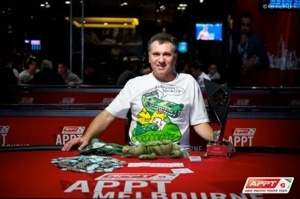
Billy “The Croc” Argyros Wins 2013 APPT Melbourne Main Event

Source: PokerNews

20130913-184017.jpg

The latest Asia Pacific Poker Tour champion has been crowned at the Crown Poker Room in Melbourne, Australia. After five tough days of action, Aussie poker veteran Billy “The Croc” Argyros claimed victory of the 2013 APPT Melbourne Main Event.

Argyros is one of the original inductees in the Australian Poker Hall of Fame and has a poker resume which includes tracked results in each of the last four decades. Now, in 2013, Argyros has taken down one of the most prestigious titles in the country and his second largest career score.

“I haven’t won a tournament since Cleopatra was skiing down the Nile!” quipped Argyros after he took down the title and $134,500 following a three-handed deal.

2013 APPT Melbourne – Final Table Results
Place Player Prize
1 Billy Argyros $134,500*
2 Bowdy Tolhopf $166,000*
3 David Yan $133,000*
4 Ashley Mason $58,400
5 Robert Damelian $45,900
6 Joe Cabret $37,550
7 Phi Luu $29,200
8 Ravi Maravar $22,920
9 Jazz Mathers $16,650
*Denotes three-handed deal

When the APPT Melbourne Main Event final table began at midday local time, everyone was expecting it to be a very long day in the Crown Poker Room. Then, within the first hour, four players had been eliminated.

The first player to find the rail was short stack Jazz Mathers. Starting the day with around five big blinds, Mathers was happy to look down at early in the action and get all his chips in. Mathers had to come up against Ravi Maravar’s and would unfortunately hit the rail when the dealer rolled out a board.

Despite picking up extra chips when he eliminated Mathers, Maravar would be the next player to exit. Maraver first lost most of his chips when he ran his into David Yan’s , then lost the rest of them all in preflop holding against Ashley Mason’s .

Just moments after Maravar hit the rail, Phi Luu joined him. With blinds at 15,000/30,000, Luu’s final hand saw him move all in for 295,000 from under the gun holding the . Billy Argyros looked down at in the big blind and made the call. No help came for Luu and it was all over in seventh place.

Six-handed play would become five-handed very quickly as 2013 Aussie Millions runner-up Joe Cabret couldn’t turn his Day 3 “chip and a chair” story into a victory. Cabret’s final hand was a flip that he couldn’t win as his was out drawn by David Yan’s .

At this point Robert Demalian was still in contention and looking good to find another big result after making a deep run in this year’s WSOP Main Event. However, Demalian was ousted in fifth place when he was all in preflop holding the and couldn’t stay ahead of Bowdy Tolhopf’s .

Mason started the day as the chip leader, but seemed to be card dead and could never really get anything going. Eventually Mason found himself all in preflop holding the against Billy Argyros’ . The board ran out and Mason was sent out in fourth place, adding $58,400 to the $49,350 he received for winning a $1,650 Six-Max side event last week.

Just a short while later, Argyros, Yan and Tolhopf agreed ICM (independent chip model) deal. The players left $29,500 aside for the eventual champion, and because Tolhopf was a big chip leader, he locked up $156,000, while Yan received $133,000 and Argyros claimed $115,000.

The players were fairly deep stacked at the time of the deal and so it wasn’t too surprising that it would take around four hours to reach heads-up play. In the end, third place went to Yan after he took an unfortunate beat. Yan’s was all in preflop against Tolhopf’s , and he couldn’t stay ahead as a board was spread on the felt.

Argyros started the heads-up battle with a slight chip lead over Tolhopf. With $29,500 on the line, the two players decided to do another chop, with Argyros taking home $14,500, Tolhopf claiming $10,000, and $5,000 left aside for the champion.

The eventual final hand of the 2013 APPT Melbourne Main Event saw Tolhopf all in preflop holding the against the of Argyros. The final five cards spread on the felt for this tournament were , and with that Tolhopf was sent home in second place, while Argyros was the champion!

Argyros is now the second Australian Poker Hall of Fame member to win APPT Melbourne after Leo Boxell claimed victory in the 2011 APPT Melbourne Main Event.

Ο Μάνος για τον Μάρκο Βαμβακάρης

Ο Μάρκος Βαμβακάρης

Ο Μάρκος Βαμβακάρης

Ο Μάνος Ελευθερίου εξηγεί τι τον οδήγησε να καταγράψει στο βιβλίο του «Μαύρα Μάτια» τα εφιαλτικά παιδικά χρόνια του Μάρκου Βαμβακάρη στη Σύρα – κοινό γενέθλιο τόπο και των δυο τους.
«Με τον Βαμβακάρη ασχολήθηκα από την επομένη του θανάτου του» λέει ο Μάνος Ελευθερίου.

Τι σας ώθησε να ασχοληθείτε με τη ζωή του Μάρκου στη Σύρα, από τη στιγμή της γέννησής του, το 1905, έως τα 15 του, που έφυγε από το νησί;
Με τον Βαμβακάρη ασχολήθηκα από την επομένη του θανάτου του, μαζεύοντας όσα γράφτηκαν στις εφημερίδες. Λίγο μετά διάβασα την «Αυτοβιογραφία» του. Εκεί μιλάει για τον γενέθλιο τόπο του, τη Σύρα, που είναι και δικός μου. Έτσι σιγά-σιγά άρχισα να μαζεύω υλικό γι’ αυτά τα πρώτα χρόνια του, και εννοώ για την περιρρέουσα ατμόσφαιρα του νησιού και ιδιαιτέρως της Ερμούπολης. Πολλά απ’ αυτά τα κείμενα πέρασαν στο μεταξύ σε άλλα βιβλία μου για την πατρίδα μου. Την κατάλληλη στιγμή απομονώθηκαν κάμποσα και δέσανε με τη ζωή του Μάρκου, ο οποίος τα ζούσε τότε αυτά τα γεγονότα.

Δίνετε μεγάλη έμφαση στην περιρρέουσα ατμόσφαιρα της τότε συριανής κοινωνίας.
Η ατμόσφαιρα ήταν η ίδια που ανέπνεε ο Βαμβακάρης. Και τα περισσότερα πρόσωπα πρέπει να τα γνώριζε τουλάχιστον εξ όψεως. Ο τόπος ήταν μικρός.

Πρόκειται για ένα βιβλίο-ποταμό, 410 σελίδων. Μοιάζει καρπός πολλών ετών έρευνας και εργασίας…
Ουσιαστικά πρόκειται για μια συλλογή κειμένων και πληροφοριών που κράτησε σαράντα χρόνια (σ.σ.: ανάμεσά τους, περιγραφές εφημερίδων για χορούς, αστυνομικές διατάξεις, δικαστικά έγγραφα, σπάνιες φωτογραφίες και ντοκουμέντα, όπως η ληξιαρχική πράξη γέννησης του Μ.Β. κλπ). Ό,τι έγραψα εγώ και ανέπτυξα βασίζεται πάνω σε όσα είπε για τη Σύρα ο Μάρκος στην «Αυτοβιογραφία» του.
Από τρυφερή ηλικία γνώρισε όχι μόνο την παιδική εργασία (ως βαφέας σε κλωστήριο* και ως εφημεριδοπώλης**), αλλά και τη φυλακή, όπου ακολούθησε τη μητέρα του, για 15 μέρες, όταν εκείνη συνελήφθη για λαθρεμπορία τσιγαροχάρτων.***
Η τυραννική παιδική εργασία δεν ήταν αποκλειστικότητα των βιομηχάνων της Σύρας: όπου υπήρχε λιμάνι και βιομηχανία (ας πούμε Βόλος και Πάτρα) τα ίδια γίνονταν. Όσο για τη μεταφορά λαθραίων από τη μητέρα του, ήταν ανάγκη της φτώχειας που έδερνε την εργατική τάξη. «Άρτος και κρόμμυον» ήταν το φαγητό τους.****

Πόσο αυτά τα 15 πρώτα χρόνια της ζωής του πότισαν την ψυχή του Μάρκου και αργότερα έγιναν μουσική, στίχος, τραγούδι;
Δεν μπόρεσα να εντοπίσω στους στίχους του τα εφιαλτικά παιδικά του χρόνια. Ίσως τα έκρυψε στη μουσική του και, φυσικά, είναι αδύνατο να τα βρει κανείς.

Στα αποσπάσματα από την «Αυτοβιογραφία» του, που παραθέτετε στο βιβλίο, διαπιστώνετε μια «έξοχη λαλιά», μια «εξαίσια δημοτική γλώσσα»…
Είναι η «λαϊκή λαλιά» που μ’ αρέσει ιδιαίτερα. Κανένα στολίδι, κανένα επίθετο. Μάθημα για τους πεζογράφους και τους ποιητές. Δυστυχώς, και σ’ αυτό, δεν στάθηκα καλός μαθητής παρ’ όλο το θαυμασμό και την αγάπη μου.

Τι είναι, τελικά, για τον Μάνο Ελευθερίου ο Μάρκος Βαμβακάρης;

Είναι αυτό που χάρισε στον τόπο μας, χωρίς να το επιδιώξει και, κυρίως, χωρίς να το ξέρει. Βέβαια, γνώριζε την αξία του, στο τέλος πια, αλλά τα δώρα του ήταν δοσμένα πολλά χρόνια πριν.


* «Έφτασε και το 1912. Τότε επήραν τον πατέρα μου στρατιώτη [ο Βαμβακάρης 7 χρόνων, που σημαίνει ότι σταμάτησε το σχολείο]. Με παίρνει εμένα η μάνα και πάμε να πιάσουμε δουλειά σ’ ένα κλωστήριο, του Δεληγιάννη [το σωστό: Κ. Δηλιγιάννης & Χ. Μουχτόπουλος]. Άρχισε η δουλειά μου στο βαφείο του κλωστηρίου κι εγώ έκανα πακέτα τα νήματα. Η μάνα μου έπαιρνε τρεισήμισι δραχμές την ημέρα κι εγώ τρεισήμισι δραχμές τη βδομάδα».
(Κεφάλαιο «Η μητέρα στο κλωστήριο», σελ. 172).

** «Μαζί με μένα ήταν περίπου τριάντα παιδιά ακόμη, που όλα πουλούσαν σαν κι εμένα εφημερίδες…  Τα περισσότερα παιδιά ήταν αμφιβόλου διαγωγής. Εγώ δεν έδινα καμιά σημασία στα όσα έλεγε η μητέρα μου, διότι άρχισε να με τραβά η ζωή αυτή, που όπως απεδείχθη αργότερα ήμουν προορισμένος γι’ αυτήν. Άρχισα να γνωρίζω από κοντά τη ζωή του αλήτη, τον υπόκοσμο, την ατιμία, τη χαρτοπαιξία και όλα τα κακά της μοίρας. Γνώρισα από κοντά όλα τα παρακλάδια του υποκόσμου, άρχισε να ποτίζει κι εμένα το μικρόβιο της αλήτικης ζωής».
(Κεφάλαιο «Ανήλικοι θαμώνες καφενείων, χαρτοπαίκτες και επαιτεία», σελ. 303).

*** «Τότες οργίαζε το λαθρεμπόριο. Ο θείος μου, ο μπακάλης, έκανε κι αυτός λαθρεμπόριο ζάχαρης και τσιγαρόχαρτου. Ο πατέρας μου βοηθούσε τον κουνιάδο του, μα και η μητέρα μου βοηθούσε. Εζωνότανε σαν μπλάστρι τη ζάχαρη και το τσιγαρόχαρτο και το κουβαλούσε στην αγορά, στον Πέτσα τον μπακάλη. Από τις πολλές φορές ένας υπενωματάρχης, ο Κιράνης, την έπιασε. Μας κουβαλήσανε τότες στο κρατητήριο… Δεχτήκαμε και πήγαμε και φυλακή κι εμείς τα μωρά μαζί με τη μάνα μας, δεκαπέντε μέρες».
(Κεφάλαιο «Αποκλεισμός, λαθρεμπόριο και αποκρύψεις τροφίμων», σελ. 237).

**** «Τότε, το 1912, πριν τελειώσω την τετάρτη τάξη, πήραν τον πατέρα μου στρατιώτη και άφησα το σχολειό για να πάω με τη μάνα [μου] στη δουλειά». Ήταν τότε επτά χρόνων. «Έστω κι ένα δίφραγκο την εβδομάδα ήτανε μεγάλη δουλειά. Είχε το ψωμί τότες 35 λεπτά η οκά. Έδινες 65, 70 λεπτά κι έπαιρνες ένα διπλό ψωμί, διπλό, δυο οκάδες. Ήταν φτηνά ψωμιά, στρογγυλά, κουλούρες, φραντζόλες, άσπρο ψωμί χάσικο, φτηνό ψωμί, καλό ψωμί. Όταν αρχίνησε και γινότανε πιο ακριβή η ζωή, τότες αρχίσανε και βγάλανε το μαύρο το ψωμί…».
(Κεφάλαιο «Το ψωμί ψωμάκι», σελ. 227).

#Οι παραπομπές με αστερίσκους, που προηγούνται, είναι αποσπάσματα από την «Αυτοβιογραφία» του Μάρκου Βαμβακάρη, που παρατίθενται στο «Μαύρα Μάτια- Ο Μάρκος Βαμβακάρης και η συριανή κοινωνία στα χρόνια 1905-1920», εκδόσεις Μεταίχμιο.

Exploring Fener and Balat – the old Greek and Jewish quarters of Istanbul

The haunted streets of Istanbul

The haunted streets of Istanbul

The tour began at Çibali, where we followed the sea wall in a northerly direction along the western side of the Golden Horn. Here, in another age, stood the proud Greek Fanariot mansions – squat, medieval domiciles with pediments, domed ceilings and stairs to upper levels. They were for a period the pleasure palaces of patrician and mercantile Greek families that thrived under Ottoman rule. Now neglected and fallen into disrepair, they are surrounded by traffic on one side and the Horn on the other. Once, they had been closer to the water, but the shoreline receded in direct proportion to the street levels rising, so that these intriguing buildings appear to be stranded on traffic islands and sinking into the ground. Interestingly, the dwellings are built of alternate layers of brick and stone to withstand earthquakes.

My friend Alex and I risked our lives on a busy road to visit the church of Hagios Nikolaos. The press of a button set in forbidding masonry summoned an Orthodox woman from Antioch. She has been the caretaker for fifteen years and has, she told us, three children. She looked under the weather; nevertheless, she gave us access to a rare gem.

From a covered inner courtyard she opened a heavy door to reveal a modestly sized church with a marble iconostasis. The feeble light, struggling through high dirty windows, revealed icons of saints and the Virgin. They were almost entirely obscured by soot and a cloud of incense that hung in the air. An Epitaphio covered in wilted flowers reminded us that Greek Easter had been celebrated a week earlier. Here and there burnished colour drew the eye up to the domed ceiling hung with three chandeliers.

Spying the icon of Hagios Dimitrios in a dark corner brought on unexpected surge of nostalgia. Without thinking, I asked if I may light a candle. The woman rushed off and returned with oil and a wick so that I could light the oil lamp that hangs before my namesake. It was rather disconcerting taking part in a ceremony I hadn’t performed since childhood.

On the opposite side of the courtyard is a phenomenon: the only standing Fanariot mansion visitors can safely enter without incurring personal injury. Ascending the stairs to the second storey and wandering in the early baroque Ottoman room was heartbreaking. Here were small niches built into the wall and enclosed with elegant doors, a safe; kitchen, bedrooms, all dank and dark and filled with masonry and cobwebs. Like much of what’s left from this time, it is empty and displays a siege mentality. Certainly it is forgotten and largely unknown to the world rushing by outside.

Following the remnants of the sea wall brought us to Fener. Fresh cheese borek and tea were served by a good-natured though none-too-bright boy at a local cafe.

From there we headed up the steep street to the Fener Greek Orthodox College. Established in 1454, it’s a massive red-brick edifice that dominates the neighbourhood with the arrogance of a citadel. Looming over the houses now occupied by Anatolian peasants and Kurds, the college is the emblem of a once thriving Greek community. Now it schools a mere fifty-seven students, most of whom are from Antioch and speak mainly Turkish.

The upper storey has a sprung floor to withstand earthquakes. At the end of a long corridor is an assembly hall with murals containing examples of continued Greek presence in Asia Minor for millennia, not that those who surround the school know or care. The place has an other-wordly air, as though it’s mired in an irrelevant past. What will become of the building when the school eventually closes, as it surely must, is anyone’s guess.
On the way out we met three young Israelis searching for their roots. Nearby Balat housed a substantial Jewish population, their synagogues and bathhouses still dot the area. Listening to the young men, it seemed to me that Istanbul is the place where people come to find themselves in a shattered past. Even their words sounded haunted.

My friend Alex is scathing about the current occupants of Fener and Balat.

They have no education, no respect, no understanding and no knowledge of the area’s significance. Shoddy, slap-dash renovations abound. They stick a Koranic verse above the door and think they’ve exorcised the Christian presence. Simple folk with no understanding squat in the ruins of the Theodosian wall and in the crumbling remnants of once-grand mansions. Cats wander everywhere. Washing hangs between houses. Giant elms reach over high walls that guard disused churches.

It’s picturesque but melancholy. You feel as if every footstep is in remembrance of times past; as if life here had once been very different to what it is now. Not drained and diminished but sophisticated, cosmopolitan, lived according to forgotten daily rhythms and rituals.
The point hit home when we visited another Fanariot mansion. This one stood in a seedy park by the water; it was comparatively well-preserved. I objected when Alex pushed open a make-do gate and ushered me into a courtyard occupied by a man in religious garb.
“Why?” Alex snapped. “You have more right to be here than they do.”

Indeed, the old man had no idea why we should be interested in his remarkable hovel. His bent back, the kind, vapid smile and the hands that fiddled with worry beads brought on pity. He reminded me of my father. After a quick inspection of the graceful arched colonnade and the balcony above it, I thanked the man and guided Alex out.

As we rested in a cafe, I reflected that no Greek can visit Istanbul without feelings of intense primal loss and longing. There is a deep connection to the place. You can’t help thinking of what might have been had things worked out differently. The regret, the conflicting feelings, are so powerful, they make you catch your breath. For a minute you think that if one or two variables were to change, Greek voices might still ring in the streets instead of Turkish ones. Greeks might come down the hill on the way to church. And then you hear the muezzin’s call to prayer, first from one minaret and then a multitude, and all illusions melt. This is modern Istanbul. Not Constantinople.

* Dmetri Kakmi is a writer and editor. His book Mother Land was shortlisted for the NSW Premier’s Literary Awards. He will be speaking about the book on September 17 at 10.00 am at the Collingwood Library, 11 Station St Abbotsford.

November is the month Australia will see Greek singing legend Glykeria tour again

Glykeria is coming to town

November is the month Australia will see Greek singing legend Glykeria tour again with Cretan musician Mihalis Tzouganakis

Glykeria is coming to town

The icon herself, Glykeria.

November is the month Australia will see Greek singing legend Glykeria tour again. The songstress will be back to perform to Australian audiences, with tour dates to be announced but a Melbourne show locked in for 30 November. This time the icon will be touring with Cretan musician Mihalis Tzouganakis.

Glykeria was born into a musical family in Serres. She started her career in Athens in 1974, playing in the tavern Leto in Plaka. In the ’80s, she released her first solo album, ‘Ta Smyrneika’, featuring traditional songs from Asia Minor which caused a stir in the industry, showcasing Glykeria’s unique voice to the nation.

During the following years, Glykeria performed at well-known clubs and bouzoukia, gaining momentum and many fans, and collaborating with other well-known singers, including the legendary George Dalaras.

Glykeria will perform with Mihalis Tzouganakis at Melbourne Pavilion on 30 November. Tickets start at $99 and for bookings contact Theo on 0433 318 318 or Chrissa 0413 131 888.

Greece 70th in world happiness index

Sources: ekathimerini, UN

Greece ranked a little above the middle in the 70th position among 156 countries in the United Nations’ first-ever World Happiness Report

Greece ranked a little above the middle in the 70th position among 156 countries in the United Nations’ first-ever World Happiness Report, drafted by the Sustainable Development Solutions Network and published this week.

Greece also came second behind Egypt in the dramatic decline of their happiness index from pre-crisis levels, according to the report, which compared the period of 2005-2007 with that of 2010-2012. Crisis-hit European peers in Spain came sixth in deteriorating happiness, the Italians came eighth and the Portuguese ranked in 12th place.

Ranking happiness on a scale of 0-10, the survey of 156 nations measured factors such as wealth, political freedom, strong social networks and an absence of corruption. On an individual level, good mental and physical health, someone to rely on, job security and stable families are also crucial factors that are taken into account for measuring well-being and happiness.

The world happiness average, according to the UN report, is 5.1 points, with Greece scoring a slightly higher 5.4 points at the 70th spot.

The least happy people in the world are found in poor Sub-Saharan African countries such as Togo, Benin, Central African Republic and Sierra Leone, while the happiest people are in northern Europe, and especially in Denmark, Norway, Finland and The Netherlands, where the average life evaluation score came to 7.6 on the 0-to-10 scale. This year’s report finds that Canada is in sixth place and Australia in 10th place. The US is ranked at 17th, UK at 22nd while France was at 25th and Germany 26th.

Greece’s neighbours Cyprus and Albania have happier people than Greece, ranking in the 34th and 62nd spots respectively, though Turks are more unhappy than Greeks at 77th place.

Slimy Australian animal the blobfish named world’s ugliest

Source: News

The Blobfish lives off the coast of Australia. Picture: Supplied

The Blobfish lives off the coast of Australia. Picture: Supplied

THE blobfish, a denizen of the Pacific, including Australia, that looks like a bald, grumpy old man, has been named the world’s ugliest animal, organisers of the offbeat competition say.

More than 3000 people contributed to an online poll aimed at raising awareness of unsightly species that play an important role in the ecological web.

The blobfish, a squidgy pink creature capable of enduring otherwise crushing pressures at great depth, is becoming a casualty of deep-sea trawling.

It was a clear winner, snatching 795 votes, said Coralie Young of the British Science Association, which announced the results at an annual festival in Newcastle, north-eastern England.

Runner-up was the kakapo, a rare flightless owl-like parrot that lives in New Zealand, and third was the axolotl, a Mexican amphibian also called the ‘walking fish’.

Other candidates were the proboscis monkey, which has red genitalia, a big nose and a pot belly, and the Titicaca water frog, which also goes under the less-than-scientific moniker of ‘scrotum frog’.

A total of 88,000 people visited the website where the polling took place, reflecting wide interest in the issue, Young said. “It’s a lighthearted way to make people think about conservation.”

The blobfish’s reward is to be enshrined as the official mascot of the Ugly Animal Preservation Society, a loose association of stand-up comedians who humorously champion endangered but visually unappealing species.

“The Ugly Animal Preservation Society is dedicated to raising the profile of some of Mother Nature’s more aesthetically challenged children,” it says on its website.

“The panda gets too much attention.”


The Aye Aye is a lemur native to Madagascar. Picture: AP

The Aye Aye is a lemur native to Madagascar. Picture: AP


Pig Nosed Turle. Picture: Nerdcoregirl, Flickr

Pig Nosed Turle. Picture: Nerdcoregirl, Flickr