
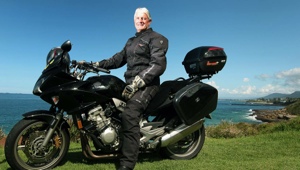
Why give this man Michael Wilkins money to go on a fantastic ride?

Source: IllawarraMercury
20130415-103336.jpg
Michael Wilkins. Picture: SYLVIA LIBER

The second time around of a life-changing experience is never the same as the first time.

Some things are easier, some things are harder.

For Michael Wilkins, now in the final preparations for his second time riding around Australia on a motorbike, he’s already noticed that money is much tighter this time.

On his first trip, in 2010, he raised more than $8000 for the Steven Walter Children’s Cancer Foundation.

This time, he’s struggling to raise $5000.

“Some of the businesses that supported me on the first ride have said they can’t do it now,” he said.

“I have written to businesses concerned with motorcycling and the community and I haven’t even received a reply. Not even a ‘no’.

“A lot of people wonder why they should give me money to go on a fantastic ride.

“I stress that none of the donated funds goes towards my costs, which will be in the order of about $8500 in accommodation, food and petrol.”

Wilkins’s motivation to set off on a trip to Townsville, west to Tennant Creek and Katharine via Mount Isa, through the Kimberley and back across the Nullarbor Desert, is not just to have a good time.

He first came across the Steven Walter Children’s Cancer Foundation while riding on the famous Snowy Ride, an annual event attracting around 3000 riders that has raised more than $3 million for childhood cancer research.

Walter was only 19 when he died in July 2000 after an eight-year fight against cancer.

His whole life revolved around motorcycles and he was a former NSW Junior Enduro Champion and an Australian Four Day silver medallist.

“The funds raised by the charity help pay for clinical trials, which are not necessarily funded by government money or drug companies,” Wilkins said.

“They are a small charity with only three employees, so the majority of the money goes to the researchers where it’s meant to go.”

His trip in 2010 was his first around Australia and it had a profound effect on the 63-year-old mechanical designer and self-confessed “born-again motorcyclist” from Bellambi.

“It was difficult readjusting when I returned,” he said.

“In fact, I still haven’t. We all had to face that fact that we had to get back in the harness and work for a living.

“It’s changed a lot of things.”

He wrote a book about the trip, A Lap for the Little Ones, and this time around will be writing a blog for the Mercury when he rides out of the Sydney Children’s Hospital on May 1.

“It is an expensive exercise but I have been able to justify that in my own mind because it is raising money for something that is pretty important, and because I had such a great time,” he said.

“It wasn’t so much the touristy things like the tree walk and the Nullarbor.

“It was more the intangible things – the freedom of being out there.

“There is such a feeling of release from responsibilities, worries, concerns and alarm clocks.

“The feeling of the freedom and the space.

“That’s the thing.”

After growing up in Oberon, where he learned how to ride dirt bikes, Wilkins came to Wollongong at the age of 22 to work at the steelworks.

He rode a bike to work and went out for more adventurous rides at weekends when he could, but time was tight.

Then he took a sales job in the early 1980s that came with a company car, and after keeping the bike unused in a garage for months, he ended up giving it to his daughter.

After many years involved in the Tech Waratahs Rugby Club, including six as president, he came back to motorcycling in his early 50s, when his body was too old for rugby.

Slowly, he met other motorcyclists and started travelling down to Phillip Island with members of the Ducati Club in Sydney.

“Although motorcycle riding is a solitary activity to a certain extent, it’s like anything – if something is worth doing, it’s worth sharing with somebody,” Wilkins said.

“That said, I often get out by myself on the bike and may do a loop down to Ulladulla, but it’s different with a group.”

Although this will be his last time around Australia, it won’t be the end of his work for the foundation, nor the end of his long bike trips.

He’s got the bug.

“There is the vastness and the wonder of it all,” he said.

“There’s the feeling that you are insignificant as an entity.

“The land is the dominating factor out there.

Australian Museum celebrates blockbuster exhibition by announcing the The Week of Alexander – 22 to 26 April Calling all named Alex & residents of Alexandria

Australian Museums blockbuster exhibition Alexander the Great: 2000 Years of treasures must close its doors on Sunday 28 April after setting attendance records for the museum over summer.

As a final celebration before these treasures are packed for transport back to the State Hermitage in St Petersburg, the Australian Museum announce The Week of Alexander.

Between Monday 22 and Friday 26 April, anyone who has Alex in their first or surname will gain entry at a special price. (proof of identity required)

And as Alexander the Great founded 20 cities that bore his name, the Museum has extended this offer to all residents of Alexandria. (proof of address required)

I urge people to take the opportunity to see these treasures for 28 April as they will not travel to Australia again in our lifetime, says Frank Howarth, Director of the Australian Museum. And I urge all Alexes to come along and discover the legacy of their famous historic namesake.

The Week of Alexander offer
to purchase your discounted tickets mention the promotional word ALEX
Adult $18 (normally $24) saving of $6 or a 25% discount
Family $50 (2 adults & 2 children – normally $60) saving of $10 or 16% discount

Alexander the Great: 2000 years of treasures
Collection from the State Hermitage, St Petersburg, Russia
Exclusive in Australia to the Australian Museum in Sydney
http://www.alexandersydney.com.au

Tickets available at the museum, but to avoid the queues pre-purchase tickets
at http://www.ticketmaster.com.au or by calling 136 100

Scientists develop simple blood test to track tumour evolution in cancer patients

Source CancerResearch.uk

Cancer Research UK Press Release

Cancer Research UK scientists have developed a new way of looking at how tumours evolve in real-time and develop drug resistance by tracking changes in the patients’ blood, described in a study1 published in Nature.

Scientists at the Cancer Research UK Cambridge Institute at the University of Cambridge2 used traces of tumour DNA, known as circulating tumour DNA (ctDNA) found in cancer patients’ blood to follow the progress of the disease as it changed over time and developed resistance to chemotherapy treatments.

They followed six patients with advanced breast, ovarian and lung cancers and took blood samples, which contained small amounts of tumour ctDNA, over one to two years.

By looking for changes in the tumour ctDNA before and after each course of treatment, they were able to identify which changes in the tumour’s DNA were linked to drug resistance following each treatment session.

Using this new method they were able to identify several changes linked to drug-resistance in response to chemotherapy drugs such as paclitaxel (taxol) which is used to treat ovarian, breast and lung cancers, tamoxifen which is used to treat oestrogen-positive breast cancers and transtuzumab (Herceptin) which is used to treat HER2 positive breast cancers.

And they hope this will help shed new light on how cancer tumours develop resistance to some of our most effective chemotherapy drugs as well as providing an alternative to current methods of collecting tumour DNA – by taking a sample direct from the tumour – a much more difficult and invasive procedure.

Dr Nitzan Rosenfeld, Cancer Research UK funded scientist and one of the study authors, said: “Tumours are constantly changing and evolving which helps them develop a resistance to many of the drugs we currently give patients to treat their disease.

“We’ve shown that a very simple blood test can be used to collect enough tumour DNA to suggest to us what parts of the cancer’s genetic code is changing and creating tumour resistance to chemotherapy or biologically-targeted therapies.

“We hope that our discoveries can pave the way to helping us understand how cancers develop drug resistance as well as identifying new potential targets for future cancer drugs.”

Kate Law, director of clinical research at Cancer Research UK, said: “Research is helping us to find answers to one of cancers’ biggest questions – how tumours develop resistance to many of our most effective drugs.

“New techniques like this blood test, which offers a more personalised approach to treating cancers, will help us improve the effectiveness of treatments for patients.”

Neo-Nazi Golden Dawn Thugs Clash with Roma in Kalamata Hospital Raid

Source: IBTimes.UK

Members of Greece’s neo-Nazi Golden Dawn party have clashed with a group of Roma in a raid on Kalamata Hospital in the southern Peloponnese.

The extremists, led by MP Dimitris Koukoutsis, swooped on the hospital hunting for foreign nurses. Earlier this year, four women from Bulgaria were forced to leave the Panarkadiko hospital in Tripoli, Peloponnese, after dozens of Golden Dawn members evicted them.

This time, however, they were confronted by Roma who had taken to the hospital a 22-year-old victim of a racially motivated attack. Violence broke out between the two groups but was broken up by police.

Koukoutsis accused the Roma of “involvement in delinquency” and said Golden Dawn would not regard them as equal citizens until they gave up crime. He said delinquency was “in their DNA”, according to ENET website.

Hospital director Yirgos Bezos said that Golden Dawn’s raid on the hospital was “unacceptable.

The row came days after a leading member of a Roma settlement in Komotini, northern Greece, threatened Golden Dawn with a provocative video on YouTube.

In the footage, two Roma men wield guns, axes and chainsaws and dare the neo-Nazi party to launch a raid on their camp. “You will have to send a lot of guys to my camp,” says one man.

Addressing Nikos Michaloliakos, chairman of Golden Dawn, the unnamed Roma leader brags about having many “crazy guys” watching his back.

“Michaloliakos, round up your mongrels,” says the man.

Greece Records Negative Inflation

Source: GreekNewsAgenda

Greece recorded its first negative inflation rate in 45 years in March 2013, according to data released by the Hellenic Statistics Authority on April 9.

The consumer price index fell to -0.2%, from 0.1% in February, reaching thus its lowest reading since 1968.

Deflation came despite a 26.9% increase in heating oil prices and a 12.3% increase in electricity rates, while medicines recorded the biggest drop, averaging at 14.6%.

The deflation process is expected to continue for the remainder of the year, with inflation seen coming in at zero at the end of 2013.

Revised data on Greek international commercial transactions, including petroleum products, from 2004 to 2012 released by the Hellenic Statistical Authority (ELSTAT) on March 28, show an unprecedented increase in Greek exports since 2004.

In particular, exports have increased by 57% in the period 2009-2012, thus accounting for 13.8% of the GDP in 2012 compared to 7.6% in 2009.

Furthermore, the Panhellenic Exporters Association (PEA) analysis shows a 109.4% increase in exports, a small rise in imports (8.8%) and a significant improvement of the Greek trade balance (-32.7%) compared to 2004. The top three sectors with trade surpluses are: tobacco and beverages, animal and vegetable oils & fats, and raw materials.

It should be noted that the data revision was based on the implementation of an Action Plan, between ELSTAT and Eurostat in order to enhance external trade statistics and harmonize them with EU requirements.

‘Einstein parents’ say no to kids’ vaccination

Source: The Daily Telegraph

ALMOST 80,000 Australian children are not immunised against deadly diseases, and the highest number live in Sydney’s west.

Experts say the “baby Einstein” demographic – parents who take an intensive interest in their children’s education and health, eat organic food and use alternative medicines – is responsible.

Sydney’s west has an immunisation rate of 90 per cent for five-year-olds but last financial year was home to 3600 children who were not fully immunised. In wealthy Manly, Mosman and eastern Sydney, however, fewer than 85 per cent of children are immunised in some age groups.The figures are contained in a National Health Performance Authority report.

The World Health Organisation says immunisation rates for measles must be above 93 per cent to prevent its spread. Immunisation expert Julie Leask says parents who perform extensive research and are often suspicious of medicine are more likely to object to vaccination.

“I think what these figures say is … you can’t rely on herd immunity in your region,” the University of Sydney academic said.

Australian Medical Association president Dr Steve Hambleton said the removal of an $18.50 government incentive for doctors to chase up unvaccinated children would exacerbate the problem.

New data on immunisation rates in smaller areas shows the Richmond Valley on the north coast, home to the anti-immunisation Australian Vaccination Network, has the lowest immunisation rate in the country. Only 82 per cent of one-year-olds are fully immunised, falling to just 80 per cent for two-year-olds and 75 per cent of five-year-olds.

NSW Health infectious diseases expert Dr Jeremy McAnulty said two children died on the north coast last year during a whooping cough epidemic that infected 24,000 people. Western and southwestern Sydney were also hard hit by a measles outbreak, with 199 cases last year.Naturopath and mother-of-two Genevieve Milton is convinced vaccines can be harmful and decided against immunising her sons.

Husband Darrell, however, is pro-vaccination and admits he is not entirely comfortable with the decision. “I don’t know I totally agree with her but if Gen wasn’t going into this armed with all the information that she obviously has, then I would be more against her,” he said.Mrs Milton believes she can best protect sons Cadel, 4, and Keanu, 21 months, by strengthening their immune system with good nutrition, vitamins and good hygiene.

She says her boys “line up every day for their echinacea and fish oil” and stresses white sugar and flour must be eliminated from children’s diets for a strong immune system to develop.

Brain Drain 120,000 Professionals Leave Greece Amid Crisis

Source: Spiegel

State hospital nurses protesting in Thessaloniki. Many have left the country looking for work elsewhere.

Greece’s sky-high unemployment and shrinking economy are leading to significant brain drain, a new study has found. The number of young scientists leaving Greece has become painfully high, as more professionals abandon their homeland for better opportunities abroad.

More than 120,000 professionals have left Greece since the start of the country’s financial crisis in 2010, according to a recent study by the University of Thessaloniki.

Doctors, engineers, IT professionals and scientists have found it increasingly difficult to find work amid deep cuts to funding of health care and other publicly supported sectors.

“The number of young scientists who emmigrate has reached 10 percent of the country’s potential, and that’s very high,” the study’s director Lois Lambrianides told the Athens newspaper Ethnos on Tuesday.

Lambrianides, professor of economic geography at the University of Thessaloniki, said that the emmigrating professionals tend to leave for other European countries, settle in big cities and end up working in the private sector. She said half of them have multiple degrees from the world’s top 100 universities.

Highest Unemployment in the EU

The study’s release followed a spec of good economic news last week when government figures showed hirings in the private sector outpaced layoffs in March. Prime Minister Antonis Samaras said while the economy remains in “critical” condition, the news was a sign of recovery.

Greece has the highest unemployment rate in the European Union, at just over 26 percent. Its economy is in its sixth consecutive year of negative growth, partially the function of deep austerity measures that have been demanded by the country’s main lenders.

The so-called “troika,” comprising the EU, the International Monetary Fund and the European Central Bank, began a new round of talks in Athens last week to evaluate Greece’s progress in reforming its economy and reducing its deficit. The lenders are demanding 150,000 fewer public sector jobs in Greece by 2015.

The leader of the junior coalition Socialist party, Evangelos Venizelos, said Tuesday after a meeting with the troika that the reform of the bloated public sector in Greece was a “test of our credibility.”

“We should not be afraid of reform,” he added. “We need it.”

Προκαλούν με διαφήμιση οι Τούρκοι: «Στη βόρεια Κύπρο δεν έχει κρίση»

Source: Ant1iwo.com

Χαλαρώστε – Στη Βόρεια Κύπρο δεν υπάρχουν ανησυχίες για το Ευρώ, είναι το σλόγκαν της τουριστικής καμπάνιας του ψευδοκράτους.

Η οικονομική κρίση της Κύπρου φαίνεται πως λειτουργεί σαν βούτυρο στο ψωμί των Τουρκοκύπριων που δεν έχασαν ευκαιρία να «χτυπήσουν» τον τουρισμό της Κύπρου και να αποπειραθούν να μαγνητίσουν τους «διαφυγόντες τουρίστες».

Καλούν, λοιπόν, τους ξένους να επισκεφθούν τη «Βόρεια Κύπρο» γιατί εκεί θα είναι ασφαλείς… αντίθετα, όπως υπονοούν με το… νότιο τμήμα του νησιού.

«Πολλοί άνθρωποι δεν γνωρίζουν πως το νόμισμα στη βόρεια Κύπρο είναι η τουρκική λίρα.

Τα οικονομικά προβλήματα τα οποία υπάρχουν στις ειδήσεις τώρα περιορίζονται μόνο στη νότια Κύπρο», γράφουν οι Τούρκοι στην ιστοσελίδα τουριστικής προβολής των κατεχομένων.

THE NEW TAXATION LAW FOR EXPATRIATES WILL BE REVIEWED

WORLD COUNCIL OF HELLENES ABROAD (SAE)

Δρ. Όλγα Σαραντοπούλου
Γραμματέας

​​​​​​​​​Vienna, 09.04.2013

THE NEW TAXATION LAW FOR EXPATRIATES WILL BE REVIEWED

Following the pointing out of aspects of the proposed new taxation law for Expatriates and the multiple interventions by the World Council of Hellenes Abroad through SAE Secretary Dr. Olga Sarantopoulos, and the subsequent mobilization of the Greek Organizations around the world, the Greek Government decided to review this extremely important issue.

We believe that the review of the new law regarding the taxation for Greeks living abroad should deal with the essence of the problem and should not exclude the Diaspora from the process. It is necessary that the Government takes seriously into consideration the proposal for the establishment of a Committee involving representatives of the Tax Department for residents abroad, who know in depth the issue, tax consultants, finance professors, representatives of the Omogeneia , SAE, the Secretariat for Greeks Abroad of MFA and the Ministry of Finance. So that the new regulations which will emerge through this cooperation will meet up with a just solution for the Expatriates and will bring them closer to the Homeland in these difficult times experienced by our country.

As highlighted by Dr.Sarantopoulos, after long consultations she had with relevant personalities responsible for the Tax Department for residents abroad, tax consultants, legal advisers and other competent people, each region where expatriates live has its own pecularities, which should be examined in detail. It is a fact that intergovernmental agreements to avoid double taxation do not exist everywhere -like e.g. in Australia for which she called for the immediate commencement of procedures in order to reach an intergovernmental agreement. She also pointed out that the certificates requested by the law are not issued by all countries as they have different rules.

Regarding the review of the law, Dr. Olga Sarantopoulos called upon Finance Minister Ioannis Stournaras to take into account the serious objections from the part of our organizations around the world and to take personally care of the very important issue. She underlined once more that the institutional process should be followed in order to restore the sense of justice in the Greek Diaspora.

—————————————————–

ΕΠΑΝΕΞΕΤΑΣΗ ΤΟΥ ΝΟΜΟΣΧΕΔΙΟΥ ΓΙΑ ΤΗΝ ΦΟΡΟΛΟΓΙΑ ΟΜΟΓΕΝΩΝ

Κατόπιν της ανάδειξης των πτυχών του προτεινόμενου νέου νομοσχεδίου για την φορολογία Ομογενών και των πολλαπλών παρεμβάσεων εκ μέρους του Συμβουλίου Απόδημου Ελληνισμού μέσω της Γραμματέως ΣΑΕ Δρ.Όλγας Σαραντοπούλου και της ακόλουθης μαζικής κινητοποίησης των Ομογενειακών Οργανώσεων ανά τον κόσμο, η Ελληνική Κυβέρνηση αποφάσισε να επανεξετάση το άκρως σημαντικό για την Ομογένεια αυτό θέμα.

Θέλουμε να πιστεύουμε ότι η επανεξέταση της φορολόγησης των Ελλήνων του εξωτερικού θα ασχοληθεί με την ουσία του προβλήματος και δεν θα γίνει ερήμην της Ομογένειας. Είναι αναγκαίο η Κυβέρνηση να λάβει σοβαρά υπόψη της την πρόταση για την σύσταση Επιτροπής στην οποία θα συμμετέχουν ειδικοί εκπρόσωποι της ΔΟΥ κατοίκων εξωτερικού, που γνωρίζουν σε βάθος το θέμα, φοροτεχνικοί, καθηγητές οικονομικών, εκπρόσωποι της Ομογένειας και του ΣΑΕ, της ΓΓΑΕ και του Υπουργείου Οικονομικών, ώστε οι νεες ρυθμίσεις που θα προκύψουν να ανταποκρίνονται σε μία λύση που δεν θα αδικεί την Ομογένεια και θα την φέρει πιο κοντά στην μητέρα Πατρίδα στίς δύσκολες στιγμές που βιώνει η χώρα.

Υπενθυμίζεται ότι όπως ανέδειξε η Δρ.Σαραντοπούλου, μετά από πολύωρες διαβουλεύσεις με τους αρμόδιους υπεύθυνους της ΔΟΥ κατοίκων εξωτερικού, φοροτεχνικούς ,νομικούς και άλλων αρμοδίων, υπάρχουν ιδιαιτερότητες σε κάθε περιφέρεια οπου ζουν Ομογενείς , οι οποίες θα πρέπει να εξεταστούν λεπτομερώς. Δεν υπάρχουν παντού διακρατικές συμφωνίες για την αποφυγή διπλής φορολόγισης -όπως π.χ.στην Αυστραλία για την οποία ζήτησε την άμεση έναρξη των σχετικών διαδικασιών για να υπογραφεί διακρατική συμφωνία. Υπογράμισε δε οτι και τα πιστοποιητικά που ζητάει ο νόμος δεν εκδίδονται απο όλες τις χώρες .

Η Δρ. Όλγα Σαραντοπούλου καλεί τον Υπουργό Οικονομικών κ. Ιωάννη Στουρνάρα κατά την επανεξέταση του νομοσχεδίου, να λάβει υπόψη τις σοβαρές ενστάσεις εκ μέρους των ομογενειακών μας οργανώσεων ανά τον κόσμο και υπογράμμισε ότι θα πρέπει να ακολουθηθεί η θεσμική διαδικασία για την αποκατάσταση του αισθήματος δικαίου στον Απόδημο Ελληνισμό.

Elli Kokkinou, Katerina Stanisi and Kosta Karafotis in Sydney, Melbourne and Adelaide 10, 11 and 12 May 2013

Three famous Greek singers of Laika (Folk-Popular) songs, Katerina Stanisi, Elli Kokkinou and Kostas Karafotis, are preparing for their performances in Australia.

The three singers on  May 10 will be in Sydney, May 11, in Melbourne and May 12 in Adelaide.

Elli Kokkinou has also performed in concerts in America and Australia in the past, with Christos Dantis.


DOWNLOAD SYDNEY VENUE LAYOUT