Vasilis Vasilas’ interview with Harry Hondros whose family owns Enfield Produce and Pets

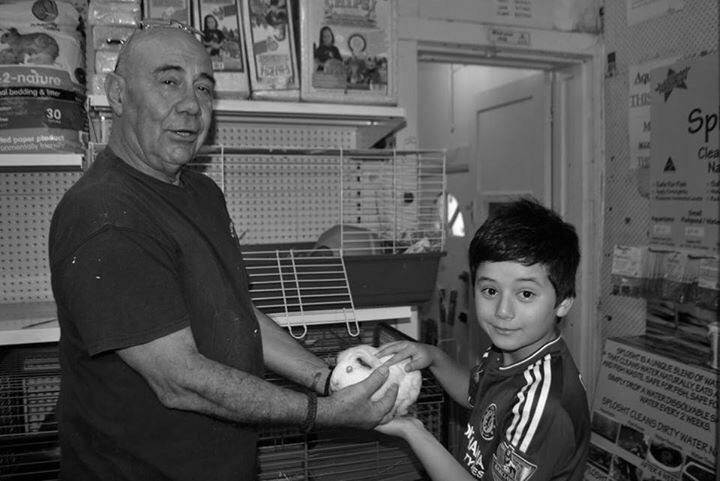
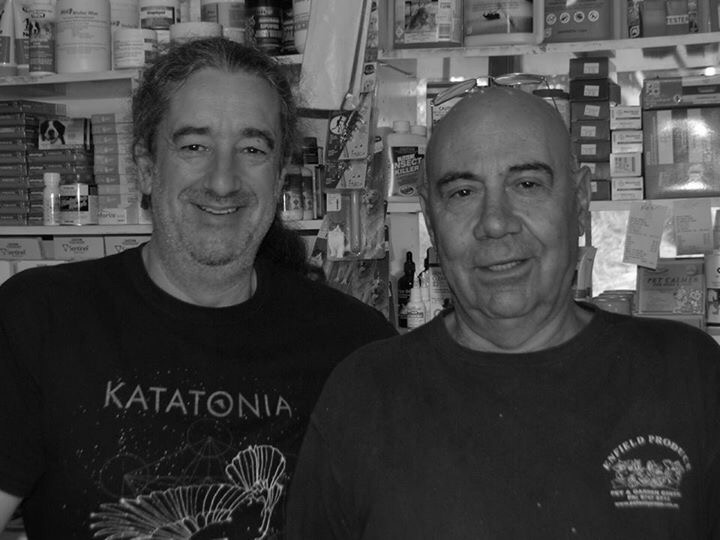
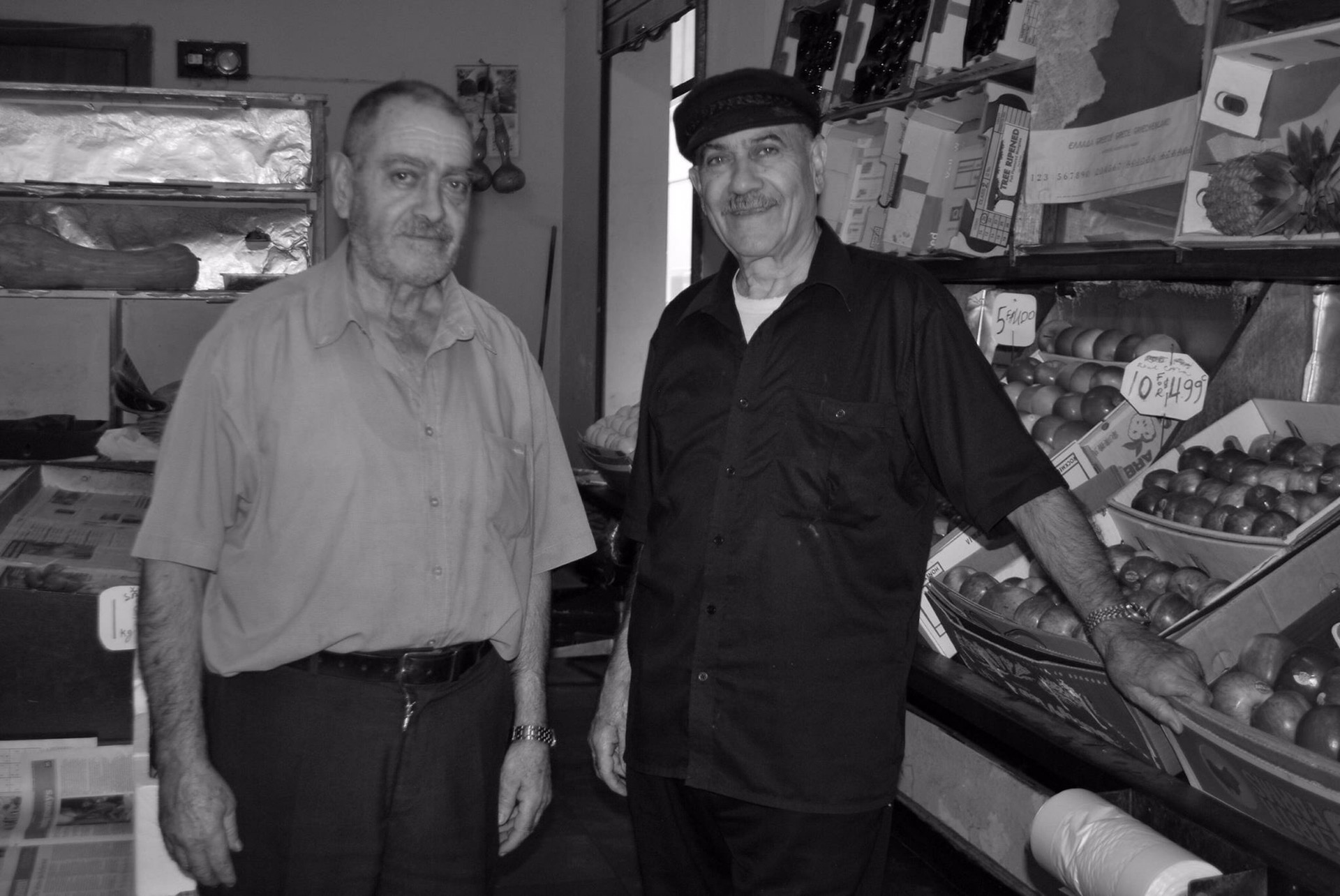
Vasilis has recently interviewed Harry Hondros whose family owns Enfield Produce and Pets… Yes, a Greek pet shop in Sydney! Jam-packed with products and pets!

Vasilis believes Harry is one of the most colourful Greeks he has ever met, ‘When Harry was working in Tumut NSW (1960s), at the Excelsior Café, he became so much part of the local community that he played rugby league for the Wynyard Pub’s team, Wynyard Wobblers, became a bull-jumper at the local rodeo club, which competed in rodeos all over NSW (and even Queensland) and even trained in Ju-jitsu… which is simply amazing for any Greek migrant at the time.’ 

On a serious side, Vasilis greatly admires Harry and his family’s determination and love for their work. ‘Having to compete with the megastores such as Bunnings and Petbarn does not daunt them in any way; they provide the customer service and good quality products customers want and this is why they have such a thriving business,’ Vasilis explains.

Source: https://www.facebook.com/SYNDESMOS-CONNECTING-PEOPLE-FROM-LESVOS-393246219501/

Eurovision Song Contest 2017 – second Semi-Final – Live

The second Semi-Final of the 2017 Eurovision Song Contest will take place on Thursday the 11th of May, live from the IEC in Kyiv, Ukraine.
https://youtu.be/90N4hTch-SM

The story of Hellenic Textile Mill starts in the 19th century

Documenta show sheds light on family business

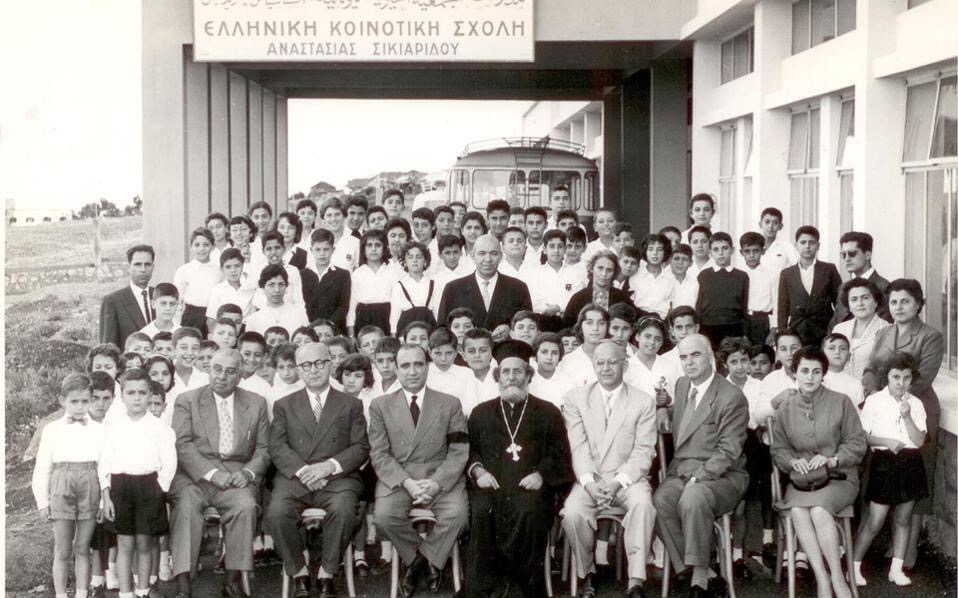
The story of Hellenic Textile Mill starts in the 19th century, in the cosmopolitan Ottoman Empire, and ends at a building complex on Pireos Street that has been home for the last few decades to the Athens School of Fine Arts, where the Sikiaridis and the Ambazoglou families, bonded by marriage, founded one of the country’s most important textile mills.

“Documenta asked us to make a short film about the premises that once belonged to our family,” says architect Elizabeth Sikiaridi, who is one of the narrators of the 18-minute documentary “Fabric,” along with her brother Simos Sikiaridis.

The film is being screened at the art school’s old library at 256 Pireos Street as part of the documenta 14 international art show. While detailing the history of the textile mill, the documentary also casts light on the lives of the middle and upper classes in the Ottoman Empire. In addition it offers insight into industrialization in Athens after 1922 and the influx of refugee workers from Asia Minor.

“The documentary presents the history of Hellenic Textile Mill but also the story of our family, which, starting from Cappadocia and stopping in Constantinople and Beirut, settled in Athens in the mid-1920s and founded the business,” says Sikiaridi.

The factory was founded by Simos Sikiaridis, the narrators’ grandfather. Before 1924, his business had extended beyond the Ottoman Empire to the West, the main market for his fabrics. When the Sikiaridis and Ambazoglou families moved to Athens, they decided to open a mill for processing wool. Both families were wealthy – the former thanks to textiles and the latter to grain – and bought land on Pireos Street, building their homes and the factory, and later selling other plots at a profit. They founded the Sikiarideio Foundation to treat children with trachoma but World War II scuppered the original plan, though after the war and up until 1971 it did help children at risk of tuberculosis.

The family also invested in the Greek capital’s boom and built the avant-garde Rex Theater on Panepistimiou Street, as well as founding a Greek community school in Beirut in 1951. Despite being rebranded as the Anglo-Hellenic Textile Mill, the factory gradually lost its edge and eventually went bankrupt in 1981. The space was saved thanks to Nikos Kessanlis, who was looking for a new home for the Athens School of Fine Arts, and in 1992, the entire complex was bought by the state.

“There is virtually nothing left of the family’s history,” says Sikiaridi. “But the purpose for which the space is being used is perfect.

Source: ekathimerini.com

Vasilis Vasilas’ interview with Miltiade Miltiadou Milton’s in business in Tailoring in Belmore, Sydney

Vasilis recently interviewed Miltiade Miltiadou who is from Spathariko, Ammohosto, Cyprus, about the story behind his business, Milton’s Tailoring, which is in Belmore, Sydney. 

As Vasilis points out about his motivation to do this interview, ‘Tailoring is unfortunately a dying trade and Miltiade would be one of the last Cypriot or Greek tailors in Sydney; it was just an opportunity to get his story and his views about the changing fortunes of tailoring…’

Source: https://www.facebook.com/SYNDESMOS-CONNECTING-PEOPLE-FROM-LESVOS-393246219501/

A lecture entitled “The Letters of Chion and Themistocles” will be presented this Thursday 11 May 2017 by John Penwill

PRESS RELEASE ​​                           

9/5/2017


Greek History and Culture Seminars:

The Letters of Chion and Themistocles

A lecture entitled “The Letters of Chion and Themistocles” will be presented this Thursday 11 May 2017 by John Penwill from LaTrobe University, as a part of the Greek History and Culture Seminars, offered by the Greek Community of Melbourne.

This lecture will take a close look at two collections of letters, neither of which is highly regarded by the academic community: The Letters of Chion (hereafter LC) purport to be a set of letters home by a young man on his way to Athens to study in Plato’s Academy and the effect his time there has on his political judgement when it comes to deciding what to do about the dictatorship in his native city, Heraclea, following a successful coup d’état during his absence.

The Letters of Themistocles (hereafter LT) likewise focus on an individual protagonist prominent in Athenian politics about a century earlier, and like the LC purport to be a set of letters written to a selection of friends and enemies in his home city and elsewhere following his ostracism in 471 BCE.

Both texts use the epistolary form to explore the character and motivation of their protagonist, but do so in very different ways: all letters bar one of the LC are addressed to Chion’s father Matris, whereas in the LT the recipients come from a range of individuals and locations.

But in both cases what we are clearly dealing with is a carefully constructed and thought-provoking text, and one that is at least one grade of sophistication above the essays on such topics which students were required to compose in the schools of rhetoric that abounded in the first and second centuries CE.​

John Penwill grew up in Tasmania and studied first at the University of Tasmania and subsequently at Downing College, Cambridge . He has a first class honours degree in Classics and a Diploma in Education. He taught at Monash University from 1972-1977 and at the University of Tasmania from 1978-1981 before being appointed to La Trobe University’s Bendigo campus.

John’s general research interest is in the field of Greek and Roman literature. He has for the past 40 years been Associate Editor of the international refereed journal Ramus: Critical Studies in Greek and Roman Literature, to which he has himself contributed a number of articles. His particular interest is in Roman literature of the late republic and early empire, and his focus within that is the interface between literature and philosophy.

John has also published articles on Plato’s Symposium, the Letters of Themistocles, the literature and philosophy of the Flavian period, Virgil’s Aeneid and Georgics, Epicurean theology, Lactantius’ De Ira Dei, the battle narratives in Homer’s Iliad, Livy’s representation of Numa (the second king of Rome), Tacitus’ Dialogue on Orators, Terence’s Hecyra, Seneca’s Trojan Women, the Letters of Chion and epic poetry of the Flavian period.

He is a Vice-President of the Classical Association of Victoria, and was editor of the CAV’s journal Iris from 1996 to 2012.​


When: 11/5/2017 @ 7:00pm

Where: Greek Centre, Mezzanine, 168 Lonsdale Street, Melbourne

Entry: FREE​


__________________________

More information: 9662 272

Level 3, 168 Lonsdale St., Melbourne, Vic. 3000

Phone: +61 3 9662 2722, Email: info@greekcommunity.com.au, Website: greekcommunity.com.au

Eurovision Song Contest 2017 – Opening Ceremony – full video

The opening ceremony of the 2017 Eurovision Song Contest will broadcast live from Mariyinsky Palace in Kyiv. 

All 42 countries and the hosts will enter the red carpet and be interviewed by press from all over Europe and beyond. 

The opening ceremony marks the start of the Eurovision Song Contest weeks. 

The Finals of the Eurovision Song Contest will take place on the 9th, 11th and 13th of May.

Vasilis Vasilas’ interview with the Houlis family who opened their fruit shop in Marrickville in 1969

The fruits of their labour.

Vasilis has interviewed the Houlis family who opened their fruit shop in Marrickville in 1969 and are closing in on their fiftieth anniversary…

They have an incredible story: Frangoulis lost communication with his siblings at the end of the Greek Turkish War (1922), as he was marched into the Asia Minor hinterland, while they were saved by being taken to Kalymnos. 

At the exchange of populations between Greece and Turkey, Frangoulis, is sent to Kefalonia, where he manages to locate his siblings through the Red Cross. Getting to Samos was not difficult; however, Kalymnos was under Italian rule at the time. 

It was only when Frangoulis sails across to Kos, under Italian rule too, that he works on a tobacco farm and finally gets the paperwork to get Kalymnos, where he reunites with his siblings. What an odyssey!!!! Frangoulis undertook another odyssey- to Australia in 1961…

Brothers, Nominos, John and Theophilos, as well as their father Frangoulis, worked for years in the cane fields of Innisfail, Queensland, and would do seasonal work, grape picking in Mildura, and pick and shovel work in Sydney (during the off season of cane-cutting). 

As Vasilis points, ‘The Houlis story epitomises the migrant’s story, as this family worked its guts out for years to successfully establish their family and business in Sydney.’ 

In the photograph is Theophilos and Giannis Houlis…

Source: https://www.facebook.com/SYNDESMOS-CONNECTING-PEOPLE-FROM-LESVOS-393246219501/

Vasilis Vasilas’ interview with Arthur Gerakas of Speedy Shoe Repairs in Ashfield

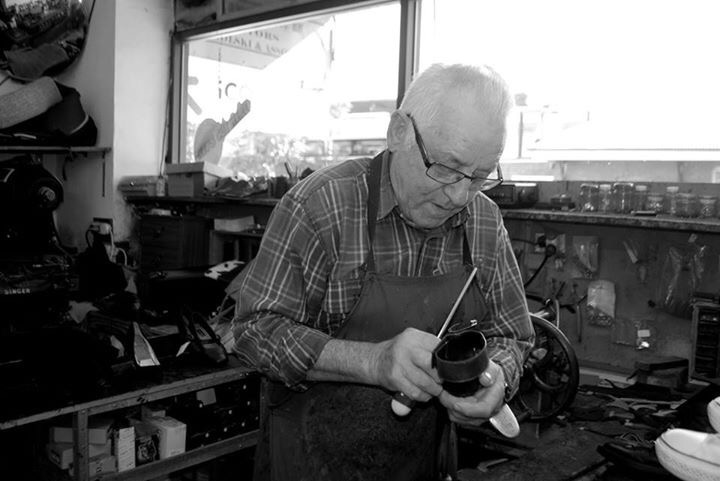
Vasilis continues on his merry way; this time he interviewed Arthur Gerakas of Speedy Shoe Repairs in Ashfield. It was Arthur’s brother-in-law, Elias Stavrou, who opened the shoe repair business in the late 1960s, and Arthur took over the shop in 1972, and Arthur’s son, Jim, has run the shop since the mid 1990s. Arthur continues working in the shop for a few hours a day, helping out Jim. 

The Gerakas family has seen a lot of changes to Ashfield over forty years; they are now the last Greek-run shop, of the post War generation, left in Ashfiled, as the Greek delicatessen shut shop about seven months ago. 

As Vasilis explains, ‘I call Arthur and Jim the dynamic duo; they are are great team..I also love the way the trade has passed down from one generation to the next; in this case, it is passing from Arthur to Jim’s hands, and the trade (and shop) survives to service the community.’

Source: https://www.facebook.com/SYNDESMOS-CONNECTING-PEOPLE-FROM-LESVOS-393246219501/

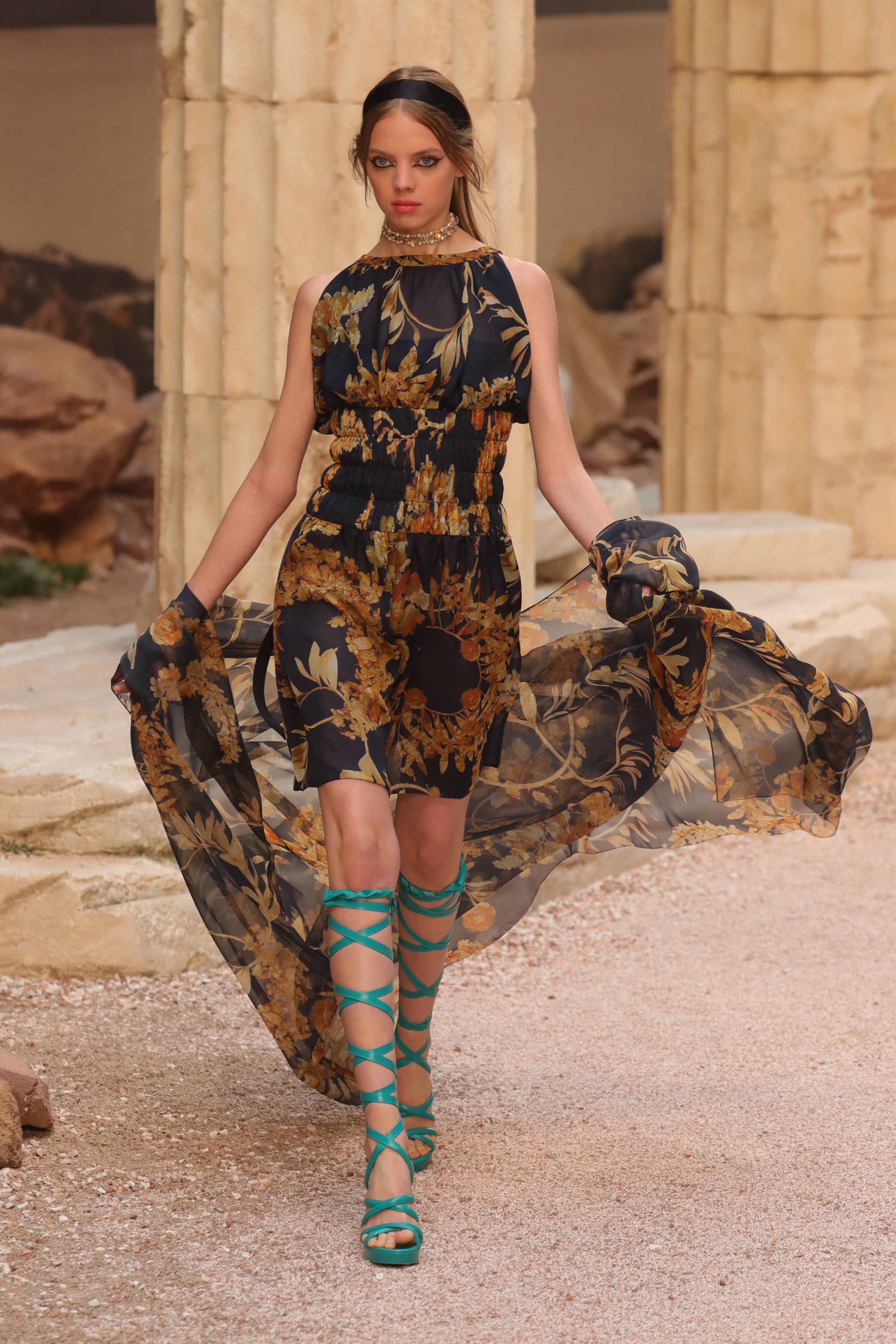
Greek drama: Chanel recreates Parthenon for Paris show 2017

https://youtu.be/5OFhV8wf0DA

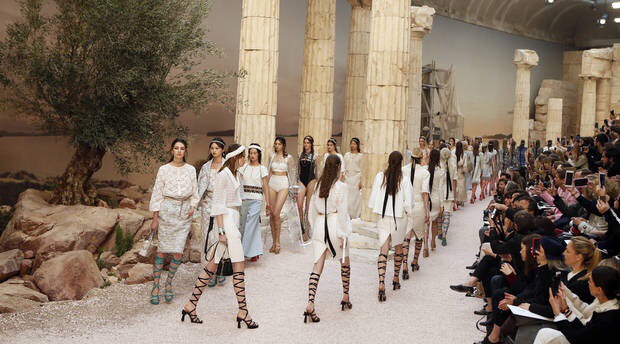
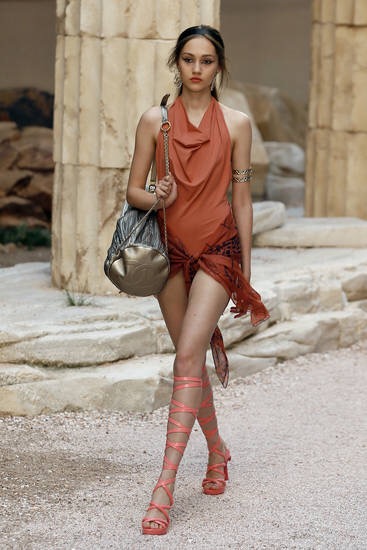
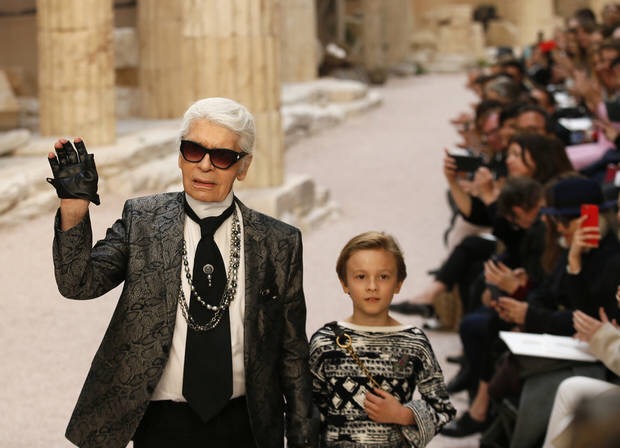
Karl Lagerfeld climbed Mount Olympus for inspiration in creating Chanel’s latest resort collection, presenting a spectacular Grecian-themed show to a celebrity audience in Paris on Wednesday.

While Gucci will go to Florence, Louis Vuitton to Kyoto, and Dior to Los Angeles to show off their cruise fashions- Lagerfeld chose to host the normally itinerant mid-season collection in Chanel’s terra mater.

Lagerfeld, a larger-than-life fashion showman who is rarely upstaged, opted instead to bring the wonders of the ancient world to Paris’ Grand Palais.

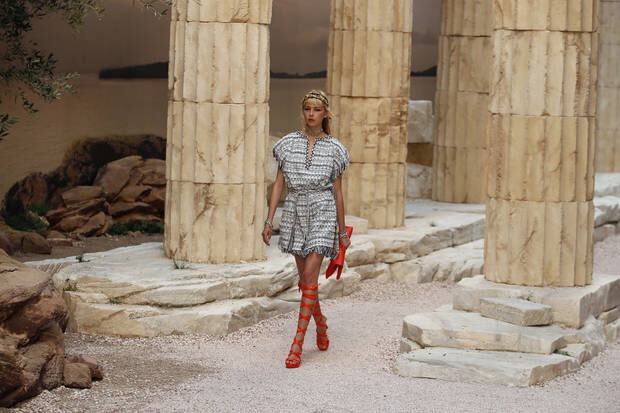
Celebrity guests who included Keira Knightley, Isabelle Huppert and filmmaker Pedro Almodovar gazed in awe at the backdrop that recreated ruins from the Parthenon in Athens and the famed Temple of Poseidon on Cape Sounion stone for stone, column for column.

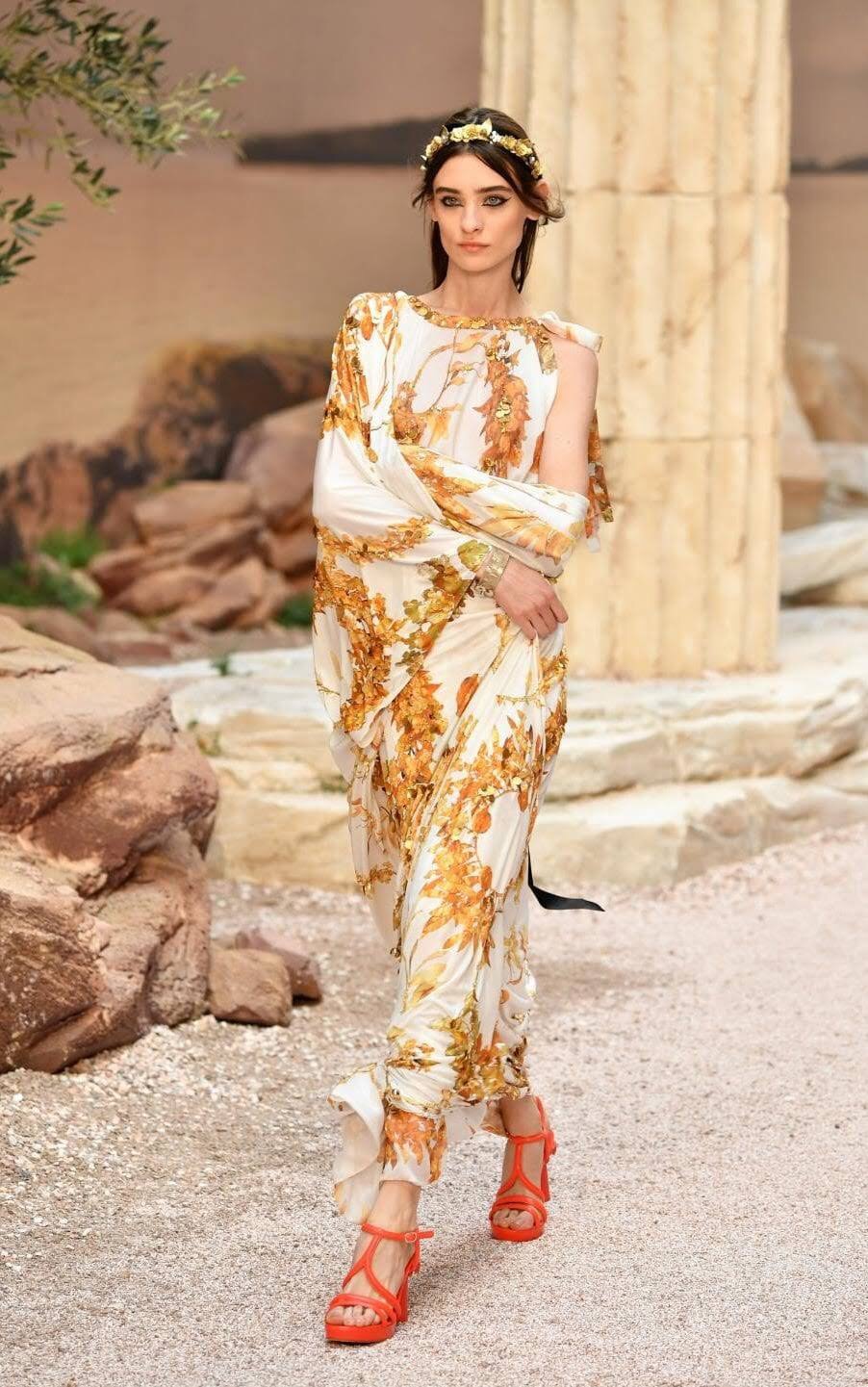
Pebbles, marble stones and sand decorated the runway alongside a real olive tree, while shrubs and mountain flowers peeked out from between the rocks by which the Grecian goddess-styled models walked during the 15-minute presentation.

“Reality is of no interest to me. I use what I like. My Greece is an idea,” Lagerfeld said of the display.

If Greece invented drama, Lagerfeld is perhaps a fitting heir.

The over-the-top decor contrasted with some very subtle and accomplished fashion designs.

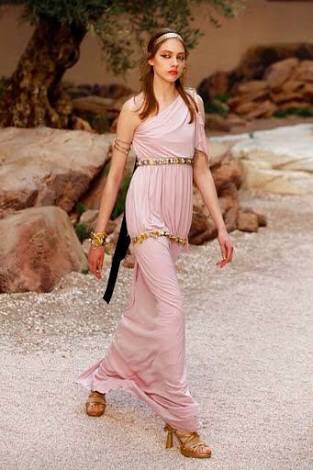
Cycladic blues, terracotta, earth browns and gold infused the looks, which riffed on Ancient Greek references.

They were replete with laurel leaf head ornaments, golden arm clasps, footwear bearing knee-high straps and even an arrow quiver transformed into a golden backpack. Thick fibers reminiscent of loomed weavings fringed tweed tunic dresses.

A clay-colored dress – with a roll under the bust and tight midriff – evoked the silhouette of the curved Greek amphora vase.

Lagerfeld loves ancient history.

“The criteria of beauty in ancient, then classical, Greece still hold true. There have never been more beautiful representations of women. Or more beautiful columns,” Lagerfeld said.

“It is really about the youth of the world in all its power and unpredictability, just like the unforgiving gods,” he added.

Cruise or resort collections – mid-season shows presented by only a handful of the world’s fashion power houses – were conceived to target wealthy women who travelled on cruise ships in winter.

Nowadays, they’re used simply as a lucrative commercial stimulant for the increasingly buoyant fashion industry’s between-season lull.

Previous years have seen Chanel’s Lagerfeld present the cruise collection in far-flung places such as Havana and Dallas.

But more recently, the 83-year-old designer has chosen his home city to celebrate the brand’s commitment to Paris and its importance to global fashion.
___
Thomas Adamson can be followed at Twitter.com/ThomasAdamson_K
Copyright 2017 The Associated Press. All rights reserved. This material may not be published, broadcast, rewritten or redistributed.
By THOMAS ADAMSON
Associated Press

Vasilis Vasilas’ interview with Giorgos Koulouris’ tailoring shop in Dulwich Hill closed after 37 years of operation

When a shop closes…

It is such a sad experience when a shop closes for the last time, especially after many years of operation. 

This is the case of Giorgos Koulouris’ tailoring shop in Dulwich Hill, which recently closed after thirty-seven years of operation! 

Vasilis was fortunate enough to interview Giorgos on the second last day before the final close. 

It was an emotional experience, as so many of Giorgos’ customers and friends continually dropped into the shop to farewell Giorgos…

As Vasilis points out, ‘Giorgos’ shop was much more than a shop; over the years, it became a small community, as the shop was a place for the local Greeks to come and meet, and exchange views on all sorts of issues. 

As these customers came to say their goodbyes to Giorgos, you could see that both Giorgos and the customers were saddened by the closure of the shop. The customers were part of Giorgo’s life but Giorgos was part of their lives too.

Giorgos and his wonderful character, zest, and humour will be sadly missed…

Source: https://www.facebook.com/SYNDESMOS-CONNECTING-PEOPLE-FROM-LESVOS-393246219501/