“I studied accounting, had the big fat Greek wedding. We purchased our working-class, suburban picket fence, birthed our daughter. I did everything I was supposed to.
Ten years later I fall from wog grace, land in the
single-parents Centerlink queue. Mum wants to bury herself in Springvale Cemetery. This wasn’t meant to happen. Then I’m introduced to men and dating.
But I don’t fuck and tell. Not me. I’m a Good Greek Girl.”
What does it mean to be a female born in Australia but raised in a migrant culture? Is it easier just to be a Good Greek Girl? What happens when you do that and it all falls apart?
Following on from their poignant one-off collaborations, Nick Tsiavos and Koraly Dimitriadis explore the space between music, film, language and theatre.
Koraly Dimitriadis
Koraly is a widely published Cypriot-Australian writer and performer. She is the author of the controversial bestselling Love and F**k Poems. Koraly received an Australia Council ArtStart grant this year and wrote, produced and co-directed four films of her poems, one of which will be incorporated into the theatre production Good Greek Girl. Koraly presents on 3CR radio and has a residency at Brunswick Street Bookstore. She is mentored by Christos Tsiolkas. www.koralydimitriadis.com
Nick Tsiavos
Nick Tsiavos is a bassist and composer whose work operates at the intersections of a number of cultural boundaries: from the mystery and beauty of 6th century Byzantium and the 12th century Medieval West, to the instability and anarchy of the present. He explores the musical possibilities that occur when Ancient Chant collides with the energies of Modernism, contemporary Minimalism and experimental improvisation. http://nicktsiavos.net/
Film: Extract from the Good Greek Girls film project
Films was written, co-directed and produced by Koraly Dimitriadis. Cinematographer and co-director, Nathan Little. The films are adapted from Koraly’s poems from her book, Love and Fuck Poems, and from her upcoming book, Good Greek Girls. Partially funded by Australia Council. A selection will be screened at the 2013 Greek Film Festival.
Researchers in Melbourne have begun the painstaking task of unravelling thousands of boxes containing historical Greek archives.
The priceless collection of art, newsreels and photographs captures the Hellenic diaspora in Australia.
And the race is on to preserve the material before it fades into history.
0
New future for historic Greek migration archive
Scholarship and heritage: from left, Ambassador Haris Dafaranos and his wife Eva with Greek community member Spiros Rombotis, La Trobe’s Professor Chris Mackie and Maria Herodotou, Archives Project supervisor Maria Ammazzalorso and Eva Fisch.
La Trobe University’s recently announced three-year Greek Archives project was inspected in September by a high-level delegation when the Greek Ambassador to Australia, Mr Haris Dafaranos and Consul-General for Victoria, Mrs Eleni Lianidou, visited the Melbourne campus.
Also taking part were the Greek Consul for Education Mr Vasileios Gkogas, three Greek community members of the La Trobe University Greek Archives Project Committee, Tassos Revis, Spiros Rombotis and George Papadopoulos, as well as Dr Maria Herodotou and Dimitris Gonis from La Trobe’s Modern Greek Studies Program.
The event was hosted by La Trobe Head of Humanities, Professor Chris Mackie, who chairs the Project Committee, project manager and Library Collections Librarian Eva Fisch, and Dr Michális S. Michael from La Trobe’s Centre for Dialogue.
Social history: Ambassador Dafaranos and Mrs Dafaranos with librarian Eva Fisch, right.
The Greek Archives document 130 years of the Greek diaspora in Australia and were formerly part of the National Centre for Hellenic Studies and Research (EKEME in Greek), which ceased operating in 2007.
They hold a wide-range of material on the social history of Greeks in Australia which is being curated and listed by a team of three bi-lingual trained staff under the direction of the University Library.
History of Greek settlement
Professor Mackie said the Greek government delegation came to see the archives and discuss their accessibility for students of the Greek diaspora in order to help the Greek and wider community learn more about the history of Greek settlement in Australia.
One of the first tasks of the project, he said, was to provide access to the Dardalis Archives of the Hellenic Diaspora, sponsored and named after Melbourne businessman and Greek community philanthropist Zissis (Jack) Dardalis.
Ambassador Dafaranos said he applauded La Trobe for undertaking such an important task. He said the extensive materials in the archive would be extremely useful for scholars in Australia and around the world, as well as for the next generation of the local Greek community.
‘What we have here now is a solid basis for the future. Greeks of Melbourne feel strongly about this archive. I believe we have an excellent team and that we can work together to have this collection promoted and used by students and researchers.’
Print and film culture: inspecting ‘The Beauty of Peran’, historic poster of a famous 1930s film, and a linotype machine adapted for early Greek publications in Australia.
Project manager Eva Fisch said the work involved going through more than 5,500 archive boxes, 80 meters of bound newspapers, costumes, newsreels, films, art objects, as well as material stored on 60 computers donated to the archive over the past 13 years.
More than 700 boxes of archives had already been completed.
She said the newspaper collection was probably one of the most extensive in the Greek diaspora anywhere in the world.
‘Dating back to 1907 the collection holds some of the oldest newspapers published in Athens, and there are a lot of papers spanning the years of the two world wars.’
Link to today’s boat people
Ms Fisch said a number of exciting projects using the archives were already in train. For example, a Master of Information Studies student will be working with the project team on devising a display on subjects such as Greek local community history and global citizenship later this year.
‘The latter display will draw links between decisions made by a family deciding to step foot on a boat in search of a better life, and major changes in our society,’ she said.
An article, published earlier this year (11 March 2013) in the Greek newspaper Neos Kosmos by Nick Kitsakis was researched at the archives. The article traced the origins of the Hellenic (soccer) cup in Victoria, and who was responsible for the organisation of this cup from the 1960s.
And a steam-punk-like industrial relic, a typesetter modified by a Greek printer to deal with the differences between the English and Greek alphabets, is the subject of another research project.
The 33 year-old Greek Australian Arthur Papas, is considered to be one of the top coaches in India. This country does not have a longtime football tradition, but the population is second in the world.
Moreover, Arthur Papas is considered as a top upcoming coach in Asia. He started his career from his birth country of Australia. At the age of 25, he was a football player but had already undergone in six knee surgeries, preventing him from continuing his game.
As coach he was distinguished by the Greek team named Okli. Then he worked as assistant coach to the U-17 Australian team as well as to Newcastle Jets. At the age of 32 he decided to continue his career in India.
There, he was responsible for the Olympic team where he assumed Dembo team (India category A) with excellent results leading him to be one of the first names of India.
Nevertheless, Arthur Papas expressed his aspirations for a career Greece.
The well-known music composer of Australia Pantelis Volaris, who is from the Greek island of Lemnos, founded the renovation of the historic “Kountouriotis Bridge” where the Greek admiral and naval hero Pavlos Kountouriotis raised the Greek flag during the Battle of Limnos in 1912.
This gesture was appreciated by the authorities of his homeland and Volaris came back to Melbourne excited and moved.
Volaris, who visits Greece every year, stayed in Lemnos until the 8th of October in order to be present at the celebrations of the local anniversary of October 8, 1912, when Lemnos became part of Greece, during the First Balkan War.
The residents of the island seized the opportunity to honor and express their gratitude to Volaris, who, on his own initiative, funded the renovation of that historic bridge of his village, while he also contributed to the erection of a monument at the seaside location of Vourlidia, where the liberation army of Pavlos Kountouriotis landed in 1912.
Obviously touched, Volaris thanked everybody for honoring him and wished that they would always celebrate this anniversary and remember the sacrifices the Greek people made.
The current President of the GOC of NSW Harris Danalis.
After a majority decision by the members of the Greek Orthodox Community (GOC) of NSW at their Annual General Meeting last Sunday – The election of a new Board of the GOC of NSW have been scheduled for Sunday December 1st.
The attention is now focused on the various stakeholders in order to form the ticket/ballots that will take part in the GOC elections.
The AGM held at the GOC’s premises in Lakemba was attended by 223 members and many of the questions from the floor enquired on the economic situation of the Community, which for 2012-2013 financial year posted a deficit of over $ 500,000.
As explained by the Board, the loss was mainly due to the foregone rents of the building in Paddington and also to the increase in staff levels and subsequent salary costs required under new government regulations for the Community’s Nursing Home.
The deficit is expected to continue for another one to three years until the renovations to the building in Paddington are completed, when it is expected that this property will once again become the financial lifeblood of the Community.
In his report the President, Mr. Harris Danalis, spoke extensively about all the services that the Community provides, while the treasurer Christos Belerchas focused on the financial outcomes- Both rejecting claims that in the last eight years the debts of the Community have increased, explaining that in 2005 the organisation was in debt $ 7 million and in 2013 that amount decreased to approximately $ 6 million.
The AGM unanimously accepted, with only one amendment, the proposals that would bind the new Board of Directors to proceed with the renovations to the Paddington building and update members on a regular basis about the progress of the works.
Another proposal discussed by the AGM, was the restriction of the use of voting by proxy. Under current rules, a voting member can register as many proxies as they want.
After hearing arguments for and against, the Presidium did not accept the proposal nor put it to a vote, because the resolution went contra to the Companies Act and this decision was consistent with the legal council (Barrister) the Board received on this issue.
Mr Nikos Thliveris was elected unopposed as president of the Election Committee, with the following elected to assist him: Katerina Vetsikas, Thanasis Economou, Anna Ioannides,
Costas Apoifis, Fokion Vouros, Stella Valenzuela.
The Greek Film Festival (GFF) marks two decades when it kicks off in Brisbane tomorrow night before making its way to Sydney, Melbourne, Adelaide and Canberra throughout November.
The festival kicks of with opening night movie What If… by writer/director Christoforos Papakaliatis. His debut feature, Papakaliatis is well known in the Greek TV arena. A Sliding Doors type of story, Demetris (also played by Papakaliatis) faces two very different paths, one as a bachelor and one as a man in love, each hinging on whether or not he takes his dog for a walk one particular night.
Box office gold in Greece, festival director Penny Kyprianou says it was the perfect choice for opening night. “It’s very accessible, with a bit of romance and drama, and it offers a different perspective to the Greek financial crisis; how financially that situation affects love and relationships.”
Marking the anniversary, Kyprianou has selected a hit list of nine festival favourites from past years, including two from writer/director Constantinos Giannaris, One Day In August and From the Edge of The City. The New York Post branded the latter a Greek version of My Own Private Idaho. Tassos Boulmetis’ A Touch Of Spice will also return to reignite the taste buds.
The Greek diaspora have their voices heard during GFF too, with closing night given over to French Greek filmmaker Costa-Gavras. Le Capital stars popular French comedian Gad Elmaleh. “Gavras is well-known for political thrillers,” Kyprianou says. “This looks into the corporate banking world and its very quick success and then demise. He’s an amazing storyteller.”
One of Kyprianou’s top picks this year is the kooky The Eternal Return of Antonis Paraskevas, written and directed by Elina Psykou. Antonis, a veteran TV host plagued by plummeting ratings, stages his own kidnapping to revive public interest. “Of course things go awry,” she says. “It’s a very original story and I think it will appeal to people who enjoy dark humour.”
For the fourth year running GFF incorporates the Greek-Australian Short Film Festival, showcasing nine shorts back-to-back in one meaty session. Australian audiences will get a second chance to see Melbourne-based filmmaker Natalie Cunningham’s You Know What I Love You, after it screened at this year’s Melbourne International Film Festival.
A simple affair that follows a day in the life of Cunningham’s 94-year-old Greek-speaking grandmother, Giannoula Panagiotopoulos, it’s a heart-warming glimpse into a life that will be instantly recognisable to Greek Immigrants and yet has a certain universality.
“Yes, it’s in Greek, and she has her own particular experience, but I think it speaks to so many people,” Cunningham says. “We’re very close and I’ve spent my whole life listening to her stories. I’m studying at the VCA, and we had the task of making a ten-minute short last year, which seemed like the perfect opportunity to make a film about her.”
Cunningham and assistant director Kylie Beale spent the entire day shooting, including capturing a gold moment involving a rather large log for the fire which Giannoula deals with ingeniously. “You can imagine the volume of material we had to work with, and all the memories. It was really hard to get it down to 10 minutes.” Maybe there’s a feature in it? “She’s got enough stories.”
“Odyssey of a Warrior” is a documentary about Reg Saunders, the first Aboriginal Officer who took part in the battle of Crete currently being filmed and produced by journalist Michael Sweet.
Saunders’ Cretan years, where he experienced the selfless courage of the Cretan people, are central to the film and informed his views on social justice ever after. The film will use footage already shot in Crete – where Saunders’ daughters recently met the villagers who saved their father’s life – a deeply emotional and dramatic event – symbolizing a powerful contemporary multicultural message of kinship.
About this film
The story of Reg Saunders MBE (1920-1990) – the Australian army’s first Aboriginal Officer is a story of courage, humility and huge adventure.
This film tells Saunders’ life story – from growing up in Lake Condah Mission in western Victoria to leaving Melbourne on a troopship as a 19-year-old Digger in the opening days of WWII. It tells of his time in Crete in 1941 – fighting the Nazis, and then going on-the-run – an extraordinary chapter in his life, when, with the help of mountain villagers, he evaded capture for a year.
Deliverance from the hands of the Germans in Europe meant that he would go on to fight in the jungles of New Guinea, and after WWII in Korea. In each case, his return to civvy street was a harrowing indictment of Australian society at the time.
This war hero – loved by those he led, who fought for his country out of a sense of duty and pride – returned to a society blighted by injustice.
Out of uniform he suffered the indifference and outright hostility of a society where institutional racism was endemic.
After challenging the genocidal evil of the Nazis, the Japanese as they advanced towards Australia, and the communist uprising in Korea – Saunders had one last opponent to fight – Australia’s own inequitable system of entrenched racial prejudice.
As the nation’s social conscience and political system began to evolve and intervene on the welfare of all Australians, in 1969 Saunders took up a position in the newly-created Office of Aboriginal Affairs as one of its first liaison officers.
There he helped change the behaviour of the Australian public service in its interactions with Indigenous people.
A multi-layered story this drama-documentary will use rarely-seen archive material, dramatic reconstruction, and sequences filmed in Greece and Victoria.
The film will use footage already shot in Crete – of Saunders’ daughters recent meeting the villagers who saved their father’s life – a deeply emotional and dramatic event – symbolising a powerful contemporary multicultural message of kinship.
In Crete, Saunders witnessed the selfless courage of another ancient rural people. The experience informed his views on social justice ever after. His experiences in Crete are central to the film.
This documentary is made with the assistance and support of the Saunders family and has exclusive access to personal records, documents and photographs.
FUNDING AMOUNT SOUGHT
AUD $100000
TOTAL PROJECT BUDGET
AUD $140000
LENGTH OF PRODUCTION
40 minutes
STAGE OF PRODUCTION
Completion
HOW DOES THE PROJECT MEET THE AIMS OF A PHILANTHROPIC FOUNDATION?
This film is about the importance of strong, mutually supportive multicultural retionships in Australian society – it is about the evolution of Aboriginal rights, but it is also a story of Australia’s rich history of South European migrant culture that stemmed from the bonds created in war.
Reg Saunders is an important role model and his story has never been documented on a canvas it deserves for the screen.
WHAT OUTCOMES DO YOU HOPE TO ACHIEVE BY MAKING THIS FILM AND HOW WILL YOU MEASURE ITS IMPACT?
A deeper knowledge of the story of Reg Saunders and his legacy. Measurable outcomes relate to the educational outreach activities related to the production including monitoring the level of distribution of the film on DVD. The producer will approach Australian broadcasters with a view to acquiring the film when complete.
WHAT IS YOUR EDUCATION AND OUTREACH STRATEGY
The intention would be for the film to be comercially distributed on DVD/Blu-ray as well as broadcast. The producer will seek distribution in schools as a teaching material for Australian High schools’ curriculum.
WHO ARE THE FILMMAKERS RESPONSIBLE FOR THE PROJECT?
Writer/Director Mike Sweet is a former documentary director and producer of BBC TV documentaries. He has also made radio documentaries for the ABC (ABC Radio National).
Mike Sweet’s work for the BBC (The Slate arts series) was nominated for a ‘Race in the Media Award’ by the UK’s Commission for Racial Equality. His other broadcast and production credits include:
The Slate – Six Postcards from Another Wales. [BBC]
The Slate – William’s Story. [BBC]. Both films dealt with multicuturalism in the UK.
Double Dragons – Hong Kong Handover special [BBC]
La Musique du Salon Deben Bhattacharya. [ETV – Bangladesh/France coproduction]
Witness 19.2.42: The bombing of Darwin [for Darwin City Council/Dept of Veterans’ Affairs]
Target Darwin [Online/iPad production for Fairfax Media]
ABC Radio National documentary production credits:
Producer: By Design: ‘Searching for Beni’. Hindsight: ‘The Road to War’.
BBC Radio credits: ‘A Different Dragon – Hong Kong Handover’.
South Asia Today.
Wests Tigers’ Braith Anasta showed why he is a quality player after he led Greece to a 90-0 whitewash over Hungary at Budapest on Sunday.
Anasta piled on 46 points for the Greeks, who included eight players from the Greek Rugby League domestic competition. He scored four tries and kicked 15 goals from as many attempts, many of them wide out.
“I was really nervous before the game. I talked to my mum and brother before the game and I was emotional,” said Anasta.
“To play for Greece was a proud moment for me, for my dad and grandparents. It was the first time I was in Greece and I loved it.”
Greece took just three minutes of play to open their account when Sebastian Sell scored after a backline movement.
It was 12-0 after 10 minutes of play after Kristian Aroutsidis scored wide out. Anasta kicked the conversion from the sideline.
Terry Constantine scored two tries in three minutes, Mitchell Zampetides scored a brace and Anasta went over for his first of his four pointers as Greece established a 42-0 lead at half-time.
Anasta scored two quick tries early in the second half before Nake Ioannis, one of the eight players chosen from Greek domestic competition, burrowed over from dummy half to score in the 52nd minute. Anasta added the extras and Greece were cruising at 60-0.
Adam Bouris added two tries while Terry Conastantinou crossed for his third try of the game.
Sell scored in the 73rd minute and it was fitting that Anasta finished the scoring when he latched onto an intercept to score with two minutes remaining.
The positive to come out of the game was the way the local Greek players performed.
“The European and International Federation need to put resources into countries like Greece and Hungary,” said Anasta.
“The passion for the game in Greece was incredible. They want to play Rugby League and we need to help them.”
Greece 90 (Braith Anasta 4, Terry Constantinou 3, Mitchell Zampatides 2, Sebastian Sell 2, Adam Boris 2, Nake Ioannis , Kristian Aroutsidis tries; Anasta 15 goals) d. Hungary 0 at Mac Stadium, Budaprest, Hungary. Referee: Radoslav Novakovic. Half-time: Greece 42-0. Crowd: 1013.
A BIG THANKS goes to Steve and Rosa Prapas together with their family and friends for their huge effort on the day.
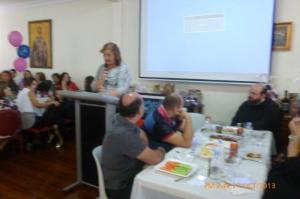
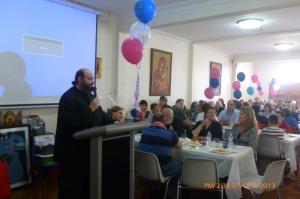
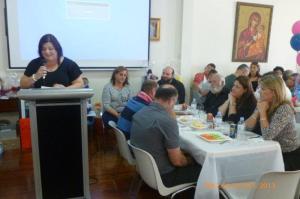
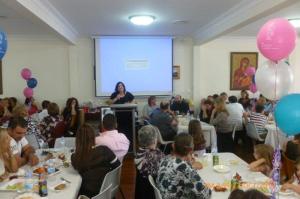
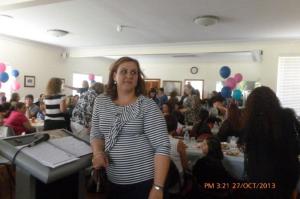
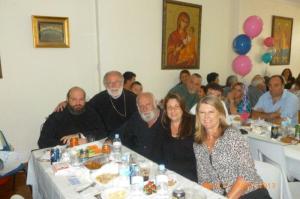
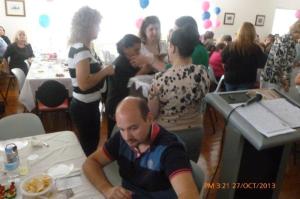
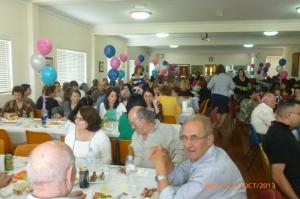
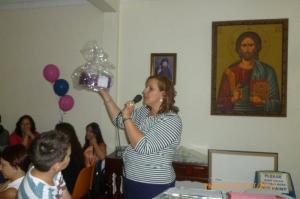
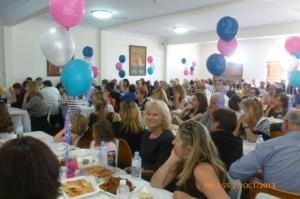
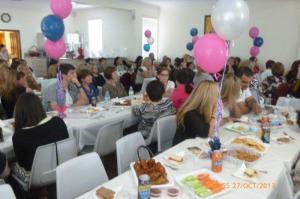
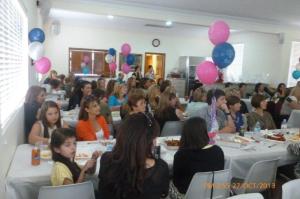
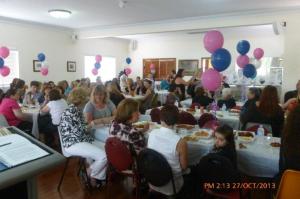
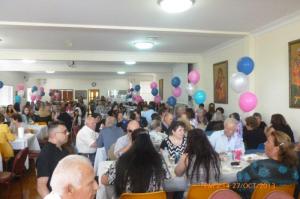
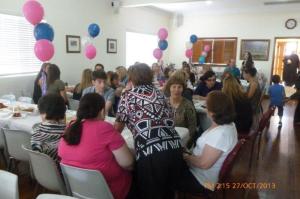
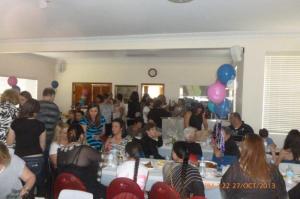
A wonderful tea charity event was organised at St Nicholas Church at Marrickville on the Sunday 27th October, 2013 to raise much needed funds for Bear Cottage at Manly.
A lot of work was put into the planning and running of the event to raise money towards Bear Cottage, Manly.
Peoples’ generosity ensured that all raffles, money board games, auction items were sold in record time.
Steve and Rosa Prapas are extremely pleased to announce that $14,000 was raised for Bear Cottage in Manly which will directly go to the children of the cottage in an effort to make those beautiful smiles even bigger.
The huge donation to Bear Cottage would not have been possible without the generous donations from businesses and individuals that supported the event through cash or donation of prizes.
The day was a huge success with 220 supporters from the Marrickville Greek community and as well as non-greek residents of the area.
Rosa Prapas
Reverend Christodoulos Economou
Penelope Tserpes talking about her experience at Bear Cottage
Rosa Prapas watching slides of Rita’s experience at Bear Cottage
Reverend Christodoulos Economou, Reverend Father Nicolaos Bozikis, Rita’s grandfather and mother and Narrelle Martin (Hospice nursing unit manager, Bear Cottage)
People couldn’t get enough of buying tickets
Rosa Prapas on a roll in starting the auction items
Coffee and cake time
j
What is bear cottage?
A little bit about Bear Cottage
Bear Cottage is the only children’s hospice in NSW, one of only two in Australia, and the only one in the world affiliated with a children’s hospital. It is a very special place that’s dedicated to caring for children with life-limiting conditions and their families.
Planning began for Bear Cottage almost 20 years ago, when Dr John Yu and Dr Michael Stevens from The Children’s Hospital at Westmead decided to enhance the hospital’s palliative care program.
Located on Sydney’s Northern Beaches, in Manly, Bear Cottage is like a home away from home – as far removed from a hospital environment as possible. Here staff do not wear uniforms, no medical procedures are carried out in the bedrooms, the children’s rooms are designed to like a normal bedroom, and we even have a family pet, Frankie, our adorable Labrador. That said, Bear Cottage is set up to provide excellence in paediatric medical care 24 hours a day, and our affiliation to The Children’s Hospital at Westmead means we have access to some of the best medical resources in the world.
The facility was established entirely through community support, at a cost of $10 million, and was officially opened on St Patrick’s Day, 17 March 2001,
Bear Cottage does not receive any recurrent government funding and so continues to rely on donated funds and community support to raise over $2.9 million required to operate each year.
,
Who benefits from Bear Cottage?
Bear Cottage provides support, respite and end of life care for children with life-limiting illnesses and their families.
We care for children from across Australia, regardless of where they receive their primary care, although the majority of families that access the service are from NSW. The children who visit Bear Cottage will range from newborn infants to 18 years of age; however accommodation is also available for parents, as well as siblings, of the children staying.
When these families are told that their child’s life will be cut short, their everyday existence takes on a monumental change. As they embark on such a terrible journey, there are limited options available to help them get through each day, and answer the many questions that arise. Having Bear Cottage available to them for care and support enables these families to focus on the important things, such as spending quality time together and making every moment count.
Most families staying at Bear Cottage will come for respite; with the average length of stay is around one week to ten days. Families are generally able to visit Bear Cottage around 4 times a year for general respite, however for end of life care this can be open ended.
m
The Facts and Figures
Estimates suggest there are well over 5000 children aged 0 – 19 years across Australia requiring palliative care. In the last year alone we have cared for well over 200 children with a life-limiting illness. There have been 16 children this year that have come to Bear Cottage for end-of-life care – where they can be surrounded by love and support, in a happy, safe environment, right until the end. And in the last 10 years we have supported around 600 families, both current and bereaved, as they go through their heart wrenching journey.
.
Why is Bear Cottage special?
Whilst staying with us, our families can do as little or as much as they like. We have staff and volunteers on hand to do the cooking and cleaning, allowing families to forget about the stresses of everyday life, if just for a short time. We are fully medically assisted, so our nurses are available 24 hours a day to administer medications and support and guidance; and Frankie, our resident dog, is always around for a cuddle. We have full-time play and music therapists, and volunteers are there so mum and dad can spend time together or with their other children – often something that is forgotten when you’re caring for a terribly ill child.
Bear Cottage is there for every child, parent, or family who needs us, and they will never have to pay a cent. With one, and sometimes both parents, giving up work to care for their child, many of our families are simply not in a financial position to pay for anything that is not absolutely necessary.
By having Bear Cottage available to them at no charge means they can take a break and re-charge their batteries, safe in the knowledge that their child is being cared for by the best staff available. They can enjoy time with one another without having to worry about the housework and cooking. Most importantly though, they can spend quality time together and create special memories that will last long after their child has passed away.
l
Goals for Bear Cottage – 2013
It currently costs more than $2.9 million a year to keep the doors open at Bear Cottage. With no recurrent government funding, we rely entirely on community support to raise these funds.
Our goal for 2013, as with every year, is to raise sufficient funding to keep Bear Cottage available for the very special kids and their families that rely on it. We also aim to give the children that visit Bear Cottage as many special memories as possible – because although we can’t add years to their lives we can add life to their years.
All funding makes an incredible difference to Bear Cottage and the children that come here. It allows us to continue providing vital services such as:
paying for daily medication for patients
funding important kid and parent camps
providing a play therapist for the children
ensuring that vital equipment is available for treatment and care
help fund families to stay at Bear Cottage for respite and end of life care
help pay for a specialised paediatric palliative care doctor
For many people, Bear Cottage is perceived as a sad place. But for those families who visit here, the staff who work here and the volunteers and community who support us, it is an incredibly special and happy place, where lasting memories are created.
Something to behold: Catherine with a headpiece from”Replica’s are us”. Pictures: John Veage
Pictures: John Veage
Pictures: John Veage
Mary ”Effie” Coustas. Pictures: John Veage
An estimated 40,000 people attended the annual Gymea Village Fair on Sunday – a record, according to organisers.
The turnout was even more impressive considering that the weekend shaped up as a Super Sunday for fairs across St George and Sutherland Shire including the Greek festival at Carss Park, Halloween celebrations at Kyeemah, as well as the Food and Groove Festival at Bexley the previous day.
Aussies might be keen on yelling ‘‘oi’’ oi’’ ‘‘oi’’, but around this time of year Greeks like to mark ohi day.
The ‘‘ohi’’ stands for ‘‘no’’ symbolising Greek resistance during World War II to the forces of Italy’s Mussolini.
The Greek commemorative day marked on Sunday added a lighter side to the anniversary when an estimated crowd of about 20,000 people came to mark the occasion with the Being Greek festival at Carrs Bush Park.







 Something to behold: Catherine with a headpiece from”Replica’s are us”. Pictures: John Veage


 GREEK WORLD MEDIA