Greek-Canadian stand-up comic bringing laughs to Athens

Source: Ekathimerini

One of Greece’s wayward sons is about to make a stand-up return. With the support of the Canadian Embassy, Canadian-Greek comedian Angelo Tsarouchas will take the stage at the Michael Cacoyannis Theater this Sunday, November 24. The show – in English but sprinkled with bits of Greek – forms the subject of “Back to Sparta,” a film documenting the comedian’s lifelong goal to perform live in his ancestral country.

Tsarouchas was born in Montreal, but his family originally hails from Sparta. “People would ask me how I learned to speak Greek and I would tell them it was because my mother couldn’t speak English,” notes the current Los Angeles resident. Tsarouchas has performed for audiences around the world, but this visit marks his first to Greece in a professional capacity. “This is where my parents are from. We used to spend summers here when we were younger. It’s always been a dream of mine to come back.”

Much of Tsarouchas’s humor pokes fun at his bulky figure and Greek heritage. His last stand-up special, “Bigger is Better,” premiered on Showtime and attracted upward of 14 million viewers. Past performances have also included roles in the films “Harold and Kumar Go to White Castle” and “Cinderella Man.” The production of a new sitcom series, “The Angelo Show,” was recently confirmed and will feature fellow comedian Vince Vaughn in the role of executive producer.

Tsarouchas lists Harry Klynn (Vassilis Triantafyllidis) and Lakis Lazopoulos as his greatest artistic influences. Last week he had the opportunity to meet Lazopoulos in Athens – “a very funny man and a class act.”

Touring across Canada and the United States, fellow comedians would ask Tsarouchas why Greeks were always so congenial to one another. “That’s just the way we are,” he would reply. “That’s the way we’ve been raised. We’re probably the proudest people on Earth.” Tsarouchas’s homecoming takes him back to the roots of that pride. “I only wish that more artists of the diaspora would do the same,” he adds.

General admission to Tsarouchas’s “One and Only Stand-Up Comedy Performance” costs 10 euros. Tickets can be purchased in advance by calling 210.341.8579 or visiting the Michael Cacoyannis Foundation’s website, http://www.mcf.gr. The show begins at 9 p.m. Michael Cacoyannis Foundation, 206 Pireos.

Owners of some 300 hotels in Greece are seeking investors in Russia to sell their units

Source: Ekathimerini

Hoteliers look for investors from Russia

The owners of some 300 hotels in Greece are seeking investors in Russia to sell their units, Nikos Angelopoulos, the honorary president of the Association of Hellenic Tourism Enterprises (SETE), revealed on Thursday.

Angelopoulos added that the hotel owners have already sent the relevant information to the Russian Embassy in Athens.

He was speaking at a round-table discussion on tourism development that took place at a Thessaloniki hotel, organized by the German-Greek Chamber of Commerce and Industry.

Given the major difficulties hoteliers are facing, SETE President Andreas Andreadis will meet with top officials of banks and the Hellenic Bank Association in the coming days in a bid to find a solution to the cash flow problem in the tourism sector.

Thousands detained in Greek jails

Source: nation.com.pk

Thousands of Pakistani youngsters remain stranded at detention facilities in Athens city of Greece after illegal border-crossings, said an FIA officer, citing 42 Pakistani deportees who touched down in Lahore on Thursday.
The deportees arrived by Qatar Airlines flight QR-620 at around 7:50 in the morning. It was the third flight within a week brining deportees back from Athens in large numbers.  Forty-four Pakistanis were deported on Wednesday and 31 on November 14 from Greece. The deportees were transported under International Organization of Migrants programme.
A 60-member Greek intelligence squad handed the deportees over to FIA Immigration Additional Director Basharat Shehzad and other authorities deputed at the Lahore airport.
The deportees tell the sad story of their peers trapped in Athens. There is nobody who could listen to these youngsters, they say.  According to a senior FIA official, all the deportees were released against personal surety and none was sent to Agency’s Anti-Human Trafficking Cell for further action. Only one of them possessed the genuine travel documents, added Ali Imam Zaidi, FIA Immigration assistant director. Ninety-five per cent of these deportees belonged to upper Punjab districts of Gujranwala, Gujrat, Sialkot, Mandi Bahauddin, Lala Musa, Kharian and Jhelum, senior FIA official Abu Zar Sibtain told The Nation.
Another FIA official who wished anonymity raised the alarm that human trafficking was on the rise in the country, notably in upper Punjab. But, he added, the Agency could not act accordingly because of many influential persons and parliamentarians having stakes in this big business.  The official further said only cosmetic measures had been taken to curb human trafficking and that was the reason the real accused were operating freely unmindful of the bad name they were brining to the country.
The economy of Greece is already in a shambles due to which Pakistanis crossing into Greece in search of better future got trapped there. As per the laws, after being arrested and deported, a person is not supposed to be arrested or sent to jail in his homeland.
Interestingly, a former FIA Punjab director Waqar Haider had chalked out a strategy about sending deportees from airport to FIA provincial headquarters just for fame. His blue-eyed inspector Chaudhry Hanif would then mint money from them by hook or by crook. Each deportee had to pay Rs25,000 to Rs30,000 to secure his release.
Nevertheless, everything has changed now. Incumbent FIA Punjab Director Qudratullah Marwat has ordered to release every deportee from the airport. It may be noted here that most of the deportees were between 22 and 30 years of age. They had paid a huge sum of money to get out but put their lives at risk instead.
Reports say each deportee would pay around Rs0.5 million to Rs0.7 million to human smugglers for his entry to Greece.
An FIA officer said human traffickers used illegal route of Iran via Balochistan, and then from Iran to Turkey and into Greece. They make their entry through illegal border-crossings where, sometimes, border police open fire on them and some of them lose their lives too.
Sometimes these deportees are kidnapped by their own Pakistani people after reaching Greece. As per reports, Pakistanis already present in Greece and those who are jobless have started abducting their own countrymen for ransom.
These criminals trap newcomers. They lure them with providing of good jobs but after transporting them to undisclosed locations they torture them. They make telephone calls to their families in Pakistan and demand ransom from them.

Ancient Greek gears: the mystery of the first computer

Source: irishtimes.com

That’s Maths: A mechanical device first discovered underwater in 1900 shows how advanced the Greeks were

A reconstruction of Antikythera Mechanism in Athens. Photograph: Louisa Gouliamaki/AFP/Getty ImagesA reconstruction of Antikythera Mechanism in Athens. Photograph: Louisa Gouliamaki/AFP/Getty Images

Two storms, separated by 2,000 years, resulted in the loss and recovery of one of the most amazing mechanical devices made in the ancient world.

The first storm, around 65 BC, wrecked a Roman vessel taking home loot from Asia Minor. The ship went down near the island of Antikythera, between the Greek mainland and Crete. The second storm, in 1900, forced some sponge divers to shelter near the island, where they discovered the wreck.

This led to the first major underwater archeological expedition. In addition to sculptures and other art works, an amorphous lump of bronze, later described as the Antikythera Mechanism, was found.

On examination, the bronze lump turned out to be a complex assemblage of gears, a mechanical device previously unknown in Greek civilisation. Inscribed signs of the Zodiac suggested that it was probably for astronomical rather than navigation purposes.

Several techniques were used to establish that the AM is about 2,000 years old. Carbon dating of the ship’s timber put it at about 200 BC, but the wreck could have been many decades later.

The style of amphora jars found on board implied a date between 86 BC and 60 BC. Coins found in the wreckage allowed this to be pinned down to about 65 BC.

The inscriptions on the mechanism link it to Corinth and thence to its colony at Syracuse, where Archimedes flourished. This gives an intriguing possibility that the AM was in a mechanical tradition inspired by Archimedes.

The mechanism was driven by a handle that turned a linked system of more than 30 gear wheels. Using modern imaging techniques, it is possible to count the teeth on the wheels, see which cog meshes with which and what are the gear ratios. These ratios enable us to figure out what the mechanism was computing.

The gears were coupled to pointers on the front and back of the mechanism, showing the positions of the sun, moon and planets as they moved through the zodiac. An extendable arm with a pin followed a spiral groove, like a record player stylus. A small sphere, half white and half black, indicated the phase of the moon.

Even more impressive was the prediction of solar and lunar eclipses. It was known to the Babylonians that if a lunar eclipse is observed, a similar event occurs 223 full moons later. This period of about 19 years is known as the Saros cycle. It required complex mathematical reasoning and technology to implement the cycle in the mechanism.

The mechanism could provide accurate predictions of eclipses several decades ahead. Derek de Solla Price, who analysed it in the 1960s, said the discovery was like finding an internal combustion engine in Tutankhamen’s tomb.

The Antikythera mechanism has revolutionised our thinking about the scientific legacy of the Greeks. It is like modern clockwork, but clocks were invented in medieval Europe. It shows that the Greeks came close to our technology. Had the Romans not taken charge, we might today be far in advance of our current level of technology.

All the gear ratios are now understood; there was even a dial to indicate which of the pan-Hellenic games would take place each year, with the Olympics occurring every fourth year. Just one small cog remains a mystery. Research is continuing, and more remains to be discovered about this amazing high-tech device.

Two weeks ago, a bill was introduced in Turkish parliament to convert Hagia Sophia into a mosque

20131120-122923.jpg

Source: http://hellenicleaders.com/HagiaSophia

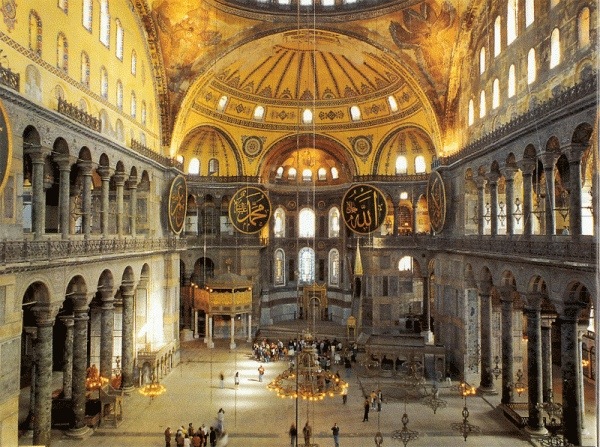
A few days ago, deputy prime minister of Turkey Bulent Arinc stood next to Hagia Sophia and made a shocking declaration: he declared to his audience that “[w]e currently stand next to the Hagia Sophia Mosque […] we are looking at a sad Hagia Sophia, but hopefully we will see it smiling again soon.”

The Greek government has released a response:

“The repeated statements from Turkish officials regarding the conversion of Byzantine Christian churches into mosques are an insult to the religious sensibilities of millions of Christians and are actions that are anachronistic and incomprehensible from a state that declares it wants to participate as a full member in the European Union, a fundamental principle of which is respect for religious freedom. Byzantine Christian churches are an intrinsic element of world cultural and religious heritage, and they should receive the necessary respect and protection.”

Of course, the Turkish government couldn’t care less about the reaction of Greeks or Christians. The movement within Turkey to turn Hagia Sophia into a mosque has gained steam as of late, and earlier this year, a petition was submitted to a parliamentary commission to accomplish the conversion.

Less than two weeks ago, a bill was introduced in Turkish parliament to convert Hagia Sophia into a mosque, laughably claiming that its conversion into the museum it is today was somehow “illegal.” This is what the bill’s sponsor had to say about the matter:

“This bill has been prepared aiming to open the Hagia Sophia – which is the symbol of the Conquest of Istanbul and which has been resounding with the sounds of the call to prayer for 481 years – as a mosque for prayers.”

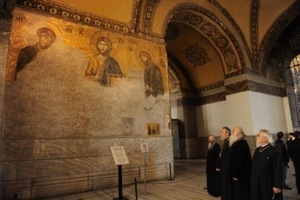
And there you have it. For millions around the world, Hagia Sophia symbolizes the history of Christianity, the glorious grandeur of Byzantine architecture, or the stunning ability of man to sculpt faith into a creation that stirs the hearts of onlookers to this very day.

For the bill’s sponsor and many others in Turkey? Hagia Sophia is simply “the symbol of the Conquest of Istanbul,” a passive representation of the height of Ottoman power. For them, Hagia Sophia has no intrinsic value but is instead a means to an end. Its conversation into a mosque would be yet another “conquest,” a victorious notch in the proverbial belt of an re-ascendent Ottomanism.

The “Blue Mosque” – located just a over a kilometer away from Hagia Sophia.

After all, it’s not like the city needs another mosque. Just one kilometer away from Hagia Sophia is Turkey’s famous Blue Mosque, completed in 1616 and still used to this day as a mosque for prayers.

Still, the relentless pursuit of converting historical Christian sites to mosques marches on in Turkey. One other Hagia Sophia, a smaller church-turned-museum in Trabzon, Turkey, has already been turned into a mosque this year. A court ruled that its conversion into a museum was “illegal.” It’s a case that sets a dangerous precedent.

We need your help to stand up for Hagia Sophia. Add your voice to the international petition in opposition to converting Hagia Sophia into a mosque:

http://hellenicleaders.com/HagiaSophia

20131120-123002.jpg

AUC’s Greek campus to be transformed Into Egypt’s first technology park

Source: dailynewsegypt.com

Greek Campus in Downtown to be transformed into Egypt’s first technology park

The Greek Campus has functioned as home for the AUC library back when the main AUC campus was Downtown (Photo from The American University in Cairo)

The Greek Campus has functioned as home for the AUC library back when the main AUC campus was Downtown
(Photo from The American University in Cairo)

A part of The American University in Cairo (AUC) for almost five decades, the Greek Campus will now be home to Egypt’s first technology park in downtown Cairo. AUC has signed a 10-year lease agreement with Tahrir Alley Technology Park (TATP), a Cairo-based company that intends to keep the Greek Campus name and operate it, with AUC retaining full ownership. A reception was held on the Greek Campus on Thursday, 14 November to officially announce the university’s plans. “We hope this new initiative will bring vitality to what has been, and will remain, our neighborhood and the home of our historic Tahrir Square campus,” said AUC President Lisa Anderson. “It is especially rewarding to see that the campus will be used to serve the purpose of advancing technology and entrepreneurship.” Ahmed El-Alfi, founder of TATP, looks forward to creating a hub where entrepreneurship and creativity can thrive in the heart of Cairo: “The Greek Campus will not only act as technologically advanced office spaces but also as a center for creative minds, startups, and technology multinationals to work, meet, and collaborate.”

The location dates back to even earlier times since it was established in 1964 (Photo from The American University in Cairo)

The location dates back to even earlier times since it was established in 1964
(Photo from The American University in Cairo)

Purchased by the university from the Greek community in 1964, the Greek Campus –– which has been closed since after AUC relocated to New Cairo in 2008 –– was the hub of social activity for students, located one block away from the Main Campus. It housed the library, Social Science Building, Social Research Centre, Jameel Center and School of Continuing Education (previously known as the Centre for Adult and Continuing Education and Division of Public Service). When it was first purchased, the Greek Campus included a theatre, print shop, two tennis courts and a cafeteria.

The Greek Campus was purchased during the presidency of Thomas Bartlett, who was in his mid-30s at the time, who worked relentlessly on expanding AUC’s facilities for it to grow and become a first-class institution contributing to Egypt’s development. “In the late 1940s, it was apparent that more space was needed to accommodate the expansion in the student body and programmes,” said Bartlett in “The Day We Bought the Greek Campus.”

To do that, Hill House and the Science Building were constructed in 1953 and 1966, respectively. In 1964, money that was initially going to be used for the construction of a 10-storey building on the Main Campus was used instead for the purchase of the Greek Campus, the largest addition to the university during Bartlett’s tenure. “Suddenly, the opportunity came to buy two Greek schools, where the Greek Campus is now located, [but] we first needed approval to use the money given to us for construction on the Main Campus for purchasing the Greek schools instead,” said Bartlett, who served as interim AUC president from 2002 to 2003 and is currently an AUC trustee. “The Board of Trustees approved the proposed shift on 19 July 1964.”

It is located in the middle of Downtown Cairo, a walking distance from AUC’s main gate on Mohamed Mahmoud’s street (Photo from The American University in Cairo)

It is located in the middle of Downtown Cairo, a walking distance from AUC’s main gate on Mohamed Mahmoud’s street
(Photo from The American University in Cairo)

Once permission was secured, Bartlett faced another challenge. The Greek community wanted hard currency, and that is something “AUC did not have and could not legally have paid,” he said. In addition, there were doubts as to whether AUC was eligible to buy the Greek Campus under the laws that were in effect at the time. “Fortunately,” said Bartlett, “Mr. Pierakos [Greek community leader] eventually accepted Egyptian pounds, and the Egyptian authorities did not object to the sale.”

“On the day of the sale,” Bartlett said, “Mr. Fayek Wissa, the accountant, and I had to carry several satchels containing the purchase money, since a cheque was not legal tender for the transaction. About EGP 409,500 in ten pound denominations had to be counted and transferred in the presence of the official in the registration office. That was done, and the final papers for the purchase were signed on 15 March 1965.”

One of the most distinct features of the Greek Campus was the library. The library was initially located in Hill House, but with the rapid increase in the university’s collection of books and periodicals and the ever-expanding needs of students and faculty members, the building became inadequate. In 1971, President Christopher Thoron consulted with experts in the field, and the Board of Trustees asked American architect Hugh Jacobson to draft plans for a new library that would be located in the Greek Campus. In May 1974 AUC broke ground on the project and construction progressed until 1976, when a fire broke out, destroying columns, beams and cement work on the first floor. Work on the library was halted for nearly two years, and in 1982, under the tenure of President Richard F. Pederson, the Greek Campus library was complete. Jacobson designed the library building with its exterior facing the street, as well as a plaza and platform steps extending from the building to the garden areas at the centre of the Greek Campus. As Thomas A. Lamont noted in The American University in Cairo: 1987 – 1995: “The dramatic contours of AUC’s library have given the Greek Campus its own architectural flavour.”

The campus is known for its shaded areas, which were often frequented by students resting in between classes (Photo from The American University in Cairo)

The campus is known for its shaded areas, which were often frequented by students resting in between classes
(Photo from The American University in Cairo)

The most attractive building is that of the library designed by architect Hugh Jacobson (Photo from The American University in Cairo)

The most attractive building is that of the library designed by architect Hugh Jacobson
(Photo from The American University in Cairo)

Another major building on the Greek Campus was the Abdul Latif Jameel Centre for Middle East Management Studies, for which construction began in 1987 and was completed in 1989. The building accommodated the steady growth of the student body in the late 1980s and early 1990s, as well as the increasing demand on management, engineering sciences and other professional programmes. The Social Science Building on the Greek Campus, with its long, tall staircase, housed the departments and offices of the School of Humanities and Social Sciences. In addition, the Division of Public Service, which is now the School of Continuing Education, offered, for many years, adult education courses at the Greek Campus to large numbers of Egyptians, affirming the university’s mission of service to the community.

An integral part of student life, the Greek Campus has been witness to 50 years of AUC traditions, activities and memories; from performances in Wallace Theatre, University Senate meetings in the Blue Room, student club activities, including group weddings for orphans, late-night stays in the Caravan newsroom and crowds of students at the Copy Centre to International Day festivities: fun for children at the day care centre and gatherings in the Model United Nations office located in the Social Science Building.

To bid farewell to the Greek Campus before the university’s move to New Cairo, a gathering was held there in May 2008, bringing together members of the AUC community. The event included folklore and music performances, as well as a documentary featuring faculty, students and alumni reflecting on precious memories and favourite spots on campus.


Turkey pays tribute to late Greek Cypriot leader Clerides

Source: hurriyetdailynews.com

People pass a poster showing former Cypriot President Glafcos Clerides in the capital Nicosia, on Nov. 15, 2013. AP photo

People pass a poster showing former Cypriot President Glafcos Clerides in the capital Nicosia, on Nov. 15, 2013. AP photo

Turkey has released a condolence message for former Greek Cypriot leader Glafcos Clerides, voicing sadness over his loss and underlining his service for the Greek Cypriot people.

“It is particularly saddening that Clerides lost his life without being able to see that a permanent and comprehensive resolution that would rebuild partnership on the island had been reached,” the Turkish Foreign Ministry said in a written statement released on Nov. 17.

The statement also recalled that Clerides’ lobbying efforts for a U.N. reunification plan for Cyprus had ultimately failed after the Greek Cypriot side rejected it in a public referendum in April 2004. The plan, named after then-U.N. Secretary-General Kofi Annan, was accepted by the Turkish Cypriot community.

Born in Nicosia on April 24, 1919, Clerides, 94, founded the ruling right-wing DISY party in 1976 and served as Greek Cyprus’ president from 1993 to 2003 in back-to-back terms.

The Foreign Ministry statement particularly underlined that, starting from 1968, Clerides had played an important role in the negotiation process aimed at resolving the Cyprus issue, along with the founder president of the Turkish Republic of Northern Cyprus (KKTC), the late Rauf Denktaş.

Greek militant group claims Golden Dawn killings

Source: reuters.com

People holding flowers and a Greek flag stand near the local offices of far-right Golden Dawn party, following last night's shooting, in a northern suburb of Athens November 2, 2013. REUTERS/John Kolesidis

People holding flowers and a Greek flag stand near the local offices of far-right Golden Dawn party, following last night’s shooting, in a northern suburb of Athens November 2, 2013.

A Greek anti-establishment group has claimed responsibility for a drive-by shooting this month that killed two supporters of the far-right Golden Dawn party and raised fears of an escalation of political violence.

The previously unknown group “Militant People’s Revolutionary Forces” said the attack had been carried out in retaliation for the fatal stabbing of anti-fascism rapper Pavlos Fissas, to which a Golden Dawn sympathizer has confessed.

Police could not confirm the authenticity of the claim, which came on the eve of rallies to commemorate the 40th anniversary of a bloody student uprising against the military junta that ruled Greece at the time.

“The brazen murder of Pavlos Fissas was the drop of blood that made the glass overflow,” the group wrote in an 18-page letter filled with anti-establishment invective published on the news website http://www.zougla.gr . It called the rapper’s killing a “turning point”.

“The armed attack-response … is the starting point of the people’s campaign to send the neo-Nazi scum of Golden Dawn where they belong, to the dustbin of history,” it said.

The shooting of the two young Golden Dawn supporters outside the party’s offices in Athens on November 1 came at a time of growing public anger against a party widely regarded as neo-Nazi and accused of attacks against migrants and leftists.

Golden Dawn denies accusations of violence and rejects the neo-Nazi label. It denies any involvement in Fissas’s killing.

An opinion poll released on Saturday indicated that support for Golden Dawn had grown since the two men were gunned down.

The party, Greece’s third most popular in surveys, had shed almost a third of its support after Fissas’s death in September.

The poll by ALCO for Sunday’s Proto Thema newspaper, conducted on November 12-15, put support for Golden Dawn at 8.8 percent, up 2.2 points in a month but still below the 10.8 percent it enjoyed in June.

A government crackdown on Golden Dawn after evidence linking it to Fissas’s killing has led to party leader Nikolaos Mihaloliakos and five more of its lawmakers being charged with belonging to a criminal group. Mihaloliakos and two of the lawmakers have been remanded in custody until their trial.

(Reporting by Karolina Tagaris; Editing by Kevin Liffey)

Mykonos’ charming Greek identity makes it the perfect location for an unforgettable break

Source: dailyrecord.co.uk

WHILE Mykonos has evolved into a playground for the rich and famous, it’s lively nightlife still makes it the ideal place to let your hair down.

MykonosMykonos

MYKONOS town is just warming up at midnight as we wander through the area known as Little Venice, named because of the lofty houses with bright balconies jutting out over the Aegean Sea.

“Which bar is the best?” I ask a waiter from a nearby taverna. He looks me up and down. “Depends what you’re into,” he replies, winking.

“Well, we’re married straight girls who like dancing to gay disco music,” I say, not missing a beat.

He points us in the direction of Semeli Bar, where revellers are already boogying to a medley of Black Eyed Peas, Abba and Greek pop. We soonjoin in.

Whatever your persuasion – gay, straight, married, single, young, old – if you’re out for fun, then this tiny island in the Greek Cyclades is the ideal place to let your hair down.

I visited 25 years ago as a backpacker and it wasn’t quite as glamorous then (rooms were £2 a night and a cheese pie was considered fine dining). But over the past decade it has morphed into one of the hippest destinations in the world. It’s the kind of place where you might easily bump into George Michael in his Speedos or, in our case, the multi-millionaire coiffeur Charles Worthington.

We stayed at one of a new breed of uber-cool boutique hotels, Grace Mykonos, situated above the beach at Agios Stefanos, with its kaleidoscope of sun parasols and the most authentic Greek tavernas on the island.

On arrival, we are handed a glass of champagne and told to relax, which isn’t difficult amid the typical Mykonian architecture, all dazzling white and minimalist. It’s the perfect backdrop for the copper and bronze olive trees by the sculptor Constantinos Valaes, which stand in the reception area.

He’s just one of the Greek artists showcased in the hotel’s own Gallery Skoufa (see what I mean about cool?).

I feel instantly transformed from a tired 40-something mum-of-three into a cooler, younger, less stressed version of myself. We love our two-bedroom, two-bathroom suite with its huge arty photographs on the wall.

There’s a plunge pool on our terrace and a bottle of sparkling wine chilling – perfect for our indulgent girls’ weekend.

At the pool, we feel like we’ve stepped into a photo shoot. We settle down on the designer loungers and the pool attendant rushes over to position our umbrella.

“Be a darling and bring us the cocktail list,” I rasp.

I’ve only been here an hour and I’ve turned into Jackie O. Cabanas with huge pillows are dotted around the pool with views down to the beach.

For a night of pure hedonism, you can party poolside at Paradise Beach at the island’s largest club, where a dressed-to-impress crowd go wildevery night – but we take our pleasure a little more sedately.

We head first to Alley, a cocktail bar with a terrace for people-watching in the thick of the town’s cobbled streets, where popcorn is served in mini supermarket trolleys and we discover the delights ofapple martinis.

Restaurant Kostas is a popular choice, with rich seafood risottos, moist chicken souvlaki and some good house wine.

The bars near the water’s edge in Little Venice are wonderfully atmospheric, especially when the moon is full. We enjoy cucumber mojitos at Verandah, listening to Judy Garland numbers being belted out from a gay piano bar above us.

Mykonos town has had 40 years to get used to tourism and it has adapted well, retaining its Greek identity. It is a maze of snow-white alleys and sugar cube houses trimmed with blue. It’s a much quieter place during the day, in spite of the daily deposit of cruise ship day-trippers.

We got happily lost wandering up to the four iconic 16th Century windmills, popping in and out of art galleries and jewellery shops, where fine gold filigree is the catch of the day.

The interior of the island is barren and dry (thank God for that burst of purple bougainvillea that livens up the landscape) but the beaches are some of the most beautiful in Greece. If you can keep up with thelife of an international poseur all day as well as all night, then oil up, stick on your superstar shades and lounge around at Psarou, Paradise and Super Paradise Beach.

We head instead to Ornos Beach, where small boats shuttle beach-hoppers to the sands on the south of the island. Ornos is popular with locals and has a more relaxed vibe. And you don’t feel like you’ve got to hold your stomach in after lunching on fried prawns and octopus at the lovely beach shack-style Ithaki.

Most visitors here don’t go in for too much sightseeing, preferring to sleep on the beach all day and party all night.

However, if your hangover permits, it’s worth making the effort to cruise across to tiny, uninhabited Delos, just one mile south-west of Mykonos town. It’s one of the most important archaeological sites in Greece, dating from about 1000BC. It’s now an open-air museum, full of huge pillars, an amphitheatre, ruined houses, mosaics and marble statues.

By the fourth night and partied out, we admit defeat by dining under the stars at Grace’s Mediterranean restaurant. We tuck into a sharing platter of soft shell crab, followed by rack of lamb with honey potatoes, rounded off by cocktails until we agree on an early night – at 2am.

Ελλάδα – Ρουμανία 3-1 All Goals & Highlights Greece vs Romania {15/11/2013}

Greece 3-1 Romania: Masterful Mitroglou puts hosts in control of the tie

The Olympiakos striker scored on either side of Dimitris Salpingidis’ goal to seal a vital first-leg win, although Bogdan Stancu kept the visitors alive.

Two goals from Konstantinos Mitroglou saw Greece beat Romania 3-1 in Piraeus on Friday and seize control of the World Cup playoff.

The Olympiakos star – who has been in superb form this season – scored on either side of a Dimitris Salpingidis strike to cancel out Bogdan Stancu’s early equalizer and ensure Greece goes into next week’s second leg in Bucharest as the favorite to qualify.

Mitroglou claimed his first with a cushioned volley, before the visitors equalized five minutes later courtesy of Stancu’s header.

Salpingidis regained the lead for Greece almost immediately with a tap-in, and Mitroglou netted his second of the game in the 66th minute with another volley before Costin Lazar was sent off in stoppage time.

Both sides made three changes from their last group-stage qualifiers, with Borussia Dortmund’s Sokratis Papastathopoulos among those to return for the hosts while Bogdan Lobont lined up in goal for Romania after first-choice goalkeeper Ciprian Tatarusanu injured his back in training.

The first action of note brought the opening goal in the 14th minute, as Salpingidis’ lofted pass caught the visiting defense square and Mitroglou was left all alone to volley home from 12 yards.

Greece’s lead lasted just five minutes, though, as Stancu nodded home from a tight angle at the far post after getting on the end of Gabriel Torje’s free kick from the left. That was the first goal the Greeks had conceded at home in their qualifying campaign, but it appeared to have no ill effect as they restored their advantage immediately.

Georgios Samaras found Vasilis Torosidis on the right side, and his cushioned first-time cross was converted by Salpingidis sliding in at the far post.

Six minutes before the break, Razvan Cocis wasted a golden chance to equalize when he blazed over from 10 yards following Cristian Tanase’s penetrating pass.

After a quiet start to the second period, Mitroglou doubled the hosts’ advantage midway through the half. Samaras’ left-wing free kick was flicked on by Konstantinos Katsouranis and the ball was allowed to travel across the box to Mitroglou, who volleyed home with the aid of a deflection.

Lobont denied Mitroglou his hat trick six minutes later, and substitute Theofanis Gekas had an 89th-minute strike ruled out for offside before Romania’s substitute Lazar saw red in stoppage time for a second bookable offense.

Samaras then missed a golden opportunity to all but seal Greece’s place at Brazil 2014 when he headed over from 6 yards in injury time, but Fernando Santos’ side still heads to Bucharest in control of the series at the halfway stage.