Κελεκίδου-Κουρκούλης: Μασκέ party για χάρη του γιου τους

Κελεκίδου-Κουρκούλης: Μασκέ party για χάρη του γιου τους

Είναι η μεγάλη τους αγάπη και κάνουν τα πάντα για εκείνον.

Η Κέλλυ Κελεκίδου και ο Νίκος Κουρκούλης δεν χαλάνε κανέναν χατίρι στον γιο τους Θάνο – Ραφαήλ.

Έτσι οι δυο τους έχουν επινοήσει πολλούς τρόπους προκειμένου να διασκεδάζουν μαζί του και να παίζουν.

Συχνά – πυκνά λοιπόν, ντύνονται μασκέ και κάνουν το δικό τους prive party με τους αγαπημένους τους ήρωες.

Helen Kountouris was declared the best designer out of a group of 420 designers for her overall work

Second time win for Greek Australian designer

Second time win for Greek Australian designer

L-R: Helen Kountouris with Richard Munao, director of Corporate Culture.

Greek Australian designer Helen Kountouris has taken out the people’s choice award for Designer of the Year at this year’s IDEA awards held last Friday at the Seymour Centre in Sydney.

The designer was declared the best designer out of a group of 420 designers for her overall work, but it was only three years ago in 2009 when she won the same award.

“It was quite a shock,” Helen tells Neos Kosmos of winning the award again, “it’s voted by your peers and the general public and you don’t’ find out until the night.”

The designer, who has recently become a mum to nine-month-old Sophia, has launched her own brand Helen Kountouris brand in June this year.

The Panier Stool is the first product released under this brand, but she says she is still designing for European brands. Next year she plans on launching more products under her own brand.

“I am really excited,” says Helen.

“I’ve always wanted to look at producing products under my own brand but had concentrated on working with large European brands for a long time., but having a little baby and knowing that I wasn’t able to travel quite as frequently solidified my idea that now is the right time to produce products under my own brand.”

According to the IDEA official website, Kontouris’ entry this year in the Object – Furniture and Lighting category was the Panier stool, a low-standing stool that directly references the intricate techniques and geometric patterns of traditional basket weaves.

Clean lines and a tapering form provide a familiar aesthetic, and the highly adaptable stool sits comfortably within both commercial and residential environments. The choice of locally produced and rotationally-moulded polyethylene also ensured an energy-efficient manufacturing process.

Kontouris has presented her design work in Italy, Germany, the USA, the UK, Spain and in other countries, where her talent has been appraised. Celda, Ritzenhoff, Kundalini and Schiavellos are some of the international interior design companies promoting her work worldwide.

Greek singer Nikos Ganos will be in Australia in December to perform his greatest club hits

Source: DJKrazyKon

Nikos Ganos Live @ Hard Rock’Goes Greek’ (Boxing Day)

Embedded image permalink

d

Greek singer Nikos Ganos will be in Australia in December to perform his greatest hits including Say My Name, Break Me, Last Summer and to enjoy a traditional hot Australian Christmas.

Ganos was discovered by Greek TV show Super Idol. Even though he came in third place, his music career was just about to take off. Since then, he has worked with Kaiti Garbi, Giorgos Mazonakis, Marinella and Yiannis Parios. Last Summer remains as one of the most popular songs in the charts and his latest super dance hit Koita ti Ekanes, reached the top 20 in Greece.

Nikos latest song Poso Akoma is modern Greek music at its best. His music is played and danced to in the biggest clubs in the country. Nikos Ganos and Heaven Music presents the new dance hit Break Me which once again has had revolutionised Greek music. Nikos has now become one of the main representatives of the Greek dance scene.

After the number one hit single of 2010 Last Summer and the smash hit of 2011 Break Me Nikos shows no signs of slowing down with his latest release This Love is Killing Me set to remain in the charts for a while longer.

Nikos is collaborating with Alex Papakonstantinou, a composer who currently works with international pop stars, creating the sound that will dominate this winter in the international pop dance scene with lyrics by Alexandra Zakka.

He loves to spend his free time skateboarding through the city and in the winter seasons he loves to snowboard. His interests also include making short films, specialising in mystery.

Nikos Ganos will perform Christmas night, Tuesday 25 December at Seven Nightclub, 52 Albert Road, South Melbourne. General tickets are $35 pre sold / $45 at the door, backstage VIP tickets: $60 pre sold. For more information (03) contact: 9690 7877 or visit www.tropicalsoundwaves.com or www.infect.com.au

The Sydney show will take place on Boxing Day, Wednesday 26 December at Hard Rock Cafe, level 2, Harbourside, Sydney, NSW. Pre sold tickets $50 (buy online at www.krazymusic.com.au) or from outlets – Frappe (Earlwood), Bay Vista (Brighton) Giorgio’s (Belmore). At door $65 (if not sold out prior). For more information contact DJ Krazy Kon via www.djkrazykon.com, email info@krazypromotions.com.au or call 0418 451 481.

Tickets on sale Monday 12 November
Buy online at http://www.krazymusic.com.au
or from outlets – Frappe (Earlwood) Bay Vista (Brighton) Giorgio’s (Belmore)
Pre sold $50


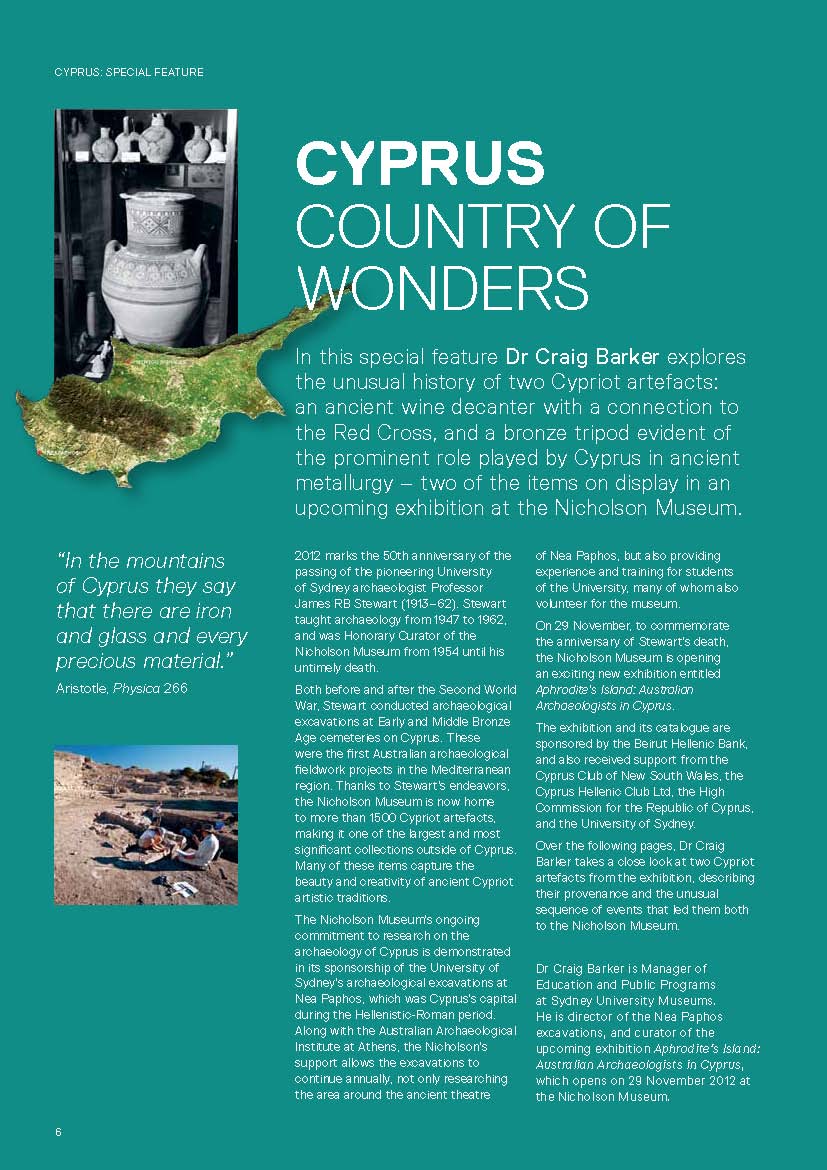
Exhibition Cypriot Antiquities “APHRODITE’S ISLAND: AUSTRALIAN ARCHAEOLOGISTS IN CYPRUS”

Female terracotta figurine with baby (NM 47.347) Late Cypriot II (c. 1450-1200 BC)

Female terracotta figurine with baby (NM 47.347) Late Cypriot II (c. 1450-1200 BC)

No 83 Cypriot horse and rider ‘Aphrodite’s Island: Australian Archaeologists on Cyprus’
k

Sydney.edu.au/museums/pdfs/newsletters/2782_Muse_November.pdf
l

On the occasion of the Cyprus Presidency of the Council of the European Union, the Nicholson Museum at the University of Sydney and the High Commission of the Republic of Cyprus cordially invite you to the opening of the exhibition of Cypriot Antiquities “APHRODITE’S ISLAND: AUSTRALIAN ARCHAEOLOGISTS IN CYPRUS” and to the launching of the accompanying Catalogue, which will take place on Thursday, 29 November, 6–8pm, at the Nicholson Museum.

The history of Cyprus is one of the oldest recorded in the world and its civilization goes back 11,000 years, to the 9 Millennium B.C. during the early Neolithic Period or Stone Age.

This exhibition showcases the importance of Cypriot archaeology and its unique contribution to the European and world historical and cultural heritage. Furthermore, it celebrates the important Cypriot archaeological collections of the Nicholson Museum and the extraordinary work of Australian researchers who have investigated the island’s history.

The exhibition “APHRODITE’S ISLAND: AUSTRALIAN ARCHAEOLOGISTS IN CYPRUS” will be officially opened by Her Excellency Professor Marie Bashir AC CVO, Governor of NSW and Chancellor of the University of Sydney.

It would be an enormous pleasure to see you there to enjoy this wonderful exhibition of Cypriot antiquities that will travel us back to the very ancient times of the island! Please feel free to also forward this email to friends and other contacts who may be interested in attending the opening of the exhibition “APHRODITE’S ISLAND: AUSTRALIAN ARCHAEOLOGISTS IN CYPRUS”.

“Yet whatever changes economics or politics made, whatever artistic influence gained favour, Cyprus remained essentially herself and the products of her art retained a distinctive Cypriot character. There is perhaps more continuity of tradition in the island than anywhere else in the Middle East, and yet greater ability to borrow and adapt.”
James Stewart, in A.D. Trendall-J.R. Stewart, Handbook to the Nicholson Museum, (2nd edition) 1948, p. 119.

Cyprus, the third largest island in the Mediterranean, has a rich archaeological and cultural tradition dating back more than ten thousand year. Legend has it that Aphrodite, the mythical goddess of love and beauty, was born in the waters off the coast of Cyprus. 2012 marks the 50th anniversary of the passing of Professor James Stewart, who excavated on the island before and after the Second World War and developed the Nicholson Museum’s collection of over 1500 Cypriot items, but the legacy of Australian archaeological investigations on the island continues today. Fieldwork projects by Australian universities continue, including the Nicholson Museum sponsored excavations at Nea Paphos; the Hellenistic-Roman capital of the island.
This exhibition will celebrate the Cypriot archaeological collections of the Nicholson Museum, and explore the stories of the Australian researchers who have investigated the island’s history.

Opening 29 November 2012

Exhibition Sponsor: Beirut Hellenic Bank
Exhibition Supporters: The Cyprus Community of NSW and the Cyprus Hellenic Club Ltd

Event details

  • When: 6.00pm – 8.00pm
  • Where: Nicholson Museum
    The Quadrangle
  • Cost: Free
  • Contact: Bookings Essential; Contact Museum Reception
    T + 61 2 9351 2812
    nicholson.museum@sydney.edu.au
  • More info: EXHIBITION OPENING TIMES:
    Monday to Friday 10.00am – 4.30pm
    The First Saturday of Every Month 12.00pm – 4.00pm
    Closed on Public Holidays.
  • Sponsored by:Exhibition principal sponsor: Beirut Hellenic Bank.Exhibition supporters: High Commission of the Republic of Cyprus, Cyprus Community of New South Wales and Cyprus Hellene Club Ltd.The exhibition is part of the celebrations of the Cyprus Presidency of the Council of the European Union in 2012.

p


Now Princess Theodora of Greece and Denmark is a star in the world’s most popular soap

Picture the scene: Her Majesty the Queen settling in for the afternoon, shoes off, TV on, chocolate biscuits at the ready, watching her goddaughter Princess Theodora of Greece and Denmark on the popular American soap The Bold And The Beautiful.

‘It’s a very nice image,’ admits Theodora, ‘although somehow I don’t think the Queen is a big Bold And The Beautiful fan.

I should get some DVDs to her as it doesn’t air in the UK, but I think she’s probably too busy to watch.’

The Queen's goddaughter Princess Theodora of Greece and Denmark stars on the popular American soap The Bold And The BeautifulThe Queen’s goddaughter Princess Theodora of Greece and Denmark stars on the popular American soap The Bold And The Beautiful

The Queen may not have time to keep up with the most-watched soap opera in the world, but viewers in America have been treated to the sight of her goddaughter, an actress who goes by the stage name Theodora Greece, stalking the offices of the show’s resident baddie Bill Spencer (played by Don Diamont) as his trusted secretary, Alison.

The ups and downs of the Royal Family have often been likened to those of a soap opera; now one of their member has actually gone and joined one.

The daughter of the former King Constantine II of Greece and Princess Anne-Marie of Denmark, Theodora was born in 1983, ten years after the Greek monarchy was abolished and exiled.

The fourth of five children, she was raised in London and speaks with a perfect English accent. She made headlines as a baby when, after bursting into tears during her christening, Theodora was only quieted when her godmother calmed her down by stroking her forehead.

‘And ever since then she’s been a very hands-on godparent,’ says Theodora. ‘She’s always very interested in what I’m doing and encouraging. She has a great sense of humour too, and is a great personal inspiration to me because she’s such a tireless worker.

The Danish Royal Family and their guests arrive for a Galadinner at Christiansborg PalaceThe Danish Royal Family and their guests arrive for a Galadinner at Christiansborg Palace

‘I don’t get to see her very much at all, maybe once a year, because I live in LA now and she’s so busy, but she’s very involved and full of good advice. And like all godparents, of course, she always gives great presents!’

Theodora grew up in Hampstead with Princes William and Harry as her playmates. ‘My father is William’s godfather and Princess Diana was my younger brother Philippos’ godmother, so we were all pretty close. We had lots of fun during the summer holidays and I just remember running around Highgrove and playing in the tree houses with them.’

She boarded at the all-girls Woldingham School in Surrey, and it was there that her passion for acting first flourished. ‘I was very shy when I was young,’ she says, ‘and so I started acting in school plays because I thought it might bring me out of my shell.

‘In my first play, I was Bugsy Malone and I loved it, I just never stopped. My parents loved coming to see me in things, especially my dad.’ The Queen, too, has always encouraged Theodora’s acting aspirations, which are coming to fruition after a series of small parts in independent films such as The Lightkeepers, with Gwyneth Paltrow’s mother Blythe Danner.

Pretty, blonde and bubbly, 29-year-old Theodora appears to have wandered in from Hollywood central casting and, given her royal lineage, directors must be falling over themselves to hire her. ‘Well, I’ve always gone to auditions as Theodora Greece, I try to stay anonymous. I’ll sometimes try and pass myself off as American too, just because I want to get parts because of my ability.’

Theodora went for the role of Alison last year thinking it would be a one-off part, ‘but they must have liked me because I’ve been there ever since.

She couldn't make the Royal Wedding but watched it with her friends until 4amShe couldn’t make the Royal Wedding but watched it with her friends until 4am

Bill Spencer is the villain of the show and Alison gets to see what he’s up to. They have a sort of Bond-Moneypenny relationship and his evil ways rub off on Alison, so that’s fun to play.’

Having lived in Los Angeles for the past three years, Theodora missed this year’s Jubilee celebrations, ‘although I watched it all on BBC America’, she says.

But she did get back to watch the Olympics and says, ‘I absolutely loved the Bond sketch with the Queen. I thought it would have been a lookalike actress, so when she turned around I was shocked. She was a good sport and it’s a great example of her sense of humour.’

She only sees her godmother once a year but says she buys great Christmas presentsShe only sees her godmother once a year but says she buys great Christmas presents

Of course, the Queen could have ended up as more than just a godmother to Theodora. As royalty (albeit exiled), the young girl was touted as a possible match for Prince William, something which amuses her even now. ‘I grew up knowing him, so I don’t think that was on the cards,’ she says.

‘My parents and elder brother [Crown Prince Pavlos] went to his wedding last year, but because I was in LA  I couldn’t go. But I did have one of my best friends over and we sat there at 4am watching it on TV.’

Theodora is currently single, but dating. And sounds far too busy for all that anyway, what with her soap work and an upcoming part in the big screen re-make of the 60s TV series The Big Valley, opposite Richard Dreyfuss and Lee Majors.

‘I was cast about a year and a half ago, so I hope the film finally gets made. I’d love to carry on doing what I’m doing and hopefully move on to making movies and getting leading roles. I may as well admit it,’ she says, ‘I’d love to win an Oscar one day. That’s my ultimate ambition.’

And as busy as she is, no doubt even Princess Theodora’s godmother would stay in to watch that particular event on TV…

Pavlopetri in Greece, The City Beneath the Waves

A BBC4 hourly documentary will display the wonders of the submerged city of Pavlopetri in Greece, an ancient and forgotten city literally lost in the  mists of time.

A team of underwater archaeologists and experts used CGI technology to reveal the secrets of Pavlopetri in Greece, the world’s oldest submerged city.

The city is off the coast of southern Laconia in the Peloponnese and is about 5,000 years old and has an almost almost complete town plan, including streets, buildings, and tombs.

The story goes back in 1967 when marine archaeologist Nick Flemming, stumbled upon some of the remains of this submerged “treasure,” something that not even Greeks were aware of. Since the 1960′s no one has done any research about the origins or even tried to find Pavlopetri until now.

This mini-documentary revealed that this ancient city consisted of 15 buildings and while on a helicopter ride above the seashore the crew could clearly see some of the remains, under the waves, still visible today. Oscar Pizarro, marine archaeologist, and his team used a mapping torpido (underwater robot) to scan and take pictures of this underwater city.

The findings astonished everyone, since they dated back to 2000 B.C. and indicated that it was a very wealthy city, due to naval trading. The team also took a trip to the nearby villages and some of the deserted areas around Pavlopetri and discovered that the architecture was was very similar to that of the submerged city; in fact so little has changed in the last 3000 years. Pavlopetri was officially the first neighborhood of Europe.

Elias Spondilis -head of the Greek team – took charge and his underwater team tried to excavate one of the large pythos that was found laying on the sea floor and that was very similar to the ones that were used in Knossos.

Both the Greek and the English team agreed that the city was an active trading port, due to its location, but above all it was a cultural melting pond. With all this information and findings available only time will tell what more will surface for this ancient Greek jewel.

No Problem with Macedonia, Just with Nationalist Rhetoric – Bulgarian FM

Source: Novinite

Bulgaria: No Problem with Macedonia, Just with Nationalist Rhetoric - Bulgarian FM
The foreign minsiters of Bulgaria, Greece, and Romania held a meeting in a trilateral format as the representatives of the three major Balkan EU member states. Photo by BGNES

Bulgaria does not have a problem with Macedonia and its aspirations for EU membership but with the nationalist rhetoric of some of its political leaders, Bulgarian Foreign Minister Nikolay Mladenov declared at a trilateral meeting with his Greek and Romanian counterparts.

Mladenov hosted in Sofia Monday Greek Foreign Minister Dimitris Avramopoulos and Romanian Foreign Minister Titus Corlatean for a mini-summit of Balkans‘ three major EU member states, Bulgaria, Greece, and Romania.

Bulgaria, Greece, and Romania have thus set out to “speak with one voice” in the European Union, their foreign ministers made it clear at their trilateral meeting.

In addition to Mladenov, the Foreign Ministers of Greece and Romania have also made it clear that Macedonia needs to prove its good-neighborliness before it can be allowed to join the European Union.

In their words, Macedonia‘s EU path needs to rest on a resolution of its “name dispute” with Greece – which has been blocking Macedonia‘s NATO and EU integration since the former Yugoslav republic is claiming a name that is also borne by an administrative district in Northern Greece – as well as on the Macedonian leaders’ ability to do away with their nationalist rhetoric and verbal assaults on Bulgaria.

Bulgaria’s President Rosen Plevneliev recently told EU Enlargement Commissioner Stefan Fuele that Macedonia is not ready for EU accession talks.

Plevneliev thus in effect reiterated the position of Foreign Minister Nikolay Mladenov who recently made it clear that Bulgaria does not support Macedonia‘s EU entry unconditionally.

Earlier, in a special statement in August 2012, Bulgarian Foreign Minister Nikolay Mladenov reacted strongly to hate speech against Bulgaria in Macedonia media.

Since the early Middle Ages, all the way to the first half of the 20th century, Macedonia and its Slavic population were considered part of the Bulgarian nation not just by Bulgaria but also by its neighbors and the international community. This is why from its National Liberation in 1878 till 1944 Bulgaria waged five wars attempting to unite all of the Bulgarian-populated lands in the Balkans, including Macedonia – after the San Stefano Treaty of March 1878 providing one state for almost all Bulgarian-populated regions was revised three months later by the European Great Powers in the Treaty of Berlin leaving the regions of Thrace and Macedonia out of Bulgaria.

After both World War I and World War II, however, Serbia/Yugoslavia kept control of 40% of the territory of the geographic and historical region of Macedonia, the so called Vardar Macedonia (which in 1991 became the Republic of Macedonia), Greece retained about 50% of the region – the so called Aegean Macedonia, while only 10% of the region – the so called Pirin Macedonia – remained in Bulgaria.

The foundations of the contemporary Macedonian nation were laid in 1943-44 by Yugoslavia‘s  communists at a special congress that also proclaimed the creation of a Macedonian language and a Macedonian alphabet designed to differentiate the dialects spoken in the region of Macedonia from the Bulgarian language and to underline the creation of a distinct Macedonian national identity.

The so called question about the perceived Macedonian minority in Bulgaria exists since the late 1940s when the dictators of the Soviet Union and communist YugoslaviaJoseph Stalin and Josip Broz Tito – attempted to arrange the post-World War II order on the Balkans through the creation of a Balkan federation between Bulgaria and Yugoslavia.

One of the provisions of this state engineering project of the two notorious communist dictators was the creation of a Macedonian republic within the future federation. For that to happen, the leadership of communist Bulgaria had to cede Pirin Macedonia to Yugoslavia in exchange for the territories of the so called Western Outlands (the towns of Tsaribrod (Dimitrovgrad) and Bosilegrad where the recognized Bulgarian minority in Serbia lives today).

This provision was accepted unconditionally by the Bulgarian communist leader Georgi Dimitrov who acted under direct orders from Stalin. As a result, in the late 1940s, the Bulgarian Communist Party undertook an unprecedented campaign to force its own population in the Pirin Region (today’s Blagoevgrad District in Southwest Bulgaria) to change its Bulgarian nationality and identity into the newly invented Macedonian one, and the official census figures out of the blue recorded that 250 000 Macedonians living in Bulgaria.

The campaign to force the people of the Blagoevgrad District to become “Macedonians” was dropped by the Bulgarian Communist Party after the entire project for a Balkan federation between Bulgaria and Yugoslavia was killed with the falling out between Stalin and Tito in 1948-49 – a rift that had wide repercussions for Europe during the entire Cold War period. This left the population of Southwest Bulgaria – which was harassed by its own government on orders from Moscow – to shake off the imagined ethnic Macedonian identity imposed on it.

Ever since, however, the authorities in Skopje whose legitimacy relies primarily on the doctrine described by the Bulgarian historians as “macedonianism”, i.e. the distinct national identity of the Slavic population of the region of Macedonia, have resurfaced claims of “hundreds of thousands of ethnic Macedonians” living in Bulgaria under some sort of “brutal oppression.” Macedonian media cite as evidence for such claims statements by the so called ethnic Macedonian party “OMO Ilinden-Pirin”, whose members according to publications in the Bulgarian media are paid from Skopje and Belgrade to declare themselves as “Macedonians.”

The provocations in the Macedonian media on the “question” of “ethnic Macedonians” abroad seem to be in line with last year’s construction of monuments in Skopje of Alexander the Great and the medieval Bulgarian Tsar Samuil, both of which are deemed to be great Macedonians by the government of Macedonian Prime Minister Nikola Gruevski and his party VMRO-DPMNE – a move that caused anger in Greece, ridicule in Bulgaria, and criticism by the European Commission.

Some 50 000 Macedonians have granted Bulgarian citizenship in the past decade, and that the figure has seen a staggering increase in the past couple of years, as many Macedonians are, in the worlds of Bulgarian historian, ex Diaspora Minister and current head of the National History Museum, Bozhidar Dimitrov, returning to their “Bulgarian roots.”

As of 2010, it is much easier for Macedonians to get Bulgarian citizenship because the Bulgarian authorities no longer ask them to provide a document of Bulgarian origin – which is usually some sort of a church or municipal certificate from the time of their grandparents; instead, for the purposes of granting citizenship, the Bulgarian state has switched to assuming that all Macedonians are of Bulgarian origin.

Unlike Greece, which gets enraged by FYROM‘s moves toying with the cultural heritage from the Antiquity period and is tangled with Macedonia in the notorious name dispute, Bulgaria’s governments traditionally react to propaganda fits by Skopje with disregard, while the general public in Bulgaria accepts them with ridicule. To the extent that Bulgaria has made any claims towards Macedonia, those have boiled down to the refusal to allow Skopje to hijack Bulgaria’s historical heritage from the Middle Ages and the 19th century Revival Period.

Bulgaria was the first sovereign nation to recognize the independence of the Republic of Macedonia in 1992.


Multicultural Greek Council brings together citywide chapters

Source: Thedp

Members believe that balancing multiple chapters is ‘not a simple task’

Not all of Penn’s Greek organizations call campus home.

Six of the 14 fraternities and sororities within Penn’s Multicultural Greek Council are citywide organizations. These MGC chapters include members from multiple schools within the Philadelphia area, including Drexel and Villanova universities.

College senior and Penn MGC President Jacqueline Baron believes citywide fraternities and sororities are a positive thing for Penn students.

“Being part of a citywide organization is a great way to get off Penn’s campus and explore,” Baron said.

She added that, apart from meeting for chapter at least once a month, these organizations also hold workshops and host community service activities together.

Alpha Kappa Alpha sister and Drexel student Chantee Steele echoed Baron’s sentiments.

“Citywide organizations are very different than fraternities and sororities concentrated on one campus,” Steele said. “I think of it as a good thing. Our organizations have diversity of thought coming from different institutional backgrounds.”

According to Drexel MGC President Zicky Villette, the Greek bond is just as strong in citywide organizations as it is in sororities and fraternities on a single campus.

“We’re close because we’re forced to spend time together,” he said jokingly. “In any fraternity, you have your brothers and that will not change.”

While being part of a citywide fraternity or sorority lends itself to a unique experience for students, it does tend to cause problems that campus organizations do not face.

For example, coordinating meetings and keeping in touch with brothers and sisters is not always easy.

“Because we only have two people in the chapter with cars, and both of those people are at Drexel, we have a hard time commuting,” Steele said. “Paying for gas and traveling is difficult.”

Villette agreed that balancing multiple schools is not a simple task.

“Coordination is difficult because of the way our schedule works,” Villette said. “Our semesters are different. We have 10-week quarters instead of semesters.”

Although some of the citywide organizations include as many as five different schools, Baron said Penn is the “hub” of MGC activity in the area.

“Penn has the resources that most of the other schools don’t,” she said. “We have the rooms needed to accommodate our meetings and events. Penn also has a lot of great networking opportunities.”

In addition, Steele believes that Penn “understands the MGC culture” more than other schools do.

Villette added, “Penn has the best quality of MGC organizations and they spend the most time on MGC events.”

However, the inclusion of citywide chapters within Penn’s MGC gives it a smaller presence on campus than the Panhellenic and Interfraternity councils, Baron said.

“[Citywide MGC chapters] can’t have houses because their members are spread all over,” she added. “And all of their members aren’t on campus so we don’t always seem as big as we are.”

“Being part of a citywide organization is all about how you decide to deal with it,” Villette said. “Some things are different … Everything else — the brotherhood — is the same.”

Mixed views aired over historic posts’ heritage listing

Source: ABCNews

A western Queensland mayor says the heritage listing of three historic posts marking the south-west corners of the state’s border may help to bring more tourists to the remote region.

The Queensland Heritage Council says Cameron, Hadden and Poeppels corners have a significant story to tell about the state’s history and have been added to the Heritage Register.

Bulloo Mayor John Ferguson says Cameron Corner attracts tens of thousands of visitors a year and its history is important.

“It’s pretty desolate country out there – it’s just sand hills and clay pans,” he said.

“People will probably take more notice now of why it was heritage listed.

“It’s probably about 400 kilometres from home, from Thargomindah, west-south-west of us.

“They are concrete posts and that is where you can stand on the posts and be in every state at once or three states at once, South Australia, New South Wales and Queensland.

“A lot of tourists go there and sit on the posts and move around and take a photo of themselves in Queensland, one in New South Wales and one in South Australia.”

Diamantina Mayor Geoff Morton is not convinced the listing of Poeppels Corner, west of Birdsville, will achieve much.

“The post is out in the middle of the desert, there’s nothing out there to hurt only a bit of sand,” he said.

“It’s a non-event really.”

He says it is already a popular tourist destination.

“Poeppels Peg is pretty much renowned as a tourist attraction as it is,” he said.

“It depends on who you talk to but 40,000 to 60,000 tourists go through Birdsville every year and half of them go across the desert.

“Poeppels Peg is already an iconic position. If it had any extra advantage, it would be minimal.

“The Simpson Desert is already well known and this is just another small part of a very large picture.”

The posts have all been replaced with concrete pillars.

50th Anniversary of Europa Nostra will be celebrated in Athens

Next year’s European Heritage Congress will take place in June 2013

Europa Nostra’s next year’s European Heritage Congress will take place in Athens, on 13-17 June 2013. It will bring together members of Europa Nostra and other representatives of the ever-growing cultural heritage movement from all over Europe. This Congress will mark the 50th anniversary of Europa Nostra’s continuous action in favour of Europe’s cultural heritage. The Congress will be organised with the assistance of Europa Nostra’s member organisation and its country representation in Greece, Elliniki Etairia which itself has this year celebrated 40 years of action on the protection of the environment and the cultural heritage of Greece and Cyprus.

Concurrently with the European Heritage Congress, one of the Local Award Ceremonies for Greece will take place at the Averoff building, housing the School of Architecture of the National Technical University of Athens. This prestigious building received one of the 2012 EU/EN Grand Prix Awards in the category of Conservation, for the meticulous restoration completed last year. The Local Award Giving Ceremony will take place at the Averoff Building itself, in the evening of Friday 14 June. A lecture will follow. The evening will end with a unique opportunity for a night visit to the extraordinary National Archaeological Museum of Athens.

The Excellence Fair, with presentations by all the Award Laureates for 2013, will be held on Saturday 15 June at the Benaki Museum. This will be followed by a Pilgrimage to the Athenian Democracy which will take participants to a heritage walk during which readings of passages of classic authors on the working of Athenian Democracy will be read, in English, by Greek actors. The evening will be brought to a spectacular ending at the National Observatory of Athens (another EU/EN Award Winner in 2010), where participants will have the chance to view one of the first Neoclassical buildings built in Greece, on a site that has continuously been used for the purpose of observing the Universe, since antiquity. The Mariolopoulos-Kanaginis Foundation will host this special evening.

Three exhibitions have been prepared and are expected to be inaugurated, during the Congress:

– The first, located at the offices of Elliniki Etairia, will be on “EU Prize for Cultural Heritage/Europa Nostra Awards; Winners from Greece 1978-2012″.

– The second, hosted by the Benaki Museum and supported by the A.G. Leventis Foundation, will be on “The Modern Movement in Athens”, and

– The third –provided that funding is secured– will be on “EU Prize for Cultural Heritage/Europa Nostra Awards 2002-2012; A Decade of Promoting Excellence in Cultural Heritage”. This exhibition will be located on the pedestrian road of Dionysiou Aeropagitou, on the way leading up to the Herodes Atticus Theatre, where the participants, as well as, the Athenian public will be able to view and appreciate the Power of Example, which remains at the core of Europa Nostra’s raison d’être.

The General Assembly, marking the 50th anniversary of Europa Nostra, will be hosted by the New Acropolis Museum and chaired by Europa Nostra’s President Maestro Plácido Domingo. This important session will be preceded by a specially organised visit of the Acropolis Hill where members will have the chance to view the current restoration work being meticulously conducted by the Acropolis Restoration Service, an organisation that has been dedicated to this work since 1975.

The culmination of the Congress will be the European Heritage Awards Ceremony, celebrating the winners of the 2013 European Union Prize for Cultural Heritage/Europa Nostra Awards, which will take place at Herodes Atticus Theatre, at the foot of the Acropolis, in the evening of Sunday 16 June 2013. Maestro Plácido Domingo, President of Europa Nostra, and Mrs Androulla Vassiliou, European Commissioner responsible for Education, Culture, Multilingualism and Youth will be co-hosting this exceptional event. The ceremony will also include a cultural performance which will seek to stress the inextricable link between Europe’s tangible and intangible heritage and to highlight the essential contribution of Greece to Europe’s heritage.

The Europa Nostra Congress in Athens will be attended by a large number of heritage professionals, volunteers from all over Europe, many prominent invited guests, as well as, representatives of other EU institutions such as, the Council of Europe and UNESCO. H.E. Mr Karolos Papoulias, President of the Hellenic Republic, has granted his high patronage to the entire Congress and to the Ceremony in particular.

The Congress will conclude with a One-Day-Boat Tour of the islands of Hydra and Aegina. At Hydra, participants will have the chance to visit three buildings having received EU/EN Awards for their outstanding restoration, whereas, at Aegina, visits to the classical temple of Athina Afaia, and the first buildings built in Greece, right after the Greek Revolution of 1821, will be offered. Post-Conference Tours will include a full-day excursion with visits to the Industrial Heritage Site of Lavrion and the Classical Temple of Sounion (organised in close cooperation with Europa Nostra’s Industrial and Engineering Heritage Committee) or, as an alternative, 3-day tour of Messene, Pylos, Koroni and other places of special heritage interest at the Peloponnese.

The Europa Nostra team, both at the Hague and in Athens, is working hard for the preparation of the Congress. One of the main activities is to secure funding, by inviting sponsors – private and institutional – to support all the events. This goal, under the current economic environment both in Greece and in Europe, seems to be challenging. Yet, the Europa Nostra team is confident that it will prove to be equally successful as the Congress itself.