An international group of scientists from Australia and Canada are getting closer to a new treatment for prostate cancer

Source: ACRF

Cancer researchers find prostate cancer “Achilles Heel” and move closer to a new treatment.

An international group of scientists from Australia and Canada are getting closer to a new treatment for prostate cancer that works by starving tumours of an essential nutrient.

Dr Jeff Holst from Sydney’s Centenary Institute, and his colleagues from Adelaide, Brisbane and Vancouver have shown they can slow the growth of prostate cancer by stopping the protein ‘leucine’ from being pumped into tumour cells.

Leucine is involved in cell division and making proteins. It ‘feeds’ cell growth by being pumped through ‘protein pumps’ on the surface of our cells.

In 2011, Dr Holst and his colleagues showed that prostate cancer cells have more ‘protein pumps’ on their surface compared with normal cells. These pumps are allowing the cancer cell to take in more leucine, thereby stimulating overactive cell division.

In a follow-up study, recently published in the Journal of the National Cancer Institute, Dr Holst and his team were able to successfully block the leucine pumps with targeted chemical compounds. As a result, they inhibited the activity of more than 100 genes which contribute to prostate cancer growth and spread.

“There are currently no drugs that target these leucine nutrient pumps, but we are working on that.” Said Dr Holst.

“We are confident we will have new compounds available for testing in the clinic in the next few years.”

Interestingly, our bodies can’t make leucine. It is an essential nutrient which comes from our diet and is transported into cells by these specialised protein pumps.

Dr Holst said, “A lot of cancers, such as prostate cancer, are actually western diseases. Really there are very low incidence rates in Asia and Africa. But when Asian or African men migrate to the US, studies have shown that they get prostate cancer at the same rate as the Caucasian American population.”

“Western diets, high in red meat and dairy products, are correlated with prostate cancer. Interestingly these foods are also high in leucine. So we are looking at how changing diet affects how cancer cells grow—and we can now investigate this impact right down to the genetic and molecular level.”

Dr Holst and his team have suggested that other solid cancers, such as melanoma and breast cancer may well be amenable to the same approach.

No related posts.

Discovery of a lifetime: giant 5-metre, serpent-like oarfish found by snorkeller

Source: SMH

20131016-100347.jpg
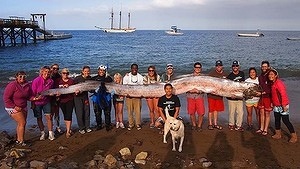
The silvery fish was found in the waters of Toyon Bay. The oarfish is the longest bony fish in the ocean. Photo: AP

A marine science instructor snorkelling off the southern California coast spotted something out of a fantasy novel: the silvery carcass of an 18-foot-long (five metre), serpent-like oarfish.

Jasmine Santana of the Catalina Island Marine Institute needed more than 15 helpers to drag the giant sea creature with eyes the size of half dollars to shore on Sunday.

Staffers at the institute are calling it the discovery of a lifetime.

“We’ve never seen a fish this big,” said Mark Waddington, senior captain of the Tole Mour, CIMI’s sail training ship. “The last oarfish we saw was three feet (90 centimetres) long.”

Because oarfish dive more than 3000 feet deep (914 metres), sightings of the creatures are rare and they are largely unstudied, according to CIMI.

The obscure fish apparently died of natural causes. Tissue samples and video footage were sent to be studied by biologists at the University of California, Santa Barbara.

Santana spotted something shimmering about 30 feet deep (nine metres) while snorkelling during a staff trip in Toyon Bay at Santa Catalina Island, about two dozen miles from the mainland.

“She said, ‘I have to drag this thing out of here or nobody will believe me,'” Waddington said.

After she dragged the carcass by the tail for more than 75 feet (23 metres), staffers waded in and helped her bring it to shore.

The carcass was on display on Tuesday for 5th, 6th, and 7th grade students studying at CIMI. It will be buried in the sand until it decomposes and then its skeleton will be reconstituted for display, Waddington said.

The oarfish, which can grow to more than 50 feet (15 metres), is a deep-water pelagic fish — the longest bony fish in the world, according to CIMI.
They are likely responsible for sea serpent legends throughout history.

BlackBerry co-founders Mike Lazaridis and Douglas Fregin considering bid for company

Source: Reuters

BlackBerry Ltd co-founders Mike Lazaridis and Douglas Fregin are considering a bid to buy the struggling smartphone maker, according to a securities filing on Thursday, raising the prospect of an alternative to a $4.7 billion offer led by its top shareholder.

The filing did not indicate whether the pair was planning to join or to present an alternative to a tentative $9-a-share bid by a group led by Fairfax Financial Holdings Ltd. Fairfax, which is headed by financier Prem Watsa, has not yet identified other members of the group.

Lazaridis and Fregin together control some 8 percent of BlackBerry, the filing said. That compares with roughly 10 percent controlled by Fairfax.

Excluding Fregin’s shares, Lazaridis controls 5.7 percent of BlackBerry, or about 60,000 shares more than he did at the end of 2012, according to Thomson Reuters data.

Lazaridis, who until early last year was one of BlackBerry’s co-chief executives and co-chairmen, appears to be considering “the widest range of options possible,” BGC Partners technology analyst Colin Gillis said.

“He’s going to talk to people by himself; he’s going to talk to Prem; he’s going to talk to everybody,” said Gillis.

Fairfax declined to comment on the Lazaridis filing, which noted that while Lazaridis and Fregin could make an offer, they could opt to take other steps, including selling their shares.

BlackBerry declined to comment specifically on the news, repeating an earlier statement that it is conducting a robust review of alternatives and would only say more if a deal is done or the strategic review is otherwise ended.

Investors have been skeptical the Fairfax offer will garner the financing needed, and Gillis noted that Lazaridis’ interest faces the same challenge because the founders, for now, do not have any funding lined up.

Analysts believe both parties could look to secure financial backing from one or more of Canada’s deep-pocketed pension funds. A foreign buyer for Blackberry faces a stringent review under the national security clause of the Investment Canada Act, as BlackBerry’s secure servers handle millions of confidential corporate and government emails every day.

Industry executives, lawyers and analysts say that could limit the pool of foreign entities that may be allowed to acquire all, or at least certain parts of the company.

In sign of investor skepticism, BlackBerry’s stock has traded well below Fairfax’s $9 offer price since the bid was announced it last month, days after BlackBerry warned it would report slumping sales, a big loss and job cuts.

News of the Lazaridis’ interest pushed shares in the company a bit higher. The stock turned positive after the news and closed on Thursday up 1.1 percent at $8.20 on the Nasdaq. But it has fallen more than 20 percent since the company warned on its earnings.

Lazaridis signed a confidentiality agreement with BlackBerry on Monday, according to the filing. If a takeover is successful, Lazaridis would become chairman, and Fregin would appoint a director, it says.

Lazaridis and Fregin, who together founded the company then known as Research In Motion Ltd in 1985, have hired Goldman Sachs and Centerview Partners LLC to assist with a strategic review of the stake.

While Lazaridis was a driving force behind the technology behind the BlackBerry, Fregin played a more minor role. He left the company as it grew into a powerhouse that produced what was then the must-have smartphone for professionals and politicians.

Fregin recently teamed up with Lazaridis again to start Quantum Valley Investments to fund quantum physics and quantum computing initiatives.

Lazaridis served as co-CEO and co-chairman with Jim Balsillie, a marketing specialist who also stepped down from those roles last year as the company’s outlook turned dire.

Its travails came to a head in August when BlackBerry put itself on the block after lackluster sales for its new devices. It has struggled for years to compete with Apple Inc’s wildly popular iPhone and a range of devices using Google Inc’s Android operating system.

Sources close to the matter have told Reuters that BlackBerry is in talks with Cisco Systems Inc, Google and Germany’s SAP AG among others, about selling them all, or parts of itself. The potential buyers have declined to comment.

Ancient monastery has few visitors amid Sinai unrest, but Bedouin neighbors protect it

20131009-223334.jpg

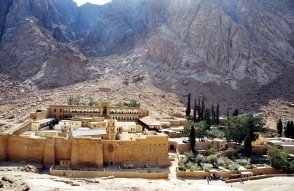
Saint Catherine’s Monastery, founded by the Emperor St. Justinian the Great, sits at the foot of Mount Sinai in Sinai, Egypt. (Hussein Talal/AP)

ST. CATHERINE’S MONASTERY, Egypt — Thousands of years of tradition say the monastery built here marks the spot where Moses fell down on his knees before a burning bush and talked to God. Hidden high in the desert mountains, guarded for centuries by scholar monks and Bedouin tribesmen, this fortress sanctuary was once as remote as any place on Earth could be.

This is no longer so. The modern world arrived at St. Catherine’s Monastery in the form of paved highways and mass tourism, which once brought thousands of pilgrims a day.

But a violent insurgency and military crackdown sweeping across Egypt’s northern Sinai peninsula has brought an unwelcome quiet to the south, where the Bedouin tribes make their money from tourists.

In August, the Egyptian government closed St. Catherine’s Monastery to visitors as a precaution. It was only the third closure in 50 years. While the monastery reopened its doors again after three weeks, Egyptian security forces are now everywhere, shepherding the handful of foreigners into the area in armed convoys.

The monks at the monastery, and the Bedouin who make their living as guides here, stress that the violence is taking place 300 miles to the north.

In the northern Sinai, the restive tribes have been sabotaging natural gas pipelines, and smuggling weapons, drugs and gasoline through their network of tunnels with the Gaza Strip. In the power vacuum created by Egypt’s upheaval, the Bedouin there have raised the black flag for militant jihad, and are waging a guerrilla campaign of extortion, kidnapping and targeted assassination against the powers of the state.

Militants in the north have launched near-daily attacks on Egyptian security forces. In August, gunmen ambushed trucks carrying Egyptian police recruits and executed 25 on the side of a road near a peacekeepers’ checkpoint.

But in the south, the Bedouin tell their children the story of how the Roman emperor Justinian brought their tribe of mason-warriors to the Sinai in the sixth century to build the walled monastery here, and protect the monks with their lives.

“We teach our children that the monastery gives us life,” said Suleman Gebaly, a guide and local chronicler. “This place puts food on our table.”

The descendants of these Justinian serfs continue to honor their task, and so do the monks in black frocks, with their long gray beards and ponytails, who devote their days to vespers and prayer and to their magnificent library, which preserves in the high desert air some of the oldest, most precious manuscripts in Christendom.

Industrial tourism came to the monastery with the building of paved highways in the early 1980s. Until recently, the monastery drew throngs — sometimes 350 tour buses a day, a thousand visitors or more — from the beach resorts at Taba, Dahab and Sharm el-Sheik along the Red Sea coast, a diver’s paradise.

Now one or two buses come a day. On a recent morning there was a tour group from India, and later a few stragglers in a couple of vans.

Camel drivers who bring visitors on the three-hour climb to the top of Mount Sinai say they are desperate for work.

On a recent dawn ascent, only six Colombians made the summit. At a hut along the trail, guide Sabah Darwish sat wrapped in blankets, drinking tea and smoking in the murk. “You’re the first foreigners I’ve seen in a month,” he said.

A Bedouin tribe called the Gebaliya still tend desert gardens and flocks of sheep and goats. Every man has a camel, if he can, though many families have had to sell their camels at steep discounts to traders, who take them down to the beach resorts and feed them from dumpsters, trying to hold on until the tourists come back.

Without tourism, the Bedouin said, they would pursue other paths — such as drug smuggling, or worse.

Two Americans were kidnapped in the region last year. The most recent abduction of foreigners occurred in the south in March, when an Israeli and Norwegian were snatched. Like most, they were released.

Under the rule of President Hosni Mubarak, “there was an understanding that anyone from the north who came to make trouble in the south, we were allowed to kill him,” said Sheik Mousa al Gebaly, who operates a guest house and guide services in the town beside the monastery.

He remembers a time back in the 1990s when even the Israelis came in large numbers to Sinai. “I would have 50 cars with Israeli plates in my parking lot. They would hire 50 guides and 200 camels a day,” Gebaly said.

At the Taba crossing between Egypt and Israel, the passport and customs halls are empty. The coast here was once a famously laid-back post-hippie haven. Now beach hotels stand as shells in the sand. Wind blows through broken glass. The decorative date palms are slumped over, brown and dead.

Once-popular seaside camps, with names like Blue Wave, Moon Camp and Nirvana are shuttered and forlorn, like beach towns in perpetual winter — no more yoga, no more snorkeling, no more bowls of hash at sunset.

At the monastery, Archbishop Damianos sat behind his desk, apologizing for his poor eyesight, fumbling for his magnifying glass and explaining that English was not his best language. He spoke five others.

“It is not so bad for a monastery to be closed for a little while. We are monks, after all,” he said, smiling at his little joke. “We’ve returned to an earlier quiet.”

The archbishop is 79 years old. He arrived here in 1961. He has spent his life among the monks and Bedouin and he is sorry the religious pilgrims have gone, but hopes they will soon return.

“When the revolutions began in Egypt, the Bedouin came to us, and said, ‘You know we have been with you all these years. This is what our ancestors were sent here to do. This is our heritage, to protect the monastery,’ ” said the bishop. “I confess I was very moved by their words. For here we are intertwined.”

The monks here tend to take the long view. The scholar Father Justin, an American from El Paso, is busy on an ambitious project to digitize more than 3,000 manuscripts and subject the ancient tomes — some written, erased and overwritten again on parchment — to multi-spectral analysis.

Father Justin stood on the roof of the library, now undergoing renovation, and pointed out the mosque below, which stood next to the basilica. He felt safe, and proud that both Muslims and Christians are at home here.

But he also mentioned the 60-foot walls that have stood for 1,400 years. “It was built as a fortress monastery, and it is easily turned into a fortress again,” Father Justin said.

But he added that he preferred to be protected by God’s good graces.

“That would be best,” he said.

Ancient City Discovered Beneath Mound in Northern Iraq

The ancient city of Idu, which dates back more than 3,000 years, is one of the largest archeological discoveries in Iraq’s Kurdish region

Archeologists from Germany’s University of Leipzig have discovered an ancient city called Idu hidden beneath a mound in northern Iraq.

According to the archeological findings, Idu was under the control of the Assyrian Empire about 3,300 years ago, then later gained its independence as the empire declined. The Assyrians reconquered the city roughly 140 years later. Researchers have found artwork, including a bearded sphinx with a human head and the body of a winged lion, and a cylinder seal dating back roughly 2,600 years depicting a man crouching before a griffon, according to NBC News.

Researchers discovered the name of the city during a survey of the area in 2008. A resident from a nearby village brought them an inscription with the name carved in it, and they spent 2010 and 2011 excavating the area. Archeologists plan to continue excavating the site once they reach a settlement between villagers and the Kurdistan regional government.

Iraq is home to several archeological treasures, including Babylon, an ancient Mesopotamian city-state dating to the 3rd millennium BC, which was discovered south of Baghdad by British scholars in the 19th century. During the U.S.-led invasion of 2003, American forces built landing areas for helicopters and parking lots for vehicles, causing irreparable damage to part of the site.

[NBC News]

The 10 Richest States In America: 24/7 Wall St.

Source: Huffington

Last year, household income remained effectively unchanged, according to data released this week by the U.S. Census Bureau. This is despite the fact that the U.S. added nearly 2.2 million jobs in 2012.

“The big story is that everything was stagnant over the year” said Economic Policy Institute’s Elise Gould. “We’re stagnant, and continue to be in a bad place.”

While the economy continues to struggle, residents in the wealthiest states continue to make far more than in the poorest. In 2012, Maryland remained the richest state in the country, with a median household income of $71,221. Mississippi was again the poorest, with an income of $37,095 — nearly half that of Maryland’s.

Despite the addition of jobs nationwide, median incomes remained stagnant in most states and were still generally below their 2008 levels, adjusted for inflation. Sheldon Danziger, president of the Russell Sage Foundation, explained that this has been the nature of the recovery. “We have an economy that continues to grow, with most of the gains going to the economic elite. I don’t see any bright prospects for the median worker, much less the poor.”

States with lower median incomes generally had much higher rates of poverty than the national rate. All of the 10 states with the lowest median income in 2012 also had among the highest poverty rates in the country. While 15.9% of Americans fell below the poverty line in 2012, nearly one in four Mississippians did.

Employment is one of the biggest factors affecting income. In some states with lower unemployment, a higher share of the households had steady income, which bolsters the state’s median. In many of the highest-income states, like New Hampshire, Minnesota and Hawaii, unemployment in 2012 was less than 6%, compared to a national rate of 8.1%.

Elise Gould, Director of Health Policy for Economic Policy Institute, explained that unemployment rates can have a significant effect on a state’s household income. “When we’re talking about average families and poor families, the vast majority of income comes from wages. So it’s about jobs.” Gould cautioned, however, that unemployment rates do not tell the full story.

Unemployment rates, for example, ignore those people who have given up looking for work or accept part-time work. According to the Bureau of Labor Statistics, while 8.1% of American workers were unemployed in 2012, 14.7% were underemployed, meaning they wanted to work full time but could not. This was an increase from roughly 10% in 2008.

The types of jobs available in each state also affect income. A review of Census Bureau industry composition data shows that people in most of the states with a higher median income were often more likely to be employed in information, finance, professional and other positions that tend to pay higher salaries. Maryland, the wealthiest state in the country, had the highest percentage of workers in professional, scientific and management positions.

At the same time, many of the low-income states had smaller percentages of these professional occupations and higher rates of employment in retail, manufacturing and transportation. The high proportion of manufacturing jobs in low-income states might be surprising, but, explained Danziger, the makeup of the manufacturing industry in the country has changed.

“There’s a difference between unionized auto company workers and non-unionized parts suppliers,” Danziger said. “Even when manufacturers haven’t cut wages, they are adopting labor-saving technological change.”

To identify the states with the highest and lowest median household income, 24/7 Wall St. reviewed state data on income from the U.S. Census Bureau’s 2012 American Community Survey (ACS). Based on Census treatment, median household income for all years is adjusted for inflation. We also reviewed unemployment data provided by the Bureau of Labor Statistics for 2012, as well as 2012 ACS data on health insurance coverage, employment and poverty.

Inherited Mutation Linked to Development of Pediatric Acute lymphoblastic leukemia

A mutation of the PAX5 gene has been found to play an important role in inherited cases of B-cell precursor acute lymphoblastic leukemia (B-ALL). The mutation was isolated in two unrelated families with high propensity for B-ALL.
“We’re in uncharted territory,” said study senior author Kenneth Offit, MD, MPH, of Memorial Sloan-Kettering Cancer Center in New York, in a press release. “At the very least this discovery gives us a new window into inherited cases of childhood leukemia. More immediately, testing for this mutation may allow affected families to prevent leukemia in future generations.” Results of the new study were published online ahead of print September 8 in Nature Genetics.

B-ALL is the most common pediatric malignancy, and children with affected siblings have between a twofold and fourfold higher risk of developing the disease. PAX5, a lymphoid transcription factor gene, is mutated in a variety of ways in approximately 30% of B-ALL cases. The new study focused on a newly described heterozygous germline variant of PAX5, c.547G>A, which encodes a protein known as p.Gly183Ser.

This mutation, found by exome sequencing, was present in two unrelated families with high rates of B-ALL; one family was of Puerto Rican ancestry and the other was of African American ancestry. The PAX5 mutation was the only mutation found to be common between the two families.

Those individuals with the mutation all exhibited 9p deletion within leukemic cells. Further analysis showed that the mutation yielded significantly reduced transcriptional activity from PAX5 compared to wild-type PAX5 (P < .0001). It appears, however, that the inherited mutation results in only “modest attenuation” of PAX5 activity accompanied by a somatic loss of the wild-type PAX5 allele thanks to the 9p alterations during leukemogenesis; in contrast, the PAX5 deletions and translocations that occur as non-inherited, somatic events in many B-ALL cases result in complete loss or “marked attenuation” of the protein’s transcriptional activity.

Overall, the researchers wrote that these findings suggest that somatic 9p alterations could be a harbinger of the germline mutation found in this study. “The recent identification of germline TP53 mutations in familial ALL and the data presented here strongly implicating PAX5 mutations in a new syndrome of inherited susceptibility to pre-B cell ALL indicate that further sequencing of affected kindreds is required to define the full spectrum of germline variations contributing to ALL pathogenesis,” they concluded.

Full list of last night’s Emmy winners

The 65th Primetime Emmy Awards in Los Angeles didn’t disappoint tonight as “Breaking Bad” took home the final Emmy of the evening for Outstanding Drama Series, giving die-hard fans a silver lining as the show concludes next week.

The night also included some surprises as “The Newsroom’s” Jeff Daniels beat out Bryan Cranston for Lead Actor in a Drama and Kerry Washington didn’t win for Lead Actress in a Drama like expected.

Michael Douglas picked up an award for his portrayal of Liberace in “Behind the Candelabra” and “Modern Family” won again for Outstanding Comedy Series. Take a look at the full list below to find out if your favorite program or star won tonight:

Outstanding Comedy Series

Fred Prouser/Reuters
30 Rock

Girls

Louie

Modern Family

The Big Bang Theory

Veep

Outstanding Lead Actress in a Comedy Series

Tina Fey, 30 Rock

Lena Dunham, Girls

Julia Louis-Dreyfus, Veep

Laura Dern, Enlightened

Edie Falco, Nurse Jackie

Amy Poehler, Parks and Recreation

Outstanding Lead Actor in a Comedy Series

Alec Baldwin, 30 Rock

Jason Bateman, Arrested Development

Louis C.K., Louie

Don Cheadle, House of Lies

Matt LeBlanc, Episodes

Jim Parsons, The Big Bang Theory

Outstanding Supporting Actor in a Comedy Series

Adam Driver, Girls

Jesse Tyler Ferguson, Modern Family

Ed O’Neill, Modern Family

Ty Burrell, Modern Family

Bill Hader, Saturday Night Live

Tony Hale, Veep

Outstanding Supporting Actress in a Comedy Series

Mayim Bialik, The Big Bang Theory

Jane Lynch, Glee

Sofia Vergara, Modern Family

Julie Bowen, Modern Family

Merritt Wever, Nurse Jackie

Jane Krakowski, 30 Rock

Anna Chlumsky, Veep

Outstanding Drama Series

Breaking Bad

Downton Abbey

Game of Thrones

Homeland

House of Cards

Mad Men

Outstanding Lead Actress in a Drama Series

Connie Britton, Nashville

Claire Danes, Homeland

Michelle Dockery, Downton Abbey

Vera Farmiga, Bates Motel

Elisabeth Moss, Mad Men

Kerry Washington, Scandal

Robin Wright, House of Cards

Outstanding Lead Actor in a Drama Series

Hugh Bonneville, Downton Abbey

Bryan Cranston, Breaking Bad

Jeff Daniels, The Newsroom

Jon Hamm, Mad Men

Damian Lewis, Homeland

Kevin Spacey, House of Cards

Outstanding Supporting Actor in a Drama Series

Bobby Cannavale, Boardwalk Empire

Jonathan Banks, Breaking Bad

Aaron Paul, Breaking Bad

Jim Carter, Downton Abbey

Peter Dinklage, Game of Thrones

Mandy Patinkin, Homeland

Outstanding Supporting Actress in a Drama Series

Anna Gunn, Breaking Bad

Maggie Smith, Downton Abbey

Emilia Clarke, Game of Thrones

Christine Baranski, The Good Wife

Morena Baccarin, Homeland

Miniseries or Movie

American Horror Story: Asylum

Behind the Candelabra

The Bible

Phil Spector

Political Animals

Top of the Lake

Lead Actress in a Miniseries or Movie

Jessica Lange, American Horror Story: Asylum

Laura Linney, The Big C: Hereafter

Helen Mirren, Phil Spector

Elisabeth Moss, Top of the Lake

Sigourney Weaver, Political Animals

Lead Actor in a Miniseries or Movie

Benedict Cumberbatch, Parade’s End

Matt Damon, Behind the Candelabra

Michael Douglas, Behind the Candelabra

Toby Jones, The Girl

Al Pacino, Phil Spector

Reality-Competition Program

Amazing Race

Dancing With the Stars

Project Runway

So You Think You Can Dance

Top Chef

The Voice

Host for a Reality or Reality-Competition Program

Tom Bergeron, Dancing With the Stars

Anthony Bourdain, The Taste

Cat Deeley, So You Think You Can Dance

Heidi Klum and Tim Gunn, Project Runway

Ryan Seacrest, American Idol

Betty White, Betty White’s Off Their Rockers

Variety Show

The Colbert Report

The Daily Show

Jimmy Kimmel Live

Late Night With Jimmy Fallon Show

Real Time With Bill Maher

Saturday Night Live

Writing For a Comedy Series

Tina Fey & Tracey Wigfield – 30 Rock

Jack Burditt & Robert Carlock

David Crane & Jeffrey Klarik

Pamela Adlon & Louis C.K.

Greg Daniels

Outstanding Directing In a Comedy Series

Lena Dunham

Gail Mancuso – Modern Family

Paris Barclay

Louis C.K.

Beth McCarthy-Miller

Outstanding Writing for Drama Series

Henry Bromell – Homeland

David Benioff

Julian Fellowes

Thomas Schauz

George Mastras

Outstanding Directing for a Drama Series

David Fincher – House of Cards

Lesli Linka Glatter

Jeremy Webb

Michelle MacLaren

Tim Van Patten

Outstanding Directing in a Variety Series

The Colbert Report – James Hoskinson The Daily Show with Jon Stewart – Chuck O’Neil Jimmy Kimmel Live! – Andy Fisher Late Show with David Letterman – Jerry Foley Portlandia – Jonathan Krisel Saturday Night Live – Don Roy King

Oustanding Writing for a Miniseries, Movie or Dramatic Special

Behind the Candelabra – Richard LaGravenese The Hour – Abi Morgan Parade’s End – Tom Stoppard Phil Spector – David Mamet Top of the Lake – Jane Campion & Gerard Lee

Outstanding Supporting Actor in a Miniseries or Movie Scott Bakula – Bob Black on Behind the Candelabra James Cromwell – Dr. Arthur Arden / Hans Grüper on American Horror Story: Asylum John Benjamin Hickey – Sean Tolke on The Big C: Hereafter Peter Mullan – Matt Mitcham on Top of the Lake Zachary Quinto – Dr. Oliver Thredson on American Horror Story: Asylum

Oustanding Directing for a Miniseries, Movie or Dramatic special Behind the Candelabra – Steven Soderbergh The Girl – Julian Jarrold Phil Spector – David Mamet Ring of Fire – Allison Anders Top of the Lake (Episode: “Part 5?) – Jane Campion & Garth Davis

Outstanding Supporting Actress in a Miniseries or Movie

Ellen Burstyn – Political Animals Sarah Paulson – American Horror Story: Asylum Charlotte Rampling – Restless Imelda Staunton – The Girl Alfre Woodard – Steel Magnolias


We got it wrong on warming, says IPCC

Source: TheAustralian

THE Intergovernmental Panel on Climate Change’s latest assessment reportedly admits its computer drastically overestimated rising temperatures, and over the past 60 years the world has in fact been warming at half the rate claimed in the previous IPCC report in 2007.

More importantly, according to reports in British and US media, the draft report appears to suggest global temperatures were less sensitive to rising levels of atmospheric carbon dioxide than was previously thought.

The 2007 assessment report said the planet was warming at a rate of 0.2C every decade, but according to Britain’s The Daily Mail the draft update report says the true figure since 1951 has been 0.12C.

Last week, the IPCC was forced to deny it was locked in crisis talks as reports intensified that scientists were preparing to revise down the speed at which climate change is happening and its likely impact.

It is believed the IPCC draft report will still conclude there is now greater confidence that climate change is real, humans are having a major impact and that the world will continue to warm catastrophically unless drastic action is taken to curb greenhouse gas emissions.

The impacts would include big rises in the sea level, floods, droughts and the disappearance of the Arctic icecap.

But claimed contradictions in the report have led to calls for the IPCC report process to be scrapped.

Professor Judith Curry, head of climate science at the Georgia Institute of Technology in Atlanta, told The Daily Mail the leaked summary showed “the science is clearly not settled, and is in a state of flux”.

The Wall Street Journal said the updated report, due out on September 27, would show “the temperature rise we can expect as a result of manmade emissions of carbon dioxide is lower than the IPCC thought in 2007”.

The WSJ report said the change was small but “it is significant because it points to the very real possibility that, over the next several generations, the overall effect of climate change will be positive for humankind and the planet”.

After several leaks and reports on how climate scientists would deal with a slowdown in the rate of average global surface temperatures over the past decade, the IPCC was last week forced to deny it had called for crisis talks.

“Contrary to the articles the IPCC is not holding any crisis meeting,” it said in a statement.

The IPCC said more than 1800 comments had been received on the final draft of the “summary for policymakers” to be considered at a meeting in Stockholm before the release of the final report. It did not comment on the latest report, which said scientists accepted their forecast computers may have exaggerated the effect of increased carbon emissions on world temperatures and not taken enough notice of natural variability.

According to The Daily Mail, the draft report recognised the global warming “pause”, with average temperatures not showing any statistically significant increase since 1997.

Scientists admitted large parts of the world had been as warm as they were now for decades at a time between 950 and 1250, centuries before the Industrial Revolution.

And, The Daily Mail said, a forecast in the 2007 report that hurricanes would become more intense had been dropped.

Writing in The Wall Street Journal, Matt Ridley said the draft report had revised downwards the “equilibrium climate sensitivity”, a measure of eventual warming induced by a doubling of carbon dioxide in the atmosphere. It had also revised down the Transient Climate Response, the actual climate change expected from a doubling of atmospheric carbon dioxide about 70 years from now.

Ridley said most experts believed that warming of less than 2C from pre-industrial levels would result in no net economic and ecological damage. “Therefore, the new report is effectively saying (based on the middle of the range of the IPCC’s emissions scenarios) that there is a better than 50-50 chance that by 2083 the benefits of climate change will still outweigh the harm,” he said.

Ethiopian man claims he is 160 years old and can recall the Italian invasion of his country in 1895

Source: TheDailyTelegraph

Is this the world's oldest man at 160?

Ethiopian farmer Dhaqabo Ebba claims to be a staggering 160 years old, which would make him the world’s oldest living man.

MANY people won’t be aware of Italy’s invasion of Ethiopia in 1895, but one man doesn’t just know about the battle – he claims to have lived through it.

Retired farmer Dhaqabo Ebba, from Ethiopia, says he is a staggering 160 years old, which would make him the world’s oldest living man.

He claims to have clear memories of Italy’s invasion of his country in the 19th century – however, there is no birth certificate to prove his age.


oldest woman

Japan’s 114-year-old Misao Okawa poses with the Guinness World Records certificate of the world’s oldest woman. Picture: AP

In a statement to Oromiya TV, he provided so much detail on the history of his local area that reporter Mohammed Ademo became convinced that Mr Ebba must be at least 160 years old.

This would make him 46 years older than the oldest ever recorded man.

‘When Italy invaded Ethiopia I had two wives, and my son was old enough to herd cattle’, said Mr Ebba.

He then recounted his eight-day horseback rides to Addis Ababa as a child – a journey that takes only a few hours today.


IF Mr Ebba's claims are true he will knock off the previous titleholder Jeanne Calment, 122. Picture: AFP

IF Mr Ebba’s claims are true he will knock off the previous titleholder Jeanne Calment, 122. Picture: AFP

As Mr Ebba grew up in an oral society, there is no paper trail and no living witnesses to verify his age.

However, if his claim can be medically confirmed, he would oust 115-year-old Misao Okawa, who is currently recognised by the Guinness World Records as the world’s oldest living person.

He would also overtake French woman Jeanne Calment as the oldest person to have ever lived.

Ms Calment died in 1997 at the age of 122.

The last man confirmed to have lived in the 19th century was Jiroemon Kimura, who was born in Japan on April 19, 1897.

Jiroemon Kimura smiling as he celebrates his 116th birthday, he died in June this year. Picture: AFP

Jiroemon Kimura smiling as he celebrates his 116th birthday, he died in June this year. Picture: AFP


He died in June this year at the age of 116 – making him the longest-living man in history.

Mr Kimura, who lived in Kyotango, Japan, left behind seven children, 14 grandchildren, 25 great-grandchildren and 15 great-great-grandchildren.

According to 2011 government data, Japan has more than 50,000 centenarians, reinforcing its reputation for longevity.