New clue to aggressive brain tumors

Source: wustl.edu

Scientists at Washington University School of Medicine in St. Louis have identified a biological marker that may help predict survival in people with deadly brain tumors. The researchers showed that when the marker is present at higher levels, brain cancers known as glioblastomas are more aggressive.

The cancer cells do not make the marker, a protein called F11R. Instead, it is made by noncancerous cells, called monocytes, found within the tumor. Monocytes normally support and protect healthy brain cells, but they also can provide critical support to tumors.

“Monocytes are very dynamic cells, and they can adapt to changing circumstances including the development of a tumor,” said senior author David H. Gutmann, MD, PhD, the Donald O. Schnuck Family Professor of Neurology. “We need to better characterize the specific contributions of these cells to brain tumors, as well as to identify treatments that block their ability to help these cancers form and grow.”

The study recently is available online in PLOS ONE.

Glioblastomas are rare but are among the most dangerous tumors. Even with radiation and chemotherapy, the median survival rate is little more than a year.

Hoping to provide another avenue of attack for these cancers, Gutmann and his collaborators have been studying how non-cancerous cells contribute to brain cancer formation and growth.

In earlier studies, Gutmann has shown that monocytes are critical for the formation and continued growth of low-grade brain tumors in mice that resemble those arising in children with neurofibromatosis type 1 (NF1).

Winnie W. Pong, PhD, a staff scientist in Gutmann’s laboratory, wanted to determine whether monocytes in the glioblastomas originate in the brain early in embryonic development or migrate into the brain from the bone marrow. Differences in where cells originate may affect their ability to support cancer development and growth.

To address this question, Gutmann turned to Elaine Mardis, PhD, co-director of The Genome Institute at Washington University, for help. Mardis has been a leader in developing techniques for sequencing RNA, the material cells use to copy protein-building instructions from DNA. The number of RNA copies of a gene present in a cell reflects how often the cell is using the gene to make its protein.

“We asked Elaine to apply new RNA sequencing techniques to very small samples of monocytes from normal mice and from mouse glioblastomas,” Gutmann said. “She and her colleagues at The Genome Institute accomplished a small tour de force to perform the analysis.”

F11R emerged as one of the best indicators of whether monocytes came from the brain or from bone marrow. F11R normally is made by monocytes that originate in the brain and not by those that come from bone marrow.
However, the scientists also learned that this distinction vanishes in glioblastomas, where both types of monocytes make F11R. Gutmann reasoned that the tumor may prompt this change, suggesting that the protein could be important to cancer cells.

“When we checked for connections between F11R levels and the aggressiveness of brain tumors, we found more F11R-expressing monocytes in malignant tumors relative to their more benign counterparts,” he said. “Moreover, even among the most malignant tumors we could use F11R to predict differences in patient survival rates.”

To find new treatments for these deadly cancers, Gutmann and his colleagues are working to identify factors made by monocytes that help the tumors grow.
“The idea that we may be able to starve brain cancer cells of critical growth factors produced by noncancerous support cells may one day lead to the development of additional strategies to combine with conventional chemotherapy or radiation to combat brain tumors in children and adults,” he said.

Funding from the National Cancer Institute (U01-CA160882 to DH and DHG; U01-CA141549 to DHG) and National Institutes of Health (NIH)(RC4-NS072916 to DHG) supported this research. WWP was partly supported by a grant from the W.M. Keck Foundation.

Pong WW, Walker J, Wylie T, Magrini V, Luo J, Emnett RJ, Choi J, Cooper ML, Griffith M, Griffith OL, Rubin JB, Fuller GN, Piwnica-Worms D, Feng X, Hambardzumyan D, DiPersio JF, Mardis ER, Gutmann DH. F11R Is a Novel Monocyte Prognostic Biomarker for Malignant Glioma. PLOS ONE, published online Oct. 15, 2013.

Washington University School of Medicine’s 2,100 employed and volunteer faculty physicians also are the medical staff of Barnes-Jewish and St. Louis Children’s hospitals. The School of Medicine is one of the leading medical research, teaching and patient care institutions in the nation, currently ranked sixth in the nation by U.S. News & World Report. Through its affiliations with Barnes-Jewish and St. Louis Children’s hospitals, the School of Medicine is linked to BJC HealthCare.

New role for DNA unraveler in preventing brain tumours and other cancers

Source: Cancerresearch.uk

Cancer Research UK Press Release

A molecule originally implicated in DNA repair may also be a crucial factor in preventing tumours such as medulloblastoma, a type of childhood brain tumour, according to research published today in Science (Thursday).

The molecule, called RTEL1, is known to be responsible for maintaining the ends of our chromosomes, the structures that contain the genetic material DNA. Now Cancer Research UK scientists have discovered that it also plays a critical role throughout the entire genome.

Dr Simon Boulton and his team, based at the charity’s London Research Institute, found that RTEL1 works together with another molecule called PCNA. Like a hair tie, RTEL1 helps PCNA as it forms a ring around the DNA allowing it to remove knots and untangle DNA as it gets copied. This process is essential for correctly copying DNA, so that cells can grow and divide without making genetic mistakes.

When RTEL1 contains a fault preventing it from binding to PCNA, DNA replication is disrupted and mistakes are made, which can lead to cancer. When the researchers looked in mice whose RTEL1 gene was flawed in this way, they found a substantial increase in the incidence of several types of cancer, including lymphoma and medulloblastoma, the most common type of childhood brain cancer.

Previous studies had shown that there was a potential link between RTEL1 and brain cancers, although it wasn’t understood why. This study confirms that RTEL1 is definitively involved in preventing cancer by stopping mistakes from being made during DNA replication, but more research is needed to understand why it appears to be particularly associated with brain tumours.

Dr Simon Boulton, based at Cancer Research UK’s London Research Institute, said: “This research exemplifies why it’s so important to study fundamental cellular processes in model systems. With the aid of new technologies, we have uncovered an unexpected role for the RTEL1 protein, and shown that this new role in maintaining and replicating DNA may hold the key to some types of cancer.”

Dr Simon Boulton was recently named as one of the recipients of the 2013 Paul Marks Prize for cancer research from the Memorial Sloan-Kettering Cancer Center in America.

Dr Kat Arney, Cancer Research UK’s senior science communications manager, said: “Unravelling the inner workings of cancer cells is essential if we are to truly make progress in beating cancer. This is an important step forward in understanding the molecular machinery that copies our DNA and what happens when it goes wrong. And it could open the door to future approaches for prevention, diagnosis or treatment.”

Fashion Police’s George Kotsiopoulos Heads to Sawgrass Mills

Source: Edgeofthenet

OK, I have to admit I have had a bit of a crush on George Kotsiopoulos ever since the first time I saw him on “Fashion Police.” I mean, come on, he is so super cute and that smile makes me melt every time.

Having said that, can you imagine how excited I was when I found out I was going to interview him? I think I was very professional and did a good job of hiding my school girl crush during the interview, however. It was a pleasure to interview George and find out what a sweet, genuine guy he is shortly before his appearance in South Florida at Sawgrass Mills on Friday, October 25.

At what age did you originally get interested in fashion?

As long as I can remember I always cared about what I wore. It probably started around 2nd or 3rd grade.

Did you have a unique fashion style as a child?

No, but I was very particular about what I wore. If I liked something, I would wear it a lot. It was the bane of my mom’s existence because she thought people would think we were poor.

What was your first professional job in Fashion?

[I worked] as an associate fashion editor at The New York Times Magazine.

Who was the first famous person you styled?

It was the beautiful Kate Hudson for the New York premiere of “Almost Famous” and the Screen Actors Guild Awards.

Who are your favorite people to style?

My favorite is anyone who is interested in fashion and who cares and is open to new ideas. I find that usually either very knowledgeable or totally clueless works best. The worst is someone who thinks they know everything. Then we usually fight and it’s not a creative process.

Who do you think is the best dressed male and female nowadays?

I like the way Emma Stone puts herself together. In addition, Rihanna is incredible, Kerry Washington is elegant, and Zoe Saldana is a fashion plate. I like Ryan Gosling because he seems to be interested in fashion, and of course George Clooney for always being classic. In addition, Andrew Garfield always looks cool; he wears fashion without it wearing him.

What is a fashion must-have for all men?

I think a good pair of straight-legged dark washed jeans with simple stitching [is a must]. I personally like a heavier winged tip shoe as well. A grey suit also works well for any occasion.

What’s the “it” product for men’s fashion right now?

For fall, it’s lots of paisley, bomber jackets, tweedy checks from Brooks Brothers, and color is back.

What’s a very important tip in fashion?

Know what size you are!

How did you get the job on Fashion Police?

I had been kicking around in TV for 10 years or so and they asked me to audition. I was lucky that the planets aligned, and it has changed my life.

How is it working with Giuliana, Kelly and Joan? Is it as fun as it looks?

Yeah, it’s super fun to work with all three of them. Kelly was just crashing my room during Fashion Week. It’s a pleasure to work with people you like, you enjoy their company, and you want to hang out with them.

How come such a sexy man like yourself is single? What qualities are you looking for in a man?

I think it’s hard to meet guys in L.A., as guys tend to be somewhat standoffish (including myself). I was just in New York and it seemed much easier to meet guys.

I want a guy who takes care of himself physically, as I do, and he should be fun and funny and smart and of course ambitious. And I need someone who I can plop into many situations and he can take care of himself. He also needs to be charming, but not too charming.

What’s ahead for George?

I have a book coming out in January that’s called “Glamorous by George.” I am also working on a clothing line that will debut sometime next year. In addition, I am looking to do more television. I want to stay on television as long as television will have me.

Don’t forget to see George in person at The Colonnade Outlets at Sawgrass Mills Tour de Fashion on Friday, October 25 from 10 a.m. to 4 p.m. Tickets are $30 for the Designer Level and $75 for the Couture Level. This is a charity event and 100% of the profits go to 35 local charities including Poverello and Pride Center. Tickets can be purchased at: ColonnadeOutletsTourDeFashion.com.

Member of Roosh V Forum makes world map of ‘easy to bang’ women

Source: News

A map which is offensive to every single country in the world. Picture via Target Map

A map which is offensive to every single country in the world. Picture via Target Map Source: Supplied

IF YOU want to know which girls around the world are the easiest to “bang”, don’t worry, some creepy pick-up artists on the internet have got you covered.

Daryush Valizadeh – better known as Roosh V – is no stranger to controversy.

His travel guide e-books – including Bang Ukraine, Don’t Bang Latvia, Bang Poland and Don’t Bang Denmark – have been described as “rape guides” and have offended every country he’s written about, Gawker reports .

This week a member of his pick-up artist army on the Roosh V Forum has been bragging that a map he made which shows “how easy girls are by their country” has “gone viral”, receiving 570,000 hits.

The map has five ratings, “Very easy to bang”, “Easy to bang”, “Normal difficulty to bang”, “Hard to bang” and “Very hard to bang”.

Australia is ranked as “normal difficulty to bang”.


Roosh V's controversial 'Bang' e-books.

Roosh V’s controversial ‘Bang’ e-books. Source: Supplied

Middle Eastern countries including Iraq, Iran and Saudi Arabia we ranked as most difficult. African countries such as Kenya and Ethiopia and South American countries Bolivia and Peru were rated “easiest to bang”.

Just in case you are still unsure about the type of guy Roosh V is, on his website he states his community beliefs, including:

“Women are sl**s if they sleep around, but men are not. This fact is due to the biological differences between men and women.”

“A woman’s value is mainly determined by her fertility and beauty. A man’s value is mainly determined by his resources, intellect, and character.”

Oh dear.

400-metre asteroid sighted may ‘blow up the earth’ in 2032

Source: NewsLimitedNetwork

diagram

This diagram shows the orbit of asteroid 2013 TV135 (in blue), which has just a one-in-63,000 chance of impacting Earth in 2032. Picture: NASA/JPL-Caltech

NASA to launch asteroid ‘lasso’ 3:27

Watch the atmospheric animation of NASA’s new mission: to lasso an asteroid, take samples from it and return them to earth.

A LARGE asteroid has been discovered zipping past Earth that astronomers say is dangerous and will return on August 26, 2032.

“A 400-metre asteroid is threatening to blow up the Earth,” Russian vice-premier Dmitry Rogozin, in charge of his nation’s space research, wrote on his Twitter account.

“Here is a super target for the national cosmonautics.”

The asteroid was discovered by astronomers in the Ukraine on Saturday who promptly named it 2013 TV135.

ASTEROID HEADING TOWARDS NEW YORK? YOU’D BETTER PRAY – NASA

AUSTRALIAN INVENTS ASTEROID WRAP THAT COULD SAVE WORLD

The astronomers said they discovered the asteroid was approaching Earth at a potentially dangerous trajectory, RIA Novosti reported. They calculated the potential collision date – with a force as powerful as two thousand atomic bombs – but acknowledged that the odds of an impact are 1 in 63,000.

NASA said in a statement, named “A reality check”, that it was 99.998 per cent certain that when it heads back around the planet in 2032 it will sail past again.

“This is a relatively new discovery,” said Don Yeomans, manager of NASA’s NEO Program. “With more observations, I fully expect we will be able to significantly reduce, or rule out entirely, any impact probability for the foreseeable future.”


Until further investigation by NASA, the asteroid has a danger rating of 1 out of a possible 10 on the Torino Impact Hazard Scale, the system that gauges the danger of impact destruction by asteroids, CNN reported

The 1 rating means that it poses “no unusual level of danger.”

NASA said the asteroid 2013 TV135 “came within 6.7 million kilometres” of Earth – about 20 times as far away from Earth as the moon.

That pales in comparison to the closest shave the Earth has had from an asteroid its size in recorded history.


Asteroid 2012 DA14 passes Earth safely 0:45

The small near-Earth asteroid 2012 DA14 passed very close to Earth on Feb. 15, 2013, as NASA’s Near-Earth Object Program Office, Jet Propulsion Laboratory explains

On February 15, asteroid 2012 DA14, which was 50m long and weighed 200,000 tonnes, passed around 27,000 kilometres above the Earth.

Two behemoths will pass by Earth in the next three months at similar distances as 2013 TV135.

In November, an asteroid that NASA believes to be two-to-three kilometres wide, will pass at a distance of 19 million kilometres, and in January, another large one will come as close as 8 million kilometres from the planet.

NASA believes that neither will hit Earth.

Skull, 1.8 million years old, may rewrite human evolution after being found in Dmanisi Georgia


A WELL-PRESERVED skull from 1.8 million years ago offers new evidence that early man was a single species with a vast array of different looks.

With a tiny brain about a third the size of a modern human’s, protruding brows and jutting jaws like an ape, the skull was found in the remains of a medieval hilltop city in Dmanisi, Georgia, said the study in the journal Science.

It is one of five early human skulls – four of which have jaws – found so far at the site, about 100 kilometres from the capital Tbilisi, along with stone tools that hint at butchery and the bones of big, saber-toothed cats.

Lead researcher David Lordkipanidze, director of the Georgian National Museum, described the group as “the richest and most complete collection of indisputable early Homo remains from any one site.”

The skulls vary so much in appearance that under other circumstances, they might have been considered different species, said co-author Christoph Zollikofer of the University of Zurich.

Early Human

In this photo taken October 2, 2013, in Tbilisi, Georgia, David Lordkipanidze, director of the Georgia National Museum, holds a pre-human skull found in 2005 in the ground at the medieval village Dmanisi, Georgia.

“Yet we know that these individuals came from the same location and the same geological time, so they could, in principle, represent a single population of a single species,” he said.

The researchers compared the variation in characteristics of the skulls and found that while their jaw, brow and skull shapes were distinct, their traits were all within the range of what could be expected among members of the same species.

“The five Dmanisi individuals are conspicuously different from each other, but not more different than any five modern human individuals, or five chimpanzee individuals, from a given population,” said Mr Zollikofer.

“We conclude that diversity within a species is the rule rather than the exception.”

skull

A reconstruction of the early homonid from the Georgian skull find.

Under that hypothesis, the different lineages some experts have described in Africa — such as Homo habilis and Homo rudolfensis — were all just ancient people of the species Homo erectus who looked different from each other.

It also suggests that early members of the modern man’s genus Homo, first found in Africa, soon expanded into Asia despite their small brain size.

“We are thrilled about the conclusion they came to. It backs up what we found as well,” said Milford Wolpoff, a paleontologist at the University of Michigan.

Mr Wolpoff published a study in the journal Evolution last year that also measured statistical variation in characteristics of early skull fossils in Georgia and East Africa, suggesting a single species and an active process of inter-breeding.

Skull find

The fossilised remains of the early homonid were uncovered in a small stone grotto near the city of Dmanisi, Georgia.

“Everyone knows today, you could find your mate from a different continent and it is normal for people to marry outside their local group, outside their religion, outside their culture,” Mr Wolpoff said.

“What this really helps show is that this has been the human pattern for most of our history, at least outside of Africa,” he added.

“We don’t have races. We don’t have different subspecies. But it is normal for humans to vary, and they have varied in the past.”

But not all experts agree.

Early Human

This 2005 photo provided by the journal Science shows a pre-human skull found in the ground at the medieval village Dmanisi, Georgia.

“I think that the conclusions that they draw are misguided,” said Bernard Wood, director of the hominid paleobiology doctoral program at George Washington University.

“What they have is a creature that we have not seen evidence of before,” he said, noting its small head but human-sized body.

“It could be something new and I don’t understand why they are reluctant to think it might be something new.”

In fact, the researchers did give it a new name, Homo erectus ergaster georgicus, in a nod to the skull as an early but novel form of Homo erectus found in Georgia.

Early Human

In this photo taken October 2, 2013, ancient skulls and jaws of pre-human ancestors are displayed at the Georgia National Museum in Tbilisi, Georgia.

The name also retracts the unique species status of Homo georgicus given to the jaw that was found in 2000 along with other small, primitive skulls.

The jaw lay a few metres from where Skull 5, belonging to the same owner, was later discovered in 2005.

Co-author Marcia Ponce de Leon said Skull 5 is “perfectly preserved” and “the most complete skull of an adult fossil Homo individual found to date.”

Its discovery, in such close quarters with four other individuals, offered researchers a unique opportunity to measure variations in a single population of early Homo, and “to draw new inferences on the evolutionary biology” of our ancestors, she said.

Dmanisi skulls 1 - 5 and landscape

3D scan images of a selection of skulls found at the Dmanisi dig site. Picture: University of Zurich

Mythical yeti ‘could be descended from ancient polar bear’

20131018-125734.jpg

20131018-125744.jpg

A British geneticist said Thursday he may have solved the mystery of the yeti, after matching DNA from two animals said to be the mythical beast to an ancient polar bear.
“We have found an exact genetic match between two samples from the Himalayas and the ancient polar bear,” said Bryan Sykes, emeritus professor at Oxford University

There have for centuries been legends about hairy, ape-like creatures, also known as “migoi” in the Himalayas, “bigfoot” in North America and “almasty” in the Caucasus mountains.

The myth was given credence when explorer Eric Shipton returned from his 1951 expedition to Everest with photographs of giant footprints in the snow.

Eyewitness accounts have since fuelled speculation that the creatures may be related to humans, but Sykes believes they are likely to be bear hybrids.

A reported sighting of the famous Abominable Snowman.

He made a global appeal last year for samples from suspected Yeti sightings and received about 70, of which 27 gave good DNA results. These were then compared with other animals’ genomes stored on a database.

Two hair samples came up trumps — one from a beast shot in the Kashmiri region of Ladakh 40 years ago and the other found in Bhutan a decade ago.

“In the Himalayas, I found the usual sorts of bears and other creatures amongst the collection,” Sykes told BBC radio, ahead of the broadcast of a TV programme about his findings.

“But the particularly interesting ones are the ones whose genetic fingerprints are linked not to the brown bears or any other modern bears, (but) to an ancient polar bear.”

The DNA from the Himalayan samples was a 100 percent match with a sample from a polar bear jawbone found in Svalbard in Norway, dating back between 40,000 and 120,000 years.

Brown bears and polar bears are closely related as species and are known to interbreed when their territories overlap, according to Sykes.

“This is an exciting and completely unexpected result that gave us all a surprise,” he said in a statement, adding: “There’s more work to be done on interpreting the results.

“I don’t think it means there are ancient polar bears wandering around the Himalayas. But… it could mean there is a sub-species of brown bear in the High Himalayas descended from the bear that was the ancestor of the polar bear.

“Or it could mean there has been more recent hybridisation between the brown bear and the descendent of the ancient polar bear.”

A breast cancer drug holds hope for patients with pancreatic cancer

Source: YahooNews

A breast cancer drug holds hope for patients with pancreatic cancer, one of the deadliest cancers.

A breast cancer drug can double two-year survival rates of patients with pancreatic cancer, trial results have shown.

Nab-paclitaxel, marketed as Abraxane, also increased the proportion of patients still alive after one year by 59 per cent.

It is already approved for women with spreading breast cancer who have run out of other options.

Pancreatic cancer is one of the deadliest cancers, killing 80 per cent of patients within a year.

The disease claimed the life of Hollywood star Patrick Swayze.

Data from the MPACT (Metastatic Pancreatic Adenocarcinoma Clinical Trial) study showed significant improvements when patients were treated with Abraxane in combination with standard chemotherapy.

Average survival increased from 6.7 months to 8.5 months. One year survival rates rose from 22 per cent to 35 per cent and at two years they doubled from 4 per cent to 9 per cent.

The results are published in the New England Journal of Medicine.

“Today’s news represents a major step-forward in the treatment of advanced pancreatic cancer,” said consultant oncologist Dr Harpreet Wasan, from Hammersmith Hospital in London, who runs a pancreatic cancer research program.

“The prognosis for these patients is exceptionally poor and, unlike many other cancers, current treatment options are limited. Based on this data, nab-paclitaxel offers patients a major new advance.”

Ali Stunt, founder and chief executive of the charity Pancreatic Cancer Action, said: “Pancreatic cancer is lagging behind other cancers in terms of treatments that extend survival, but nab-paclitaxel has the potential to offer hope to patients with this deadly disease.”

Abraxane’s manufacturer Celgene has applied to the European Medicines Agency (EMA) for a licence to use the drug to treat advanced pancreatic cancer.

Lund University cancer researchers have discovered the path used by exosomes to enter cancer cells

Source: Healthcare

Cancer cells’ communication path blocked

Lund University cancer researchers have discovered the path used by exosomes to enter cancer cells, where they stimulate malignant tumour development. They have also succeeded in blocking the uptake route in experimental model systems, preventing the exosomes from activating cancer cells.

VIDEO STORY
The Lund University research team has looked at how cancer cells communicate with surrounding cells and how this encourages the development of malignant tumours. The idea is to try and inhibit tumours by disrupting this communication. The focus of their research is ‘exosomes’, small virus-like particles that serve as ‘transport packages’ for genetic material and proteins transmitted between cells.
The importance of exosomes in the tumour microenvironment has been demonstrated within the field in recent years, as it has been shown that tumour development is halted if the production of exosomes inside the cancer cell is stopped.

“However, it is very difficult to achieve this in a clinical situation with patients. A major question in the field recently has therefore been the uptake path into the cell. How do the exosomes get into the recipient cells? That is what our discovery is about”, says Mattias Belting, research group leader and Professor of Clinical Oncology at Lund University.

The Lund researchers’ discovery is the exosomes’ journey from the sender cell to the receiver cell and how the receiver cell captures and internalizes the exosomes. They have also found a way to block the path to uptake in the receiver cell.

“When we block the path into the cell, we also block the functional effects of the exosomes. This means that the entry route now appears to be a very interesting focus point for future cancer treatments”, says Mattias Belting.
In the current study, the Lund researchers have shown that heparan sulfate proteoglycans – proteins with one or several long sugar chains connected to them – serve as receptors of exosomes and carry them into the cell. It is the proteoglycans’ sugar chains, heparan sulfate, that capture the exosomes at the surface of the cell.
“Previous studies have shown that heparan sulfate plays a role in the cells’ uptake of different viruses, such as HIV and the herpes simplex virus. In this way, the mechanism by which exosomes enter cells resembles the spread of viral infections”, says Helena Christianson, doctoral student in Belting’s research team and first author of the study.

Earlier this year, Mattias Belting and his colleagues published an article in PNAS that showed how they had managed to isolate exosomes in a blood sample from brain tumour patients. The analysis suggested that the content of the exosomes closely reflected the properties of the tumour in a unique way.

“Research on exosomes is exciting and relatively new. There is significant potential for exosomes as biomarkers and treatment targets of various cancers as we learn more about them”, says Mattias Belting.

Study:
Cancer cell exosomes depend on cell-surface heparan sulfate proteoglycans for their internalization and functional activity

Authors: Helena C. Christianson, Katrin J. Svensson, Toin H. van Kuppevelt, Jin-Ping Li and Mattias Belting
PNAS

Contact:
Mattias Belting, Professor of Clinical Oncology at Lund University, consultant at Skåne University Hospital
+46 733 507473

‘Raiders of the Lost Ark’ redux? Ancient golden tablet owned by Holocaust survivor from LI sparks international battle

Source: newsday

20131016-102253.jpg

Ostensibly, it’s a run-of-the-mill family dispute over a father’s will.

But the case, listed as Matter of Flamenbaum, Deceased, mixes elements of “Raiders of the Lost Ark” with the Holocaust, sibling rivalry, ancient Assyrian history and obscure legal concepts.

The seven judges of New York’s highest court heard arguments in the case Tuesday, trying to make sense of who rightfully owns a credit-card-sized piece of gold that had been missing for decades and now could be worth millions of dollars.

The estate of Holocaust survivor Riven Flamenbaum of Great Neck is appealing an order requiring it to return an ancient gold tablet to the Vorderasiatisches Museum in Berlin.

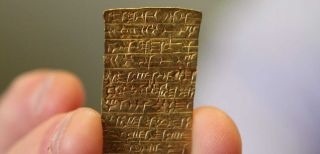
The 9.5-ounce, inscribed tablet was excavated about 100 years ago by German archaeologists who found it in the foundation of the Ishtar Temple, a ziggurat in the Assyrian city of Ashtur, in what is now northern Iraq. Court documents said the tablet dates to the reign of King Tukulti-Ninurta I of Assyria (1243-1207 BC), making it more than 3,200 years old. The inscription describes the building of the temple complex.

It was put on display in the Vorderasiatisches Museum in Berlin in 1934. But when the museum’s artifacts were inventoried in 1945, at the end of World War II, the tablet was missing.

Flamenbaum died in 2003; in 2006, amid a dispute about the estate, his son, Israel Flamenbaum, informed the museum that the estate had possession of the gold tablet. The museum filed suit to regain possession and the case has been in court since.

A lower court found for the estate, but a midlevel court overturned it, ruling for the museum. The Court of Appeals typically takes four to six weeks to decide a case.

Hannah Flamenbaum, one of Riven’s daughters and the executor of the estate, said her father, an Auschwitz survivor, traded Red Cross packages for silver and gold pieces with Russian soldiers at the end of the war.

“It was either for two packs of cigarettes or a piece of salami,” Hannah Flamenbaum said outside the courtroom Tuesday, repeating what she called the family lore. “My father, in his nature, probably traded for it. He was a peddler.”

Riven Flamenbaum, a native of Poland, moved to New York around 1949 and ran a liquor store. He kept what he called his “coin collection” either on a mantel or in a little red wallet. Hannah said he brought the tablet to Christie’s, the famed auction house, in 1954, but they told him he had a forgery. She said they never thought much about it until Riven died at age 92. Israel Flamenbaum filed objections to Hannah’s accounting of the estate and notified the Berlin museum about the tablet, according to court documents.

Hannah and a sister maintain that the museum’s claim on the artifact is barred by a legal doctrine known as laches. Plainly stated, it means that the museum gave up its claim to the tablet because it “failed to exercise reasonable diligence to locate” it for more than six decades.

Steven Schlesinger, the lawyer representing the estate, said any claim by the museum is complicated by the passage of so much time and Riven Flamenbaum’s death. Schlesinger said the tablet, which is being held in a safe-deposit box, has been said to be worth $10 million, but no one knows the true value.

Raymond Dowd, attorney for the museum, countered that until Vorderasiatisches received Israel Flamenbaum’s letter, it had no idea of the tablet’s whereabouts.”Did the museum have an obligation to seek it out,” Chief Judge Jonathan Lippman asked.

“No,” Dowd replied.

“Is it really fair for your client to sit around 60 years and wait until [Riven Flamenbaum] is dead, and then come in and sue?” Judge Robert Smith probed at another point.

Dowd said many scholars had written about the missing piece, so it was known in the research world.

“Obviously, Israel Flamenbaum knew about it,” Dowd said. “He wrote the museum and said item VA994 is in my family’s possession.