Blood test to tackle melanoma treatment

Source: News.com.au

A SIMPLE blood test could identify those patients whose melanoma – the most serious form of skin cancer – has started to spread to other parts of the body, according to new research.

The test allows scientists to examine DNA shed from cancer tumour cells into the bloodstream, in particular a gene called TFP12.

The gene usually helps stop healthy skin cells growing out of control, which can potentially lead to cancer.

But in melanoma patients this gene is switched off because of the presence of chemical “tags” known as DNA methylation.

Experts behind the test found that higher levels of DNA methylation suggested the cancer had spread around the body.

Early stage tumours had relatively low levels of DNA methylation, while advanced cancers (those that had spread) had much higher levels, suggesting the gene was more tightly shut down.

Measuring levels of methylated TFP12 in DNA in the blood could help doctors work out whether the disease has spread and what treatments may be needed.

Dr Tim Crook, study author and a consultant medical oncologist based at the University of Dundee, said: “Once melanoma starts to spread it becomes far more difficult to treat. But actually detecting whether or not it has started to spread is also challenging.

“By using a blood test, we have the basis of a simple and accurate way of discovering how advanced the disease is, as well as an early warning sign of whether it has started to spread….

“There’s increasing evidence that the latest treatments are more effective in these early stages and, if we can identify patients whose cancer has only just started to spread, this would significantly improve the chances of beating the disease.”

The same Dundee researchers have identified another potential biomarker – NT5E.

This gene appears to become methylated and switched off as melanoma first develops. But if NT5E becomes unmethylated again, the gene is reactivated and helps the disease to spread more aggressively.

The researchers suggest that NT5E could be a possible target for the development of new treatments to tackle melanoma, particularly for aggressive cancers that have spread to the brain, lungs and other organs.

Professor Charlotte Proby, a Cancer Research UK dermatologist based at the University of Dundee, said: “Using blood tests to assess the landscape of our DNA is a simple way to learn more about what’s going on under the skin. The switching on and off of certain genes seems to affect when, where and why the melanoma spreads.

“Our goal is to develop a panel of similar biomarkers that will help us to accurately detect those patients needing extra treatment to fight their melanoma.

Species of Humpback Dolphin Found in Australia

20131103-100705.jpg

Source: National Geographic

Hiding in plain sight, researchers have discovered a new species of humpback dolphin living off the northern coast of Australia.

The discovery came when scientists with the Wildlife Conservation Society (WCS) tried to settle a decades-old argument among marine mammal researchers.

“For many years, there’s been this debate about the number of species of humpback dolphins,” said Howard Rosenbaum, director of the WCS ocean giants program. Scientists have proposed everything from two to four species within the group’s genus Sousa.

But there was never enough good evidence supporting claims of more than two species, Rosenbaum said. So about ten years ago, the community decided that until they had more information, they’d recognize only two species—the Atlantic humpback dolphin and the Indo-Pacific humpback dolphin.

New Science

Rosenbaum and colleagues decided to revisit this old argument, and started collecting physical and genetic samples from humpback dolphin populations throughout their range. This included samples from West Africa, the Indian Ocean, the Pacific Ocean, and off the coast of Australia.

“From a management standpoint, the marine mammal community has specified that they need at least two different forms of evidence to justify different species [designations],” said Rosenbaum.

So he and his colleagues tried to collect as comprehensive a data set as possible to get the best chance of putting this argument to rest. Usually, genetic analyses into the question of new species consider only DNA from an organism’s mitochondria—the cell’s battery pack.

This is because mitochondrial DNA is inherited only through the mother and is easier to work with than DNA from a cell’s nucleus, said Martin Mendez, assistant director for the Latin American and Caribbean program at WCS.

But Mendez and colleagues looked at DNA from both parts of the cell. That, combined with physical characteristics including the length of the dolphins’ beaks and the number and position of their teeth, suggested there were four species of humpback dolphin. Not two.

Three of those species were ones researchers had previously proposed. They encompass a species off of West Africa (S. teuszii), one in the central and west Indian Ocean (S. plumbea), and one in the eastern Indian and west Pacific Oceans (S. chinensis).

The fourth species, an as-yet unnamed group off the north coast of Australia, was a pleasant surprise, said Rosenbaum. (Related: “From Darth Vader to Jelly Doughnuts, Weird Species Names Abound.”)

In some ways, this species is new to science, said Mendez. But in other ways, it isn’t because researchers have known about this group down in Australia for a while. They just didn’t realize it was a different species.

It’s rare to find a new species of mammal, said Mendez. “[But] it’s also not crazy to find new species when you’re using the kind of [genetic] information we’re using.

“One of the reasons we’re finding new species is because we’re finding new tools,” he explained. “Genetics opens a new window into these kinds of questions.”

Aiding Conservation

Mendez is hopeful that this discovery—reported this week in the journal Molecular Ecology—will help in the management of this IUCN Red List group. The Atlantic humpback dolphin is considered vulnerable, and the Indo-Pacific group is considered near threatened.

The legal framework used to protect vulnerable species is based on species designations, he explained. “We’re proposing that Australia has its own humpback [dolphin] species, which has implications for conservation strategies.”

“Countless dolphins die every year as bycatch in fisheries,” said Rosenbaum. The humpback dolphin is subject to particularly high rates of bycatch, and in some places is hunted directly.

“By describing these different species, we hope that this sets the stage not only for the appropriate conservation protections to be put in place by different countries, [but that] it also helps reduce threats like bycatch.”

Photographer Jimmy Nelson finds the last tribes on earth

Source: News.com.au

The Kazakhs are Turkic people originating from the northern parts of Central Asia. For more than two centuries the men have hunt

The Kazakhs are Turkic people originating from the northern parts of Central Asia. For more than two centuries the men have hunted on horseback with trained gold eagles. Picture: Jimmy Nelson Source: Supplied

IT WASN’T that they were unfriendly – they had repeatedly offered him of vodka, which, not being much of a drinker, he’d refused. But after failing to persuade them to pose for him, he decided to put his camera away and play the grateful guest.

The result was that in no time at all he got steaming drunk and slumped into an alcoholic stupor. The next thing he knew, he was waking up in a teepee tent surrounded by about 30 people with a bladder fit to burst.

Wrapped up in about eight layers of clothes and with the temperature minus-40c outside, British photographer Jimmy Nelson had no option than to pee in his pants and drift back off to sleep.

The next thing he knew was the tent had collapsed under a stampede of reindeer – animals who, unbeknown to him, are attracted to the salt in urine. Soon the beasts had surrounded him trying to lick his clothes.

“At the beginning the Tsaatan people were absolutely livid. But by making a complete plunker of myself and becoming the laughing stock of the group, they finally began to open up.”


The Tsaatan (reindeer people) of northern Mongolia are a nomadic tribe who depend on reindeer for nearly all aspects of their su

The Tsaatan (reindeer people) of northern Mongolia are a nomadic tribe who depend on reindeer for nearly all aspects of their survival. Picture: Jimmy Nelson Source: Supplied

Gaining the acceptance of people has been the key to Jimmy’s work.

Jimmy, who travelled widely as a young man before becoming a successful commercial photographer, has spent the last three years photographing 35 of the most aesthetically beautiful and remote tribes in all corners of the world.

His new book Before They Pass Away is a snapshot of these tribes as they are now and stands as both a piece of art and an historical document.


Photographer Jimmy Nelson visited 35 tribes in three years before publishing Before They Pass Away by Jimmy Nelson, published by

Photographer Jimmy Nelson visited 35 tribes in three years before publishing Before They Pass Away by Jimmy Nelson, published by teNeues, 128, also available as Collector’s Edition XXL, http://www.teneues.com Source: Supplied

His journey took him across all five continents, visiting such far-flung places as the mountainous region of Bayan Olgii in Mongolia, the Baliem Valley of Papua New Guinea and the wildest parts of southern Ethiopia.

One of the tribes was the Mursi in Ethiopia, where the women wear clay plates in their lower lips. At the age of 15, girls get pierced, after which their lips are stretched out to create enough space to place the lip plate.

The lip plates are believed to have been invented to make women less attractive to slave traders. The Mursi are one of the last tribes to wear the plates and if the latest generation, increasingly influenced by the modern world, choose not to practice the tradition it may soon die out altogether.

While he is careful to point out that the book is primarily a commercial project as opposed to some grandiose political statement, Jimmy hopes it will create a greater awareness of the beauty and individuality of the people he has encountered and encourage a positive dialogue between the tribes and the modern world.


The Himba are an ancient tribe of semi-nomadic herders, living since the 16th century in scattered settlements throughout the re

The Himba are an ancient tribe of semi-nomadic herders, living since the 16th century in scattered settlements throughout the region of the Kunene River in northwest Namibia and southwest Angola. Picture: Jimmy Nelson Source: Supplied

He said: “The essence of the project is to make people aware of how scarce their individuality is. Not to be patronising, but to say this is what you are and to show them they have a value that is precious.

“The world is changing and we’re not going to stop it, but I hope in my own way, to encourage them not to abandon everything that makes them so individual.”


The Drokpa Tribe, which numbers around 2,500, live in three small villages in the Dha-Hanu valley of Ladakh, which is situated i

The Drokpa Tribe, which numbers around 2,500, live in three small villages in the Dha-Hanu valley of Ladakh, which is situated in Jammu and Kashmir, a disputed territory between India and Pakistan. They are the only authentic descendants of the Aryans left in India. Picture: Jimmy Nelson Source: Supplied

While all the tribes he encountered were completely different in terms of appearance, the similarities were obvious.

“From a social perspective they were the same,” Jimmy says. “The further you get away from civilisation, the more people work as a family unit, the greater respect they have for the older generations and for each other. The further away you get, the kinder people are.”

Growing up in Africa, Asia and South America, British photographer Jimmy Nelson developed a deep fascination for the indigenous cultures he encountered and has seen first hand how the world has changed.


Photographer Jimmy Nelson intends to visit another 35 tribes before they die out. Picture: Jimmy Nelson

Photographer Jimmy Nelson intends to visit another 35 tribes before they die out. Picture: Jimmy Nelson Source: Supplied

But it is the pace of change in the past five or six years, due to the internet and improved roads, that he has found most startling.


The Maori are the indigenous people of New Zealand, who arrived in New Zealand in the thirteenth century AD having made the epic

The Maori are the indigenous people of New Zealand, who arrived in New Zealand in the thirteenth century AD having made the epic sea voyage from the islands of Eastern Polynesia. Picture: Jimmy Nelson Source: Supplied


Legend has it that twelve large canoes each carried a different tribe. Even today, most Maori people can say which original trib

Legend has it that twelve large canoes each carried a different tribe. Even today, most Maori people can say which original tribe they are descended from. Picture: Jimmy Nelson Source: Supplied

When he visited the tribes in southern Ethiopia, for example, the journey from the airport took him three weeks. Today after new roads have been built to the area it would only take a couple of days.

The next step is to return to all the tribes he photographed and show them the completed book. Then he intends to photograph a further 35 tribes in more politically unstable areas of the world where he would require special permission from authorities’ helpto get access.


The people of Ladakh live in very high mountain valleys between the Himalaya and Karakoram ranges in the northern Indian state o

The people of Ladakh live in very high mountain valleys between the Himalaya and Karakoram ranges in the northern Indian state of Jammu and Kashmir. The Ladakhi share the beliefs of their Tibetan neighbours. Tibetan Buddhism, mixed with images of ferocious demons from the pre-Buddhist Bon religion, has been the principal religion in Ladakh for more than a thousand years. Picture: Jimmy Nelson Source: Supplied

Why we celebrate Halloween?

Why we celebrate Halloween

Halloween is around 6000 years old. It is derived from the ancient Celtic festival called Samhain celebrated on October 31, the day before the Celtic New Year began. It was believed to be the day when spirits of the dead visited the living world.

Amidst the fun and frolic of Halloween, is its true significance forgotten? Halloween is about trick-or-treating, guising, wearing scary costumes, lighting bonfires, making pumpkin lanterns, and telling and listening to horror stories. How are these traditions related to the festival?

The term Halloween is an abbreviated form of ‘All-hallow-even’ that comes from All Hallows’ Day, also known as the All Saints’ Day. It was regarded as a religious day in the European Pagan culture. Pope Gregory III and Gregory IV shifted the Christian Feast of the All Saints’ Day to November 1. Today, All Saints’ Day follows Halloween. During the 9th century, both were celebrated on the same day.

The Celtic festival Samhain marked the end of harvest season. It was believed that the boundary between the living and dead worlds dissolved on the night of October 31 and that spirits of the dead visited the living world. People feared the spirits. To seek protection from them, people wore scary costumes and lit bonfires.

Halloween and the Jack O’Lantern

A pumpkin lantern is made by placing a lit candle inside a carved pumpkin. The pumpkin symbolizes the Stingy Jack of Ireland. Here’s his story.

Jack was a greedy, old farmer. Once he invited the Devil for a drink for which he didn’t want to pay. He asked the Devil to turn into a coin so that he could buy them drinks. The Devil did as told. Jack slid the coin into his pocket with a silver cross. This did not allow the Devil to change back to his original self. He agreed to free the Devil under the condition that he would not trouble him for a year and not claim his soul if he were to die. The following year, Jack tricked the Devil again. He asked him to climb a tree and trapped him there. In return of freeing him, he asked for a favor. It was decided that the Devil would not bother him for ten more years. When Jack died, he was neither accepted in heaven, nor could the Devil claim his soul. The Devil cursed Jack. He was condemned to roam on earth during nights. He was given a burning coal as his guiding light. Jack carved out a turnip, placed the burning coal inside it and used it as his lantern. The Irish called him Jack of the Lantern or Jack O’Lantern.

Turnips, potatoes and even beets began to be used to make lanterns. Immigrants brought the tradition to America, where pumpkins were chosen. The tradition continues, and has become an important part of Halloween celebrations the world over. Pumpkins are carved into comical or fearful faces and placed at the doorsteps of houses. Originally, carved pumpkins were also associated with the harvest season in America. By the late 19th century, they were linked with Halloween.


Why are Orange, Black, and Purple the Colors of Halloween?

Black and orange are regarded as the traditional colors of Halloween. Over the years, even purple, green and red have become popular as Halloween colors. They are used heavily in decorations and have become a part of Halloween party themes. People dress up in these colors. Gifts and supplies are wrapped in these colors. Let’s see how they are linked with Halloween.

Orange is associated with pumpkins, autumn, and fire. Since Samhain was celebrated in autumn and orange leaves and gourds are elements of this season, orange came to be linked with Halloween. Orange also represents strength and endurance which might have a link with the wars between Julius Caesar and the Celtics.

Black is linked with death, fear, night, and silence. Since Halloween was believed to be the day when the boundaries between the living and dead worlds blurred, the festival came to be linked with death and hence the color black. Black also represents bats, black cats, witches, and vampires which are a part of Halloween lore.

Purple represents the supernatural, the spiritual, and the mystic. Halloween elements like witches, vampires, and spirits of the dead add that mystic element to the festival, making purple a Halloween color.

Red, the color of blood and evil, and green, the color of goblins and monsters are regarded as Halloween colors owing to their symbolism.


How Black Cats, Spiders, Owls, and Bats are associated with Halloween

We see them in Halloween costumes and masks. They become themes for treats and party food. Why are they a part of Halloween celebrations?

Black cats were considered to be reincarnations of living beings. In the Middle ages, people believed that witches turned themselves into black cats. That’s how black cats were linked with Halloween.

Spiders have long been associated with haunted houses and graveyards. This ‘haunt’ element links them with Halloween. During the Middle Ages, spiders were regarded as companions of witches. According to a superstition, seeing a spider on Halloween meant that the spirit of a loved one was watching over you.

Bats and Owls are attracted to bonfires lit on the Halloween night. And that’s how they are linked with the festival. Bonfires were a part of Samhain traditions. Bonfires lit during the nights attracted insects. Bats and owls came to prey on them. As Samhain evolved into Halloween, bats and owls came to be associated with it. According to an old myth, a bat flying into a house on Halloween meant that the house was haunted. Bats have been a part of the vampire lore, and especially so after the discovery of vampire bats in the 16th century. This has strengthened their association with Halloween.


Why are Apples associated with Halloween?

Candy apples are a common Halloween treat. Bobbing for apples is a fun game played for Halloween, which includes lifting apples floating in water with your mouth, without using your hands. Traditionally, unmarried women played this game. It was believed that the first one to lift an apple would find her love soon. Around the time of Samhain, there’s a Roman festival celebrated to honor Pomona, the goddess of fruit trees. She was also regarded as the goddess of fertility. An apple is her symbol and hence the association of apples with Samhain and also Halloween.


Why Trick or Treat?

It was believed that spirits of the dead visit our world on the Halloween night. Years ago, there was a superstition that they would come disguised as beggars and go door to door asking for money during Samhain. It became a custom to not let them return empty-handed. Even before trick-or-treat, the tradition was followed in Great Britain and Ireland, where children and poor people would go door to door, pray for the dead in those families and receive food in return. Back then, the tradition was called souling. Trick-or-treating during Halloween is believed to have existed in Scotland in 1895 when the tradition was to visit households asking for food and money. Some time in the early 20th century, trick-or-treating came to America and spread west to east.

Today, kids dressed in scary or funny costumes visit houses in their neighborhood, asking for treats. At each door, they say “trick or treat” which means “give us a treat or we will play a trick on you!” Since the 1950s trick-or-treating is a Halloween tradition in many parts of the world.


Halloween in Different Cultures

In Ireland, people dress up like creatures from the underworld. Barmbrack is important in the Irish tradition. It is a kind of fruit bread. There’s a tradition to bake cakes with a ring, rag, or a coin placed in them. Whoever gets the ring is believed to find his love soon; finding a rag foretells poverty while finding a coin indicates otherwise. A game called Puicini is also a part of the Irish Halloween traditions. In this game, a blindfolded person chooses a plate from several others. The food in that plate determines his life in the following year. Fireworks during the preceding month are a prominent feature of the Halloween celebrations in Ireland.

In Scotland, houses were protected with candle lanterns. If the evil spirits got past the lanterns, it was a custom to leave the house and spare it for the spirits for one year. Until recently, trick-or-treating was not known to the Scottish. Children dressed in scary animal costumes and pretended to be evil spirits. They went guising to houses in the neighborhood and received offerings from homeowners.

On the Halloween night, Austrians leave food and light a lamp on the dinner table to greet souls of the dead. The Belgians too, light candles in memory of the dead. The Czechoslovakians place chairs by the fire for spirits of the dead to attend their gatherings.

In China, Halloween is known by the name Teng Chieh. They have a tradition to place food in front of the photographs of their deceased loved ones. Bonfires and lanterns are meant to serve as guides for the spirits on their way to our world. In Hong Kong, Halloween is known as Yue Lan or Festival of the Hungry Ghosts. They believe it’s the time when spirits of the dead visit the living world. American expats celebrate Halloween on a grander scale. Hong Kong Disneyland and Ocean Park host annual shows for them. Influenced by the American pop culture, the Japanese have started celebrating Halloween only recently. Decorations are limited to tourist attractions. Costume parties are a private affair and trick-or-treating is not commonly practiced. Halloween is limited to only some parts of Philippines. The Filipinos regard November 1 as the Day of the Dead and observe it on a grand scale. October 31 which is Halloween is not a public holiday for them.

Alla helgons dag is what Halloween is called in Sweden. It is celebrated in the week following October 31. For them, it’s the time to remember their departed loved ones.

In Latin America, Mexico, and Spain, Halloween is a three-day celebration to remember the dead. Houses are decorated to greet spirits of the dead family members. Food of their choice is prepared and family members gather to remember their loved ones. In some families, there’s a custom to gather near the graves of the deceased.

Halloween became an American holiday only in the 19th century. It was a custom in North America to seat an unmarried woman in front of a mirror in a dark room. It was believed that her husband-to-be would appear in the form of an image in the mirror. Seeing a skull meant that she would die before marriage. Today things have changed. Trick-or-treating, bonfires, and parties are integral to Halloween celebrations. Halloween is the second most popular holiday in the United States. In some parts of Central and South America, Halloween is popular, while in others it is not. In Colombia and Chile, children dress up and visit houses in their neighborhoods, asking for treats. Teenagers and adults attend costume parties. In Brazil, Halloween celebrations are limited to only some schools.

Halloween in the United Kingdom is believed to have a Pagan origin. During the Puritan times, celebrating Halloween was forbidden by law. Influenced by the Americans, the English started celebrating it in the 20th century and trick-or-treating, costume parties, and apple bobbing became a part of their Halloween traditions. The festival is celebrated in other countries like Netherlands due to American influences.

Australians have never found Halloween much relevant to their culture. They have stayed away from this festival for long. It’s only in the last few years that Halloween has started gaining some popularity there. In France, Halloween is regarded as an American holiday and isn’t linked with remembering the dead. Halloween in Africa is derived from the American Halloween. In most parts of the Indian subcontinent, Halloween is not celebrated.

In cultures where Halloween is celebrated, traditions change but only slightly. In most parts of the world, it is celebrated as a day to remember the dead or seek means to communicate with them. As it is linked with harvest, many of its traditions revolve around food and fertility. Halloween is associated with a mixed bag of elements. There’s horror, there’s excitement; there’s fright, there’s fun. The celebrations today have taken an all new form, but the underlying philosophy is almost the same.

Are these the 10 best attractions in Europe?


Cappadocia. Picture: Wadgey, Flickr

Cappadocia. Picture: Wadgey, Flickr Source: Supplied

NINE months ago Peter Shaw quit his job in Perth to set off on a journey without an end date. Here he reveals his picks of the places you can’t afford to miss while in Europe.

“It’s tough putting together a list of the 10 best tourist attractions in Europe.

After all, Europe’s a big place and there are a ridiculous number of great sites to experience.

So following my list of the worst attractions in Europe, here are some of the best. Enjoy.

1. Cappadocia, Turkey

Hoodoos, fairy chimneys, earth pyramids – whatever you want to call them – they look awesome. These earthly towers of cool are about as common in Cappadocia as carpet salesmen are in the Grand Bazaar, and to make them even more interesting, a large portion have been hollowed and carved out to form dwellings that look like they’d be more fitting to a sci-fi film like Avatar than Central Turkey.

Try to imagine one of the most interesting and desolate places on earth with a solid dose of history, a dash of adventure and spectacular sunsets and you have Cappadocia. Lying on the ancient Silk Road, the region has been inhabited since the latter part of the Bronze Age and the remnants of the various civilisations who once called the area home now lie scattered across the region. Underground churches, real life Flintstone houses and hot air ballooning make the Cappadocia experience possibly one of the more memorable in your life.

Travel tip: Hire a scooter or four-wheeler and go off-road; exploring the fairy chimneys around Goreme. When it gets too steep leave the bike and keep going on foot for some truly breathtaking views. I’d recommend packing a bottle of (great) locally produced wine and timing your walk to catch a spectacular Cappadocia sunset.


The weird sites in Cappadocia. Picture: Virtualwayfarer, Flickr

The weird sites in Cappadocia. Picture: Virtualwayfarer, Flickr Source: Supplied

2. Sagrada Familia, Spain

Gaudi was to architecture what Einstein was to physics, Tesla was to electricity and Leonardo was to the Ninja Turtles. In my opinion it’s humanity’s single greatest architectural achievement and the Pyramids, Hanging Gardens and Acropolis can all go jump in the lake.

It’s like nothing you have ever seen and in the words of an American tourist I overheard: “What kind of insane genius could come up with something like this?!” Gaudi described the interior of his work as a ‘spiritual forest’ and the building does indeed remind you of something organic, even alive … The outside of the building is enough to keep anyone spellbound with its size, complexity and the bizarre interplay of shapes.

While not as ‘alien’ as the exterior, the inside of the cathedral is equally powerful and interesting. The colours, shapes, columns, scale, use of light and metal make it literally breathtaking. I can’t think of anything else in the world I have ever seen built by man that comes even close to this building.

Travel tip: Buy your tickets online, print them out and you can skip the insane line wrapping around the block. For some reason people don’t seem to research these things before arriving, and much like the Louvre, spend hours waiting in line in the hot sun.


Top 10 surprisingly awesome places in Europe

Sagrada Familia. Picture: Supplied Source: News Limited

3. Bruges, Belgium

It is one of the best preserved medieval towns in Europe, however the downside of Bruges is that every man and his dog knows about it! Still, it is worth a couple of days in any European itinerary.

Bruges is built on the canals, is a history buff’s dream and has one of the best medieval squares in the world; complete with bell tower and enough Gothic architecture to keep the Addams Family happy. Hire a bike and tour the canals from the saddle (in summer), you can circumnavigate the town in about an hour and there are plenty of quaint little lanes and cobbled streets to meander down and explore when you’re not riding along the canals themselves.

Travel tip: Summer pulls larger crowds than The Beatles did so I’d recommend visiting in winter, which has the added bonus of the beautiful buildings and canals being dusted in snow.


Bruges - Market Square shops. Picture: Supplied

Bruges — Market Square shops. Picture: Supplied Source: Supplied

4. The Tower of London

Maybe it’s the small part of me that still holds some nerdish Game of Thrones style fantasy about being a knight sitting atop a steaming warhorse, leading my men at arms into glorious battle … OK I admit it’s not a very realistic fantasy as just the thought of medicine, hygiene and religious practices in the 12th century are enough to keep me firmly grounded in the 2013. Still, the Tower of London is a fantastic experience for anyone with an interest in English or Medieval history.

The various museums within the walls and White Tower are really worth a look given the powerful historical context of the structure. Hilariously, there are also the world’s biggest and smallest sets of full plate armour on display. That’s right, the museum even has the armour of a giant and a dwarf. Brilliant.

Travel tip: Your admission includes a free tour by one of the well-practised and hilarious Beefeaters, which are absolutely worth doing.


Tower Bridge in London. Picture: Supplied

Tower Bridge in London. Picture: Supplied Source: Supplied

5. Sachsenhausen Concentration Camp, Berlin

This place is scary. This memorial museum lets you walk in the footsteps of a concentration camp prisoner for a day. Rewarding as it is confronting, the Sachsenhausen experience is an important one for anyone visiting Berlin.

Travel tip: Pack lunch and spend a day with your audio guide (cheap and totally essential in my opinion) wandering the grounds, going through each area in-depth for a powerful, moving and unforgettable experience. I spent about six hours at Sachsenhausen and felt that I could easily have spent a few more wandering the grounds, absorbing the personal stories and tragedies of its occupants.


Sachsenhausen Concentration Camp. Picture: David. Kungsholmen, Flickr

Sachsenhausen Concentration Camp. Picture: David. Kungsholmen, Flickr Source: Supplied

6. The Louvre, Paris

So you’ve made the pilgrimage to see the Mona Lisa and noticed its somewhat underwhelming demeanour … the best part is you now get to spend the rest of the day getting lost (both physically and metaphorically) in the labyrinthine halls of one of the world’s best museums. There is so much art at The Louvre that if you spent a minute at each piece (forgetting the time spent admiring the building itself) it would take roughly 24 days to see them all. You would also have seen enough naked flesh to make Vegas blush.

Travel tip: The first Sunday of every month is free and there are MULTIPLE ENTRANCES. Never wait in the main (glass pyramid) line to get in. On a recent visit this line was literally about two kilometres long and yet the side entrance I used did not have a single person waiting.


The pyramid of the Louvre Museum. Picture: AFP

The pyramid of the Louvre Museum. Picture: AFP Source: AFP

7. Orvieto, Italy

An absolute must for anyone visiting central Italy, this tiny village is perched precariously atop a rocky and fortified plateau in the Umbria region (very similar to better known Tuscany). This for me is the real Italy, with rustic lanes, cobbled roads, beautiful buildings and the earthy colours all brought together with the sound of old Italian ladies pinching the cheeks of their grandkids. I can honestly say this is one of my favourite spots in all of Europe.

The village is accessed via the funicular at the train station and once at the top you can easily walk around the entire town in a day taking in the amazing views of the surrounding countryside which is dominated by vineyards, fruit plantations, old churches and monasteries. There is also a rather impressive 14th century cathedral and a series of underground tunnels, passages, galleries and cellars cut deep into the rock below the town itself known as the ‘Underground City’.

Due to the extreme average age of Orvieto’s’ withered inhabitants (everybody is really, really old) there are a number of random emergency defibulators (like phone booths) situated all over the village. Some would say that they’re only necessary due to the town’s heart-stopping views.

Travel tip: Orvieto is easily accessed out of Rome, lying only about two hours away by high-speed train.


Orvieto. Picture: Hsivonen, Flickr

Orvieto. Picture: Hsivonen, Flickr Source: Supplied

8. Santorini, Greece

I feel sorry for the donkeys in Santorini. They have the unenviable job of hauling an endless supply of overweight tourists up the side of a truly monumental cliff. It’s a tourism hotspot (which usually I hate) however in this case I’m going to overlook the irritations of dealing with tourists because Santorini is amazing. This crescent moon-shaped Greek Island is what’s left of what was once a more symmetrical shape after one of the largest volcanic eruptions in recorded human history (the Minoan Eruption) disintegrated most of the island in about the year 250. Yep that’s right most of the island exploded!

The volcanic activity is the reason behind Santorini’s famous black sand beaches (which physics dictates is also the reason so many tourists have burnt feet here).

The classic town of Oia on the NW point of the island is famous for its blue domed roofs, whitewashed dwellings and as one of the best spots to watch the fabled Santorini sunsets, which alone are worth coming to the Island to see. Join the mob of eager tourists in the early evening to enjoy the sun’s last hour as it plunges into the South Aegean.

Travel tip: Santorini is like a magnet for cruise ships and prices reflect this so the best way to do the island is to sleep out of town, hire a four-wheeler and cruise the island at your leisure.


Santorini. Picture: Supplied

Santorini. Picture: Supplied Source: Supplied

9. The Burren, Ireland

What would the earth look like if people stopped planting crops, trees and grass, then decided to just grow rocks instead? Exactly like the Burren, that’s what. The name ‘Burren’ derives from the Irish word Boireann, meaning ‘great rock’ … wonder why they called it that? This rural ‘Karst’ landscape in NW County Clare, Ireland is filled with more rocks than soil.

I have no idea what the farmers do, given 80 per cent of their land is one big stone. Like everywhere in country Ireland the people are absurdly pleasant and the quaint roads are also so narrow that every time you pass another car you get a few more grey hairs. There are some memorable sites in the area too, including the fabled cliffs of Moher, the tiny musically inclined village of Dingle and more pubs than a drunk Irishman can poke an empty Guinness glass at. The Burren is where you go to hike through the little lanes, climb ancient stone walls, gawk at standing crosses, meander through cow-laden fields and dance to excellent Irish music. It’s ountry Ireland at its best.

Travel tip: You need a car to really appreciate the region.


The Burren. Picture: TechnoHippyBiker, Flickr

The Burren. Picture: TechnoHippyBiker, Flickr Source: Supplied

10. The Isle of Skye, Scotland

The most northerly island of the Inner Herbrides of Scotland is a beautifully picturesque, barren and untamed place. It’s an amazing spot to do some camping and hiking, and has some of the most intriguing landscapes in all of the UK. Skye also has the rather unique ability to make its inhabitants constantly appear as though they have just woken up and stumbled out of bed. It’s windy on Skye, really, properly, briskly, category five, Scottish windy; even in summertime (which may or may not actually exist in Scotland, the jury’s still out on that one).

There are two spots on the isle that turn it from just ‘damn cool’ to ‘freaking amazing’.

• The old man of Storr, a large rocky pinnacle that dominates the southern approach of the Trotternish Peninsula. You can see it from kilometres away and can climb up to the bottom of the pinnacle if you’re careful (lots of loose rocks, and a fairly steep incline) but the view is worth the effort and with any luck the area will get covered in low hanging clouds for added atmosphere. It’s also been used as a location in many films due to its remarkable appearance, the latest being Ridley Scott’s Prometheus.

• The Fairy Glen is a tiny area on the outskirts of Uig that does almost feel magical in an eerie sort of way (hence the name, genius). The glen is dominated by a number of bizarre corkscrew shaped ‘twisted’ hills in addition to the gnarled, old trees and enough creepy stone piles and circles to keep the Blair Witch happy (legend has it that if you get lured into a stone fairy circle by the fairy lights you will be trapped there, mesmerised by their dancing forever). Sadly I didn’t see any fairies or freaky lights but the glen does make for a truly memorable experience and some very unique photos.

Travel tip: Camp on Skye if you can, that or hire a camper van and stay in one of the many campsites on the island.”


The Isle of Skye. Picture: Supplied

The Isle of Skye. Picture: Supplied Source: News Limited

Underwater Marmaray tunnel linking Europe and Asia via Istanbul opens

Source: News

Turkish President Abdullah Gul (3rd R), Turkish Prime Minister Recep Tayyip Erdogan (4th R), Somalian President Hasan Sheikh Mahmud (2nd R) and Japanese Prime Minister Shinzo Abe (R) listen to the train driver at the Uskudar Marmaray station.

TURKEY has opened world’s first underwater tunnel connecting two continents, fulfilling an Ottoman sultan’s dream 150 years ago in a three-billion-euro mega project.

The Marmaray tunnel runs under the Bosporus, the strait that connects the Black Sea to the Sea of Marmara and divides Istanbul between Asia and Europe. The tunnel is 13.6km long, including an underwater stretch of 1.4km.

It is among a number of large infrastructure projects under the government of Turkish Prime Minister Recep Tayyip Erdogan that have helped boost the economy but also have provoked a backlash of public protest.

“I wish from God that the Marmaray that we are inaugurating will be a benefit to our Istanbul, to our country, to all of humanity,” Mr Erdogan said at the opening ceremony.

Officials hope that with up to 1.5 million passengers a day, the tunnel will ease some of Istanbul’s chronic traffic, particularly over the two bridges linking the two sides of the city. A more distant dream is that the tunnel may become part of a new train route for rail travel between Western Europe and China.

The underwater portion of the tunnel wasn’t dug, but was dropped in sections to the sea bottom – the immersed-tube method used around the world.

Turkish officials say that at more than 55m deep, it is the world’s deepest railway tunnel of its type.

Turkey is for the first time connecting its European and Asian sides with a railway tunnel, completing a plan initially proposed by an Ottoman sultan about 150 years ago.

Started in 2005 and scheduled to be completed in four years, the project was delayed by important archaeological finds, including a 4th century Byzantine port, as builders began digging under the city.

Rejecting any fears that the tunnel could be vulnerable to earthquakes in a region of high seismic activity, Turkish Transportation Minister Binali Yildirim said that it is designed to withstand a massive 9.0 magnitude quake. He calls it “the safest place in Istanbul.”

The tube sections are joined by flexible joints that can withstand shocks.

Ottoman Sultan Abdulmejid is said to have proposed the idea of a tunnel under the Bosporus about a century and a half ago. One of his successors, Abdulhamid, had architects submit proposals in 1891, but the plans were not carried out.

The tunnel is just one of Mr Erdogan’s large-scale plans. They include a separate tunnel being built under the Bosporus for passenger cars, a third bridge over the strait, the world’s biggest airport, and a massive canal that would bypass the Bosporus.

The projects have provoked charges that the government is plunging ahead with city-changing plans without sufficient public consultation. The concern fueled protests that swept Turkey in June.

Officials hope the tunnel will eventually carry 1.5 million passengers a day, easing some of Istanbul’s chronic traffic problems.

Tuesday’s ceremony on the 90th anniversary of the founding of the Turkish Republic was attended by Mr Erdogan and other officials, including Japanese Prime Minister Shinzo Abe, whose country was heavily involved in the construction and financing of the railway tunnel project.

Japan’s Seikan tunnel linking the Japanese islands of Honshu and Hokkaido is the world’s deepest, getting 140 metres below the seabed and 240m below sea level. The Channel Tunnel linking Britain and France is as much as 75m below sea level.

EARLIER:

The inauguration of the ambitious scheme – dubbed “the project of the century” by the government – coincides with the 90th anniversary of the founding of modern Turkey.

The idea was first floated by Ottoman sultan Abdoul Medjid in 1860 but technical equipment at the time was not good enough to take the project further.

However the desire to build an undersea tunnel grew stronger in the 1980s and studies also showed that such a tunnel would be feasible and cost-effective.

Mr Erdogan, a former mayor of Istanbul, revived the plan in 2004 as one of his mega projects for the bustling city of 16 million people – which also include a third airport, a third bridge across the Bosphorus and a canal parallel to the international waterway to ease traffic.

His ambitions were one cause for the massive anti-government protests that swept the country in June, with local residents complaining the premier’s urban development plans were forcing people from their homes and destroying green space.

Mr Erdogan’s critics accuse him of bringing forward the inauguration of the Bosphorus tunnel in time for municipal elections in March 2014.

The project will not be fully operational immediately and construction is expected to continue for several more years.

Construction of the tunnel started in 2004 and had been scheduled to take four years but was delayed after a series of major archaeological discoveries.

Some 40,000 objects were excavated from the site, notably a cemetery of some 30 Byzantine ships, which is the largest known medieval fleet.

But these unexpected finds eventually frustrated Mr Erdogan, who complained two years ago that artefacts were trumping his plans to transform Istanbul’s cityscape.

“First (they said) there was archaeological stuff, then it was clay pots, then this, then that. Is any of this stuff more important than people?”

Transport is a major problem in Istanbul, and each day two million people cross the Bosphorus via two usually jammed bridges.

“While creating a transportation axis between the east and west points of the city, I believe it will soothe the problem… with 150,000 passenger capacity per hour,” said Istanbul’s mayor Kadir Topbas.

The best true stories from the fake world of wrestling

Source: News

Wrestling legend Uncle Elmer had a real wedding to his bride Joyce live on WWE in 1985. Courtesy WWE.


John Cena is one of the biggest current day wrestlers. Photo: Supplied

John Cena is one of the biggest current day wrestlers. Photo: Supplied

“AN honest man can sell a fake diamond if he says it is a fake diamond, ain’t it?”

Today’s kingpin CEO of professional wrestling, WWE owner Vince McMahon, would agree with that sentiment. But he didn’t say it. The quote belongs to 1920s wrestling promoter Jack Pfefer. Even around the turn of last century, when legitimate wrestling was vying with boxing as spectator sport, promoters knew the truth: wrestling is boring. Two guys lying on a mat, entangled for minutes at a time. Who’d pay to watch that?

So they faked it. Slaps across the face that missed by inches. Melodramatic headbutts that sent 300-pound bruisers flying onto their backs. Sleeper holds, pile-drivers, the suplex body slam that hoisted complicit doomed wrestlers off their feet – and lifted fans out of their chairs in excitement.”

In his new book The Squared Circle: Life, Death and Professional Wrestling, author David Shoemaker tells the history of the fabulism – but also notes that some of the best stories are the ones that weren’t faked.

The NY Post asked Shoemaker to pick his favourite true tales from professional wrestling:

1. Doctors use Andre the Giant’s legendary booze intake to determine how much anaesthesia to give him

As with everything involving the gargantuan Frenchman, the myth is indistinguishable from the reality, but the legend of Andre the Giant’s drinking almost overshadows his wrestling triumphs.

There are numerous stories of his drinking feats: 119 beers in one sitting, 156 beers in one sitting, a case of wine on a four-hour bus ride, a $40,000 bar tab while filming “The Princess Bride,” an average of 7,000 calories of alcohol intake a day.

When Vince McMahon asked Andre to come back to the WWF as a villain in 1987 to feud with Hulk Hogan and headline WrestleMania III, Andre said that his back was too hurt for him to wrestle. McMahon was determined, though, so he paid for Andre to have surgery and let him rehab at the McMahon family home.

Legend has it that the anaesthesiologist responsible for putting Andre under had never before had a giant for a patient and had no idea how much anaesthesia to give him. He ended up asking how much booze he normally drank and used that as a guide for his dosage. “It usually takes two litres of vodka just to make me feel warm inside,” Andre quipped.


Andre the Giant died in 1993. Photo: Supplied

Andre the Giant died in 1993. Photo: Supplied

2. Captain Lou Albano gets run out of Chicago by the mob

Before he became the wacky, rubber-band-wearing manager famous as a part of the WWF’s Rock ‘n’ Wrestling Era (and for playing Cyndi Lauper’s dad in her “Girls Just Want to Have Fun” video), Captain Lou was a wrestler in his own right. He paired up with Tony Altomare to form The Sicilians, a tag team presenting itself as Mafia tough guys. While they were wrestling as villains in Chicago, they enraged fans with their tactics – and they also managed to infuriate the real-life Mafia.

In 1961, three members of the Chicago Outfit – supposedly including Tony Accardo – paid The Sicilians a visit and told them to lay off because their antics were giving the mob a bad name. They must have made their point – The Sicilians left town surreptitiously, hightailing it back to the Northeast.

3. Uncle Elmer gets married on WWF television – for real

Usually it’s safe to assume that what happens on wrestling TV shows is fake. But when the October 1985 wedding of Uncle Elmer, a rotund, snaggle-toothed, overalls-clad rube who was the “uncle” of Hillbilly Jim was hyped as a special attraction on Saturday Night’s Main Event, it was even more ridiculous than it sounded on its face – it was a real wedding between Elmer (real name Stan Frazier) and his fiancee, Joyce Stazko.

It’s unclear why Joyce agreed to have her nuptials performed in front of TV cameras – and with her husband-to-be playing the role of a dimwitted hog farmer – but undoubtedly Vince McMahon thought the wedding would make the show a smash hit.

Barnyard animals filled the ring, “Rowdy” Roddy Piper interrupted the proceedings with a string of insults, announcer Jesse “The Body” Ventura heckled the couple over the PA and the whole crowd laughed hysterically through – nonetheless Elmer and Joyce managed to make it through. They walked out of the arena that night as man and wife, and the marriage lasted for six years. Presumably they left the pigs at ringside.

4. Harley Race pulls a gun on Hulk Hogan

In the mid-’80s, McMahon’s WWF went national, threatening the status quo of the wrestling world. Until then, numerous promotions were set up across the country, operating independently under the banner of the NWA.

So, when McMahon started airing national WWF shows and touring his troupe into the cities normally controlled by these territorial groups, the old guard was none too happy. It wasn’t till they toured into the long-time NWA stronghold of Kansas City, though, that the enmity reached a boiling point.

Supposedly, Hulk Hogan was in the dressing room when a local wrestler named Harley Race stormed in. Race walked up to a seated Hogan and punched him, knocking him to the floor. When Hogan sheepishly said that he was surprised Harley wasn’t carrying a gun, Race reached into this jacket and pulled out a .38 Special. Nobody got shot, but Race had made his point. Hogan later claimed that Race actually tried to burn down the WWF ring, though Race denies it. Like most other regional promoters, Race lost a lot of money when the WWF took over, and to make back the money he lost, he ended up going to work for McMahon just a couple of years after the gun incident.


Hulk Hogan is now 60 years old. Photo: AP Photo/Chris Carlson

Hulk Hogan is now 60 years old. Photo: AP Photo/Chris Carlson

5. Yukon Eric loses an ear to Killer Kowalski

In October 1952, Yukon Eric – a beloved, brawny mountain man, was fighting the nefarious Wladek Kowalski in front of an electric Montreal crowd. The two rivals were deep into their match when Kowalski climbed the ropes to deliver his signature knee drop.

He landed on the side of Eric’s head, accidentally clipped one of Eric’s cauliflowered ears – the grotesquely bloated and hardened ears wrestlers are famous for – and accidentally tore it off the side of his head.

The fans went nuts, and when the papers the next day confirmed the mauling, outrage grew to a fever pitch. The promoter feared for Kowalski’s personal safety, lest some livid fan decide to exact some vigilante justice. So it was suggested to Kowalski that he visit Eric in the hospital to give the appearance of contrition. Kowalski agreed – he and Eric were friends in real life, after all.

There was a reporter from the local paper there covering the plight of Eric, and when Kowalski got into the hospital room, the sight of his “foe” in a ridiculous full-head bandage made him laugh.

“I swear, the first thing I thought of was Humpty Dumpty on the wall,” Kowalski later said. Eric laughed right along, but when the reporter heard the laughter from the hall, he only heard Kowalski’s booming voice, and the headline the next day said that Kowalski showed up only to laugh in Eric’s face.

It only confirmed the fans’ revulsion toward the villain. Suddenly Kowalski had a new nickname – “Killer” – and a new persona as a masochist. Real injures sell tickets, though, and after that, Eric and Kowalski were drawing giant crowds all over the country.

6. Randy Savage kept Miss Elizabeth under lock and key

“Macho Man” Randy Savage was one of the biggest wrestling stars of the 80s and 90s, and his on-screen character was famous for being more than a little nutty, obsessed with treachery and sedition, and overly protective of his lady friend, Miss Elizabeth. Any other wrestler who gave her undue attention – from George “The Animal” Steele to Hulk Hogan – was deemed an enemy. In real life, Savage and Liz were married and, as it turns out, the protectiveness was more than just show. Hogan himself has said that Savage would make Elizabeth keep her gaze fixed on the ground backstage so she wouldn’t make eye contact with any of the other guys, and he made sure she had her own locked dressing room to keep her separate from the fray. It’s also frequently reported that as his obsession deepened, he would lock their home – from the outside – when he left, sometimes shutting her inside for days at a time.


Randy Savage was known as the 'Macho Man,' and died in 2011. Photo: AP Photo/WWE

Randy Savage was known as the ‘Macho Man,’ and died in 2011. Photo: AP Photo/WWE

7. The Spider Lady (a k a The Fabulous Moolah) steals Wendy Richter’s title – for real

Negotiating a contract could be hell in the WWF.

On Nov. 17, 1985, female superstar Wendy Richter was in the middle of salary talks with the WWF when she was set to defend her WWF women’s title against a masked opponent named The Spider Lady. But when the masked challenger made her way to the ring, Richter – and the fans – could clearly tell it was Richter’s long-time rival, The Fabulous Moolah, under the mask.

While most people probably thought it was just another storyline doublecross, Moolah’s arrival was a legitimate shock to Richter. As The Spider Lady enters the ring, you can see she isn’t acting.

She tries to wrench off Moolah’s mask to expose her, but to no avail – Moolah muscled Richter into submission, and the complicit referee counted a quick three. After the bell, Richter yanked off the mask and exposed Moolah, attacked her, and tried for a pin of her own, but it was too late.

It’s only when the announcer climbed into the ring that Richter realised it was all over. “Ladies and gentlemen,” legendary voice of the WWF Howard Finkel said, “the winner of this bout and new World Wrestling Federation Ladies Champion: The Spider? The Fabulous Moolah?”

Richter was livid, but there was nothing to be done. Moolah had the title back, and Richter would never get her new contract. She was never seen in the WWF again.

8. Bruiser Brody gets killed by a co-worker in Puerto Rico

Bruiser Brody was one of the biggest draws before the WWF went national – a 6-foot-plus wild man with a curly, black mane and a penchant for violence. Like many stars of the era – and particularly the monstrous sort of stars – he travelled the world plying his brutal trade.

In 1988, Brody was in Puerto Rico for a big card full of American talent. Before his match, he was called into the locker room shower by Jose Gonzales – a k a Invader No. 1 – a wrestler and close confidant of the promoter (and star) of Puerto Rico, Carlos Colon.

Suddenly, the other wrestlers in the locker room heard Brody moan and looked up to see Gonzales holding a bloody knife.

Brody was a notoriously difficult person to work with, declining to lose any time he didn’t feel like it, but even taken in the extreme, this seemed like a shocking means of working out business affairs.

When paramedics got there, they couldn’t move the enormous Brody, so fellow wrestler Tony Atlas carried him to the ambulance, but it was too late: He died at the hospital.

Gonzalez was charged with murder, but the charges were reduced before trial, and neither Mantel nor Atlas nor any other American wrestler on hand that night was brought back to San Juan to testify. Gonzalez claimed to have been acting in self- defence, and after Colon, a local hero without equal, testified in his defence, Gonzalez was acquitted.


David Shoemaker’s The Squared Circle: Life, Death, and Professional Wrestling (Gotham) is out this week.


New creatures found in Cape York’s ‘lost world’

Source: News

A new species of leaf-tailed gecko sits on a tree trunk in this Cape York rainforest. Picture: Supplied

A new species of leaf-tailed gecko sits on a tree trunk in this Cape York rainforest. Picture: Supplied Source: Supplied

SCIENTISTS have discovered a lost world of unknown creatures in a rainforest perched on massive boulders in a remote part of Cape York in Queensland’s north.

Surveys have previously been conducted on the millions of black granite boulders piled hundreds of metres high around the base of Cape Melville, north of Cooktown.

But the rainforest has remained largely unexplored, fortressed by massive walls of boulders.

In March, James Cook University’s Dr Conrad Hoskin and National Geographic photographer and Harvard University researcher Dr Tim Laman led a research team that was choppered in to explore the area.

Within several days they found three species previously unknown to science: a leaf-tailed gecko, a golden-coloured skink, and a boulder-dwelling frog.


A new species of boulder frog found among the boulders of the Cape Melville Range. Picture: Supplied

A new species of boulder frog found among the boulders of the Cape Melville Range. Picture: Supplied Source: Supplied

“The top of Cape Melville is a lost world,” Dr Hoskin said. “Finding three new, obviously distinct vertebrates would be surprising enough in somewhere poorly explored like New Guinea, let alone in Australia, a country we think we’ve explored pretty well.

“They’ve been isolated there for millennia, evolving into distinct species in their unique rocky environment.”

Dr Hoskin described the findings as the discovery of a lifetime.

The highlight of the expedition was the discovery of the “primitive-looking” Cape Melville Leaf-tailed Gecko of which its new scientific name – Saltuarius eximius – means exceptional or exquisite.


Herpetologist Conrad Hoskin with a new species of leaf-tailed gecko. Picture: Supplied

Herpetologist Conrad Hoskin with a new species of leaf-tailed gecko. Picture: Supplied Source: Supplied

Intriguing features of the gecko are its huge eyes and long and slender body and limbs – most likely adaptations to life in the dimly lit boulder fields.

Patrick Couper, Curator of Reptiles and Frogs at the Queensland Museum, says the gecko is the strangest new species he’s seen in his 26-year career as a herpetologist.

“That this gecko was hidden away in a small patch of rainforest on top of Cape Melville is truly remarkable,” he said.

Scientists are hopeful future expeditions will reveal further secrets.


Conrad Hoskin holds a new species of Shade Skink (Saproscincus saltus). Picture: Supplied

Conrad Hoskin holds a new species of Shade Skink (Saproscincus saltus). Picture: Supplied Source: Supplied

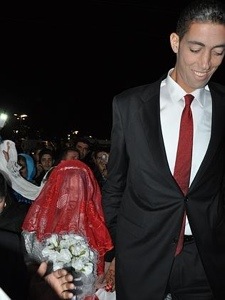
World’s tallest man Sultan Kosen gets married in Turkey

Source: News

The height difference between the pair is over two feet.

IT IS a good thing that opposites attract, otherwise Sultan Kosen might’ve had a hard time finding a woman of similar proportions to share his life with.

The world’s tallest man is 2.51 metres high, which is a good two feet and seven inches taller than his new bride, Merve Dibo.

The Turkish farmer was married in a ceremony at the weekend, after previously almost giving up hope he’d ever find love, the Daily Mail reports.

The Turkish farmer has married his lady love, Merve Dibo, from Syria.
He’s one of only 10 people in recorded history to top the eight feet mark. And he also holds the current Guinness World Record for the largest feet and hands on the planet.

Kosen’s gigantic wedding suit needed to be custom made, obviously. And his celebrity status in his home country meant the nuptials were a who’s who of Turkey.

Definitely worth Instagramming.
“Now I will have my own family and private life,” he said. “How unfortunate I could not find a suitable girl of my own size. My fiancee is over 1.75 meters tall, but I believe I’ve found the person for me.”

Kosen suffers from a rare disorder called pituitary gigantism, which causes his body to continually produce the growth hormone.

His condition is believed to have been caused by a tumour in the pituitary gland.

Doctors thought they had cured him in 2008 when they removed the tumour but he continued to grow by half an inch (1.27cm) a year.

Now medics say he has finally stopped growing.

20131028-094942.jpg

Roma family in Ireland reunited with daughter

Source: CNN

Two blonde, blue-eyed girls taken from Roma couples. Authorities turn to DNA tests for answers.

For a family in Ireland, it’s proof the girl is indeed their biological daughter.

For a girl in Greece, the mystery remains as to who she is and who her real parents are.

In Dublin, a 7-year-old girl whom Irish police took from a Roma couple two days ago was reunited with her parents.

A DNA test confirmed she is their daughter, a source familiar with the case’s legal proceedings told CNN on Wednesday.

Police, acting on a tip, had removed from the girl Monday and placed her in protective care.

The Roma mother and father — who live in the suburb of Tallaght — told CNN that they have a passport for the girl, but that they did not call her by the name on the passport.

The couple, who appeared to be very upset by the situation, also showed CNN photos of the girl.

The parents appeared in family court earlier Wednesday, after which their attorney said the couple is going to take some time before considering its legal options, the British Press Association reported.

“Her parents greatly appreciate the help and assistance that they have been given by friends and relatives over the last few days,” Waheed Mudah told the PA. “They now intend to concentrate on looking after their family and, in particular, in trying to reassure their daughter that she will be their care.”