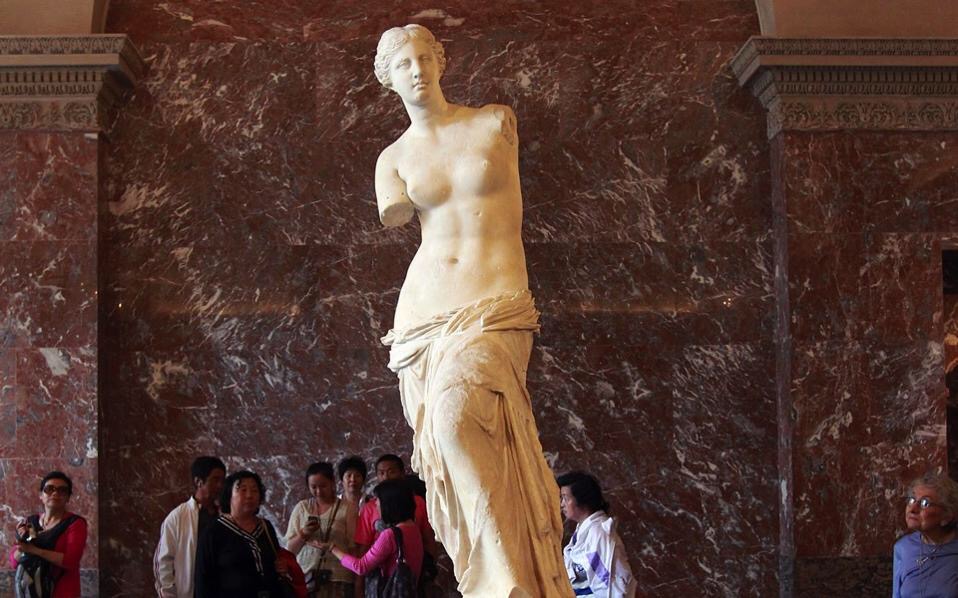
A little over two years ago, the mayor of the island of Milos, Gerasimos Damoulakis, visited the Louvre Museum in Paris to see the Venus de Milo – the Aphrodite of Milos – up close. But upon entering, rather than asking for a ticket, he said: “I am the mayor of Milos. I do not accept that I should have to pay for a ticket as I came to see one and only one exhibit, the Aphrodite of Milos, which belongs to my island.”
After they’d received this sudden request, the museum’s operators held an impromptu meeting and decided to agree and invite the mayor and his entourage to enter for free. The doors of the museum opened and the Greek mission headed to the big hall which houses the famous statue. They sat for a while to look at it in awe and then left with the promise that one day they would not have to undertake such a long journey to admire it.
Gathering signatures
Two-and-a-half years later, the Milos mayor’s efforts to have the marble sculpture returned to the island have intensified. “The issue has tortured me for 15 years [a photograph of the statue can be seen on the municipality’s website], but now the time is ripe. We have now a documented legal position that states when the statue was taken from the island there was no business transaction, but there was an act of war.
“The statue was taken by a French naval officer and loaded onto a French warship. At that time, we were in a period of war,” says Damoulakis. He has already set up a bidding committee, which has taken care of the request to collect a million signatures so that the matter can be taken up in the European Parliament. “Some on Milos thought I was joking, but I always meant what I said. Work has already begun on the restoration of an old girls’ school in Plaka, the capital of the island, where the Aphrodite’s permanent home will be.”
The sculpture, which symbolizes female beauty and femininity, is carved out of Parian marble. It is 2.02 meters tall and weighs 900 kilos. It dates back to around 100 BC. It was unearthed by a farmer named Giorgos Kentrotas in 1820. The Aphrodite was in two pieces and her hands were missing. According to one interpretation, a French officer, Olivier Voutier, who was wintering in the port with the warship Estafette, realized the value of the statue.
He informed the French consul in Milos, who returned to buy it. News of this, however, got out and other potential buyers rushed to the island. The French appeared to bargain better with the Ottomans, and they ended up leaving with the valuable “commodity.”
On March 1, 1821, the French ambassador Charles Francois de Riffardeau, Marquis de Reviere, gave the statue to King Louis XVIII as a gift to be displayed in the Louvre, where it remains to this day.
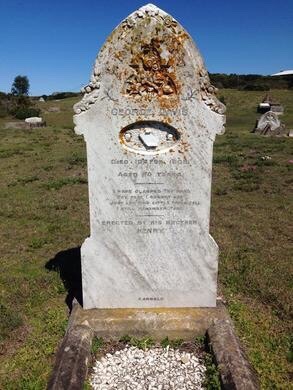
Hidden among popular Sydney golf courses is a little remembered graveyard populated by smallpox victims.
Hidden amongst the finest golf courses of Sydney’s Eastern Suburbs is the Coast Cemetery, an aging graveyard that remembers a time when the whole area existed solely to house smallpox victims.
In 1881, Sydney fell victim to an outbreak of smallpox, a highly infectious disease for which began tearing through the local population. Thus a makeshift city was built near the coast, removed from the Sydney city center to prevent its spread by quarantining any sufferers far away from the general population. As the outbreaks continued, the permanent Coast Hospital was built, including its own cemetery where any patients that died of the disease were required to be buried.
The hospital and cemetery continued to be used into the 1900s with outbreaks of the bubonic plague, typhoid fever, and leprosy infecting the city. In 1934, the hospital was renamed the Prince Henry Hospital and in 1946, the majority of deadly outbreaks staunched, it became a teaching hospital.
The cemetery is quite unique as the people who were buried there, some 2,000 patients and nurses of the hospital, having been relocated to the isolated hospital, are not necessarily from the area.
The site today is often overlooked in favour of the nearby suburb, the historically significant La Perouse. But this site offers something different, a snapshot of a very real, very frightening part of Sydney’s history reflected in the quiet, and often haunting, graveyard. Know Before You Go
Follow Cape Banks Road until you reach a small trail named “Cemetery Trail.” There is just enough space to leave your car at the start of the trail and then you must walk the rest of the way.
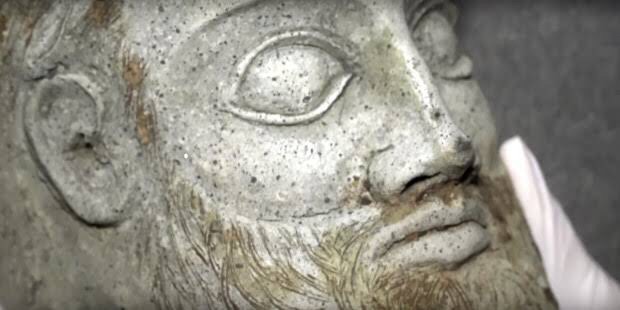
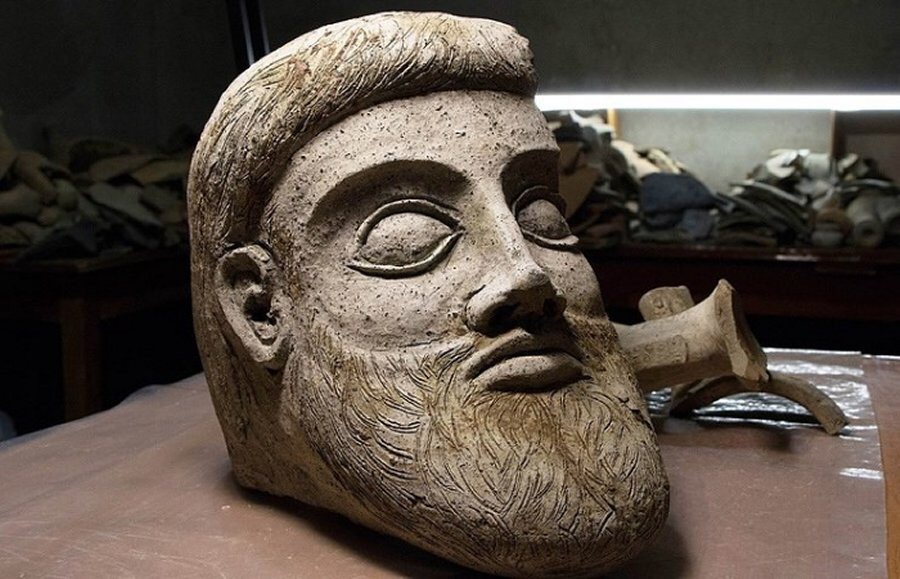
Russian builders discover an unusual terracotta head off the Crimean Peninsula.
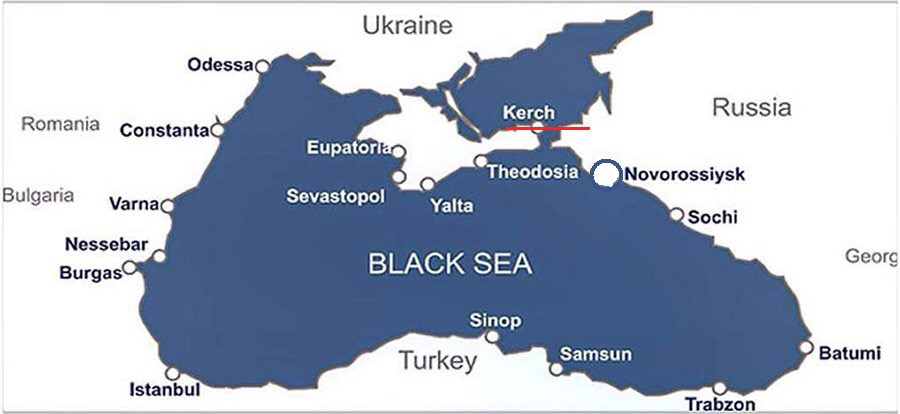
In Kerch Bay, in the strait that occupies the east coast of the Crimean peninsula, where the Black Sea meets the Sea of Azov, a group of Russian builders are working on a bridge that will eventually join the two coasts.
But as the workers were moving land on the seabed in order to place the bridge’s foundations, they came across an exceptional find: the head of a 2,500-year-old terracotta statue of a Greek god.
Sergei Olkhovskiy, head of the underwater archaeology unit of the Russian Academy of Sciences wrote on the website of the Crimean Bridge Information Center that “This finding is unique on the northern coast of the Black Sea (…) we believe this head was made in Asia Minor around the 5th century BC,” according to the note published by David Ruiz Marull in the Spanish journal El País.
The archaeological study of the newly discovered “pottery field” began about two years ago, when the bridge was being designed. Since then, underwater excavations have collected more than 60,000 pieces (most of them fragments of ceramic vessels made in the Mediterranean and Asia Minor between the 5th and 3rd centuries BC).
There are many discoveries that challenge the well-established scientific beliefs of evolution, but most of them are being denied or covered-up by the elites who have a certain interest in keeping history as it is.
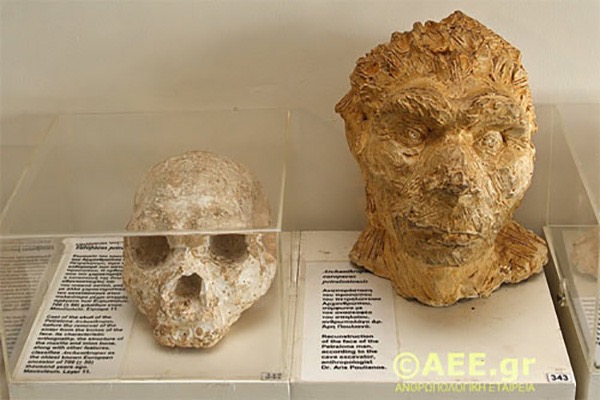
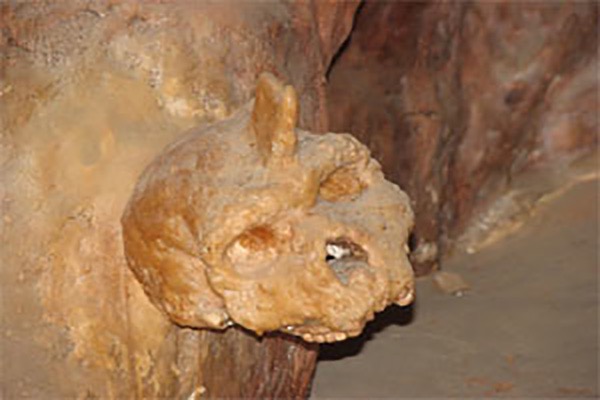
In 1959, a narrow cave was found in Northern Greece by a shepherd boy. When venturing inside with a couple of local villagers, they’ve discovered the cave was rich in minerals and after further digging inside out of curiosity, the locals found an out of place relic – a human skull embedded in a cave-wall. Later excavations unearthed many fossil remains of pre-humans, animals, and tools made of bone and stone.
The skull was extracted from the Petralona cave where it had been discovered and was furtherly sent to the University Thessaloniki in Greece for a more detailed research. Archaeologists agreed that after a complete study had been conducted, the skull will be sent to the local museum where its history would be known to others.
However, this never happened since the analysis of the skull revealed it had been trapped inside that cave for approximately 700,000 years, making it the oldest human eropeoid of the age ever discovered in Europe. Dr. Paulianos who researched the skull revealed that ‘The Petralona Man’ evolved independently in Europe and he was not a descendent of any of the species that came out of Africa.
In other words, the skull held clear evidence of a different evolutionary path followed by humans in Europe that directly contradicted with the ‘Out of Africa’ theory, a doctrine accepted by modern science.
In 1964, a group of German researchers tried to debunk the findings of Dr. Paulianos by claiming that the skull was nearly 50,000 years old and that it was in fact from a species of humans originating from Africa. However, analysis conducted in 1971 by a team of US researchers showed once again that the Petralona skull was indeed 700,000 years old. They managed to establish the date based on the examination of the caves sediments and stratigraphy.
Scientists from twelve countries ran different tests on the skull. All of them received similar results that credit the work of Dr. Paulino as being correct. Research continued until 1983 when Greece was taken over by a dictatorship which ordered for all remains found in the cave to be deprived of public access, including foreign researchers. That’s when the challenging discovery remained on hold for more than 15 years, and the Greek government offered no viable argument for their decision.
The issue was later taken to court by the Anthropological Society of Greece and scientists were once again given free access to the cave. This was a minor victory whatsoever, since the Ministry of Culture has allegedly tried to get the courts to rule in their favor and once again restrict the access to the site. I know it comes hard to believe from a democratic point of view, but no conclusive argument was given by the Greek government as to why they wanted the cave secured.
Researchers today have determined the skull is that of Homo Erectus, an ancient hominid, but it also has characteristics of Neanderthals and strong European traits as well. According to the latest tests, the skull appears to be either Homo Sapiens or part Homo Sapiens, thus putting the skull in direct conflict with the ‘out of Africa’ theory.
Dr. Poulianos’ findings reject the ‘out of Africa’ theory, reason for why his research was deliberately suppressed in today’s academic circles. The doctor and his wife were also assaulted and injured in their home back in 2012. To dig deeper into the wound, the Greek government deprived him and his team of further access to the cave where he intended to finalize the research. To cover-up the story, a sign has been placed outside the cave stating that the skull discovered inside is 300,000 years old, and Wikipedia today has dated the skull even younger.
The reason why the government of Greece is harshly suppressing the finds of Dr. Paulianos may be obvious for some of you, but to highlight the main idea – if the research conducted so far is proven to be correct, it means that human beings didn’t just originated from Africa; they were found scattered throughout the entire globe, thus proving the entire theory of evolution served by modern science is all but untrue. It’s the same with the Native Americans, where the accepted theory of evolution asserts they came across the Alaskan land bridge into the Americas, while the aboriginals insist their ancestors where always present in the Americas.
Once again, we have further proof that modern history is teaching us some serious lies. It appears that information not fitting into the general accepted paradigm is either being covered-up or dismissed as fables. The skull from Greece proves the scientific path that’s now being followed is rotten and controlled. REAL science should follow the tracks and change the until-now-accepted beliefs where it is the case.
Professor C.G. Nicholas Mascie-Taylor of the University of Cambridge sent a letter to the Ministry of Culture in Greece stating that the correct date of the skull is 700,000 years old instead of 300,000. See the letter below.
The Greek Ministry of Education, Religions, Culture and Sports,
Bouboulinas 20-22,
Athens 106 82,
Greece
5 September 2012
Dear Sir,
I am writing on behalf of the European Anthropological Association, which is the umbrella professional and academic association linking all of the national European biological anthropology and human biology societies, to express our concerns about the conservation of the Petralona Cave and Skull, the misinformation of the dating of the skull, as well as the treatment of personnel associated with the conservation of the Cave.
The bases of our concerns are that the skull has been damaged through many scratches and the crown of a tooth (1st molar) cut off. As requested by Anthropological Association of Greece what is required is a detailed description of the present status of the skull, so that no one in future can arbitrarily damage it further. There is also the problem of dating which has been scientifically dated at about 700,000 years ago not 300,000 as is given at the information desk. There is a very detailed record of the excavations and findings which need to receive further public presentation but which have never been catalogued so as to prevent specimens going missing.
It is very unfortunate that the Greek Archaeological Department stopped Dr Aris Poulianos from further work in the Cave without any explanation. It is also very worrying that Dr Poulianos and his wife were physically attacked and injured in their home earlier this year and the culprits have not been found. He was also verbally abused when attempting to give an invited presentation to teachers and school children.
Senior anthropologists and geologists have also been denied access to the Cave and the specimens for further study on a number of occasions without substantive reasons. Earlier this year there has also been misinformation given to the Greek Parliament concerning financial aspects of the Cave.
I look forward to receiving answers to these questions.
Yours faithfully
Professor C G N Mascie-Taylor MA, PhD, ScD (all Cambridge), FSB, FNAS (Hungary)
Enterprise and Diversity: Greek-Australian Occupational Pursuits, 1810s to Present
Documentary photographer, Effy Alexakis, and historian, Leonard Janiszewski will present a lecture entitled “Enterprise and Diversity: Greek-Australian Occupational Pursuits, 1810s to Present”, on Thursday 27 April, at the Greek Centre, as a part of the Greek History and Culture Seminars, offered by the Greek Community of Melbourne.
From the late nineteen century until the closing decades of the twentieth century, Greeks played a large part in Australia’s food catering industry.
They continued, nevertheless, to enter a wide variety of diverse occupations. These included: agricultural and pastoral activities, mining, sea-related industries, itinerant work, secondary industries, public life, professional fields, and artistic and sporting avenues.
Moreover, their contribution in some activities proved significant. This lecture reveals, acknowledges and celebrates their complex and broad involvement in Australia’s mainstream development over the last two hundred years.
Documentary photographer, Effy Alexakis, and historian, Leonard Janiszewski, have been researching the Greek-Australian historical and contemporary presence in both Australia and Greece since 1982.
Their project and archives, In Their Own Image: Greek-Australians, encompasses visual, oral and literary material and is based at Macquarie University, Sydney. Their archive is one of the most significant collections in the country on Greek-Australians.
Various national and international touring exhibitions, three major books, over 200 book chapters, articles, conference papers, and three film documentaries have been produced. Of their exhibitions, the most pronounced have been ‘In Their Own Image: Greek-Australians’ and ‘Selling and American Dream: Australia’s Greek Café’. The former was created in partnership with the State Library of NSW and toured throughout Australia as well as Athens and Thessaloniki in Greece; in Athens it was part of the Sydney 2000 Olympic Cultural Festival, ‘Reaching the World’ and in Thessaloniki it was invited as the Australian component of the City’s ‘Cultural Capital of Europe 1997’ program. The latter opened at the National Museum of Australia, Canberra, in 2008, and is still touring.
Alexakis’ photographs are held in both public and private collections in Australia – most significantly in the Australian National Gallery, Canberra, and the State Library of NSW, Sydney. She currently works as a freelance photographer after completing 25 years service as Senior Photographer with Macquarie University. Alexakis has been ranked in the top ten portrait photographers in Australia. In 2001 Janiszewski was awarded the New South Wales History Fellowship to research a history of the ‘Greek café’.
Both Alexakis and Janiszewski are Research Fellows with the Department of Modern History, Politics and International Relations at Macquarie University. Janiszewski is also Curator with the Macquarie University Art Gallery. Alexakis and Janiszewski have served on numerous history and arts committees.
Sponsors
We’d like to thank the following donors: Kon Tsementis-Floudas, Maria Dikaiou in mem. of George H. Asproftas and Michael H. Asproftas, Chris & Angela Fifis, Konstandina Dounis in mem. of her parents Sophia and Theodoros Dounis.
During the course of the year considerable expenses are incurred in staging the seminars. In order to mitigate these costs individuals or organisations are invited to donate against a lecture of their choice.
You too can donate for one or more seminars and (optionally) let your name or brand be known as a patron of culture to our members, visitors and followers, as well as the broader artistic and cultural community of Melbourne.
When: Thursday, 27 April 2017, 7:00pm
Where: Greek Centre, (Mezzanine, 168 Lonsdale Street, Melbourne)
Information: 9662 2722
Level 3, 168 Lonsdale St., Melbourne, Vic. 3000
Phone: +61 3 9662 2722
Email: info@greekcommunity.com.au,
Website: greekcommunity.com.au
——————————————————-
PRESS RELEASE
26/3/2017
Διάλεξη για τις επαγγελματικές επιδιώξεις Ελληνοαυστραλών από το 1810 ως σήμερα
Η φωτογράφος Εφη Αλεξάκη και ο ιστορικός Leonard Janiszewski θα παρουσιάσουν την Πέμπτη 27 Απριλίου στο Ελληνικό Κέντρο μια διάλεξη με τίτλο «Επιχειρήσεις και Διαφορετικότητα: Ελληνο-Αυστραλιανές επαγγελματικές επιδιώξεις, από το 1810 ως σήμερα», στο πλαίσιο των Σεμιναρίων Ελληνικής Ιστορίας και Πολιτισμού, που προσφέρονται από την Ελληνική Κοινότητα της Μελβούρνης.
Από τα τέλη του δέκατου ένατου αιώνα μέχρι τις τελευταίες δεκαετίες του εικοστού αιώνα, οι Έλληνες διαδραμάτισαν σημαντικό ρόλο στη βιομηχανία τροφίμων της Αυστραλίας.
Συνέχισαν, ωστόσο, να ασχολούνται σε μια ευρεία ποικιλία διαφορετικών επαγγελμάτων. Μεταξύ αυτών περιλαμβάνονται: οι γεωργικές και ποιμαντικές δραστηριότητες, οι μεταλλευτικές βιομηχανίες, οι θαλάσσιες βιομηχανίες, οι πλανόδιες εργασίες, οι δευτερογενείς βιομηχανίες, η δημόσια ζωή, οι επααγλμεατικοί χώροι και οι καλλιτεχνικές ακια αθλητικές δραστηριότητες.
Επιπλέον, η συμβολή τους σε ορισμένες δραστηριότητες αποδείχθηκε σημαντική. Αυτή η διάλεξη αποκαλύπτει, αναγνωρίζει και γιορτάζει την πολύπλοκη και ευρεία συμμετοχή τους στην ανάπτυξη της Αυστραλίας τα τελευταία διακόσια χρόνια.
Η φωτογράφος Effy Alexakis και ο ιστορικός Leonard Janiszewski ερευνούν την ελληνο-αυστραλιανή ιστορική και σύγχρονη παρουσία τόσο στην Αυστραλία όσο και στην Ελλάδα από το 1982. Το έργο και τα αρχεία τους, ‘In Their Own Image: Greek-Australians’, περιλαμβάνει οπτικό, προφορικό και λογοτεχνικό υλικό και εδρεύει στο Πανεπιστήμιο Macquarie του Σίδνεϊ. Το αρχείο τους είναι μία από τις σημαντικότερες συλλογές στη χώρα για τους Έλληνο-Αυστραλούς. Πραγματοποιήθηκαν διάφορες εθνικές και διεθνείς περιοδεύουσες εκθέσεις, τρία μεγάλα βιβλία, πάνω από 200 κεφάλαια βιβλίων, άρθρα, άρθρα συνεδρίων και τρία ντοκιμαντέρ. Τόσο η Αλεξάκη όσο και ο Janiszewski είναι ερευνητές στο Τμήμα Σύγχρονης Ιστορίας, Πολιτικής και Διεθνών Σχέσεων του Πανεπιστημίου Macquarie. Ο Janiszewski είναι επίσης επιμελητής της γκαλερί τέχνης του Πανεπιστημίου Macquarie. Η Αλεξάκη και ο Janiszewski έχουν υπηρετήσει σε πολυάριθμες επιτροπές ιστορίας και τέχνης.
Πότε: Πέμπτη, 27 Απριλίου 2017, 7:00μμ
Πού: Ελληνικό Κέντρο, (Mezzanine, 168 Lonsdale Street, Melbourne)
As the daughter of first generation immigrants from Greece I am The American Dream. Although long lost, the passport photo depicting the wide-eyed look of terror in the eyes of my father will forever be ingrained in my memory.
He and his seven siblings arrived at Ellis Island from a small remote village on Greece’s Peloponnesus. They took one passport picture; I have to wonder if they were too poor to take eight. Before they arrived in the US they hadn’t ventured beyond the boundaries of Kerkezi, their isolated bucolic village; although only miles from the crystal clear blue picturesque Aegean Sea, my father had never seen an open body of water.
Although they left abject poverty during World War II, their adjustment to American life was not always easy. None of them spoke a word of English. Unable to assimilate to the drastic lifestyle change, my grandmother took her own life just shy of her tenth year living in the U.S.
Growing up, my sisters and I used to gather in my eldest sister’s bed at night as my father told us his “village” stories. We would lie together, mouths agape, eyes wide, mesmerized by the harrowing tales of his childhood during the war.
When we wouldn’t finish our dinner at night, my father would convey to us what hunger felt like by telling us that as a child he would precipitously squeeze on their chickens to see if a premature egg would pop out. He described the eggs as soft, velvety and warm, melting in his mouth like a lighted toasted marshmallow. He would lick each finger clean and pray that these “golden” warm eggs would assuage his atavistic fear of hunger and the persistent rumble of his empty belly.
Our favorite story of all, called “matches”, always began with a prelude of how we (girls) take for granted the smallest necessities which were of monumental importance to him as a child. His family cooked their evening meals with matches which required walking miles in the rugged terrain of the Peloponnesus. On one particular quest for fire, after losing a shoe, his journey became punctuated with bouts of pouring rain.
The streams swelled as he struggled to make it to his destination. Hopping over rocks and ascending slippery slopes he finally arrived; filthy, scraped, cheeks seared red and icy cold; he was indefatigable. Despite bone-chilling cold and exhaustion, he requested the matches with alacrity, carefully placed them in his pocket, and began the long trek back to his village. As he reached the last 500 yards, one of the streams had swelled and widened. He furiously tried to hop across but slipped on the last green, mossy rock and fell into the water, soaking the box of matches.
He hobbled home, filthy, exhausted, and with his one-shoed foot, he wept and lamented the fact that his family would not have a warm meal for days. In his primordial quest for fire, he failed. We listened, gobsmacked.
My father was 12 years old when he arrived in the US; he swept floors at the local grocer and was eventually promoted to produce manager. He continued odd jobs to put himself through UC Berkeley, all the while sending money to his father who worked as a priest in Colorado. It was not always easy, his siblings were discomfited when other children hurled pejorative epithets of their family’s “weird” traditions. They were teased, they were bullied, but they remained grateful and proud to grow up Greek-American.
My father ended up with 3 post graduate degrees, one of them a Ph.D., he eventually wrote a book about his family’s traumatic emigration to America. Despite coming from poverty, starvation, and neglect, they were optimistic for a better future in what they would forever refer to as “the greatest country.” My father returned to Greece in his late twenties and married my mother, a child bride of 19. She was not formally educated but successfully ran her own business, out-earning my father. We lived in a nice home, we took vacations, and college tuition was paid for. They had achieved The American Dream.
Even as a young child, the great disparity between our idyllic childhood and his tumultuous was difficult for me to reconcile. My father’s stories gave me a unique sense of gratitude just to be American; ensconced in a life that was literally and figuratively thousands of miles away from his. Coming to America was not a choice for my father’s family; it was a means of survival.
Freedom and opportunity, however, did come at a price. As months, years, and decades passed, the colorful fabric that made up their cultural traditions slowly began to fade to soft pastel shades; they all yearned for that part of them that died when they embarked on that long journey across the ocean. My mother always told me that there is no greater heartbreak than that of being torn between the love of two countries.
As I see the refugee crisis in Syria, I wonder about the pernicious effect our collective attitudes about immigrants have had on us as Americans. Have we become so desensitized and engrossed by the political discourse that we are more concerned with which party is right or wrong than whether these people live or die? Most of all, I wonder how, seventy years later, unlike my Fathers generation, the immigrants of today have no hope for a better future in “the greatest country.”
When I see the wide-eyed terror in the eyes of these children, I cannot look away because in their eyes I see a part of my very own history. As Americans, we bear the burden of being “The Shining City” on the hill. We are bestowed with the greatest responsibility— because we hold these truths to be self-evident, that all men are created equal, that they are endowed by their Creator with certain inalienable rights. My hope is that as Americans, we work together, both at home and abroad, to bestow these immutable basic human rights to life, liberty, and the pursuit of happiness to all of those wide-eyed children in need across the globe.
It was a battle of ‘mass slaughter and mass grief’, the first time Australians were confronted with ‘the full force and horror of industrialised warfare.’
That’s how Veterans’ Affairs Minister Dan Tehan this week described the 14-hour bloodbath that became known as the Battle of Fromelles 100 years ago.
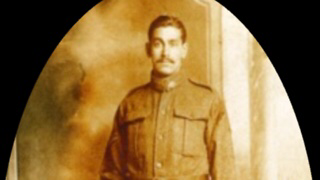
Nearly 2000 Australian soldiers died and nearly 3000 were wounded in one day. One of them was 38-year-old Indigenous digger, Albert Charles Leane.
It will probably never be known how many Indigenous Australians have served in the Australian defence forces. At the time of the First World War, Aboriginal people were not even entitled to vote.
Those who enlisted were not required to declare their ethnicity and even today, ticking the “Aboriginal or Torres Strait Islander” box is voluntary.
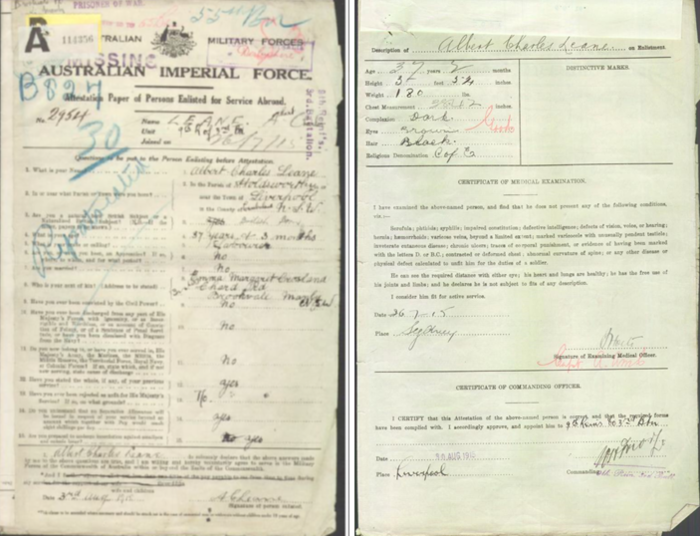
Albert Charles Leane’s Service Record
Albert Leane, who was born in 1877 in Holsworthy, New South Wales, had signed up at the age of 37 the year before the battle. He had sailed from Sydney to Egypt to join the 55th Battalion and then shipped out to the Western Front.
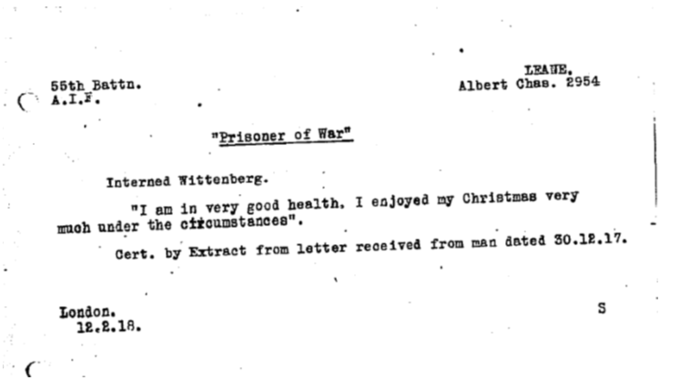
On July 19, the full horror of war erupted at Fromelles and as German machine gunners strafed the battlefield Albert was wounded in the legs. He was captured by the Germans and became a prisoner of war, first at Stendal in Germany and then at Wittenberg.
He wrote several letters to his family from the PoW camps. In two of them, which are with the Australian Red Cross Society and on his service file, he reassures his loved ones by saying he’s doing well “under the circumstances”.
Australian Red Cross Society Wounded and Missing Enquiry. Bureau file, 2954 Private Albert Charles Leane. Australian War Memorial
When the war ended he was released and shipped to England in December 1918, returning to Australia the following March.
At the Centennial Memorial Ceremony held at Fromelles earlier this week, Mr Tehan said 16,900 Australians remain unaccounted for from the fighting on the Western Front.
“The industrial scale of the killing, the machines and weapons that swept away life created limited time for recognition, recovery or even burial,” he said.
“The grief and uncertainty of families with no plots for their loved ones was immense, pieces of their lives could never be fully recovered.
“It is our duty to honour their duty … they are unknown but not remembered any less.”
Mr Tehan thanked the French people and particularly the people of Fromelles for the respect they continued to show to the Australian fallen.
The AWM have at present approximately 1000 names of Aboriginal Australians who fought in the First World War. Many who tried to enlist were rejected on the grounds of race but this did not deter them changing their nationalities, names and places of origin in attempts to enlist.
Note: NITV wishes to thank Aunt Judith Joyce Niece of Albert, who provided the photos and information used for this article.
Aunt Judy is a Darug women, who wishes to Acknowledge and pay respect to her elders both past and present. She also would like to thank Philippa Scarlett and Rebecca Batemen for all the research they have done into her family’s history.
Προσκυνητής στον αρχαίο ελληνορθόδο ναό του Αγίου Γεωργίου, στο Κάϊρο! Συγκινητή επίσκεψη, με την κάμερα του enlefkotv, στο πιο λαμπρό μνημείο του Χριστιανισμού στην Αίγυπτο. Βρίσκεται κοντά στις πυραμίδες, μεταξύ της αρχαίας Μέμφιδος και της Ηλιουπόλεως.
Χτίσθηκε στα θεμέλια του Παλαιού Οχυρού της Βαβυλώνας στην ευρύτερη περιοχή της Μέμφιδας, που ήταν η αρχαία πρωτεύουσα της Κάτω Αιγύπτου. Το 383 μ.Χ. ο Μέγας Θεοδόσιος με διάταγμά του μετέτρεψε το φρούριο σε ναό προς τιμήν του στρατιώτη Αγίου Γεωργίου. Ο ιερός ναός είναι κτισμένος στον τέταρτο όροφο επάνω σε πύργο Ρωμαϊκού φρουρίου, το οποίο πολλές φορές χρησίμευε σαν καταφύγιο των Χριστιανών. Αξίζει να σημειωθεί ότι εδώ υπάρχει και το μοναδικό ελληνικό νεκροταφείο στο Κάιρο, όπου βρίσκονται οι τάφοι των μεγάλων ευεργετών, το μνημείο του άγνωστου αεροπόρου και το ηρώο πεσόντων στη μάχη του Ελ Αλαμέιν. Επίσης, υπάρχουν σπουδαία έργα μεγάλων γλυπτών.
——————————————-
The Holy Monastery of St George is located in the are of Old Cairo. It is the old area known as Babylonos of Egypt, which took its name after the settlement of the Babylonian captives which the Pharaoh Ramses I (1390 BC) brought to Egypt from his campaign in Asia. It is close to the pyramids, between ancient Memphis and Heliopolis.
The Monastery of St George through the ages operated as a convent, hospital, poorhouse, old age home, school and cemetery, was prone to consecutive destructions and renovations, the last in 1904, when it suffered serious damage from a fire and was renovated by Patriach Fotios (1900-1925).
The Church of St George is round, eight-columned, similar to the Basilica of St Vitale in Ravenna, surrounded by an ancient wall at a distance of half a square kilometer, the largest part of which has been destroyed. In 1998 Greece undertook the construction of a new wall to preserve its ancient parts, with two entrances, the central one towards the Hegumen’s residence and the other entrance towards the Greek cemetery, which witnesses to and preserves glorious memories of the Hellenes of Egypt.
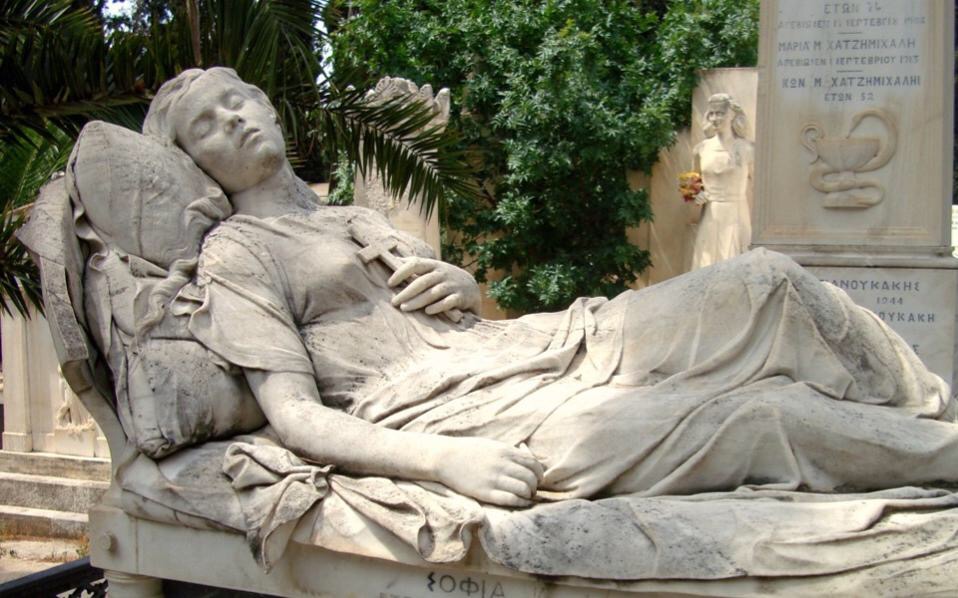
Yiannoulis Halepas’s ‘Sleeping Girl’ was sculpted for a young woman who committed suicide at the age of 18, in 1878, after her father prevented her from being with her beloved, an Italian opera singer. (Photo: Nikos Vatopoulos)
In Greek, the words for monument (mnimeio) and tomb (mnima) both come from the word “mnimi,” or memory, making cemeteries places where death, life and continuity are celebrated. And while other countries make sure to maintain their biggest cemeteries in a state of perfection and to develop them for tourism – like the Pere Lachaise in Paris, for example – in Greece, the country’s most important cemetery, Athens First Cemetery, has for years been neglected by authorities.
While there are numerous coffee-table and other such books on the cemetery, there has never been a comprehensive a guide for people interested in its outdoor sculpture and the eminent men and women of politics, the sciences, the arts and the letters who are buried there.
This, however, is no longer the case, thanks to Olkos publications, which recently released an up-to-date and user-friendly guide of 170 pages, comprising texts by Athens University Professor Emeritus Kardamitsis-Adami Maro and architect Maria Daniil, and photographs by the architect and photographer Yiorgis Yerolymbos.
The guide is an initiative of the Hellenic Society for the Protection of the Environment and Cultural Heritage, which has done some amazing work in nature conservation and in the restoration of important historic buildings.
But what is so interesting about this guide to the First Cemetery? First and foremost, the maps that show the number of each grave site and help visitors locate those that are most valuable from an artistic or historical point of view – anyone who has been there knows how hectic the layout is.
Athens First Cemetery was established by royal decree in 1837 and has been in continuous operation for the entire 180 years since. It was expanded in the 1940s to include a section for Protestants and Jews, while there are also many Catholics in the Protestant section.
The Olkos guide provides valuable information on its history, but also extensive references and explanatory texts on the art of great sculptors or craftsmen that adorns many of the burial site.
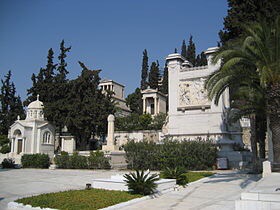
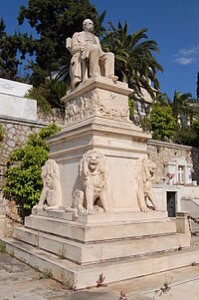
Apart from the emblematic “Sleeping Girl” by Yiannoulis Halepas (which will likely be removed for preservation to the National Sculpture Gallery), there are 1,000 other remarkable sculptures, temples, tombstones and monuments created by celebrated Greek artists of the past and present. There are also works by acclaimed architects such as Lysandros Kaftantzoglou, Ernst Ziller, Theophil Hansen and Aris Konstantinidis. Foreground: Tomb of the Pesmazoglou family (right) and Melina Mercouri (middle). Background: Tomb of Heinrich Schliemann (left on the high pedestal).
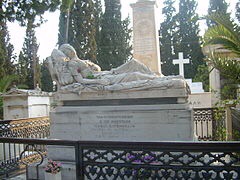
Tomb of Sofia Afentaki, a work of Yannoulis Chalepas.
Grave of Georgios Averoff
In the cemetery there are three churches. The main is the Church of Saint Theodores and there is also a smaller of Saint Lazarus. The third church is a Catholic church.
The cemetery includes the tomb of Heinrich Schliemann, designed by Ernst Ziller, the tomb of Ioannis Pesmazoglou, that of Georgios Averoff, and one named I Koimomeni (the Sleeping Girl), by the sculptor Yannoulis Chalepas, from the island Tinos. There are also separate burial places for Protestants and Jews.
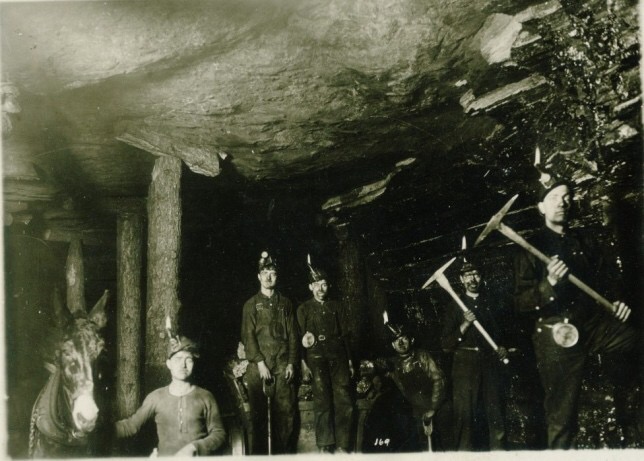
In the late 1800s and early 1900s, coal miners used candles to make their way deep underground through the mines, a dangerous practice because of the highly explosive nature of coal dust.
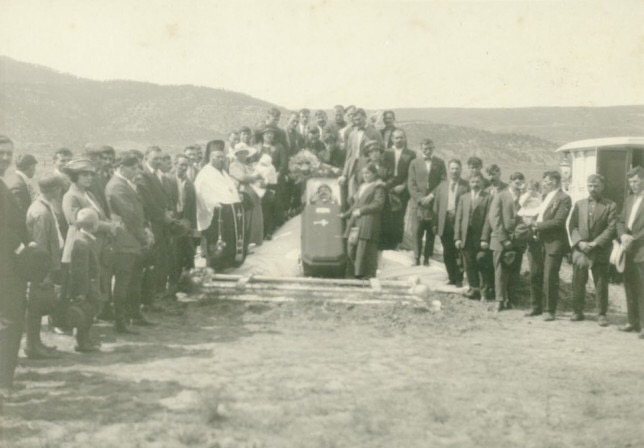
The 1929 funeral of Chris Melonakis’ grandfather, who died from an infection 10 days after unsanitary dental work. He worked in the mine until the day before he died.
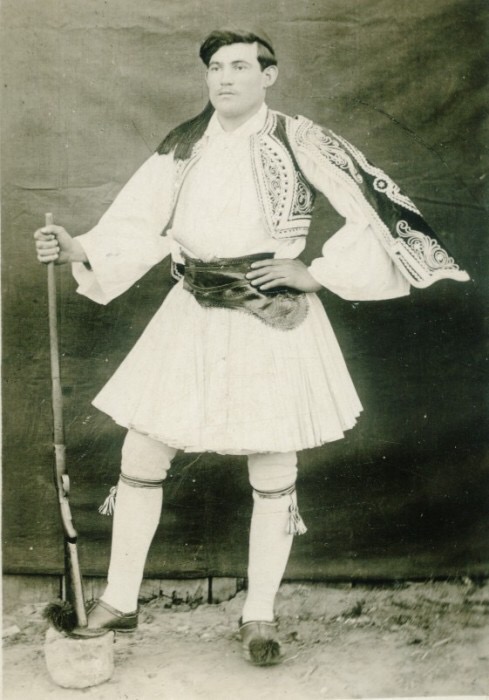
An unidentified man in traditional Greek garb from the early 1900s.
This story originally aired on 9/15/2016.
On September 15, 1913 the United Mine Workers union voted to strike in southern Colorado to protest dangerous working conditions and poor pay.
The strike eventually blew up into one of the the most violent times in labor history. In 1914, women and children suffocated when company-backed militiamen burned the union tent camp at Ludlow, Colorado. The Ludlow Massacre ignited 10 days of violence known as the Colorado Coal Field War.
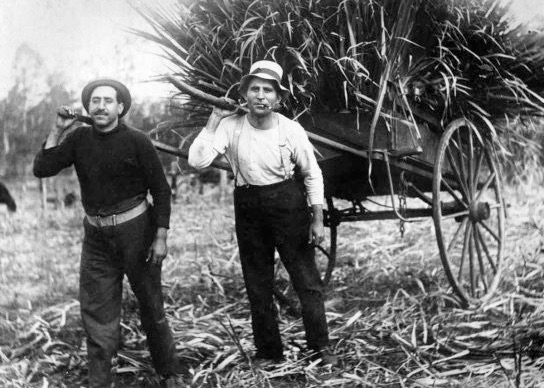
Hundreds of thousands of Greeks immigrated to the U.S. in the early 1900s. For many the only work they could get was in the dangerous coal mines around the West. Most of the Greeks in southern Colorado were working in coal mines owned by the huge Colorado Fuel and Iron company, known as CF&I. The mines were notoriously dangerous and the miners lived in extreme poverty.
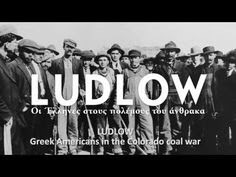
Greek miners have been called the bone and sinew of the strike, and freedom fighters. Their story is the focus of a new documentary: “Ludlow, Greek Americans During The Colorado Coal War.” The film screens at the University of Colorado in Boulder on Tuesday, Sept. 20.
Frosso Tsouka of Athens, Greece is one of the filmmakers and retired Colorado district judge Chris Melonakis of Westminster is a descendant of Greek miners. They spoke with Colorado Matters host Nathan Heffel.
Trailer for “Ludlow: Greek Americans in the Colorado Coal War.”
John McCutcheon sings The Colorado Strike Song at the Ludlow Massacre Memorial, April 18, 2014.
In 1910, the year Louis Tikas filed his citizenship papers, he was part owner of a Greek coffee house on Market Street in Denver. By the end of 1912 he was an organizer for the United Mine Workers of America. In between he worked as a miner-strikebreaker in Colorado’s Northern (Coal) Field but ended up leading a walkout by sixty-three fellow Greeks at the Frederick, Colorado mine. It was a short journey in time, but a long leap across the ages.
“So Tikas enters his destiny,” wrote Zeese Papanikolas:
It is a moment worth considering. In making the turn from scab to striker he was following the path of thousands of immigrants before him, of whole nationalities. In a profound way, more than at that moment when he set foot on Ellis Island, more than at that other moment when he signed his first papers with a new name, walking out of the Frederick stockade was the most American thing he had done. The revolt of the Greeks in the Utah Copper Company mines [led by the Western Federation of Miners in September 1912] was prophetic. For when the Greeks at Bingham, Utah, rose up against [the padrone] Leonidas Skliris, without knowing it they were rising up against a whole ethos, that ignorance, that poverty in their past which had created such men as Skliris and which, in this New World so desperately needed them. The Bingham strike had not made union men of the Greeks. It was for Tikas and the immigrant organizers like him to take such unformed revolts one step further; to make of the anarchy of the industrial world a map (Papanikolas, Page 49. Emphasis added).
In 1912 there had been much recent history in the ongoing struggles to construct such a map; a mighty conflict was still being waged against the power of monopoly capital by the American people. Politically, that war had manifested itself in the Populist movement; the Grange movement and the farmers’ revolt; the 1896 candidacy of William Jennings Bryan for President; and the efforts to build a party of labor. On the labor front were the struggles to build national and industrial unions to effectively counter the power of the great trusts. Fierce battles were fought in the great strikes of the period. There was the great railroad strike of 1877, the first nationwide strike in history, where “American troops fired on American workingmen as regiments under General Phil Sheridan were recalled from fighting the Sioux and thrown against the workers of Chicago” (Boyer and Morais, Page 59).
There was the massacre of union men at Homestead (Pennsylvania) Steel in 1892 and the bloody defeat of the Eugene Debs-led American Railway Union in 1894 when monopoly pulled out all the stops and used the power of the federal government (employing 14,000 troops, marshals and police) to break the Pullman Strike. In Colorado, state Governors used troops to act as strikebreakers on behalf of corporate interests on ten separate occasions between 1879 and 1904 (and would again at Ludlow in 1914), mostly against the Western Federation of Miners and the United Mine Workers (Ibid., Page 142).
Although the broader issue largely had been settled by the time Louis Tikas became a UMWA organizer in 1912 the war had not ended, and the legacy and spirit of those working people’s struggles were not lost on him and others of his generation.
Tikas was chased from the northern field, shot and wounded by Baldwin-Felts detectives as he escaped through the back door of a boarding house in Lafayette, Colorado in January 1910. But he had proved his worth as an organizer among the Greek workers to UMWA leaders like John Lawson, District 15 International organizer (Papanikolas, Pages 51-52). When the UMWA held a special convention in Trinidad, Colorado September 16, 1913 to list its demands and issue the Southern Field strike call, Tikas was there (Ibid., Page 76).
Philip Foner pointed out, “As in the case of the 1903 strike, nearly all of the demands were already on the statute books of Colorado but had been ignored by the company” (Foner, Page 201). CF&I further ignored the miners’ strike demands and immediately evicted between eleven and thirteen thousand of them from the company houses they and their families lived in. A mass exodus soon took place:
They hitched their scrawny teams to wagons, loaded their shabby belongings and frightened families, and began the slow trip down the canyons toward the tent cities [thirteen colonies overall, provided by the union] in locations near Walsenburg, Aguilar, Ludlow, Forbes, and Starkville.
Clouds boiled down over the mountains and dumped an icy rain on the slow caravans. Horses and mules slipped and stumbled in the mud as they wound their way down steep grades. Miners cursed. Women wept. Children, too miserable to cry, huddled in the wagons, peering out through the cold sleet, their faces pinched and ghostlike in the gloom (Sampson, ‘Remember Ludlow!, Page 12).
The tent colony at Ludlow–under Louis Tikas’ leadership–was the largest of these. Located eighteen miles north of Trinidad, it became home for more than a thousand people (including most of the Greek workers and their families) for the next six months, during which one of Colorado’s worst winters was to unfold.
March to Tragedy The events of the next six months were a steady march toward tragedy, toward what Foner labeled “one of the most shameful episodes in American history” (Foner, Page 196). In keeping with the tried and true formula used so successfully against striking workers in the past, CF&I moved swiftly to the attack. It immediately doubled its guard force, made up largely of Baldwin-Felts detectives, increased their weapons stores and laid siege to the tent colonies. An armored car (the “Death Special”) with a mounted machine gun, built especially by the company for the purpose, ceaselessly patrolled the strike district, firing into the tent colonies indiscriminately. The Forbes colony was fired into on October 17, killing one miner and severely wounding a little boy and girl (Sampson, ‘Remember Ludlow!’, Pages 13-14). “On October 24, mine guards, wearing deputy sheriff badges as usual, fired into a group of strikers in Walsenburg an killed four of them” (Foner, Page 202).
Colorado Governor Ammons on October 31 sent the National Guard–a thousand troops under the command of union-hater General John Chase–into the strike district. These troops were ordered to remain neutral (as they did at first), but as time passed, many grew tired of the duty and quit. They were replaced more and more by company thugs who drew double paychecks, one from the state and one from the coal companies (Ibid., Page 203. Sampson, ‘Remember Ludlow!’, Page 14).
Then, “On November 28, Governor Ammons, yielding to pressure, lifted the ban on the importation of strikebreakers from outside the state and ordered the militia to become the protective agent for the escort of the scabs into the mines.” This pressure of course came from the usual sources: mine owners, bankers, businessmen, citizens’ committees, newspaper editors, etc. (Foner, Page 203).
Meanwhile, the companies’ terror campaign against the tent colonies was stepped up:
In searching the miners’ tents for guns, the militiamen robbed them and even raped some of the women. Strikers were thrown into jail without the slightest provocation and were held without any opportunity to prove their innocence.
Mother Jones [who had come to Colorado to assist the miners] was arrested and held incommunicado for twenty days, with two armed sentries posted outside her prison door…. [In January] militia cavalrymen destroyed the tent colony near Forbes and drove the inhabitants, including women and children, into a mountain snowstorm (Ibid., Page 203).
The stage was set for the “final solution” in early April 1914, when “Governor Ammons withdrew all but two of the [National Guard] troops from the field…leaving Company A, a cavalry outfit, and Troop B in the field. These two troops were made up mostly of company men, mine guards and gunmen and were stationed near Ludlow” (Sampson, ‘Remember Ludlow!’, Page 16). THE EPILOGUE
The Ludlow Massacre began the morning of April 20, the day after the people at the Ludlow colony had celebrated their Greek Easter. After the explosion of several bombs, an apparent signal to attack, troops surrounding the colony began firing into it. All day long, machine gun bullets ripped through the tents. As Joanna Sampson has described the scene: “The tent colony exploded in terror. People dodged bullets. Frantic parents searched for their children while screaming ‘run for the hills!’ Dogs and chickens ran wildly up and down the streets” (Ibid., Page 19).
Toward evening, the soldiers “advanced with [Rockefeller] Standard oil, soaked the tents and set them afire” (O’Connor, Page 1). Soon after, Louis Tikas, who during the long day had heroically helped women, children and the wounded escape the carnage, was captured by the militia and taken before Lieutenant Karl Linderfelt, who grabbed a rifle and broke it over Tikas’ head. Though the exact details following that incident are not known, Tikas soon was dead, shot three times in the back. Thus the circumstances of Tikas’ death–even though it is well known he was murdered by coal company managers and the state of Colorado–are similar to what is left us about his life: a “shadow caught against the flow of history.” But the shadow cast by his legacy for future generations of working people is a long one.
The next day two women and eleven children were found dead in a pit the miners had dug beneath one of the tents, suffocated where they had retreated to escape the bullets and fire. More than 30 were killed and 100 wounded during the course of the strike. The strikers fought back savagely after Ludlow, attacking company property and firing on mine guards throughout the district. The war ended only when federal troops arrived on the scene to enforce a truce.
“John D. Rockefeller, Jr. won the Ludlow Massacre,” Harvey O’Connor wrote. “The women and children were no match for him.”
The scorn of the nation was turned on this industrial autocrat. Men and women in mourning picketed his offices at 26 Broadway, New York City. He was denounced in Congress and all over America. President Wilson directed the Industrial Relations Commission to find out why he and his fellow millionaires hated unions so much that they would murder to protect the open shop. [Detailed accounts of the strike and massacre appear as part of the testimony before that commission. Foner and others have relied extensively on the findings in their studies.]
In vain did Rockefeller and his aged father try to wash the blood of Ludlow from their hands by lavish gifts to charity. For every dollar they gave away, a mother wept a bitter tear for her charred child; a widow breathed a curse upon the murderer of her husband (O’Connor, Pages 1-2).


 GREEK WORLD MEDIA