Ballarat in Victoria has a hidden and immortal connection to Lemnos Island in the northern Aegean

From Ballarat to Mudros Bay

From Ballarat to Mudros Bay

Principal Matron Grace Margaret Wilson of 3 AGH on Lemnos in May 1915.
PHOTO: AWM Collection. ID no. A05332.

The connecting thread between Ballarat – Victoria’s third largest city – and Greece is long and deeply interwoven. The first Greeks who arrived in Victoria came to Ballarat to seek their fortune in the 1850s gold rush; men like Andreas Lekatsas from Ithaca and Natale Spiridon Giorgio D’Angri from Corfu. But the shared fortunes of Ballarat and Greece are even more profound.

The link reveals a rich seam of the ANZAC legend. Last week, the 30th October marked the 94th anniversary of the signing of the Armistice between the Allied powers and the defeated Ottoman Empire that ended the First World War. That historic event took place aboard a Royal Navy battleship – HMS Agamemnon in Mudros Harbour on Lemnos Island in the northern Aegean. For Australia, as for many nations, the First World War remains the most costly conflict in history in terms of deaths and casualties.

From a population of fewer than five million, almost 417,000 men enlisted, of which over 60,000 were killed and 156,000 wounded, gassed, or taken prisoner. The Diggers who fell rest in Commonwealth War Graves across Europe and are immortalised in monuments in every town and city in Australia. 50,000 Australians fought in the Dardanelles and nearly nine thousand were killed in that campaign alone. In the northern Aegean, while we’re aware of the graves at Gallipoli, few know of those on Lemnos nearby, nor the island’s central role in the Dardanelles campaign.

Lemnos was the vital supply base for the Gallipoli operation – from its early occupation by the Allies in February 1915 until the evacuation of the peninsula at the end of that horrendous blood-stained year. Lemnos’ strategic location – just 130 kilometres from the entrance to the Dardanelles – made it the perfect transit point, training centre, hospital and recuperation area for the troops at the Gallipoli front. Prior to the Gallipoli landings on 25th April 1915, infantry practiced landing techniques on its beaches.

Two Australian hospitals (in addition to British and Canadian hospitals) were established on the island and the staff included over 120 Australian nurses. A few brief resumes – snapshots of lives – can shed some light on this generation whose fate was enmeshed with the Gallipoli campaign. They came from every corner of Australia, and Ballarat’s ANZACS give us a microcosm of that experience. Women rarely figure in any traditional telling of the ANZAC story but they played a vital role.

Nurse Isabel Curnow with the 3rd Australian General Hospital (AGH) and Nurse F. Hudson, with the 2nd Australian Stationary Hospital (ASH) were just two of the hundreds of nurses who served on Lemnos during the Gallipoli campaign. Isobel had trained at the Ballarat District Hospital. By the time she enlisted at the age of 34, she had worked both at Ballarat and at Melbourne’s Queen Victoria hospital, specialising in operating theatre techniques. Eight days after enlisting she was on her way to the war with the newly formed 3rd AGH. After their journey across half the globe, nurses Curnow and Hudson disembarked at Turk’s Head at Mudros in August 1915. On arrival, they had no tents, equipment or water, and no sanitation. The 3AGH hospital opened at West Mudros with more than a thousand beds and had expanded to 1,700 beds by the end of the campaign.

Isobel went on to serve in Egypt, France and England. She returned to Melbourne in February 1919. Her duty done, she left the AIF two months later. Nurse Hudson’s 2nd ASH was first deployed to Egypt, moving to Lemnos with the 3rd AGH. By October 1915 the hospital occupied sixty large marquee-tents and had 1,200 beds and 25 nursing sisters. When the peninsula was evacuated the hospital and Nurse Hudson returned to Egypt. The experience of serving on Lemnos – despite being tempered by the realities of the war – left an indelible mark on those who spent time there.

For many it was an intensely positive experience. One nurse, Sister Donnell, wrote on leaving Lemnos on 20th January 1916: “…there are many things we will miss; the unconventional freedom…the glorious colourings of the sky, the watching of the beautiful Star of Bethlehem at night, and the harbour and the hills; but when we think of the cold, the wind, and dust, we are thankful we are not going to spend the winter there … Goodbye Lemnos. We take many happy memories of you. I would not have liked to miss you …” Another daughter of Ballarat, Gertrude Munro, served as a nurse in the northern Aegean in WWI.

After the Gallipoli campaign, she was sent to the Salonika front which replaced the Dardanelles as the main theatre of the war in the region. 34 year-old Gertrude, from Alfredton had enlisted in the Army Nursing Service in August 1916, sailing for Thessaloniki via Egypt. She was based at the 60th British Hospital at Hortiach. As was the case in the Dardanelles, malaria and other contracted illnesses played a huge and terrifying role in the campaign, with more than 160,000 British cases of disease and over 500,000 non-battle casualties recorded on the front.

Gertrude Munro served for two years before succumbing to pneumonia and malaria at Thessaloniki in October 1918. She is buried at the Mikra Military Cemetery in Greece’s second city and was posthumously awarded the 1914/15 Star, the British War Medal and the Victory Medal. More than five and a half thousand soldiers who served in Australia’s armed forces during WWI were born in or near Ballarat. The connection between Lemnos and the Victorian town is poignantly underscored by some of the 148 young men who fell in the line of duty and who remain on Lemnos to this day.

Corporal Charles Edward Gunn of the 21st Battalion AIF was born in Sebastopol. Charles was 22 years-old and a carpenter when he enlisted in January 1915. The 21st Battalion arrived in Egypt in June that year and landed at Anzac Cove on 7th September, but Charles Gunn never made it to that fateful shore. He died as a result of a torpedo attack days before south-west of Lemnos, by a German submarine on the HMT Southland, a former ocean liner on which he was a passenger. North of Ballarat lies the town of Learmonth, the birthplace of Donald Chisholm.

Enlisting in February 1915, Chisholm a 19-year-old farm labourer became a private in B Company, 23rd Battalion. Donald’s unit was deployed to one of the most infamous parts of the Anzac front line – Lone Pine. Young Donald was killed in action on 2nd September 1915. An even younger Digger was Henry Stevens who enlisted at Ballarat in February 1915. Like Chisholm, he joined the 23rd, and like so many involved in the Gallipoli campaign, he didn’t die from war wounds but from disease. Diphtheria took him less than nine months after arriving.

James Leslie White from Wendouree near Ballarat was a member of the 22nd Battalion – deployed to Gallipoli in the first week of September. He also died of diphtheria on 12th November. His unit would leave Gallipoli the next month, but John White’s eternal home would be Lemnos. Dairy worker James Williams Sims was born at Kyneton. His sister said that he was “one of the first to enlist”, doing so on 18th September 1914 at Lismore NSW. He was placed with the 15th Battalion in Brisbane.

Six weeks after the outbreak of war, the 15th formed part of 4th Brigade, commanded by the legendary Colonel John Monash. They landed at Anzac Cove late in the afternoon of 25th April 1915. Until August the battalion was involved in the hopeless task of establishing and defending the front line of the ANZAC beachhead. 31 year-old James was wounded in May, receiving a bullet to his left arm. He rejoined his unit a month later but contracted enteric fever. Evacuated to the ASH on Lemnos, he died on 24th July.

Private William Edward Withers was a 24-year-old labourer when he enlisted in February 1915 at Ararat. Signed up to 22nd Battalion his company was deployed at Gallipoli in the first week of September. Within days he was evacuated to ASH with pneumonia and diphtheria, passing away soon after. It’s likely that both James and Withers would have been tended by Nurse Hudson. Perhaps they shared stories of more carefree days in Ballarat. The fact that the majority of Ballarat’s ANZACS buried on Lemnos died from disease should come as no surprise. Disease was rife on the Gallipoli peninsula. Poor sanitation and food, a shortage of fresh water, lice and flies – all ensured that diseases were endemic amongst the soldiers on the peninsula.

Dysentery, diarrhoea and enteric fever were common. Diggers would often take part in battle while suffering from these debilitating illnesses. Between May 1915 and Jan 1916, up to 30 per cent of the AIF troop’s strength were reduced due to sickness or wounds. Only twice during the whole campaign did the proportion of men being evacuated from Anzac with battle wounds – during May and the two weeks of the August offensive – exceed the proportion being taken off with some form of illness. The roll-call of the Ballarat ANZACS represent a snapshot, a handful of the tens of thousands of young lives lost in a campaign that defined Australia.

Every year the islanders of Lemnos commemorate ANZAC Day with a solemn and moving ceremony. Representatives of the Australian, British, and Greek governments attend to lay wreaths and pay their respects. The local community, including school children and church representatives take part, coming together in a profound shared experience. That enduring connection – forged in war – between Australia, Lemnos, Greece and Gallipoli remains. Our histories entwined nearly a century ago will never be undone.

This Sunday a commemorative service will be held at the Greek Orthodox Church of St Nicholas in Ballarat followed by a wreath-laying ceremony. We shall remember them. Jim Claven is a historian and secretary of the Lemnos Gallipoli Commemorative Committee. Research sources: Victorian Parliamentary Friends of Greece – Lemnos Gallipoli Commemorative Committee – ANZAC Study Tour of Lemnos and Greece Report 2012. Katrina Hedditch, Lemnos 1915 – A nursing Odyssey to Gallipoli, Press Here, Ocean Grove, 2011. Michael Tyquin, Gallipoli – An Australian Medical Perspective, Big Sky Publishing, 2012.


A Rose Bay walkathon for Greek welfare

Source: Wentworth-courier

Andrew Boucas creates a Byzantine Cross for the Greek Church in Rose Bay as part of fundraising efforts for the Greek Welfare Centre.

Andrew Boucas creates a Byzantine Cross for the Greek Church in Rose Bay as part of fundraising efforts for the Greek Welfare Centre.

GREEK delicacies were a welcome reward for those who took part in the Rose Bay walkathon for the Greek Welfare Centre on Sunday.

More than 600 people took part in the walkathon which was hosted by the Greek Orthodox Parish of St George, Rose Bay.

Woollahra mayor Andrew Petrie and state opposition local government spokeswoman Sophie Cotsis joined other local councillors and walkers in the fundraising event.

Funds raised will go towards a range of community and aged care services.

From Jewboy to Greek drama – Dead Europe, adapted from Christos Tsiolkas’s

Source: Jewishnews

europe

AUSTRALIAN filmmaker Tony Krawitz was catapulted into the international limelight in 2005 when his short film Jewboy premiered at the Cannes Film Festival.

Now his first feature film, Dead Europe, adapted from Christos Tsiolkas’s controversial novel, is set to make him a household name, especially in Jewish homes.

Jewboy was set in Sydney’s ultra-Orthodox community and was based on Krawitz’s own experiences driving taxis when he was a university student.

While Dead Europe has its dark heart and central mystery in the persecution of Jews over the centuries, culminating in the Holocaust, it is set around a gay, non-Jewish, Australian-born photographer of Greek heritage named Isaac (Ewen Leslie from Jewboy), who travels to Europe to take back his father’s ashes.

“As a Jew I’m really fascinated by my culture,” says Krawitz, who lives in Sydney. “From the amazing stories and experiences of the Jewish people over the ages and in contemporary culture, there’s a rich well to draw upon.

“I found Dead Europe interesting because it was about Jews, and in a sense the Holocaust, about hatred and especially anti-Semitism. It was written in a way that I hadn’t come across before.”

Tsiolkas’s novels are multi-layered and powerful, and like The Slap, which was made into a hit TV mini-series by the ABC, Dead Europe viscerally probes beneath the surface of all its characters.

It was this quality in the storytelling that excited Krawitz, and made him want to turn Dead Europe into a film.

“It reminded me a lot of Greek tragedy, or even biblical stories such as Job, or ‘I walk through the valley of the shadow of death.’ Those really old, ancient ideas and beliefs really inspired me to make the book into a film,” he says.

“What really underpins the story is a powerful scream for human rights. Christos began writing Dead Europe when the wars in the former Yugoslavia broke out. He was shocked that this kind of inhumanity could be happening again on European soil. It reminded people again of World War II. But at the end of the day what really moved me is that Dead Europe is a gripping read.”

As adapted by Krawitz and his collaborators – Oscar-winning producer Emile Sherman and actress turned writer Louise Fox – the film is different in many ways from Tsiolkas’s novel, which combines two narratives: a fairytale that takes place in a Greek village before and after World War II, and a second story which takes place in the present.

In Krawitz’s film, these two stories are blended, and Isaac’s hallucinogenic descent into the horrors of the past makes for riveting cinema.

Krawitz was born in South Africa and migrated with his family to Australia in 1987, aged 19. With memories embedded in his consciousness of his maternal German-Jewish grandparents, who were forced to flee Berlin in 1935, Krawitz was impressed with Tsiolkas’s Dead Europe because of the way it strips bare the prejudices that, even today, lie like a dark secret under the surface of European culture.

“I found it really brave that with Dead Europe Christos interrogated his own preconceived notions of Jews and inherited hatreds,” he says.

“In South Africa, Jews were classified as white people. I grew up under a really unjust system that had paternalistic notions about what black people were like. It was something I had to unpack for myself, and that resonated for me in the book as well.”

Krawitz is particularly proud that three Jews worked together in bringing Dead Europe to the screen.

“Emile Sherman, the producer (The King’s Speech, Disgrace), writer Louise Fox and I are all Jews, and I think we were drawn to Dead Europe for similar reasons,” he says.

“It is a powerful story about someone we can identify with, who seems like a really good person, who becomes infected with his own prejudices.

“Isaac is having a psychological breakdown, and the film is told through his point of view. But the Europe we see on the screen is the Europe he experiences.

“When I read the book I loved it. I found out that the option rights were available, and it was only about a month later that I got a call from Sherman, completely out of the blue.

“‘Have you read the book?’ he asked me. I didn’t know him very well then. ‘That’s really weird,’ I told him. ‘I’ve been trying to get the rights myself.’ So we got together,” Krawitz says.

“Louise was one of the founding members of Barrie Kosky’s Gilgul Theatre and a good friend who I’ve known for 15 years. She comes from a theatrical tradition and was involved as an actor in contemporary Yiddish theatre in Australia in the ’90s.

“Since then she’s become a full-time writer, and is not only one of the smartest people I know, but interested in what it means to be Jewish in a historical sense, and as an Australian Jew in the 21st century.”

Krawitz has notched up an impressive CV since his days studying film at the University of Technology in Sydney, and the Australian Film Television and Radio School.

Since Jewboy he has directed many episodes for television dramas and mini-series, and his feature-length documentary The Tall Man (2011) won a swathe of awards, including an AWGIE (Australian Writers’ Guild award) for best documentary script.

On a personal level, his greatest achievement has been his long-time friendship and marriage to fellow Australian director Cate Shortland (Somersault, 2004), whose latest film Lore – about five destitute German children who travel about 900 kilometres to their grandmother’s house in Hamburg after the defeat of Germany in World War II – has been selected as the Australian entry for the best foreign language Oscar at the 2013 Academy Awards.

Krawitz met Shortland 20 years ago and the couple have two adopted South African children, aged 18 and four.

“The funny thing is that when we met at a friend’s party, and we were both in our early 20s, we ended up bonding over a discussion about history and fascism,” says Krawitz.

“It’s just curious, a weird twist of fate, that these two films (Dead Europe and Lore) got funded at a very similar time, which made for a crazy time last year trying to juggle two films and two children.”

Dead Europe opens in cinemas on November 15.


The Greek Community was saddened to hear about the passing of centenarian Nicholas Peter Careedy (Karydis)

Remembering Nicholas Careedy (Karydis)

Remembering Nicholas Careedy (Karydis)

Nicholas Careedy in the Australian Royal Air Force.

The Greek Community was saddened to hear about the passing of centenarian Nicholas Peter Careedy (Karydis) on 14 October.

Careedy, the fourth child and only son of Peter and Marietta Careedy, was born in Mylopotamos, Kythera on the 1 March 1912.

After completing high school in Kythera he remained in his village until he left for military service.

He spent the first six months of service in the recruiting office of the 31st regiment in Athens and then the office of the military academy.

When he got his discharge from the army, Nick completed a bee-keeping course, establishing his own business in Mylopotamos, however the economic state of the 1930’s forced him to decide to migrate to Australia.

Nick arrived in Toowoomba on the 10th of January 1937 and worked in his brother-in-law, Harry Andronicos’s cafe.

He became involved with the Greek Community’s Kytherian Association in Toowoomba and served on the committee for eight years.

He was also a member of TOC H and the organising committee of the Greek war relief fund. When Italy invaded Greece during WW2, he was very sorry he was not there to take part in the victory the Greek army had in Albania.

When Japan bombed Darwin in February 1942, although still a Greek national, Nick enlisted in the Royal Australian Air-Force and finally was accepted in October. He served for 3 1/2 years in the security division and saw active service in Darwin and New Guinea.

After he received his discharge he went to Goondiwindi for 12 months and then to Toowoomba where with Harry Andronicos they opened a drapery business.

From 1946 he was a member of the R.S.L eventually forming a Hellenic Sub-Branch. He became the foundation President and served for thirteen years. He was also given life membership in 2001 and a certificate of merit for his service.

In 1951 he moved to Brisbane where he opened a frock salon in the city, became treasurer of the Greek Red Cross and became a member of the Greek community. This year Nick was honoured with life membership to the Greek Community.

In 1954, he joined A.H.E.P.A. where he served as National Supreme President and was honoured with life membership in 2004.

Nick received the “Multicultural Services Award”, from the Premier of Queensland in 1997. Three years later, he was honoured with the Order of Australia medal at Government House for his charity work.

Although experiencing much in his life, his proudest moments were marrying Nina Kalafatas in 1963, the birth of their much loved only child Marietta, who with her husband Paul, have been blessed with two beautiful children Connie and Nicholas.

In 2003, Nick, Nina, Paul, Marietta, Connie and Nicholas all journeyed over to Greece for five weeks, where Nick proudly got to show his family his homeland.

They even stayed in the house where he was born. This meant so much to him.

In 2007, with the assistance of Doctor Peter Marendy, $20 000 was raised to build a War Memorial that was unveiled on Remembrance Day.

The Olive tree, symbolising peace, was lovingly planted and tended by Nick. As it continues to grow, it is a reminder of Nick’s dedication to those who served in wars.

Nick was a fortunate man, living a long, happy life, which many of us got to celebrate earlier this year at his 100th birthday.

Living to the grand age of one hundred Nick daily tended to his garden, loved to travel, enjoyed fishing and lawn bowls.

Over the past two months, while the family were going through the hardest time they have ever had to face, it was the love and support shown by so many that helped to get them through. Thank you must be given to many people: To Father Laurentios and Father Gregory for officiating today’s ceremony, and taking the time to visit Nick recently.

Perry Panagiotakis for his chanting in church which Nick always loved to hear. He has inherited his dear father’s magnificent voice.

To the doctors and staff at Greenslopes Private Hospital for their professional care, and to Nick’s incredible GP Dr Steve Hambleton who he respected so very much and the staff at the Kedron Park Medical Centre. Nina, Paul, Marietta, Connie and Nicholas, wish to extend their sincere thanks and gratitude to all who knew Nick Careedy.

Nick was a fortunate man, living a long, happy life, which many of us got to celebrate earlier this year at his 100th birthday. Living to the grand old age of 100, Nick tended daily to his garden, loved to travel, and enjoyed fishing and lawn bowls.

Nick was also a religious man who enjoyed attending church on a regular basis. He and Nina would try to travel to Greece as often as possible to visit his relatives and friends in Kythera.

Nick led a full and happy life and is now resting in God’s care, watching over us. We will always be grateful to have had the opportunity for Nick to have been part of our lives. Nick will be greatly missed by all his family and friends. He was laid to rest on Friday 19 October 2012 at Agia Paraskevi, Taigum, Australia.

‘Operation Domestic’ – an unexplored avenue of Greek migration

Source: NeosKosmos

“Greek women came to Australia in large numbers and in the early sixties they outnumbered the men”

‘Operation Domestic’ - an unexplored avenue of Greek migration

“Vassiliki Daflou, a small, pretty, blue eyed girl from Epiros, in NW Greece, on the Albanian border, is typical of thousands of poverty stricken, desperate people in Europe, particularly in Greece, Italy and Spain, to whom ICEM has brought happiness. In Sydney Vassiliki cooks on a gas stove, works as a domestic in a hospital, and boards with a Greek family…” Photo: National Archives of Australia.

Greeks of the diaspora have migrated for a variety of reasons, whether as a result of events in Greece, or to be close to family that have already migrated. Dr Maria Palaktsoglou, Lecturer in Modern Greek language and culture in the Department of Language Studies, Flinders University, has recently discovered another reason Greek women in particular decided to make the long journey to Australia and has decided to investigate it further, so as to understand more fully the experiences of these women.

Through a scheme established by the Intergovernmental Committee for European Migration (ICEM) and Australia in the late 1950s called ‘Operation Domestic’, Greek women were invited to migrate to Australia as domestic servants for families both in cities and in the country. This plan was intended to benefit both countries involved, as many in Greece were still suffering the social and economic after-effects of both the German occupation of Greece during the Second World War, as well as the Greek Civil War that followed.

Australia, on the other hand, was much more economically stable, and there was a need for cheap domestic labour. These women were apparently eager to escape the harsh economic climate of Greece, and so agreed to migrate to Australia. In total, nearly 4000 Greek women were involved in this scheme. While researching Greek migration, Dr Maria Palaktsoglou stumbled upon ‘Operation Domestic’, and was surprised to discover that although domestic servants have received much attention from scholars around the world in more recent years, there has not as yet been any research undertaken on this unique group of Greek women who came to Australia from the late 1950s.

Dr Palaktsoglou is currently the Director of Studies and the co-ordinator of first year Modern Greek topics at Flinders University. She is well versed in matters relating to Greek migration, having carried out research related to both literary history and semi-migration-history. She has written two books and several articles on these topics, which makes her well suited to an analysis of the Greek women who were a part of ‘Operation Domestic’. She is herself also a Greek migrant to Australia, so can relate somewhat to the women who were a part of ‘Operation Domestic’.

Palaktsoglou told Neos Kosmos: “I can partly understand the emotions, the doubts, the fear these women experienced before and upon arrival and settlement in Australia. It’s a story which needs to be told.” Indeed, research on these women is vital now, as most are in their late ’60s and ’70s. Dr Palaktsoglou fears that the unique experiences of this group of women may be lost in the future, so is eager to draw from their extensive “cultural knowledge and personal memories” to aid this essential study on Greek migration to Australia.

Similar studies have emerged about Greek women who migrated to Canada for similar reasons, and Palaktsoglou has realized the importance of similarly documenting the experiences of those who came to Australia. She has already spent some time in National Archives around Australia collecting information about Greek female migrants to Australia, and has analysed newspapers from the period.

She also plans to access the archives of the ICEM for more information. Dr. Palaktsoglou has identified three main aims of her research, being to collect these women’s stories first hand, to figure out exactly how ‘Operation Domestic’ worked, and to determine how long it lasted, as well as how successful it was in aiding Greek women to leave a country that was in economic turmoil. She is now searching for Greek Australian women who came to Australia under the ‘Operation Domestic’ scheme so as to gain this information.

She has not yet conducted any interviews with women, as the correct procedure for research involving human subjects did require her to gain ethics approval from the Flinders University Social and Behavioural Research Ethics Committee before seeking interviewees. Having now gained that approval, Dr Palaktsoglou has now advertised publicly for Greek female migrants who arrived in Australia under the ‘Operation Domestic’ scheme, through the ICEM, in the late 1950s and 1960s, and then were then domestic workers in Australia.

These women will help Dr Palaktsoglou include this significant group of Greek women in the body of knowledge already existing on domestic workers around the world. Those who do become involved will be interviewed, either in Greek or English, with a Greek-speaking researcher from Flinders University, about their immigration and later domestic work. As demanded by ethics standards, all confidentiality is assured, and the women involved will remain anonymous in all resulting publications – whether they are articles or books.

Dr Palaktsoglou believes that this research will benefit not only the growing number of people around the world investigating domestic workers, but will also aid general history focusing on Greeks of the diaspora, as well as specifically Greek-Australian history. She told Neos Kosmos: “I believe that the project is very important as it will add to the collective history of Greek migration to Australia. Greek women came to Australia in large numbers and in the early sixties they outnumbered the men.

Despite that, we do not have many works which specifically address women’s migration.” Dr Palaktsoglou is seeking to redress this imbalance. She does have some information about the women from archives she has already consulted: “For the women who came as domestic servants the information is very limited. Because it’s early stages I do not know what the findings will be but I hope that the outcomes will be revealing. According to the Scheme ‘Operation Domestic’, the women who were targeted were ‘underprivileged, with no dowry and no real prospect of getting a prosperous future’ (a good marriage that is).

So it’s interesting to see if these women stayed with their employers for the duration of the two years and if they settled in the country successfully.” Dr Palaktsoglou is hoping that, with the cooperation of a number of the Greek women who were involved in this scheme, she will be able to add to the already rich body of knowledge of Greek domestic workers and Greek female migration to Australia.

This will not only help us today discover how significant members of our community migrated to Australia, but also ensure that those in the future will have as much information as possible about the history of Greek migration to Australia. Those who are interested in participation, or for further enquiries, contact Dr Maria Palaktsoglou, Lecturer in Modern Greek at Flinders University, South Australia on (08) 8201 5960 or maria.palaktsoglou@flinders.edu.au


Greeks of Australia may soon have the right to vote in Greek elections

Greeks of Australia may soon have the right to vote in Greek elections if draft law giving expatriates the right to vote is approved

Right to vote in Greek elections

Greeks living in Australia may have the right to vote in Greece’s elections after the debate resurfaced this week led by Greek Minister of Interior, Euripidis Stylianidis. Mr Stylianidis told members of the Hellenic Parliament’s Special Committee on Hellenes Abroad, that the right to vote for expatriates was a “critical national issue” and told the committee that many Greek politicians are in favour of giving the vote to Greeks of the diaspora.

As it stands, a working group of the Ministry of the Interior are preparing draft law for expatriates to vote. The law will need to include information on the equality of the voting process; the legitimacy / transparency of the voting process and administrative procedures needed for the votes to take place worldwide. The ministry is also looking at the financial aspect of Greeks abroad voting and the need for the financial impact of the operation to be minimal.

The draft law will be followed by a public consultation and after the suggestions of the parties have been included, will go up as a bill for a vote in the Parliament. Greece views Greeks abroad as a powerful source in promoting Greece’s image as many expatriates around the world are in prominent position. The ministry feel allowing them to vote will ultimately create a strong and more successful Hellenic Republic.

Allowing Greeks of the diaspora the right to vote will also create solid relationships between the countries and Greece and create a better peace and understanding for Greeks of the diaspora and for Greeks in Greece. All the members of the Hellenic Parliament’s Special Committee on Hellenes Abroad expressed their desire to give rights to expatriates to vote. The members of the committee have also discussed the need to solve administrative issues, such as: the registration of expatriates on the electoral lists; how they would vote – postal, with polls, or via internet – and the reliability of these votes; and the costs of voting aboard.

Several members suggested one or two regions abroad are created with electoral seats that could be removed from the ballot territory. However, with the postal vote, the minister raised some concerns. One of them being high cost, as well as the fact that the postal vote does not ensure that the voter is the one voting and not his relative or member of the family.

In contrast, the ballot box is the only unimpeachable vote, but should be seen from the reduction of costs point of view. Interior Minister Stylianidis has described this week’s fruitful discussion as an important first step on the vote of expatriates, stressing a need for constant dialogue on this issue. The President of SAE (World Council of Hellenes), Stefanos Tamvakis, who attended the meeting, expressed his disappointment about the lack of representation of expatriates in the Greek Parliament, stressing though that the Greeks of diaspora do not want their vote to influence the balance of power in Greece. Mr Stylianidis explained that of all member countries of the EU, only Greece and Ireland do not give this right to their expatriates.


Steve Kyritsis, author of Greek Australians to talk at Ithacan Society

Steve Kyritsis, author of Greek Australians in the Australian Armed Forces WWI and WWII will be talking about his motivations for writing the book

Kyritsis to talk at Ithacan Society

Honouring duty and sacrifice: Steve Kyritsis, president of the Hellenic RSL and author of Greek Australians in the Australian Armed Forces WWI and WWII.

Steve Kyritsis, author of Greek Australians in the Australian Armed Forces WWI and WWII will be talking about his motivations for writing the book, and shedding more light on the remarkable stories it contains, at the Ithacan Philanthropic Society next month.

In May, hundreds of veterans’ families, MPs, and other dignitaries joined Mr Kyritsis at the Victorian Parliament for the book’s official launch by Murray Thompson MP. At the launch, Mr Thompson – speaking on behalf of Victorian Premier Ted Baillieu – said that Steve Kyritsis had created “a lasting tribute to the ideals, service and courage of Greek Australians who had served Australia”.

The book, dedicated to the contribution and sacrifice of Australians of Greek heritage who served in both World Wars, took three years of painstaking research at the National Archives and in many cases extensive personal interviews with veterans and their families across Australia. Published in Greek and English the 745 page publication reveals the name of every Greek who enlisted with the Australian military as far back as the second Anglo-Boer War (1899-1902).

His research uncovered five individuals who took part in the Boer War, 80 who served in WWI – (including 11 who fought at Gallipoli) and nearly 2500 Greek Australians who served in WWII. Mr Kyritsis told Neos Kosmos: “I felt I had a duty as a veteran myself to tell these stories going back more than 100 years. “These veterans’ names were in a dark room, and I wanted them to be acknowledged.”

Mr Kyritsis’ talk will take place on Sunday 18 November at 3pm at the Ithacan Philanthropic Society’s club rooms at 329 Elizabeth Street, Melbourne.


Australia’s Ambassador Jenny Bloomfield promotes diaspora role in Greek recovery

Jenny Bloomfield, Australia’s Ambassador in Athens says Greece should capitalise on the diaspora’s knowledge to assist Greece’s long-term economic growth

Ambassador promotes diaspora role in Greek recovery

Ambassador Jenny Bloomflield at the IHT Investment Forum in Athens.

Ambassador Jenny Bloomfield used the platform of a major investment forum organised by the International Herald Tribune to proclaim the need for stronger engagement between Greece and Australia on trade relations.

The forum – which took place in Athens on October 15 and 16 – was attended by leading analysts, advisors to the Greek government and political leaders – including Prime Minister Antonis Samaras and PASOK president and former Finance Minister Evangelos Venizelos.

Ms Bloomfield’s speech entitled Developing stronger links to the Greek diaspora: The role of Hellenism abroad in today’s Greek crisis invited Greece to harness the entrepreneurial skills of Greeks living outside Greece, had been nation-builders in their adopted countries – none more so than Australia. The Ambassador told the conference that Australia’s migrants had “contributed to building one of the world’s most open economies, and one of the most open and fair societies,” and that Greek Australians were “an asset which can and should be utilised to broaden and deepen bilateral relations and help develop cooperation which promotes productivity, entrepreneurship, innovation and our common prosperity.

“Greeks abroad are an important bridge and a link between Greece and the world, which can help support the country’s efforts for sustainable long-term economic and social development. “Just as the one million Australians who live, work or study abroad, including 150,000 in Greece, represent Australia in the world, Greeks abroad are Ambassadors for their country,” said the Ambassador.

“The skills, knowledge and experience they gain, the connections they forge, their understanding of different cultures and ways of thinking, can bring substantial economic, educational, cultural, diplomatic and other benefits to their homeland.” Ms Bloomfield added that “in today’s globalised world, the term ‘migration’ takes on new dimensions and new meaning.

“Today, mobility among professionals is a natural trend which impacts positively on the individual, but also on broader society,” she said. “Not the so-called ‘Brain Drain, but ‘Brain Gain'” Ms Bloomfield told the conference that the world’s most successful economies are also the most open economies, and that the Greek crisis offered companies opportunities to restructure and adapt their business models, as well as provide a greater capacity to expand and invest in overseas markets.

Countries with a diaspora presence she said could offer new markets for products, services and two-way investment: “At the same time, businesses of the diaspora can have an important role to play in the effort to secure economic growth. “They know the language, the culture and local conditions. They have personal and professional links and financial, property and business interests in both countries.

They are in a unique position to recognise and take up investment opportunities, utilising their understanding and connections with both countries”. Ms Bloomfield said that trade connections to the diaspora offered important advantages to Greece. “But of themselves, they are not enough,” she added. “The right conditions in the origin country must also be in place, to enable the full potential of this valuable resource of the diaspora to be realised.

“These include an open, stable, well-managed and supervised regulatory framework for business activity and investments, achieved through institutional and structural reforms that free up productive capacity by removing distortions, reduce barriers and bureaucratic limitations, and improve performance through enhanced productivity and competition.”

Ms Bloomfield said that Australia’s experience with structural reforms had underpinned 20 years of continuous growth in the Australian economy, at rates higher than most other developed economies. The Ambassador suggested the Greek government should consider implementing policies which would make it easier for commercial collaboration between the diaspora and the Greek state, including the transfer of pension and taxation rights and the offering of tax incentives.

She also proposed that the government in cooperation with business could help support network building, identify investment opportunities and enable co-funding diaspora investment initiatives. “Exploiting synergies, investing in the valuable resource of the diaspora, is worthwhile,” she said. “I believe that the diaspora has the capacity to make an effective and potentially substantial contribution to the recovery of the Greek economy.”

Guinness World Record for the largest Greek Zorba Syrtakia dance was not successful in Sydney

THE Greek Ohi Day is set to become an annual celebration and part of local tradition following the success of the first Being Greek Festival at Carss Bush Park on Sunday.

Organisers estimated that 20,000 people came and went during the afternoon, with at least 15,000 in the park at the 4pm peak hour.

Five lambs on the spit disappeared quickly, along with 100 kilos of yeeros meat, 6000 souvlakis and many thousands of loukomathes (those delicious honey puffs).

‘‘It was so unexpected for the festival’s first year,’’ said organiser Billy Billiris.

‘‘We were shocked, but it was a reward for all the hard work — there were many nights when we didn’t sleep.’’

But did they manage to create a new Zorba record — said to stand at 5000 people joining in the famous dance?

Mr Billiris said that it could have been done, given all the people present, but organisation had let them down.

‘‘We only managed to register 2000 people but we’ll be better prepared next year,’’ he said.

Ohi Day, or No Day, celebrates the Greeks saying ‘‘no’’ to Italian dictator Benito Mussolini in World War II when he wanted to occupy strategic Greek sites in 1940.

No Syrtaki Record, But Greek for a Day

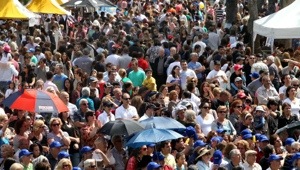
Some 20,000 people attended the Being Greek Festival, a festival full of kefi, held in Sydney on Oxi Day, Oct. 28. it was organized by the municipality of Kogarah, the Greek community in the region and other immigrant organizations, under the slogan, Be Greek for a Day.

The organizers attempt to break the Guinness World Record for the largest Greek Zorba Syrtakia dance was not successful although 2,000 people participated, according to AMPE.

“We didn’t manage to break the record of participation in Zorba dance,but it was an undeniably great event,” said the organiser, Billy Biliris adding that, “This event made Greece look good while raising our National Oxi Day.”

For this event, everyone said Nai.

20121031-045839.jpg

20121031-045844.jpg

Leader of the opposition Tony Abbott has reaffirmed the coalition’s support of negotiations between Greece and Australia on a reciprocal Work and Holiday Visa

Abbott reaffirms support to Greek community

Abbott reaffirms support to Greek community

Bill Papastergiadis, GOCMV president with Tony Abbott, Leader of the Opposition.

Leader of the opposition Tony Abbott has reaffirmed the coalition’s support of negotiations between Greece and Australia on a reciprocal Work and Holiday Visa in meeting held with the Greek Orthodox Community of Melbourne and Victoria.

Mr Abbott and his chief advisor, met with President Bill Papastergiadis and GOCMV board members Kostas Tsoubakos and Nick Parthimos, where they discussed a range of issues pertaining to the Greek community in Australia.

They discussed community funding acknowledging further work needed to be undertaken to more efficiently allocate government resources to specifically target those Greek Australians most in need.

In particular, the need of a case officer to assist with Greek Australians returning to Australia and additional funding of an employee dealing with the Antipodes Language and Cultural Centre. Mr Abbott was sympathetic to explore how the Coalition can encourage the significant number of Greek speaking students to continue their Greek language education throughout their secondary schooling.

At the meeting, the GOCMV thanked Mr Abbott for his bipartisan support of the recent Federal Government grant of $2 million towards the new 14 Level GOCMV Cultural Centre to be built on Lonsdale Street.

They provided Mr Abbott with an update on the progress of the project and also invited him to attend next year’s Antipodes Festival.

Mr Abbott took on board the issues and needs of the Greek community, as expressed in the meeting, and said he was committed to further meetings between his office and the GOCMV and shadow cabinet to find a resolution for these issues.

He said he was committed to assisting Greek Australians and even looked towards his own ministry with the shadow cabinet position held by Sophie Mirabella and the parliamentary secretary position held by Arthur Sinodinos.