Christos Tsiolkas to launches his new novel Barracuda

Christos Tsiolkas has long been one of Australia’s most glittering literary treasures – and thanks to the success of his bestselling barbecue-stopper The Slap

Tsiolkas to launch Barracuda

Christos Tsiolkas has long been one of Australia’s most glittering literary treasures – and thanks to the success of his bestselling barbecue-stopper The Slap, he’s now a household name.

In his sixth novel, Barracuda, Tsiolkas once again holds up a mirror to the deepest insecurities and most dearly held dreams of middle class Australia.

Tsiolkas delivers a searing exploration of failure, and how to come back from it − on the back of his greatest literary success.

Join our foremost chronicler of contemporary Melbourne at the centuries-old Athenaeum for a typically tender and coruscating look at how we live now, in conversation with Michael Williams.

Co-presented by the Wheeler Centre and Readings at The Capitol Theatre, 7.30 pm – 8.30 pm, Wednesday 23 October. For info and bookings visit http://wheelercentre.com/

Artist expressions of interest for the 32nd Greek Festival of Sydney

Sydney’s Greek Fest wants you

Sydney's Greek Fest wants you

The Greek Festival of Sydney has opened registrations to interested artists to take part in the event. The festival – which will take place on the weekend of the 22-23 February 2014 – is inviting anyone interested in taking part in the festival to submit an application to the 2014 Greek Festival of Sydney cultural events program.

Organised by the Greek Orthodox Community of NSW and the Organising Committee of the 32nd Greek Festival of Sydney, the festival will also be followed by numerous cultural events at various venues throughout Sydney through March and ending in early April.

The Greek Festival of Sydney is seeking applications and expressions of interest from all areas of the Australian, Greek and Greek Australian arts and cultural community with links to ancient, medieval, modern and contemporary Greek culture.

Event proposals are requested from all artists and groups who are involved in the areas of sport, theatre, music, dance, literature, film, comedy, visual arts, design, crafts, food and wine, history and education and any other area that falls under the arts or cultural ‘umbrella’.

The Greek Festival of Sydney encourages applications from all other cultural groups who have proposals that could enrich its program and provide a fresh perspective on any mutual cultural links.

All applications must be received at the Festival Offices by 5.00 pm, Friday 8 November, 2013.

Application forms are available online at website www.greekfestivalofsydney.com.au or by contacting the Greek Festival of Sydney office on (02) 9750 0440 or e-mail greekfestival@goc.com.au

Knock Out at Anesi Lounge in Sydney, Australia on Sept 28 2013!

Embedded image permalink

Rich Greek Aussies top BRW list

While mining magnate Gina Rinehart tops the list, Con Makris is still the richest Greek Australian with a $900 million fortune

Rich Greek Aussies top BRW list

Kerry Harmanis

27 May 2013

Adelaide businessman Con Makris is the richest Greek Australian according to the BRW Top 200 Rich List, while another six Greeks have made the list.
At number 40 on the list, Mr Makris made his estimated $900 million fortune from property investments, but started off in humble beginnings. Like many migrants, Mr Makris started in retail ventures, buying fish and chip shops and grocery stores but then moved on to shopping centres.
While the number seems high, it has been falling for quite some time. In 2011, the Makris family had amassed more than $1.07 billion and became the first Greek Australian billionaires, then fell last year to $910 million.
BRW predicts the number will keep falling if his ventures continue to stagnate.
“While Makris has done well with his shopping centre investments, his development pipeline has stalled in the past few years,” BRW writes.
“A residential estate and shopping centre in Victor Harbor has languished for so long its permits ran out. A CBD-fringe property, once a furniture shop, has been empty since 1989 and Makris has owned it since 2001.”
No surprise that mining magnate Gina Rinehart topped the list again, with a fortune estimated at $22 billion.
But this is the first year her fortune has dropped considerably since its high in 2012 with more than $29 billion in her pocket. A whopping $19 million per day gets wiped off her fortune, showing the resources boom could be cooling. The drop has also bumped her off the world’s richest woman title, while her lengthy and bitter court battle with her children might cut a big chunk of her fortune soon.
Barrister turned miner Kerry Harmanis is the second richest Greek Australian, coming in at number 80 with an estimated net worth of $590 million. At $570 million last year, the Perth local has boosted his total with sound investments in property, shares and his mining ventures. He made $500 million selling his nickel business Jubilee Mines to Xstrata in 2007, but doesn’t take the mining tycoon title well. He’s known for being very low key, plays the mandolin and surfs a lot.
Ten points down, at number 90 is Sydney’s Theo Karedis, who has steadily been increasing his fortune after selling his own liquor stores to consortium Coles Myer in 2002 for $175 million.
The well-noted Harry Stamoulis is the 93rd richest Australian, sitting on $480 million, up from $445 million last year. Inheriting his father’s riches after selling the soft drinks company Gold Medal to Cadbury’s in 2004, the family now invests in property and has slowly increased their net worth. This year, Mr Stamoulis applied for a permit to build 258 triple-storey townhouses in the re-zoned Fishermans Bend precinct of Port Melbourne while his $24 million dollar house is still being built.
The family have been very active members of the Greek community, setting up the Hellenic museum while funding many Greek language newspapers and radio stations.
Another family not on the list is the Paspaley family, who still privately own their pearling business in Darwin. The family is estimated at a fortune over $900 million with their ventures into aviation, fishing, retail and hotels also making them a considerable profit.
Back on the list at number 131 is car dealership magnate Nick Politis. With a $360 million fortune, the 71-year-old made his first rich list appearance in 1987 and stayed till 2006.
“Politis’s wealth has been boosted by the continuing strong performance of listed car dealership AP Eagers,” BRW says.
Greek-born Australian George Koukis made the list at 153, with a fortune of $320 million, up $5 million from last year. The banking software he founded in 1993 amassed him his fortune, now his company Temenos is worth $3 billion.
Last to make it on the list is Greek Australian Spiros Alysandratos. From Kefalonia, the travel businessman fell into the industry after failing to find a discounted flight back to Europe. Now his company, Consolidated Travel, provides wholesale ticketing services for travel agencies while looking after the back office operations of a string of foreign airlines.
BRW reports that the overall value of Australia’s wealthiest 200 fell by $4.4 billion to a total of $176.8 billion.

Assistant treasurer-elect Arthur Sinodinos will take responsibility for Australia’s $1.6 trillion superannuation industry

Source: SMH

Super industry welcomes appointment

Assistant treasurer-elect Arthur Sinodinos will take responsibility for Australia’s $1.6 trillion superannuation industry, but the title will go.

The industry was unsure on Monday when a minister for superannuation was not listed in Tony Abbott’s ministry.

But returning the sector to Treasury is not new; Labor introduced the country’s first superannuation minister, Nick Sherry, in 2007.

The Coalition’s former spokesman for superannuation, Mathias Cormann, has been promoted to finance minister. As expected, Joe Hockey will be treasurer, Steven Ciobo will be parliamentary secretary to the treasurer and Arthur Sinodinos will serve as assistant treasurer.

Alex Dunnin, director of research at super research firm Rainmaker, said putting super into the hands of Senator Sinodinos was ”probably a real stroke of luck for the sector as Sinodinos seems one of the most level-headed players in the whole cabinet, at least among the heavyweights”.

He added that Senator Sinodinos might ”also signal that the government doesn’t really have much interest in more superannuation or financial services reform, or even fussing too much with rolling things back.

”The industry will welcome the appointment … but I suggest the smarter players in the retail side of the trade will not be overly rapt, at least if they were expecting more restructuring.”

John Brogden, chief executive of the Financial Services Council, said ”as a former Treasury economist and chief of staff to John Howard, Arthur Sinodinos has unparalleled experienced for the role as assistant treasurer”.

David Whiteley, head of the industry super lobbying group Industry Super Network, said Senator Sinodinos had ”considerable experience in financial services”.

The announcement comes as the corporate regulator said it was scrutinising the aggressive marketing of property to self-managed superannuation funds, which account for almost one-third of the enormous industry’s total assets. ”ASIC [Australian Securities and Investments Commission] is also experiencing an increase in reports of misconduct about aggressive marketing of investments, notably direct property, through SMSFs,” it said in a consultation paper released on Monday.

And ASIC weighed into the debate over the minimum size for a fund, noting many industry participants question whether $200,000 is enough to establish a SMSF.

ASIC wants Australian financial services licensees to warn clients that SMSF investors are not entitled to compensation due to fraud or theft, after a parliamentary inquiry found SMSF investors in the collapsed Trio Capital were not aware they were ineligible or to other risks associated with SMSFs.

ASIC said financial planners and accountants should disclose the ”potentially significant” costs associated with managing a SMSF.

Sophie Mirabella surrenders seat of Indi after conceding victory to Cathy McGowan

Source: TheAustralian

FORMER Coalition frontbencher Sophie Mirabella has surrendered her seat and will not demand a recount.

She revealed in a statement that she had conceded the Victorian seat of Indi to independent Cathy McGowan.

Ms Mirabella has taken full responsibility for the loss after suffering a two-party-preferred swing of more than 9 per cent.

“Today I have contacted Cathy McGowan to congratulate her on her win in Indi and concede defeat,” she said.

“Representing the people of Indi in the Federal Parliament has been a high honour and a very special privilege.

“I want to thank the electors of Indi for their support over the last decade. They have enriched my life and that of my family and, together, we have achieved so much for our community.

“I also thank those who voted for the Liberal Party in this election and in the previous four elections in Indi.

“This election is over and the responsibility for the outcome is mine.

“Despite the closeness of the count I have decided not to seek a recount. I unreservedly accept the decision of the democratic process.”

The decision came as she trailed by 387 votes with little more than 1000 to be counted.

Ms Mirabella’s concession is both a personal blow to her as well as a blow to Liberal leader Tony Abbott.

She was considered an automatic selection in any Abbott Cabinet and had been a strident supporter of his leadership.

At the same time, the loss of the seat is a bitter blow to the Liberal Party and will spark further soul-searching about what went wrong.

Ms McGowan was backed by senior Nationals members in the north-east Victorian electorate amid anger over three cornered contests being waged in Victoria.

The dispute was linked to the Liberal decision to run in nearby Mallee against the Nationals despite the Nationals having held Mallee for many years.

However, senior Liberals have rejected this claim, arguing that Ms Mirabella had already been facing a contest from Ms McGowan.

Ms McGowan said she’ll have to “grow in the job” and thanked Ms Mirabella for her 12 years of service.

“My intention would be to be a really good local member and be able to represent the diversity of voices in Indi,” she said.

Cosmetic king Napoleon Perdis had humble beginnings growing up in Parramatta

Source: TheSundayTelegraph

Napoleon Perdis with his mother Liana Perdis and father John Perdis.

Napoleon Perdis with his mother Liana Perdis and father John Perdis. Source: News Limited

Cosmetic king's humble beginnings

Napoleon Perdis at the head office of Napoleon Cosmetics in Alexandria. Source: News Limited

Napoleon Perdis with his mother as a child.

Napoleon Perdis with his mother as a child. Source: Supplied


A family picture of Napoleon Perdis.

A family picture of Napoleon Perdis. Source: Supplied


NAPOLEON Perdis wasn’t like most 13-year-old boys growing up in Parramatta in the 1970s.Raised in a Greek-immigrant family, his “woggy” upbringing made life tough in an “Anglo-western” neighbourhood.

It didn’t help either that he loved doing his mother’s make-up.

He watched, mesmerised, as she laid out her palette of powders and creams and step by step, embellished and coloured her face in glamour.

Thirty years later, and Perdis is the country’s cosmetic king whose company turned over $82 million in Australia alone in the year to June 2012.

He’s sells through Myer and in some of the most prestigious stores in the United States, including Bergdorf Goodman on Fifth Avenue.

And Perdis has signed a deal to open four concept stores in the Middle East and distribute his make-up across the region, cementing his status as the nation’s most successful beauty export.

In an exclusive interview with The Sunday Telegraph, the Los Angeles-based Perdis said his ambition from here is to “be happier” and he’s preparing to move his family back to Australia after 2014.

“I want more of a human connection now. I was very ambitious and very angry for a long period of time,” he said.

“I like human beings now. That sounds terrible: it’s just that I’m happier to get to know people.”

Perdis’ dream of a cosmetic empire began when he picked up a make-up brush, at age 13, to help his mother, Liana Perdis, prepare to head out.

“I believe in fabulous,” Perdis said.

“She would do these little tips, one of them I actually still use: she used to extend the line of the eye with the eyeliner. She’d put it and then she’d dab it.”

His first attempt at doing her make-up was a little heavy-handed.

“I remember specifically seeing this thing in a magazine: they were putting electric blue mascara on and they put a little bit in the eyebrow to give a little highlight and (I did that to her) and she went out with it – but she looked like a drag queen.

“She was very proud that I had done her make up.”
The family owned a hot food bar, Stolos Snack Bar, in the city and Perdis was obliged to work in the shop.

“There was a Salvation army car park down the road and we would wash the under arms in that car park, change, go out and do Greek dancing after closing the shop. We still stunk of hamburgers and fish but it was all okay,” Perdis said.

“It was great discipline. At the time, I hated it. It was tough for a kid, to be at school in an Anglo-western world and then have to do these very kind of Greeky, woggy things.

“They are kind of tortured memories but they do shape you.”

The money Perdis brought home on weekend gigs doing make-up for brides convinced his father John Perdis to let go of ambitions that his son was destined to be a chemist or lawyer.

“I saw how much money he would come out with: more than some people earn in a week,” Mr Perdis, 83, said.
Mr Perdis gave his son and daughter-in-law, Soula-Marie Perdis a $30,000 start-up loan.

“I said: ‘This is a little thing – I can describe this as a single brick, build on it and you will go up to the sky’. That was my wish but I never believed that they would get there.”

Sunday Style editor-in-chief Kerrie McCallum said Perdis’ persistence, determination and remarkable stamina have made him Australia’s biggest cosmetics export.

“In terms of business success and his celebrity, he would have to be the most well known Australian,” Ms McCallum said. “He is up against big international companies, which is no mean feat.”

Vogue Australia editor Edwina McCann said: “For one of our makeup artists to build a brand in Australia which today is stocked at Bergdorf Goodman, the legendary US department store on Fifth Avenue, is an incredible achievement and an indication of his international following.”

Perdis and Soula-Marie nine years ago moved to LA with their daughters, Lianna, 13, and 11-year-old triplets Athina, Alexia and Angelene.

They had intended to move back to Sydney next year, but expansion in the US, chiefly through department store Neiman Marcus, has temporarily delayed that plan.

Perdis said: “I am probably more proud (of Australia) now than when I was living here, because I left as an angry wog.”

Turning 40 was also a catalyst for change.

In the months before the milestone birthday, he had lap-band surgery and has been dieting and exercising since, shedding 78 kilos and scaring his staff with the endless energy that has injected.

“That was a big realisation when I came over 40: I’ve done all this fight and now I’m a big fat pig. I haven’t worked on myself, at all, I am really unhealthy. All I have done is worked and worked and worked.”

Napoleon Perdis Cosmetics latest Australian accounts filed with the Australian Securities and Investments Commission show revenue grew from $72.3 million in 2010-2011 to $81.6 million in 2011-2012.

A small loss in the 2011 financial year was turned into a profit of $1.882 million in the 2012 financial year.

Perdis said the team around him is committed to his vision and those who were not, he has no time for.

“There’s people that you’re like: ‘I edit you out of my life. You are no longer relevant. I’m driving and I’m going: you are on the bus or not’. But there’e a lot of people on the bus and it’s only bigger. So for all the disbelievers, there’s a lot of believers. The volume alone of our business proves that, let alone the longevity of staff here.


Sophie Mirabella cut down as witch-hunt on political circuit hits fever pitch

Source: TheAge

It is said there’s a special place in hell reserved for those who stand by while others commit bad deeds.

Less recognised is the hellish place, in the here-and-now, set aside for women who play the political game as robustly as men. These may be our new secular witches.

To the case of Julia Gillard can be now added Sophie Mirabella. It is immaterial that they come from opposite ends of the field and that neither would be happy in the other’s company. They’re certainly not directly comparable, the latter communing with right-wing fringe-dwellers brandishing abusive ”ditch the witch” signs regarding the former.

Nonetheless, the virulence of the reaction to Mirabella’s electoral denouement is surprising.
News that she has lost her seat to a fellow conservative, Cathy McGowan, has disproportionately delighted people across the political spectrum. The left is understandably cock-a-hoop that a smug warrior of the right, and one of Tony Abbott’s senior frontbenchers, has been taken out. But in the Liberal and Nationals parties, few tears are being shed for the pocket dynamo whose adversarial style invited uncharitable comparisons with pit-bulls, crazed wolverines, etc. Mirabella’s characterisation as ”political terrorists” her Liberal colleagues who opposed the mandatory detention of asylum seekers, was hardly subtle.

But there have been plenty of others over the years who’ve made gooses of themselves with hateful comments such as referring to a childless PM being ”deliberately barren”, for instance. What is notable about the outpouring of glee, however, is its universality and intensity.
People in the beltway, including aides, politicians, and even many journalists, seem inordinately pleased. Some have forgotten what good copy Mirabella provided from time-to-time. In the halls of Parliament it was hard to find anybody who wasn’t privately glad that the Victorian hardliner was toast.
Much of it is pure schadenfreude, of course. But it still feels unnecessarily pointed.

The gold standard of our double standard in politics is the Keating-Gillard comparison. Both became prime minister by knocking off sitting Labor prime ministers but only one was lauded for courage and determination. The other was an ambitious backstabber, a cunning shrew with betrayal coursing through her veins.

The qualities seen as admirable in a man seem to sit less comfortably in our view of women. Many will not even concede that gender was an issue in the interpretation of Gillard, so will regard as nonsense the idea that Mirabella is being treated with extra venom, due to an underlying patriarchy.
But with relatively few cases of female political leaders, the question remains to be legitimately debated. Is it possible that women are subconsciously judged more harshly when they seek to exercise power?

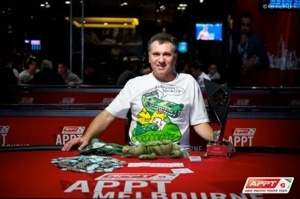
Billy “The Croc” Argyros Wins 2013 APPT Melbourne Main Event

Source: PokerNews

20130913-184017.jpg

The latest Asia Pacific Poker Tour champion has been crowned at the Crown Poker Room in Melbourne, Australia. After five tough days of action, Aussie poker veteran Billy “The Croc” Argyros claimed victory of the 2013 APPT Melbourne Main Event.

Argyros is one of the original inductees in the Australian Poker Hall of Fame and has a poker resume which includes tracked results in each of the last four decades. Now, in 2013, Argyros has taken down one of the most prestigious titles in the country and his second largest career score.

“I haven’t won a tournament since Cleopatra was skiing down the Nile!” quipped Argyros after he took down the title and $134,500 following a three-handed deal.

2013 APPT Melbourne – Final Table Results
Place Player Prize
1 Billy Argyros $134,500*
2 Bowdy Tolhopf $166,000*
3 David Yan $133,000*
4 Ashley Mason $58,400
5 Robert Damelian $45,900
6 Joe Cabret $37,550
7 Phi Luu $29,200
8 Ravi Maravar $22,920
9 Jazz Mathers $16,650
*Denotes three-handed deal

When the APPT Melbourne Main Event final table began at midday local time, everyone was expecting it to be a very long day in the Crown Poker Room. Then, within the first hour, four players had been eliminated.

The first player to find the rail was short stack Jazz Mathers. Starting the day with around five big blinds, Mathers was happy to look down at early in the action and get all his chips in. Mathers had to come up against Ravi Maravar’s and would unfortunately hit the rail when the dealer rolled out a board.

Despite picking up extra chips when he eliminated Mathers, Maravar would be the next player to exit. Maraver first lost most of his chips when he ran his into David Yan’s , then lost the rest of them all in preflop holding against Ashley Mason’s .

Just moments after Maravar hit the rail, Phi Luu joined him. With blinds at 15,000/30,000, Luu’s final hand saw him move all in for 295,000 from under the gun holding the . Billy Argyros looked down at in the big blind and made the call. No help came for Luu and it was all over in seventh place.

Six-handed play would become five-handed very quickly as 2013 Aussie Millions runner-up Joe Cabret couldn’t turn his Day 3 “chip and a chair” story into a victory. Cabret’s final hand was a flip that he couldn’t win as his was out drawn by David Yan’s .

At this point Robert Demalian was still in contention and looking good to find another big result after making a deep run in this year’s WSOP Main Event. However, Demalian was ousted in fifth place when he was all in preflop holding the and couldn’t stay ahead of Bowdy Tolhopf’s .

Mason started the day as the chip leader, but seemed to be card dead and could never really get anything going. Eventually Mason found himself all in preflop holding the against Billy Argyros’ . The board ran out and Mason was sent out in fourth place, adding $58,400 to the $49,350 he received for winning a $1,650 Six-Max side event last week.

Just a short while later, Argyros, Yan and Tolhopf agreed ICM (independent chip model) deal. The players left $29,500 aside for the eventual champion, and because Tolhopf was a big chip leader, he locked up $156,000, while Yan received $133,000 and Argyros claimed $115,000.

The players were fairly deep stacked at the time of the deal and so it wasn’t too surprising that it would take around four hours to reach heads-up play. In the end, third place went to Yan after he took an unfortunate beat. Yan’s was all in preflop against Tolhopf’s , and he couldn’t stay ahead as a board was spread on the felt.

Argyros started the heads-up battle with a slight chip lead over Tolhopf. With $29,500 on the line, the two players decided to do another chop, with Argyros taking home $14,500, Tolhopf claiming $10,000, and $5,000 left aside for the champion.

The eventual final hand of the 2013 APPT Melbourne Main Event saw Tolhopf all in preflop holding the against the of Argyros. The final five cards spread on the felt for this tournament were , and with that Tolhopf was sent home in second place, while Argyros was the champion!

Argyros is now the second Australian Poker Hall of Fame member to win APPT Melbourne after Leo Boxell claimed victory in the 2011 APPT Melbourne Main Event.

Exploring Fener and Balat – the old Greek and Jewish quarters of Istanbul

The haunted streets of Istanbul

The haunted streets of Istanbul

The tour began at Çibali, where we followed the sea wall in a northerly direction along the western side of the Golden Horn. Here, in another age, stood the proud Greek Fanariot mansions – squat, medieval domiciles with pediments, domed ceilings and stairs to upper levels. They were for a period the pleasure palaces of patrician and mercantile Greek families that thrived under Ottoman rule. Now neglected and fallen into disrepair, they are surrounded by traffic on one side and the Horn on the other. Once, they had been closer to the water, but the shoreline receded in direct proportion to the street levels rising, so that these intriguing buildings appear to be stranded on traffic islands and sinking into the ground. Interestingly, the dwellings are built of alternate layers of brick and stone to withstand earthquakes.

My friend Alex and I risked our lives on a busy road to visit the church of Hagios Nikolaos. The press of a button set in forbidding masonry summoned an Orthodox woman from Antioch. She has been the caretaker for fifteen years and has, she told us, three children. She looked under the weather; nevertheless, she gave us access to a rare gem.

From a covered inner courtyard she opened a heavy door to reveal a modestly sized church with a marble iconostasis. The feeble light, struggling through high dirty windows, revealed icons of saints and the Virgin. They were almost entirely obscured by soot and a cloud of incense that hung in the air. An Epitaphio covered in wilted flowers reminded us that Greek Easter had been celebrated a week earlier. Here and there burnished colour drew the eye up to the domed ceiling hung with three chandeliers.

Spying the icon of Hagios Dimitrios in a dark corner brought on unexpected surge of nostalgia. Without thinking, I asked if I may light a candle. The woman rushed off and returned with oil and a wick so that I could light the oil lamp that hangs before my namesake. It was rather disconcerting taking part in a ceremony I hadn’t performed since childhood.

On the opposite side of the courtyard is a phenomenon: the only standing Fanariot mansion visitors can safely enter without incurring personal injury. Ascending the stairs to the second storey and wandering in the early baroque Ottoman room was heartbreaking. Here were small niches built into the wall and enclosed with elegant doors, a safe; kitchen, bedrooms, all dank and dark and filled with masonry and cobwebs. Like much of what’s left from this time, it is empty and displays a siege mentality. Certainly it is forgotten and largely unknown to the world rushing by outside.

Following the remnants of the sea wall brought us to Fener. Fresh cheese borek and tea were served by a good-natured though none-too-bright boy at a local cafe.

From there we headed up the steep street to the Fener Greek Orthodox College. Established in 1454, it’s a massive red-brick edifice that dominates the neighbourhood with the arrogance of a citadel. Looming over the houses now occupied by Anatolian peasants and Kurds, the college is the emblem of a once thriving Greek community. Now it schools a mere fifty-seven students, most of whom are from Antioch and speak mainly Turkish.

The upper storey has a sprung floor to withstand earthquakes. At the end of a long corridor is an assembly hall with murals containing examples of continued Greek presence in Asia Minor for millennia, not that those who surround the school know or care. The place has an other-wordly air, as though it’s mired in an irrelevant past. What will become of the building when the school eventually closes, as it surely must, is anyone’s guess.
On the way out we met three young Israelis searching for their roots. Nearby Balat housed a substantial Jewish population, their synagogues and bathhouses still dot the area. Listening to the young men, it seemed to me that Istanbul is the place where people come to find themselves in a shattered past. Even their words sounded haunted.

My friend Alex is scathing about the current occupants of Fener and Balat.

They have no education, no respect, no understanding and no knowledge of the area’s significance. Shoddy, slap-dash renovations abound. They stick a Koranic verse above the door and think they’ve exorcised the Christian presence. Simple folk with no understanding squat in the ruins of the Theodosian wall and in the crumbling remnants of once-grand mansions. Cats wander everywhere. Washing hangs between houses. Giant elms reach over high walls that guard disused churches.

It’s picturesque but melancholy. You feel as if every footstep is in remembrance of times past; as if life here had once been very different to what it is now. Not drained and diminished but sophisticated, cosmopolitan, lived according to forgotten daily rhythms and rituals.
The point hit home when we visited another Fanariot mansion. This one stood in a seedy park by the water; it was comparatively well-preserved. I objected when Alex pushed open a make-do gate and ushered me into a courtyard occupied by a man in religious garb.
“Why?” Alex snapped. “You have more right to be here than they do.”

Indeed, the old man had no idea why we should be interested in his remarkable hovel. His bent back, the kind, vapid smile and the hands that fiddled with worry beads brought on pity. He reminded me of my father. After a quick inspection of the graceful arched colonnade and the balcony above it, I thanked the man and guided Alex out.

As we rested in a cafe, I reflected that no Greek can visit Istanbul without feelings of intense primal loss and longing. There is a deep connection to the place. You can’t help thinking of what might have been had things worked out differently. The regret, the conflicting feelings, are so powerful, they make you catch your breath. For a minute you think that if one or two variables were to change, Greek voices might still ring in the streets instead of Turkish ones. Greeks might come down the hill on the way to church. And then you hear the muezzin’s call to prayer, first from one minaret and then a multitude, and all illusions melt. This is modern Istanbul. Not Constantinople.

* Dmetri Kakmi is a writer and editor. His book Mother Land was shortlisted for the NSW Premier’s Literary Awards. He will be speaking about the book on September 17 at 10.00 am at the Collingwood Library, 11 Station St Abbotsford.