The world’s nine most incredible natural swimming pools inluding Giola, Thasos, Greece

Source: News

Ik Kil in Cenote, Mexico.

Ik Kil in Cenote, Mexico. Source: Supplied

INFINITY, horizon, lagoon, lap and plunge – there’s plenty of different types of hotel pools.

But some of the best spots for travellers are home to the world’s most amazing natural wonders. Here’s Expedia’s Listopedia Bucket List for the most stunning natural swimming pools.

IK KIL, CENOTE, MEXICO

Known as the “Sacred Blue Cenote,” this enchanting sinkhole will lure you into her perfect waters. The walk down to the deep cavern promises to be an experience. As you meander through mysterious vines and tropical vegetation, small birds flicker above the trees, and you can’t help but get a sense that something special awaits. This clear blue sink hole needs to be seen to be felt.

PAMUKALLE, TURKEY


A castle of cotton, the Turks say.

A castle of cotton, the Turks say. Source: Supplied

Pamukkale translates to “cotton castle”, a reference to the white terraces of travertine rock formed in the flow of water from the hot springs of south-western Turkey. A national treasure, this site has tight security but they’ll still let you go for a dip in the shallow pools.

DEAN’S BLUE HOLE, BAHAMAS


Imagine the day's drifting away on one of those chairs. Bring along the SPF 30+.

Imagine the day’s drifting away on one of those chairs. Bring along the SPF 30+. Source: Supplied

Feel the freedom as you swim around the 1,000-foot-wide, almost perfectly round ‘blue hole’ in the Caribbean. Dean’s Blue Hole is 650 feet deep, making it a favoured spot for adventurous free divers, who lunge to great depths with no equipment except for their enduring lungs. The turquoise water around the perimeter is known to be home to many colourful species of fish, making it a great snorkel destination. The water in the centre of the blue hole is deep and vast, the perfect place to duck dive down and explore the mysteries lurking beneath.

TAKAMA-GA-HARA ONSEN, NORTHERN JAPAN ALPS, CENTRAL HONSHU


No shortage of solace here.

No shortage of solace here. Source: Supplied

If you want to go somewhere that very few do, then take the one day hike to this “secret hot spring” high up in the Japanese alps. Surrounded by mountains, this natural sanctuary is translated to “High Plain of Heaven” in Japanese mythology. If you’re seeking a little healing and solace, then a soak in the soothing, mineral-rich hot springs will do you the world of good. This is one destination that’s far off the beaten tourist path, but it’s the perfect place to just get lost for a while.

BULEY ROCKHOLES, LITCHFIELD NATIONAL PARK, NORTHERN TERRITORY


Close to home, but a million miles away.

Close to home, but a million miles away. Source: Supplied

Take time out and head to Litchfield National Park where you can cool off in the crystal clear rock holes, all of varying sizes. It’s the perfect place to wind down after exploring the park, where you’ll never be short of things to do. Chill out under a waterfall, absorb the scenic bush surrounds or sit and relax, as the chorus of the native birds soothe your soul.

GIOLA, THASOS, GREECE


Taking infinity pool to another level, this lagoon opens up to the Aegean Sea.

Taking infinity pool to another level, this lagoon opens up to the Aegean Sea. Source: Supplied

On the beautiful island of Thasos lies a secluded lagoon called Giola. This seaside gem is carved into the rocks and offers breathtaking views over the Aegean Sea. The natural seaside lagoon is filled with pristine water and is located far away from any source of distraction. It’s a place to soak, relax and find a little tranquillity.

TAT KUANG SI WATERFALL, LUANG PRABANG, LAOS


Is this the backyard pool of your dreams?

Is this the backyard pool of your dreams? Source: Supplied

There’s no better way to cool off in the Laotian heat than submerging yourself in the enticing blue-green waters of the Tat Kuang Si Waterfall. Spend the day swimming at the base of the falls, swinging from the tree rope and exploring the walking tracks that wind through the tropical green jungle. The Tat Kuant Si Waterfall is located in a national park along the Mekong River and is a must see when in Laos.

HAVASU FALLS, SUPAI, ARIZONA


You might think a place like this would be crawling with tourists. Not so.

You might think a place like this would be crawling with tourists. Not so. Source: Supplied

If you’re seeking an oasis in the desert, look no further than Arizona’s Havasu Falls. A place where two worlds collide, you get to experience the traditional culture of the American Indians and witness Mother Nature in all her glory. The beauty is you’ll need a permit from the Havasupai Tribe and there are limited tourists allowed to visit at any one time, allowing you the space to breathe in the beauty and appreciate the miracle of nature.

THE DEVIL’S POOL, VICTORIA FALLS


Only for the brave. This waterfall claims thrillseekers' lives each year.

Only for the brave. This waterfall claims thrillseekers’ lives each year. Source: Supplied

One for the real experience seekers, if you’ve ever wondered what it would be like to peep over the top of the world’s largest waterfall, then you need to take the leap of faith into the Devils Pool. Just don’t jump too far – the 355ft drop takes a few lives a year.

Push grows for Aussie Socceroos coach ANGE Postecoglou

Source: TheAustralian

20131013-091328.jpg

ANGE Postecoglou has urged caution about the growing push for a homegrown Socceroos coach, insisting ability matters far more than nationality.

Football Federation Australia chief executive David Gallop says feelers have already been put out to find Holger Osieck’s replacement.

Internationals including Guus Hiddink and Gerrard Houllier have been linked with the vacant role while Australian coaches such as Postecoglou and Graham Arnold are also believed to be in the frame.

Arnold has already put his hand up and says he believes the time is right for a local to lead the Socceroos.

That view has been strongly backed by fellow A-League coaches John Aloisi and Alistair Edwards, while Gallop says having an Australian coach is the long-term preference, regardless of whether a local is appointed this time.

While Postecoglou said he would do whatever he can to help grow the game in Australia, he added that appointing a coach just because they’re Australian would be the wrong approach.

“The only thing I would recommend strongly is to appoint the best person for the job,” Postecoglou told reporters.

“I don’t like this whole ‘Let’s go local as opposed to overseas.’

“It’s our national team, whoever the best person for the job is, that’s who should get it.”

But Arnold believes it’s time to have an Australian.

“I do believe Australian coaches are now ready. Probably the criticism a few years ago was right and was correct because I didn’t even have a pro licence,” he said.

“But now I do have a pro licence and the coaching across the board is so much better.

“I do believe that probably an Australian with the passion and the pride to coach the Socceroos would be fantastic, whoever it is, whether it’s Ange, Tony Popovic or whoever.”

Aloisi, the former Socceroo whose penalty goal famously put Australia into the 2006 World Cup, agreed there were coaches in the A-League ready to step up either now, or in the near future.

“Are we bringing in foreign coaches just for the sake of it or have we got coaches good enough to end up coaching at that level?” he said

“I think that we’ve got a few that are good enough.”

Edwards said Postecoglou would be his choice, based on his experience and domestic achievements.

“It’s always good to look overseas to see what we can learn from but I think we’ve done that and I think the coaches we have in the A-League now and the brand of football that is being played, on and off the park, they’re good managers, they’re good technical coaches and I think the time is right for us to put in a local coach,” Edwards said.

The WOGBOYS are back! – Live On Stage 2014

The smash hit stage show is back! Wogboys Live

Nick Giannopoulos

Alex Dimitriades

Frank Lotito

Vince Colosimo

Wog Boys Nick Giannopoulos and Vince Colosimo chat about their new live remixed and rewogified stage comedy Wogboys.

Two of Australia’s most famous and loved actors, NICK GIANNOPOULOS and VINCE COLOSIMO are returning to the stage for the first time in over a decade, with their critically acclaimed hit stage show WOGBOYS. They will be joined by AACTA award winning actor, ALEX DIMITRIADES & star of the recent Aussie film comedy Big Mamas Boy, FRANK LOTITO.

WOGBOYS is the record breaking, critically acclaimed stage show that inspired the hit Aussie comedy film The Wog Boy. Set in the mid 90s, this hilarious and insightful play examines everyday situations in the lives of a group of Wogboys.

Following over a decade of successfully acting, writing, producing and presenting in movies, stage shows & television, both Nick and Vince will go back to their roots, reprising the wog phenomenon and channeling the essence of Acropolis Now, Wogs Out of Work and the uber-successful The Wog Boy/ Kings of Mykonos feature films.

Don’t miss this much-loved, hilarious and insightful comedy written and directed by Nick Giannopoulos.

From the creator of Wogs Out of Work, Acropolis Now & The Wog Boy

WOGBOYS is the record breaking, critically acclaimed stage show that inspired the hit Aussie comedy film The Wog Boy.

Set in the mid 90s, this hilarious and insightful play examines everyday situations in the lives of a group of Wogboys.

Book now! Strictly limited season!

o

MELBOURNE

Princess Theatre
163 Spring St, Melbourne
OPENING JANUARY 9
(Cut price preview January 8)
Thursday, Friday & Saturday – 8PM
Sunday – 6PM

Buy Tickets Now

k

SYDNEY

Enmore Theatre
118-132 Enmore Rd Newtown
OPENING FEBRUARY 7
(Cut price preview February 6)
Friday – 8pm
Saturday – 7pm & 9:30pm
Sunday – 6pm

Buy Tickets Now

.

.

Nick Giannopoulos

One of Australia’s most accomplished & adored comedians; Nick has excelled & transitioned with great success from stage to television to film & beyond. A graduate of the Victorian College of the Arts, Nick essentially started the ‘wog’ phenomenon when he created & co-wrote the stage production Wogs Out of Work. Nick also co-created the smash hit sit-com Acropolis Now.

His first feature film The Wog Boy broke Australian box office records. He followed that with The Wannabes co-starring Isla Fisher and then The Kings of Mykonos: Wog Boy 2, which would go on to become a major International box office hit. Collectively all of Nick’s films have grossed over $20 million at the Aust. Box office.

k

Alex Dimitriades

Alex made his film debut playing the title role in breakout Australian feature film, The Heartbreak Kid. This was followed by an outstanding turn as the troubled “Ari” in Head On (Cannes Film Festival official selection) a performance that earned him an AFI Best Actor nomination in 1998 and a Film Critics’ Circle of Australia Award for Best Actor in 1999. He also received an AFI nomination in 2001 for his supporting role in the film, La Spagnola. Alex has also appeared in the films Three Blind Mice, Ghost Ship, Deuce Bigalow, Kings Of Mykonos, Summer Coda with Rachel Taylor, and recently completed filming on the soon to be released, The Infinite Man. Alex recently won the AACTA award for best actor in a TV series for his performance in The Slap.

k

Frank Lotito

Frank Lotito was destined to become a performer. From his early days as the class clown, to being discovered by a producer working as a waiter, destiny came knocking.

In 2011 Frank appeared in his first full-length feature film Big Mamma’s Boy, a laugh out loud comedy about life, love and lasagna, which he also wrote and produced. This lead to Frank producing his first US indie film in 2013. Shot entirely in New Orleans called the Lookalike, starring Justin Long, Jerry O’Connell and John Corbett. Frank is currently working on his next film The Cook & The Critic scheduled to shoot in New York and Italy in 2014.

k

Vince Colosimo

One of Australia’s most recognized actors with an extensive and successful career across theatre, television and film, Vince first came to the public’s attention in the feature films Street Hero & Moving Out. Vince has since gone on to appear in many more award winning films including; Walking On Water, The Nugget, Take Away and Opal Dreams. After landing a featured role in the internationally acclaimed film Chopper, he went on to win an AFI Award for Best Supporting Actor in 2002 for his performance in the feature film Lantana. In 2008 Vince starred in Underbelly one of the most successful Australian TV series ever. 2009 saw Vince star alongside Leonardo DiCaprio in Body Of Lies while in 2010 he appeared opposite Willem Dafoe & Ethan Hawke in Daybreakers. That year also saw him reunite with Nick Giannopoulos in The Kings of Mykonos: Wog Boy 2.

Bali victims remembered 2013

Tribute to the 43 NSW victims of the Bali bombing, including Greek Australian sisters Dimitra and Elizabeth Kotronakis.

On the thirteen anniversary of the bombing that killed 202 people, including 88 Australians.

The Kotronakis sisters were in Bali with their newly-married sister, Maria, and her new husband Kosta, when they were killed in the attacks on popular night-spots in Kuta.

The Age reported in 2003 that the Kotronakis sisters had just come from the 300-person Greek Orthodox wedding in Blacktown, where they were Maria’s bridesmaids.

Also killed in the attack was the third bridesmaid, cousin Christina Betmalik, as well as another cousin, Louiza Zervos, who had joined the bridal party for the holiday.

'this is our justice'

TRAGIC loss … Maria Elfes (second right) on her wedding day with her bridesmaids (L-R) Christine Betmalik, sisters Elizabeth (Lizzy) & Dimmy Kotronakis. All three bridesmaids died following the 12/10/02 terrorist car bomb explosion in Kuta Beach area on.

From wedded bliss to grief … the wedding party, from left, Lizi Kotronakis, Christine Betmalik, Louiza Zervos, Maria Elfes, Dimmy Kotronakis, Kosta Elfes.

Peter Kotronakis and his wife Vicky (middle) with another family member Christine Parris at the site of the Sari Club that killed their two daughters Elizabeth (33) and Dimmy (27).

Peter Kotronakis and his wife Vicky (middle) with another family member Christine Parris at the site of the Sari Club that killed their two daughters Elizabeth (33) and Dimmy (27).
Photo: Brendan Esposito

Vicky Kotronakis is consoled by family member Christine Parris at the site of the Sari Club where her daughters died.Vicky Kotronakis is consoled by family member Christine Parris at the site of the Sari Club where her daughters died.

Australia:
Gayle Airlie, Belinda Allen, Renae Anderson, Peter Basioli, Christina Betmilik, Matthew Bolwerk, Abbey Borgia, Debbie Borgia, Gerardine Buchan, Steve Buchan, Chloe Byron, Anthony Cachia, Rebecca Cartledge, Bronwyn Cartwright, Jodie Cearns, Jane Corteen, Jenny Corteen, Paul Cronin, Donna Croxford, Kristen Curnow, Francoise Dahan, Sylvia Dalais, Joshua Deegan, Andrew Dobson, Michelle Dunlop, Craig Dunn, Shane Foley, Dean Gallagher, Angela Golotta, Angela Gray, Byron Hancock, Simone Hanley, James Hardman, Billy Hardy, Nicole Harrison, Tim Hawkins, Andrea Hore, Adam Howard, Paul Hussey, Josh Iliffe, Carol Johnstone, David Kent, Dimmy Kotronakis, Elizabeth Kotronakis, Aaron Lee, Justin Lee, Stacey Lee, Danny Lewis, Scott Lysaght, Linda Makawana, Sue Maloney, Robert Marshall, David Mavroudis, Lynette McKeon, Marissa McKeon, Jenny Murphy, Amber O’Donnell, Jessica O’Donnell, Sue Ogier, Jodie O’Shea, Corey Paltridge, Charles van Renen, Brad Ridley, Ben Roberts, Bronwyn Ross, David Ross, Kathy Salvatori, Greg Sanderson, Cathy Seelin, Lee Sexton, Tom Singer, Anthony Stewart, Julie Stevenson, Jason Stokes, Behic Sumer, Nathan Swaine, Tracy Thomas, Clint Thompson, Robert Thwaites, Jonathan Wade, Vanessa Walder, Jodie Wallace, Shane Walsh-Till, Robyn Webster, Marlene Whiteley, Charmaine Whitton, Gerard Yeo, Luiza Zervos.

Has Today Tonight presenter Helen Kapalos put her foot in it again?

Source: News

Today Tonight presenter Helen Kapalos suffered through a TV presenter's nightmare in June. Picture: Supplied

Today Tonight presenter Helen Kapalos suffered through a TV presenter’s nightmare in June. Picture: Supplied

HAS Channel Seven presenter Helen Kapalos stuffed up again?

After she was let go by Channel Ten last year, Ms Kapalos agreed to appear as a “reporter” in a mock current affairs show called Tomorrow Whenever.

Ironically, both the short film and its title are blatant parodies of Today Tonight, where Ms Kapalos now works.

In the film, Ms Kapalos pretends to report on Senate legislation subsidising caravans in Australians’ back yards to house asylum seekers.

She interviews a human rights advocate, a bogan couple, a group of refugees and a parody of former Greens leader Bob Brown.

Caravans for Refugees

The mockery is merciless. “Bob Green”, the fake Greens Senator, is in love with a tree in his back yard. He tells Ms Kapalos she “should see the size of its trunk”. The human rights activist has crafted an Islamic prayer mat with an in-built compass to find Mecca, and the bogan couple really, really hates Collingwood.

The fake current affairs report was the brainchild of Adrian Cappola, the owner of Aussie caravan brand Elite Caravans. Hence the plot involving subsidised caravans for asylum seekers.

Ms Kapalos wrote a blog post about the film in January. She was impressed by the concept.

“There are some emails that jump through the page and hit you in the solar plexus,” she said. “It was like that when I first heard from Jim Shomos, a film director whose words fired up my synapses and tickled my funny bone at the same time.

“I had never even met the guy so I was impressed he had the balls to connect in such a direct and entertaining manner.”

Obviously, she realised the subject of asylum seekers could be controversial.

“The issue of asylum seekers has become, with good reason, one of Australia’s most pressing social debates, with a frustrating dictum of boundaries and conditions attached,” she said. “I was happy just for a day not to see it treated as a political handball.”

Ms Kapalos experienced every news presenter’s worst nightmare in June when she was caught on air with no script or autocue. She stumbled disastrously over her words in a cringe-worthy 90 seconds of television.

At least she was trying to make people laugh this time.

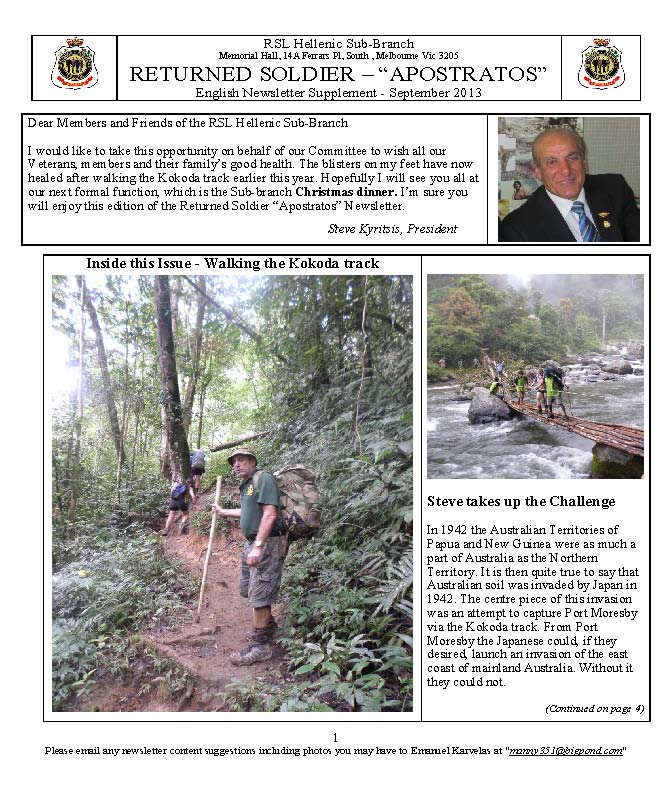
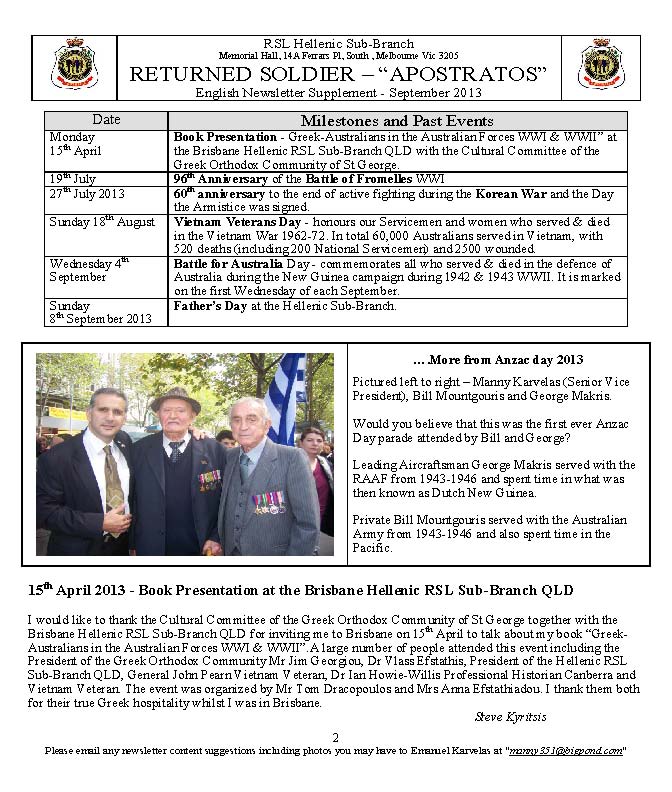
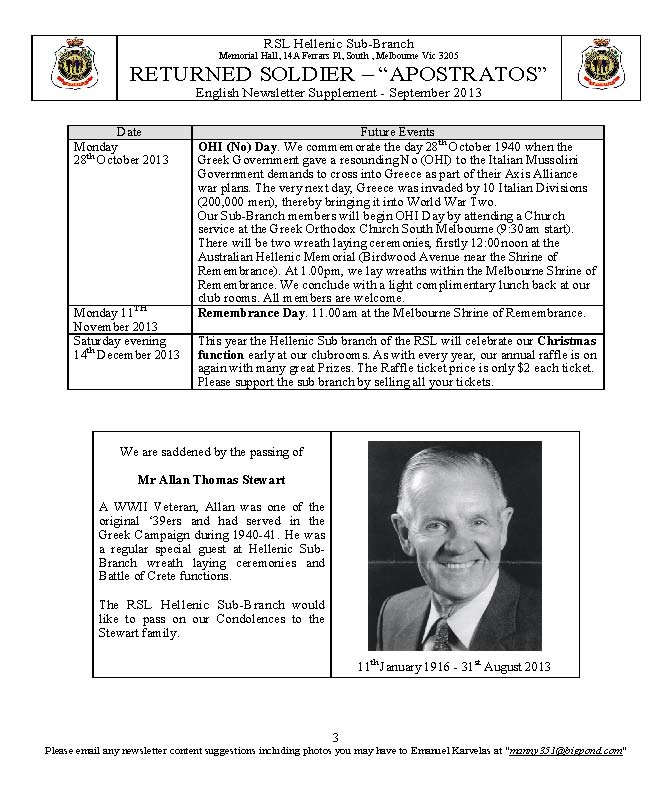
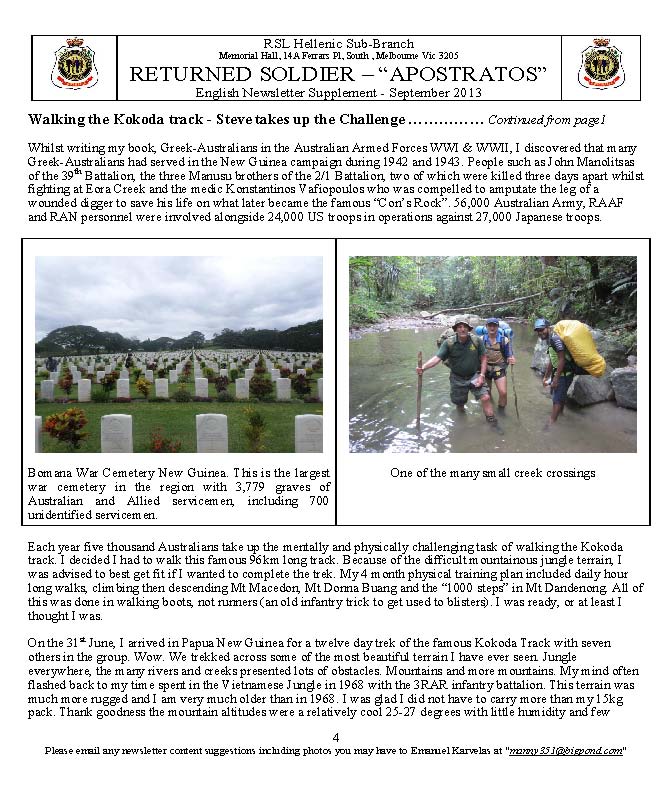
RETURNED SOLDIER RSL Hellenic Sub-Branch Newsletter Sep 2013

RETURNED SOLDIER RSL Hellenic Sub-Branch Newsletter Sep2013

RETURNED SOLDIER RSL Hellenic Sub-Branch Newsletter Sep2013_Page_1

RETURNED SOLDIER RSL Hellenic Sub-Branch Newsletter Sep2013_Page_2

RETURNED SOLDIER RSL Hellenic Sub-Branch Newsletter Sep2013_Page_3

RETURNED SOLDIER RSL Hellenic Sub-Branch Newsletter Sep2013_Page_4

RETURNED SOLDIER RSL Hellenic Sub-Branch Newsletter Sep2013_Page_5

RETURNED SOLDIER RSL Hellenic Sub-Branch Newsletter Sep2013_Page_6

On Foreign Soil: The Search for Fallen Diggers

Source: mikesweet01

Loren Brown, the grand-daughter of Private John McGarrity, who was killed in April 1941 and whose remains have never been found. Photo: Meredith O'Shea

Loren Brown, the grand-daughter of Private John McGarrity, who was killed in April 1941 and whose remains have never been found. Photo: Meredith O’Shea

Taking cover behind a stone wall near a village in northern Greece on April 12, 1941, two Australian soldiers, Private John McGarrity and Lance Corporal Robert Brown, sheltered against a stone wall, after pelting across a frozen field in a hail of German heavy machine gun fire.

”I guess that was close,” McGarrity said, figuring they were safe, despite the enemy’s proximity. ”Let’s make the best of it and have a smoke.”

He rolled his cigarette, but never got to light it.”He gave a soft cry and collapsed to the ground,” Brown later told the Red Cross.

Almost immediately, Brown was hit too. As the two Diggers lay bleeding on the cold earth, a German officer appeared. Brown was told he was now a prisoner of war; medics would see to his mate.

”I had one last look at Private McGarrity,” he said in his Red Cross statement, ”but he was lying very still. I cannot say [if] he was dead or wounded – that was the last time I saw him.”

Brown’s testimony, from a German POW camp in 1943, is the only source of information about McGarrity’s fate: his body, like those of up to 20 other Australian soldiers killed during the same battle, was never recovered.

Now, with mixed emotions, McGarrity’s family, including his 75-year-old daughter, is preparing for the possible discovery of his remains in the grounds of a disused military compound near the tiny Greek village of Vevi.

Greece’s minister for Macedonia and Thrace (the region in which Vevi is located) has told Fairfax the Greek government is prepared to fund a dig at a site near where McGarrity and about 20 others are believed to have been buried anonymously in 1941.

If the dig proves its supporters correct, Vevi could resonate for Australians in the same way as the French town of Fromelles where, in 2009, researchers unearthed the remains of 250 Allied soldiers from World War I, including 124 Australians whose identities have been established by DNA tests.

Like the long campaign to unearth the Pheasant Wood site at Fromelles in northern France, the push to explore the fields around Vevi was initiated by amateur historians who have cross-referenced military documents with local knowledge and hearsay.

Keith Rossi, Victoria’s RSL historian for the past 26 years, is among those who believe an investigation of Vevi is well overdue. ”Look at Fromelles, when they had all that evidence – for years they didn’t do a bloody thing,” says the 91-year-old retired brigadier. ”Why doesn’t someone just go up and have a look?”

Rossi was in Vevi in 1991 to commemorate the 50th anniversary of the Greek campaign when he had an illuminating encounter. ”I was standing there at the wreath-laying ceremony and an elderly chap spoke to me,” Rossi says. ”We got talking about dead soldiers and the 2/8th Battalion, and this local said there were Australian soldiers from the war buried across the road – behind the wall.”

Rossi has talked about his encounter ever since, but it has taken nearly a quarter of a century for the conversation to grow into a concerted campaign to unravel the mystery, and to prove – one way or the other – if the rumours are true.

John McGarrity, the son of an Irish Catholic shipwright, was born in Newcastle, England, in 1905, and emigrated to Australia with an assisted passage in 1928, listed as a labourer.

He worked as a farmhand in Victoria and in manufacturing in Sunshine, where he was a member of the local running club. In 1937, aged 32, he married Norma Plumridge. Daughter Patricia was born in October the same year and Margaret in February 1939.
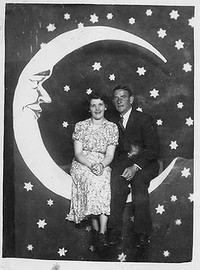
John McGarrity and wife Norma at Luna Park, Melbourne in 1939.

John McGarrity and wife Norma at Luna Park, Melbourne in 1939.

Within months of Margaret’s birth, Australia was at war with Germany. McGarrity enlisted and in April 1940, his 2/8th Infantry Battalion left Melbourne for the Middle East. Having suffered the heaviest casualties of any Australian unit during the first battle for Tobruk in January 1941, it embarked for Greece on March 31.

Twelve days later, McGarrity, a popular soldier ”full of wit and humour”, according to a fellow Digger quoted in his military record, would become one of the first of more than 600 Anzac troops killed in the doomed Greek campaign.

It was an operation that began in the snows of northern Greece, where Australian and New Zealand forces – supported by Greek and British units – took on the might of Hitler’s invading Panzer army, and the SS Leibstandarte, the elite and fanatical Nazi division originally formed as bodyguards for Hitler.

Facing the same troops that had torn through Poland, France and Belgium, the Commonwealth forces were handicapped from the start by inferior armaments, poor communications and virtually no air cover.

On April 12, 1941, the 2/8th Battalion was 16 kilometres south of the border with Yugoslavia, clinging precariously to the eastern side of the Monastir Gap, near Vevi.

For more than 24 hours it repulsed the enemy. The mission was to hold the German advance long enough to allow the withdrawal of Greek forces on the Yugoslav and Albanian borders.

That afternoon, a vital phone line connecting the 2/8th’s front line to Battalion HQ was cut. McGarrity and Lance Corporal Brown volunteered to make the repair.

As they made their way forward, the German attack intensified. The 2/8th’s front line began to disintegrate, overrun by German infantry and fast-moving Panzers.

About 4pm, exposed in open ground, McGarrity and Brown came under heavy machinegun fire. The stone wall they sheltered behind proved useless, with both men shot and Brown taken prisoner of war.

McGarrity was among 28 Australian troops killed at Vevi, many of whom, from the 2/8th and 2/1st Anti Tank Regiment, were never recovered.

He was reported as ”missing in action, presumed killed” and it would not be until 1944 that McGarrity’s wife, Norma, bringing up their two daughters in Kew, would receive confirmation from the army that her husband was dead. They could not tell her what happened to his body.

If Allied prisoners died of their wounds in enemy hands, German burial units would usually identify them from identity discs or paybooks and create written records, simplifying identification of a burial site and the individuals within it years later. No such documentation has ever been found for McGarrity and a number of other members of his battalion who fell at Vevi.

After Greece was liberated in 1944, the work of the Australian War Graves Commission – charged with finding burial sites – was hampered severely in northern Greece by the Greek Civil War. The remains of those who were found were reinterred at Phaleron War Cemetery in Athens. Some 2029 Commonwealth servicemen who died on the mainland in the Greek campaign are buried or commemorated at Phaleron; 596 of the burials are unidentified. Only one member of the 2/8th Battalion killed on April 12, 1941, has a known grave at Phaleron.

Maria Cameron is one of three amateur historians involved in research on the Vevi missing.

The Port Fairy researcher, whose other projects include identifying the remains of World War I Diggers at Fromelles, has cross-referenced Australian and German military records, and believes there is ample evidence to support the proposition that Vevi still holds the remains of Australians killed there.

”If the AWGC did recover bodies in the area after the war, the German records would have given the recovery units a clue. For McGarrity and others, there are no records of that kind at all,” Cameron says.

”The absence of information in the records on John McGarrity and others from the 2/8th show they’re the ones who were never recovered. ”It’s the same as Fromelles, we couldn’t say they were definitely there.”

Melbourne military historian Carl Johnson has also examined the records relating to Vevi, and says that McGarrity qualifies as a leading contender for a soldier who fell at Vevi and is likely to be still there.

”His files were held open to September 1945, which shows the total lack of information the military had about his final resting place,” says Johnson.”In addition to McGarrity I’d say there’s strong evidence for others being contenders for those never recovered from the 2/8th and 2/1st Anti Tank Regiment. There could be up to 20, from both units all told.”

A third researcher, Newcastle schoolteacher Tom Tsamouras, who has been working on identifying the site pointed out in 1991 by Rossi, is also confident about the location. ”What needs to happen is for the Australian government to help the Greek authorities investigate it,” he says.

A spokesperson for Unrecovered War Casualties – Army, the unit of the Australian Defence Force that investigates alleged burial locations of Australian soldiers, said while the department had ”no verifiable evidence”, it was looking into the matter. The Greek government has been more enthusiastic. ”The army have already drafted plans for a preliminary 15-day dig covering an area of two acres at the location, which is near a disused military compound,” says Tsamouras, who, through Greek contacts, brought the matter to the attention of Greece’s Minister for Macedonia and Thrace, Theodoros Karaoglou.

Karaoglou confirmed these details and says he believes the cost of an initial dig would be less than €30,000 ($41,000). He has vowed to authorise the expenditure personally.

Karaoglou says the dig will go ahead once the Greek army, on whose land the site sits, gives permission.Despite the likely imminence of the dig, there has been no communication between the Greek authorities and the Australian Defence Force, according to the UWCA spokesperson.

Nonetheless, members of McGarrity’s family believe the Australian government should get involved.

Daughter Margaret died last year, but Patricia still lives in Melbourne’s eastern suburbs. Pat’s daughter, Loren Brown, says she and her mother support the idea of an investigation taking place – whatever its findings.

”The possibility of an investigation has raised a mix of emotions in the family. Some believe we should leave history as it is, undisturbed. Others feel cautious optimism, to finally know the truth,” says Loren.

”It would be wonderful to give our grandfather a proper grave, titled and recognised. These men gave their young lives for their country. Surely it is Australia’s responsibility to find them and give them the recognition they deserve.”

Margaret’s son, Phillip Wittmer, agrees. ”It’s about honouring his memory,” he says. ”These men made the ultimate sacrifice. We owe them the honour of a proper burial, to dignify their lives, rather than leaving them. At the same time, I’m not getting my hopes up too much. What will be will be.”


INDEPENDENT senator Nick Xenophon demands Papuan trio explanation

Source: TheDailyTelegraph

The West Papuan activists snuck into the Australian consulate, Bali

Three West Papuan activists have been convinced to leave Australia’s consulate in Bali. Source: AAP

INDEPENDENT senator Nick Xenophon says West Papuan activists were “effectively threatened” to leave the Australian consulate in Bali ahead of Prime Minister Tony Abbott’s arrival for the APEC summit.

Senator Xenophon is demanding an immediate explanation for the departure of the three men, after they scaled a wall into the mission early on Sunday morning.

He alerted AAP to the incident after being contacted by human rights groups.

It’s understood Australian officials persuaded the trio – Rofinus Yanggam, Markus Jerewon and Yuvensius Goo – to leave the consulate about 7am local time.

The three men were calling for international journalists to be allowed into the troubled Papuan provinces and for the release of at least 55 political prisoners from Indonesian jails, including Filep Karma, who has been jailed for 15 years in Abepura prison.

The security breach came ahead of Mr Abbott’s arrival for the APEC leaders’ summit on Sunday.

Senator Xenophon called on Australian Foreign Minister Julie Bishop to provide a detailed timeline and explanation of what occurred.

“These three young men were not asking for West Papuan independence from Indonesia. All they were asking for is entirely consistent with the Lombok Treaty of 2006, signed by both Australia and Indonesia,” he said.

“Instead of getting sanctuary and help, the Australian government effectively threatened them and now there is serious concern over the activists’ safety.”

Senator Xenophon’s calls were backed by Professor Clinton Fernandes of the University of NSW, who has written extensively on West Papua and the Australian/Indonesian relationship.

He said when the media circus had moved on after APEC, the trio “may be tried, most certainly they will be beaten, and at some point might be disappeared”.

Mr Yanggam told the Guardian Australia he left the consulate in fear for his life after the consul-general, Brett Farmer, told them the Indonesian police and army would be called.

“They told us: ‘We don’t accept you to stay here. If you stay here for five minutes, I will call the Indonesian army to come and take you out’,” Mr Yanggam said.

“I know that if I am arrested then my life will be over. So better to get out now.”

In a letter addressed to the Australian people, the trio said they wanted Mr Abbott, Japanese Prime Minister Shinzo Abe and US Secretary of State John Kerry to stand up for Papuan rights.

“We want these leaders to persuade the Indonesian government to treat Papuan people better,” the handwritten letter said.

Many of their colleagues had tried to have their voices heard but had ended up in prison, they said.

“These political prisoners committed no crime. They are explicitly committed to non-violence,” the letter said.

“The Indonesian government arrested and jailed them for discussing their political human rights beliefs.”

The trio ended the letter with a plea for help.

“We seek refuge and plead for our safety.”

Australia’s Department of Foreign Affairs and Trade said the trio had left the consulate “voluntarily” at 7am Bali time after delivering a protest letter.

Interim Labor leader Chris Bowen said he had full confidence that the consul-general and Australian officials were acting appropriately.

Chobani appoints five new employees to sales and marketing

Source: foodmag

Chobani appoints five new employees to sales and marketing

Greek yoghurt maker, Chobani Australia has appointed five new employees to its commercial team as the company continues to grow from strength to strength.

The new sales team appointments include Joesph DePetro as National Account Manager – Woolworths, Ivan Cook as National Account Manager Foodservice & independents, George Gabriel as National Account Manager (Coles).

Lyn Radford, general manager of sales and category management for Chobani Australia said that she was thrilled to provide customers with an increased sales presence.

“We’re thrilled with the positive response from our customers, who continue to support us with increased ranging, and in turn we are supporting them with an increased team and dedicated resources across our key channels,” said Radford. “Our movement into the foodservice channel in 2014 is also another exciting development that we are looking forward to.”

Within the marketing department, the two new appointments include Mark Malak who will assume the position of Group Brand Manager and Ann Strode as Field Marketing Manager.

Damian Young, general manager of marketing said that the newly expanded marketing team will have a strong focus on developing below the line campaigns for next year.

“Chobani is going from strength-to-strength, with total brand awareness now over 25 percent nationally, which we’re extremely pleased with considering the short time we have been in the market,” said Young. “Together with our Gippsland range we are now number two yogurt manufacturer in Australia and we’re delighted to be expanding our team to support this growth, with a strong focus next year on broadening our experiential efforts across Australia.”

Bollywood’s golden age in Australia’s Greek community

Source: SBS

  • null

    (Source: Courtesy of Peter Yiannoudes)
  • null

    A poster, partly in Greek, for The Son of India (Source: Courtesy of Peter Yiannoudes)
  • null

    Advertisement in Greek for Mother India (Source: Courtesy of Peter Yiannoudes)
  • null

    (Source: Courtesy of Peter Yiannoudes)
  • null

    A poster, partly in Greek, for The Son of India (Source: Courtesy of Peter Yiannoudes)

(Transcript from World News Australia Radio – click on the audio tab to listen to the item):

As Australia prepares for a visit from one of Bollywood’s biggest actors Shahrukh Khan, Greek-Australian Peter Yiannoudes is looking back at another era of Bollywood cinema in Australia.

Peter Yiannoudes imported films from Greece for Australia’s Greek community and then expanded to include Indian films, mainly Bollywood features which played to packed houses of mainly Greek migrants in the 1950s and 1960s.

He’s now setting up a museum in Melbourne with some of his favourite movie posters from that era.

Peggy Giakoumelos has the story.

(Sound effects of movie):

That’s actors Raj Kumar and Nargis, from the 1957 Hindi epic film Mother India.

The movie tells the tale of a poor rural village woman named Radha, whose family is in debt to a money lender.

With her husband losing his arms in an accident, she struggles to raise her children.

This tale of social injustice and rural hardship resonated with Greeks overseas and in Australia at the time, as did many Indian films.

Peter Yiannoudes says so much so, that at the first screening of Mother India in a Greek cinema in Australia, police had to be called control crowds angry at not being able to get a seat.

“Mother India was the biggest success we ever had outside of the Greek film Golfo. It was 1964 when we released the film in the National Theatre on Bridge Street in Richmond. It was a small theatre about 1000 seats. The theatre was pre-booked nearly two weeks earlier. So on that particular day nearly 5000 people came to see the film. So we called the police to send the people away and allow inside the cinema only the people who had the tickets pre-booked. And the Sun-Herald wrote that never before had that happened in cinema like that.”

Peter Yiannoudes, who migrated to Australia in the 1950s from Cyprus, says his love of cinema was forged from necessity.

Forced to leave school early to make ends meet, he took a job at a local movie house before migrating to Australia and running more than 40 cinemas around the country.

His cinemas mainly catered to Australia’s large community of Greek migrants who like those back home in Greece, were mad for Indian musicals.

After a meeting with an Indian superstar, Peter Yiannoudes decided to introduce Indian films to Australia.

“In 1959 I met the Indian actress Nargis. Nargis was the most popular actress in India and in Greece as well and in Egypt. So she persuaded me to go to India and start showing Indian as well as Greek films. So I went in 1959 and I stayed a couple of weeks in India and then I came to an agreement with two studios there, and in 1961 we brought the first Indian film to Australia, just to see how Greeks can accept this Indian film and really it was a very, very big success.”

Why the appeal?

Dramatic themes of social adversity, poverty, migration, meddling families, and of course everyone’s perennial favourite, love – were themes prominent in the films of both cultures.

Add to this a backdrop of highly choreographed singing and dancing – and the allure of Bollywood became a perfect fit for Greeks looking for some escapism after the country’s brutal civil war.

And while the cross-cultural influence mainly went one way from India to Greece – there was one Greek actress who did manage to break into the Indian market – bleached blonde Aliki Vougiouklaki.

Here she is singing a number influenced by the Bollywood genre.

(Sound of singing)

That’s a song from the Greek film The Lady and the Tramp, released in the late 1960s – reflective of the Bollywood influence on Greek cinema.

The University of Sydney’s Professor of Modern Greek Studies Vrasidas Karalis has written widely on the history of Greek cinema and its Indian influences.

“The connections between Greece and India go back to the historical and especially they can be traced back into the music especially India has influenced Greece in the production of the songs that we have, the most popular Greek songs, are originally of Hindi origin. According to the research of Dimitris Eleftheriotis, He proved that essentially the Greek melodramas of the mid 60s and late 60s were of were essentially modelled along of Hindi musicals and Bollywood musicals.”

Vrasidas Karalis says it was a simple yet successful formula.

“The recipe was so successful that is to say drama, songs, drama songs, and finally in the end you have this huge explosion of both drama and songs that made everyone cry and was really successful.”

Anupam Sharma is an Indian-Australian film-maker and was also one of the judges of Australia’s first Bollywood reality show on SBS TV.

He’s also written a number of research papers about the history of Bollywood cinema.

Anupam Sharma says the connection between Australia and Bollywood goes back to the 1930s when an Australian of Greek and Scottish origin became one of the biggest stars of Indian cinema.

Largely unknown in Australia, Fearless Nadia got around in a mask and hat and with whip in hand, became one of India’s most successful female actors and stuntwomen.

“Blue-eyed blonde from Perth, Mary Evans became the first franchise and lead actress in Bollywood known as Fearless Nadia or the Fearless Hunterwali. SInce then there have been ups and downs, we have had sporadic exchanges, until about 1996 when a major Indian film shot a major song and dance sequence with the Opera House in the background and that kind of ignited interest for Australian locations in Bollywood. And then in 1998 Feroz Khan, India’s Clint Eastwood, decided to script Australia into his film, and shoot here and I believe that was a major milestone. There have been over 300 projects which include feature films, music videos, tv serials, film festivals, seminars, discussions delegations, books and a lot of Australian crew going to India and working in India on Bollywood films lots of specialist crews going there. I call it like an Indian goddess it has many arms.”

Anupam Sharma says Bollywood cinema has been popular in many other countries outside India – mainly in the Middle East, Greece, North Africa and Russia.

But in Australia, except within migrant communities, it’s been slower for the genre to catch on.

The 2011 Australian Census showed there were close to 300,000 Indian-born people living in Australia, up by 200,000 in a decade.

Add to this increased migration from other South Asian countries where Bollywood films are also widely watched, and the popularity of the genre is increasing.

Anupam Sharma says it’s too early to tell how much of an impact Bollywood will eventually have in Australia.

“It’s still to be decided whether they’re getting more into Bollywood cinema as a novelty factor or on a regular basis. And that’s a very important discussion. That’s very important research on its own. A lot of people go and see Bollywood film tongue in cheek with a wine glass, and say ok, we have had a Bollywood experience and they are others who get hooked on to it, something like the Greeks did or the Russians did ages ago. There are others which are getting hooked onto Indian cinema which is more than just Bollywood. So there are different sectors and sub-sections out there. But it is fair to say that Bollywood is certainly the music the dance, the colour is certainly catching on in Australia to good results.”

Peter Yiannoudes is planning to open his Melbourne museum to the general public later this year.

He says it will feature some of his more than 10,000 Greek and Indian movie poster collection as well as other items from his more than 50 years in the film industry.