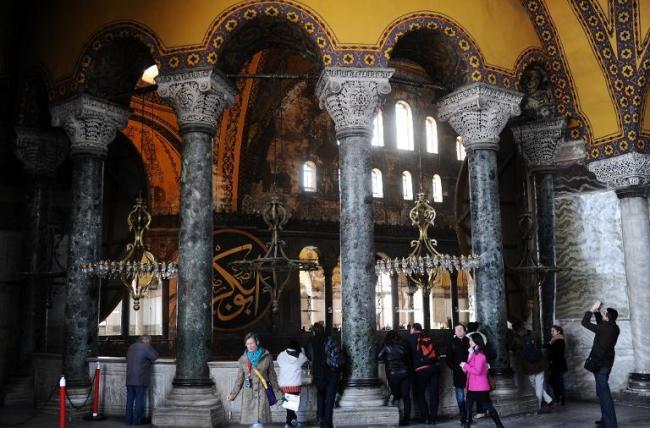
Hagia Sophia, the jewel of the ancient Eastern Church, is lost again

Source: thechristians.com

The Turks plan soon to repossess the iconic Christian cathedral Muslims stole in 1453

Holy Wisdom cathedral: The biggest of many being seized by Islam.

Holy Wisdom cathedral: The biggest of many being seized by Islam.

If Turkey’s Islamic government has its way, the ongoing elimination of Orthodox and Aramaic Christianity from the country will soon be crowned by transforming the Hagia Sophia, the iconic cathedral of eastern Christianity, into a mosque. “We are looking at a sad Hagia Sophia but hopefully we will see it smiling again soon,” Islamist deputy prime minister Bulent Arinc confirmed last week in Istanbul. Hagia Sophia, which means Holy Wisdom, served as the Byzantine capital’s main church from 537 until the Muslim conquest in 1453.

In 1914, Turkey (then the heartland of the Ottoman Empire) had 12.9 million Muslims and 2.75 million Christians. Today its population stands at 75.6 million, including perhaps 150,000 Christians. The inevitable Greek protests on behalf of Hagia Sophia will be easily ignored. The Orthodox Christian population of Istanbul has fallen from more than 500,000 in 1920 to maybe 2,000, according to Mihail Vasiliadis, who edits the community’s newsletter.

Islam seizes Constantinople in 1453: Eastern Christendom’s ancient bulwark gone.

Islam seizes Constantinople in 1453: Eastern Christendom’s ancient bulwark gone.

Many historic churches and monasteries are threatened

Hagia Sophia’s stunning beauty was widely credited a millennium ago for drawing the pagan Russians toward Orthodoxy rather than Roman Catholicism. When the Turks conquered the city, the sultan immediately declared its cathedral a mosque. Thus it remained until 1934, when the secularizing revolutionary Ataturk converted it to a museum with restored Christian frescoes. In 2002, Turkey’s Muslim Justice and Development Party took power and began the process of rededicating it to Islam.

Recently, a Muslim students’ group demanded that the museum become a mosque again. Its application to the government was accompanied by an opinion poll indicating support by 97 percent of Turks. The government has already removed the structure’s legal definition as a museum. Other historic churches and monasteries in Turkey are being pushed through the same process of dechristianization, warns Vasiliadis, adding that “all this government cares about is consolidating the Muslim-led nation-state.”

The dramatic fall of Constantinople to an Islamic army in 1453, opening eastern Europe to subsequent conquest, is recounted in Chapter 6.


Turkey’s Islamic government jails journalists in record numbers

During the First World War, an estimated 1.5 million Armenians were killed through government-instigated mass murders. Anti-Greek pogroms followed, led by the secret police, in part because ethnic Greeks had sided with the western allies in Turkey’s defeat. An Aramaic-speaking pocket of about 500,000 Christians in southeastern Turkey has been entirely eliminated beyond a handful of older individuals. For decades, Christians have been plagued by Islamic murders and assaults, pushing the survivors toward emigration.

Government pressure is not relenting after a decade in power. This fall Turkey rescinded an Ataturk-inspired ban on women wearing traditional headscarves while working for state institutions. With government backing, Turkish media have been forcibly moved into Islam-friendly ownership. At least 70 opposition journalists are in jail, more than any other country in the world.

Religious tensions flare again at Istanbul landmark Hagia Sophia

Perched on the tip of Istanbul’s historic peninsula, Hagia Sophia ― with its spectacular dome, elegant curves and towering minarets ― is an iconic sight for millions of tourists visiting the city each year.

But should it be a mosque, a church or a museum?

The 1,500-year-old complex overlooking the Bosphorus is at the heart of a bitter dispute over its fate after Turkey’s Deputy Prime Minister Bulent Arinc called for it to be converted back into a Muslim place of worship.

People visit the Hagia Sophia, at Sultanahmet in Istanbul. (AFP)

His comments, though not official policy, have added to concerns over what critics say is the government’s increasing efforts to impose Islamic values on secular Turkish society.

And the Byzantine monument could become a political hot potato for Prime Minister Recep Tayyip Erdogan, who is seeking to shore up flagging support among conservative Muslims ahead of elections next year.

Hagia Sophia, which in Greek means “Holy Wisdom,” was built in the sixth century and served as an Orthodox church for centuries ― and as the seat of the Patriarchate of Constantinople ― before being converted to a mosque by the Ottomans in the 1400s.

Mustafa Kemal Ataturk, the founder of the modern Turkish republic, declared it a museum in 1934 and it opened the following year.

“We are looking at a sad Hagia Sophia, but hopefully we will see it smiling again soon,” Arinc said earlier this month.

Greece, whose territory was once part of the Ottoman empire and is often at odds with Turkey over religious issues, reacted furiously, saying such comments offended the religious feelings of millions of Christians.

Mihail Vasiliadis, editor-in-chief of Istanbul-based Greek daily Apoyevmatini, says Hagia Sophia is an important symbol for the entire Orthodox Christian community.

“There are some who have been seeing a sad Hagia Sophia for more than 500 years and they are the ones who want to see it returned as a church,” he told AFP.

Istanbul’s tiny Greek community, which numbers just a few thousand, is already irked over the issue of Ankara’s insistence on reciprocal steps from Athens to improve their religious rights.

“There is no need to add salt to the wound,” Vasiliadis said.

Last month, Greece flatly rejected the idea of reviving two mosques in Athens in return for the reopening of an Orthodox clergy school in Turkey.

Two other churches that also bear the name Hagia Sophia have recently been turned into mosques in Turkey.

There are already an estimated 83,000 mosques across the country ― up around seven percent since Erdogan took office 11 years ago.

Istanbul itself has around 3,000, including the stunning 17th century Blue Mosque just a short distance from Hagia Sophia.

For devout Muslims, however, opening Hagia Sophia for worship is also about paying a homage to Fatih Sultan Mehmet, the Ottoman emperor who turned it into a mosque following the conquest of Constantinople and joined the first prayers in 1453.

The nationalist Islamist Great Union Party (BBP) has staged several demonstrations to seek a repeal of the ban on Muslim prayers in Hagia Sophia, part of a UNESCO World Heritage site encompassing the Byzantine and Ottoman treasures of old Istanbul.

Armed with a land registry certificate dated 1936 that describes the complex as a mosque, BBP deputy leader Bayram Karacan claimed that its conversion into a museum was illegal.

“The fact that Hagia Sophia is a museum has never been accepted by the Turkish people … restoring it as a mosque would be akin to reclaiming sovereignty over it,” Karacan said.

Outside Hagia Sophia, visitors and local residents were divided over the possible conversion of the monument, described by UNESCO as one of the historic quarter’s “unique architectural masterpieces.”

“We have plenty of mosques here and many of them are empty. Who will fill all these mosques if it is converted? Tourists will not come here anymore,” said 52-year-old shop owner Fehmi Simsek.

Emerging from Hagia Sophia, 23-year-old German tourist Tamara said the complex was a testament to Istanbul’s historical and religious importance throughout the centuries.

“Why would you want to change such a remarkable building?”

Historian Ahmet Kuyas of Galatasaray University in Istanbul said the debate could be linked to Turkey’s upcoming elections, with local polls in March, a presidential ballot in August and parliamentary elections in 2015.

Erdogan, nicknamed the “Sultan,” has frequently touched a nerve over his conservative religious policies, including crackdowns on the sale and advertising of alcohol and allowing women working in the public service to wear Islamic headscarves.

“Turning Hagia Sophia into a mosque would be another blow to secular Turkey,” Kuyas said, describing the site as “a symbol of universal peace, peace between nations, between religions.”

Sevda, a veiled Turkish woman, said it would be more accessible to all as a mosque, as currently there was a fee to enter the museum.

“It belongs to us and therefore it should be a mosque,” added her companion Kubra.

A visitor from Spain who gave his name only as Alex said he did not object to a change in the status as long as people could still visit.

“It is a beautiful place that everyone should see,” he added.

Famagusta church ‘re-opens’

Source: incyprus.philenews.com

Hundreds flocked to the mediaeval Ayios Georgios Eksorinos church in occupied Famagusta yesterday, for the first Greek Orthodox service in 56 years, described as the largest gathering of Greek-Cypriot faithful in a service held in the occupied territories since 1974.

Ayios Georgios Eksorinos, situated within the walled city, had been abandoned from 1957 because of an outbreak of inter-communal violence.
Officiating was Constantia-Famagusta Bishop Vasilios, with Mayor Alexis Galanos and the municipal council attending.

In his sermon, Vasilios made extensive reference to a famous work by mediaeval writer Leontios Machairas, who had provided ample evidence of the city’s leading role in the strengthening of the Greek Orthodox Church in Cyprus.

Famagusta, the Bishop said, is referred to as the city ‘of one church for every day’, with 365 temples built within its boundaries.

It was, Vasilios stressed, a financial and commercial hub for the region and became an axis of political developments on the island for a long period, during and beyond mediaeval times.

Given the line of succeeding conquests of Cyprus by Christians of different dogmas, Famagusta is marked with many architectural gems of historic significance, such as St John’s Cathedral where the kings of Cyprus and Jerusalem were crowned, as well as Saint George of the Greeks.

The Famagusta Bishop congratulated organisers for their initiative to reopen the church for the first time since 1957 and said that ‘this is the first but not the last service that will be held’.

On a practical basis and in spite of the political difficulties, Famagusta Municipality and a Church committee have taken up the responsibility of holding services on a regular basis, with voluntary input from locals who want to see another rare piece of cultural heritage preserved and brought to religious life.

Ayios Georgios Eksorinos, an imposing structure of clear architectural influence, was built in the 14th century, during Venetian rule and has been turned into a concert hall.

It’s one of the better preserved churches in the occupied north but does however require extensive conservation work, due to humidity damage to the icons and frescoes.

Greek Parliament approves budget for 2014

Source: Ekathimerini

The Greek Parliament early on Sunday voted a budget for 2014 into law with 153 MPs in the 300-seat House voting in favor despite reservations among many in the coalition to backing further austerity.

The budget was backed by all but one of the coalition’s 154 MPs — Aris Spiliotopoulos of conservative New Democracy was absent — with 142 MPs voting against the bill and one present.

Speaking before the vote, Prime Minister Antonis Samaras said that economic recovery was in sight, referring to a primary surplus predicted in the budget, and accused the leftist opposition SYRIZA of undermining the government’s efforts toward recovery. “For the first time after many years, we will not need to borrow for our needs,” Samaras said, adding that unemployment was set to drop from next year. The premier even quoted the late Nelson Mandela toward the end of his speech, declaring, “It always seems impossible until it’s done.”

Earlier leftist SYRIZA leader Alexis Tsipras said that approving the blueprint was the “road to the continuation of destruction for Greece” and said that it would not be revised by Greece’s troika of foreign lenders but by SYRIZA which would come to power and “get rid of the troika.” He said a writedown to Greece’s debt was the only solution.

In his speech Finance Minister Yannis Stournaras said SYRIZA’s alternative economic plan — which would involve the nationalization of Greek banks — was a “nightmare scenario.”

The budget, which foresees a 0.6 percent growth rate for next year and sets out 5.6 billion euros in spending cuts and projected tax revenue, received the backing of coalition MPs though many indicated, over several days of debate in Parliament, that they would not lend the same support to other reforms in the works, chiefly a controversial unified property tax which is to be submitted in Parliament on Tuesday.

However, the budget still lacks the approval of Greece’s troika of foreign creditors, the European Commission, European Central Bank and International Monetary Fund, who left Athens last month after failing to reach an agreement with government officials on reforms and on a fiscal gap for next year. EC spokesman Simon O’Connor said in a Twitter posting on Saturday night that “a full negotiating team” would return to Athens in January once the government has made further progress in implementing reforms. “Technical discussions” would continue next week,” he said.

Greece’s parliament has approved a tough budget for next year, including further spending cuts of €3.1 billion ($A4.71 billion), aimed at ending the country’s deep recession.

The coalition government, which enjoys a narrow majority in the 300-seat chamber, scraped through with 153 deputies backing the 2014 budget in a late evening vote.

The move came as Greece’s troika of international creditors – the European Union, the European Central Bank and the International Monetary Fund – announced they had delayed until January their next trip to Athens.

Senior auditors from the so-called creditor troika had been expected to return to Athens on Monday to resume an evaluation of pledged Greek reforms.

The EU-ECB-IMF decision means talks on unblocking €1 billion in bailout funds are postponed.

The budget approved by parliament foresees a return to growth for the embattled Greek economy.

But earlier on Saturday a spokesman for EU Economic Affairs Commissioner Olli Rehn said the international negotiating team would not return to Athens until next month “after the authorities have made further progress in implementation” of reforms demanded by Greece’s creditors.

An agreement with the troika is necessary to unblock the €1 billion instalment of financial aid pending since the summer.

Athens has been keen to wrap up the talks before it assumes the rotating EU presidency in January.

The creditors and Athens disagree on the level of a forecasted financing gap for 2014 and the measures that need to be taken to cover it.

Discussions are reportedly stumbling on the issue of a new property tax, debtor property auctions, layoffs in the state sector and the slow pace of privatisation.

The government is under pressure from the troika to loosen a moratorium on home foreclosures but such a measure is likely to be opposed by several ruling party MPs and could risk the cohesion of the conservative-socialist coalition.

Greek Prime Minister Antonis Samaras stressed in parliament that the country had “achieved a number of reforms which many had considered impossible”.

The changes made are “enormous,” he said, citing fresh competitiveness and a drastic reduction in the budget deficit.

Greece’s budget for 2014 has not yet been approved by the troika and could yet be amended in the coming months with new austerity measures that the Greek government has thus far rigorously opposed.

As it stands the budget foresees a 0.6 per cent growth in GDP for next year after six consecutive years of recession. A four per cent contraction is expected this year.

Great day in ‘Annacropolis’: Annapolis Greek community proud of Pantelides’ victory

Source: capitalgazette.com

Annapolis Inauguration

Annapolis Inauguration

Christos P. Panagopoulous, Greece’s ambassador to the United States, speaks at Mayor Mike Pantelides’ inauguration. Pantelides is of Greek and Cypriot heritage.

Pantelides Royal Restaurant

From left, Jimmy Walker, a cook at the Royal Restaurant since 1932; owner Savvas “Sam” Pantelides, the grandfather of Mayor Mike Pantelides; and Fay Mason, a waitress since 1945, look over old menus in a photograph from 1976.

Pantelides Royal Restaurant

Andre “Butch” Pantelides, an uncle of Mayor Mike Pantelides, places a “Closed” sign in the window for the last time as the Royal Restaurant at 23 West St. shut its doors for good in 1976.

Annapolis holds its inauguration of the City Council and new Mayor Mike Pantelides.

Theano Panos Platt, a first-generation U.S. citizen, isn’t a blood relative of the new Annapolis mayor. But when election officials counted the final ballots and the tally favored Mike Pantelides, it was as if her own son had won.

Platt said she cried tears of joy “like at the birth of a child.” Her elation doubled because she knew the occasion came on his saint’s name day.

During Pantelides’ inauguration Monday, supporters provided commentary on Twitter. One hashtag may have said it best: #Annacropolis.

And when the new mayor had to choose where to go after taking the oath, it was only fitting to have a “small gathering of friends and family” — about 50 people — for a meal of lamb, potatoes and Greek pastries at the Saints Constantine and Helen Greek Orthodox Church, the focal point of the local Greek-American community.

After a nail-biter election won by a 30-year-old political newcomer, city residents of Greek extraction are claiming Pantelides’ win as their own.

Many who share Pantelides’ roots said the campaign’s hard work and integrity reflected the new mayor’s Greek and Cypriot lineage.

That he’s two generations removed from the motherland but still wears his heritage proudly is a hopeful sign to them, not just for the city, but for the welfare of Annapolis’ Greek community.

A small band

Just 0.5 percent of Annapolis’ population — about 180 people — claims Greek ancestry, according to 2010 U.S. Census data. Approximately 450 families are congregants at the Greek Orthodox church, which draws from Anne Arundel and Prince George’s counties and the Eastern Shore.

The Census estimated that Anne Arundel County has 5,000 residents of Greek extraction, accounting for a little under 1 percent of the population.

The community is tied by family, faith and a common language, often still spoken in bits and pieces at home.

They’re a close-knit ethnic and religious group that still sends their children to Greek Orthodox dances, youth socials and basketball tournaments in the hope they’ll find lifelong friendships and romantic attachments there.

Harriet Adam, whose parents and grandparents are Greek, said all the Greek kids who grew up with her in Annapolis thought they were “cousins,” even if they weren’t.

Much of the Greek community came to Annapolis in the ’30s and ’40s. Relatives or friends already in the United States sponsored immigrants.

They planted roots in communities where they had connections, opening businesses and eventually raising enough funds to build a Greek Orthodox church downtown on Constitution Avenue.

At one point, naturalized Greek-Americans operated close to two dozen restaurants in Annapolis.

Pantelides’ grandfather, Savvas “Sam” Pantelides, opened the Royal Restaurant on West Street, where the BB&T Bank is today, after immigrating from Cyprus in the 1940s.

A newspaper ad for the restaurant showcased Sam’s wit. In 260 words, he described his philosophy of life, which he believed was full of contradictions and misunderstandings:

“If he is in politics, he is a grafter and a crook; if he is out of politics, you can’t place him because he is an undesirable citizen … Life is a funny road, but we all like to travel it just the same.”

Greek brothers

Pantelides filled last week’s inauguration with signs of his Greek heritage, making it one of the most unusual ceremonies in memory.

His priest, the Rev. Kosmas Karavellas, gave the invocation. Two prominent dignitaries — Greece’s ambassador to the United States and the consul for the Cypriot embassy — delivered speeches.

It was an appropriate epilogue for a campaign that drew donations from friends and extended family of Greek heritage throughout the region. When Pantelides won, Karavellas said, Greek parishes nationwide contacted his church with congratulations.

A line in the new mayor’s speech — a pledge to make Annapolis again the “Athens of the East” — went viral online.

The pride transcended party lines. U.S. Rep. John Sarbanes, a Baltimore County Democrat whose district includes Annapolis, supported incumbent Mayor Josh Cohen in the election. But he called Pantelides the night before the election to say he looked forward to working with him if he won.

On Monday, Sarbanes was no longer a partisan. He was Pantelides’ Greek brother.

“With this audience, I probably would have preferred to be honored as Ioannis Sarbanes,” he said, using the Greek version of his name.

A long tradition

In taking public office, Pantelides is following a tradition old enough to make Annapolis look newfangled.

“Greece is recognized as the birthplace of democracy. The philosophers that came from that country — there’s so much that started there,” said Steve Samaras, an Annapolis jeweler who is of Greek heritage.

“Even to this day, we feel that sense of pride, especially children that have been raised in Greek households,” Samaras said.

The word “democracy” comes from the Greek word demos, which means “commoners,” and kratos, meaning “rule.”

Platt said Greek culture and politics go hand-in-hand because of the emphasis on public service and viewing one’s community as a family.

“You can’t walk into a Greek restaurant or a cafe or a village somewhere and not hear the rumblings of the politics going on, whether it’s in the next town over or the next country. Politics has always been an engaging topic,” she said.

In his new office at City Hall last week, Pantelides looked around at the blank walls, considering how to decorate. The coffee table had a single book in the center — one on Cyprus.

“I should Greek the place up a little bit,” he said. “We’ll Greek it up somehow.”

He can’t speak the language fluently, but understands some of it. And he has picked up other cultural traits.

“If there’s a room full of Greek people, you have to talk over another person to get your point heard,” Pantelides said. “But I don’t think it’s come up in department meetings yet.”

Pantelides isn’t Annapolis’ first Greek-American chief executive. John Apostol was mayor from 1973 to 1981.

Apostol’s campaign was another exciting time for the local Greek community, remembered Samaras, who owns Zachary’s Jewelers at the foot of Main Street.

His grandparents, who were Greek immigrants, were “worker bees” for the campaign, along with Pantelides’ father, John Pantelides. They held signs and made phone calls.

“I felt a very strong sense of my roots,” Samaras said.

Slovenian and Greek troubles to dominate Europgroup talks

Source: irishtimes.com

Fears Ljubljana will need euro zone’s sixth bailout, while Athens may miss €2b surplus target

Slovenian prime minister Alenka Bratusek, whose government has pledged to avoid seeking official help from EU and IMF. Photograph: EPA/Andrius Ufartas

Slovenian prime minister Alenka Bratusek, whose government has pledged to avoid seeking official help from EU and IMF. Photograph: EPA/Andrius Ufartas in Brussels.

Euro zone finance ministers meet today in Brussels amid mounting fears about the Slovenian economy, and continuing difficulties with the Greek bailout as the troika once again postponed a visit of its full review team to Athens.

While significant progress was made on new bank resolution rules at a meeting on Friday in Berlin between German finance minister Wolfgang Schäuble and a select group of European finance ministers, ministers will today focus on the fiscal situation in specific euro zone countries, before turning to banking union at tomorrow’s meeting of all 28 European finance ministers.


Potential sixth bailout

Ministers will be updated by the Slovenian finance minister on the financial situation of the former Yugoslav state, which is battling to avoid becoming the sixth euro zone country to seek a bailout.

The small country of two million people has been badly affected by falling exports, weak consumer spending and problem loans in its banking system. Results of stress tests on the country’s banks, which are predominantly state-owned, are due later this week.

While the government has pledged to inject €1.2 billion into its banking sector, it is expected that the banks will need about €5 billion. However, a senior eurogroup official stressed that euro zone officials believe such a figure “would be manageable” from Slovenia’s own resources.

The government of prime minister Alenka Bratusek, which has pledged to avoid seeking official help from EU and International Monetary Fund lenders, survived a confidence vote in the Slovenian parliament last month.

Meanwhile, a European Commission spokesman confirmed that talks between Greek officials and the troika of international lenders will now not fully resume until January, though a reduced team will travel to Athens on Wednesday to resume technical discussions, amid continuing disagreements about the scale of adjustments needed for the Greek programme.

While the Greek parliament passed its 2014 budget over the weekend, the eurogroup has yet to sign off on the latest instalment of Greece’s rescue package, amid disagreements over the scale of Greece’s fiscal gap for 2014.


Austerity intolerance

Greece’s international lenders believe the country may miss its budget surplus target by €2 billion unless it finds new savings. This figure is disputed by Athens, which is opposed to imposing further austerity on a country that has already undergone severe economic retrenchment.

Greece, which assumes the rotating presidency of the Council of the European Union in January, is approaching the end of its sixth year of recession. It has the highest unemployment rate in the euro zone, at over 27 per cent.

The European Commission forecasts the country’s debt to gross domestic product ratio will peak at 176 per cent this year. While the two Greek bailouts, worth about €240 billion, are due to end in a year’s time, there are concerns that the country may need further funds, amid reports of a funding gap of up to €10 billion in its rescue programme.

Το ίδρυμα του Ωνάση σκόνταψε σε… ξένα χέρια

Πώς ο Σταύρος Νιάρχος κερδίζει (μετά θάνατον) τον Αριστοτέλη Ωνάση; Την ώρα που το Ιδρυμα Νιάρχου μεγαλουργεί, το Ιδρυμα Ωνάση μοιάζει, λένε, με κερδοσκοπικό όχημα στα χέρια του….

δρα Αντώνη Παπαδημητρίου. «Πόσο έξαλλος θα γινόταν άραγε ο Αριστοτέλης Ωνάσης, αν μπορούσε να δει πως το όνομά του πέρασε πίσω από αυτό του παλιού του αντιπάλου, του Νιάρχου, στη σημερινή Ελλάδα της φτώχειας;» Με αυτά τα λόγια αντιδρούν παλαιοί, παραγκωνισμένοι σήμερα συνεργάτες του στο γεγονός ότι το ίδρυμα «Σταύρος Νιάρχος» πρωταγωνιστεί στην προσπάθεια ανάτασης της χώρας με δωρεές εκατοντάδων εκατομμυρίων ευρώ στην ελληνική κοινωνία.

Την ίδια ώρα το κοινωφελές ίδρυμα «Αλέξανδρος Σ. Ωνάσης» υπό την καθοδήγηση του προέδρου του (και ταμία) δρα Αντώνη Παπαδημητρίου αναλίσκεται σε αμφίβολης αξίας δράσεις. Οπως, για παράδειγμα, μελέτες για την αναμόρφωση της Πανεπιστημίου, βραβεύσεις, υποτροφίες ολίγων και τη στήριξη δικών του δραστηριοτήτων, σαν την (υπόσχεση για) επένδυση 30.000.000 ευρώ στο Ελληνικό Επενδυτικό Ταμείο, που αποτελεί έναν ξεκάθαρα κερδοσκοπικό μηχανισμό γερμανικής έμπνευσης. Ακόμα κι αν πραγματοποιεί άλλες δράσεις, είναι «άγνωστη η έκτασή τους, εξαιτίας της παροιμιώδους αδιαφάνειας με την οποία διοικείται το ίδρυμα» σχολιάζουν παράγοντες που ανήκουν στο κύκλο των ελληνικών ευαγών ιδρυμάτων.

Την ίδια ώρα, πληθαίνουν τα δημοσιεύματα που προσάπτουν στο Ιδρυμα Ωνάση (την παρακαταθήκη που άφησε στη χώρα του ο χρυσός αυτός Ελληνας) δουλειές με Τούρκους, Σύριους και παράγοντες που συνδέονται με ιρανικά συμφέροντα. Οπως και για τη φορολογική του συνεισφορά στη χώρα, καθώς χρησιμοποιεί ως έδρα το Vaduz του Liechtenstein. «Οπου υπάρχει καπνός υπάρχει και φωτιά» λένε οι επαΐοντες συμπληρώνοντας πως αν και δύσκολα μπορεί κανείς να πει ότι υπάρχει κάτι το μεμπτό στις πράξεις της διοίκησης, αυτού του βεληνεκούς τα ιδρύματα πρέπει να αποτελούν φάρους κοινωνικής ευσυνειδησίας και ηθικής λειτουργίας».

Στον αντίποδα, το Ιδρυμα Νιάρχου ρίχνει εκατοντάδες εκατομμύρια ευρώ για να πολεμήσει τη φτώχεια, αλλά και να καταστήσει την Αθήνα πολιτιστικό κέντρο της Μεσογείου με το Κέντρο Πολιτισμού – Ιδρυμα Σταύρος Νιάρχος στο Φάληρο, όπου το 24ωρης λειτουργίας εργοτάξιο θυμίζει πολύβουο μελίσσι. Ο συνολικός προϋπολογισμός του έργου είναι 566.000.000 ευρώ και χρηματοδοτείται εξ ολοκλήρου από το Ιδρυμα Νιάρχου, ενώ εκτιμάται ότι θα έχει ολοκληρωθεί τον Νοέμβριο του 2015.

Πέραν όμως αυτών των ποσών, από το 1996 μέχρι σήμερα το ίδρυμα «Σταύρος Νιάρχος» έχει εγκρίνει συνολικά τη διάθεση 1 δισεκατομμυρίου ευρώ μέσω 2.400 δωρεών σε μη κερδοσκοπικούς οργανισμούς σε 109 κράτη ανά τον κόσμο. Από το σύνολο των δωρεών του ιδρύματος άνω του 80% του συνολικού ποσού έχει διατεθεί σε οργανισμούς και πρωτοβουλίες στην Ελλάδα. Τελευταίο δείγμα γραφής, η πρωτοβουλία των 100.000.000 ευρώ που αποσκοπεί κυρίως στο να συμβάλει στην ανακούφιση των δυσμενών συνεπειών από την οικονομική κρίση βοηθώντας εκείνους που έχουν περισσότερη ανάγκη να αντιμετωπίσουν τις δύσκολες αυτές συγκυρίες με τον λιγότερο επώδυνο τρόπο.

Την ώρα όμως που αυτά πράττει το ίδρυμα του Σταύρου Νιάρχου, οι άνθρωποι που ανέλαβαν τη διοίκηση του Ιδρύματος Ωνάση, του ιστορικά εμβληματικού ανταγωνιστή του, «πάγωσαν» τις πρωτοβουλίες τους. Ας δούμε τι γράφει η επίσημη ανακοίνωση του ίδρύματος:
«Το Διοικητικό Συμβούλιο του Ιδρύματος Ωνάση κατά τη συνεδρίασή του τον Μάιο του 2010 αποφάσισε τη διακοπή του προγράμματος χορηγιών σε φορείς στην Ελλάδα και το εξωτερικό. Το Διοικητικό Συμβούλιο του Ιδρύματος προχώρησε στην ανακατανομή των διαθέσιμων, σύμφωνα με τη διαθήκη του Αριστοτέλη Ωνάση, ποσών αποκλειστικά για τα δικά του προγράμματα: υποτροφίες σε Ελληνες, υποτροφίες σε αλλοδαπούς για ελληνικές σπουδές, Βραβεία Ωνάση, το Θυγατρικό Ιδρυμα στη Νέα Υόρκη με τις ετήσιες εκθέσεις του και το Πρόγραμμα Επισκεπτών Καθηγητών κλπ., τα οποία συνεχίζονται κανονικά. Η Στέγη Γραμμάτων και Τεχνών του Ιδρύματος Ωνάση, η οποία ξεκίνησε τη λειτουργία της το φθινόπωρο του 2010, θα απορροφήσει μεγάλο μέρος των πόρων του Ιδρύματος».
Τρία χρόνια λοιπόν ύστερα από αυτή την απόφαση αίσθηση προκάλεσαν δύο αποφάσεις του προέδρου του Ιδρύματος Ωνάση, δρα Αντώνη Παπαδημητρίου, καθώς ήρθαν με διαφορά λίγων ημερών. Είχε βέβαια προηγηθεί προ έτους και η επένδυση δεκάδων εκατομμυρίων δολαρίων στη δημόσια εγγραφή ναυτιλιακής στη Wall Street.

Τώρα (τέλη Νοεμβρίου) το Ιδρυμα Ωνάση ανακοίνωσε ότι θα επενδύσει 30.000.000 ευρώ στο Ελληνικό Επενδυτικό Ταμείο μαζί με τη γερμανική κρατική τράπεζα KfW και (ίσως) με την Ευρωπαϊκή Τράπεζα Επενδύσεων. Το ταμείο αυτό όμως δεν είναι κοινωφελές. Θα διέπεται από τους νόμους του Δουκάτου του Λουξεμβούργου και θα έχει ως καταστατικό στόχο την εξασφάλιση κέρδους για της επενδυτές του. Εμφανίζεται έτσι φειδωλό και με στόχο το κέρδος, σε μια προσπάθεια που θα μπορούσε να στηρίξει την απασχόληση.

Την ίδια ώρα βγάζει από τα ταμεία του 100.000.000 δολάρια για να αγοράσει τέσσερα πλοία του κλυδωνιζόμενου στόλου του πλουσιότερου Τούρκου επιχειρηματία, του Mehmet Emin Karamehmet. Παράγοντες της Ακτής Μιαούλη, που δεν θεωρούν «εφοπλιστή» τον Αντώνη Παπαδημητρίου και εκτιμούν ότι έχει ως προτεραιότητα τη δημόσια εικόνα του και τις σχέσεις του με την εκάστοτε «αφρόκρεμα», σχολιάζουν πως δεν τα πήρε καν σε τιμή ευκαιρίας, ενώ απορούν με την κίνηση, καθώς δεν αφορά δεξαμενόπλοια -στα οποία παραδοσιακά το όνομα Ωνάση δραστηριοποιείται- αλλά φορτηγά.
«Είναι μια σπεκουλαδόρικη κίνηση, όπως αυτές που κάνουν πολλοί άλλοι, οι οποίοι όμως δεν είναι επιφορτισμένοι με την παραγωγή κοινωνικού έργου» αναφέρουν. Τα αγόρασε δε «σίγουρα όχι σε τιμές ευκαιρίας, όπως θα περίμενε κανείς, εξαιτίας των πιέσεων που δέχεται η ναυτιλιακή του Τούρκου» αναφέρουν ναυλομεσίτες. «Είναι σαν να τον ξελασπώνουν» αναφέρει λιγότερο επιεικής εφοπλιστής. Η ναυτιλιακή του Ιδρύματος Ωνάση, η Olympic Shipping, έχει στόλο με 13 τάνκερ.

Για τη δε Στέγη Γραμμάτων και Τεχνών που λειτουργεί στη Συγγρού το ίδρυμα, πολλοί είναι εκείνοι που εκτιμούν ότι «περίσσευε στην Αθήνα του Μεγάρου Μουσικής και του Κέντρου Πολιτισμού Σταύρος Νιάρχος, που είχε προαναγγελθεί». «Είναι σαν ο δόκτωρ Αντώνης Παπαδημητρίου να ήθελε μια δικιά του σκηνή» λένε κάποιοι.

Η κριτική στο management της δεύτερης γενιάς των συνεργατών του Αριστοτέλη Ωνάση δεν είναι καινούργια. Πολλά έχουν γραφτεί και ακόμα περισσότερα ψιθυρίζονται. Μεταξύ αυτών, και η ηθική ένσταση ότι έχουν μετατρέψει ένα από τα εμβληματικά ελληνικά ιδρύματα σε «οικογενειακή υπόθεση» και πως έχουν de facto αποκλείσει από τη διοίκησή του τους νόμιμους κληρονόμους και συγκεκριμένα την Αθηνά Ωνάση. Δεν είναι λίγοι άλλωστε εκείνοι που αποδίδουν την αποξένωσή της από τη χώρα στη συμπεριφορά του ιδρύματος.
Η εμπλοκή σε υπόθεση με λαθραίο πετρελαίο

Πλήγμα αποτέλεσε για το προφίλ του ιδρύματος και η προ μηνών εμπλοκή του σε υπόθεση λαθρεμπορίας ιρανικού πετρελαίου. Συγκεκριμένα, ναυτιλιακή ελεγχόμενη από το ίδρυμα πούλησε δεξαμενόπλοιό της σε εταιρικό όχημα συμφερόντων του Δημήτρη Καμπή, ο οποίος κατηγορείται από την Ουάσινγκτον για παράβαση των διεθνών κυρώσεων επί του Ιράν και ειδικότερα ότι λειτουργεί ως βιτρίνα για να μπορεί να εξάγει πετρέλαιο η Τεχεράνη.

Ο Καμπής αγόρασε τα δεξαμενόπλοιά του από διάφορους ιδιοκτήτες, πλην όμως σε μάλλον υψηλές τιμές, σύμφωνα με πηγές της αγοράς. Ενα από αυτά το αγόρασε από το Ιδρυμα Ωνάση. Για να γίνει αντιληπτή η βαρύτητα της υπόθεσης αρκεί να αναφερθεί πως οι business Καμπή με το Ιράν θεωρούνται από πολλούς πως αποτελούν τον πραγματικό λόγο που παρέμεινε προφυλακισμένος στον Κορυδαλλό από το καλοκαίρι μέχρι την περασμένη Τρίτη ο Βίκτωρ Ρέστης. Αλλες πηγές θυμίζουν πως προ διετίας είχε πουλήσει πλοία του σε Σύριους επιχειρηματίες. Τίποτα το παράνομο, αλλά σίγουρα όχι κάτι που ταιριάζει με την εικόνα του «προστάτη των γραμμάτων και των τεχνών».

Με έδρα το Liechtenstein
Για να γίνει αντιληπτό το πώς δουλεύει το Ιδρυμα Ωνάση αξίζει να αναφερθεί πως το κοινωφελές ίδρυμα «Αλέξανδρος Σ. Ωνάσης» συστάθηκε τον Δεκέμβριο του 1975, σύμφωνα με την επιθυμία του Αριστοτέλη Ωνάση και με έδρα του το Vaduz του Liechtenstein. «Ο πολιτισμός, η παιδεία, το περιβάλλον, η υγεία και η κοινωνική αλληλεγγύη» αναφέρονται ως οι βασικές προτεραιότητες του κοινωφελούς ιδρύματος.

Ολα τα έργα του χρηματοδοτούνται αποκλειστικά από τα κέρδη ενός αυτοτελούς και θεσμικά ανεξάρτητου ιδρύματος με επιχειρηματικό χαρακτήρα, με το όνομα «Ιδρυμα Αλέξανδρος Σ. Ωνάσης», με έδρα επίσης το Vaduz του Liechtenstein, το οποίο δραστηριοποιείται κυρίως στους τομείς της ναυτιλίας και των επενδύσεων σε ακίνητη περιουσία και χρηματοοικονομικά προϊόντα. Το 50% των εσόδων του με βάση το καταστατικό πρέπει να πηγαίνει σε κοινωφελείς δραστηριότητες.

Οσο όμως και να ψάξει κανείς για ισολογισμό δεν θα βρει τίποτα. Ούτε απολογισμό κοινωνικής ευθύνης. Η μόνη εμφανής συμβολή στην καθημερινότητα των Ελλήνων είναι αυτή του Ωνάσειου Καρδιοχειρουργικού Κέντρου, που παραδόθηκε το 1992 και κόστισε 75.000.000 δολάρια. Αυτό ωστόσο έγινε από την προηγούμενη διοίκηση και όχι από αυτήν του δρα Αντώνη Παπαδημητρίου.

Το θέμα αποκτά διαστάσεις, καθώς οι καιροί που ζουν οι Ελληνες είναι τόσο δύσκολοι ώστε να χρειάζεται κάθε δυνατή βοήθεια προς την κοινωνία. «Οχι βραβεύσεις, πολιτιστικές εκδηλώσεις και κινήσεις αυτοπροβολής, αλλά έργα από τα οποία να μπορούν να ζεσταθούν, να τραφούν να στεγαστούν και να αναρρώσουν Ελληνες» αναφέρουν κύκλοι που παρακολουθούν τη φιλανθρωπική δραστηριότητα στην Ελλάδα εν γένει.


Greeks returning to Istanbul after half a century

Source: ANSAmed

Many of them are opening their own businesses

For the first time in the last 50 years the Greek population of Istanbul is rising as they are no longer leaving their city but staying, as Independent Balkan News Agency journalist Manolis Kostidis reports.

Influenced by the economic crisis plaguing Greece, Greeks are leaving their homes and moving to Istanbul; a city with 15 million population that has experienced rapid economic growth lately.

Many of them are opening their own businesses or work for companies in an attempt to escape the scourge of unemployment and recession in Greece.

Meanwhile, dozens of students are studying at Turkish universities. Some learn the Turkish language while others attend English-speaking courses in private universities.

Rough estimates indicate 800 to 1,000 Greeks have already moved to Istanbul, raising the Greek community population that had fallen to 2,500 recently from 150,000 in 1923.

This incoming flow gives hope to the Ecumenical Patriarchate that has for many years observed the Greek population of Istanbul drop rapidly.

Greek presence in Istanbul and economic relations have boosted also airline traffic between Greece and Turkey.

Eight return flights are scheduled daily on the Athens-Istanbul route by Turkish Airlines and Aegean Airlines. Meanwhile, 38 Greeks are currently employed by Turkish Airlines as Greek pilots left their jobs in Greece and now work for companies in the neighboring country.

There are also flights from Thessaloniki to Istanbul, two times a day as well as daily bus routes from Athens to Istanbul.

Kazarian says Greece needs clean numbers to attract investors

Source: Ekathimerini

Paul Kazarian, the US investor buying up Greek government bonds, calls the European Union’s accounting “completely irrational” and wants to help finance an alternative to allow Greece to return to the debt markets.

The founder of Japonica Partners & Co. said in a December 3 interview in Athens that applying International Public Sector Accounting Standards would give bond markets the same kind of audited financial statements that equity investors are accustomed to. Kazarian, who started a tender offer for the Greek securities in June, said the EU method of measuring member states’ public finances overstates the level of indebtedness.

“If you really want to be back in the capital markets and soon, you have to deliver, you have to show some early wins,” Kazarian, 58, said. “Show your debt number, give access to it and verify it, and then have the dialogue: ‘So which number is right?’ Is it a legal definition that has absolutely no economic rationality to it, or is the world-class standard the right debt number?”

Greece triggered the European sovereign debt crisis in 2009 when an incoming government said its predecessor had hidden the true size of a budget deficit that had spiraled to more than five times the euro area’s allowed limit. The country received an international bailout, and its debt ratio is projected to be 176 percent of gross domestic product this year even after completing the world’s biggest sovereign debt restructuring.

For Kazarian, who won’t say exactly how many of the restructured Greek bonds Japonica holds after its tender for as much as 4 billion euros ($5.5 billion) of the securities expired in September, applying accounting practices used in the corporate world would give a fair value for Greece’s 2013 debt. He puts that ratio at less than 100 percent of GDP.

A European Commission report in March on the suitability of IPSAS for member states noted the “essential incoherence” in the EU’S current framework, where member states’ accounts mostly record cash flows, which then are converted to generate the data used by the EU’s statistics agencies to monitor budgets. This approach “is a legal hodge podge” that “no one would aspire to adopt,” according to Kazarian.

“For the world to look at a sovereign credit that is in transition with a past that’s colored on accounting, to put it generously, they need to show something different,” he said. “They need to show that they’re world class, that they have an outside audit. What company would you ever buy that doesn’t have audited financial statements? You would never do it.”

Greek 10-year bonds, which are priced at about two-thirds of their face value, yield 8.75 percent, down from a post- restructuring high of 31 percent in May 2012. The yield, which has crept up 78 basis points since Nov. 7 as Greece and its creditors have been deadlocked over conditions for keeping its bailout loans flowing, should come down to less than 5 percent next year, according to Kazarian.

If Greece and its creditors break through their impasse, euro-area governments must still find ways to bring down the country’s debt trajectory. The focus on accounting standards is unlikely to shake the International Monetary Fund from its stance that Greece needs additional debt relief to lower its debt to 124 percent of GDP by 2020, one of the fund’s conditions for continuing to contribute to the bailout program, according to Gabriel Sterne, an economist at Exotix Ltd. in London.

Kazarian’s bet

“Kazarian’s taken a view on Greece, and he’s putting his money where his mouth is and his mouth where his money is,” Sterne said. “The big problem for Greece is that not enough of this portfolio flows and hedge-fund interest is going into physical capital. What Greece needs is not so much hedge funds, although it doesn’t do any harm, but what they really need is venture capitalists.”

Kazarian started Providence, Rhode Island-based Japonica after leaving Goldman Sachs Group Inc. Japonica gained prominence in the U.S. during the late 1980s and early 1990s for deals including an attempted buyout of food company Borden Inc., a failed $1.6 billion takeover of railroad operator CNW Corp. and the purchase of appliance maker Sunbeam-Oster Co.

Kazarian said his intention when he first came to Greece in April 2012 was to invest in companies, not government bonds. Now that Japonica has acquired as many bonds as it wants, the firm would consider reinvesting profits from these into Greek companies, he said.

Japonica has taken out full-page advertisements in newspapers including the Financial Times, New York Times and Greece’s Kathimerini describing Greece as an A+ credit given its fiscal consolidation since the start of the crisis and calling on the country to become the first in the euro area to adopt IPSAS accounting. He has offered to fund the start up costs to get Greece to report financial statements under the IPSAS definition next year.

Kazarian sees Greece reaching a debt estimate by the middle of next year, with audited financial statements signed by two firms achievable by the end of June 2016.

“If we see something that should change, we do our best to change it,” he said. “We discuss it rigorously internally, we come to conclusions and we make our decisions. This is not a shallow analysis. We’re very careful.” [Bloomberg]

Fashion Designer John Varvatos attends the opening of his new Toronto store and the launch of John Varvatos

Source: TheStar.com

Rock sensibility lies behind John Varvatos’s work: Beker

John Varvatos’s passion for music has driven him from the get-go — a constant inspiration since his early days growing up in Detroit.

John Varvatos is a Greek American men’s sportswear designer who cut his teeth at Ralph Lauren and Calvin Klein. These “chukkas” in trendy oxblood suede with tire treads, are from his pre-fall Star USA collection, the lower priced line, landing at $225 at Harry Rosen. Snag now to wear late summer with denim, chino or corduroy.

Fashion Designer John Varvatos attends the opening of his new Toronto store and the launch of John Varvatos: Rock in Fashion book at the Yorkdale store.

George Pimentel / GETTY IMAGES

Fashion Designer John Varvatos attends the opening of his new Toronto store and the launch of John Varvatos: Rock in Fashion book at the Yorkdale store.

If ever there was a brilliant study in the role attitude plays in style, “Rock in Fashion,” the hip new coffee table book by designer John Varvatos, is it.

Based on a spectacular collection of photographs from rock’s golden age, with an emphasis on the ’70s, this meaty array of imagery is a celebration of the kind of cool many of us aspired to in our youth — still aspire to, perhaps — at a time when music was fresh and raw and not digitally downloadable.

As one of the most successful and arguably best menswear designers in America, John Varvatos’s passion for music has driven him from the get-go — a constant inspiration since his early days growing up in Detroit.

And though he pursued a career in fashion, first with Ralph Lauren, and then with Calvin Klein, launching his own label in 2000, Varvatos’s rock sensibility not only spills over into his edgy designs, but informs his chic style emporiums.

The best examples are his New York Bowery boutique, home of the former legendary CBGB’s club, and now his newest store, at Yorkdale. This is his first shop outside the U.S., and Varvatos says he chose Toronto because it feels more international than any other North American city, next to New York. He’s also always had a penchant for the music scene here, and even dated a Torontonian for three years in his college days.

John Varvatos paid a visit to Toronto recently, and I caught up with him at his new Yorkdale store to talk about music, shopping, and how to achieve rock star style.

What was the first band you fell in love with?

Probably the Rolling Stones. Only because I saw them on the Ed Sullivan show. I was 7 or 8, and my sister was a year older, and she liked The Beatles. I liked them, but they didn’t connect with me as much. When I look back, I think it was because The Stones seemed a little more rough around the edges, a little more bad boy. Something about the music connected with me. It wasn’t as sweet. And then I heard The Kinks on the radio with “You Really Got Me” and I’d never heard anything like that electric guitar. It kind of put a lightning bolt through me. And then it was The Who, with “I Can See For Miles.”

What about the role of image in all this? That’s something that really did escalate with the advent of music television. How did you first become aware of rock imagery?

Our first source for that imagery was magazines. That’s all we had back then. There was a music magazine out of Detroit called Creem, and from the time I was 12 I was addicted to it. Every month when it came out I’d sit on the floor of this record store, Sam’s Jams, and I would study every page, always asking Sam to tell me about the various musicians. And then I’d follow the British magazines, like New Musical Express, and those images were my insights into who these musicians were. Those photographers were capturing something in the moment, something intriguing. Later it moved on to music television, where it became alive. It was the first time that you could really see something move. And those images were on my bedroom walls. Those musicians were my icons: I wanted to look like them, to be them.

Yeah, didn’t we all! But in terms of you wanting to be a designer… You didn’t know at the time that you’d one day want to be dressing these rock stars!

No… I started working in a men’s store when I was about 15 years old. I did that so I could get a discount and buy clothes! My parents had no money, and I did know that a few of things I did get, that had a little edge to them, really did work with the girls, for sure. I’d get a great reaction! And I was a shy kid. So I thought, “Well, if that works … then I need more of that!” ’Cause attention was not going to come because my personality was so outgoing! So I became one of the coolest dressed kids at school ’cause I spent every penny I earned on the clothes. Other than working at men’s stores, I never really thought about getting into fashion. But then I got a job at Ralph Lauren in sales, and when I came to NY and started spending time in the design studio, because I was involved with the merchandising, and started to see how the product was coming together … Well the lightbulb really went off. I was 29 years old, and I finally realized what it was that I wanted to do.

When you look at the eclecticism of style that rock stars had, it’s amazing. But was there one particular iconic rock star that made you think, “Wow…This guy really has it down!”?

Growing up in Detroit, there was a band called The Stooges with Iggy Pop. And they continue to be one of my favourite bands of all time. In those days, they were so against the grain of everything else. But stylistically, both musically and in terms of their persona, they were so different. Then the other one that blew my mind from the minute I saw him was Jimi Hendrix. It was like he kind of came from another planet. He wasn’t wearing a spacesuit but he had this look about him that scared everyone in the music industry… Not that he was scary-looking. But people were afraid that he was taking the baton and he was going to own it. Suddenly, everybody wanted to look like him and be like him and be around him.

Let’s talk about the importance of attitude versus the importance of the actual clothes themselves. What truly does give someone great style?

It’s how people carry things. My first great style icon was Steve McQueen. He wasn’t a fashionista by any stretch. But it was the way he’d wear a suit, or a pair of jeans and a white T-shirt. There was something about the fit… But it’s the way you carry it, the way you walk into a room with it.

You really have taken the retail experience to a whole other level. What’s your philosophy about the fun inherent in shopping?

Everybody was talking about shopping “experiences” for years, but I never thought most of these new stores I was seeing were much of an experience. They were just about buying the clothes. But things changed when we took over the old CBGB’s club in The Bowery and turned that into a store. I started thinking that it had to be cultural, to give you an experience that just made you feel you wanted to be there, no matter where in the world you were coming from. And it wouldn’t bother me if people left the store without a bag. If they went back and talked about the space and really enjoyed it, then I knew I did my job. At The Bowery store in New York, we do live shows, which we’re hoping to do here at Yorkdale as well. We do the shows once a month and don’t charge for them: everyone from stadium artists to young up-and-comers. It’s that cultural experience of turning people on to new things and things that you’re bringing from the past to the forefront as well.

It’s kind of like the way we used to hang out at record stores as kids.

Exactly.

If you had to give advice to aspiring groovy guys out there who want to emulate that rock star vibe, what would you suggest?

First thing, it’s not about how much you spend, it’s about great fit. Whether you spend $500 on a suit or $5000, it’s just got to fit you great — no matter what size you are. If you start with that premise, then it’s finding things that you feel comfortable in. And I’m not talking about whether it’s loose or soft… It’s about when you look in the mirror, if you feel sexy or strong or powerful. That’s really what it’s about. Because if you look in the mirror and say, “That’s not me!” you have to figure out if it’s “not you” because it’s new to you or just because it doesn’t suit your personality. Because the first thing that you want to create is your own style. My key word is individuality. Be yourself. Don’t try to be a mirror of somebody else.