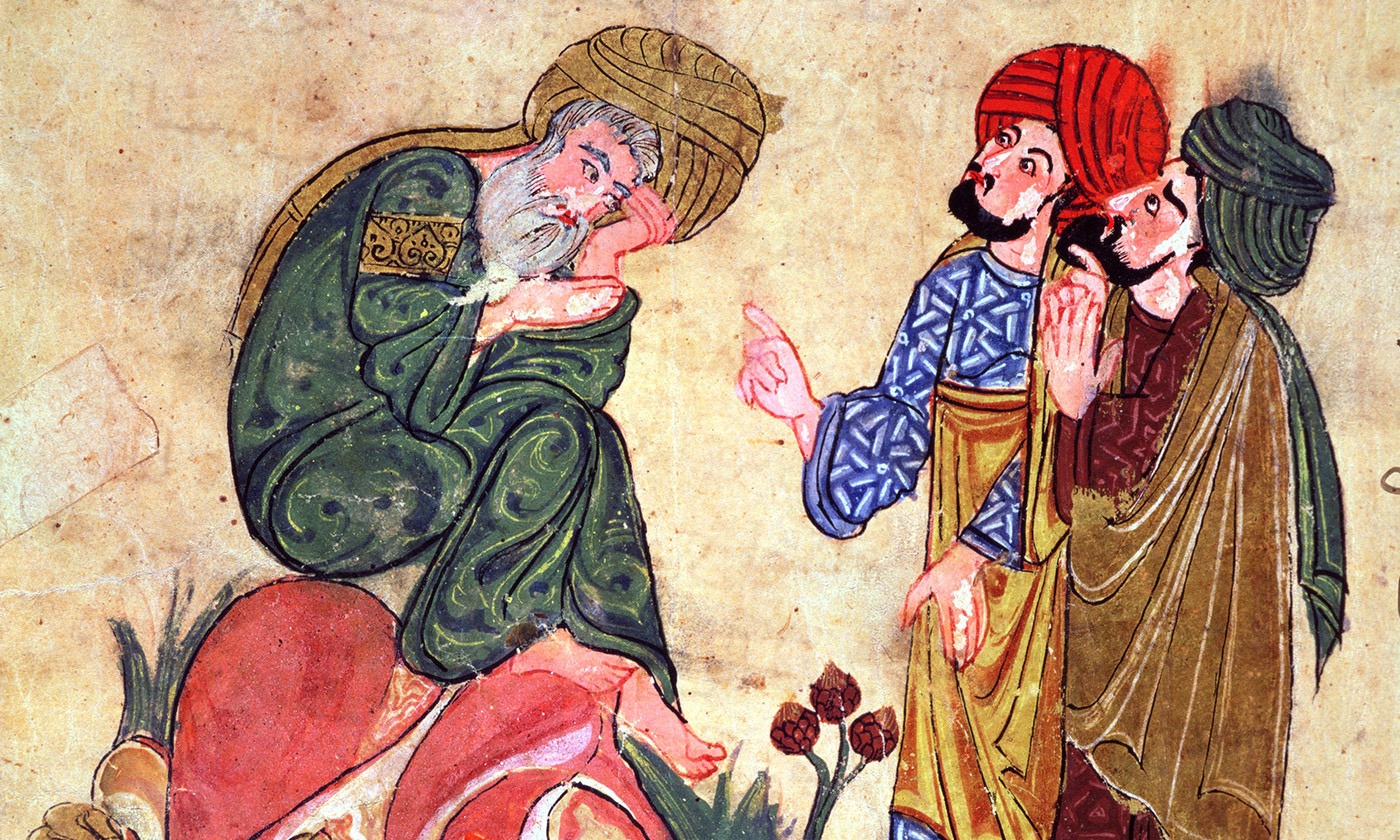
Arabic translators did far more than just preserve Greek philosophy

https://youtu.be/qFT_Km87AqU 

In European antiquity, philosophers largely wrote in Greek. Even after the Roman conquest of the Mediterranean and the demise of paganism, philosophy was strongly associated with Hellenic culture. The leading thinkers of the Roman world, such as Cicero and Seneca, were steeped in Greek literature; Cicero even went to Athens to pay homage to the home of his philosophical heroes. Tellingly, the emperor Marcus Aurelius went so far as to write his Meditations in Greek. Cicero, and later Boethius, did attempt to initiate a philosophical tradition in Latin. But during the early Middle Ages, most of Greek thought was accessible in Latin only partially and indirectly.

Elsewhere, the situation was better. In the eastern part of the Roman Empire, the Greek-speaking Byzantines could continue to read Plato and Aristotle in the original. And philosophers in the Islamic world enjoyed an extraordinary degree of access to the Hellenic intellectual heritage. In 10th-century Baghdad, readers of Arabic had about the same degree of access to Aristotle that readers of English do today.This was thanks to a well-funded translation movement that unfolded during the Abbasid caliphate, beginning in the second half of the eighth century. Sponsored at the highest levels, even by the caliph and his family, this movement sought to import Greek philosophy and science into Islamic culture. Their empire had the resources to do so, not just financially but also culturally. From late antiquity to the rise of Islam, Greek had survived as a language of intellectual activity among Christians, especially in Syria. So when Muslim aristocrats decided to have Greek science and philosophy translated into Arabic, it was to Christians that they turned. Sometimes, a Greek work might even be translated first into Syriac, and only then into Arabic. It was an immense challenge. Greek is not a semitic language, so they were moving from one language group to another: more like translating Finnish into English than Latin into English. And there was, at first, no established terminology for expressing philosophical ideas in Arabic.

What drove the political class of Abbasid society to support this enormous and difficult undertaking? Part of the explanation is no doubt the sheer utility of the scientific corpus: key texts in disciplines such as engineering and medicine had obvious practical application. But this doesn’t tell us why translators were paid handsomely to render, say, Aristotle’s Metaphysics or Plotinus’ Enneads into Arabic. Research by leading scholars of the Greek-Arabic translation movement, especially by Dimitri Gutas in Greek Thought, Arabic Culture (1998), has suggested that the motives were in fact deeply political. The caliphs wanted to establish their own cultural hegemony, in competition with Persian culture and also with the neighbouring Byzantines. The Abbasids wanted to show that they could carry on Hellenic culture better than the Greek-speaking Byzantines, benighted as they were by the irrationalities of Christian theology.

Muslim intellectuals also saw resources in the Greek texts for defending, and better understanding, their own religion. One of the earliest to embrace this possibility was al-Kindī, traditionally designated as the first philosopher to write in Arabic (he died around 870CE). A well-heeled Muslim who moved in court circles, al-Kindī oversaw the activity of Christian scholars who could render Greek into Arabic. The results were mixed. The circle’s version of Aristotle’s Metaphysics can be almost incomprehensible at times (to be fair, one could say this of the Greek Metaphysics too), while their ‘translation’ of the writings of Plotinus often takes the form of a free paraphrase with new, added material.

It’s a particularly dramatic example of something that is characteristic of the Greek-Arabic translations more generally – and perhaps of all philosophical translations. Those who have themselves translated philosophy from a foreign language will know that, to attempt it, you need a deep understanding of what you are reading. Along the way, you must make difficult choices about how to render the source text into the target language, and the reader (who might not know, or not be able to access, the original version) will be at the mercy of the translator’s decisions.

Here’s my favourite example. Aristotle uses the Greek word eidos to mean both ‘form’ – as in ‘substances are made of form and matter’ – and ‘species’ – as in ‘human is a species that falls under the genus of animal’. But in Arabic, as in English, there are two different words (‘form’ is ṣūra, ‘species’ is nawʿ). As a result, the Arabic translators had to decide, every time they came across the word eidos, which of these concepts Aristotle had in mind – sometimes it was obvious, but sometimes not. The Arabic Plotinus, however, goes far beyond such necessary decisions of terminology. It makes dramatic interventions into the text, which help to bring out the relevance of Plotinus’ teaching for monotheistic theology, repurposing the Neoplatonic idea of a supreme and utterly simple first principle as the mighty Creator of the Abrahamic faiths.

What was the role of al-Kindī himself in all this? We’re not entirely sure, actually. It seems clear that he did no translating himself, and he might not even have known much Greek. But it is recorded that he ‘corrected’ the Arabic Plotinus, which could have extended to adding his own ideas to the text. Evidently, al-Kindī and his collaborators thought that a ‘true’ translation would be one that conveys truth, not just one that has fidelity to the source text.

But al-Kindī wasn’t satisfied with this. He also wrote a series of independent works, usually in the form of letters or epistles to his patrons, who included the caliph himself. These letters explained the importance and power of Greek ideas, and how these ideas could speak to the concerns of ninth-century Islam. In effect, he was like a public relations man for Hellenic thought. Which is not to say that he slavishly followed the ancient predecessors who had written in Greek. To the contrary, the originality of al-Kindī’s circle lay in its adoption and adaptation of Hellenic ideas. When al-Kindī tries to establish the identity of the first principle in Aristotle and Plotinus with the God of the Quran, the way has been prepared by translations that already treat that principle as a Creator. He knew what we are apt to forget today: that translating philosophical works can be a powerful way of doing philosophy.

Via Egnatia – The ancient Roman road that connected Rome with Constantinople

Dec, 2 2016

All roads lead to Rome, one of the reasons why the Roman Empire became as powerful as it did was because of their ingenious and long-lasting roads. The Romans were famous road builders.

Their vast road network laid the foundations for modern day highways across Europe, and many of them are built directly over the ancient ones or run parallel to them.

At the peak of the Roman Empire, the total distance that the roads covered was more than 400,000 km.

appian_way
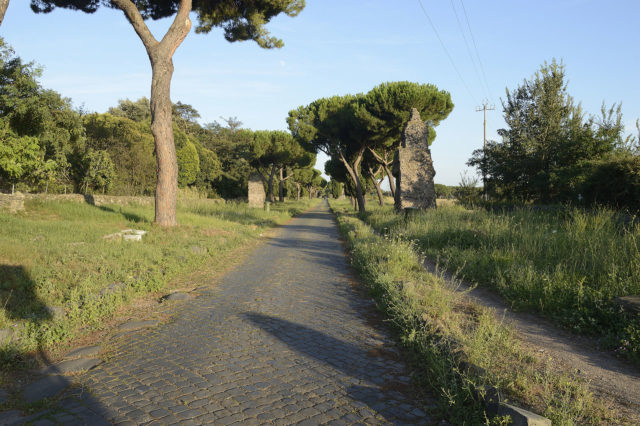
Wia Appia in Rome, near Casalrotondo / Photo credit

With the help of this network, the Romans were able to transport reinforcements, supplies, and trade goods to even the most distant and secluded parts of their empire.

The roads were also crucial for the foundation and development of many cities. Settlers often picked roadside locations for their settlements, and some of those settlements became major cities.

One such famous road that brought prosperity to a whole region, built in the second century BC, was called Via Egnatia.

It connected Rome with the Eastern provinces of Illyricum, Macedonia, and Thrace. Those provinces are the territories of Albania, Macedonia, Greece and the European part of Turkey.

The Via Egnatia stretch of road was an important part of the Roman road network mainly because it connected Rome with Constantinople (modern day Istanbul).

It became a lifeline between the Western and Eastern part of a huge Empire.

via_egnatia_librazhd
Part of the Via Egnatia in Albania / Photo credit

The need for such road arose with the Roman expansion towards the east. At the time before the road existed, there was no infrastructure in the newly conquered provinces and communication with Rome was hard.

According to some written account, the construction of the road began in 145 BC, under the supervision of Gnaeus Egnatius, the newly appointed governor of the province of Macedonia.

The road took the name of its builder, Gnaeus Egnatius.

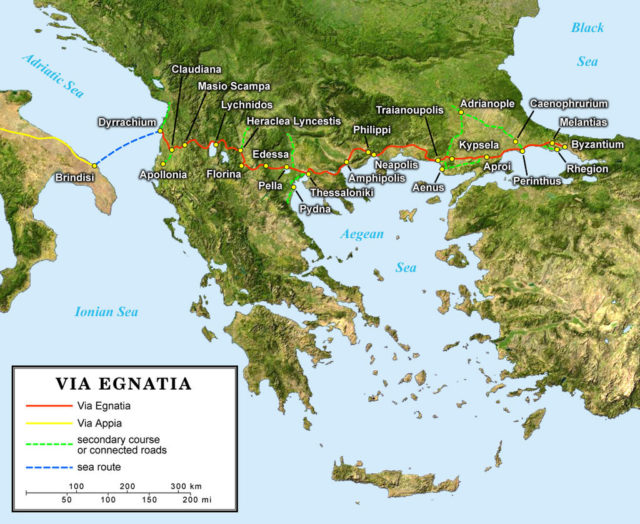
Via Egnatia begins on the East shore of the Adriatic Sea, near the ancient port of Dyrrachium (modern day Durres, Albania) and it lays directly opposite from Brindisi, at the end of Via Appia.

Via Appia was one of the oldest and most prestigious roads in the ancient Roman Empire which connected Rome to Brindisi, on the western shore of the Adriatic.

1024px-via_egnatia-en
A map showing Via Egnatia from its beginning to the end. Photo credit

The road then followed the river Genusus (Shkumbin) and went over the Jablanica Mountain from where it descended to the shores of Lake Lychnitis, and it passed near the ancient town of Lychnidos (modern day Ohrid, Macedonia).

From here, the road turns South and goes over a few high mountain passes, and it continues East passing through Pella (the ancient capital of the kingdom of Alexander the Great). Then the road reaches the northern coastline of the Aegean Sea at the city of Thessalonica.

From Thessalonica, the road went all the way to Constantinople (Istanbul), and it covered a total distance of around 1,120 km.

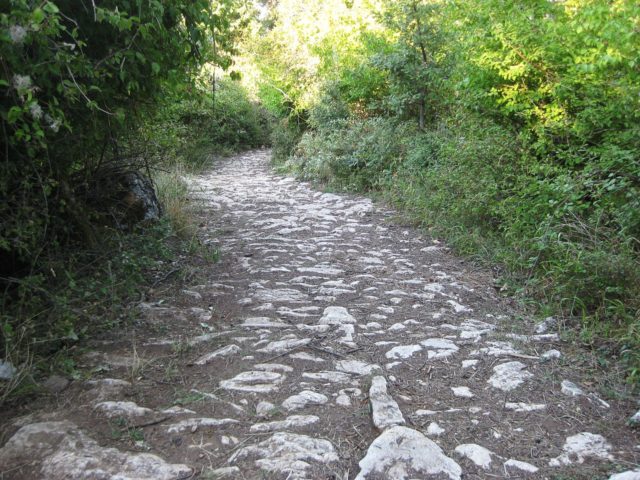
1280px-via_egnatia_radozda
A remaining segment of Via Egnatia near Radozda (a village on the shore of Lake Ohrid) / Photo credit

Since it was constructed, Via Egnatia played a major role in the shaping of the whole region. It was used for spreading Roman culture, religion, and shaping borders.

In the Byzantine days, most of the land trade routes with Western Europe passed through Via Egnatia.

Later, during the Crusades, most of the armies that traveled by land used Via Egnatia to reach Constantinople from where they went to the holy land.

Via Egnatia part of many historically significant moments in Roman history, and it has been mentioned by many historians.

Paul the Apostle (Sain Paul) on Via Egnatia during his famous second missionary journey, traveled from Philippi to Thessalonica and it has been mentioned in Acts of the Apostles (the fifth book of the New Testament)

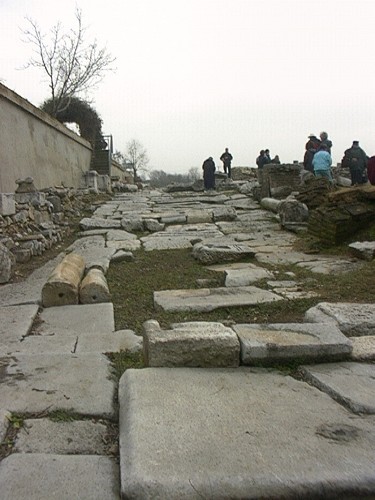
viaignatia_solun
Remains of Via Egnatia in Thessaloniki / Photo credit

During Caesar’s civil war, Julius Caesar and Pompey the Great marched their armies along Via Egnatia.

One more exciting moment in history happened along the Via Egnatia; the forces of Mark Antony and Octavian followed Cassius and Brutus along Via Egnatia to avenge Julius Caesar’s murder (the battle of Philippi).

Liberators’ civil war Mark Antony and Octavian pursued Cassius and Brutus along the Via Egnatia to their fateful meeting at the Battle of Philippi.

It was also used by the Ottomans during their conquest of Europe.

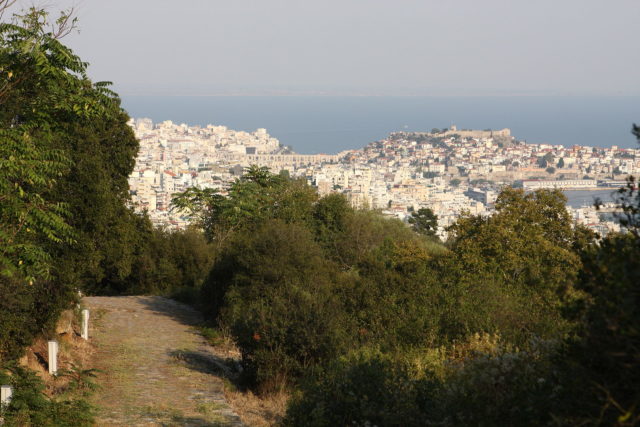
kavala_egnatia_1
A surviving part of Via Egnatia near Kavala (Neapolis) / Photo credit

Today, some segments of the Via Egnatia can still be seen scattered across Albania, Macedonia, Greece, and Turkey. This speaks a lot about the durability of ancient Roman roads.

There is also a modern highway in Greece called Egnatia Odos which runs parallel with the ancient Via Egnatia. This stretch that connects Thessaloniki with the Turkish border on the Evros river carries the legacy of the Roman road builders.

‘We were mobbed, a scary kind of mobbed’: Aniston recalls being mobbed by paps over baby bump

Aniston calls for readers to stop buying “B.S. tabloids” during her Ellen appearance.

Aniston calls for readers to stop buying “B.S. tabloids” during her Ellen appearance.Source:YouTube

The actress then called on viewers to stop buying the “B.S. tabloids”.

“Women, I have to say, are many of the authors of these horrible articles written in these B.S. tabloids so we have to stop listening to them and we have to stop buying them,” she said to applause. She finished her thoughts by telling the audience: “It’s up to us what makes us happy and fulfilled.”

In her essay published earlier this year, Aniston called out the sexism she experiences through tabloid stories.

“The way I am portrayed by the media is simply a reflection of how we see and portray women in general, measured against some warped standard of beauty,” she wrote.

Jason Mantzoukas Guest Stars on ‘Gilmore Girls’

Jason_Mantzoukas

Many viewers with early 2000s nostalgia have been anticipating the revival of the popular “Gilmore Girls” series on Netflix, and today we got to see Jason Mantzoukas guest star on one of the new series episodes.

The “Gilmore Girls” revival premiered as four feature-length episodes, each following the mother and daughter duo during a different season in a year of their lives.

Mantzoukas, who is currently playing a detective in the TV comedy “Brooklyn Nine-Nine”, played a role in the “Spring” episode of the show. His character, Robert Castellanos, is a lawyer for Naomi Shropshire, who dissolves her book contract with Rory.

Guest stars old and new showed up in the “Gilmore Girls” revival, including Carole King, Jason Ritter, Sutton Foster, and Mae Whitman.

Check out the revival on Netflix to see Mantzoukas join Lorelai, Rory, and the rest of the Stars Hollow gang back on the small screen.

Documentary Tells Little-known Story of Nazis Murdering the Jews of Kastoria [trailer]

A screening of the documentary titled Trezoros: The Lost Jews of Kastoria Greece is taking place the week of November 25 through December 1, at the Laemmle Music Hall Theater in Los Angeles.

Directed by Lawrence Russo and co-directed and produced by Larry Confino, the documentary chronicles the little-known story of the destruction of what was once a thriving Sephardic Jewish community in Greece in the town of Kastoria, where Christians and Jews lived side-by-side for over 2,000 years.

The tapestry of the town of Kastoria was forever changed when the invasion of the Axis forces took over Greece and eventually sent the Jewish population to its death at Nazi concentration camps.

The survivors themselves tells their stories in Trezoros which is accompanied by never-before-seen archival footage of the devastating events during World War II.

Official Website: trezoros.com/
Screening Venue: laemmle.com/films/41019

The richest Greeks in the world for 2016

Forbes presents for another year its list with the richest people in the world. This years list features 1,810 billionaires, down from a record 1,826 a year ago. Their aggregate net worth was $6.48 trillion, $570 billion less than last year. It was also the first time since 2010 that the average net worth of a billionaire dropped – it is now $3.6 billion, $300 million less than last year. 10 Greeks are featured in the list.

See the Greeks in the Forbes 2016 World’s Billionaires:

1.Jim Davis

This year Jim Davis is on 286th place with 4.9 billion dollars while last year he was on 481 place (446 in 2014’s list). His fortune is estimated at $ 3,7 billion, while last year he had 3,4 billion. His parents moved to USA when his was a little boy. He is the owner of «New Balance».

2.John Catsimatidis

On this year’s list he is on 477 place with a fortune of 3,4 billion. Last year he was on 557 place (551 in 2014’s list).

3.John Paul DeJoria

On 559 place we find John Paul DeJoria. His fortune is estimated at $2,9 billion (551 place at 2014’s list with $3 billion). He was born to immigrant parents, a Greek mother and an Italian father. His main income source is John Paul Mitchell Systems, his hair products company. Actually, before building his business empire, he used to be a homeless guy living in his car.

4.Philip Niarchos

On place 688 we find Philip Niarchos with an estimated fortune of $2,5 billion (737 place at 2015’s list). He has in his art collection some of the most valuable paintings in the world.

5.Dean Metropoulos

Dean Metropoulos is 722 place with a fortune of $2,4 billion (he was on 1284 place at 2014’s list with $1,3 billion). He is the owner of Pabst Brewing, which produces more than 24 brands of beer and drinks. His family moved to USA when he was 9 years old. Read more about Dean Metropoulos here.

6.Spiros Latsis

This year he is on 906 place with a fortune of 2 billion. Last year he was on 782 place with $2,4 billion (506 place at 2014’s list with $3.2 billion). He was born in Athens and he is the son of Giannis Latsis.

7.George Argyros

He is on 1011 plce with a fortune estimated at 1,8 billion dollars. Last year he was on 979 place with a fortune estimated at $2 billion (731 place at 2014’s list with $2,4 billion). He deals with real estate and investments and had served as U.S. ambassador to Spain.

8.Alexander Spanos

He is on 1067 place with 1,7 billion dollars. Last year he was on place 1500 with 1.3 billion dollars (place 1465 at 2014’s list with $1,1 billion). He is the owner of San Diego Chargers.

9.Peter Peterson

Peter Peterson is on place 1121 with a fortune of 1,6 billion dollars. Last year he was on place 1054 with a fortune of $1,8 billion (796 place at 2014’s list with 2,2 billion dollars). He’s a businessman, banker, author and politician and has prominently served as the United States Secretary of Commerce from February 29, 1972 to February 1, 1973 under President Nixon. Currently he’s considered to be the most influential persona in the country.

10. Filaretos Kaltsidis

Until 2015 he was the richest Greek in the world and the 369 richest person in the world with a fortune of 4,4 billion dollars. This year he is on 1198 place with a dramatic fortune lose, as he now has 1,5 billion dollars. In 2014 list he was on 234 with total fortune of $6 billion. He holds both Greek and Russian citizenships. Kaltsidis’s Eurocement Holding AG is Russia’s largest producer of cement, with annual production capacity of 38 MT, expected to raise up to 50 MT in the near future according to corporate plan.

Nick Georgalis: Meet the richest Greek Australian under 40

The son of Greek migrants is raising the bar on a mission to reshape the future of Canberra

According to The Business Review Weekly’s (BRW) Young Rich List for 2016, Greek Australian businessman Nick Georgalis is among the nation’s wealthiest young entrepreneurs, ranking at number 17 with assets worth an astonishing $144 million dollars.

Although this is the third time the entrepreneur has been featured on the prestigious list, what really stands out is that the 40-year-old businessman has managed to double his assets in just 12 months, climbing from 36th place to number 17, reaching a new milestone with a $72 million increase in his asset value.

The founder and managing director of Canberra-based construction giant Geocon is also the highest-achieving Greek Australian and the driving force behind some of the most exciting and ground-breaking residential, commercial and retail projects within the ACT.

Born and raised in Canberra, the son of Greek migrants from the area around Kalambaka, in the municipality of Trikala in Thessaly, started his career as a real estate agent and remains passionate about the construction and building industry.

In an exclusive interview with Neos Kosmos, Georgalis talks about his journey towards success, his future plans and his dream in creating a progressive and vibrant future for Canberra.

How does it feel to be included in the BRW Young Rich List for 2016?
It is always rewarding to be recognised for hard work but this accomplishment represents the enormous network of support that has been created through Geocon and how our projects are contributing to the growth of Canberra in the years to follow.

How would you describe Geocon today?
Geocon is Canberra’s powerhouse integrated property enterprise with capabilities across development, construction, hospitality management and investment. Our hallmark is architecturally stunning buildings that deliver a new standard of contemporary living. We set the benchmark for high-rise residential and hotel accommodation in Canberra, and we continue to raise the bar.

Founded on a strong entrepreneurial culture, we believe in continually breaking new ground. From our earliest days in construction, to the formation of Geocon a decade ago, we are passionate about our city and building its future. We deliver a level of amenity and quality inclusions that is unparalleled in Canberra and we are leaders in sustainability, client service, project execution and pricing. At Geocon, exceptional is the norm.

When did you start your business and to what would you attribute the secret of your success?
I started this business in 2007 with a turnover of $5 million and five people working in my business. Today we have 220 people and a turnover of $200 – $250 million per annum. We are the developer, the builder and the hoteliers and don’t rely on contracting out any of those components of what we do. As I always say, I am quite fortunate that the best in the business want to work for Geocon and be part of our story.

Tell us a little more about your new project and any other new projects coming up.
The Wayfarer project in Belconnen that we are currently working on is, at 27 stories, the tallest tower in Canberra, with 331 apartments and a value of $145 million. This project is close to sold out and completing in December this year.

We currently have three projects under construction − Wayfarer in Belconnen with 331 apartments, Southport in Tuggeranong with 360 apartments and Infinity in Gungahlin with 424 apartments, totalling more than 1,100 apartments under construction. All these projects are the tallest towers in each area. There is a pipeline of 2,000 apartments and hotels rooms on top of what is currently under construction, with a value in excess of $1 billion dollars that will be delivered over the next few years in Canberra.

The most exciting project is our Section 200 project in the Belconnen town centre, with 1,300 apartments, hotel, retail, commercial and car park that will be released next year. Again, we will be pushing the height limit in Canberra on this project and hoping to commence construction mid-2017.

How hard was it to get to where you are at today and which elements make your business so successful ten years later?
We are still a very young business. We are only ten years old and it hasn’t been easy to get to where we are today, nor will it be easy to keep delivering the ambitious projects we are currently delivering and have in the pipeline.

I have always been quite fortunate in attracting the best talent across all sectors of industry to work with me. Having hard working and committed people working alongside me makes the journey much easier.

How many people do you have working with you at the moment?
Geocon and Abode Hotels currently have 220 direct employees, and by 2020 we are anticipating to have about 450 direct employees. At any one time we have over 1,000 people working across our projects as contractors on top of this.

What advice would you give to young entrepreneurs taking their first steps in business today?
The most valuable thing a business has is its people. You will find that most businesses are not factories that rely on machinery to deliver their product but need people to do this. So, keep investing in your people and look after them. Surround yourself with good, hard-working, committed people who share your vision.

How connected are you with Greece and your heritage and cultural identity?
My mother and father are both immigrants to Australia and moved here in the ’70s when they were both young. They started a family here and brought with them the strong culture that all Greeks inherit and share with their families, so we always stay quite close and connected to Greek culture and its origins. My children have all been to Greece recently and I was able to share with them the experiences I also had when I was a young boy.

Source: NeosKosmos

Greek-Australian Scientist Publishes Study Highlighting Exercises That Can Save Your Life

heart attack

According to international research headed by Professor Emmanuel Stamatakis, a Greek-Australian scientist at Sydney University, tennis, swimming and aerobics are the three best sports for health. On the contrary, he notes, football and jogging are less beneficial and do not keep away the possibility of early death.

Details on his research were recently published in the British magazine British Journal of Sports Medicine and was compiled of analyzed data from over 80,300 people with an average age of 52. The study monitored the participants for nine years during which 8,790 died from several different reasons.

The study showed that the danger of death from health related causes decreased 47 percent in the group of individuals who engaged in playing tennis, squash or badminton and that tennis in particular reduces the chances of death from a cardiac disease by 56 percent.

Those individuals who opt to swim can expect a 28 percent decrease in dying from health related causes, which is similar to what individuals who participate in aerobics can expect as the study showed a 46 percent decrease.

Professor Stamatakis is a graduate from the Sports Science School of the University of Thessaloniki, which he completed in 1995. In 2002 he attended Bristol University where he completed his Ph.D, followed by teaching at the Epidemiology and Public Health Department of London University College. In 2013 he became a Professor at the University of Sydney, where he still teaches today.

Source: ANA-MPA

Rockets reach deal to bring Greek star Kostas Papanikolaou over for next season

Source: probasketballtalk.nbcsports
JSF Nanterre v FC Barlelona Basket -Euroleague

There was great comedy back in 2012 when the Knicks had just one second round pick and used it to take Greek small forward Kostas Papanikolaou — Knick’s fans had no idea who he was and freaked out.

Eventually Papanikolaou’s rights worked their way to the Rockets, who have signed a deal to bring the oversized small forward over for next season, something first reported by Marc Stein of ESPN. Papanikolaou has a fully guaranteed $4.8 million this coming season and a team option for $4.6 million next season.

There will be minutes to be had at the three behind Trevor Ariza (especially with Chandler Parsons gone) and even at the four where it’s Terrence Jones and Jeff Ardrien trying to space the floor for Dwight Howard inside (Papanikolaou can shoot the three). Papanikolaou is 6’8” and 230 pounds and according to reports works pretty hard on defense, so he can play the stretch four and defend a little.

Aside that, honestly I know little more than Knicks fans about him. Last season he played for Barcelona, one of the top teams in Europe. According to the DraftExpress scouting report he’s kind of a classically European big — great feel for the game, can shoot the rock, plays with a high IQ but he has average athleticism and there are questions about how much he’ll be able to do at the NBA level.

We will get a chance to see him at the World Cup where he will play for the Greek national team.

Older Greek Men Feel Pain of Job Losses

Unemployment Rate Is About Twice the Euro-Zone Average

An unemployed worker in February in Perama, near the port of Piraeus Associated Press

PERAMA, Greece—Most weekdays, Thanassis Tziombras, a 50-year-old worker at the shipbuilding zone here at the main Greek port of Piraeus, is up before dawn and out looking for work by 6 a.m.

Some 40 minutes away, in the posh Athens suburb of Psychico, Constantinos Tsimas, a 54-year-old U.S.-educated marketing consultant, wakes up to another day of working the phones and emails seeking clients.

There is a social gulf between these two men, but they are united in one thing: the financial and psychological struggle that comes with being older and unemployed in a country where the economy has shrunk by almost a quarter in six years.

Greece’s economy has taken such a brutal beating that it is in a category apart from other European countries suffering through the recession. Where Greece lost some 25% of its economic output, Spain lost about 6%. Experts say that, even as the Greek economy begins to recover, the shock has been so severe that older workers are unlikely to ever hold full-time jobs again.

Unlike in other parts of Europe, Greek reforms have largely removed provisions that protected older workers. In Spain and Italy labor-market regulations favoring baby-boomers over their children are still largely in place, entrenching the so-called two-tier labor market. But in Greece, everyone seeking work largely faces similarly poor odds, said Raymond Torres, head of research at the International Labor Organization, the United Nations labor agency.

While Greece’s youth unemployment is still a record for the EU—almost 60% of people aged 15 to 24 were out of work in 2013—the unemployment rate among older Greek males is about twice the euro-zone average and almost four times that of Germany.

Some 18% of 40-to-59-year-old Greek men were out of work last year, according to Eurostat, the European Union statistics agency. In the U.S. where the recession set in sooner than in the EU, the unemployment rate for men in this age group peaked at 8.2% in 2010 and has been declining since to reach 5.7% in 2013.

One in five jobs lost in Greece between 2008 and 2013 was from the middle-aged male group. The Spanish equivalent was one in eight. In Italy, middle-aged men actually added jobs in the recession years.

Greece’s older men are more often families’ sole breadwinners. Female employment rates here, at 43.3% in 2013, are the lowest in the EU, where the average is 62.5%, according to Eurostat.

Recent pension reforms, meanwhile, mean older Greek men who have lost their jobs could be looking at several years of no income. Greece has increased the retirement age to 67 for both men and women, changing a decades-old system that allowed some categories of workers as young as 55 to retire on a full pension.

“If they don’t have a job and they have to wait so long for a pension, what are they doing in the meantime? They are at serious risk of poverty,” said Anne Sonnet, a senior economist at the Organization for Economic Cooperation and Development, a Paris-based think tank.

In Greece, with its macho, traditional culture, unemployed men are at risk of depression, says Dr. Kyriakos Katsadoros, a psychiatrist and the science chief of Klimaka, a suicide-watch nongovernmental organization in Athens, who also noted risks of alcoholism and domestic violence.

“We were used to providing for our families through honest work. We were proud of our work—now we’re just ashamed,” says Mr. Tziombras, counting his worry beads between his fingers.

He is sitting in an old classroom on the port now used by the Communist-led laborers’ union here. “Don’t kill the mosquitoes—it’s others who are sucking your blood,” is written in chalk on the blackboard.

He says the union, apart from political guidance, provides “solidarity and psychological support” to workers.

The shipbuilding zone at Perama in Pireaus, once buzzing, is now a wasteland of idle cranes and scattered ship parts. Men sit in cafes waiting for word that a vessel has docked for maintenance and is in need of day workers.

At its peak in 2008, 6,500 men worked here. The shipbuilding industry retains workers on a daily rate as opposed to hiring them as staff, but in 2008 there was so much demand that these workers were effectively employed full time. In the good years, they would take home a net daily salary of about €70, or about $95. They haven’t agreed to cut this rate, despite calls by employers’ associations. Today, about 1,000 workers remain, doing sporadic work.

Mr. Tziombras says his wife managed to find a job as a cleaner at a local school, bringing a few euros into the household budget, but their relationship has been strained by the financial woes. Economists say it is a growing trend in Greece for women that didn’t previously work outside the home to take jobs as their spouses lose theirs.

Late last year he drove across the country to get a few days’ work at a factory. He has been doing odd jobs at construction sites around Piraeus and Athens, and continues to show up each morning at the port ready for work. The last time he got a job was for three days in January.

“We have gone through our savings, we’ve sold everything we owned, we stopped any nonessential activity,” Mr. Tziombras says.

A law against foreclosing on primary homes means that he isn’t likely to lose his home because of mortgage arrears, although he frets the provision may soon be revised. His two children, 17 and 22, are in high school and college. They will continue to depend on him for years, he predicts.

Concerns are in some ways similar in Mr. Tsimas’s wealthier neighborhood. Shame at being out of work is the first thing mentioned.

“It’s socially shameful but, more than anything, I was ashamed because I had to ask my wife for money,” Mr. Tsimas says.

His wife brings home a good salary from her investment-banking job, but the loss of income from his work still hit the family budget, which supports one child at a British university and one in a private school.

He, too, has turned to politics and voluntarism to feel useful—although a very different brand to communist Mr. Tziombras and his labor-union activism. Mr. Tsimas is a member of Drassi, a liberal political party that seldom gets more than 1% in elections. He runs an online forum with friends where they debate about the economy and politics.

For all the shared experiences of shame, financial struggle and family strain, the bottom line for the two men is very different.

“I actually think unemployed working-class guys my age may be better off in a way, because their expectations were always lower,” says Mr. Tsimas. “Being at this state at 54 is certainly not what I expected for myself.”

Still, his material concerns are not about survival.

“Last year I gave my daughter my iPhone for her birthday,” he says looking at his own older mobile phone. “I couldn’t afford a new one.”

Mr. Tziombras says he has given up on all of the smaller joys of life for him and his family, like dance classes for his daughter or the occasional night at the movies with his wife. It’s now all about subsistence.

“Cutting everything that’s not food turns the workers into animals,” he says.