Abbott government planning ‘repeal day’ to cut 8000 laws

The Abbott government is planning a “repeal day” in parliament in March when it hopes to axe more than 8000 federal laws in a push to cut red tape costs.

The Australian reports that the “repeal day” is scheduled for the final parliamentary sitting week in March and is part of a federal government plan to slash red tape by $1 billion a year.

The Statute Law Revision Bill and the Amending Acts 1901-1969 Bill will propose slashing 8000 redundant laws going back around 100 years.

On the same day, parliament will be presented with a number of bills proposing the repeal of “burdensome regulations”.

The bills are to be debated in the coming weeks, with the government reportedly claiming they’ll represent the “biggest single reduction in federal laws ever put before the commonwealth parliament”.

The “repeal day” concept is said to be borrowed from the US, where congress has regular repeal days.

ASIO spying on Syria fund-raisers amid terrorism funding fears

Source: CanberraTimes

Australia’s intelligence agencies have been monitoring phone calls, freezing bank accounts and making covert home visits to warn people donating money to Syrian war victims that they suspect the funds might instead be financing terrorism.

Fairfax Media has been told that charities, community organisations and individuals have been visited by agents of the domestic spy agency ASIO, warning them not to continue sending money overseas through the channels they have been using.

Some people have received letters, without any prior warning, saying accounts had been frozen.

Community members have complained about the tactics, saying it is creating an atmosphere of fear and anxiety for people who are already ”emotional” about the plight of the Syrian people.
An Erskineville woman, Khadija, whose brother had his passport suddenly cancelled on the grounds he might ”engage in politically motivated violence”, claimed that her phone messages had been monitored by ASIO and people who had donated to her fund-raising drive had been intimidated by visits from agents warning them off.
She said ASIO told people that they had Viber messages between her and them about the donations. ”They were terrified,” she said. ”And they won’t speak to me any more.”
Yet Khadija said ASIO had not approached her or asked any questions about the fund-raising that she had been doing. She believes the Muslim community is being targeted just for trying to help people who are victims of the Syrian conflict.
”All we wanted to do was send money for the kids, and that is what we have been doing,” she said.
Sydney’s Middle Eastern communities have been working hard raising money for the victims, says community advocate Rebecca Kay.
She told Fairfax Media that people were devastated about what was taking place.
”They are very emotional – at fund-raising events they are taking the rings off their fingers and the necklaces from their necks to auction to raise money,” Ms Kay said.
But the problems have stemmed from intelligence reports the flow of some money overseas has ended up supporting banned groups involved in the conflict and not the victims. Financing terrorism is an offence under Australian law.
The Independent National Security Legislation Monitor annual report said the conflict was of concern in relation to terrorism financing. It said $21 million had been sent from Australia in the past financial year.
A spokesman for ASIO said it could not comment on operational activity. But a spokesman for the Australian Federal Police, which investigates terrorism financing offences, said the AFP understood many Australians wanted to help and might want to send money through trusted family members or friends.
But he said the best way was through legitimate UN agencies and non-government organisations that did not support either side in the conflict. That way, he said, they were not committing any offences.
One community member criticised the ”back-door approach” by authorities, saying it was not helping. She said the community was always active in fund-raising, as it was last year for bushfire victims.
”It is so simple,” she said. ”Educate the community, put some advertisements out there in the Arabic media and the local newspaper saying which charities to donate through and why.
”Visiting people at home and fearmongering isn’t right. It’s cruel. People just want to help and they already have trust issues.”
But Dr Tamer Kahil, president of the Australians for Syria Association, which has been sending money through legitimate channels, said he did not see harm in government officials coming to ask questions.
”We welcome them and open our books for them,” he said. ”I don’t want anyone to be scared.”

UN Refugee Agency says Australia may be breaching international law

AAP News Limited Network

The UNHCR says Australia’s policy of turning back boats may breach obligations under international law.

THE United Nation’s refugee agency says the Abbott Government’s policy of towing or turning back boats may breach Australia’s obligations under international law.

Spokesman for the United Nations Refugee Agency (UNHCR) Babar Baloch says the organisation is seeking an explanation from the Australian government over reports a number of asylum-seeker boats have been returned to Indonesian waters.

Mr Baloch said the UNHCR found a policy of “pushing” back asylum-seeker boats “very concerning”.

“Any such approach would raise significant issues and potentially could place Australia in breach of its obligations under the Refugee Convention and international law,” he told ABC radio today.

“If people who are in need for international protection seek a country’s safety, then they must be allowed to go through a process which helps to determine if these people are in need.”

Prime Minister Tony Abbott and Immigration Minister Scott Morrison have refused to comment on reports that the Australian navy and customs have either towed back or turned back as many as five boats in the past month.

Mr Abbott has made no apologies for the government’s secrecy over its border protection operations, likening the fight against people smugglers to a war.

A Channel Ten Wake Up exclusive with Tony Abbott talking about his asylum seeker policy.

Mr Morrison noted the UNHCR had been a long-term critic of the Coalition’s border protection policies, and that the government’s actions did not breach Australia’s international obligations.

“Border protection is an issue of national sovereignty,” he said in a statement today.

“The government is taking the steps necessary to protect our borders consistent with our domestic laws and international obligations.”

Greens immigration spokeswoman Sarah Hanson-Young said turning back and towing back boats was “dangerous” and “illegal”.

The government was “thumbing its nose” at international law, she said.

“The rest of the world is watching in horror, and there will be consequences for Australia, whether it’s in the courts or whether it’s through international diplomacy,” she told reporters in Adelaide.

Christopher Doukas, 13, finds 16th century Portugese swivel gun on Northern Territory beach

Source: news.com.au

Shipwreck timbers add to mounting evidence that explorers visited New Zealand, Australia, much earlier than generally accepted

Timbers from a shipwreck found in New Zealand have been dated to some 70 years before Captain Cook 'discovered' ...

Timbers from a shipwreck found in New Zealand have been dated to some 70 years before Captain Cook ‘discovered’ the islands in 1769. Source: Supplied

TIMBERS from a shipwreck in New Zealand have been dated to some 70 years before Captain Cook and is just the latest in a string of finds showing ancient seafarers explored our great southern lands – but never returned.

The timbers, from a wreck found in New Zealand’s Kaipara Harbor on the North Island, have been identified as having originated in Southeast Asia as early as 1700.

Captain Cook’s Endeavour encountered New Zealand in 1769.

The find comes just weeks after it was revealed a small canon found on a remote Northern Territory beach likely originated in Portugal before being lost by Indonesian seafarers some time about 1760.

Cook first sighted Australia on May 6, 1770.


Christopher Doukas, 13, found a cannon buried in the sand on Dundee Beach while on a family outing.

Christopher Doukas, 13, found a cannon buried in the sand on Dundee Beach while on a family outing. Source: Supplied

Australian historians believe that Dutch explorer Willem Janszoon was the first European to have reached Australia in 1606, closely followed by fellow Dutch seafarer Dirk Hartog.

Legend surrounds what may be an early shipwreck in Armstrong Bay in southwest Victoria. Known as the “Mahogany Ship”, speculation identifies it as a Portuguese caravel. Attempts to relocate the wreck have since failed.

But no such mystery surrounds the location of the wreck in New Zealand.

The University of Auckland’s Dr Jonathan Palmer, who used tree-ring techniques to date the ship’s timbers, is calling for a full excavation of the wreck now buried under some 10 meters of sand.

Dr Palmer told TVNZ his first reaction at seeing the dating results was “Good God, this could be really important It really needs excavation. It needs to be an eminent archaeologist”.

The ship was discovered in 1982 by a local mussel fisherman. The wood he salvaged was later identified as the tropical hardwood Lagerstroemia.

It has only recently been further analysed.


Several 1000-year-old copper coins from Kilwa Sultanate, East Africa, have been found on an island off the coast of the North...

Several 1000-year-old copper coins from Kilwa Sultanate, East Africa, have been found on an island off the coast of the Northern Territory. Source: Supplied

Palmer cites Captain Cook’s log books as reporting Maori traditions of earlier shipwrecks as further evidence such a dig would be worthwhile.

Cook recited an account by local Maori of “earlier encounters with Europeans, with the ships having been wrecked and the survivors killed and eaten”.

The exact position of the wreck has been pinpointed through use of a magnetometer survey. While buried in sand, the sand bank itself is no longer under water.

The 107cm bronze swivel cannon found at Dundee Beach southwest of Darwin in 2010 was recently determined to have sat on the seabed for some 250 years.

Teen Christopher Doukas found the light artillery piece buried in the sand during an unusually low tide in 2010.


Christopher Doukas and the cannon he found.

Christopher Doukas and the cannon he found. Source: Supplied

“The cannon is one of the most significant historical artefacts ever found in Northern Australia,” geomorphologist Dr Tim Stone of archaeological group Past Masters told AAP.

An Indonesian vessel could have been blown off course and on to Australian shores, he said, and the gun find could represent one such incident.

Metal analysis tests are being undertaken in Australia and North America to try to determine the source of the bronze used to cast the gun.

The cannon isn’t the only indication of such an event.

Five 1000-year old coins from the ancient African kingdom of Kilwa were recently identified after being found in the Northern Territory in 1944.

Christmas beetle numbers on the decline as imposter numbers grow

Source: smh.com.au

Just like Santa Claus, when it comes to Christmas beetles the real thing is bigger, rarer and shinier than the fakes that abound in Sydney’s centre at this time of year.
Experts from the Australian Museum say the Christmas beetles reported in Sydney’s more populous areas are likely two impostors, an Argentine lawn beetle and the native chafer.
”Clearly some people are confusing them,” said Chris Reid, a research scientist with the Australian Museum Research Institute.
There are about seven species of Christmas beetles found in the bushier areas of Sydney, including suburbs near the Royal National Park and Ku-ring-gai.
The impostors are dull brown and about 1.5 centimetres long. In contrast, the real thing is shiny, often an iridescent green or metallic brown in keeping with the season, and twice as large.
To tell apart the species, entomologists look at the insects’ bums, which are easy to see, Dr Reid said. The king beetle, about 3.5 centimetres long, has a dull-green rear, he said. Another large species that reached pest proportions in the 1920s had an orange tufted rear.
The washerwoman species of Christmas beetle has a shiny posterior and is about 2.5 centimetres.
”In the 1920s, there are records of Christmas beetles being so common around the harbour that the branches of eucalypts were hanging down into the water,” he said.
While Christmas beetles are common in rural areas, the washerwoman (a type of scarab) is considered a pest in areas such as Armidale, Dr Reid has not seen one in the inner city in the past 15 years. But he has seen many impostors, which people may mistake for Christmas beetles. The impostors thrive in garden lawns. While they are growing in numbers, Christmas beetle numbers are falling because of the decline in habitat.
The adults mainly feed on eucalyptus leaves and prefer open woodland to forest, thriving in pastures where trees have been left in place. On farmland they can form dense masses on remaining eucalypts, chomping through leaves, sometimes killing their hosts, while their larvae feed on roots, usually grasses.
Correction: The caption on the original version of this story said the Argentine lawn beetle was on the left and the native chafer was on the right, instead of the other way around.

Minister awards 2013 HSC first in course recipients

Source: det.nsw.edu.au

l
Media release

The Minister for Education Adrian Piccoli today presented 2013 HSC students with First in Course Awards at an event at Australian Technology Park.

“Any student who receives their HSC has worked hard, and I congratulate all students who have completed their exams this year,” Mr Piccoli said.

“HSC courses are demanding and the assessment and examination process is designed to challenge students.

“To claim the First in Course spot is a great honour for these students, and they, their teachers and their families should be very proud.

“The First in Course Awards acknowledge the highest achieving student in each HSC course, where the result is in the highest possible band for that course.

“The HSC is a world-class credential and coming first demonstrates and extremely high level of achievement on an international level.

“Completing the HSC requires immense dedication from students, and support from both teachers and parents,” Mr Piccoli said.

The ceremony saw students receive a Certificate for Excellence from the Minister in front of their families and senior representatives from across the education sectors.

2013 highlights include:

Awards made to 121 students in 112 courses

Equal first place in nine courses

Three students receiving a First in Course Award for more than one course

83 of the 121 recipients are young women, and 38 are young men

12 students live in regions outside of Sydney, including students from: Inverell, Grafton, Hermidale, Coonamble, Griffith, Wagga Wagga, and two students from Cooma.

This year marked the first examination of the Financial Services course. This course is designed to provide students with skills and knowledge to seek a job straight from school or as a sound foundation for higher level education or university studies.

Over 70,000 students will have access to their HSC results from 6.00am tomorrow (Wednesday 18 December).

Results are available online and by SMS using a secure system requiring a Student Number and HSC PIN. For more information on HSC results go to studentsonline.bos.nsw.edu.au

The Board of Studies HSC Results Inquiry Centre 1300 13 83 23 will be open from 9 am for students with questions about their HSC results.

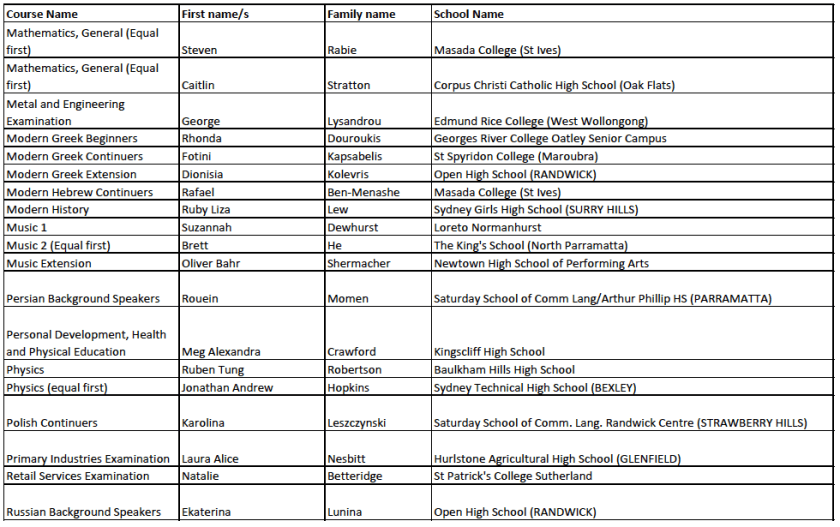
List of students who won awards
http://www.dec.nsw.gov.au/documents/15060385/15385042/351Q2704.PDF

Screen shot 2013-12-17 at 5.46.10 PM

Screen shot 2013-12-17 at 5.46.19 PM

Screen shot 2013-12-17 at 5.46.36 PM

Screen shot 2013-12-17 at 5.46.45 PM

Screen shot 2013-12-17 at 5.46.53 PM

Screen shot 2013-12-17 at 5.47.00 PM

Hunter students top HSC courses

HUNTER and Central Coast students have outperformed tens of thousands of their peers to top traditional and vocational courses in the Higher School Certificate.

Lambton High School student Claire Brooks has come first in the state for Earth and Environmental Science, St Philip’s Christian College, Waratah, student Daniel Lee holds the state’s top spot in Construction and TAFE Hunter Institute student Ashlie Fisher came first in the Entertainment Industry exam.

St Joseph’s Catholic College East Gosford student Maddie Doorn has topped the Studies of Religion I exam.

The four students were honoured at a First In Course awards ceremony in Sydney on Tuesday.

Awards were given to 121 students- including 83 young women and 38 young men- in 112 courses.

Daniel, 18, of Maryland said he chose to study Construction to further his plans to work with an aid agency in poverty relief.

”I just always wanted to do it: I did a few mission trips with Aboriginal communities when I was younger and I’ve got a heart for it,” he said.

“I’ve just got back from Vanuatu where I went instead of schoolies to build a playground for a school.”

Daniel said he studied most for Construction because it wasn’t his strongest subject.

“I laughed when I heard I came first, I wasn’t feeling confident about it so I was shocked.”

He has been offered a scholarship to study for a Bachelor of Arts majoring in International Poverty and Development Studies at Avondale College at Cooranbong next year.

Aspiring film director Ashlie Fisher, 18, of Belmont North travelled every Tuesday afternoon from Warners Bay High to TAFE Hunter Institute at Tighes Hill to study Entertainment Industry, in which she now holds a Certificate III qualification.

She volunteered at Starstruck and Newcastle Writer’s Festival as part of her work placement and has applied what she learned to her part time job at Hoyts Charlestown.

“I’ve always loved Steven Spielberg films, so he is a big inspiration,” she said.

“I went well in trials so was pretty confident when I walked into the exam and pretty happy when I came out, but I didn’t expect this, this is amazing.”

She said the award was “the icing on the cake” after being accepted to study at the Australian Film Television and Radio school from next year.

Claire Brooks, 18, of Elemore Vale had to double check there hadn’t been a mistake when told of her achievement.

“I’ve always done pretty well but it was a shock to be first,” she said.

Claire said she had been fascinated by volcanoes, earthquakes and plate tectonics since she was a child.

She used mind maps to remember course content, which she hopes she will continue to build on with a Bachelor of Science majoring in Earth and Environmental Science and geology at the University of Newcastle.

Claire’s father Anthony, also a science enthusiast, passed away this year.

“I know he would be really happy, my mum and sister are proud of me and amazed I did so well.”

Claire was also awarded this year the Reuben F Scarf Award for Commitment to studies and the Ashley Sands Memorial Award for achieving first place in her grade in Earth and Environmental Science.

“I’m a little bit nervous about the results coming out on Wednesday, but excited too.”

Maddie Doorn, 17, of Bateau Bay said she had enjoyed learning about the history of religion, including how it developed and was expressed.

“But I actually put more effort into other subjects, so this was a nice surprise.”

The NSW Institute of Sport scholarship holder divided her time this year between studying and representing her state in basketball, having also been selected to the under 19 Australian squad.

She hopes to study physiotherapy next year at the University of Sydney or the Australian Catholic University.

NSW Minister for Education Adrian Piccoli said HSC courses were demanding and the assessment and examination process was designed to challenge students.

“The HSC is a world- class credential and coming first demonstrates an extremely high level of achievement on an international level.”

Ice cream hits the spot at CanTeen

Source: Sunshinecoast

THE daily stresses of living with cancer were washed away with a scoop of ice cream by the beach for a group young people visiting the Sunshine Coast.

Wendy’s Ice Cream brought a sweet treat to 65 children and teenagers having a break at Dicky Beach as part of the annual CanTeen Summer Program yesterday.

Smooth and creamy ice cream was taken from the freezer, across the sand to the group in a surprise delivery.

The children spent the warm summer’s day at the Caloundra beach playing games and swimming on the second last day of the camp.

CanTeen is an organisation which supports, develops and empowers young people living with cancer.

The organisation runs the five-day overnight programs to provide much-needed relief for these young Australians.

An extra 23,000 young people every year have to face the challenge of dealing with cancer – whether they’ve been diagnosed themselves or a parent, brother or sister has the disease.

“A cancer diagnosis threatens the security of a young person’s world, leaving them feeling vulnerable, frightened and confused,” CanTeen programs officer Jaimie Trotter said.

“Attending a CanTeen program gives our members the chance to meet other young people who truly understand what they’re going through while also having some fun.

“The programs are free to attend and that’s why we’re so grateful for every donation we receive from the community and our corporate supporters such as Wendy’s.

“The programs wouldn’t be possible without them.”

The biggest vessel ever sent to sea is coming to Australia

Source: CanberraTimes

Prelude, the biggest floating vessel to be ever built, will work in the gas industry off West Australia.

It will be the biggest thing ever sent to sea – but as the Prelude FLNG vessel was launched last week, plans were already underway for something bigger.
With a bow and stern half a kilometre apart, four football pitches would fit on Prelude’s deck were it not for a clutter of kit towering up to 93 metres high that will draw gas from under the sea bed for dispatch to Asia by the boatload.

But as the partly-built structure floated out of dry dock for the first time, developer Royal Dutch Shell wants to consolidate its advantage as the first mover in Floating Liquefied Natural Gas (FLNG) – an as-yet untried technology for which Prelude will be the flagship.

The oil company’s technicians are designing something even larger and tougher than Prelude, a vessel that will need to last 25 years moored in the Indian Ocean’s “cyclone alley” off Australia’s northwest coast, producing enough gas to supply a city the size of Hong Kong.

“Yes we will move bigger and move into more extreme environments,” Bruce Steenson, Shell’s general manager of integrated gas programmes and innovation told Reuters last week. “We are designing a larger facility … That will be the next car off the rails.”

Prelude, which analysts says may cost over $12 billion to build and which is due to be producing by 2017, is a potential game changer for the oil and gas industry.

If it is an economic success, gas fields worldwide that are too far out to sea and too small to develop any other way could become viable for LNG production.

Making the first-ever FLNG unit even more of a focus as it takes shape in Samsung Heavy Industries’ Geoje shipyard in South Korea, the prototype vessel’s most likely first copy model of similar size will now be for the Browse project – another venture for gas off Australia.

“DESIGN ONE, BUILD MANY”

Escalating costs forced backers to dump their original, land-based LNG plant plans, and in September this year, they decided to go ahead with Shell’s FLNG technology instead.

“The Browse structure will be 90 percent the same as Prelude,” Steenson told Reuters on the sidelines of a conference, citing the “design one, build many” mantra Shell hopes will eventually pay off and placate shareholders worried about the firm’s total $45 billion-a-year capital spending bill.

Browse’s developer, Woodside Petroleum, said in October it may use as many as three of the FLNG vessels Shell is developing along with Samsung Heavy and oil and gas engineers Technip.

An even bigger FLNG plant than the ones to be built for Prelude and Browse could make life more interesting for the competition – a wide range of land-based “wannabe” LNG exporters in Canada, Russia and east Africa, all hoping to tap burgeoning Asian gas demand the same way a number of Australian and US-based LNG developments will over the coming few years.

Anchored about 200 km off the Australian coast, Prelude will chill the gas to reduce its volume by a factor of 600 and load it on to specialised LNG tankers.

Prelude will only produce about 3.6 million tonnes a year (mtpa) of LNG along with its 5.3 mtpa of liquids and other hydrocarbons – a fraction of some land-based LNG plants.

Steenson envisages a bigger version could produce far more – giving it economies of scale closer to those to be enjoyed by bigger land-based producing plants such as Gorgon, a 15.6 mtpa plant taking shape on northwest Australia’s coast to tap offshore gas.

Gorgon, led by Shell’s US-based rival Chevron, should be producing in early 2015, well ahead of Prelude, but it is way over budget and now scheduled to cost $52 billion against an original $37 billion. Plans for a land-based Browse plant were cancelled this year as its likely cost reached $45 billion, and as the outlook for global gas demand faltered.

OCEAN ACCESS

Shell has shied away from offering estimates of Prelude’s likely cost, but analysts say FLNG could end up less expensive. They have put the cost of Prelude at $10.8-$12.6 billion.

At 600,000 tonnes with its storage tanks full, Prelude will be vast, but it takes up just a quarter of the space a land-based LNG plant of a similar capacity would occupy because components are stacked on top of each other.

LNG plants need access to the ocean anyway so that LNG tankers can load. FLNG eliminates the need for land purchase and reduces environmental objections. With cooling water straight from the ocean and gas tipped piped straight into LNG tankers, there is no need for long seabed pipelines and jetty construction.

Shell’s earliest FLNG designs were made in the 1990s but ended up shelved because of economic recession and technical difficulties. Shell started looking again at the idea in the early 2000s, but it was the discovery of the Prelude field in 2007 – too small and too remote to develop any other way – that gave the technology its first shot in the real world.

A final investment decision was taken to go ahead with 488-metre long Prelude in 2011. Its keel was laid in May this year and two giant sections of its hull built on opposite sides of the harbour were joined together in the summer at Geoje Island.

As was the case with the pioneering design, the bigger FLNG vessel design awaits a suitable gas discovery to match it, Steenson said at the London Business School’s annual global energy summit.


Modelling shows what could happen if between Melbourne and Mount Gambier volcanic chain erupts

Source: News.com.au

Mount Gambier's Blue ...

A sneak peak … Mount Gambier’s Blue Lake is the most prominent feature of the region’s volcanic chain. Source: News Limited

AND you thought there were no volcanoes in Australia.

In fact the Mount Gambier volcanic chain erupted a mere 5000 years ago – a blip in the world of geophysics – and volcanologists believe a similar event could rival the 2010 volcanic eruption in Iceland in terms of impact.

The news follows the revelations earlier this week that the magma basin underneath Yellowstone National Park in the United States was two and a half times larger than previously thought, leading to new predictions about the damage it could cause in an eruption event.

Dr Jozua van Otterloo and Professor Ray Cas from the School of Geosciences at Monash University used modelling to show the last known eruption of the Mount Gambier volcanic chain would have been a size four eruption on the Volcanic Explosivity Index (VEI) – equivalent to Eyjafjallajökull, the Icelandic peak which went up in 2010, grounding aeroplane traffic in many parts of the world.

A shadow cast on the planet ... the grey areas represent the spread of the ash from the Eyjafjallajökull volcani...

A shadow cast on the planet … the grey areas represent the spread of the ash from the Eyjafjallajökull volcanic eruption in Iceland in 2010. Scientists believe the Mount Gambier eruption of 5000 years ago would have been of a similar size. Image: Monash University Source: Supplied

Dr van Otterloo said Australia could face the same scale of tragedy if the Mount Gambier chain were to erupt.

“Little is known about the magnitude of eruptions from this volcanic province (the Newer Volcanics) that stretches around 400 kilometres between Melbourne and Mount Gambier. It has over 400 eruption centres and has been active for at least 4 to 5 million years,” he said.

“Normally the size and magnitude of eruptions of active volcanoes are determined based on observations during these eruptions. Using 3D geometrical modelling, we’ve shown it is also possible to obtain volume estimates for different deposits of a prehistoric, monogenetic volcanic centre.”

Aerial view of Mt Gambier's Blue Lake. Picture: Frank Monger

Ol’ blue eyes … Mt Gambier’s gorgeous lakes are a product of the region’s active geophysical history. Picture: Frank Monger Source: Supplied

The team produced a diagram showing the impact of ash plume as it dispersed from the 2010 Iceland eruption over Europe, but juxtaposed over Australia with the eruption in Mount Gambier.

The team believe the eruption that took place 5000 years ago would have produced an ash plume 5-10km high and displaced material equivalent to the volume of 130,000 Olympic-sized swimming pools.

“Magma rose to the surface from a depth of 80 kilometres and a large part of that magma interacted with the shallow groundwater which made the eruption so violent,” Dr van Otterloo said.

Volcanic aftermath ... Rock formations at Cape Duquesne, near Portland in Victoria (100 kilometres from Mount Gambier), were ...

Volcanic aftermath … Rock formations at Cape Duquesne, near Portland in Victoria (100 kilometres from Mount Gambier), were formed by lava flows meeting the sea. Picture: Monash University Source: Supplied

And when could the chain erupt again? Nobody knows.

“When and where the next eruption will occur is unknown,” Dr van Otterloo said.

“That is why our team continues undertaking extensive research in the area. Although statistics tell us it could be a long time before the next eruption, the main hazard is that when it does, we will only have a few days warning.”

Dr van Otterloo said a similar eruption in the region would cause closure of the major airspace of eastern Australia, health risks from fine ash composed of glass fragments, destruction of crops and impacts on livestock up to 100 kilometres from the erupting site and disruption to local infrastructure.

“Understanding explosive volcanism aids the community to manage risk and provides insight into potential regional or global disruptions including to infrastructure, and impact on climate,” Dr van Otterloo said.

The Monash team published their findings in the Bulletin of Volcanology.

Pretty, but with a hell of a temper ... the steep banks of Mount Gambier's Blue Lake are actually the sides of t...

Pretty, but with a hell of a temper … the steep banks of Mount Gambier’s Blue Lake are actually the sides of the volcanic crater. Source: Supplied