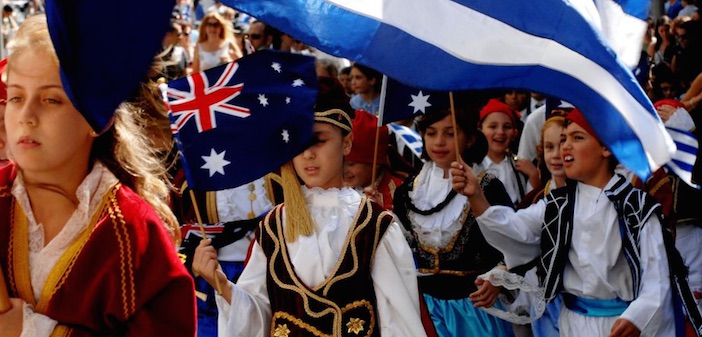
Greek Australians Giving Back to their Homeland

Source: pappaspost.com

Australia has been a mecca for immigrants for more than a century and like the United States and Canada, it’s a place tens of thousands of Greeks have settled and created their own communities. The thriving metropolis of Melbourne, Australia’s second largest city, boasts the third largest Greek population in the world— after Athens and Thessaloniki.

Numerous efforts have been underway via the church and smaller organizations to give back to the people of Greece during the economic crisis, which has turned into somewhat of a humanitarian crisis for many people in Greece.

The Hellenic Initiative, launched a few years ago in the United States by a group of concerned businessmen and women led by Dow Chemical CEO Andrew Liveris (himself a Greek Australian) sought a substantive way to give back to Greece.

The movement has now landed in Australia and is already making waves Down Under in their efforts to help their compatriots in Greece.

More than 150 leaders of the Greek-Australian community met in Sydney in April to discuss how to mobilize Australian support for The Hellenic Initiative, which launched in Athens a few years ago with former U.S. President Bill Clinton as an honorary figurehead and supporter.

“It was energizing to see so many of my fellow Greek Australians coming together to join an international movement to support Greece,” said THI Chairman & co-Founder, Andrew N. Liveris. “I was equally excited to see that passion in the room towards the need and ability to have a real and lasting impact on our ancestral homeland. THI is proud to see its Australian chapter come to be,” Liveris concluded.

Michael Printzos, the program director of the Australian Hellenic Initiative returned from a trip to Melbourne where he said he raised almost $2 million in support. Of that amount, $200,000 came in direct cash support and the remainder in indirect support from 20 companies, including ANZ Bank, including offering 40 six-month paid internships for Greek graduates.

One not-for-profit program Australian-Greek money helps is “Boroume” literally meaning “we can”, that coordinates the virtual foodbank by linking businesses in Athens that want to give surplus food to charities.

Founders Alexander Theodoridis and Xenia Papastavrou said they started in 2012 linking just one bakery with surplus food at the end of the day to a charity and now have established 300 “bridges” between food outlets to charities and providing 6500 meal packages a day.

Boroume began with 10,000 euros from Australia’s Greek community and that support continues.

“Who are clientele? The neo-poor people who were middle class, both parents working, two children and all of a sudden they lost their jobs, they had a mortgage to pay, it doesn’t take long,” Theodoridis said.

But support won’t come only in direct donations to charity. The Hellenic Initiative has bigger plans.

“One way of looking at it is feeding someone fish and at the same time trying to make them fish for themselves so it’s the more long time sustainable solution to start a business and hire people than to have soup kitchens all the time in the center of Athens,” Printzos said.

Rockets reach deal to bring Greek star Kostas Papanikolaou over for next season

Source: probasketballtalk.nbcsports
JSF Nanterre v FC Barlelona Basket -Euroleague

There was great comedy back in 2012 when the Knicks had just one second round pick and used it to take Greek small forward Kostas Papanikolaou — Knick’s fans had no idea who he was and freaked out.

Eventually Papanikolaou’s rights worked their way to the Rockets, who have signed a deal to bring the oversized small forward over for next season, something first reported by Marc Stein of ESPN. Papanikolaou has a fully guaranteed $4.8 million this coming season and a team option for $4.6 million next season.

There will be minutes to be had at the three behind Trevor Ariza (especially with Chandler Parsons gone) and even at the four where it’s Terrence Jones and Jeff Ardrien trying to space the floor for Dwight Howard inside (Papanikolaou can shoot the three). Papanikolaou is 6’8” and 230 pounds and according to reports works pretty hard on defense, so he can play the stretch four and defend a little.

Aside that, honestly I know little more than Knicks fans about him. Last season he played for Barcelona, one of the top teams in Europe. According to the DraftExpress scouting report he’s kind of a classically European big — great feel for the game, can shoot the rock, plays with a high IQ but he has average athleticism and there are questions about how much he’ll be able to do at the NBA level.

We will get a chance to see him at the World Cup where he will play for the Greek national team.

Older Greek Men Feel Pain of Job Losses

Unemployment Rate Is About Twice the Euro-Zone Average

An unemployed worker in February in Perama, near the port of Piraeus Associated Press

PERAMA, Greece—Most weekdays, Thanassis Tziombras, a 50-year-old worker at the shipbuilding zone here at the main Greek port of Piraeus, is up before dawn and out looking for work by 6 a.m.

Some 40 minutes away, in the posh Athens suburb of Psychico, Constantinos Tsimas, a 54-year-old U.S.-educated marketing consultant, wakes up to another day of working the phones and emails seeking clients.

There is a social gulf between these two men, but they are united in one thing: the financial and psychological struggle that comes with being older and unemployed in a country where the economy has shrunk by almost a quarter in six years.

Greece’s economy has taken such a brutal beating that it is in a category apart from other European countries suffering through the recession. Where Greece lost some 25% of its economic output, Spain lost about 6%. Experts say that, even as the Greek economy begins to recover, the shock has been so severe that older workers are unlikely to ever hold full-time jobs again.

Unlike in other parts of Europe, Greek reforms have largely removed provisions that protected older workers. In Spain and Italy labor-market regulations favoring baby-boomers over their children are still largely in place, entrenching the so-called two-tier labor market. But in Greece, everyone seeking work largely faces similarly poor odds, said Raymond Torres, head of research at the International Labor Organization, the United Nations labor agency.

While Greece’s youth unemployment is still a record for the EU—almost 60% of people aged 15 to 24 were out of work in 2013—the unemployment rate among older Greek males is about twice the euro-zone average and almost four times that of Germany.

Some 18% of 40-to-59-year-old Greek men were out of work last year, according to Eurostat, the European Union statistics agency. In the U.S. where the recession set in sooner than in the EU, the unemployment rate for men in this age group peaked at 8.2% in 2010 and has been declining since to reach 5.7% in 2013.

One in five jobs lost in Greece between 2008 and 2013 was from the middle-aged male group. The Spanish equivalent was one in eight. In Italy, middle-aged men actually added jobs in the recession years.

Greece’s older men are more often families’ sole breadwinners. Female employment rates here, at 43.3% in 2013, are the lowest in the EU, where the average is 62.5%, according to Eurostat.

Recent pension reforms, meanwhile, mean older Greek men who have lost their jobs could be looking at several years of no income. Greece has increased the retirement age to 67 for both men and women, changing a decades-old system that allowed some categories of workers as young as 55 to retire on a full pension.

“If they don’t have a job and they have to wait so long for a pension, what are they doing in the meantime? They are at serious risk of poverty,” said Anne Sonnet, a senior economist at the Organization for Economic Cooperation and Development, a Paris-based think tank.

In Greece, with its macho, traditional culture, unemployed men are at risk of depression, says Dr. Kyriakos Katsadoros, a psychiatrist and the science chief of Klimaka, a suicide-watch nongovernmental organization in Athens, who also noted risks of alcoholism and domestic violence.

“We were used to providing for our families through honest work. We were proud of our work—now we’re just ashamed,” says Mr. Tziombras, counting his worry beads between his fingers.

He is sitting in an old classroom on the port now used by the Communist-led laborers’ union here. “Don’t kill the mosquitoes—it’s others who are sucking your blood,” is written in chalk on the blackboard.

He says the union, apart from political guidance, provides “solidarity and psychological support” to workers.

The shipbuilding zone at Perama in Pireaus, once buzzing, is now a wasteland of idle cranes and scattered ship parts. Men sit in cafes waiting for word that a vessel has docked for maintenance and is in need of day workers.

At its peak in 2008, 6,500 men worked here. The shipbuilding industry retains workers on a daily rate as opposed to hiring them as staff, but in 2008 there was so much demand that these workers were effectively employed full time. In the good years, they would take home a net daily salary of about €70, or about $95. They haven’t agreed to cut this rate, despite calls by employers’ associations. Today, about 1,000 workers remain, doing sporadic work.

Mr. Tziombras says his wife managed to find a job as a cleaner at a local school, bringing a few euros into the household budget, but their relationship has been strained by the financial woes. Economists say it is a growing trend in Greece for women that didn’t previously work outside the home to take jobs as their spouses lose theirs.

Late last year he drove across the country to get a few days’ work at a factory. He has been doing odd jobs at construction sites around Piraeus and Athens, and continues to show up each morning at the port ready for work. The last time he got a job was for three days in January.

“We have gone through our savings, we’ve sold everything we owned, we stopped any nonessential activity,” Mr. Tziombras says.

A law against foreclosing on primary homes means that he isn’t likely to lose his home because of mortgage arrears, although he frets the provision may soon be revised. His two children, 17 and 22, are in high school and college. They will continue to depend on him for years, he predicts.

Concerns are in some ways similar in Mr. Tsimas’s wealthier neighborhood. Shame at being out of work is the first thing mentioned.

“It’s socially shameful but, more than anything, I was ashamed because I had to ask my wife for money,” Mr. Tsimas says.

His wife brings home a good salary from her investment-banking job, but the loss of income from his work still hit the family budget, which supports one child at a British university and one in a private school.

He, too, has turned to politics and voluntarism to feel useful—although a very different brand to communist Mr. Tziombras and his labor-union activism. Mr. Tsimas is a member of Drassi, a liberal political party that seldom gets more than 1% in elections. He runs an online forum with friends where they debate about the economy and politics.

For all the shared experiences of shame, financial struggle and family strain, the bottom line for the two men is very different.

“I actually think unemployed working-class guys my age may be better off in a way, because their expectations were always lower,” says Mr. Tsimas. “Being at this state at 54 is certainly not what I expected for myself.”

Still, his material concerns are not about survival.

“Last year I gave my daughter my iPhone for her birthday,” he says looking at his own older mobile phone. “I couldn’t afford a new one.”

Mr. Tziombras says he has given up on all of the smaller joys of life for him and his family, like dance classes for his daughter or the occasional night at the movies with his wife. It’s now all about subsistence.

“Cutting everything that’s not food turns the workers into animals,” he says.

Γιώργος Τσαλίκης & Καίτη Γαρμπή – Να σε ζηλεύουν πιο καλά (VC 2014)

Ο Γιώργος και η Καίτη μετά από 12 χρόνια όταν είχαν τραγουδήσει το ντουέτο τους “Θα μείνει μεταξύ μας” συναντήθηκαν ξανά στο στούντιο αυτή την φορά για να διασκευάσουν το υπέροχο και διαχρονικό λαϊκό τραγούδι “Να σε ζηλεύουν πιο καλά”. Οι δύο καλοί φίλοι και συνάδελφοι χάρηκαν πολύ αύτη την δεύτερη τους μουσική συνάντηση στο στούντιο και την μοιράζονται μαζί σας με αγάπη.Στίχοι: Βασίλης Παπαδόπουλος Μουσική: Θεόδωρος Καμπουρίδης Ενορχήστρωση – Παραγωγή: Κώστας Λαινάς Σκηνοθεσία :Αντώνης ΣωτηρόπουλοςΚυκλοφορεί απο την GABI Music

Dimitris Minasidis collects 62kg gold as Gareth Evans finishes fifth

Source: ABCNews

Pacific wins two weightlifting medals at the Glasgow Commonwealth Games

Dika Toua.jpg

Athletes from the Pacific have won two medals at the Commonwealth Games in Glasgow – both in weightlifting.

Veteran Papua New Guinean weightlifter Dika Toua won a silver medal in the Womens 53kg event.

Samoan weightlifter, Nevo Ioane Vaipava won bronze in the 62kg class.

In the leadup to the men’s event, it was billed as the ‘Battle of the South Seas’ with Tuvalu’s Lapua Lapua expected to be 26 year-old Vaipava’s main challenger.

However, the gold medal was won by Cyprus’ Dimitris Minasidis with a total lift of 276kg ahead of Sudesh Peiris of Sri Lanka, 3kg behind.

Dimitris Minasidis of Cyprus competes in the Men's 62kg Weightlifting

With a total lift of 271kg, Vaipava managed to hold off a challenge from PNG’s Morea Baru.

In women’s competition, Diki Toua was considered favourite for gold as the three medallists from the Delhi Games in 2010 were all absent from Glasgow.

But 16 year-old Nigerian schoolgirl Chika Amalaha won the gold with a total lift of 196kg to Toua’s total lift of 193kg.

India’s Santoshi Matsa picked up the bronze with lifts totalling 188kg.

30 year-old Toua started weightlifting in 1996, following a family tradition after her aunt also represented Papua New Guinea. She has competed at four consecutive Olympic games since her debut as a 16 year-old at Sydney in 2000 when she became the first female weightlifter to represent PNG.

Nevo Ioane Vaipava.jpg

Toua’s best result in Olympic competition is a sixth-place finish at the 2004 Games in Athens.

In her athlete biography, the mother-of-two says her most memorable sporting achievement was winning a silver medal at the 2006 Commonwealth Games in Melbourne.

After two days of competition, New Zealand has bagged eight medals.

India currently has ten, Malaysia two and Singapore, Sri Lanka and Bangladesh one.

Athletes from 13 Pacific nations are competing at the Glasgow Games with Fiji represented for the first time since Melbourne in 2006.

Fiji was banned from the Commonwealth Games in 2009 after refusing free and fair elections.

The ban was lifted in March, giving Fiji just four months to prepare for the Games.

Andri Eleftheriou of Cyprus won the bronze medal shoot-off

Source: SMH

Laura Coles claims Commonwealth shooting gold

Gold medal effort ...  Laura Coles  of Australia competes in the Women's Skeet qualifying at Barry Buddon Shooting Centre.Gold medal effort … Laura Coles of Australia competes in the Women’s Skeet qualifying at Barry Buddon Shooting Centre. Photo: Jeff J Mitchell / Getty Images

Laura Coles has won gold in the women’s skeet to claim Australia’s first shooting medal of the Commonwealth Games.

The 27-year-old exercise physiologist shot 14 out of 16 targets in the gold medal shoot-off against Wales’ Elena Allen, who missed three shots to finish with silver on Friday.

On the podium ... from left, Elena Allen of Wales, Laura Coles of Australia and Andri Eleftheriou of Cyprus receive their medals after winning the Women's Skeet final at Barry Buddon Shooting Centre.On the podium … from left, Elena Allen of Wales, Laura Coles of Australia and Andri Eleftheriou of Cyprus receive their medals after winning the Women’s Skeet final at Barry Buddon Shooting Centre. Photo: Jeff J Mitchell/Getty Images

Andri Eleftheriou from Cyprus won the bronze medal shoot-off. Australia’s Lauryn Mark made it to the semi-final, finishing sixth.

Greek origin Turkish citizen appointed to Imbros Municipal Police

Karanikolas GR TR IBNANicholas Karanikolas is a Greek origin Turkish citizen living permanently on the island of Imbros and recently appointed to the municipal police.

Karanikolas submitted his application for this position last April and the new mayor of the island, Cetin Unal, decided he be appointed to the position in March 2014.

The policeman speaking to the Turkish newspaper Zaman said that his colleagues treat him nicely and is like a family and added that so far he has not faced any difficulty due to his origin.

“I am very happy to work in the Municipality. God bless our mayor”, Karanikolas said to the turkish newspaper.

The mayor of the island said that the appointment of Nicholas promotes the Greco-Turkish friendship and added that the Greek population of the island appreciates very much the fact that a Greek in origin was appointed to the police.

Australian tourist in Greek arrest crossfire

An Australian tourist has been injured as Greek police captured one of the country’s top fugitives after a shootout in central Athens.

An Australian man has been caught in the crossfire as Greek police captured far-left extremist Nikos Maziotis – one of the country’s top fugitives – after a shootout in central Athens.

“Nikos Maziotis has been arrested,” a police source said on Wednesday, adding that a police officer had been injured in the shooting near the tourist district of Monastiraki.

Maziotis and a policeman were injured during the shootout accoridng to media reports.

According to early reports, two male tourists – an Australian and a German – were also lightly hurt in the exchange of fire, the police source said.

Maziotis himself, a leading member of defunct militant outfit Revolutionary Struggle, was more seriously injured, state television Nerit reported.

“I saw a man being taken away with his hands behind his back, he was bleeding profusely,” a witness told reporters at the scene.

“I believe he was wearing a wig,” she added.

Media reports said Maziotis was armed with a handgun and a grenade, which he threw at the police but failed to explode.

Maziotis, 42, and his companion Panagiota Roupa – also a one-time member of Revolutionary Struggle – had been conditionally released from prison in 2012 and subsequently disappeared.

They have a four-year-old son who was born in an Athens hospital a few months after his parents were imprisoned in 2010.

Revolutionary Struggle, which first emerged in 2003, was once deemed by authorities to be the country’s most dangerous far-left organisation and is on EU and US lists of terrorist groups.

The United States put a bounty on the group after it fired a rocket at the US embassy in Athens in 2007 without injuring anyone.

Greek of the Week Features Vicki Liviakis!

Source: newgreektv.com

Greek of the Week Features Vicki Liviakis!

New Greek TV’s featured Greek of the Week is Emmy-Award winning journalist Vicki Liviakis!

Liviakis is a KRON 4 news anchor based in San Francisco and has always wanted a career in journalism. She describes, “My father was a TV repairman and his brother was a rocket scientist. My mother’s family loved to perform – on Broadway and at The Met. Because I lacked the talent to sing – I used my voice to tell stories, to inform and sometimes even move people”.

The intelligent Greek-American journalist was born to Greek parents and grew up in Sacramento, California. Her father’s origins are from a small village outside of Hania, Crete, while her mother is from Kalamata and Corinth. The acclaimed news anchor explains how her ethnicity influences her daily life, “I never altered my given name – Vicki Liviakis. Like any ethic name it can create an opportunity to educate. I’m always happy to explain its roots from the island of Crete”. Her favorite places in Greece are Santorini, Crete and Hydra. She views Greece as, “a special place to refresh your body, mind and soul”.

Liviakis, a mother of one son, had an all-American childhood with a Greek twist. Her father coached Little League, while her mother was the PTA President, but also served as the President of the Orthodox Church community and taught Sunday School. Of her tight-knit family she declares, “My Papou lived with us in his later years and he loved his krasi!”

The stunning news anchor graduated from the University of California at Berkeley and studied Social Science, Political Science and Journalism. Liviakis began her journalism career in radio, working as a news director and host. She then broke into television as a freelance reporter, host and anchor.

Liviakis’ very successful career includes winning two Emmy Awards for Best Entertainment Program for The West and for Best On Camera Performance for a PBS title. She has been honored with a plethora of other awards, including six Associated Press Awards and Best Documentary and Best Mini Series Awards from the Radio-Television News Directors Association. The American Women in Radio and Television honored Liviakis for her Outstanding Contributions to Broadcasting.

The talented news anchor has traveled around the globe reporting on a wide range of international events. Liviakis views herself as, “A journalist and witness to living history and a storyteller. I discovered long ago that fact is stranger than fiction, and truth is the most powerful tool in the telling of a compelling story”. Vicki Liviakis’ offers her best piece of advice for anyone trying to fulfill their dream, “Do what you love, love what you do. The rest takes care of itself”.

Historic Houses of Worship: St. Photios Greek Orthodox National Shrine

Source: staugustine.com

Vividly painted frescoes in St. Photios Greek Orthodox National Shrine depict scenes from the life of Christ, the apostles and the saints.   Jackie Kramer

Jackie Kramer
Vividly painted frescoes in St. Photios Greek Orthodox National Shrine depict scenes from the life of Christ, the apostles and the saints.

St. Photios stands as a tribute to the first permanent colony of Greeks who arrived in America with fellow immigrants from Corsica and Italy on June 26, 1768. They were recruited by Scottish physician Andrew Turnbull and his partner, who received grants from Great Britain to help develop settlements in newly acquired Florida.

The Greeks escaped oppression in their homelands only to find themselves toiling under deplorable conditions as indentured servants in New Smyrna, south of St. Augustine, where they were promised tracts of land in exchange for their hard work. Though many perished, hundreds who survived fled to St. Augustine in 1777.

The English allowed them to worship in Casa Avero, a home built in 1749. The Avero House was purchased by the Greek Orthodox Diocese in 1966, and in 1972, it was officially listed on the National Register of Historic Places.

The shrine has been established as a living memorial “…to the first Greek settlers on the American continent and to all the Greek Orthodox pioneers whose love of freedom and desire for a better life for themselves and their children brought them to this New World.” (Shrine Newsletter, Sept. 2013).

St. Photios is filled with photographs, historical documents and artifacts. The chapel is a real gem in which religion is brought to life through art and architecture. Archways gracefully yield one to another.

Walls and ceilings are frescoed by artist Geroge Fillipakis, with Byzantine-style scenes from the life of Christ, the apostles, and the saints. The paintings are heavily embellished with 22-karat gold leaf.

It is easy to see why the St. Photios Chapel is referred to as “The Jewel of St. George Street.”