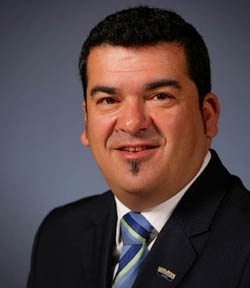
The Macedonian Minister of Macedonia and Thrace, Mr Theodoros Karaoglou

Source: NeosKosmos

Macedonian Minister to tour Melbourne

A glendi and academic lectures in store for the Minister.

The Macedonian Minister of Macedonia and Thrace, Mr Theodoros Karaoglou, will be visiting Melbourne to attend celebrations and events in support of Macedonian issues.

The Minister will be treated to the unique Greek Australian flavours of the Macedonian community at the Macedonian Glendi on November 18.

The popular event brings together a 30,000 strong crowd of Greeks and Australians every year. Also on the agenda are two lectures by Professor George Bambniotis.

The first entitled “The language of our ancestors in a migratory environment: The case of the Greek language” will be held at the Hellenic Museum on Thursday 22 November at 6:30 pm.

The second entitled “The different dialects of Ancient Greek: The development of the Macedonian language” will be held at the Medical School of Melbourne University on Tuesday 27 November at 6:30 pm.

As well as the lectures, Mr Karaglou will attend many consultative functions, including events run by the Pan Macedonian Association of Melbourne and Victoria and the Australian Hellenic Council.

20121029-121329.jpg

We take a historical look at the beginnings of OXI Day in Australia

OXI day in Australia

We take a historical look at the beginnings of OXI Day in Australia, and how the first Greek Australians dealt with the onset of WWII in their adopted nation

OXI day in Australia

Greek Australians marching in the OXI Day parade in Australia.

Today marks the anniversary of OXI Day – a day celebrated throughout Greece, and by Greeks of the diaspora – to commemorate the rejection by Greek dictator Ioannis Metaxas of the ultimatum made by Italian dictator Benito Mussolini on October 28, 1940.

Below is an excerpt from Hugh Gilchrist’s historical book Australian’s and Greeks volume 3, in which he looks at the way Australia’s Greeks viewed and prepared for World War II and the Australian governments response to help.


The Greeks in Australia
Australia’s Greeks had watched events in Europe with increasing anxiety. Their attitude to the Metaxas regime, as might be expected, had been divided. Of their three newspapers, Panellinios Kiryx (Hellenic Herald) had initially denounced it as Fascist-inspired; Ethnikon Vima (National Tribune) had voiced mild criticism of it; Phos (Light) had given it enthusiastic support. Dr Vrysakis had claimed that Greece was enjoying paternal government; but Australia’s left-wing Greeks remained adamantly opposed to the regime.

Campaigns to raise funds to buy aircraft also divided Australia’s Greek communities. A fund in aid of the Greek air force, backed by Greece’s Consuls, by the Greek Orthodox Archbishop and by Phos, but opposed by the Greek Left, raised about £800 (to which Antony Lucas, Greece’s Consul in Melbourne, contributed £500). Another fund, launched in Sydney by Ethnikon Vima, had by October 1939 raised about £2,555 in aid of the Royal Australian Air Force.

Virtually all of Australia’s Greeks, however, were from the outset supportive of Britain and the Allies. In January 1940, long before anyone imagined that Australian troops would be involved in Greece, Panellinios Kiryx enthusiastically applauded the spectacle of the AIF’s 16th Brigade parading through Sydney streets, preparatory to service overseas.

This warm pro-Allied sentiment among Australia’s Greeks did not at first receive due recognition from some of Australia’s less educated citizens. Insults were sometimes hurled at Greek shop-keepers in the mistaken belief that the latter were Italian; and in June 1940 Greek shop-keepers in Melbourne gathered outside the Greek Consulate, seeking protection of their shops from what were described as “a few irate young Australians”.

In a radio broadcast Dr Vrysakis appealed to Australians not to lump all southern Europeans together, but to consider every Greek as being well disposed towards Australia. “To prevent confusion”, he added, “my compatriots have formed a Greek-Australia League, whose object is to strengthen the ties between our two countries”.

The League, said to have been founded in Sydney in May 1940, issued placards to Greek shop-keepers, bearing the words: “This is a Greek Shop”; but it appears to have done little else, and soon faded.

When Greece declared war on Italy, public opinion in Australia changed overnight. The mainstream press, until then equivocal about the Metaxas regime, warmly praised Greece’s resistance to Italian aggression; and, when Australian troops in north Africa defeated an Italian army in February 1941, Greeks and Australians felt united in a common cause.


The Commitment to Greece

Repulse of the Italian invasion produced a temporary euphoria in Greece, but it became increasingly clear that a German invasion of the Balkans, as a prelude to an invasion of southern Russia, would not be long delayed; as early as September 1940 Australian newspapers were predicting an invasion of the Balkans in the following spring. Metaxas faced two questions: could Britain provide enough military assistance to Greece in her war against Italy without provoking a German invasion?; and, in the event of a German invasion, could Britain act with enough strength to repel it?

Soon after Italy’s attack, the question of military aid to Greece began to exercise the mind of Prime Minister Winston Churchill. He cabled Foreign Secretary Anthony Eden in Cairo: “Greek situation must be held to dominate all others now. Aid to Greece must be attentively studied, lest the whole Turkish position is lost through proof that England never tries to keep her guarantees”. Eden doubted that enough troops or air cover could be spared from North Africa for a decisive effect on the Greek situation. Metaxas felt that an inadequate British force would serve no useful purpose. A British offer to send specialist and technical troops was declined.

At the end of January 1941 Metaxas died, after a short illness, leaving Greece with a weak and indecisive parliamentary government. Churchill, however, heartened by Allied victories in north Africa, instructed the Allied commander in the Middle East, General Wavell, that the defence of Greece must be given priority, despite doubt whether the Greek government would accept a British offer of a substantial fighting force.

At this juncture Australia’s Prime Minister, Robert Mcnzies, arrived in Cairo, primarily to inspect Australian troops in Egypt. Not until 10 February was he informed by Wavell of what was proposed for the defence of Greece. On 18 February Wavell briefed the Australian force commander, Lieutenant-General Blarney, on the proposed operation, involving at least one Australian division. But Blarney failed to inform the Australian government until 8 March. Possibly he assumed that Menzies had agreed to Wavell’s proposal; but from the outset Blarney doubted the operation’s prospect of success.

In London on 23 February Menzies was briefed by Churchill. At that time Eden and the Chief of the Imperial General Staff, Sir John Dill, were in Cairo, about to confer with the new Greek government, led by the Athenian banker Alexander Koryzis, on the prospects of an Allied defence of Greece. Even at this stage, however, the Australian government had not been told that its troops were to be deployed in Greece.

In London Menzies – as he wrote many years later – made it clear that the case for intervention in Greece, at a time when the position in Egypt and Cyrenaica, though currently satisfactory, was in its nature precarious, must be established. Although my colleagues and I were willing to be bold, we also wanted to be as prudent as possible. We were not in a war of local defence, but in a world war, the chances of which might take us into strange places.

In Canberra there was resentment at the lack of earlier consultation. Army Minister Percy Spender later wrote:
In the early part of 1941, when plans were in the making to send aid to Greece, scant consideration seems to have been given by Churchill and his advisers to whether what they were planning would meet with the approval of the Australian government. So-called consultation between London and Australia, despite the exchange of many cables, was not full and complete.

Although still dogged by doubts, the Greek government on 23 February agreed to the proposed Allied force. Menzies had been persuaded to agree to the planned operation. The Dominions Office cabled Acting Prime Minister Arthur Fadden, seeking the Australian government’s formal approval. Menzies cabled Fadden, setting out the pros and cons, and recommending agreement, albeit “with some anxiety”. Churchill informed Eden that there was “no need to anticipate difficulties” from either Australia or New Zealand.

When the Australian War Cabinet received the Dominions Office cable on 26 February it had still not heard from General Blarney. It had, however, accepted Wavell’s and Dill’s assessment that, although the operation involved some risk, it would, if successful, have valuable political results in the Balkans and Turkey, and even in the United States, whereas failure to fulfil the British commitment to aid Greece could produce an adverse political outcome.

With many misgivings, War Cabinet agreed to Australia’s participation, while seeking specific assurances that the Allied force would be equipped with maximum striking capability, and that, if the venture failed and evacuation of the force became necessary, adequate evacuation plans should have been made in advance.

Blarney had an opportunity to voice his doubts when summoned by Wavell and Dill to a conference on 6 March; but, as he wrote to Spender, his views were not sought: “I felt that I was receiving instructions”. Reporting the Greek army’s poor equipment and the probability of insufficient air cover, he told Spender that, in view of the disparity between the opposing forces in numbers and training, the operation would be extremely hazardous.

But his views reached the Australian Government too late for effective consideration. On 5 March British, Australian and New Zealand troops began embarking from Egypt for Greece.

* This excerpt was taken from the book Australians and Greeks: Volume III: The Later Years, by Hugh Gilchrist, published by Halstead Press.


 

Message from WHIA President J. Pandazopoulos for the OXI Day Celebration

20121026-223341.jpg

MESSAGE FOR THE CELEBRATION OF THE “OXI DAY”

October 28, 2012

Today, Greece and all the Hellenes celebrate the “ΟΧΙ DAY” which marks the anniversary of one of the most important days in the history of the world.

On 28 October 1940, the Greeks, a small, battered and courageous nation, refused to give in to the Italian forces during World War II. Τhis significant historical refusal had a profound impact on the conducting of the entire war.

That same nation remains courageous and keeps on fighting for democracy, freedom, respect, and is proud of its roots. Despite the difficult period that Greece faces, the Hellenism stands on its own strength and has already achieved in developing new powers and comparative advantages.

Commemorating all the soldiers of the 1940 battle, we celebrate the “OXI DAY” and promise to keep on “fighting like Greeks” for our motherland’s best.

ΜΗΝΥΜΑ ΓΙΑ ΤΟΝ ΕΟΡΤΑΣΜΟ ΤΗΣ ΕΘΝΙΚΗΣ ΕΠΕΤΕΙΟΥ ΤΟΥ «ΟΧΙ»

28 Οκτωβρίου, 2012

Σήμερα, η Ελλάδα και όλοι οι Έλληνες γιορτάζουν την εθνική επέτειο του «ΟΧΙ», που σηματοδοτεί τον εορτασμό μιας από της σημαντικότερες ημέρες της παγκόσμιας ιστορίας.

Την 28η Οκτωβρίου 1940, οι Έλληνες, ένα μικρό, τυραννισμένο αλλά γενναίο έθνος, αρνήθηκε να παραδοθεί στα ιταλικά στρατεύματα κατά τον Β’ Παγκόσμιο Πόλεμο. Αυτή η σημαντική ιστορική άρνηση υπήρξε καταλυτική για την εξέλιξη ολόκληρου του πολέμου.

Το ίδιο έθνος παραμένει γενναίο και περήφανο για τις ρίζες του, συνεχίζοντας να αγωνίζεται για δημοκρατία, ελευθερία και αλληλοσεβασμό. Παρά τη δύσκολη περίοδο που αντιμετωπίζει σήμερα η Ελλάδα, ο ελληνισμός στηρίζεται στις δυνάμεις του και έχει ήδη καταφέρει την ανάπτυξη νέων δυνατοτήτων και συγκριτικών πλεονεκτημάτων.

Τιμώντας την μνήμη όλων των στρατιωτών της μάχης του 1940, γιορτάζουμε την επέτειο του «ΟΧΙ» με την υπόσχεση να συνεχίσουμε να «μαχόμαστε σαν Έλληνες» για το καλό της πατρίδας μας.

Greek Orthodox Church, South Brisbane

Recently we discussed various aspects of immigration to this country.

Today we are looking at the development of Brisbane’s vibrant Greek community, in particular their churches. Greece itself is having severe economic issues as this post goes to air, and it may result in that country departing the European Union.

I’ve been to Greece a couple of times and marvelled at the antiquities and the fact that it is the basis of our concept of democracy.

It would be a shame if the country imploded now. But as my Greek barber says, “All the hard-working Greeks are in Australia making fortunes.

Those left want a welfare state but aren’t willing to pay taxes”.

I’m sure the problem isn’t that simple, but it is interesting that a Greek man interprets things in that way.

Greece, wedged between Europe and Asia, had been invaded from one direction or another for centuries, and the population was used to fleeing to new homes. Greeks started to arrive in Queensland as far back as the 1860s, mostly to rural towns.

During the twentieth century, some Greekmigrants in Queensland worked in the mining and sugar industries, and many established small shops and cafes. Most Queensland outback towns had at least one Greek cafe or milk bar.

A Greek community centre was established in Charlotte St Brisbane in 1913, and in 1922 the first Greek Orthodox priest arrived in Brisbane.

He conducted services in St Luke’s Anglican Church in Charlotte St until the completion of the first Greek Orthodox church, also in Charlotte St, in 1929.

Here is a photo of the laying of the foundation stone and dedication in late 1928.

Photo & Video Sharing by SmugMug

(Photo: State Library of Queensland and John Oxley Library; #50666)

And here is a later picture of that church from around 1955. It no longer exists.

(Photo: State Library of Queensland and John Oxley Library; #202766)

Although immigration ceased during WWII, it started again soon afterwards, and there was a large intake of Greek migrants during the 1950s.

During the war Greece had been invaded by the Italians, who were initially repulsed, and then the Germans.

The Greek mainland was occupied by Axis powers from 1941 to 1944, so it was no wonder that many Greek citizens were prepared to travel overseas to a new life.

Most Greek migrants were Greek Orthodox Christians, and the church in the centre of Brisbane became too small for the swelling congregation.

In 1956 land was purchased in South Brisbane to allow the construction of a new church.

Plans were drawn up by RM Wilson, the foundation stone was laid on 4 May 1958 and the church was consecrated on 24 April 1960.

Here is a recent photograph of the church.

(Photo: © 2012 the foto fanatic)

It seems to me that the Greeks are very strong on family and their cultural traditions.

There is a large Greek Club next to the church that enables these traditions to continue amongst newer generations.

Of course, Greeks know how to have fun and the annual Paniyiri festival that has been running since 1976 is held over the road from the church and draws huge crowds each year.

Photo & Video Sharing by SmugMugPhoto & Video Sharing by SmugMug

(Photos: couriermail.com & gocstgeorge.com.au)

Family history: Dust, dates, documents and dowry agreements

Source: NeosKosmos

Researching my family history – beyond our migrant experience – occurred in 1971 and 1977 when I visited my village, Sianna, Rhodes.

The engagement photo of George and Chyrsanthe Sarris.

Being an archivist and genealogist / family historian, I am very used to dealing with old and fragile documents and conducting research for others. Researching and documenting my own family history, however, is another matter altogether. There is a different level of excitement when dates and documents are discovered.

I will use the occasion of my parent’s 65th wedding anniversary to illustrate my point. Researching my family history – beyond our migrant experience – occurred in 1971 and 1977 when I visited my village, Sianna, Rhodes, having migrated to Australia in 1954, as a six-year-old. Whilst exploring the family home I discovered an abandoned, nondescript, wooden trunk that had belonged to my late maternal grandfather who had passed away in 1968 at the ripe old age of 90.

Inside the dusty trunk I discovered a plethora of ‘official documents’ and certificate butts from both the Church and Municipal Offices of the village.
The documents, dating from the 1890s to the mid 1960s, related to baptism certificates, marriages, deaths, and so forth. One document – which I suspect is my maternal grandmother’s birth certificate – is written in Ottoman script (pre 1912), and many are in Italian, dating from the Italian occupation (1912 – 1943). My grandfather was also the village priest – hence the existence of the trunk and its contents.

Original documents and photographs from that period are relatively scarce and often in a rather poor condition. I was surprised to observe how much of the material was in relatively good condition. Fascinating stuff. What has all of this to do with dates, documents, and dowry agreements? Everything. My parents, George, the son of Spiros and Despina Sarris, and Chrysanthe, daughter of Papa Panayiotis and Presbytera Evterpi Photakis, aged 25 and 21 respectively, were married on the 19 October 1947.

And of course, Papa Panayiotis conducted the marriage service, which was held in the Church of Saint Panteleimon, in the village of Sianna, Rhodes. In the trunk were two original documents directly relating to my parent’s marriage.

Specifically, the Dowry Agreement (Proikosumfwnon) and the wedding service permission (issued by the Metropolitan of Rhodes). The structure, language and contents used in the agreement makes fascinating reading and will be the subject of a more in-depth article in the future.

After all, it seems to me that the Proikosumfwnon, in essence, is the precursor to what we now refer to as a Prenuptial Agreement. In addition, a formal photograph of my parents as an engaged couple exists. But the real gem is a very small photograph, measuring no bigger than 6×4 cm, taken on their wedding day – there is no other photographic record of the marriage.

It was taken in front of the church just before the commencement of the wedding service. The bride flanked by her future father-in-law, partly obscured, and future sister-in-law, and the groom in separate circles, dance the traditional sousta. 65 years later they live in Adelaide, having migrated to Australia in the early ’50s. They have two sons Spiros married to Hristina, and Panayiotis married to Constantina; grandchildren: Anthea, George married to Anthoula, and Paul; great-grandchildren Spyridon and Ekaterina – who this year celebrates her first birthday on the same date 19 October.
These documents and photographs, together with expired passports, birth certificate extracts, form the documentary basis of our migrant family history. For my parents and our extended family these items are priceless. They give us a connection to the past and a treasure to pass on to our children and their children. For me the journey of discovery continues. There is more dust to be removed, more documents and dowry agreements to discover, more dates to record, more photographs to examine… * Spiros Sarris is an archivist and genealogist based in Adelaide, Australia.

ONE MONTH TO GO Alexander the Great: 2000 years of treasures opens 24 November 2012

MEDIA RELEASE

One month to go

Alexander the Great: 2000 years of treasures opens on 24 November

With just one month to go until the 24 November opening of Alexander the Great: 2000 Years of treasures at the Australian Museum, the staff of the State Hermitage in St Petersburg are busily preparing the exhibition for transport to Sydney.

“This will be the first time this outstanding collection has been seen outside the Hermitages in St Petersburg and Amsterdam,” says Frank Howarth, Director of the Australian Museum.

“Massive resources are involved in bringing this exhibition from St Petersburg to Sydney. There will be a total of 29 curators and conservators accompanying the exhibition to and from Australia – quite apart from our own team working on the project at the Australian Museum.”

“This extraordinary exhibition largely focuses on the legacy of Alexander and how his story has lived on through the centuries,” Elizabeth Cowell, the exhibition’s Project Manager.

Catherine the Great, 18th century Empress of Russia and founder of the State Hermitage, was fascinated by Alexander. She began this collection of treasures relating to Alexander and it is unsurpassed in terms of its breadth.

“The diversity is incredible, from an enormous tapestry that’s over four by seven metres, going down to small coins and tiny exquisite cameos made of precious stones,” says Elizabeth. “There’s a lot of gold jewellery, marble statues, terracotta pottery and so much more – from Alexander’s time right up to the 19th century.”

“Anyone who comes to the exhibition will not only marvel at the incredible objects, but also as they discover more about the man and his incredible achievements,” says Fran Dorey, researcher for the exhibition. “He led the world’s first professional army, numbered at over 100,000 at its peak. He led this mind-blowing number of personnel into battles which modern military strategists still study and teach, some two thousand years later.”

“This is a special opportunity’ says Frank Howarth. ‘The story of one of history’s most iconic figures will be told here in Sydney thanks to the exceptional collection of the State Hermitage. This is an exhibition that should not be missed.”

Alexander the Great: 2000 years of treasures

From 24 November, 2012 Exclusive in Australia to the Australian Museum in Sydney

Register to keep up to date with news of the exhibition at http://www.alexandersydney.com.au

Purchase tickets at http://www.ticketmaster.com.au or by calling 136 100

For further media enquiries only:

Bruce Pollack, Pollack Consulting (02) 9331 5276 or bruce@pollackconsulting.com

Steven Godbee, Steven Godbee Publicity, 0408 706 099 or steven@stevengodbee.com.au

Political economist Yanis Varoufakis attracts the biggest ever audience

Political economist Yanis Varoufakis attracts the biggest ever audience at the Greek Orthodox Community of Melbourne and Victoria

It was standing-room only at the Lonsdale Street headquarters of the Greek Orthodox Community of Melbourne and Victoria on Tuesday, as political economist Yanis Varoufakis shared his thoughts on the Greek crisis, why no such thing existed, and by the way – how to escape it.

The lecture – based upon Varoufakis’ contention that the eurozone is in its final death-throes amidst a wider global economic conflagration – was fittingly the last event to be presented at GOCMV’s current headquarters, before it too succumbs to the bulldozers.

For those who have followed his many utterances as a TV news analyst and online in recent years, it was vintage Varoufakis – eloquent, strident claims of the imminent destruction of the eurozone, within an overarching narrative of the drastic shortcomings of globalised capitalism.

Greece is a sideshow – a victim of disreputable bankers propped up by the EU which for Varoufakis is a fatally flawed institution, without the internal systems – and more importantly without the political will – for member states with surpluses to support other states who have deficits.

To begin, he asked his audience to reflect on whether the current economic and social problems in Greece should be described as a crisis at all. He pointed to the winter of 1941-1942, when over a hundred thousand Greeks died of starvation, and the 1974 invasion of Cyprus, as crises worthy of the name. “Greece is experiencing an existentialist catastrophe” he said.

“It would be just as silly to talk about the Greek crisis today, as it would be to speak of ‘the Tasmanian crisis’ in the 1930s. “The Greek people today are part of a general crisis, of which Greece is but an interesting, sad and tragic part,” said Varoufakis.

He spoke with few notes, repeating an agenda he has been espousing for some time: how the Greek, eurozone and global economic crises should be viewed as a kind of wooden Russian doll – each the offspring of the other.

“But we Greeks were one million percent responsible for Greece being the first domino to fall,” said the former advisor to PASOK, admitting that a large chunk of responsibility for the current situation lay with Greece’s political elites over decades.

Varoufakis, who worked for George Papandreou between 2004 and 2006, said the question was not whether Greece would or should leave the euro, but rather, when would Germany make up its mind, if Germany itself wishes to remain in the euro?

The EU’s demand for austerity measures to be fulfilled – in order for Greece to continue to receive bailout funds – was torture, a case of “waterboarding” he said. “Germany knows the austerity measures will not work, but it applies them because it is making its own mind up about whether it wants to remain in the euro. “I say to Germany, make it up,” said Varoufakis to widespread applause.

Then it was over to Q and A’s. The audience was largely warm and referential to the former University of Sydney lecturer, with only one or two dissenting voices, suggesting that the globe-trotting economist might be prone to “a selectivity of facts”. According to his critics, Varoufakis’ “modest proposals” as he refers to them, are based on his beliefs which some say are a mix of utopian socialism and a cautious neo-Keynesianism.

His most vocal detractors accuse him of being light on concrete suggestions for development, and too often when talking about Greece, deliberately choosing to avoid the immense dysfunctionality of its economy and the reasons for it.

He did offer three suggestions for escaping the crisis and saving the eurozone. “You don’t need federation, and you don’t need to torture people [with austerity],” said Varoufakis defiantly.

“What you do need to do is get rid of the national banking systems, make the European Central Bank take part of the debt of member states – debts which can’t ever be serviced – and make this debt disappear, and an investment policy is needed to resuscitate the [European] economy.”

As audience members filed down the dimly-lit stairs of the GOCMV building (the lift had decided not to function properly on the last, busiest night of its existence), each reflected on Varoufakis’ analysis and wish-list for action, hoping that the GOCMV building and Greece, will rise from their respective ashes, phoenix-like in the not too distant future. If only the reconstruction of a nation’s economy was as simple as laying bricks and mortar.

Australia’s links to Greece and Cyprus according to Maria Vamvakinou MP

Greece may benefit from Australia’s UN security seat

Australia’s links to Greece and Cyprus may work to the countries’ benefit after Australia won its bid for a seat on the United Nations Security Council, according to Maria Vamvakinou MP.

She says the advocacy of diaspora communities in Australia have ensured that issues pertaining to Greece and Cyprus are at the front of the minds of politicians as Australia takes its seat on the UN Security Council.

“The bilateral relationship between Australia and Greece is in excellent condition and operates in various levels”.

“The Greek community in Australia has very strong links to Greece itself and as a result of that our relationships at that level are very close and that feeds into the parliament to parliament relationship and government to government.”

She added that current crisis in Greece had “stirred” the Greeks in Australia into action, who in turn advocate on their behalf, and noted the commencement of negotiations of the work and holiday visa their most recent success.

Ms Vamvakinou added that Australia will continue to support dialogue between both the Greek-Cypriot and Turkish-Cypriot communities to try and broach a resolution, considering as a nation, she said Australia saw the first rapprochement activities between Greek-Cypriots and Turkish-Cypriots in Melbourne some 12 years.

“Australia – and even the governor General when she was there in June – will continue to support Australia’s Cypriot academic dialogue which exists at the moment – which is dialogue between Greek Cypriots and Turkish Cypriots academics who are working away trying to find ways outside the direct political context so Australia has an interest in assisting that,” she said.

However, out of the 140 votes Australia gained to get the seat on the council, Greece was not one of them. As Greece needs to vote as part of the European Union, their vote went to fellow European country Luxembourg.

Ms Vamvakinou is pleased that Australia received the seat saying that as a country with good relationships with the world, Australia will have a strong role in “shaping the worlds future”.

“Our middle power is proven on the grounds in this country to be able to broker dialogue between conflicting communities so am looking forward to us using those expertise and hopefully we can make a difference.”

Mrs Vamvakinou said Australia has always seen itself as as ‘honest broker’ and will take that approach on their seat on the UN security council.

“We have a history of operating at that middle level. We are a country that is relatively neutral I think in the sense that we have good relationship broadly speaking with world communities,” she added.

However, the issues in Greece and Cyprus may take a back seat as Australia will focus its attention on issues in Syria, and Afghanistan – where Australia’s security interests are deeply engaged.

Australian Hellene co-winner of prestigious local history prize

20121022-230459.jpg
PHOTO: Dr Diamadis receiving his award from Crs Shane O’Brien and Joe Awada

Australian Hellene named Joint Winner of Prestigious History Prize

Sydney, 20 October 2012: Sydney academic Dr Panayiotis Diamadis has been named Joint Winner of the 2012 Ron Rathbone Local History Prize. The winning entry is titled ‘Hellenism by the Bay: the Hellenic Presence in the City of Rockdale’.

At the presentation ceremony on Saturday, newly-elected Rockdale Mayor, Councillor Shane O’Brien, made the announcement and presented Dr Diamadis with the prize. His work is the first panorama specifically of the Australian Hellenic community of the geographic area of the City of Rockdale as it stands in 2012.

Inaugurated in 2006 to honour former Mayor, Councillor and historian Ron Rathbone OAM, the aim of the prize is to foster the research and writing of local history.

Entrants in the prize are asked to submit a piece of original research on any aspect of the Rockdale Local Government Area – its history, buildings, organisations, people, parks, natural features or events.

A researcher with strong interest in Australian Hellenic history, Dr Diamadis developed an exploration of the deep connections of this local government area with Hellenism.

The human dimension, the tangible aspect of the relationship, includes the range of venues offering Hellenic cuisine, the buildings owned or utilised by Australian Hellenic community organisations and the physical monuments commemorating people, places and events linking Rockdale and Hellenism.

Amongst the intangible ones are the Hellenic toponyms to be found throughout the area, and the legacy of the pursuit of athletic excellence, first developed by the ancient Hellenes millennia ago.

According to the 2011 Census, with 9.4 per cent of the population (8,664 people) speaking Hellenic (Greek), the dominant language spoken at home, after English. The broader St George region is home to the most concentrated Hellenic community in the country.

‘Hellenism by the Bay’ presents the relationship between Hellenism and the City of Rockdale since the earliest days of European settlement in the area. The picture that has emerged is one of a vibrant, diverse social group, which has contributed, and which continues to contribute to the City of Rockdale on a scale far greater than mere numbers indicate.

The winning entry is being prepared for publication in early 2013.

«Macedonia’s lost decade»

On Wednesday 24 October, the ‘Short History of Macedonia’ lecture series continues, part of the Hellenic Open University of Sydney.

In Week 7 of the short course, the topic is Macedonia’s so-called ‘lost decade’: ten years of Nazi invasion and occupation, followed by civil war.

The presentation commences at 7:30pm at AHEPA Hall, 394 Princes’ Highway, Rockdale. All welcome.

————————————————

Μεγάλη διάκριση για συμπάροικο ιστορικό

Σύδνεϋ, 20 Οκτωβρίου 2012: Ο γνωστός για την δράση του στην παροικία, καθηγητής Δρ Παναγιώτης Διαμάντης, ανακυρήχθηκε Συν-Νικητής του Αριστέιου Ιστορίας Ron Rathbone για το 2012. Η απομονή του μεγάλου βραβείου έγινε για την έρευνα του συμπάροικου με τίτλο «Η Ελληνική παρουσία στον Δήμο του Rockdale».

Στην τελετή απομονμής του Σαββάτου, ο νεο-εκλεγής Δήμαρχος, Councillor Shane O’Brien, έκανε την ανακοίνωση και παρουσίασε στον Δρ Διαμάντη το αριστείο. Η ερευνά του είναι η πρώτη πανοραμική ανασκόπηση συγκεκριμένα για την Ελληνική παρουσία στον Δήμο Rockdale.

Το Αριστείο εγκαινιάστηκε το 2006 προς τιμή του πρώην δημάρχου, δημοτικού συμβούλου κι ιστορικού Ron Rathbone OAM. Στόχος του Αριστείου είναι η ανάπτυξη της έρευνας και της καταγραφής της ιστορίας του Δήμου.

Υποφήφιοι για το Αριστείο υπέβαλαν αυθεντική (original) έρευνα γύρω από κάποια πτυχή του Δήμου Rockdale – ιστορική ανάπτυξη, κτίρια, οργανώσεις, πληθυσμός, δημοτικοί κήποι, φυσικές ομορφιές ή γεγονόντα.

Ερευνητής με ισχυρό ενδιαφέρον για θέματα Ελληνο-Αυστραλιανής ιστορίας, ο Δρ Διαμάντης ανέπτυξε πραγματικά εκπληκτική έρευνα των βαθειών δεσμών του Ελληνισμού με την περιφέρεια αυτή.

Η ανθρώπιη διάσταση, η χειροπιαστή πτυχή των σχέσεων, συμπεριλαμβάνει τους χώρους που προσφέρουν Ελληνική κουζίνα, τα κτίρια τα οποία είναι ιδιοκτησία παροικιακών οργανώσεων ή που χρησιμοποιούντε από αυτά, και τα μνημεία που μας θυμήζουν τους ανθρώπους, τα τοπία και τα γεγονόντα τα οποία συνδέουν το Rockdale με τον Ελληνισμό.

Η έρευνα του Δρ Διαμάντη επίσης συμπεριλαμβάνει τα Ελληνικά τοπονύμια του δήμου, καθώς και την παράδοση αθλητισμού, μία παράδοση που πρωτοαναπτήχθηκε από τους αρχαίους Έλληνες πριν από χιλιάδες χρόνια.

Σύμφωνα με την Απογραφή του 2011, το 9,4% του πληθσμού του Δήμου Rockdale (8,664 άτομα) ομιλεί την Ελληνική στην οικία, η δεύτερη γλώσσα μετά την Αγγλική. Στην ευρήτερη περιοχή του St George (οι Δήμοι Rockdale, Kogarah και Hurstville) ζει ο πιό συμπαγής πληθυσμός Ελληνικής καταγωγής σε όλη την Αυστραλία.

Η έρευνα «Η Ελληνική παρουσία στον Δήμο του Rockdale» παρουσιάζει την σχέση του Ελληνισμού με τον Δήμο του Rockdale από τις πρώτες ημέρες της εγκατάστασεις των Ευρωπαίων στην περιοχή. Αναπτύσετε μιά εικόνα μιάς ζωντανής κοινωνικής ομάδας, η οποία έχει προσφέρει στον Δήμο πολύ περισσότερα από ότι παρουσιάζουν οι αριθμοί και τα ποσοστά.

Η έρευνα του Δρ Διαμάντη ετοιμάζετε για δημοσίευση στις αρχές του 2013.

«Η χαμένη δεκαετία της Μακεδονίας 1940-49»
Συνεχίζετε την Τετάρτη 24 Οκτωβρίου, το μάθημα του Ελληνικού Ανοικτού Πανεπιστημίου «Μιά Σύντομη Ιστορία της Μακεδονίας».

Στο 7ο κατά σειρά μάθημα, εξετάζετε η λεγόμενη «χαμένη» δεκαετία του 1940: η εποχή της Ναζιστικής εισβολής και κατοχής και του εμφυλίου πολέμου.

Το μάθημα ξεκινά άπο ώρα 7:30μμ στο AHEPA Hall, 394 Princes’ Highway, Rockdale.
Η παρουσίαση είναι δίγλωσση (Αγγλικά κι Ελληνικά) και όλοι είναι ευπρόσδεκτοι.

Ο Yanni στην Αυστραλία αρχές του 2013


Ο παγκοσμίου φήμης γνωστός μουσικός

Ο παγκοσμίου φήμης γνωστός μουσικός

Περιοδεία στην Αυστραλία -τη δεύτερη στην καριέρα του- θα πραγματοποιήσει στις αρχές του 2013 ο παγκοσμίου φήμης Έλληνας μουσικοσυνθέτης, Yanni.

Η επίσκεψή του στην Αυστραλία (και τη Νέα Ζηλανδία), στο πλαίσιο παγκόσμιας περιοδείας του που πραγματοποιεί από τον περασμένο Απρίλιο, θα ξεκινήσει από το Μπρίσμπαν στις 15 Ιανουαρίου και θα συνεχιστεί στο Σίδνεϊ στις 17, στη Μελβούρνη στις 19, στην Αδελαΐδα στις 23 και θα ολοκληρωθεί στην Πέρθη στις 27 Ιανουαρίου.

Με μια εντυπωσιακή 15μελή ορχήστρα, ο Yanni θα παρουσιάσει χαρακτηριστικές συνθέσεις του από την πολύχρονη καριέρα του.

Για την ιστορία να αναφέρουμε ότι το πραγματικό του όνομα είναι Γιάννης Χρυσομάλλης, αλλά όλοι τον ξέρουν με το καλλιτεχνικό του όνομα Yanni.

Ο Yanni γεννήθηκε το 1954 στην Καλαμάτα. Εγκαταστάθηκε στη Νέα Υόρκη το 1972 και φοίτησε στο Τμήμα Ψυχολογίας του Πανεπιστημίου Μινεσότα. Όταν έβρισκε ελεύθερο χρόνο, ο Yanni έπαιζε πιάνο στους «Chameleon», ένα ροκ συγκρότημα της δεκαετίας του ’70. Πολύ γρήγορα η μουσική τον κέρδισε ολοκληρωτικά, αναγκάζοντάς τον να αφήσει τις σπουδές του.

Έτσι, έμεινε στη Νέα Υόρκη και αφοσιώθηκε στο πιάνο και τη δημιουργία δικών του συνθέσεων.

Από πολλούς ο Yanni χαρακτηρίστηκε ως φαινόμενο των 90’s. Μία από τις σημαντικότερες στιγμές της καριέρας του ήταν όταν συνεργάστηκε με τη Φιλαρμονική Ορχήστρα του Λονδίνου.

Η γνωστή βρετανική αεροπορική εταιρεία British Airways χρησιμοποίησε μια σύνθεση του Yanni για τη διαφημιστική της εκστρατεία.

Η σχέση του Yanni με τη γνωστή ηθοποιό Linda Evans τον έκανε διάσημο και στις Ηνωμένες Πολιτείες. Αρκετά άλμπουμ του έχουν προταθεί για βραβείο Grammy μεταξύ αυτών το «Dare To Dream» και το «My Time».

Όσο για το περίφημο «Reflections Of Passion», έγινε πολλές φορές πλατινένιο πραγματοποιώντας έναν εξαιρετικά μεγάλο αριθμό πωλήσεων.

Ο Yanni υπήρξε και μέλος της ελληνικής εθνικής ομάδας κολύμβησης εφήβων και σε ηλικία μόλις 14 ετών κατέρριψε το πανελλήνιο ρεκόρ κολύμβησης, στα 50 μέτρα ελεύθερο.

Παρά το γεγονός ότι από τα μέσα της δεκαετίας του ’80 πούλησε πάνω από 6 εκατομμύρια αντίτυπα, η καριέρα του εκτινάχθηκε ακόμα περισσότερο τον Μάρτιο του 1994 όταν κυκλοφόρησε σε δίσκο και βίντεο η συναυλία-σταθμός που έδωσε για πρώτη φορά στην Ελλάδα στο Ωδείο Ηρώδου του Αττικού στις 25 Σεπτεμβρίου του 1993 με τον τίτλο «Yanni in Concert: Live Acropolis» παρουσία 2.000 χιλιάδων θεατών.