Επιστολή διαμαρτυρίας από ελληνικές οργανώσεις της Αυστραλίας για το κλείσιμο της ΕΡΤ

ΑΝΑΚΟΙΝΩΣΗ ΤΥΠΟΥ

Δέκα από τις μεγαλύτερες ομογενειακές οργανώσεις της Αυστραλίας, μεταξύ των οποίων οι Ελληνικές Ορθόδοξες Κοινότητες Μελβούρνης, Σίδνεϊ και Περθ και το Παγκόσμιο Συμβούλιο Κρητών, καταδικάζουν με κοινή ανακοίνωσή τους το κλείσιμο της δημόσιας ραδιοτηλεόρασης και ζητούν την άμεση επαναλειτουργία της ΕΡΤ, η οποία όπως τονίζουν αποτελεί γέφυρα επικοινωνίας της ομογένειας με την μητέρα πατρίδα.
Η ανακοίνωση των δέκα ομογενειακών οργανώσεων έχει ως ακολούθως:

ΕΠΙΣΤΟΛΗ ΔΙΑΜΑΡΤΥΡΙΑΣ
Μελβούρνη 19/6/2013
Η ομογένεια της Αυστραλίας πληροφορήθηκε με λύπη και απογοήτευση την απόφαση της ελληνικής κυβέρνησης να διακόψει τη λειτουργία της δημόσιας ραδιοτηλεόρασης ΕΡΤ και την απόλυση όλου του προσωπικού της.
Η πρωτοφανής αυτή ενέργεια έχει προκαλέσει μεγάλες αντιδράσεις στο χώρο της ομογένειας, μειώνοντας ταυτόχρονα την εικόνα της Ελλάδας διεθνώς και ιδιαίτερα σε μια δύσκολη για την πατρίδα μας περίοδο.
Σύσσωμη η ομογένεια της Αυστραλίας μέσω των αντιπροσωπευτικών της οργανισμών καταγγέλλει και καταδικάζει την ενέργεια αυτή και καλεί την κυβέρνηση να αναθεωρήσει την απόφασή της, να επιτρέψει άμεσα την επαναλειτουργία της ΕΡΤ και να προβεί, αν είναι αναγκαίο, στις απαιτούμενες μεταρρυθμίσεις για την αποτελεσματικότερη λειτουργία της.
Εδώ και χρόνια η ΕΡΤ αποτελεί γέφυρα επικοινωνίας με την μητέρα πατρίδα, συμβάλλοντας τα μέγιστα στην προώθηση του Ελληνικού πολιτισμού, της γλώσσας και των παραδόσεών μας σε όλον τον κόσμο, ενώ είχε αναδειχθεί σε πολύτιμο μέσο προβολής της Ελλάδας ως κοιτίδας σύγχρονου πολιτισμού, τουριστικού προορισμού και επενδυτικού ενδιαφέροντος.
Εκφράζουμε την αλληλεγγύη και συμπαράστασή μας σε όλο το προσωπικό της ΕΡΤ και τους ενθαρρύνουμε να συνεχίσουν τον αγώνα τους για την προστασία των δικαιωμάτων τους και για μια ελεύθερη δημόσια ραδιοτηλεόραση.

Ελληνική Ορθόδοξη Κοινότητα Μελβούρνης και Βικτώριας
Eλληνική Ορθόδοξη Κοινότητα Νέας Νότιας Ουαλίας
Ελληνική Κοινότητα Δυτική Αυστραλία
Ελληνική Ορθόδοξη Κοινότητα Βόρειας Επικράτειας
Παγκρητική Αδελφότητα Μελβούρνης και Βικτώριας
Παγκόσμιο Συμβούλιο Κρητών
Παμμεσσηνιακή Αδελφότητα Μελβούρνης «Παπαφλέσσας»
Ποντιακή Κοινότητα Μελβούρνης και Βικτώριας
Αυστραλο-Ελληνική Κοινωνική Πρόνοια
Fronditha Care

Victory lures Greek champion Giorgos Karagounis

Source: TheAustralian

MELBOURNE Victory is hoping to pull off a stunning coup by signing one of Greece’s greatest players, Giorgos Karagounis.

The Australian understands coach Ange Postecoglou was in Athens last week speaking with the most capped player in Greek football with a view to him joining the club for next season’s A-League.

Karagounis, 36, is understood to be ready to make a decision in the next week. The quality midfielder is set to leave English Premier League club Fulham, where he played 21 games last season and was a teammate of Socceroos goalkeeper Mark Schwarzer, and is also considering offers from Greek giants Panathinaikos and other European clubs.

While he does not have the profile of an Alessandro Del Piero, who took the A-League by storm with his brilliant efforts for Sydney FC last season, Karagounis would nonetheless be a coup for the A-League.

Karagounis, who is the captain of the Greek national team and is remembered for leading it to a stunning upset win at Euro 2004, would prove a massive hit in Melbourne, where the city’s huge Greek population would be well aware of his stature.

And, his signing would no doubt provide a huge boost for Victory’s membership and gate figures.

Karagounis has had a wonderful 15-year professional career, playing for the likes of Panathinaikos (118 games), Inter Milan (21 games) in the Italian Serie A and Portugal’s Benfica.

Despite his age, he is still a regular with the Greek national team and has played over 125 games for his country. He played in the 1-0 win over Lithuania in a World Cup qualifier on Saturday.

The remains of Australians killed in World War II may soon be unearthed near a small village in Greece

Source: TheAge

Taking cover behind a stone wall near a village in northern Greece on April 12, 1941, two Australian soldiers, Private John McGarrity and Lance Corporal Robert Brown, decided to snatch a break after narrowly escaping German heavy machinegun fire.

”I guess that was close,” McGarrity said, figuring they were safe for a moment, despite the enemy’s proximity. ”Let’s make the best of it and have a smoke.”
He rolled his cigarette, but never got to light it. ”He gave a soft cry and collapsed to the ground,” Brown later told the Red Cross.

Almost immediately, Brown was also shot. As the two Diggers lay bleeding on the freezing earth, a German officer appeared. Brown was told he was now a prisoner of war; medics would see to his mate.

”I had one last look at Private McGarrity,” he said in his Red Cross statement, ”but he was lying very still. I cannot say [if] he was dead or wounded – that was the last time I saw him.”

Brown’s testimony, from a German POW camp in 1943, is the only source of information about McGarrity’s fate: his body, like those of up to 20 other Australian soldiers killed during the same battle, was never recovered.

Now, with mixed emotions, McGarrity’s family, including his 75-year-old daughter, is preparing for the possible discovery of his remains in the grounds of a disused military compound near the tiny Greek village of Vevi.

Greece’s minister for Macedonia and Thrace (the region in which Vevi is located) has told Fairfax the Greek government is prepared to fund a dig at a site near where McGarrity and about 20 others are believed to have been buried anonymously in 1941.

If the dig proves its supporters correct, Vevi could resonate for Australians in the same way as the French town of Fromelles where, in 2009, researchers unearthed the remains of 250 Allied soldiers from World War I, including 124 Australians whose identities have been established by DNA tests.

Like the long campaign to unearth the Pheasant Wood site at Fromelles in northern France, the push to explore the fields around Vevi was initiated by amateur historians who have cross-referenced military documents with local knowledge and hearsay.

Keith Rossi, Victoria’s RSL historian for the past 26 years, is among those who believe an investigation of Vevi is well overdue.

”Look at Fromelles, when they had all that evidence – for years they didn’t do a bloody thing,” says the 91-year-old retired brigadier. ”Why doesn’t someone just go up and have a look?”
Rossi was in Vevi in 1991 to commemorate the 50th anniversary of the Greek campaign when he had an illuminating encounter.

”I was standing there at the wreath-laying ceremony and an elderly chap spoke to me,” Rossi says. ”We got talking about dead soldiers and the 2/8th Battalion, and this local said there were Australian soldiers from the war buried across the road – behind the wall.”

Rossi has talked about his encounter ever since, but it has taken nearly a quarter of a century for the conversation to grow into a concerted campaign to unravel the mystery, and to prove – one way or the other – if the rumours are true.

John McGarrity, the son of an Irish Catholic shipwright, was born in Newcastle, England, in 1905, and emigrated to Australia with an assisted passage in 1928, listed as a labourer.

He worked as a farmhand in Victoria and in manufacturing in Sunshine, where he was a member of the local running club. In 1937, aged 32, he married Norma Plumridge. Daughter Patricia was born in October the same year and Margaret in February 1939.
Within months of Margaret’s birth, Australia was at war with Germany.

McGarrity enlisted and in April 1940, his 2/8th Infantry Battalion left Melbourne for the Middle East. Having suffered the heaviest casualties of any Australian unit during the first battle for Tobruk in January 1941, it embarked for Greece on March 31.

Twelve days later, McGarrity, a popular soldier ”full of wit and humour”, according to a fellow Digger quoted in his military record, would become one of the first of more than 600 Anzac troops killed in the doomed Greek campaign.

It was an operation that began in the snows of northern Greece, where Australian and New Zealand forces – supported by Greek and British units – took on the might of Hitler’s invading Panzer army, and the SS Leibstandarte, the elite and fanatical Nazi division originally formed as bodyguards for Hitler.

Facing the same troops that had torn through Poland, France and Belgium, the Commonwealth forces were handicapped from the start by inferior armaments, poor communications and virtually no air cover.

On April 12, 1941, the 2/8th Battalion was 16 kilometres south of the border with Yugoslavia, clinging precariously to the eastern side of the Monastir Gap, near Vevi.

For more than 24 hours it repulsed the enemy. The mission was to hold the German advance long enough to allow the withdrawal of Greek forces on the Yugoslav and Albanian borders.

That afternoon, a vital phone line connecting the 2/8th’s front line to Battalion HQ was cut. McGarrity and Lance Corporal Brown volunteered to make the repair.

As they made their way forward, the German attack intensified. The 2/8th’s front line began to disintegrate, overrun by German infantry and fast-moving Panzers.

About 4pm, exposed in open ground, McGarrity and Brown came under heavy machinegun fire. The stone wall they sheltered behind proved useless, with both men shot and Brown taken prisoner of war.

McGarrity was among 28 Australian troops killed at Vevi, many of whom, from the 2/8th and 2/1st Anti Tank Regiment, were never recovered.

He was reported as ”missing in action, presumed killed” and it would not be until 1944 that McGarrity’s wife, Norma, bringing up their two daughters in Kew, would receive confirmation from the army that her husband was dead. They could not tell her what happened to his body.

If Allied prisoners died of their wounds in enemy hands, German burial units would usually identify them from identity discs or paybooks and create written records, simplifying identification of a burial site and the individuals within it years later. No such documentation has ever been found for McGarrity and a number of other members of his battalion who fell at Vevi.

After Greece was liberated in 1944, the work of the Australian War Graves Commission – charged with finding burial sites – was hampered severely in northern Greece by the Greek Civil War. The remains of those who were found were reinterred at Phaleron War Cemetery in Athens. Some 2029 Commonwealth servicemen who died on the mainland in the Greek campaign are buried or commemorated at Phaleron; 596 of the burials are unidentified. Only one member of the 2/8th Battalion killed on April 12, 1941, has a known grave at Phaleron.

Maria Cameron is one of three amateur historians involved in research on the Vevi missing.

The Port Fairy researcher, whose other projects include identifying the remains of World War I Diggers at Fromelles, has cross-referenced Australian and German military records, and believes there is ample evidence to support the proposition that Vevi still holds the remains of Australians killed there.

”If the AWGC did recover bodies in the area after the war, the German records would have given the recovery units a clue. For McGarrity and others, there are no records of that kind at all,” Cameron says.

”The absence of information in the records on John McGarrity and others from the 2/8th show they’re the ones who were never recovered. ”It’s the same as Fromelles, we couldn’t say they were definitely there.”

Melbourne military historian Carl Johnson has also examined the records relating to Vevi, and says that McGarrity qualifies as a leading contender for a soldier who fell at Vevi and is likely to be still there.

”His files were held open to September 1945, which shows the total lack of information the military had about his final resting place,” says Johnson.
”In addition to McGarrity, I’d say there’s strong evidence for others being contenders for those never recovered from the 2/8th and 2/1st Anti Tank Regiment. There could be up to 20, from both units all told.”

A third researcher, Newcastle schoolteacher Tom Tsamouras, who has been working on identifying the site pointed out in 1991 by Rossi, is also confident about the location. ”What needs to happen is for the Australian government to help the Greek authorities investigate it,” he says.

A spokesperson for Unrecovered War Casualties – Army, the unit of the Australian Defence Force that investigates alleged burial locations of Australian soldiers, said while the department had ”no verifiable evidence”, it was looking into the matter.

The Greek government has been more enthusiastic. ”The army have already drafted plans for a preliminary 15-day dig covering an area of two acres at the location, which is near a disused military compound,” says Tsamouras, who, through Greek contacts, brought the matter to the attention of Greece’s Minister for Macedonia and Thrace, Theodoros Karaoglou.

Karaoglou confirmed these details and says he believes the cost of an initial dig would be less than €30,000 ($41,000). He has vowed to authorise the expenditure personally.

Karaoglou says the dig will go ahead once the Greek army, on whose land the site sits, gives permission.

Despite the likely imminence of the dig, there has been no communication between the Greek authorities and the Australian Defence Force, according to the UWCA spokesperson.

Nonetheless, members of McGarrity’s family believe the Australian government should get involved.

Daughter Margaret died last year, but Patricia still lives in Melbourne’s eastern suburbs. Pat’s daughter, Loren Brown, says she and her mother support the idea of an investigation taking place – whatever its findings.

”The possibility of an investigation has raised a mix of emotions in the family. Some believe we should leave history as it is, undisturbed. Others feel cautious optimism, to finally know the truth,” says Loren.

”It would be wonderful to give our grandfather a proper grave, titled and recognised. These men gave their young lives for their country. Surely it is Australia’s responsibility to find them and give them the recognition they deserve.”

Margaret’s son, Phillip Wittmer, agrees. ”It’s about honouring his memory,” he says. ”These men made the ultimate sacrifice. We owe them the honour of a proper burial, to dignify their lives, rather than leaving them. At the same time, I’m not getting my hopes up too much. What will be will be.”

20130609-124456.jpg

20130609-124505.jpg
Loren Brown, the grand-daughter of Private John McGarrity, who was killed in April 1941 and whose remains have never been found. Photo: Meredith O’Shea


Εγκαινιάσθηκε ο έρανος υπέρ της Ελλάδας

30/5/2013

ΔΕΛΤΙΟ ΤΥΠΟΥ

Εγκαινιάσθηκε ο έρανος υπέρ της Ελλάδας

Με τη συμμετοχή μεγάλου αριθμού αντιπροσώπων σχολείων, εκπαιδευτικών, οργανισμών και ιδιωτών πραγματοποιήθηκε την Τρίτη το βράδυ σε αίθουσα του Αρκαδικού Κέντρου, η επίσημη έναρξη του εράνου για την Ελλάδα που διοργανώνει η Σχολική Επιτροπή Γονέων της Ελληνικής Ορθόδοξης Κοινότητας Μελβούρνης και Βικτώριας και η οργάνωση των «Πρεσβευτών της Ελλάδας» (Ο κάθε Έλληνας είναι πρεσβευτής της Ελλάδας Α.Ε.).

Στόχος του εράνου είναι να συγκεντρωθούν χρήματα με τη συνεργασία των ελληνικών σχολείων και της παροικίας γενικότερα για την ενίσχυση του Μητροπολιτικού Κοινωνικού Ιατρείου Ελληνικού (ΜΚΙΕ), το οποίο ιδρύθηκε το Δεκέμβριο του 2011 με πρωτοβουλία του Διαδημοτικού Δικτύου Αλληλεγγύης και την υποστήριξη του Δήμου Ελληνικού – Αργυρούπολης.

Σκοπός του Κοινωνικού Ιατρείου είναι να προσφέρει δωρεάν πρωτοβάθμια ιατροφαρμακευτική περίθαλψη σε κοινωνικά ευπαθείς ομάδες με ελάχιστους ή μηδαμινούς οικονομικούς πόρους.

Το φιλανθρωπικό αυτό ίδρυμα λειτουργεί αποκλειστικά με εθελοντές γιατρούς και θεραπευτές και δέχεται δωρεές μόνο σε είδη.

Για το λόγο αυτό όλα τα χρήματα που θα συγκεντρωθούν θα διατεθούν για την αγορά φαρμάκων ή και ιατρικού εξοπλισμού.

Κατά τη διάρκεια της εκδήλωσης παρουσιάσθηκε βίντεο στα Ελληνικά και Αγγλικά για τις υπηρεσίες του ΜΚΙΕ, ενώ στις δραστηριότητές του αναφέρθηκαν και οι ομιλητές.
Η ιδρύτρια των «Πρεσβευτών της Ελλάδας» κ. Εύη Γιαννά αναφέρθηκε στον έρανο και στις δραστηριότητες του ΜΚΙΕ καλώντας όλους να ενισχύσουν τον έρανο.

Ο συντονιστής του γραφείου εκπαίδευσης του Γενικού Προξενείου της Ελλάδας κ. Βασίλης Γκόκας κατά τη διάρκεια της ομιλίας του κάλεσε όλους να συσπειρωθούν γύρω από την κίνηση αυτή και να την υποστηρίξουν.

Εκ μέρους της Κοινότητας μίλησε ο συντονιστής εκπαίδευσης και μέλος του Διοικητικού Συμβουλίου κ. Θόδωρος Μάρκος υπογραμμίζοντας τις δραστηριότητες του ΜΚΙΕ, λέγοντας πως «είναι πολύ σημαντικό το γεγονός ότι αυτό το Κοινωνικό Κέντρο προσφέρει τις υπηρεσίες του δωρεάν σε όλους τους κατοίκους της Ελλάδος, ανεξαρτήτου προέλευσης», προσθέτοντας ότι η «Κοινότητα συνεχίζει το φιλανθρωπικό της αγώνα και σήμερα, όπως έπραξε επανειλημμένα και στο παρελθόν όταν η Ελλάδα είχε ανάγκη.»

Παράλληλα, συνεχάρη εκ μέρους της Κοινότητας την κίνηση των Πρεσβευτών της Ελλάδας, λέγοντας πως πρέπει όλη η παροικία να την στηρίξει.

Στη συνάντηση αποφασίστηκε κάθε σχολείο να διοργανώσει ειδική εκδήλωση με σκοπό τη συγκέντρωση χρημάτων για την ενίσχυση του εράνου.

Σημειώνεται ότι η Επιτροπή Γονέων των σχολείων της Κοινότητάς μας προγραμματίζει τρεις εκδηλώσεις υπέρ του σκοπού αυτού: μια μουσική βραδιά για τους γονείς, βραδιά κινηματογράφου και ημέρα συγκέντρωσης «χρυσών» κερμάτων.

Χαρακτηριστικό της συνάντησης ήταν η διάθεση συνεργασίας και η μεγάλη ανταπόκριση από την πλευρά των σχολείων να βοηθήσουν την κίνηση αυτή.

Διάλεξη του Κώστα Καραμάρκου με θέμα: «Ελλάδα 1974-2013: Μια κριτική επισκόπηση»

ΑΝΑΚΟΙΝΩΣΗ ΤΥΠΟΥ

Μια κριτική επισκόπηση της σημερινής κατάστασης στην Ελλάδα πρόκειται να επιχειρήσει ο δημοσιογράφος Κώστας Καραμάρκος σε διάλεξη, που θα δώσει αυτή την Κυριακή, στα πλαίσια των εκδηλώσεων του Φεστιβάλ Αντίποδες και των Σεμιναρίων Ελληνικής ιστορίας και Πολιτισμού της Ελληνικής Ορθόδοξης Κοινότητας Μελβούρνης και Βικτώριας.

Είναι καθολικά αποδεκτό ότι στην Ελλάδα, σήμερα, η τρέχουσα οικονομική, κοινωνική, πολιτιστική και πολιτική κρίση της χώρας, σηματοδοτεί το τέλος της μεταπολίτευσης, δηλαδή, τη χρονική περίοδο που αρχίζει αμέσως μετά την πτώση της στρατιωτικής χούντας, στα μέσα του 1974 και τρέχει μέχρι σήμερα. Ο ιστορικός αυτός κύκλος των 40 ετών περίπου, σηματοδοτεί μια περίοδο που η Ελλάδα απολάμβανε την πολιτική σταθερότητα και όπου η πλειοψηφία των Ελλήνων απολάμβαναν άνευ προηγουμένου πολιτικές και κοινωνικές ελευθερίες, καθώς και τον σχετικό πλούτο. Λοιπόν … Τι πήγε στραβά; Γιατί η Ελλάδα κατέληξε στη μονάδα εντατικής θεραπείας; Υπάρχει διέξοδος από αυτή την πολλαπλή κρίση; Ποιες ανταγωνιστικές δυνάμεις και πώς προσπαθούν να κάνουν τη χώρα να “ξεκινήσει εκ νέου” στον 21ο αιώνα; Μπορούν να τα καταφέρουν;
Ο ομιλητής θα επιχειρήσει να απαντήσει στα ερωτήματα, με μια κριτική προσέγγιση της περιόδου της μεταπολίτευσης, κατά τη διάρκεια της οποίας δημιουργήθηκαν τα περισσότερα από τα προβλήματα και όπου μπορούν να αναζητηθούν όλες οι «νέες» απαντήσεις.

Ο Κώστας Καραμάρκος γεννήθηκε στην Κοζάνη και μετανάστευσε στην Αυστραλία το 1981 σε εφηβική ηλικία. Απόφοιτος του Πανεπιστημίου της Μελβούρνης, όπου ειδικεύτηκε στην Ιστορία και στη Φιλοσοφία των Επιστημών, ο Κώστας πέρασε πάνω από μια δεκαετία ασχολούμενος με το κοινοτικό ραδιόφωνο, όπου εργάστηκε στο ραδιοσταθμό του 3ZZZ τόσο ως διαχειριστής όσο και ως εκφωνητής, ενώ ήταν αναμιγμένος με το Αυστραλιανό Εργατικό Κόμμα και το Φεστιβάλ Αντίποδες.

Η διάλεξη με θέμα «Ελλάδα 1974-2013: Μια κριτική επισκόπηση» θα δοθεί στο The Wheeler Centre (176 Little Lonsdale Street, Melbourne, μεταξύ των οδών Russell & Swanston Street), την Κυριακή 19 Μαΐου, στις 3.00μμ. Η είσοδος είναι ελεύθερη στο κοινό.

______________
ΠΛΗΡΟΦΟΡΙΕΣ/ΣΥΝΕΝΤΕΥΞΗ: κ. Νίκο Ντάλλα: 0403-047063

Vevi and Corinth targeted in attempt to locate troops buried anonymously

Diggers of Greece begins

Vevi and Corinth targeted in attempt to locate troops buried anonymously

Lambis Englezos at his home in Melbourne. Englezos’ work on the lost Diggers of Fromelles resulted in 250 Australian and Commonwealth soldiers from WWI being identified and given proper burials.

A concerted effort is being made to find and identify the remains of Australian soldiers who fought and died during the Greek campaign in WWII, and who 72 years later still lie buried in unmarked graves.

Research being led by a team of amateur historians in Melbourne and Sydney is seeking to unravel the mystery of 26 Australian troops killed-in-action and who are unaccounted for, who were reportedly buried by the Germans in April 1941 as Nazi forces swept through northern Greece.One member of the group, Mr Lachlan McPherson, believes the remains of more than 20 soldiers of the 2/8th Australian Infantry Battalion who fought at Vevi are likely to be located near the battle site.Mr McPherson told Neos Kosmos: “I’m convinced that there are more than 20 soldiers from the 2/8th Battalion buried in unmarked graves.

“We have a list of around 26 Australians unaccounted for who we think are there.”Mr McPherson travelled to Canberra last month to present the group’s findings to the Australian War Memorial as part of a campaign to bring the matter to the attention of the Australian government.

“We want the government to take some action on this,” said Mr McPherson.

The Australian Army’s Unrecovered War Casualties unit is responsible for investigating assertions of the discovery of Australian wartime human remains and the whereabouts of alleged burial locations of Australian servicemen.Vevi, 16 kilometres south of the Yugoslav border, was the site of the first engagement between Australian and German troops during the Greek campaign in WWII.

Standing at the narrow end of the Monastir Valley and surrounded by steep hills, the Vevi Pass was in theory a naturally strong defensive position.On 9 April 1941, troops from the 2/4th and 2/8th Australian Infantry Battalions, as well as British, Greek and NZ units began taking up positions at Vevi. Their job was to hold the advancing Germans long enough to allow the withdrawal of Greek forces in Macedonia and Albania.

The Germans first attacked Allied forward positions two days later and despite being exhausted from a long march and bitterly cold weather, the 2/8th managed at first to fend them off.Confronted with a heavier German onslaught the next day, the battalion was outflanked and unable to hold its ground. A confused withdrawal resulted, which effectively destroyed the 2/8th as an effective fighting force for the rest of the campaign.

Although the Vevi Pass was not held as long as was intended, its defence achieved its aims.

Allied casualties at Vevi are estimated at some 60 killed-in-action, with 28 Australian soldiers dead. 480 British Commonwealth troops were taken prisoner.

The group’s research has also recently revealed details of possible unmarked Australian war graves at Corinth.

At least 12 soldiers of the 2/6th Battalion who were killed in the battle for the Corinth Canal are believed to lie in unmarked graves near Corinth dug by the Germans.Lambis Englezos, instigator of the campaign which located and identified the remains of 250 Commonwealth soldiers who died at Fromelles in WWI (who is not involved with the Vevi or Corinth research) told Neos Kosmos that all credible projects which attempt to find, identify and give soldiers a proper marked burial place should be commended.

“We have a moral obligation to do this. If you can find your war dead you have to recover them. They can’t be a financial or logistical inconvenience.

“If the research is solid the officials will take it up and look for it,” said Mr Englezos.”If you lose someone, you’ve got to get them. Don’t leave them in anonymous ground. Give them their dignity, and hopefully their identity.”

$5m in Federal Budget to shield Adelaide Greek Orthodox church from aircraft noise ‘fair’

Source: TheAustralians

HINDMARSH MP Steve Georganas has defended a $5 million grant to a local Greek Orthodox church affected by aircraft noise.

Mr Georganas said the grant to the St Nicholas Greek Orthodox Church in Thebarton to install soundproofing, which was announced in last night’s Federal Budget, was not “pork barrelling” ahead of the upcoming federal election.

“`This was a program put in place … by the former Howard government in 2000-01, and we’re just continuing the program.”

The church is currently in Mr Georganas’ marginal electorate of Hindmarsh, but following a redistribution will fall into the seat of Adelaide from the 2013 election, which is held by Employment Participation minister Kate Ellis.

Instead, Mr Georganas said the grant – which was provided as part of the Adelaide Airport Noise Amelioration Program – followed money given to insulate 648 homes, along with schools and other public buildings in the area from the impact of aircraft noise.

Mr Georganas said other churches, including the St James Anglican Church in Mile End, the St George Orthodox Church in Thebarton and the St Mary and Anba Bishoy Coptic Orthodox Church in Cowandilla, had also received funding.

Mr Georganas said he had advocated for funding on the church’s behalf, but it was also a move strongly supported by the local community.

The installation of soundproofing at St Nicholas Greek Orthodox Church will be offset by the collection of a noise levy at Adelaide airport.

City of West Torrens councillor and St Nicholas parishioner Arthur Mangos said the church had campaigned for funding to soundproof the church for several years, and were pleased their turn had now come.

“The parish has been very patient, the community has been very patient,” he said.

He said noise from flights regularly disrupted services and were so loud that parishioners could not hear themselves speak.

“I’m looking forward to the day I can attend a service and enjoy it without hearing a jet flying overhead.”

Prime Minister Julia Gillard this morning told ABC Radio providing the grant was the right decision.

“The airport levies are paid around the nation, and yes, some of that money is used to deal with noise for people who live in the vicinity of the airport,” she said.

“If I was asked is it fair for people who live with aircraft noise get some alleviation from that aircraft nose, I would say yes, it’s fair.”

Οι Έλληνες ηλικιωμένοι στηρίζουν την Κοινότητα και το Ελληνικό Πολιτιστικό Κέντρο

20130515-100028.jpg

20130515-100034.jpg

15/5/2013

ΑΝΑΚΟΙΝΩΣΗ ΤΥΠΟΥ

Οι Έλληνες ηλικιωμένοι στηρίζουν την Κοινότητα και το Ελληνικό Πολιτιστικό Κέντρο

Την έμπρακτη υποστήριξή της προς την Ελληνική Ορθόδοξη Κοινότητα Μελβούρνης και Βικτώριας και το έργο της και ειδικότερα sτο υπό ανέγερση νέο κοινοτικό κτίριο, όπου θα στεγασθεί το Ελληνικό Πολιτιστικό Κέντρο, εξέφρασε μια ακόμη παροικιακή οργάνωση.
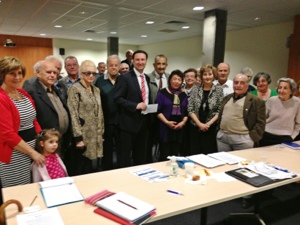
Πρόκειται για την Ένωση Συλλόγων Ελλήνων Ηλικιωμένων Μελβούρνης και Βικτώριας, το Διοικητικό Συμβούλιο της οποίας κατά τη διάρκεια της συνεδρίασης των αντιπροσώπων της, την Παρασκευή 10 Μαΐου, παρέδωσε στον πρόεδρο της Κοινότητάς μας κ. Βασίλη Παπαστεργιάδη επιταγή με ένα σημαντικό ποσό, υπέρ της ανέγερσης του νέου κοινοτικού κτιρίου.

«Την απόφαση για τη δωρεά την έλαβε η ολομέλεια του Συμβουλίου μας. Πρότεινα εγώ προσωπικά να γίνει η δωρεά και την ενέκρινε ομόφωνα το Συμβούλιο,» λέει ο πρόεδρος της Ένωσης κ. Θεοδόσης Νομικός, προσθέτοντας: «Είπαμε να βάλουμε και εμείς ένα λιθαράκι στην προσπάθεια της Κοινότητας για το καλό όλη της παροικίας μας. Θα πρέπει όλοι να βοηθήσουμε αυτό το μεγάλο έργο και να μην παραμένουμε αδρανείς. Είναι για το καλό όλων μας και για τις επόμενες γενιές, για να δείξουμε τι είμαστε ως Ελληνισμός της Μελβούρνης και ως Έλληνες γενικότερα.»

Ο κ. Νομικός δήλωσε επίσης πως το έργο αυτό έπρεπε να είχε γίνει εδώ και πολύ καιρό, εκφράζοντας ταυτόχρονα τα συγχαρητήριά του τόσο στον πρόεδρο της Κοινότητας κ. Παπαστεργιάδη όσο και σε όλα τα μέλη του Διοικητικού Συμβουλίου. «Είναι ένα άριστο έργο και έπρεπε να είχε γίνει από καιρό. Συγχαίρω τον κ. Παπαστεργιάδη και όλο το Διοικητικό Συμβούλιο για την απόφασή τους να προχωρήσουν στην ανέγερση του νέου κτιρίου και τη δημιουργία του Πολιτιστικού Κέντρου,» είπε. «Από τότε που ο κ. Παπαστεργιάδης έγινε πρόεδρος, αποφάσισε με το Συμβούλιό του να κάνει αυτό το όνειρο πραγματικότητα και τελικά το πέτυχε. Έτσι σήμερα το βλέπουμε ένα παίρνει σάρκα και οστά. Συγχαρητήρια τόσο στον ίδιο όσο και σε όλα τα μέλη του Συμβουλίου.»
Παράλληλα, υπογράμμισε το γεγονός ότι ο κ. Παπαστεργιάδης στηρίζει πάντα την Ένωση και παρευρίσκεται σε όλες τις εκδηλώσεις της.

Από την πλευρά του ο πρόεδρος της Κοινότητας ευχαρίστησε τον κ. Νομικό, τα μέλη του Διοικητικού Συμβουλίου της Ένωσης και τους αντιπροσώπους της για την ευγενική και συγκινητική τους χειρονομία, τονίζοντας ότι η πράξη τους αποτελεί παράδειγμα προς μίμηση.
Εξήρε το έργο της Ένωσης που φροντίζει πάντα για θέματα που απασχολούν τους Έλληνες ηλικιωμένους και αναφέρθηκε στην πορεία των εργασιών οικοδόμησης του Ελληνικού Πολιτιστικού Κέντρου. Όλοι οι παρευρισκόμενοι έδειξαν μεγάλο ενδιαφέρον, τονίζοντας ότι «περίμεναν πολλά χρόνια για να δουν να γίνεται κάτι που θα ενώνει τον Ελληνισμό της Μελβούρνης».

Με την ευκαιρία σημειώνεται ότι η Ένωση έχει καλέσει όλα τα μέλη της, αλλά και όλους τους παροικιακούς φορείς να συμμετάσχουν σε δημόσια συγκέντρωση που διοργανώνεται την Τετάρτη 10 Ιουλίου, στις 10π.μ., στα σκαλοπάτια της Βουλής της Βικτώριας, για την προστασία των δικαιωμάτων των συνταξιούχων και τη βελτίωση των συνθηκών διαβίωσής τους. Τη συγκέντρωση διοργανώνει η Επιτροπή “Fair Go For Pensioners”, μέλος της τριμελούς γραμματείας της οποίας είναι και ο κ. Νομικός.

Κυβερνητική δωρεά $30,000 στην Ενορία-Κοινότητα Αγίων Αποστόλων του Νιούκαστλ

Tον ελληνορθόδοξο ιερό ναό της πόλης του Νιούκαστλ, επισκέφθηκε την Κυριακή των Βαΐων, ο πολιτειακός βουλευτής κ. Timothy Francis (Tim) Owen, όπου με πολύ σεβασμό και με έκπληξη για το πλήθος των πιστών παρακολούθησε την Θεία Λειτουργία.

Τον κ. Owen καλωσόρισε ο ιερατικώς προϊστάμενος του ναού, π. Νικόλαος Σκορδίλης.

Στη συνέχεια, ο κ. Owen μετέβη στην αίθουσα τελετών του ναού, το γνωστό Ελληνικό Κοινοτικό Μέγαρο, και παρακάθισε με όλο το εκκλησίασμα στο παραδοσιακό γεύμα της Κυριακής των Βαΐων.

Μετά από σύντομη προσλαλιά του προέδρου της Ενορίας-Κοινότητος, κ. Αποστόλου Μυλωνά, ο κ. Owen, ανακοίνωσε τη δωρεά της πολιτειακής κυβέρνησης Νέας Νότιας Ουαλίας του ποσού των $29.450, η οποία εδόθη στην Ενορία-Κοινότητα μετά από την αίτηση που υπέβαλε στο Κρατικό Πρόγραμμα Κοινοτικής Στήριξης (Community Building Partnership).

O κ. Owen δήλωσε ότι η δωρεά προσφέρθηκε στην Ενορία-Κοινότητα Αγίων Αποστόλων ως αναγνώριση της πολύτιμης και πολύπλευρης προσφοράς της στην ελληνική παροικία του Νιούκαστλ αλλά και γενικότερα στην τοπική κοινωνία.

Τόνισε δε ότι η αίτηση ήταν πολύ καλά προετοιμασμένη και εντυπωσίασε την Επιτροπή που εξέτασε τις αιτήσεις όλων των οργανισμών που ζήτησαν ενίσχυση.

History of the Greek Orthodox Church in Brisbane

The Greek Orthodox Church in Brisbane.The Greek Orthodox Church in Brisbane.

During 1922, the first Parish Priest, Archimandrite David Maravelis arrived in Brisbane and accordingly held his services at St Luke’s Anglican Church in Charlotte Street in the City.

Later that year, the Church sub-committee of the Greek Community of Brisbane, under the direction of John Stratigakis, Efstratios Christofidis, Peter Aroney, John Mavromatis and Minas Tsikleas, purchased a property in Russell Street, South Brisbane (the present Hellenic House – Kafenio) with the vision c d2of building a Church in accordance with the wishes of the majority of the Greeks of Brisbane.

However, another body of opinion existed who wanted the Church to be built in front of the existing Hellenic Club in Charlotte Street.

The Greek Orthodox Church in Brisbane.The Greek Orthodox Church in Brisbane.

In 1927, with the guidance of the then Honorary Consul-General for Greece, Christy Freeleagus, and others, a General Meeting was held and a decision to build the Church in Charlotte Street was agreed upon.

In 1928, during a brief visit to Brisbane, Metropolitan Christoforous Knitis ordained Elias Kotiathis from Rhodes as the new Parish Priest to succeed Archimadrite Daniel Maravelis.   During 1928, work on the erection of the Church commenced.

On the 31 March 1929 the Foundation Stone was laid and the Church was named in honour of Saint George. Although small, this Church served the needs of its congregation for 30 years.

As a result of the war, migration stopped for 10 years.  The 1950’s saw a rapid increase in the number of Greek migrants to Australia and the Brisbane Community.  This resulted in overcrowding at the Old Church, particularly during feast days such as Christmas and Easter.  This facilitated discussions on the building of a new Church.

General Meetings revolved around the issue of a new Church and subsequently the Community began searching for a suitable site for its establishment.

The Community had already purchased a building in 1952 in Browning Street, South Brisbane (the present G.O.Y.A. House), but it was felt that this was not suitable.

At a General Meeting on the 22 April 1956 under the Chairmanship of Metropolitan Theophylaktos, it was decided that if another suitable property could not be found, then a new Church would be built on the Browning Street site.

Later that year it was decided to purchase land situated at the corner of Edmondstone Street and Besant Street, South Brisbane for the new Church.  Ron Martin Wilson Architects drew up plans and these plans were approved by the Archdiocese in Sydney and by the Brisbane City Council.

On the 4 May 1958 in the presence of Government Officials, Members & Parishioners, Metropolitan Theophylaktos laid the Foundation Stone for the new Church and so commenced the building of the new Church of St George.

On the 24 April 1960, Archbishop Ezekiel officiated at the consecration of the new Church. 2004 marked the 75th Anniversary of the first Greek Orthodox Church in Brisbane.

  • This article was supplied on behalf of the Greek Orthodox Church in Brisbane