Stephanopoulos has history of calling presidential debates for Democrats

Source: FoxNews

Ideally, journalists who cover presidential debates should be fair, objective truth-seekers, but tonight’s showdown between President Obama and GOP challenger Mitt Romney may have the deck stacked in favor of the sitting president — at least when it comes to ABC News’ coverage.

ABC News anchor and chief political correspondent George Stephanopoulos will be one of the journalists analyzing Wednesday’s debate for his network, and the former communications director for Bill Clinton has never been shy about his leftist leanings.

According to analysis from the Media Research Center’s Newsbusters blog, Stephanopoulos declared victory for the Democratic candidate in eight out of the past nine general election presidential debates — including Al Gore’s infamous eye-rolling-and-deep-sighing performance in his 2000 debate with George Bush, disagreeing with the majority of pundits who ceded victory to the soon-to-be president.

“Gore dominated,” Stephanopoulos declared after the debate. “It was even the way that he would interrupt Jim Lehrer and say, ‘Listen, I want one more word.’ He looked like he was dominating, and then again, the issues that the time was spent on, prescription drugs, education, Social Security, even the RU-486 and abortion issue, all of those favor Gore.”

Just last Sunday, during an appearance on “Good Morning America,” Stephanopoulos argued that Romney is under “huge, huge” pressure. “He is behind right now. He is behind nationally, he’s behind in all of the battleground states. This is the last big audience that Mitt Romney is going to have with about four and a half weeks left to go.”

Should a journalist who is covering the presidential debates — one who is ostensibly supposed to be neutral — be offering such a negative opinion of one of the candidate’s chances in what could be a game-changing night?
Former New York Times executive editor Max Frankel criticized Stephanopoulos’ ascension from politics to punditry.

“The overnight transformation of George Stephanopoulos from partisan pitchman to television journalist highlights a disturbing phenomenon: the progressive collapse of the walls that traditionally separated news from propaganda,” warned Frankel way back in 1997. “Self-respecting news organizations used to pride themselves on the sturdy barriers they maintained to guard against all kinds of partisan contamination.”

For the past 15 years, there are numerous examples of Stephanopoulos championing Democrats with his purportedly “objective” analysis.
“(Obama) comes in at a significant disadvantage on commander in chief,” Stephanopoulos said after the 2008 debates between Obama and John McCain, a former prisoner of war.

“People wonder whether he has this experience to be president, to handle national security, and I think on answer after answer after answer, he showed confidence, he showed toughness and he showed he belonged on that stage. … Bottom line, the winner is Barack Obama.”

Stephanopoulos even gave the edge in 2004 to John Kerry, who went on to lose the election to George Bush. “I think the most important thing that Senator Kerry did stylistically last night is he showed strength in his demeanor,” Stephanopoulos opined post-debate.

“I guarantee you that if you didn’t speak English, you walked in and watched the debate last night without the sound on, you would believe that John Kerry was the incumbent, was the president.”

Just last week, Stephanopoulos posted a video on his blog in response to one of his Twitter followers who asked if the momentum of the presidential race could change with the debates.

“(Here’s) the predicament that Mitt Romney faces right now,” explained Stephanopoulos. “You go back to the last 19 elections, in 18 of them the person who was ahead at this point, late September, 40 days out, has won the race,” adding that the former Massachusetts governor’s “back is certainly up against the wall right now.”
So, who will win the debate tonight? If you ask Stephanopoulos, history says the odds are 88 percent that he’ll say Obama.

New York City Greek Film Festival 2012

Source: Nycgreekfilmfestival

20121004-074810.jpg

20121004-074816.jpg

20121004-074822.jpg

Constance the Falcon – ruler of Siam

Source: NeosKosmos

Of all the obscure and yet impossibly implausible Greeks that have graced the pages of history, perhaps the most alluring is Constance Hierax, or Phaulkon – literally ‘the Falcon’ – who expeditiously ascended through the ranks of King Narai’s court to become the Prime Minister of Siam, the precursor kingdom to modern day Thailand.

Consistently vilified throughout history by scholars and contemporary authors, Phaulkon was given such eccentric characterizations as adventurer, trader, pirate, cavalier, smuggler and a rogue, who set forth to manipulate others solely to parlay political and economic supremacy.

However, it is only upon careful examination and assessment of the primary sources that the real Phaulkon emerges: a self-educated linguist and entrepreneur who became a diplomat when he was abruptly thrust into the political arena.

A pawn of the establishment, he was manipulated by “interlopers” or private traders and an astute king, who was desperately trying to keep his nation’s autonomy by pitting foreign usurpers against one another while enacting measures to ensure the strength and longevity of his country from neighbouring states.

Constance Phaulkon may not have been the first outsider to obtain a position of prominence in Siam in his era, but he was able to achieve a position of prominence that was to be coveted but never duplicated.

At the pinnacle of his power, he was in control of a nation. Power came with a price: loneliness and isolation from those whom he suppressed in the political arena.

The obscure Constantine Hierax was born in Cephalonia in 1647, in a family of impeccable pedigree.

His father was the son of the governor of Cephalonia, and his mother’s forebears governed the island under the Republic of Venice.

Family lineage notwithstanding, in 1660 at age 13, with no formal training, he left home in search of a better life, taking up with an English master where he completed several voyages prior to migrating from the Mediterranean to England.

In England he soon became immersed in the heady politics of Restoration England, studying the English language and enlisting in Prince Rupert’s fleet against the Dutch. Subsequently, he sailed to India under another master who changed his name from Hierax to “Falcon,” the English equivalent.

Feeling a strong attachment to the Far East, upon his return to England he decided to return and make his fortune as a trader.

Consequently, he signed on as an assistant gunner on the Hopewell, bound for Batam in 1669 in order to obtain passage back to The East Indies. Arriving in Batam, he enlisted his services with the British East India Company where he was assigned as a junior clerk.

Here he picked up yet another language, Malay, in addition to Siamese, English, Greek, Latin and Portuguese.

Phaulkon’s first big break came on 29 May 1678 at a birthday party for King Charles II of England. A gunner, while loading a cannon, accidentally set fire to the gunpowder that spread to the well-stocked powder magazine nearby. When everyone fled, he alone entered the magazine, removing the open cask of gunpowder, thereby saving the magazine and the factory.

For his heroism, he was given a reward of one thousand crowns. Having never before set his eyes on such a princely sum, he saw this as an opportunity to make his fortune.

He resigned his post with the East India Company in Batam and invested in a modest vessel and cargo that he intended to sell in Aceh.
It was at this point that his fortunes decidedly changed.

The city of Singora had rebelled against Siamese rule, and Phaulkon decided to make a profit by supplying the rebels in that town with arms and provisions. However, during the voyage a storm broke out and his boat was broken into pieces by the violent sea off the cost of Ligor.

This unfortunate experience was observed by some locals, and the Siamese authorities were quickly notified.

The Governor caught wind of what was going on and interrogated Phaulkon and his crew. Phaulkon, who had by this time mastered the Siamese language, replied to the governor in his mother tongue.

He surprised the governor and was able to talk his way out of receiving any punishment by stating he was working for the East India Company and was bringing supplies to various towns in Siam when the ship was wrecked.

To avoid further suspicion from the Siamese that he was trading outside the Company and carrying contraband goods, Phaulkon offered his services to the Barcalon, or foreign minister, in 1680, to serve as an interpreter between himself and the English.

Acquitting himself in his position admirably, he soon earned the trust of the king. After the death of the king’s chief counsellor, the Iranian Aqa Muhammad, the king foiled an attempt by the Iranians at his court to dethrone him and replace him with his brother.

Fearing the Iranians, the king turned to Phaulkon to fill the void in his administration. However, by degree of momentum, raised him in the space of eight years to the highest credit and authority.

He was put at the head of the finances of the Kingdom, and also the direction of the King’s household. Almost all public affairs of the most important concern were determined by his advice, and whoever had anything to solicit was required to apply to him.

Although at the zenith of his power in 1685 he was in complete control of the country, he refused to accept official positions, rightly fearing to create more enemies than he already had.

He placed non-entities in government posts and held all the power in his hands. The Abbe De Choisy in his memoirs states; “Mr. Constance, though neither Phra Klang, nor prime minister possessed all their functions…”

In the mid 1680s, King Narai had Phaulkon turn to the French in the hope of using them to counteract the Dutch influence in Siam. Initially the idea had merit, since the Dutch and the French were enemies in Europe.

The credit for opening up the relations between Siam and France did not go to Phaulkon, but to the French Catholic missionaries whose main aim was to propagate Roman Catholicism in Annam, Tonkin, and China. Narai sent two embassies to France with the hopes of securing their “friendship.” The first embassy was shipwrecked, and the second embassy was entrusted with the duty of inviting France to send an embassy to Siam with the idea of concluding a treaty of friendship. Louis XIV sent an embassy to Siam in hopes of converting Narai to Christianity.

While the French embassy itself was written off as a failure, it represented a great success for Phaulkon and Siam. For his master, he had obtained the coveted alliance with France without surrendering anything more than vague offers for the missionaries, which were never published.

Phaulkon’s closeness to the king naturally earned him the envy of some members of the royal court, which would eventually prove to be his undoing. When King Narai became terminally ill, a rumour spread that Phaulkon wanted to use the designated heir, Phra Pui, as a puppet and actually become ruler himself.

As unlikely as this was, it provided an excuse for Pra Phetracha, the foster brother of Narai, aided by the Durch enemies of Phaulkon to stage a coup d’etat, the 1688 Siamese revolution. Without the king’s knowledge, both Phaulkon and his followers, as well as the royal heir, were arrested and executed on June 5, 1688 in Lopburi. When King Narai learned what had happened, he was furious, but was too weak to take any action. Narai died several days later, virtually a prisoner in his own palace. Phetracha then proclaimed himself the new king of Siam and began a xenophobic regime which expelled almost all foreigners from the kingdom.
Despite being a man of outstanding qualities, Phaulkon is considered a failure in conventional historiography. Orientalising historians emphasize his Greek background, possessing “all of their negative behaviour traits and vices,” as one stated, despite having limited contact with Greece after the age of thirteen, save for a few letters from his mother and bottles of Greek wine which he lavishly entertained.
Yet the truth is much different. Phaulkon ably ran the kingdom for his master and was able to deftly skit past the imperialistic ambitions of the European powers. Siam during his time was enlightened, tolerant, pluralistic and independent.

Phaulkon’s legacy can be felt in the careers of the Europeans who also raise to positions of power in Asia.

In Japan, Will Adams, hero of the famous novel Shogun by James Clavell, also received an official title coupled with the corresponding influence, but without ever reaching the height of power as Phaulkon.

The Portuguese adventurer Philip de Brito was the first to trace the route toward absolute power in Burma, who after winning over the king of Arakan, betrayed him.

No-one however, has been as reviled and then forgotten as the Falcon, Constantine Hierax.
*Dean Kalimniou is a Melbourne solicitor and freelance journalist.


AΓΓΕΛΟΣ ΑΝΔΡΕΑΤΟΣ – “ΝΑ ΜΑΣ ΓΡΑΦΕΙΣ” – NEW SONG 2012

Ο Άγγελος Ανδρεατος επέστρεφε πιο ανανεωμένος από ποτέ και μας παρουσιάζει την νέα του επιτυχία με τίτλο «Να μας γράφεις».

Πρόκειται για ένα άκρως ραδιοφωνικό τραγούδι, με νέο ήχο, την ενορχήστρωση του οποίου έχει αναλάβει ο κορυφαίος δημιουργός όλων των σύγχρονων επιτυχιών, Παναγιώτης Μπρακούλιας.

Τους στίχους υπογράφει ο Γρηγόρης Βαξαβανέλης, ενώ η μουσική ανήκει στον ίδιο τον καλλιτέχνη, γεγονός που έχει εκπλήσσει ευχάριστα!

Αξιοσημείωτη είναι και η ανοδική πορεία του κομματιού, αφού κατάφερε μέσα στο διάστημα των 7 ημερών να εισέλθει στην 100άδα του ελληνικού ρεπερτορίου στον mediainspector (τη μεγαλύτερη on-line υπηρεσία στην Ελλάδα καταγραφής και ανάλυσης σε πραγματικό χρόνο του προγράμματος των ραδιοφωνικών και τηλεοπτικών σταθμών) και να αγγίξει την 64η θέση….!!!!!!!!!!!!!!!!!!!!!!!!

**Διαθέσιμο συνημμένο υλικό**

Όσοι επιθυμούν το τραγούδι σε wav format μπορούν να το κατεβάσουν από εδώ:

http://www.sendspace.com/file/lq1wl4

-OFFICIAL FACEBOOK PAGE

**Σας ενημερώνω ότι ο Άγγελος Ανδρεάτος είναι διαθέσιμος για συνεντεύξεις.

Αν επιθυμείτε να ενταχθείτε στο πρόγραμμα των συνεντεύξεων, παρακαλώ επικοινωνήστε μαζί μου.

20121001-213857.jpg

Πόσο χρονών γίνεται σήμερα ο Γιώργος Νταλάρας;

Πόσο χρονών γίνεται σήμερα ο Γιώργος Νταλάρας;

Τα γενέθλιά του έχει σήμερα ο Γιώργος Νταλάρας.

Πόσο ετών γίνεται; Ο καταξιωμένος ερμηνευτής γεννήθηκε στις 29 Σεπτεμβρίου του 1949 στον Πειραιά από  οικογένεια μουσικών.

O πατέρας του, Λουκάς Νταράλας ήταν επίσης τραγουδιστής και συνθέτης στο χώρο της ρεμπέτικης μουσικής.

Οι πρώτες του μνήμες είναι στενά δεμένες με τις βασικές μορφές της ελληνικής μουσικής, το δημοτικό, το σμυρνέϊκο, το ρεμπέτικο και το λαϊκό τραγούδι.

Τα είδη αυτά τον επηρέασαν βαθιά ως καλλιτέχνη και τα τραγούδησε εκτενώς στις συναυλίες και στους δίσκους του.

Στην 44ετή καριέρα του, έχει τραγουδήσει και άλλα πολλά είδη τραγουδιού όπως βυζαντινούς ύμνους, λυρικά, σύγχρονα έντεχνα, λάτιν, όπερα, συμφωνικά έργα, ροκ, ποπ κ.α.

Έχει πραγματοποιήσει συνεργασίες με τους περισσότερους από τους σύγχρονους Έλληνες συνθέτες και τραγουδιστές. Χρόνια πολλά να του ευχηθούμε!

Σαμπρίνα: Τα γενέθλιά της και η έκπληξη που δέχτηκε πάνω στην πίστα

Σαμπρίνα: Τα γενέθλιά της και η έκπληξη που δέχτηκε πάνω στην πίστα

Η Σαμπρίνα χθες είχε τα γενέθλιά της!

Πόσο ετών έγινε;

Η τραγουδίστρια έγινε 40 ετών! Χθες βράδυ μια έκπληξη την περίμενε στο νυχτερινό κέντρο που εμφανίζεται.

Την ώρα που τραγουδούσε σταμάτησε η ορχήστρα, το «happy birthday»  έπαιζε δυνατά και ο γιος της ανέβηκε στην πίστα κρατώντας την τούρτα γενεθλίων.

Η Σαμπρίνα δεν το περίμενε και όταν τον είδε δεν μπόρεσε να συγκρατήσει την συγκίνησή της.

Αφού του έδωσε ένα φιλί έσβησε το κερί της τούρτας και αγκαλιά πήγαν στο καμαρίνι. Χρόνια πολλά να της ευχηθούμε κι εμείς με τη σειρά μας!

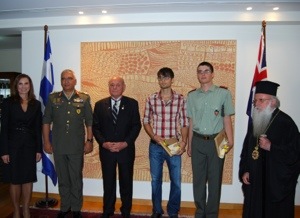
The Ambassador of Australia Jenny Bloomfield hosted an event for the Australian Veterans award outstanding Cretan students

20120929-075722.jpg
Photo caption: Ambassador Bloomfield with Chief of Defence General Kostarakos, Brigadier John Sheldrick OAM (Retd), Awarded Students and Bishop Irineos

ΠΡΕΣΒΕΙΑ ΑΥΣΤΡΑΛΙΑΣ

ΔΕΛΤΙΟ ΤΥΠΟΥ

Αυστραλοί Βετεράνοι βραβεύουν αριστούχους μαθητές από τη Κρήτη

Αθήνα, 28 Σεπτεμβρίου 2012

Η Πρέσβης της Αυστραλίας κα Τζένη Πολυξένη Μπλούμφιλντ παρέθεσε δεξίωση στην Πρεσβευτική Κατοικία κατά την οποία απονεμήθηκαν τα ετήσια βραβεία της Ένωσης Παλαιών Πολεμιστών και Αποστράτων της Αυστραλίας σε αριστούχους μαθητές της Κρήτης, που τιμούν τους άρρηκτους δεσμούς που σφυρηλατήθηκαν ανάμεσα στους δύο λαούς κατά τη Μάχη της Κρήτης.

Τα βραβεία απονεμήθηκαν στους μαθητές από τον Ταξίαρχο ε.α. John Sheldrick OAM, Πρόεδρο της Ένωσης Παλαιών Πολεμιστών και Αποστράτων της Αυστραλίας υπεύθυνο της Επιτροπής Διαχείρισης των Εκπαιδευτικών Βραβείων. Ο Αρχηγός ΓΕΕΘΑ Στρατηγός Μιχαήλ Κωσταράκος παρασημοφόρησε τον Ταξίαρχο με τον Αστέρα Αξίας και Τιμής τον οποίο αποδέχτηκε εκ μέρους των Αυστραλών Βετεράνων.

Συγχαίροντας τους φετινούς βραβευθέντες μαθητές, η Πρέσβης της Αυστραλίας κα Μπλούμφιλντ ανέφερε ότι τα βραβεία αυτά τιμούν τους διαχρονικούς δεσμούς ανάμεσα στις δύο χώρες και εκφράζουν την απέραντη ευγνωμοσύνη των Αυστραλών προς τους Κρητικούς.

Η Πρέσβης δήλωσε: «Η Μάχη της Κρήτης μπορεί να έλαβε χώρα πριν από 71 χρόνια, αλλά το μήνυμα της ειρήνης και της αλληλεγγύης παραμένει ζωντανό. Σε αυτές τις δύσκολες στιγμές, η Αυστραλία στέκεται δίπλα στην Ελλάδα με το ίδιο πνεύμα αλληλεγγύης που ένωσε τους δύο λαούς μας το 1941. Είμαστε σίγουροι ότι η Ελλάδα θα ξεπεράσει τις προκλήσεις της και θα βγει από την κρίση ακόμη πιο δυνατή.»

Την εκδήλωση τίμησαν με την παρουσία τους ο Υφυπουργός Διοικητικής Μεταρρύθμισης κ. Μανούσος Βολουδάκης, Βουλευτές Κρήτης, ο πρώην Πρέσβης της Ελλάδας στην Αυστραλία κ. Αλέξης Χριστόπουλος, οι Αντιπεριφερειάρχες Χανίων και Ρεθύμνου, ο Σεβασμιότατος Μητροπολίτης Λάμπης, Συβρίτου και Σφακίων κ.κ. Ειρηναίος, ξένοι Αμυντικοί Ακόλουθοι, εκπρόσωποι συλλόγων βετεράνων και μέλη της Ελληνο-Αυστραλιανής κοινότητας στην Ελλάδα.

—————————————————–

AUSTRALIAN EMBASSY ATHENS

PRESS RELEASE

Australian Veterans award outstanding Cretan students

The Ambassador of Australia Jenny Bloomfield hosted an event at the Australian Residence for the presentation of annual awards by the Returned and Services League of Australia to outstanding students from Crete, to honour the shared sacrifice of the two nations during the Battle of Crete of May 1941.

The awards were presented to the students by Brigadier John Sheldrick OAM (Retd), Chairman of National Trustees of the Returned and Services League of Australia, responsible for the RSL and the 6th Division Australian Hellenic Educational Memorial Trust. The Chief of the Hellenic Defence Forces, General Michael Kostarakos, presented the Star of Merit and Honour to Brigadier Sheldrick, who accepted it on behalf of the Returned and Services League of Australia.

Congratulating this year’s winners, Ambassador Bloomfield said that the RSL annual awards honoured the timeless bonds forged between the two countries and expressed Australians’ ongoing gratitude to the people of Crete.

The Ambassador said, “Seventy-one years after the Battle of Crete, its message of solidarity and friendship remains alive today. During these difficult times, Australia stands by Greece with the same spirit of solidarity which joined our two nations in 1941. We are certain that Greece will overcome its challenges and emerge even stronger from the crisis”.

The ceremony was attended by Deputy Minister for Administrative Reform Mr Manoussos Voloudakis, Members of the Hellenic Parliament, the former Greek Ambassador to Australia Mr Alexis Christopoulos, the Vice Governors of Chania and Rethymno, His Eminence Bishop Irineos, defence representatives, representatives of veteran associations and members of the Australian-Greek community in Greece.

Athens, 28 September 2012

World Health Rankings, δείτε τις χώρες με τα υψηλότερα ποσοστά θνησιμότητας

Source: Yahoo

Το World Health Rankings είναι ίσως μία από τις πιο μακάβριες ιστοσελίδες που έχουμε δει ποτέ, ασχολούμενη με τα ποσοστά θνησιμότητας κάθε χώρας, τις συνηθέστερες αιτίες θανάτου και άλλα στατιστικά στοιχεία που σχετίζονται με το …θάνατο.

Μόλις επισκεφθείτε την ιστοσελίδα θα δείτε έναν παγκόσμιο χάρτη όπου μπορείτε να επιλέξετε να δείτε περισσότερες πληροφορίες για τη χώρα σας, να περιορίσετε την έρευνα σας ανά ήπειρο ή να δείτε τις χώρες που πλήττονται περισσότερο από συγκεκριμένες ασθένειες, ναρκωτικά και άλλες αιτίες θανάτου.

Όσο για την Ελλάδα, η μέση δάρκεια ζωής είναι τα 79.8 έτη (77.2 για τους άντρες και 82.5 για τις γυναίκες) και οι τρεις συνηθέστερες αιτίες θανάτου είναι τα εγκεφαλικά, οι καρδιακές παθήσεις και ο καρκίνος του πνέυμονα με ποσοστά 21.96%, 18.8% και 9.34%.

Avramopoulos addressed the FYROM name issue

Source: AMNA/Athens News

Foreign minister sends message of hope

Avramopoulos addressed the FYROM name issue, Greek-Turkish relations, and the crisis at the UN General Assembly

The economic crisis does not affect Greece’s stabilizing role in the wider region, Greek foreign minister Dimitris Avramopoulos assured the UN General Assembly on Friday in New York.

He also called on Skopje to abandon its intransigence on the FYROM name issue, warning that populism and nationalism are the worst combination for advancing national interests and for stability in the region.

On Greek-Turkish relations and the Cyprus issue he called on Turkey to demonstrate their respect for international law and abandon its threat of a ‘casus belli’ against Greece as well as its threats against Cyprus, which he warned undermined the confidence-building efforts.

Lastly, Avramopoulos closed with a message of hope, saying “We will make it because Greece is larger than its geographical size and more precious than its present fiscal reality… We will make it because Greece is not about asking. Greece is about offering. Let us not forget, that Greece is a value that is in the hearts and minds of people irrespective of nationhood, race and religion. And that gives us the moral power, the support and the encouragement, along with our partners in Europe, to give and to win this fight.”

List of politicians being investigated for corruption made public

Source: Ekathimerini

Prime Minister Antonis Samaras is expected to make an official statement on a brewing political scandal after a list containing the names of more than 30 politicians that were investigated for corruption by the Financial Crimes Squad (SDOE) was leaked.

The list, which includes the name of 11 former ministers, 10 former deputy ministers and 12 former or current MPs, has been passed to prosecutors, who are preparing to investigate allegations ranging from tax evasion to gaining wealth from illegal activities.

The allegations against each of the politicians on the list have not been made public.

The list, which has been published on the Internet, contains the names of:

Nikolas Tagaras – New Democracy MP for Corinthia

Panos Kammenos – Leader of Independent Greeks

Elpida Tsouri – former PASOK MP and deputy minister

Yiannis Kourakis – former PASOK MP and deputy minister, Mayor of Iraklio

Yiannis Anthopoulos – former deputy minister, PASOK

Tasos Mantelis – former minister, PASOK

Yiannos Papantoniou – former minister, PASOK

Yiannis Sbokos – former MP, PASOK

Nikitas Kaklamanis – New Democracy MP, former Athens Mayor

Aris Spilitiopoulos – New Democracy MP, former minister

Apostolos Fotiadis – former deputy minister, PASOK

Giorgos Voulgarakis – former minister, New Democracy

Fevronia Patrianakou, former New Democracy MP

Nikos Konstantopoulos –former leader of Synaspismos

Eliza Vozemberg – New Democracy MP

Panayiotis Fasoulas – former PASOK MP, ex-Mayor of Piraeus

Akis Tsochatzopoulos – former minister, PASOK

Fotis Arvanitis – former PASOK MP

Dimitris Apostolakis – former deputy minister, PASOK

Evangelos Meimarakis – parliamentary speaker, former minister

Michalis Liapis – former minister, New Democracy

Christos Verelis – former minister, PASOK

Kostas Liaskas – former minister, PASOK

Giorgos Orfanos – former minister, New Democracy

Spilios Spiliotopoulos – former minister, New Democracy

Petros Mantouvalos – former New Democracy MP

Athanasios Nakos – New Democracy MP

Alexandros Voulgaris – former New Democracy MP

Marina Hrysoveloni – Independent Greeks MP

Leonidas Tzanis – former deputy minister, PASOK

Antonis Bezas – former deputy minister, New Democracy

Michalis Halkidis – former New Democracy MP

Michalis Karchimakis – former PASOK MP

The name of parliamentary speaker Evangelos Meimarakis had leaked last week in a press report, prompting an angry reaction from the conservative politician.

In an attempt to prove that allegations of money laundering are unfounded, Meimarakis published his source of wealth (pothen esches) declarations dating back to 1989, when he was first elected to Parliament. His last declaration, in 2010, shows savings of 290,000 euros.

The claims against Meimarakis are being investigated by the Supreme Court.

Independent Greeks leader Panos Kammenos and former Education Minister Aris Spiliotopoulos, whose names appear on the list of supposed suspects, both issued statements saying they have nothing to hide.