
Doctor rekindles ‘ancient Greek spirit’ in Athens free clinic

Source: DW

Cardiologist Giorgos Vichas, along with 90 other doctors and 140 volunteers, runs a free clinic in a middle-class neighborhood in Athens, offering free medication and health care in austerity-hit Greece.

Giorgos Vichas

Inside the Metropolitan Community Clinic in the district of Hellinikon in Athens, the waiting room is busy with volunteers and the phones are ringing non-stop. All the seats are taken. Some patients keep their eyes to the floor, because they are embarrassed – they cannot afford a simple doctor’s visit and have to come to the free community clinic instead.

Doctor Giorgos Vichas, is working with a volunteer, in one of the consulting rooms. He and his colleagues have one of the toughest jobs in Greece right now, helping cancer patients get access to medical treatment. Vichas is about to sign a referral for a 36-year-old cancer patient.

“This is a patient who will most likely lose her life because she was blocked from the national health care system. It’s a 36-year-old woman with two small children,” Vichas says.

Vichas with co-workers in the clinic
Vichas tries to help where he can

The woman and her husband have been unemployed and uninsured for years, so her cancer went undiagnosed.

“Someone has to be held accountable for this woman’s murder,” Vichas says. “And if she survives, she will be condemned to a life full of health problems. We can’t have crimes like this happening but unfortunately it is common in Greece at the moment.”

Since 2011, thousands of uninsured Greeks have found themselves locked out of the national health care system. Until then, the state provided free health care for all. But after three years of austerity measures brought on by the eurozone debt crisis, a humanitarian crisis is developing.

Standing up to the government

Vichas, along with two other doctors, angry and frustrated from seeing people dying due to the lack of access to health care, created the Metropolitan Community Clinic.

By standing up to the government, he has put his own career on the line. The group has decided not to become a non-governmental organization (NGO) and not to accept any cash donations. Medicine and other pharmaceutical items are the only donations it accepts.

There is no president or board, while all decisions are voted on in general meetings once a week. The utility bills are paid for by the local authorities and the offices are based in a prefabricated container that the municipality has provided.

Provisons on a shelf in the clinic
The clinic only accepts donations of supplies, not cash

Seeing tragedy on a daily basis, Vichas doesn’t believe in the widely trumpeted “success story,”a term the current Greek government has used to describe Athens’ efforts to curb the country’s debt and comply with the requirements of a rescue deal from the international community.

This is a ‘success story’ for the government and for Prime Minister Samaras, and this is what Germans have to become aware of,” Vichas tells DW. “A 36-year-old cancer patient with two children is dying because Samaras’ success story left her without treatment. If this is what is called civilized Europe, then I am not part of it. Once this government starts to think about the human story, then I will agree it is a Greek success story,” he adds.

Working without insurance

Thirty percent of working Greeks have no health insurance, despite a law that requires employers to provide health care for staff. But with an unemployment rate of over 27 percent, people will work for as little as 200 euros ($270) and no health insurance.

We’ve seen this neo-liberal policy with [former British Prime Minister Margaret] Thatcher, but even Thatcher’s policies seem progressive compared to what’s happening in Greece right now,” Giorgos complains.

“We’ve also seen [these policies] more recently in Argentina, when Argentina borrowed from the [International Monetary Fund] IMF. We’ve seen it in Chile. Even in Russia after the fall of communism. But what’s happening here is much more extreme,” he adds.

Protesters hold a rally outside the Greek State broadcaster ERT headquarters at Agia Paraskevi in a northern suburb of Athens, June 13, 2013 (Photo: John Kolesidis)
Austerity measures have riled many Greeks

Vichas has joined a group of doctors who have formed a watchdog on Greek health care. Its goal is to legally challenge the government in cases where patients have either died or have had severe problems due to the lack of access to the health care system.

In November, Vichas will also travel to Strasbourg to give a presentation to the Council of Europe.

Stress takes its toll

But his efforts have taken a personal toll on Vichas. He sees 30 patients a day at his public clinic, 15 a day at the community clinic and is busy keeping up pressure on the government.

The crisis has changed all aspects of my daily life and my personal life, these past two years. I work a lot more and it’s a constant battle with the ministry [of health],” he says.

“But, it also gives me strength. First because during the crisis, I feel that I’m doing my duty as a citizen and as a doctor, but also because I see that a self-organized society doesn’t need an institutional framework in order to function as long as it stands for what’s just and moral.”

Vichas is convinced that what he and others are doing at the clinic and at other volunteer organizations will be a blueprint for society in the future.

For now, more austerity measures are likely to affect Greeks this winter, but Vichas and his team are still hopeful for the future.

Ancient Greek spirit

“The reason I take part in this fight along with everyone else is in order to see the day that the ancient Greek spirit prevailsin society,” Vichas says.

“It stipulates that we live in harmony, respect each other, no matter what country of origin, religion or skin color.”

Vichas believes that sometimes ethics are more important than the law. It is about applying the lessons of Sophocles’ Antigone, he tells DW.

In Sophocles’ ancient drama, Antigone, a lone girl, stands up to the unjust commands of her uncle, Creon, the ruler of Thebes. It is a classic tale of an individual standing up to the state for moral reasons.

Antigone’s story ends in tragedy, but Dr. Vichas is convinced that, this time, things will turn out differently.
Greek scholar invented the term ‘asteroid’

Source: Stuff

Inspire and engage your audience Call today 0404855219

It was hardly the greatest mystery in the cosmos, and solving it won’t change the course of science. But a Fort Lauderdale astronomer has cracked a 200-year-old puzzle: Who coined the word “asteroid”?

Publishers might want to take notice.

“It will actually cause books to be rewritten and dictionaries to be revised,” said Clifford Cunningham, whose research revealed the true creator of the word used to describe the rocky space travellers.

It wasn’t William Herschel, the famed court astronomer for King George III, who is credited with inventing the term in 1802, Cunningham found. Rather it was the son of a poet friend of Herschel’s, Greek scholar Charles Burney Jr., who originated the term asteroid, which means “star-like” in Greek.

“It’s been a long-standing mystery,” said Rick Fienberg, press officer for the American Astronomical Society.

“Herschel was certainly one of the greatest astronomers of all time, but this is not a credit we can give him,” said Cunningham, who presented his findings Monday in Denver at the 45th annual convention of the astronomical society’s Division of Planetary Sciences.

“Asteroid was Herschel’s choice, but it was not his creation.”

Erik Gregersen, senior editor for astronomy and space exploration at Encyclopaedia Britannica, said he will review Cunningham’s work and make any necessary changes.

“We do have a big revision of our asteroid article in the works at the moment, so I’ll have to see how it fits in there,” he said. “To be accurate, the etomology of the word might have to credit this other fellow.”

Gregersen noted that revisions can be easily made, since most dictionaries are online. His own encyclopedia, for example, has been exclusively online since 2010.

Cunningham is a world authority on asteriods and one, 4276, was named Clifford after him in honor of a 1988 book, “Introduction to Asteroids.” He pored through volumes of source material at Yale University before uncovering two letters indisputably proving who first came up with the asteroid term. He is preparing to publish a formal paper on his discovery and submit it for peer review.

According to Cunningham, who is currently affiliated with the National Astronomical Research Institute of Thailand, stargazers in 1802 were baffled by the discovery of what they thought were two new planets. Herschel argued they were in fact completely different celestial entities and deserved their own identity.

But Herschel couldn’t conjure up an appropriate term, and his paper on the new objects was due to be delivered to the Royal Society in a week’s time. “He had to get a name immediately for his paper,” Cunningham said. “He didn’t have a word, and he was desperate.”

So the Sunday before the Royal Society meeting, Herschel appealed to Charles Burney Sr, a poet with whom he was collaborating on an educational poem about the cosmos. Burney considered the question and that night, by candlelight, penned a letter to his son, Greek expert Charles Burney Jr. The elder Burney suggested the words “asteriskos” or “stellula” to describe the new celestial objects.

Charles Burney Jr came back with the term “asteroid.”

It was unveiled in Herschel’s subsequent paper – and instantly dismissed.

“Every astronomer in Europe rejected it, everyone was against the creation of this word,” Cunningham said.

But within a few decades the concept of asteroids, and their name, gained legitimacy.

“It wasn’t actually accepted in the scientific field until the 1850s,” Cunningham said. “They determined they weren’t planets, but really asteroids.”

Cunningham based his conclusion on two letters from the Yale archives: the one the senior Burney wrote to his son, and another confirming that his son furnished the asteroid word to Herschel.

Fienberg attended Cunningham’s lecture and said attendees were “quite tickled” at his findings. The researcher is “well-respected” in astronomical circles, he added, and his discovery is likely to be “officially and widely recognized” once published.

The discovery’s significance, Fienberg said, is more historical than scientific. “It’s a little microcosm of how science works,” he said.

“Naming of things isn’t a trivial matter. Whenever something new arises, you have to give it the right name,” Gregersen said. “I think we got the right name.”

Ancient monastery has few visitors amid Sinai unrest, but Bedouin neighbors protect it

20131009-223334.jpg

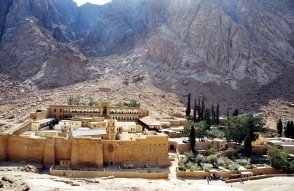
Saint Catherine’s Monastery, founded by the Emperor St. Justinian the Great, sits at the foot of Mount Sinai in Sinai, Egypt. (Hussein Talal/AP)

ST. CATHERINE’S MONASTERY, Egypt — Thousands of years of tradition say the monastery built here marks the spot where Moses fell down on his knees before a burning bush and talked to God. Hidden high in the desert mountains, guarded for centuries by scholar monks and Bedouin tribesmen, this fortress sanctuary was once as remote as any place on Earth could be.

This is no longer so. The modern world arrived at St. Catherine’s Monastery in the form of paved highways and mass tourism, which once brought thousands of pilgrims a day.

But a violent insurgency and military crackdown sweeping across Egypt’s northern Sinai peninsula has brought an unwelcome quiet to the south, where the Bedouin tribes make their money from tourists.

In August, the Egyptian government closed St. Catherine’s Monastery to visitors as a precaution. It was only the third closure in 50 years. While the monastery reopened its doors again after three weeks, Egyptian security forces are now everywhere, shepherding the handful of foreigners into the area in armed convoys.

The monks at the monastery, and the Bedouin who make their living as guides here, stress that the violence is taking place 300 miles to the north.

In the northern Sinai, the restive tribes have been sabotaging natural gas pipelines, and smuggling weapons, drugs and gasoline through their network of tunnels with the Gaza Strip. In the power vacuum created by Egypt’s upheaval, the Bedouin there have raised the black flag for militant jihad, and are waging a guerrilla campaign of extortion, kidnapping and targeted assassination against the powers of the state.

Militants in the north have launched near-daily attacks on Egyptian security forces. In August, gunmen ambushed trucks carrying Egyptian police recruits and executed 25 on the side of a road near a peacekeepers’ checkpoint.

But in the south, the Bedouin tell their children the story of how the Roman emperor Justinian brought their tribe of mason-warriors to the Sinai in the sixth century to build the walled monastery here, and protect the monks with their lives.

“We teach our children that the monastery gives us life,” said Suleman Gebaly, a guide and local chronicler. “This place puts food on our table.”

The descendants of these Justinian serfs continue to honor their task, and so do the monks in black frocks, with their long gray beards and ponytails, who devote their days to vespers and prayer and to their magnificent library, which preserves in the high desert air some of the oldest, most precious manuscripts in Christendom.

Industrial tourism came to the monastery with the building of paved highways in the early 1980s. Until recently, the monastery drew throngs — sometimes 350 tour buses a day, a thousand visitors or more — from the beach resorts at Taba, Dahab and Sharm el-Sheik along the Red Sea coast, a diver’s paradise.

Now one or two buses come a day. On a recent morning there was a tour group from India, and later a few stragglers in a couple of vans.

Camel drivers who bring visitors on the three-hour climb to the top of Mount Sinai say they are desperate for work.

On a recent dawn ascent, only six Colombians made the summit. At a hut along the trail, guide Sabah Darwish sat wrapped in blankets, drinking tea and smoking in the murk. “You’re the first foreigners I’ve seen in a month,” he said.

A Bedouin tribe called the Gebaliya still tend desert gardens and flocks of sheep and goats. Every man has a camel, if he can, though many families have had to sell their camels at steep discounts to traders, who take them down to the beach resorts and feed them from dumpsters, trying to hold on until the tourists come back.

Without tourism, the Bedouin said, they would pursue other paths — such as drug smuggling, or worse.

Two Americans were kidnapped in the region last year. The most recent abduction of foreigners occurred in the south in March, when an Israeli and Norwegian were snatched. Like most, they were released.

Under the rule of President Hosni Mubarak, “there was an understanding that anyone from the north who came to make trouble in the south, we were allowed to kill him,” said Sheik Mousa al Gebaly, who operates a guest house and guide services in the town beside the monastery.

He remembers a time back in the 1990s when even the Israelis came in large numbers to Sinai. “I would have 50 cars with Israeli plates in my parking lot. They would hire 50 guides and 200 camels a day,” Gebaly said.

At the Taba crossing between Egypt and Israel, the passport and customs halls are empty. The coast here was once a famously laid-back post-hippie haven. Now beach hotels stand as shells in the sand. Wind blows through broken glass. The decorative date palms are slumped over, brown and dead.

Once-popular seaside camps, with names like Blue Wave, Moon Camp and Nirvana are shuttered and forlorn, like beach towns in perpetual winter — no more yoga, no more snorkeling, no more bowls of hash at sunset.

At the monastery, Archbishop Damianos sat behind his desk, apologizing for his poor eyesight, fumbling for his magnifying glass and explaining that English was not his best language. He spoke five others.

“It is not so bad for a monastery to be closed for a little while. We are monks, after all,” he said, smiling at his little joke. “We’ve returned to an earlier quiet.”

The archbishop is 79 years old. He arrived here in 1961. He has spent his life among the monks and Bedouin and he is sorry the religious pilgrims have gone, but hopes they will soon return.

“When the revolutions began in Egypt, the Bedouin came to us, and said, ‘You know we have been with you all these years. This is what our ancestors were sent here to do. This is our heritage, to protect the monastery,’ ” said the bishop. “I confess I was very moved by their words. For here we are intertwined.”

The monks here tend to take the long view. The scholar Father Justin, an American from El Paso, is busy on an ambitious project to digitize more than 3,000 manuscripts and subject the ancient tomes — some written, erased and overwritten again on parchment — to multi-spectral analysis.

Father Justin stood on the roof of the library, now undergoing renovation, and pointed out the mosque below, which stood next to the basilica. He felt safe, and proud that both Muslims and Christians are at home here.

But he also mentioned the 60-foot walls that have stood for 1,400 years. “It was built as a fortress monastery, and it is easily turned into a fortress again,” Father Justin said.

But he added that he preferred to be protected by God’s good graces.

“That would be best,” he said.

Diamond Rozakeas recently visited Kastanea – her highlight was meeting the doyenne of the dying art of professional mourning – Moirologia

The last of the mourners

The last of the mourners

Eleni Rozakeas

Even at 84, Eleni Rozakeas is an imposing woman. Now slightly stooped, her once 1.8 metre frame is still lean, her movements fluid. In the customary widows’ black garb, her dark, hooded, intense dark eyes are both steely and compassionate. Her countenance is one not to be messed with, yet despite this Eleni possesses a keen sense of humour and enjoys a good belly laugh.
In the Mani region and in fact in all of southern Greece, Eleni is one of the last of the Moirologia – professional mourners or wailers.
In a funeral tradition dating back to biblical times and depicted in the Iliad and Shakespeare, Eleni will spend up to three days beside the body wailing, reciting laments and compulsively crying. She may also pull her hair out and beat her chest. The extreme and continuous wailing is to send the deceased’s spirit or soul off on a safe journey to the other side.
Religion still plays an important role in the lives of Kastanea villagers – however, even though there are forty-three churches in the small mountainside village, they struggle to get a priest to conduct services each month. Despite this, Eleni Rozakeas is still active as a professional mourner, something she has performed for decades. Sadly, she’s at an age where many of her friends and relatives are passing on, and the small cemetery high up on the mountain overlooking the village is cramped for space.
When Eleni was born, the village’s population was over 1200. These days it numbers just 84. Nobody knows for sure how old the village is, but some say it dates back over 3000 years. It has survived numerous invasions and upheavals throughout the centuries, from Ottoman invasions to WWII and the Civil War, which had an especially devastating effect on the village and its people.
The people of Kastanea were renowned for their fighting spirit – however, after the Civil War when the times were extremely tough, many of the villagers were forced to seek a new life outside Greece. Kon and Eleni Rozakeas (the mourner’s cousin) left Kastanea in the 1950’s and eventually settled in Brunswick.
When their children Diamond, Roula and Stratis visited the village last month, they decided to use Skype to reconnect their parents with their cousins. It was the first time in twenty five years that they had seen each other. There was plenty of reminiscing and joking as well, especially from Eleni senior.
For Kon and Eleni’s children, it was a slice of history and an insight into the future. While the art of moirologia may not survive in a few years, they hope their parents’ village will survive and hopefully thrive, despite the ageing of the village and the current economic woes besetting the country.
Moirologia is the vocalization that goes with Greek ritual lament, or Klama. It’s a violent sort of mourning, and was often done by professional women mourners armed with knives. American singer Diamanda Galas with roots in Mani, Greece, performs an extreme rendition.
The word moirologia derives from the ancient Greek Tragedy, with the arch-singer and the choir following the mourning. Unfortunately very few women arch-mourners have survived, and the custom has been almost eliminated.
In ancient times, the most important part of the prothesis (the part of the funeral when the body is laid out) was the ritual lament – which is what we know today as moirologia. While singing, the persons involved would move around in a pattern resembling a dance. They would improvise lament sung by friends and relatives. Another type of lament was sung by professional mourners – similar to modern day moirologia. The hired singer would lead off the lament followed by the family. A chorus of women cried out in accompaniment.

Greek politician Akis Tsochatzopoulos gets 20 years jail for bribery in landmark verdict

Source: SMH

Greek former defence minister, Akis Tsohatzopoulos, arriving for a court trial in Athens. A Greek court found Akis Tsohatzopoulos guilty of money laundering in a six-million euro case that has become emblematic of political corruption in the debt-wracked country, on October 7, 2013.Greek former defence minister, Akis Tsohatzopoulos, arriving for a court trial in Athens earlier this year. A Greek court found him guilty of money laundering in a six-million euro case on October 7, 2013. Photo: AFP

Athens: In a landmark verdict, a former Greek defence minister and co-founder of the country’s once-mighty Socialist Party, Akis Tsochatzopoulos, has been found guilty of setting up a complex money-laundering network to cover the trail of millions of dollars in bribes he is said to have pocketed from government weapons purchases.

After a five-month trial – the highest-profile case against a Greek politician in more than two decades – judges convicted Tsochatzopoulos, 74, along with 16 other defendants, including his wife, his daughter and several business partners. All were found to have colluded with him to launder the bribe money using a network of offshore companies and property purchases.

Tsochatzopoulos was sentenced to 20 years in prison, said his lawyer, Leonidas Kotsalis, who added that his client would appeal.

Regardless of the sentencing decision on the money laundering charges, Tsochatzopoulos will not escape prison. He was sentenced in March to eight years for concealing assets from the authorities, chiefly for failing to report the purchase of a house near the Acropolis, one of several properties connected to the money laundering scheme.

Tsochatzopoulos, who has been in custody at the capital’s Korydallos Prison since his arrest in April 2012, accused the authorities of political persecution and state violence during the trial, which featured vicious exchanges between him and his former associates.

He is the most senior government official to stand trial since 1991, when former Prime Minister Andreas Papandreou was acquitted on charges of accepting bribes in return for forcing state companies to prop up a troubled private bank.

In a telephone interview after the verdict, Mr Kotsalis said he had “strong reservations about the legal substantiation” of claims that his client accepted bribes.

The court heard that Tsochatzopoulos pocketed nearly $US75 million ($79.6 million) in bribes while serving as defence minister from 1996 to 2001, signing two major deals worth an estimated $US4 billion for a Russian missile defence system and German submarines.

Tsochatzopoulos had repeatedly called for members of a political and defence council that co-signed those contracts – including two former prime ministers, Costas Simitis and George A. Papandreou – to testify at his trial. But the request was rejected by the judges, who said the bribery accusations, not the arms deals, were under scrutiny.

The conviction in Athens in Monday was unusual in a country where top-ranking state officials are rarely prosecuted. But over the past year, the government of Prime Minister Antonis Samaras has intensified a crackdown on corruption among the political elite, blamed by most Greeks for a dysfunctional state system that created the country’s huge debt problem and led Greece to dependence on foreign rescue loans.

In February, Vassilis Papageorgopoulos, a former mayor of Salonika, the country’s second city, was sentenced to life in prison for embezzling at least $US24.5 million from the city.

Secret IMF documents reveal extent of concern about 2010 Greek bailout

Source: Ekathimerini

Minutes of International Monetary Fund board meetings held in May 2010 and published by the Wall Street Journal on Tuesday have highlighted the concern of many country representatives that the Greek bailout was not sustainable.

One of the key criticisms expressed during meetings held before Athens agreed its first bailout with its eurozone partners and the IMF is that the design of the bailout favored European banks at the expense of Greece.

The absence of debt restructuring at the beginning of the program also met with opposition, according to the extracts from confidential documents made public by the WSJ.

“The risks of the program are immense…As it stands, the programs risks substituting private for official financing. In other and starker words, it may be seen not as a rescue of Greece, which will have to undergo a wrenching adjustment, but as a bailout of Greece’s private debt holders, mainly European financial institutions,” said Brazil’s IMF executive director Nogueira Batista at a board meeting on May 9, 2010.

According to the Wall Street Journal, IMF records show that nearly a third of the board’s members, representing more than 40 non-European countries, raised major objections to the bailout’s design at the meeting.

“The alternative of a voluntary debt restructuring should have been on the table…The European authorities would have been well advised to come up with an orderly debt restructuring process,” said Argentina’s executive director Pablo Andrés Pereira. “The bottom line is that the approved strategy would only have a marginal impact on Greece’s solvency problems…It is very likely that Greece might end up worse off after implementing this program.”

“We have considerable doubts about the feasibility of the program…We have doubts on the growth assumptions, which seem to be overly benign,” said Swiss executive director Rene Weber. “Even a small negative deviation from the baseline growth projections would make the debt level unsustainable over the longer term…Why has debt restructuring and the involvement of the private sector in the rescue package not been considered so far?”

Directors from Brazil, Russia, Canada, Australia – representing 38 additional countries – worried about the “immense risks” of the program, the WSJ reports.

“The scale of the fiscal reduction without any monetary policy offset is unprecedented…(It) is a mammoth burden that the economy could hardly bear,” said India’s representative Arvind Virmani. “Even if, arguably, the program is successfully implemented, it could trigger a deflationary spiral of falling prices, falling employment, and falling fiscal revenues that could eventually undermine the program itself.”

According to the minutes of the May 9 meeting: “Several chairs (Argentina, Brazil, India, Russia, and Switzerland) lamented that the program has a missing element: it should have included debt restructuring and Private Sector Involvement (PSI) to avoid, according to the Brazilian ED, ‘a bailout of Greece’s private sector bondholders, mainly European financial institutions.’ The Argentine ED was very critical at the program, as it seems to replicate the mistakes (i.e., unsustainable fiscal tightening) made in the run up to the Argentina’s crisis of 2001.”

However, approval from US and most European directors mean accounted for more than half of the IMF’s voting shares and paved the way for the first Greek bailout, worth 110 billion euros, to be signed.

Prominent Greek journalist on trial again over ‘Lagarde list’

Source: Reuters

A Greek investigative journalist who published the names of more than 2,000 wealthy Greeks with Swiss bank accounts appeared in court on Tuesday to stand trial again for violating privacy laws.

The unusually speedy arrest, trial and acquittal of Costas Vaxevanis last October for publishing the so-called “Lagarde List” drew international concern and captivated Greeks angry that successive governments failed to pursue those on the list while heaping austerity cuts on everyone else.

The magazine editor, who had called last year’s trial “targeted and vengeful” and an attempt to muzzle the press, was acquitted of the charges.

Although Greece has a double jeopardy law, the prosecutor successfully argued that he be tried again by a higher court, claiming to have new evidence and saying the verdict was legally flawed.

Vaxevanis was presenting his defense behind closed doors. A verdict could come as early as Tuesday and, if found guilty, he could be jailed for up to two years or face a fine.

The “Lagarde List”, with the names of 2,059 Greeks with HSBC bank accounts in Switzerland to be probed for possible tax evasion, was given to Greece by French authorities in 2010.

The saga of how the list was passed from one senior Greek official to the next and misplaced at one point without anyone apparently taking action riveted the country.

The list – named after IMF chief and then-finance minister Christine Lagarde – features dozens of prominent business figures including a handful of shipping tycoons, companies and two politicians. It also includes a painter, an actress and many listed as architects, doctors, lawyers, and housewives.

(Reporting by Karolina Tagaris; Editing by Sonya Hepinstall)

‘Germany owes Greece WWII reparation’

Source: Presstv

Greece has announced that Germany must pay reparations for damages inflicted on the Greeks during World War II, a report says.

According to a report published by the New York Times on October 5, a group of Greek lawmakers stated in an 80-page report that Berlin owed reparations for those Greeks who died during the world war.

In the report it was mentioned that Germany also owes a large unpaid loan Athens was forced to give the Nazi state.

Greek Prime Minister Antonis Samaras says he has handed the report over to Greece’s Legal Council of State, which is to decide on the future of the case.

Athens has not yet released the total amount it believes Berlin owes. However, the figure discussed most often as the amount Germany must pay is USD 220 billion, half of the total debt Greece has.

In April, a panel set up by the Greek Finance Ministry said that Germany had to pay more than 160 billion euros in reparations to Greece.

Following the announcement, the German daily Der Spiegel said that Berlin should pay 108 billion euros for the reconstruction of its damaged infrastructure following the war.

Reports also said that Germany owed Greece 54 billion euros in loans it received during 1942 and 1944.

In July, German Finance Minister Wolfgang Schaubl said his country had to “examine exactly what happened in Greece.”

Experts believe that if Germany pays Greece what it allegedly owes, it would significantly improve the country’s likelihood of surviving the spiraling crisis and its crippling debt.

Greece has been dependent on bailout funds from international rescue loans approved by the troika of international creditors – the European Commission, the International Monetary Fund and the European Central Bank – since May 2010.

Greek Finance Ministry unveils draft budget 2014

Greek Finance Ministry unveiled the draft Budget 2014 on Monday. In the ambitious draft, Athens predicts recession at 4% from 4.6% originally foreseen. A much better figure when compared to 6.5% of 2012. Deputy finance Minister, Christos Staikouras who presented the draft budget, said that the primary surplus will be at 380 million euro in 2013 and 2.8 billion euro in 2014.

Staikouras gave also the official rate of unemployment at 27% and said that it will drop to 26% in 2014.

“The 2014 budget will also foresee a primary surplus of 2.8 billion euros (1.5 percent of GDP), compared to about 300 million euros this year.

The draft budget might also give a better idea of the fiscal gap that Greece faces next year. The Finance Ministry believes it will be about 600 million euros, whereas the troika expects it to be as much as 3 billion euros.

The final version of the budget is due to be submitted to Parliament at the end of November and could contain a number of changes compared to the draft due to be issued on Monday.” (ekathimerini)

While the government claims that there would be no additional austerity measures, the big question is where the 2.8 billion euro surplus will come from – especially the moment that the government hardly proceeds to expenditure cuts.

A not-so-secret present is being currently wrapped by the technocrats of the Greek finance ministry. With love to the Greek taxpayer: tax hikes to income from rent, tax hikes for free lancers and small enterprises, abolishing tax breaks and stricter taxes for farmers.

As of 1.1.2014 the new taxation system that will go into effect will abolish also the tax free amount of 5,000 euro for annual income.

Nevertheless the budget 2014 has to be approved by the Troika – business as usual….

PS What? the European Union claims as “poor” those with annual income of 7.500 euro? In Greece, they tax also the very poor… Of course. If they don’t cut expenditure, there is no other way than “Taxes and more Taxes”.

«Η παρουσία της Κρήτης στο έργο του Νίκου Καζαντζάκη»

Source: KRITIKA_EPIKAIRA

Στο πλαίσιο του εορτασμού των 100 χρόνων από την Ένωση της Κρήτης με την Ελλάδα, ο Δήμος Αρχανών-Αστερουσίων και το Μουσείο Νίκου Καζαντζάκη συνδιοργανώνουν ημερίδα με θέμα «Η παρουσία της Κρήτης στο έργο του Νίκου Καζαντζάκη».

Η ημερίδα θα διεξαχθεί στην αίθουσα εκδηλώσεων του Μουσείου στη Μυρτιά, την Τετάρτη, 9 Οκτωβρίου 2013, στις 7.00 το απόγευμα, και το πρόγραμμά της διαρθρώνεται σε δύο μέρη.

Στο πρώτο μέρος, τέσσερις ομιλητές θα πραγματευτούν τη σχέση του Νίκου Καζαντζάκη με σημαντικές πτυχές της Ιστορίας της Κρήτης, και συγκεκριμένα:

– Ελπινίκη Νικολουδάκη-Σουρή, «Ο Νίκος Καζαντζάκης στα εκατόχρονα της Ένωσης: προσωπικά βιώματα και ιστορική μνήμη»,

– Ελένη Κωβαίου, «Νίκος Καζαντζάκης και Μινωικός Πολιτισμός»,

– Μάνος Χαλκιαδάκης, «Ο Νίκος Καζαντζάκης και η Κρητική Πολιτεία, 1898-1913» και,

– Ben Petre, «Η πρόσληψη του πρώιμου έργου του Νίκου Καζαντζάκη από το κοινό του Ηρακλείου».

Στο δεύτερο μέρος, ο Γιάννης Κασσωτάκης στο τραγούδι και η Λίλυ Δάκα στο πιάνο, θα ερμηνεύσουν τραγούδια σε κείμενα του Νίκου Καζαντζάκη και μουσική του Μάνου Χατζιδάκι.