Exhibition Cypriot Antiquities “APHRODITE’S ISLAND: AUSTRALIAN ARCHAEOLOGISTS IN CYPRUS”

Female terracotta figurine with baby (NM 47.347) Late Cypriot II (c. 1450-1200 BC)

Female terracotta figurine with baby (NM 47.347) Late Cypriot II (c. 1450-1200 BC)

No 83 Cypriot horse and rider ‘Aphrodite’s Island: Australian Archaeologists on Cyprus’
k

Sydney.edu.au/museums/pdfs/newsletters/2782_Muse_November.pdf
l

On the occasion of the Cyprus Presidency of the Council of the European Union, the Nicholson Museum at the University of Sydney and the High Commission of the Republic of Cyprus cordially invite you to the opening of the exhibition of Cypriot Antiquities “APHRODITE’S ISLAND: AUSTRALIAN ARCHAEOLOGISTS IN CYPRUS” and to the launching of the accompanying Catalogue, which will take place on Thursday, 29 November, 6–8pm, at the Nicholson Museum.

The history of Cyprus is one of the oldest recorded in the world and its civilization goes back 11,000 years, to the 9 Millennium B.C. during the early Neolithic Period or Stone Age.

This exhibition showcases the importance of Cypriot archaeology and its unique contribution to the European and world historical and cultural heritage. Furthermore, it celebrates the important Cypriot archaeological collections of the Nicholson Museum and the extraordinary work of Australian researchers who have investigated the island’s history.

The exhibition “APHRODITE’S ISLAND: AUSTRALIAN ARCHAEOLOGISTS IN CYPRUS” will be officially opened by Her Excellency Professor Marie Bashir AC CVO, Governor of NSW and Chancellor of the University of Sydney.

It would be an enormous pleasure to see you there to enjoy this wonderful exhibition of Cypriot antiquities that will travel us back to the very ancient times of the island! Please feel free to also forward this email to friends and other contacts who may be interested in attending the opening of the exhibition “APHRODITE’S ISLAND: AUSTRALIAN ARCHAEOLOGISTS IN CYPRUS”.

“Yet whatever changes economics or politics made, whatever artistic influence gained favour, Cyprus remained essentially herself and the products of her art retained a distinctive Cypriot character. There is perhaps more continuity of tradition in the island than anywhere else in the Middle East, and yet greater ability to borrow and adapt.”
James Stewart, in A.D. Trendall-J.R. Stewart, Handbook to the Nicholson Museum, (2nd edition) 1948, p. 119.

Cyprus, the third largest island in the Mediterranean, has a rich archaeological and cultural tradition dating back more than ten thousand year. Legend has it that Aphrodite, the mythical goddess of love and beauty, was born in the waters off the coast of Cyprus. 2012 marks the 50th anniversary of the passing of Professor James Stewart, who excavated on the island before and after the Second World War and developed the Nicholson Museum’s collection of over 1500 Cypriot items, but the legacy of Australian archaeological investigations on the island continues today. Fieldwork projects by Australian universities continue, including the Nicholson Museum sponsored excavations at Nea Paphos; the Hellenistic-Roman capital of the island.
This exhibition will celebrate the Cypriot archaeological collections of the Nicholson Museum, and explore the stories of the Australian researchers who have investigated the island’s history.

Opening 29 November 2012

Exhibition Sponsor: Beirut Hellenic Bank
Exhibition Supporters: The Cyprus Community of NSW and the Cyprus Hellenic Club Ltd

Event details

  • When: 6.00pm – 8.00pm
  • Where: Nicholson Museum
    The Quadrangle
  • Cost: Free
  • Contact: Bookings Essential; Contact Museum Reception
    T + 61 2 9351 2812
    nicholson.museum@sydney.edu.au
  • More info: EXHIBITION OPENING TIMES:
    Monday to Friday 10.00am – 4.30pm
    The First Saturday of Every Month 12.00pm – 4.00pm
    Closed on Public Holidays.
  • Sponsored by:Exhibition principal sponsor: Beirut Hellenic Bank.Exhibition supporters: High Commission of the Republic of Cyprus, Cyprus Community of New South Wales and Cyprus Hellene Club Ltd.The exhibition is part of the celebrations of the Cyprus Presidency of the Council of the European Union in 2012.

p


Mixed views aired over historic posts’ heritage listing

Source: ABCNews

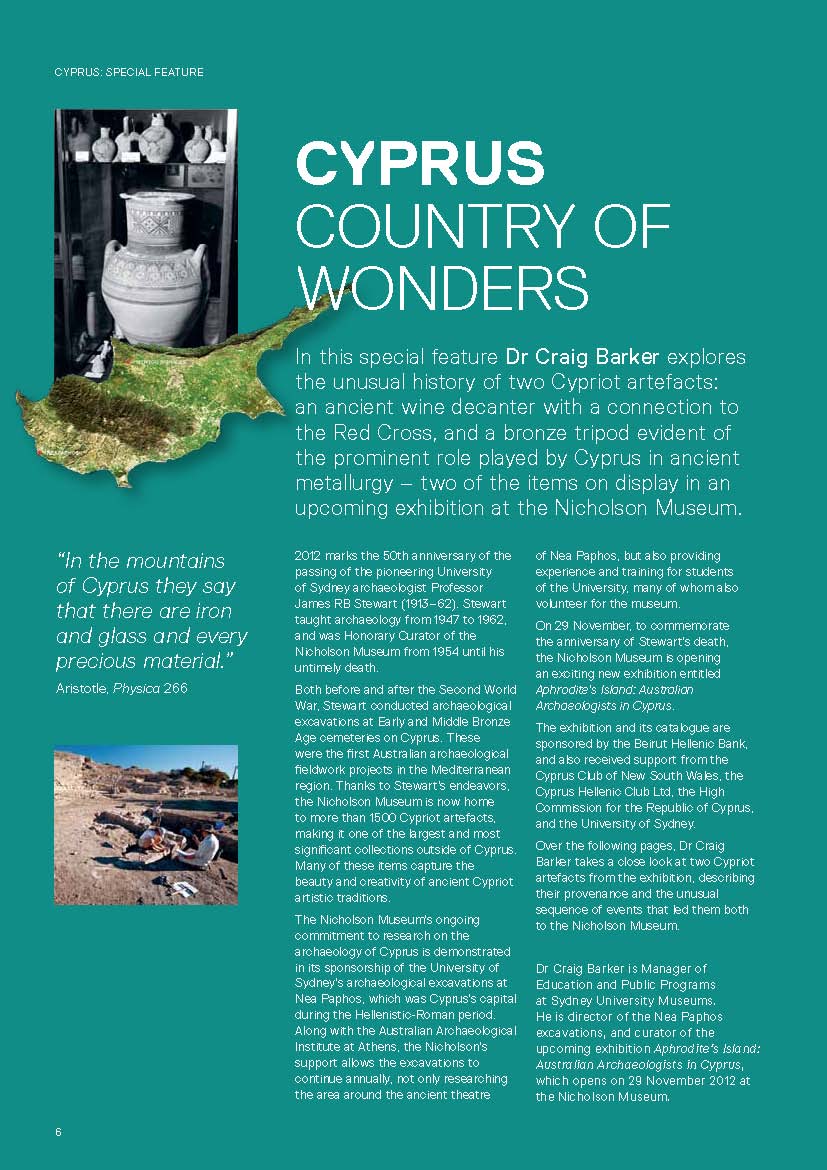
A western Queensland mayor says the heritage listing of three historic posts marking the south-west corners of the state’s border may help to bring more tourists to the remote region.

The Queensland Heritage Council says Cameron, Hadden and Poeppels corners have a significant story to tell about the state’s history and have been added to the Heritage Register.

Bulloo Mayor John Ferguson says Cameron Corner attracts tens of thousands of visitors a year and its history is important.

“It’s pretty desolate country out there – it’s just sand hills and clay pans,” he said.

“People will probably take more notice now of why it was heritage listed.

“It’s probably about 400 kilometres from home, from Thargomindah, west-south-west of us.

“They are concrete posts and that is where you can stand on the posts and be in every state at once or three states at once, South Australia, New South Wales and Queensland.

“A lot of tourists go there and sit on the posts and move around and take a photo of themselves in Queensland, one in New South Wales and one in South Australia.”

Diamantina Mayor Geoff Morton is not convinced the listing of Poeppels Corner, west of Birdsville, will achieve much.

“The post is out in the middle of the desert, there’s nothing out there to hurt only a bit of sand,” he said.

“It’s a non-event really.”

He says it is already a popular tourist destination.

“Poeppels Peg is pretty much renowned as a tourist attraction as it is,” he said.

“It depends on who you talk to but 40,000 to 60,000 tourists go through Birdsville every year and half of them go across the desert.

“Poeppels Peg is already an iconic position. If it had any extra advantage, it would be minimal.

“The Simpson Desert is already well known and this is just another small part of a very large picture.”

The posts have all been replaced with concrete pillars.

Όταν κοιτάς από ψηλά της γέφυρας στο Σίδνεϊ

Σωτήρης Χατζημανώλης, Αλέκος Κελεσίδης και Γιάννης Χατζημανώλης στο πιο ψηλό σημ

Από δεξιά, Σωτήρης Χατζημανώλης, Αλέκος Κελεσίδης και Γιάννης Χατζημανώλης στο πιο ψηλό σημείο της γέφυρας καθώς την διασχίζουμε από την μια πλευρά στην άλλη για να αρχίσει η κάθοδος

Ριψοκίνδυνος δεν υπήρξα ποτέ μου. Κι όσο μεγαλώνω, μάλλον, γίνομαι πιο συντηρητικός. Επιπλέον όταν βρίσκομαι σε ύψη με πιάνει και ίλιγγος.
Με έπεισε όμως ο  μικρός ο γιος μου να ανέβουμε πάνω στην διάσημη γέφυρα του Σίδνεϊ και να απολαύσουμε μια μεγαλειώδη θέα, όπως έλεγε.
Εγώ, ο Γιάννης μου και ο θείος του ο Αλέκος, επισκέπτης από την Ελλάδα. Την ευκαιρία μας την έδωσε ένα οικογενειακό ταξίδι στο Σίδνεϊ. Το ανέβασμα στη γέφυρα το προγραμμάτισε ο, πάντα ριψοκίνδυνος, γιος μου.

Η εμπειρία  ήταν όντως μοναδική.
Δεν είναι μικρό πράγμα να βρίσκεσαι, για  τρεις ώρες περίπου (ανάβαση και κατάβαση), 134 μέτρα πάνω από το έδαφος, για την ακρίβεια πάνω από το νερό και να μη πετάς.  (Άσχετα αν έτρεμα εγώ!).

Μας προστάτευε από την ενδεχόμενη μοιραία πτώση ένα μικρό κάγκελο κι ένας κρίκος που μας  κρατούσε δεμένους από το συρματόσχοινο ασφαλείας σε όλη την διάρκεια της διαδρομής.

Χάρη ομοιομορφίας αλλά και ασφάλειας οι «ξεναγοί» μας δίνουν να φορέσουμε μια γκρι φόρμα και πριν αρχίσει η αναρρίχηση περνάμε  από τεστ αναπνοής (για να δουν αν έχουμε καταναλώσει αλκοόλ) ενώ ανεβαίνουμε και δοκιμαστικά σε κάποιες σκάλες.
Στη συνέχεια όμως οι σκάλες είναι ιδιαίτερα απότομες και ψηλές!

Συμπληρώνουμε και ένα μακροσκελές ερωτηματολόγιο για την υγεία μας και  αν είμαστε καλά «ψυχοδιανοητικά».
Πάνω από τρία  εκατομμύρια άνθρωποι, πιστεύεται ότι έχουν ανέβει στη γέφυρα, περισσότερες από 2.000 προτάσεις γάμου έγιναν στο υψηλότερο σημείο της, ενώ ένα ζευγάρι Βρετανών παντρεύτηκε στη γέφυρα το 2008.

Το πιο ηλικιωμένο άτομο που ανέβηκε στη γέφυρα ήταν μια Αμερικανίδα 100 ετών!
Αυτά άκουγα εγώ, έπαιρνα κουράγιο και ανέβηκα! Και για όσους ενδιαφέρονται να δοκιμάσουν αυτή την εμπειρία το λεγόμενο Sydney Harbour Bridge Climb λειτουργεί 363 ημέρες το χρόνο και σε όλες τις καιρικές συνθήκες (κλείνει μόνο 30-31 Δεκεμβρίου). Ακόμα και μέχρι τις 10.00 το βράδυ.
Εμείς την ανεβήκαμε σε μια σημαντική της επέτειο.

Φέτος η διάσημη γέφυρα στο λιμάνι του Σίδνεϊ, η οποία είναι το σύμβολο της πόλης αλλά και ολόκληρης της Αυστραλίας γιόρτασε τα 80α της γενέθλια!
Η γέφυρα, με το παρατσούκλι «κρεμάστρα» χτίστηκε από χιλιάδες εργάτες εν μέσω της παγκόσμιας οικονομικής κρίσης του ‘30 και κόστισε 16 ζωές σε εργατικά ατυχήματα.

Αλλά μόνο ένας πέθανε πέφτοντας από την γέφυρα. Όλοι οι άλλοι σκοτώθηκαν στο έδαφος.
Συγκεκριμένα, για να χτιστεί η γέφυρα δούλεψαν 14.000 εργάτες επί οκτώ χρόνια, και τοποθέτησαν με τα χέρια τους τα έξι εκατομμύρια βίδες και μεταλλικά καρφιά από τα οποία αποτελείται, η γέφυρα την οποία διασχίζουν 160.000 αυτοκίνητα την ημέρα.
Έχει έξι λωρίδες για τα αυτοκίνητα και την διασχίζει και τρένο. Όταν κτίστηκε και ένωσε το  Σίδνεϊ με το βόρειο Σίδνεϊ, στην βόρεια πλευρά της πόλης υπήρχαν μόνο έξι αυτοκίνητα! (Κάθε λωρίδα και αυτοκίνητο).

Οι περισσότεροι Αυστραλοί αγαπούν την «μεγάλη γηραιά» κυρία όπως λένε τη γέφυρα και δεν θέλουν να την αντικαταστήσει κάποιο τούνελ.
Χωρίς αμφιβολία το Σίδνεϊ είναι μια από τις ωραιότερες πόλεις στον κόσμο, αν όχι η ωραιότερη.
Για να  δείτε λοιπόν,  κάθε ορίζοντα της πόλης στις καλύτερες στιγμές της  ο καλύτερος τρόπος είναι η κορυφή της γέφυρας. Είχε δίκιο ο γιος μου.
Δεν είναι εύκολο και είναι λίγο (έως πολύ) τρομοκρατικό για όσους τρομάζουν από τα ύψη, όπως εγώ.
Αξίζει όμως τον κόπο.

Το θέαμα από την κορυφή της γέφυρας εξαιρετικό.  Το σημείωνε εμφατικά και ο Αλέκος που είχε έρθει από την Ελλάδα.
Βλέπαμε τα πρασινοκίτρινα καραβάκια που συνδέουν το κέντρο με τα προάστια, και που ξεκινούν από έξι αποβάθρες, σαν θαλασσινά λεωφορεία.
Αμέτρητα σκάφη κάθε μεγέθους. Ακόμα και κρουαζερόπλοια. Αλλά και μια άσκηση με κομμάντος. Πέσαμε στη κατάλληλη στιγμή.

Δίπλα από τις αποβάθρες, ο υπερυψωμένος σταθμός του μετρό. Κι απέναντι οι πύργοι του κέντρου του Σίδνεϊ, έτοιμοι να υπερασπιστούν την επιχειρηματική ζώνη της πόλης.
Όταν το 1956 αποφασίστηκε να κτιστεί μια Όπερα για την πόλη, ένας Δανός αρχιτέκτονας κέρδισε τον διαγωνισμό μ’ ένα πρωτοποριακό σχέδιο που θα κόστιζε μόνο 7 εκατομμύρια δολάρια.Τελικά, χρειάστηκαν 17 χρόνια δουλειάς και 102 εκατομμύρια δολάρια. Το έργο ολοκληρώθηκε το 1973 κι από τότε μαζί με τη Γέφυρα η Όπερα αποτελεί το σήμα κατατεθέν της πόλης.

Αμέτρητες καρτ ποστάλ την αποθανατίζουν, αμέτρητοι τουρίστες (σαν και μας) τη θαυμάζουν καθημερινά, αφού λόγω του παράξενου σχήματος η εικόνα της αλλάζει δραματικά από κάθε οπτική γωνία. Άλλοι την παρομοιάζουν με πανιά ιστιοφόρου, άλλοι με γιγαντιαία όστρακα το ένα μέσα στο άλλο.
Η θέα της Όπερας από την γέφυρα ανεπανάληπτη. Φυσικά η ανάβασή μας και η κατάβαση γίνεται με τη συνοδεία ειδικευμένων οδηγών που όχι μόνο μας προσέχουν (για την ασφάλειά μας) αλλά μας βγάζουν και φωτογραφίες (για τις φωτογραφίες κάνω την ανάγκη φιλοτιμία και χαμογελώ άνετα) και, το πιο σημαντικό, μας λένε την ιστορία της γέφυρας.

Έτσι μαθαίνουμε πως το κοινοβούλιο της Νέας Νότιας Ουαλίας το 1922 νομοθέτησε για την κατασκευή της γέφυρας με μηχανικό τον Τζον Μπράντφιλντ που είχε και τη γενική ευθύνη.

Τα έργα ξεκίνησαν το 1923 με την κατεδάφιση 800 σπιτιών της περιοχής.
Η κατασκευή η ίδια της γέφυρας άρχισε τον Δεκέμβριο του 1928.
Τα εγκαίνιά της έγιναν με επεισοδιακό τρόπο στις 19 Μαρτίου του 1932.

Η γέφυρα είχε γίνει γνωστή ως «η γέφυρα του λαού». Την ημέρα των εγκαινίων, λοιπόν, μπροστά στα έντρομα μάτια των επισήμων και την ικανοποίηση του λαού ένας (ακροδεξιός) Ιρλανδός «εν ονόματι του λαού» με ένα ..σπαθί έκοψε την κορδέλα.

Ο  (αριστερός) πολιτειακός πρωθυπουργός Τζακ Λαγκ έμεινε εμβρόντητος. Έδεσε ξανά την κορδέλα και την έκοψε με το ..ψαλιδάκι του!
Τα εγκαίνια της πιο διάσημης γέφυρας του κόσμου ήταν γεγονός. Όπως και η ολοκλήρωση της δικής μας ανάβασης,
Ο Γιάννης και ο Αλέκος γέλαγαν με αυτήν την ιστορία (και άλλες ιστορίες)  που έλεγε η  οδηγός μας, ενώ εγώ  ένοιωθα ανακούφιση που πατούσα πίσω στο έδαφος.
Συναρπαστική η θέα του Σίδνεϊ από ψηλά, αλλά προτιμούσα να την απολαμβάνω από το έδαφος.

George Megalogenis and Prime Minister Julia Gillard during the launch of The Australian Moment in February

Megalogenis exits The Australian

Mega calls time on reporting career

Megalogenis exits The Australian
PHOTO AAP/LUKAS COCH.

The Australian’s political and economic commentator George Megalogenis has taken redundancy from News Limited to pursue his career as an author. Megalogenis began his journey as a reporter at the Melbourne Sun and spent 11 years in the Canberra press gallery between 1988 and 1999, before returning to Melbourne as a senior writer.

How he has sat on the high-wire of the political divide, articulately delivering opinions on the most vital economic issues affecting the country today, combined with a meticulous attention to detail, are key to the immense respect he developed in his readers. In his final post on his much-admired blog Meganomics last week, he announced that he was leaving to spend more time writing books. His last post was entitled Geia sou: The first article I had published in a newspaper was about the senior Gary Ablett’s knee.

The first big story I covered in the federal parliamentary press gallery had a number in it. A number so wild it had to be wrong, but the nation was in boom at the time so no one noticed. The opening two paragraphs are worth repeating here, for old time’s sake: “MILLIONS of confused moths may die at the hands of Australia’s beacon of democracy, the lighted flagpole at the new Parliament House.

“Swarms of Bogong moths heading for breeding grounds in the Victorian and NSW Alps have invaded the House.”

On my first day at the Melbourne Sun in 1986 the Challenger space shuttle crashed. On my first day working for the News Ltd bureau in Canberra in 1988, Bob Hawke and Paul Keating were kissing and making up after a public tiff following that year’s budget. My first day on The Australian in 1991 was uneventful. There I remained another 21 years, eight more in Canberra and the final 12 or so in my old hometown of Melbourne.

I will miss every part of the newspaper business – the colleagues, the scoops, and the readers. Thank you to everyone here who made this blog one of the most enjoyable parts of my career. I learnt more in our exchanges over the past five years than in any background briefing from prime ministers or treasurers… Megalogenis’ regular analyses in The Australian helped explain the whys and wherefores of public policy to a wide audience and his columns were required reading by Australia’s political leaders of all persuasions.

Not many authors get a sitting Prime Minister to launch their latest work but Julia Gillard duly obliged for the launch of his latest book The Australian Moment. In a timely coincidence The Australian Moment was shortlisted last week for a Walkley Book Award. Labor Federal Minister Penny Wong offered a message in a tweet that will no doubt be shared by many: “Huge loss for the oz and current political debate.

Hope there will be many other avenues for mega contribution.” In characteristic style, George’s last comments on his blog included the following description of himself: “The illegitimate son of Rupert Murdoch and Margaret Thatcher. Entered journalism in the midish ’80s, when deregulation was all the rage. Leaving it when we are all raging at deregulation.”

Victoria’s multicultural future under the microscope

Political leaders to share visions for meeting identity challenges

Joe Caputo, chair of the Ethnic Communities’ Council of Victoria.

The big guns of Victoria’s political parties are being wheeled out to put forward their ideas to enhance the state’s multicultural credentials and prepare the ground for greater social-cohesion. Victorian Premier Ted Baillieu, Opposition leader Daniel Andrews and Greens’ Deputy Leader Adam Bandt will speak at a high-powered conference this month that promises to shape the state’s future multicultural policies.

Organised by the Ethnic Communities’ Council of Victoria (ECCV) – Victoria’s Multicultural Identity – State Conference 2012 will take place on November 20.

The conference provides a unique forum for academics, community leaders, service providers and government to exchange ideas and strategies for enhancing social-cohesion and examine international experiences.
The ECCV says that the conference will explore the most pressing challenges facing multiculturalism; how government can help further develop the state’s multicultural identity, how positive self-identity can be encouraged in young people, and how negative stereotypical identities of ethnically diverse communities can be challenged and overturned.

The conference, which will take place at the Melbourne Convention and Exhibition Centre, will involve local and international experts gathering for a day of intensive brainstorming sessions and culminate in a gala dinner at Melbourne’s Immigration Museum.

“We’ve hand-picked a range of voices who represent many organisations, people and communities,” said ECCV chair Joe Caputo. “This conference is incredibly important for every Victorian – we are proud of our multicultural society but there are challenges we face.
“Through our conference we’re hoping to find solutions to Victoria’s identity solutions, to address key multicultural issues faced by communities and organisations,” said Mr Caputo.

“We want as many community members and voices there as possible.

There are still tickets left so please come along.” Before Victoria’s political leaders get their chance to present their views on the day, Professor Gail Whiteford Vice-Chancellor (Social Inclusion) at Macquarie University will kick off the conference’s investigations by giving a keynote presentation. Professor Whiteford recently worked on European Commission social inclusion projects with street children in Turkey and disabled people in Bulgaria.

Professor Afef Benessaieh, Professor of International Studies at the University of Quebec will take part in the session which explores youth self-identity.

Professor Benessaieh’s research in Canada has looked at sociocultural approaches to globalisation, international migration and transcultural approaches to diversity. Other speakers at the conference will include; the Chair of the Victorian Multicultural Commission, Mr Chin Tan -Deakin University’s director of the Centre for Citizenship and Globalisation, Professor Fethi Mansouri – Monash Uni lecturer and author, Dr Tim Soutphommasane – Victorian Multicultural Commission youth commissioner, Yasmin Hassen – the CEO of the Victorian Equal Opportunity and Human Rights Commission, Karen Toohey – and Australian Multicultural Foundation CEO, Dr Hass Dellal.

Conference registrations and gala dinner bookings can be made online at http://www.eccvconference.eventbrite.com/

Jacques Kallis: Second only to Sir Donald Bradman

Source: ROAR

In the lead-up to the opening Test in Brisbane, Mickey Arthur, the coach of the Australian team said he believed that Jacques Kallis was second only to Sir Donald Bradman when it comes to the greatest players to have graced the field.

A huge call, but one coming from a man who saw plenty of Kallis up close during his time as South African coach.
As if to add further to Arthur’s claim, Kallis peeled off an innings of 147 at the Gabba, his 44th Test ton, second overall to Sachin Tendulkar’s career tally of 51 centuries.

He has now passed 50 in Test matches on 99 occasions.

So just where does Kallis sit in the pantheon of cricket greats?

His numbers are phenomenal. In the history of the sport, no player has had a greater direct involvement in the game.

The current Test is his 156th, in addition to which he has played 321 one-day internationals and 25 Twenty20 internationals.

During that time he has faced 56,044 deliveries and sent down 30,256.

That adds up to an incredible total of 86,300 deliveries in which he has been directly involved in the contest, more than any other player can boast.

Kallis’ resilience given the incredible workload his body has had to endure is another hallmark of his game.

The bulk of his career has seen him occupy the number four spot in the batting order.

The current Test is his 100th at second-drop, during which time he has averaged a staggering 65.2 and scored 34 centuries, a rate better than one every three matches.

His aggregate of 12,788 runs places him fourth all-time behind Sachin Tendulkar, Ricky Ponting and Rahul Dravid.

As a batsman his career average (57.3) exceeds those of the men who are bracketed as the three pre-eminent players of his era – Tendulkar (55.1), Brian Lara (52.9) and Ponting (52.5).

Kallis never seems to be mentioned in the same breath as that trio, thanks in the main to the way he compiles his runs.

He lacks the dash and aggression of Tendulkar, Lara, or Ponting, yet his way of amassing runs has proved to be incredibly effective.

In many ways Kallis is looked upon more in the Dravid mould – an accumulator of runs rather than a rapid scoring aggressor who plays the more memorable and eye-catching knocks.

But one thing where Kallis has all of the above covered is the fact that he is a genuine all-rounder.

During the bulk of his career, he has been in South African teams that have boasted outstanding pace bowlers – Allan Donald, Shaun Pollock and Dale Steyn to name just three.

In lesser quality teams he would have been called upon to bowl even more.

But, as it is, he has captured 280 scalps at an average of 32.6.

Broad of shoulder, Kallis bowls what nowadays is referred to as a ‘heavy ball’.

Off a moderate run-up he can generate considerable pace and has often ventured past 140km/h.

His two catches to date in Australia’s first innings in Brisbane takes his career tally to 189; third place overall behind the retired Dravid (210) and the still active Ponting (194).

When it comes to ticking the boxes as an all-rounder he scores highly in each facet of the game.

When mentioning all-rounders, Sir Garfield Sobers is almost unanimously placed at the top of the tree and the great West Indian is often seen as the number two to Bradman as the game’s greatest player.

It is fascinating however when you compare the raw statistics of Sobers and Kallis.

The most effective way to do so is by averages given that Sobers played 93 Tests, 63 fewer than Kallis’ current total.

In the batting department Sobers averaged 57.8 to Kallis’ 57.3; Sobers a century every 6.1 innings and Kallis a ratio of one every 6.0; Sobers averaged 34.0 with the ball and Kallis 32.6; in the field, Sobers averaged 0.63 catches per innings and Kallis 0.64.

Sobers had the freakish ability to bowl every style – pace, finger spin and wrist spin.

Aside from that though, on a comparison of their raw statistics, little separates the pair.

Once again, many people would lean toward Sobers especially for the cavalier and swashbuckling way he batted.

But what of Kallis against the mighty quartet of all-rounders that graced the cricketing world of the 1980s – Imran Khan, Ian Botham, Kapil Dev and Sir Richard Hadlee?

It can easily be argued that each was a superior bowler to Kallis a but in the batting stakes it is the South African all the way for none of the four averaged in excess of 38.

Yet again though, he is nowhere near as free scoring or aggressive of those four.

So just where does Kallis sit in the pecking order of history?

It is as much a subjective analysis as it is objective.

And how much is Kallis ‘penalized’ by the way he goes about scoring his runs?

Bradman is a nonpareil given the sheer domination he displayed with the willow.

Then perhaps Sobers.

And then … well Kallis is hard to top.

Sydney FC start coach search

Source: SkyNews

Sydney FC chief executive Tony Pignata is adamant his club’s reputation as a transit lounge for coaches won’t affect their search for a quality replacement following Sunday’s shock resignation of Ian Crook.

Citing the building burden of pressure and scrutiny, magnified by the acquisition of Italian superstar Alessandro Del Piero, Crook stepped down after just six games, revealing it was affecting his health.

Sydney have slipped to eighth in the 10-team competition following two disastrous results – a 7-2 away loss to Central Coast followed by Saturday’s 3-2 home defeat by Melbourne Victory, where they let a two-goal lead slip.

Sydney are now searching for their seventh head coach in eight seasons but Pignata was confident Crook’s concerns about the role would not scare off potential replacements.

‘Ian wanted to make the decision, he felt he had to make the decision, we respect that, but does that impact on future coaches? I don’t think so,’ Pignata told AAP.

‘I think everyone will say that they want to have a chance and sometimes you feel you can bring something different, so I don’t think that (reputation) will have an impact.’

Assistant coach Steve Corica will act as a caretaker coach starting with Friday’s away game to fellow stragglers Brisbane.

Pignata, football director Gary Cole and chairman Scott Barlow will initiate the hunt for Crook’s successor, with the club eager to appoint someone quickly.

The list of Australian or locally-based candidates to replace Crook, who may stay on at the club in a development role, could include former national coach Frank Farina, Miron Bleiberg and former Sydney coach Branko Culina.

Another potential contender could be two-time Melbourne Victory A-League title-winning coach Ernie Merrick, who Cole knows from his time at that club.

Del Piero’s name has been mentioned in a player-coach capacity, but it seems more likely the marquee star would recommend someone else, perhaps Italian compatriot and former Chelsea coach Gianluca Vialli.

Crook was adamant he had not been forced out by the club and had actually contemplated resigning several weeks ago.

‘People look at two things. I’m sure they will go were you pushed?’, the answer 100 per cent is no, this is 100 per cent my decision,’ Crook said.

‘But number two, they will say was it because of last week and last night’s result?’

‘They were probably the straw that broke the camel’s back, but I’ve got to admit now that probably for me the catalyst was when we beat Western Sydney.

‘First win (of the season), inaugural derby, big crowd and I went home in the car afterwards and I felt completely flat.

‘At that particular time I thought it was the right time, but I stayed in there because I didn’t want to quit and the one reason I’ve done it now is because I think whoever comes to the job needs to have the time.’

After a long discussion with his wife on Saturday night, Crook texted Pignata at 1.30am on Sunday morning before revealing his decision six-and-a-half hours later.

‘For me it’s not about quitting, it’s about doing the right thing for everybody because the club have been fantastic to me,’ Crook said.

He broke the news to most of the players at a recovery session on Sunday.

‘I think Crookie deserves respect. 11 new players. Short time. Great man,’ Sydney’s Dutch defender Pascal Bosschaart tweeted.

Sydney remembers fallen diggers

Source: SMS

More than 1000 people gathered in central Sydney to remember the nation’s fallen soldiers, 94 years after the end of World War I.

Two focal points of the usually busy city stopped in unison to observe a minute’s silence at 11am (AEST) on Sunday, marking the 11th hour of the 11th day of the 11th month when guns fell silent in 1918.

A little over 1000 people gathered at the Cenotaph in Martin Place while a smaller group of about 100 came together at Darling Harbour to pay their respects to the fallen.

At Martin Place, a minute’s silence was observed following the playing of the Last Post by an army bugler and the laying of wreaths.

Official guests included NSW Premier Barry O’Farrell, Opposition Leader John Robertson, Governor Marie Bashir, federal senator Matt Thistlethwaite representing Prime Minister Julia Gillard and federal opposition frontbencher Malcolm Turnbull.

Also present was Australian Defence Force (ADF) Corporal Daniel Keighran, who this month was awarded the Victoria Cross for bravery during a firefight in Afghanistan in 2010.

“I will remember my mates who have passed away, and my family who were involved in the wars through the years as well,” Corp Keighran told reporters.
Many in the crowd – including ex-servicemen, tourists and passers-by – wore poppies as a mark of respect.
The ceremony was punctuated by a vice-regal salute by the Navy band, an affirmation of the Ode of Remembrance and the singing of the hymn, I Vow to Thee, My Country, by the crowd.
Master of ceremonies John Gatfield paid tribute to the men and women who have died in battle.

“Remembrance Day is to remember the sacrifice of those who died or those who suffered in Australia’s cause in all wars and in other conflicts,” he said.
At Darling Harbour, the service began with prayers in a small marquee outside the Australian National Maritime Museum.

Families and ex-servicemen came together to remember in particular those who took part in Operation Jaywick, one of World War II’s most daring raids in which a special unit of Australian commandos destroyed seven enemy ships.

Wreaths were laid by members of the World War II Commando Association and the Australian Commando Association, and the families of Sergeant Brett Till, who died in Afghanistan in 2009, and World War II commando Horrie Young, on the original Japanese fishing vessel used in the mission.

Ken Gurran, who served in the 2/11 commando squadron in World War II, said the service was “terrific”.
“It has real meaning,” he told AAP.
“A deep soulful meaning, because you start thinking about your mates that are no longer with you.”

Australian economy gets a wake up call

Source: ABCNews

The looming “fiscal cliff” in the United States is a key risk to the global economy.

The Reserve Bank of Australia trims its growth forecasts as it warns that the mining boom will peak earlier than expected, reports ABC’s Peter Ryan.

The Reserve Bank has marginally downgraded its growth outlook for the Australian economy and says the resources boom will peak earlier than expected.

In its quarterly statement on monetary policy released Friday (PDF), the RBA has put growth in the year to June 2013 as “a little weaker” at below 2.75 per cent before picking up to nearly 3 per cent in 2014.

The previous forecast had tipped growth as much as 3.5 per cent by June next year.

“Most of this revision to the outlook is accounted for by a change in the profile for mining investment which is now forecast to peak a little earlier and at a lower level than had been earlier expected,” the RBA says.

“This change reflects the reappraisal of spending plans in the coal and iron ore sectors as well as a reassessment of the profile for spending on some large and complex LNG projects.”

The RBA also warned that the outlook for growth is “sensitive to prospects for mining investment and the timing and extent of the anticipated recovery.”

However, the Reserve Bank believes mining exports are still forecast to “grow substantially” given the increased capacity from the current pipeline of investments.

The RBA’s statement sees inflation forecasts largely unchanged with underlying inflation expected to be close to 2.5 per cent over the next year.

Headline inflation could rise above 3 per cent by the first half of 2013 through the combined impact of the carbon price and volatility in fruit and vegetable prices.

The Reserve Bank also highlighted the looming “fiscal cliff” in the United States as a key risk to the global economy.

In a special section of the statement (PDF), the RBA said the automatic triggering of spending cuts and tax increases “would be the largest reduction in the federal budget deficit in a single year since 1969.”

“Such a rapid fiscal reduction would result in annual average growth in the United States 3 to 4 percentage points lower than otherwise in 2013.”

The Reserve Bank believes the threat of such a significant contraction, leading to a recession, means policy makers will ensure it won’t proceed to its full extent.

However, the RBA has signalled that legislative agreement between Republicans and Democrats “will require agreement” to minimise the impact of the fiscal cliff.

The RBA has also downgraded its outlook for global growth to 3.25 per cent in both 2012 and 2013.

The “fiscal cliff” aside, the RBA has noted growth “at a moderate pace” in the United States and signs that China has stabilised.

The Reserve Bank noted that Australia’s cash rate remains appropriate after leaving rates unchanged at 3.25 per cent on Tuesday.

The Australian dollar fell to a low of 103.78 US cents after the statement was released to financial markets after reaching a high earlier in the day of 104.45 US cents.

Ten’s axe falls on Helen Kapalos

Source: Mediaspy

Helen Kapalos will not continue as the Ten Network‘s Melbourne newsreader, after a shock decision aimed at cutting costs at the troubled network.

According to an article by Cameron Houston in The Age, Kapalos was told of her redundancy shortly after wrapping up Friday’s evening news, a day before she was to leave on holiday.

Kapalos’ contract will not be renewed after it expires next March, although it is not clear whether Mal Walden will continue as a single presenter, or be joined by a new co-host.

Her axing has been met with disapproval from several commentators, some of whom felt the dismissal was not handled professionally.

Houston’s piece also suggested that Ms Kapalos’ security pass had been deactivated on Friday night, leading to a tense spat between the newsreader and network management.

Ten’s management is said to have relented, allowing Kapalos to use an office computer before she left for her pre-planned holiday.

So far, Ms Kapalos’ only public statement on her axing has been on her Twitter account, where she wrote “Fall down seven times.

Get up eight. Big love to my supporters.” She ended her tweet by asking her followers to read her new blog, helenkapalos.com.au, which is to be launched today.

Helen Kapalos has been co-anchor of Melbourne’s Ten News at Five since 2006.

Prior to that, she reported for National Nine News and presented the now-defunct late news programme Nightline.

Ten faces tough times ahead, as it struggles to manage a $210 million debt pile due to mature by March next year.

The embattled network posted a near $13 million loss in late October after a year of disappointing programs and managerial turmoil.