Prime Minister Julia Gillard introduces National Disability Insurance Scheme legislation

Source: ABC

Prime Minister Julia Gillard has introduced into Parliament legislation establishing the National Disability Insurance Scheme.

The bill sets out the structure and eligibility criteria for the scheme and will be voted on early next year.

Ms Gillard says she believes the scheme will be the greatest change to Australian social policy in a generation.

“The scheme to be established by this bill will transform the lives of people with disability, their families and carers,” she said.

“For the first time they will have their needs met in a way that truly supports them to live with choice and dignity.”

Labor has announced $1 billion to establish the scheme, but long-term funding still remains unclear.

Proposed by the productivity commission, the NDIS aims to shift funding for disability away from a welfare to one based on social insurance, to which all taxpayers contribute.

Instead funding of being allocated to service providers, individuals will instead be given direct access to funding, which they can then administer either directly or through brokers.

The focus of the scheme will be on early intervention, building on the concept that significant initial financial outlay can offset greater costs incurred if problems are left untreated.

The scheme aims to cover 360,000 people with a profound or severe disability, with a separate National Injury Insurance scheme to cover people who suffer a catastrophic injury.

You can find a copy of the Australian Education Bill here:

We’ve developed fact sheets to help answer your questions about what the National Plan for School Improvement will mean for you and your schools.

Fact Sheets
Better Schools: National Plan for School Improvement
A new way of funding our schools
Helping great teachers do a great job
More information about your school
Support for students who need it most
Helping schools improve results
Information for teachers and school principals
Information for parents
What happens next
Australian Education Bill 2012

http://t.co/aEj9x12q

Extinct wombat climbed trees like a koala

Fossils have shed light on a wombat-like creature that once lived in Australia’s rainforest canopies.

Nimbadon is thought to be a tree-dwelling marsupial that lived 15 million years ago. (Illustration: Peter Schouten)
FOSSILISED REMAINS OF AN early relative of the wombat suggest that the marsupial lived in treetops around 15 million years ago.

The ancient bones, uncovered in an outback Queensland cave in the 1990s, could be the remains of the largest known tree-climbing marsupial, according to new research.

Scientists from the University of New South Wales and the University of Adelaide examined the skeleton of the species, known as Nimbadon lavarackorum, which was discovered at the Riversleigh World Heritage fossil field. The research revealed that the 70kg marsupial was equipped with powerful limbs to scale tree trunks.

Dr Karen Black, a palaeontologist from UNSW’s School of Biological, Earth and Environmental Sciences, says it was a surprise discovery given the animal’s hefty size and close ties to the wombat.

“To have a wombat-like animal up a tree was pretty amazing,” Karen says. The largest tree-climbing marsupial alive in Australia today is the Bennett’s tree kangaroo, which can weigh up to 14kg.

Extinct marsupial climbed trees like a koala

The scientists compared the Nimbadon skeleton with bones from living animals such as the koala, brushtail possum and Malayan sun bear. Honing in on the limbs, hands and feet, the study found the Nimbadon had the most in common with the koala.

“It had highly-mobile shoulder, elbow and wrist joints, so it was flexible for grabbing branches and climbing,” says Karen. “It also had very large hands and feet with opposable thumbs, and massive claws almost identical to a koala’s.”

Karen says these traits suggest that Nimbadon behaved similarly to the modern-day koala, using the same trunk-hugging method to climb trees.

But Karen says the team also found some highly unusual characteristics. The Nimbadon had relatively short hind limbs, suggesting it may have hung from branches like a sloth or orangutan.

The marsupial also sported a unique bulbous snout. “Maybe it was detecting rainforest fruits with its big nose, so it possibly could have played a role as a large seed disperser in Australia’s rainforest, which no living marsupial in Australia does,” Karen says.

Fossils reveal Australian fauna evolution

It is believed the Nimbadon died out about 15 million years ago. It was around this time that Australia’s rainforests began to recede, gradually being replaced with drier landscape.

Associate professor Rod Wells, a palaeontologist at Flinders University in Adelaide, says piecing together Australia’s early fossil record, dating back to eras such as the Miocene period, is no easy task.

“This paper represents a step beyond phylogeny [the family tree of a species],” Rod says. “It is important in that it gives us an all too rare insight into the biomechanics and behaviour of a middle Miocene marsupial, arguably Australia’s largest arboreal herbivore.”

Rod hopes further research will lead to greater insights into the evolution of Australian mammal and marsupial fauna.

The findings were originally published in scientific journal PLOS ONE.

20121127-114338.jpg

Alexander the Great comes to Sydney

TREASURES from the life and times of Alexander the Great will be exhibited outside Europe for the first time at the Australian Museum in Sydney from this weekend.
Alexander was born in 356 BC and became king of Macedon at 20 and ruler of much of the world at 30.
His story will be told through 400 objects on display at the Australian Museum from November 24.
It is the first time the collection Alexander the Great: 2000 years of treasure from the State Hermitage in St Petersburg, Russia, will be on display outside of Europe.
The only other place to host the exhibition is the State Hermitage in Amsterdam.
Australian Museum director Frank Howarth said the collection was a major coup for Australia.
“It’s a vote of confidence from the State Hermitage that we can look after and tell the amazing story of a truly amazing man,” he said on Thursday.

“He’s intriguing – he’s somewhere between a rock star persona and a military genius who could hold power over 100,000 soldiers.”
A team of 29 curators accompanied the exhibition from Russia.
Researcher Fran Dorey said the collection will explore what the world looked like when Alexander took over as King of Macedonia in 336 BC, as well as tracing his campaigns and influence on western civilisation.
The exhibition will run until April 28 next year and is subject to timed entry in order to cope with the anticipated crowds.

Best-selling author Courtenay dead at 79

MASTER storyteller and best-selling author Bryce Courtenay, who has died at 79, made an emotional farewell to his fans earlier this month in a moving video posted on his Facebook page.

Courtenay, who revealed his battle with stomach cancer in September, thanked his loyal readers for their support throughout his career.

Showing his wry sense of humour, Courtenay told how Jack Of Diamonds would be his last book  “because my use-by date has finally come up”.

“I don’t mind that, I’ve had a wonderful life,” he said. “But part of that wonderful life has been those people who have been kind enough to pick up a Bryce Courtenay book and read it and enjoy it and buy the next one and be with me in what has been, for me, an incredible journey.”

His voice cracking, the tearful author then went on to pay tribute to his faithful fans.

Bryce Courtenay

Bryce Courtenay and his wife Christine in September 2012. Picture: Penguin Books

“All I’d like to say is, as simply as I possibly can, is thank you, thank you, thank you, thank you.”

It was a simple, moving goodbye from a man who shaped Australia’s literary landscape and was adored by millions.

AFTER being delayed because of his battle with stomach cancer, Bryce Courtenay’s 21st book, on sale today, bids farewell to fans.

“It’s been a privilege to write for you and to have you accept me as a storyteller in your lives,” he writes. “Now, as my story draws to an end, may I say only, `Thank you. You have been simply wonderful’.”

His words appear on the promotional flyer with his new book, Jack of Diamonds, a novel which has taken him nearly two years to write because of his battle with stomach cancer.

When he was advised in June that the cancer was incurable, Courtenay discontinued further treatment and dedicated his last book to his doctor, Koroush Haghighi.

The South African-born author’s Facebook page is awash with tributes from fans and friends who make up his 56,000 followers around the world, including environmentalist and celebrity Mimi McPherson who wrote:

“You are one of the greatest Australians for so many reasons. I love your books immensely and read them time and time again. They continue to bring me much joy and will for years to come. The Power of One is my favorite book of all time and I recommend this book as a first to anyone who has not really discovered the joy of reading and I am pleased to say you are the reason many of my friends now love to read. I commend you for all you have done to create a more loving and understanding society in many ways, including your outspoken support of our aboriginal people. My heart aches. I dearly hope you will enjoy your time with your wife and family, and feel peace with the incredible mark you have made on this earth. God bless to you and your family and friends. XX”

And on her own website, American singer/songwriter Taylor Swift posted: “I’ve always loved reading his books. He’s a brilliant author and I’m saddened by the news of his illness. His book Jessica I read a couple years back, and it’s one of my all time favourite books. I cried, a lot, while reading it. It was heartbreakingly beautiful.”

Bryce Courtenay and his wife Christine in September 2012. Picture: Penguin Books

Thousands of other readers have voiced their gratitude to Courtenay for the joy his books have brought them as well as their sadness and sympathy for his prognosis.

Courtenay’s longtime publisher, Bob Sessions says no other author has ever come close to the sales or popularity of the former advertising executive, who wrote his debut novel at the age of 55.

“It’s extraordinary how his readers respond to his story telling skills and how they wait for his next book and rush out to grab it,” Sessions says.

“For many, many years, we all in Australian publishing knew that 100,000 copies was a huge best seller and some big names from overseas like Wilbur Smith would sell that many at Christmas time. Bryce sold 200,000. He is a phenomenon. There’s no other word to use. He outsells any other writer by an enormous margin and has done ever since (his first book) The Power of One.”

Courtenay soared to the top of the bestseller charts with his 1989 debut, The Power of One, which was subsequently made into a film starring Morgan Freeman.

At the time, he was married to his first wife, Benita, who he met while studying journalism in London in 1955. He followed her to Australia, the pair were married in 1959 and had three sons – Brett, Adam and Damon.

Bryce Courtenay

Bryce Courtenay in Sepember 2012. Picture: Penguin Books

Damon, who was born with haemophilia, contracted HIV/AIDS through an infected blood transfusion in 1991 and died at the age of 24. Courtenay’s 1993 bestseller April Fool’s Day, was a tribute to his youngest son.

Courtenay has continued to churn out bestsellers almost every year for two decades including The Potato Factory, Tommo & Hawk and Jessica.

As with most of his books, his latest novel features a talented young protagonist fighting the odds to reach great personal and professional heights amidst adversity.

In Jack of Diamonds, it’s Jack Spayd who was born in a Toronto slum and who rose to fame as a jazz musician in America only to end up working in a mine in the Belgian Congo and becoming embroiled in a German-run gambling ring.

This novel – Courtenay’s 21st in 24 years – draws on his love of music and his own experiences working in a Rhodesian mine as a teenager.

“I first discovered Beethoven, Verdi and Wagner when I was working in high explosives underground in the Rhone Antelope Copper Mines in what is now known as Zambia, then Northern Rhodesia,” he says.

“The detritus of the world washed up there, ex-Nazi SS troops and officers, the scum of the earth. It was a dangerous job, but I needed the money for university in England. And it gave me an enormous lust for life; every night I faced the prospect of not coming out alive and it paid handsomely.”

How Courtenay ended up mining in Rhodesia at the age of 17 has been the source of some contention in recent months with his sister Rosemary Anderson, aged 80, disagreeing with some her brother’s claims about his childhood.

Courtenay has publicly stated that he was born illegitimately in 1933 to dressmaker Maude Jasmine Greer and spent the first five years of his life in the small town of Barberton in the Lebombo Mountains of South Africa. He says he never knew who his father was until well into adulthood.

When Maude hit tough times as a result of the depression, Courtenay was sent to an orphanage which combined as a reform school for boys in Duiwelskloof. There, he was bullied badly and discovered the power of story telling as a means of survival.

“I was beaten up every day until one day I said, ‘Ach man, I’ll tell you a story if you stop.’ Then I threatened not to tell them the next episode if I got beaten up again. It was tough, but it could have been tougher if I hadn’t been born with blue eyes and white skin,” he says.

It was also there that Courtenay says a kindly relief teacher taught him to read English – he only knew Afrikaans up to the age of 11 – and who suggested he sit a scholarship exam for the prestigious King Edward VII School in Johannesburg.

He passed, though always felt different from his classmates who came from wealthy backgrounds. Eager to help the less fortunate, Courtenay says he started teaching African children to read English in the school’s hall, only to have the police raid the building, accuse him of being a communist and threaten to place him under house arrest if he didn’t leave the country. Hence, he headed to Rhodesia.

But Rosemary Anderson, who lives in the United States, says while she and Courtenay had a “difficult start in life”, her recollection of their childhood differs from her brother’s.

She says they spent about six months at a school in Duiwelskloof but, for the most part, lived with their mother. She also says they were aware from adolescence that their father was the man they knew as their godfather, that he paid for Courtenay’s boarding fees (rather than a scholarship) and that the pair grew up speaking English, not Afrikaans.

There’s been reports of confusion over some of Courtenay’s other claims too: that he created Mortein’s iconic Louie the fly commercial during his 32 years as an advertising executive, that he was offered a scholarship in medicine to Johannesburg Hospital and that he graduated from school amongst the top of his class, to name a few.

Courtenay has, in the past, conceded to embellishing the truth and acknowledged that he can get carried away but he insists he has never meant to mislead anyone.

Sessions says Courtenay is ‘a show man, an actor’.

“Essentially, he is a story teller and sometimes, if the lines are a little bit blurred, that’s life,” Sessions says.

“He knows who he is and he’s very comfortable in his own skin. Bryce’s memories are his memories.”
Regardless of where the line lies between fact and fiction with Courtenay, the writer’s skill lies not only with his capacity for storytelling but also with his ability to market himself.

Because of Courtenay’s health, Sessions flew from Victoria to Adelaide last week to receive the first copy of Jack of Diamonds off the press. He then flew to Canberra to deliver the hardback to Courtenay personally.
In the past, however, Courtenay has staged much grander events for his new books.

“The printer we used to use was up in Maryborough and on one occasion, we flew up in a helicopter and landed on the school oval and had a mayoral reception,” Sessions says.

“Bryce’s skills as a marketing and advertising man keep us on our toes all the time – he is always testing us and pushing us.”

Combined, Courtenay has sold more than 20 million copies of his books around the world, beating other top selling Australian novelists Matthew Reilly and Di Morrissey, according to Nielsen BookScan.

But now that Jack of Diamonds has been released, Australia’s favourite author intends to live out his final days peacefully at his Canberra home with his wife Christine, who he married last year. He and Benita divorced in 2000.
Jack of Diamonds was the first book in Courtenay’s 24-year writing career that did not deliver to the publisher on time, the result of health issues.

He has always taken seven months to write a novel, beginning 12-hour days the day after Australia Day and finishing on August 31 to ensure the book can be edited and published and in shops for Christmas.

He missed last year’s deadline but Jack of Diamonds is on sale from November 12.

Moe, York, Kirwan, Tenant Creek Australia’s hotspots for earthquakes

Source: News

Moe

Moe in Victoria is at high risk of earthquakes. Source: Herald Sun

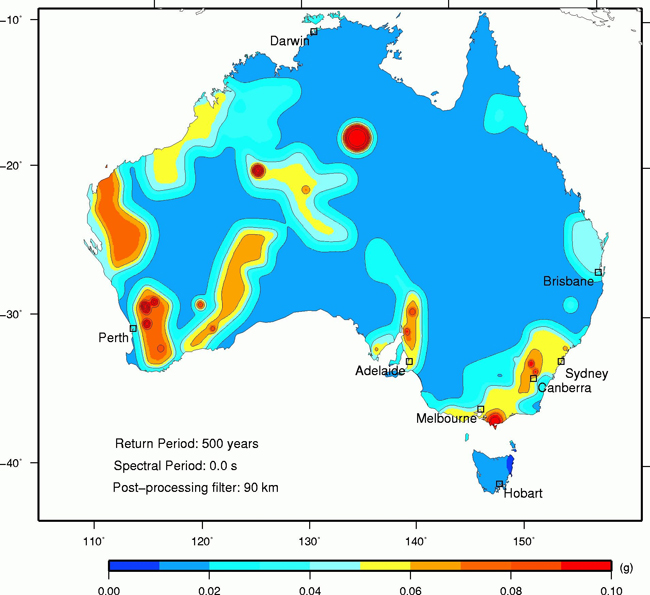
MOE in Victoria, York and Kirwan in Western Australia and Tenant Creek in the Northern Territory are the regions in Australia with the highest potential for earthquakes, according to a new Earthquake Hazard Map of Australia launched today.

Seismologists from Geoscience Australia developed the map by analysing the location of past earthquakes nationwide.

Since 1950 Australia has experienced 168 earthquakes above magnitude 5.0 and last year alone, 82 earthquakes were recorded at a magnitude 3.0 or above.

The Minister for Resources and Energy, Martin Ferguson, said the map estimates the likelihood of a particular area experiencing strong ground shaking from earthquakes and it is this, rather than the magnitude of an earthquake, that endangers people, buildings and infrastructure.

The new risk map is expected to impact Australian building standards.

”Although these maps do not enable us to predict earthquakes, they will allow engineers and planners to design and locate buildings and infrastructure so as to better protect our communities,” Minister Ferguson said in launching the map.

He also expects the modelling and data, which have been made available to the public, will be used by emergency managers, researchers and the insurance industry.

View the Earthquake Hazard Map of Australia

Ron Walker’s plan for tallest tower on rail yards in Melbourne

Source: TheAge

MELBOURNE major events supremo Ron Walker has launched a behind-the-scenes pitch to the Baillieu government for a multibillion-dollar development over the Jolimont rail yards, including the city’s tallest skyscraper.

The plan puts Mr Walker in direct competition with construction giant Daniel Grollo, who is lobbying for his vision of a civic and commercial precinct above the rail yards east of Federation Square. Mr Grollo’s Grocon also built the Eureka Tower on Southbank, the city’s tallest building.

The government is believed to be preparing to call for tenders to build over the rail yards.

Revelation of the Walker scheme – and the fact that the former Liberal Party treasurer is already lobbying in Spring Street ahead of a formal tender – is likely to be uncomfortable for Premier Ted Baillieu, renowned as a stickler for process and for his caution in dealing with business.

Mr Walker, a former lord mayor, confirmed that he had spoken to Mr Baillieu about his Jolimont scheme.
”Like all things in life, if you have an idea and it’s a good idea for Melbourne, it’s behoven upon the individual to take it to the government to see what they think about it,” he said.

”We’ve got great ideas for how Melbourne’s front yard can look.”
Last month The Sunday Age revealed the government had revived the idea of building a deck over the rail yards – a civic dream of premiers dating back to Henry Bolte – with Planning Minister Matthew Guy describing the project as the ”second phase” of Federation Square.

Mr Walker, Mr Grollo and other major construction industry players are already preparing proposals for the site.
”Bolte talked about it for years. Kennett talked about it,” said Mr Walker.
”It’s been the chatter of many premiers throughout the decades.”

Mr Walker is a towering figure in Melbourne’s civic and business life. He has also been a controversial one, no more so than 20 years ago, when the government of his friend Jeff Kennett picked his Crown consortium out of 23 bidders to build and operate Victoria’s first casino.

Mr Baillieu will be acutely aware of the sensitivity of Mr Walker’s involvement in any bidding process. That sensitivity will be heightened given that – according to a source familiar with it – Mr Walker has spruiked his scheme’s commercial tower as Melbourne’s tallest.

Another source said the Walker tower was problematic because of overshadowing of the Yarra River. The government has announced tough new planning controls along the river, including the stretch adjacent to the rail yards, to protect it from encroaching development and overshadowing.

It is understood the Walker scheme also includes new space for the National Gallery of Victoria, which is squeezed at its locations at Federation Square and its home on St Kilda Road.

Mr Walker refused to discuss his tower proposal, describing his plan as a ”community” project. An industry source said the Walker scheme would cost about $1.5 billion to build and employ up to 4000 in the process.

Mr Walker is also in serious negotiations with a cashed-up potential development partner for the rail yards project, the $18 billion building industry superannuation fund, Cbus.

Adrian Pozzo, chief executive of the Cbus development arm Cbus Property, confirmed discussions had been held with Mr Walker and other potential bidders but said the super fund had not committed to a partnership.

Last month Mr Grollo confirmed he had met Mr Guy about the project, describing it as an ”iconic opportunity for Melbourne – at little or no net cost to government”.

Both Mr Walker and Mr Grollo learnt much when they worked closely together over construction of this newspaper’s new home, Media House, over rail lines on Collins Street next to Southern Cross Station. At the time Mr Walker was the chairman of Fairfax, the owner of The Sunday Age.

”We built that [Age] building on time and on budget,” said Mr Walker. ”The technology is there and if I hadn’t have been able to prove it firsthand I wouldn’t have touched it [the rail yards project] with a 40-foot pole. We know how to do it and we know how to do it economically.”

Last month Mr Guy said the government was ”very interested and excited” about building over the rail yards. ”We’re now looking to expand on that success and we think this could also become a significant Melbourne landmark and community meeting place,” he said.
Mr Baillieu’s office declined to comment.

LABOR’S long-awaited school funding reform legislation will have to be changed in the new year

Source: DailyTelegraph

School funding laws to change in 2013

LABOR’S long-awaited school funding reform legislation will have to be changed in the new year after a funding agreement is signed.

The federal government has come under fire for the legislation it plans to put to parliament in a fortnight, a draft form of which was publicly released by the coalition on Thursday.

Opposition education spokesman Christopher Pyne criticised the draft Australian Education Bill as “all foam and no beer”.

In particular he took aim at a clause that says the act “does not create rights or duties that are legally enforceable”.

“The draft bill released to the sector is so devoid of substance and so full of motherhood statements the bill itself includes a section making it not legally binding,” he said.

“If the prime minister wanted to slap the schools sector and state governments in the face and insult the intelligence of Australians, then this bill delivers on both counts.”

A spokeswoman for Schools Minister Peter Garrett said the legislation would be legally enforceable in its final form, however.

“Details of the reforms and funding arrangements will be added to the bill as negotiations with education authorities progress,” she told AAP in a statement.

“Once that takes place the legislation will be legally enforceable.”

Prime Minister Julia Gillard was clear in her response to the Gonski school funding review in September, saying while Labor would honour its commitment to begin legislating for funding reform by the end of the year, this first bill would be aspirational.

She wants the Council of Australian Governments (COAG) to sign up to a new funding system at its first meeting in 2013.

COAG is expected to consider initial advice on what that system would look like at its meeting on December 7.

The draft bill includes a lengthy preamble outlining the principles underpinning Ms Gillard’s “education crusade”.

On school funding, it says the commonwealth will give funding for schools or school systems to any state, territory or non-government education authority that signs up to Labor’s national plan for school improvement.

It also mentions funding loadings to recognise disadvantaged circumstances of students or schools.

“This bill outlines a Commonwealth commitment to future funding for schooling based on student need as well as a series of reforms aimed at lifting schooling standards,” Mr Garrett’s spokeswoman said.

The Hon Kate Ellis MP / Job talks with African and Middle Eastern leaders on the Southside

Job talks with African and Middle Eastern leaders on the Southside

Thursday 15 November 2012

Joint Media Release

The Hon Kate Ellis MP

Minister for Employment Participation
Minister for Early Childhood and Child Care

Mr Graham Perrett MP
Member for Moreton
Federal Employment Participation Minister Kate Ellis and Member for Moreton Graham Perrett will today meet with African and Middle Eastern community leaders on the Southside to hear about local unemployment and business successes, as well as discuss the challenges some migrants face in getting good jobs.

Minister for Employment Participation Kate Ellis said the roundtable discussion will give members of Brisbane’s migrant community the opportunity to share ideas on how to improve employment services.

“I want to hear first hand from the local African and Middle Eastern community leaders in South Brisbane about their success stories as well as the challenges they face getting into the workforce,” Minister Ellis said.

“I want to know what works and what doesn’t so we can tailor our programs to the needs of our community and make sure we are delivering good jobs for locals,” Minister Ellis said.

Member for Moreton, Graham Perrett said, “There are more than 2,500 job seekers in Brisbane who were born in Africa and more than 1,100 from the Middle East, representing a huge potential boost for our local workforce.

“As the local member I know job seekers from culturally and linguistically diverse backgrounds can face a range of barriers to employment including getting work experience in Australia, or the need to develop or strengthen their English language skills – we want to help remove these barriers.

“This roundtable will provide the chance for a free flow of information so we can better link up our services to job seekers in both the African and Middle Eastern communities. The whole economy benefits when skills are best matched up with job opportunities,” Mr Perrett said.

The roundtable will also include representatives from other complementary programs including the Language, Literacy and Numeracy Program, Adult Migrant English Program and Settlement Services.

The roundtable is designed to improve service delivery by:

giving providers a better appreciation of issues faced by migrants looking for work, accessing employment services, and finding and keeping jobs, especially for young people and women
sharing success stories and exploring what can be done to improve the delivery of employment services in the short, medium and long term
sharing information on the importance of integrated serviced delivery and connecting Job Services Australia, Disability Employment Services and complementary program providers
“We’ve invested a record $5.9 billion into Job Services Australia since coming into Government to support all Australians no matter where they are born into a good job,” Minister Ellis said.

“Under our Government Job Services Australia providers have successfully placed people in more than 1.25 million jobs.”

Australian Government is holding a series of roundtables to hear from the ethic community leaders across Australia and have already held similar roundtables in Sydney, Melbourne and Adelaide.

For more information on migrant communities’ employment services providers visit: http://www.deewr.gov.au/employment/jsa/Pages/default.aspx

Doctors say thousands have suffered permanent eye damage from looking at total solar eclipse

 Source:News

Eclipse Brisbane

SOLAR: Brisbane City Council Story Bridge team leader Pat Menagh watches the eclipse from the top bridge. Picture: Peter Wallis

DOCTORS believe thousands of skygazers have suffered permanent eye damage and vision loss from “sunburnt eyeballs” after yesterday’s total solar eclipse.

Eclipse chasers who wake up today with a “black spot” in their vision have some form of eye damage, said eye expert Dr Bill Glasson.

Up to 5 per cent – or 5000 out of every 100,000 viewers – likely watched the cosmic show with the naked eye, studies show.

Even those who wore solar eclipse glasses and stared too closely at the intense rays are at risk.

More than 60,000 eclipse chasers, tourists and locals observed the rare cosmic spectacle in the skies above Cairns and Port Douglas yesterday.

Tens of thousands more watched up to three hours of a partial eclipse the length of Australia’s east coast.

About 20 million people worldwide viewed it live on various websites including NASA and couriermail.com.au.

Dr Glasson, president of the Royal Australian and New Zealand College of Ophthalmologists, said previous eclipse studies found irreversible eye damage in every five out of a hundred viewers.

“They will have a blind spot, or black spot, in the middle of their vision when they wake up,” said Dr Glasson.

“If it persists for more than a day certainly it will have done some damage. Some may find they have a permanent burn scar on the back of the eyeball and visual loss for the rest of their life.”

For North Queensland eclipse watchers, day turned into night for about two minutes.

Some decided to make the event even more memorable with marriage proposals, people rising above the clouds in hot air balloons and tourists watching the event from the decks of cruise ships.

The weather didn’t dampen the spirits of those who rose shortly after sunrise to gaze to the heavens and then cheer as darkness fell at 6.38am.

In Kuranda, 1300 gathered on a private property, including more than 40 NASA scientists.