BlackBerry co-founders Mike Lazaridis and Douglas Fregin considering bid for company

Source: Reuters

BlackBerry Ltd co-founders Mike Lazaridis and Douglas Fregin are considering a bid to buy the struggling smartphone maker, according to a securities filing on Thursday, raising the prospect of an alternative to a $4.7 billion offer led by its top shareholder.

The filing did not indicate whether the pair was planning to join or to present an alternative to a tentative $9-a-share bid by a group led by Fairfax Financial Holdings Ltd. Fairfax, which is headed by financier Prem Watsa, has not yet identified other members of the group.

Lazaridis and Fregin together control some 8 percent of BlackBerry, the filing said. That compares with roughly 10 percent controlled by Fairfax.

Excluding Fregin’s shares, Lazaridis controls 5.7 percent of BlackBerry, or about 60,000 shares more than he did at the end of 2012, according to Thomson Reuters data.

Lazaridis, who until early last year was one of BlackBerry’s co-chief executives and co-chairmen, appears to be considering “the widest range of options possible,” BGC Partners technology analyst Colin Gillis said.

“He’s going to talk to people by himself; he’s going to talk to Prem; he’s going to talk to everybody,” said Gillis.

Fairfax declined to comment on the Lazaridis filing, which noted that while Lazaridis and Fregin could make an offer, they could opt to take other steps, including selling their shares.

BlackBerry declined to comment specifically on the news, repeating an earlier statement that it is conducting a robust review of alternatives and would only say more if a deal is done or the strategic review is otherwise ended.

Investors have been skeptical the Fairfax offer will garner the financing needed, and Gillis noted that Lazaridis’ interest faces the same challenge because the founders, for now, do not have any funding lined up.

Analysts believe both parties could look to secure financial backing from one or more of Canada’s deep-pocketed pension funds. A foreign buyer for Blackberry faces a stringent review under the national security clause of the Investment Canada Act, as BlackBerry’s secure servers handle millions of confidential corporate and government emails every day.

Industry executives, lawyers and analysts say that could limit the pool of foreign entities that may be allowed to acquire all, or at least certain parts of the company.

In sign of investor skepticism, BlackBerry’s stock has traded well below Fairfax’s $9 offer price since the bid was announced it last month, days after BlackBerry warned it would report slumping sales, a big loss and job cuts.

News of the Lazaridis’ interest pushed shares in the company a bit higher. The stock turned positive after the news and closed on Thursday up 1.1 percent at $8.20 on the Nasdaq. But it has fallen more than 20 percent since the company warned on its earnings.

Lazaridis signed a confidentiality agreement with BlackBerry on Monday, according to the filing. If a takeover is successful, Lazaridis would become chairman, and Fregin would appoint a director, it says.

Lazaridis and Fregin, who together founded the company then known as Research In Motion Ltd in 1985, have hired Goldman Sachs and Centerview Partners LLC to assist with a strategic review of the stake.

While Lazaridis was a driving force behind the technology behind the BlackBerry, Fregin played a more minor role. He left the company as it grew into a powerhouse that produced what was then the must-have smartphone for professionals and politicians.

Fregin recently teamed up with Lazaridis again to start Quantum Valley Investments to fund quantum physics and quantum computing initiatives.

Lazaridis served as co-CEO and co-chairman with Jim Balsillie, a marketing specialist who also stepped down from those roles last year as the company’s outlook turned dire.

Its travails came to a head in August when BlackBerry put itself on the block after lackluster sales for its new devices. It has struggled for years to compete with Apple Inc’s wildly popular iPhone and a range of devices using Google Inc’s Android operating system.

Sources close to the matter have told Reuters that BlackBerry is in talks with Cisco Systems Inc, Google and Germany’s SAP AG among others, about selling them all, or parts of itself. The potential buyers have declined to comment.

Greek archbishop suspected of sexual harassment

Police question Elias Chacour, head of Melkite Greek Catholic Church in Israel, over lewd acts he allegedly committed five years ago

Elias Chacour, the archbishop of Akko, Haifa, Nazareth and all of Galilee of the Melkite Greek Catholic Church is suspected of sexually harassing a woman who works in the community he heads, Ynet learned on Wednesday.

Earlier this week Chacour was questioned under caution for a number of hours.

He was released on bail under restricting conditions.

According to the police, the incident in question took place some five years ago and they are not aware of any others.

The woman filed the compliant some two years ago, but due to the suspect’s status, various law enforcement agencies had to give their authorization before an investigation was launched.

Attorney General Yehuda Weinstein approved the investigation against Chacour, which is headed by Israel Police’s National Fraud Unit.

The archbishop reportedly cooperated with the investigators but has denied the allegations.

The investigators, however, found the complainant’s version to be credible.

Doctor rekindles ‘ancient Greek spirit’ in Athens free clinic

Source: DW

Cardiologist Giorgos Vichas, along with 90 other doctors and 140 volunteers, runs a free clinic in a middle-class neighborhood in Athens, offering free medication and health care in austerity-hit Greece.

Giorgos Vichas

Inside the Metropolitan Community Clinic in the district of Hellinikon in Athens, the waiting room is busy with volunteers and the phones are ringing non-stop. All the seats are taken. Some patients keep their eyes to the floor, because they are embarrassed – they cannot afford a simple doctor’s visit and have to come to the free community clinic instead.

Doctor Giorgos Vichas, is working with a volunteer, in one of the consulting rooms. He and his colleagues have one of the toughest jobs in Greece right now, helping cancer patients get access to medical treatment. Vichas is about to sign a referral for a 36-year-old cancer patient.

“This is a patient who will most likely lose her life because she was blocked from the national health care system. It’s a 36-year-old woman with two small children,” Vichas says.

Vichas with co-workers in the clinic
Vichas tries to help where he can

The woman and her husband have been unemployed and uninsured for years, so her cancer went undiagnosed.

“Someone has to be held accountable for this woman’s murder,” Vichas says. “And if she survives, she will be condemned to a life full of health problems. We can’t have crimes like this happening but unfortunately it is common in Greece at the moment.”

Since 2011, thousands of uninsured Greeks have found themselves locked out of the national health care system. Until then, the state provided free health care for all. But after three years of austerity measures brought on by the eurozone debt crisis, a humanitarian crisis is developing.

Standing up to the government

Vichas, along with two other doctors, angry and frustrated from seeing people dying due to the lack of access to health care, created the Metropolitan Community Clinic.

By standing up to the government, he has put his own career on the line. The group has decided not to become a non-governmental organization (NGO) and not to accept any cash donations. Medicine and other pharmaceutical items are the only donations it accepts.

There is no president or board, while all decisions are voted on in general meetings once a week. The utility bills are paid for by the local authorities and the offices are based in a prefabricated container that the municipality has provided.

Provisons on a shelf in the clinic
The clinic only accepts donations of supplies, not cash

Seeing tragedy on a daily basis, Vichas doesn’t believe in the widely trumpeted “success story,”a term the current Greek government has used to describe Athens’ efforts to curb the country’s debt and comply with the requirements of a rescue deal from the international community.

This is a ‘success story’ for the government and for Prime Minister Samaras, and this is what Germans have to become aware of,” Vichas tells DW. “A 36-year-old cancer patient with two children is dying because Samaras’ success story left her without treatment. If this is what is called civilized Europe, then I am not part of it. Once this government starts to think about the human story, then I will agree it is a Greek success story,” he adds.

Working without insurance

Thirty percent of working Greeks have no health insurance, despite a law that requires employers to provide health care for staff. But with an unemployment rate of over 27 percent, people will work for as little as 200 euros ($270) and no health insurance.

We’ve seen this neo-liberal policy with [former British Prime Minister Margaret] Thatcher, but even Thatcher’s policies seem progressive compared to what’s happening in Greece right now,” Giorgos complains.

“We’ve also seen [these policies] more recently in Argentina, when Argentina borrowed from the [International Monetary Fund] IMF. We’ve seen it in Chile. Even in Russia after the fall of communism. But what’s happening here is much more extreme,” he adds.

Protesters hold a rally outside the Greek State broadcaster ERT headquarters at Agia Paraskevi in a northern suburb of Athens, June 13, 2013 (Photo: John Kolesidis)
Austerity measures have riled many Greeks

Vichas has joined a group of doctors who have formed a watchdog on Greek health care. Its goal is to legally challenge the government in cases where patients have either died or have had severe problems due to the lack of access to the health care system.

In November, Vichas will also travel to Strasbourg to give a presentation to the Council of Europe.

Stress takes its toll

But his efforts have taken a personal toll on Vichas. He sees 30 patients a day at his public clinic, 15 a day at the community clinic and is busy keeping up pressure on the government.

The crisis has changed all aspects of my daily life and my personal life, these past two years. I work a lot more and it’s a constant battle with the ministry [of health],” he says.

“But, it also gives me strength. First because during the crisis, I feel that I’m doing my duty as a citizen and as a doctor, but also because I see that a self-organized society doesn’t need an institutional framework in order to function as long as it stands for what’s just and moral.”

Vichas is convinced that what he and others are doing at the clinic and at other volunteer organizations will be a blueprint for society in the future.

For now, more austerity measures are likely to affect Greeks this winter, but Vichas and his team are still hopeful for the future.

Ancient Greek spirit

“The reason I take part in this fight along with everyone else is in order to see the day that the ancient Greek spirit prevailsin society,” Vichas says.

“It stipulates that we live in harmony, respect each other, no matter what country of origin, religion or skin color.”

Vichas believes that sometimes ethics are more important than the law. It is about applying the lessons of Sophocles’ Antigone, he tells DW.

In Sophocles’ ancient drama, Antigone, a lone girl, stands up to the unjust commands of her uncle, Creon, the ruler of Thebes. It is a classic tale of an individual standing up to the state for moral reasons.

Antigone’s story ends in tragedy, but Dr. Vichas is convinced that, this time, things will turn out differently.

Greek scholar invented the term ‘asteroid’

Source: Stuff

Inspire and engage your audience Call today 0404855219

It was hardly the greatest mystery in the cosmos, and solving it won’t change the course of science. But a Fort Lauderdale astronomer has cracked a 200-year-old puzzle: Who coined the word “asteroid”?

Publishers might want to take notice.

“It will actually cause books to be rewritten and dictionaries to be revised,” said Clifford Cunningham, whose research revealed the true creator of the word used to describe the rocky space travellers.

It wasn’t William Herschel, the famed court astronomer for King George III, who is credited with inventing the term in 1802, Cunningham found. Rather it was the son of a poet friend of Herschel’s, Greek scholar Charles Burney Jr., who originated the term asteroid, which means “star-like” in Greek.

“It’s been a long-standing mystery,” said Rick Fienberg, press officer for the American Astronomical Society.

“Herschel was certainly one of the greatest astronomers of all time, but this is not a credit we can give him,” said Cunningham, who presented his findings Monday in Denver at the 45th annual convention of the astronomical society’s Division of Planetary Sciences.

“Asteroid was Herschel’s choice, but it was not his creation.”

Erik Gregersen, senior editor for astronomy and space exploration at Encyclopaedia Britannica, said he will review Cunningham’s work and make any necessary changes.

“We do have a big revision of our asteroid article in the works at the moment, so I’ll have to see how it fits in there,” he said. “To be accurate, the etomology of the word might have to credit this other fellow.”

Gregersen noted that revisions can be easily made, since most dictionaries are online. His own encyclopedia, for example, has been exclusively online since 2010.

Cunningham is a world authority on asteriods and one, 4276, was named Clifford after him in honor of a 1988 book, “Introduction to Asteroids.” He pored through volumes of source material at Yale University before uncovering two letters indisputably proving who first came up with the asteroid term. He is preparing to publish a formal paper on his discovery and submit it for peer review.

According to Cunningham, who is currently affiliated with the National Astronomical Research Institute of Thailand, stargazers in 1802 were baffled by the discovery of what they thought were two new planets. Herschel argued they were in fact completely different celestial entities and deserved their own identity.

But Herschel couldn’t conjure up an appropriate term, and his paper on the new objects was due to be delivered to the Royal Society in a week’s time. “He had to get a name immediately for his paper,” Cunningham said. “He didn’t have a word, and he was desperate.”

So the Sunday before the Royal Society meeting, Herschel appealed to Charles Burney Sr, a poet with whom he was collaborating on an educational poem about the cosmos. Burney considered the question and that night, by candlelight, penned a letter to his son, Greek expert Charles Burney Jr. The elder Burney suggested the words “asteriskos” or “stellula” to describe the new celestial objects.

Charles Burney Jr came back with the term “asteroid.”

It was unveiled in Herschel’s subsequent paper – and instantly dismissed.

“Every astronomer in Europe rejected it, everyone was against the creation of this word,” Cunningham said.

But within a few decades the concept of asteroids, and their name, gained legitimacy.

“It wasn’t actually accepted in the scientific field until the 1850s,” Cunningham said. “They determined they weren’t planets, but really asteroids.”

Cunningham based his conclusion on two letters from the Yale archives: the one the senior Burney wrote to his son, and another confirming that his son furnished the asteroid word to Herschel.

Fienberg attended Cunningham’s lecture and said attendees were “quite tickled” at his findings. The researcher is “well-respected” in astronomical circles, he added, and his discovery is likely to be “officially and widely recognized” once published.

The discovery’s significance, Fienberg said, is more historical than scientific. “It’s a little microcosm of how science works,” he said.

“Naming of things isn’t a trivial matter. Whenever something new arises, you have to give it the right name,” Gregersen said. “I think we got the right name.”

The WOGBOYS are back! – Live On Stage 2014

The smash hit stage show is back! Wogboys Live

Nick Giannopoulos

Alex Dimitriades

Frank Lotito

Vince Colosimo

Wog Boys Nick Giannopoulos and Vince Colosimo chat about their new live remixed and rewogified stage comedy Wogboys.

Two of Australia’s most famous and loved actors, NICK GIANNOPOULOS and VINCE COLOSIMO are returning to the stage for the first time in over a decade, with their critically acclaimed hit stage show WOGBOYS. They will be joined by AACTA award winning actor, ALEX DIMITRIADES & star of the recent Aussie film comedy Big Mamas Boy, FRANK LOTITO.

WOGBOYS is the record breaking, critically acclaimed stage show that inspired the hit Aussie comedy film The Wog Boy. Set in the mid 90s, this hilarious and insightful play examines everyday situations in the lives of a group of Wogboys.

Following over a decade of successfully acting, writing, producing and presenting in movies, stage shows & television, both Nick and Vince will go back to their roots, reprising the wog phenomenon and channeling the essence of Acropolis Now, Wogs Out of Work and the uber-successful The Wog Boy/ Kings of Mykonos feature films.

Don’t miss this much-loved, hilarious and insightful comedy written and directed by Nick Giannopoulos.

From the creator of Wogs Out of Work, Acropolis Now & The Wog Boy

WOGBOYS is the record breaking, critically acclaimed stage show that inspired the hit Aussie comedy film The Wog Boy.

Set in the mid 90s, this hilarious and insightful play examines everyday situations in the lives of a group of Wogboys.

Book now! Strictly limited season!

o

MELBOURNE

Princess Theatre
163 Spring St, Melbourne
OPENING JANUARY 9
(Cut price preview January 8)
Thursday, Friday & Saturday – 8PM
Sunday – 6PM

Buy Tickets Now

k

SYDNEY

Enmore Theatre
118-132 Enmore Rd Newtown
OPENING FEBRUARY 7
(Cut price preview February 6)
Friday – 8pm
Saturday – 7pm & 9:30pm
Sunday – 6pm

Buy Tickets Now

.

.

Nick Giannopoulos

One of Australia’s most accomplished & adored comedians; Nick has excelled & transitioned with great success from stage to television to film & beyond. A graduate of the Victorian College of the Arts, Nick essentially started the ‘wog’ phenomenon when he created & co-wrote the stage production Wogs Out of Work. Nick also co-created the smash hit sit-com Acropolis Now.

His first feature film The Wog Boy broke Australian box office records. He followed that with The Wannabes co-starring Isla Fisher and then The Kings of Mykonos: Wog Boy 2, which would go on to become a major International box office hit. Collectively all of Nick’s films have grossed over $20 million at the Aust. Box office.

k

Alex Dimitriades

Alex made his film debut playing the title role in breakout Australian feature film, The Heartbreak Kid. This was followed by an outstanding turn as the troubled “Ari” in Head On (Cannes Film Festival official selection) a performance that earned him an AFI Best Actor nomination in 1998 and a Film Critics’ Circle of Australia Award for Best Actor in 1999. He also received an AFI nomination in 2001 for his supporting role in the film, La Spagnola. Alex has also appeared in the films Three Blind Mice, Ghost Ship, Deuce Bigalow, Kings Of Mykonos, Summer Coda with Rachel Taylor, and recently completed filming on the soon to be released, The Infinite Man. Alex recently won the AACTA award for best actor in a TV series for his performance in The Slap.

k

Frank Lotito

Frank Lotito was destined to become a performer. From his early days as the class clown, to being discovered by a producer working as a waiter, destiny came knocking.

In 2011 Frank appeared in his first full-length feature film Big Mamma’s Boy, a laugh out loud comedy about life, love and lasagna, which he also wrote and produced. This lead to Frank producing his first US indie film in 2013. Shot entirely in New Orleans called the Lookalike, starring Justin Long, Jerry O’Connell and John Corbett. Frank is currently working on his next film The Cook & The Critic scheduled to shoot in New York and Italy in 2014.

k

Vince Colosimo

One of Australia’s most recognized actors with an extensive and successful career across theatre, television and film, Vince first came to the public’s attention in the feature films Street Hero & Moving Out. Vince has since gone on to appear in many more award winning films including; Walking On Water, The Nugget, Take Away and Opal Dreams. After landing a featured role in the internationally acclaimed film Chopper, he went on to win an AFI Award for Best Supporting Actor in 2002 for his performance in the feature film Lantana. In 2008 Vince starred in Underbelly one of the most successful Australian TV series ever. 2009 saw Vince star alongside Leonardo DiCaprio in Body Of Lies while in 2010 he appeared opposite Willem Dafoe & Ethan Hawke in Daybreakers. That year also saw him reunite with Nick Giannopoulos in The Kings of Mykonos: Wog Boy 2.

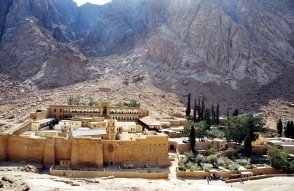
Ancient monastery has few visitors amid Sinai unrest, but Bedouin neighbors protect it

20131009-223334.jpg

Saint Catherine’s Monastery, founded by the Emperor St. Justinian the Great, sits at the foot of Mount Sinai in Sinai, Egypt. (Hussein Talal/AP)

ST. CATHERINE’S MONASTERY, Egypt — Thousands of years of tradition say the monastery built here marks the spot where Moses fell down on his knees before a burning bush and talked to God. Hidden high in the desert mountains, guarded for centuries by scholar monks and Bedouin tribesmen, this fortress sanctuary was once as remote as any place on Earth could be.

This is no longer so. The modern world arrived at St. Catherine’s Monastery in the form of paved highways and mass tourism, which once brought thousands of pilgrims a day.

But a violent insurgency and military crackdown sweeping across Egypt’s northern Sinai peninsula has brought an unwelcome quiet to the south, where the Bedouin tribes make their money from tourists.

In August, the Egyptian government closed St. Catherine’s Monastery to visitors as a precaution. It was only the third closure in 50 years. While the monastery reopened its doors again after three weeks, Egyptian security forces are now everywhere, shepherding the handful of foreigners into the area in armed convoys.

The monks at the monastery, and the Bedouin who make their living as guides here, stress that the violence is taking place 300 miles to the north.

In the northern Sinai, the restive tribes have been sabotaging natural gas pipelines, and smuggling weapons, drugs and gasoline through their network of tunnels with the Gaza Strip. In the power vacuum created by Egypt’s upheaval, the Bedouin there have raised the black flag for militant jihad, and are waging a guerrilla campaign of extortion, kidnapping and targeted assassination against the powers of the state.

Militants in the north have launched near-daily attacks on Egyptian security forces. In August, gunmen ambushed trucks carrying Egyptian police recruits and executed 25 on the side of a road near a peacekeepers’ checkpoint.

But in the south, the Bedouin tell their children the story of how the Roman emperor Justinian brought their tribe of mason-warriors to the Sinai in the sixth century to build the walled monastery here, and protect the monks with their lives.

“We teach our children that the monastery gives us life,” said Suleman Gebaly, a guide and local chronicler. “This place puts food on our table.”

The descendants of these Justinian serfs continue to honor their task, and so do the monks in black frocks, with their long gray beards and ponytails, who devote their days to vespers and prayer and to their magnificent library, which preserves in the high desert air some of the oldest, most precious manuscripts in Christendom.

Industrial tourism came to the monastery with the building of paved highways in the early 1980s. Until recently, the monastery drew throngs — sometimes 350 tour buses a day, a thousand visitors or more — from the beach resorts at Taba, Dahab and Sharm el-Sheik along the Red Sea coast, a diver’s paradise.

Now one or two buses come a day. On a recent morning there was a tour group from India, and later a few stragglers in a couple of vans.

Camel drivers who bring visitors on the three-hour climb to the top of Mount Sinai say they are desperate for work.

On a recent dawn ascent, only six Colombians made the summit. At a hut along the trail, guide Sabah Darwish sat wrapped in blankets, drinking tea and smoking in the murk. “You’re the first foreigners I’ve seen in a month,” he said.

A Bedouin tribe called the Gebaliya still tend desert gardens and flocks of sheep and goats. Every man has a camel, if he can, though many families have had to sell their camels at steep discounts to traders, who take them down to the beach resorts and feed them from dumpsters, trying to hold on until the tourists come back.

Without tourism, the Bedouin said, they would pursue other paths — such as drug smuggling, or worse.

Two Americans were kidnapped in the region last year. The most recent abduction of foreigners occurred in the south in March, when an Israeli and Norwegian were snatched. Like most, they were released.

Under the rule of President Hosni Mubarak, “there was an understanding that anyone from the north who came to make trouble in the south, we were allowed to kill him,” said Sheik Mousa al Gebaly, who operates a guest house and guide services in the town beside the monastery.

He remembers a time back in the 1990s when even the Israelis came in large numbers to Sinai. “I would have 50 cars with Israeli plates in my parking lot. They would hire 50 guides and 200 camels a day,” Gebaly said.

At the Taba crossing between Egypt and Israel, the passport and customs halls are empty. The coast here was once a famously laid-back post-hippie haven. Now beach hotels stand as shells in the sand. Wind blows through broken glass. The decorative date palms are slumped over, brown and dead.

Once-popular seaside camps, with names like Blue Wave, Moon Camp and Nirvana are shuttered and forlorn, like beach towns in perpetual winter — no more yoga, no more snorkeling, no more bowls of hash at sunset.

At the monastery, Archbishop Damianos sat behind his desk, apologizing for his poor eyesight, fumbling for his magnifying glass and explaining that English was not his best language. He spoke five others.

“It is not so bad for a monastery to be closed for a little while. We are monks, after all,” he said, smiling at his little joke. “We’ve returned to an earlier quiet.”

The archbishop is 79 years old. He arrived here in 1961. He has spent his life among the monks and Bedouin and he is sorry the religious pilgrims have gone, but hopes they will soon return.

“When the revolutions began in Egypt, the Bedouin came to us, and said, ‘You know we have been with you all these years. This is what our ancestors were sent here to do. This is our heritage, to protect the monastery,’ ” said the bishop. “I confess I was very moved by their words. For here we are intertwined.”

The monks here tend to take the long view. The scholar Father Justin, an American from El Paso, is busy on an ambitious project to digitize more than 3,000 manuscripts and subject the ancient tomes — some written, erased and overwritten again on parchment — to multi-spectral analysis.

Father Justin stood on the roof of the library, now undergoing renovation, and pointed out the mosque below, which stood next to the basilica. He felt safe, and proud that both Muslims and Christians are at home here.

But he also mentioned the 60-foot walls that have stood for 1,400 years. “It was built as a fortress monastery, and it is easily turned into a fortress again,” Father Justin said.

But he added that he preferred to be protected by God’s good graces.

“That would be best,” he said.

Bali victims remembered 2013

Tribute to the 43 NSW victims of the Bali bombing, including Greek Australian sisters Dimitra and Elizabeth Kotronakis.

On the thirteen anniversary of the bombing that killed 202 people, including 88 Australians.

The Kotronakis sisters were in Bali with their newly-married sister, Maria, and her new husband Kosta, when they were killed in the attacks on popular night-spots in Kuta.

The Age reported in 2003 that the Kotronakis sisters had just come from the 300-person Greek Orthodox wedding in Blacktown, where they were Maria’s bridesmaids.

Also killed in the attack was the third bridesmaid, cousin Christina Betmalik, as well as another cousin, Louiza Zervos, who had joined the bridal party for the holiday.

'this is our justice'

TRAGIC loss … Maria Elfes (second right) on her wedding day with her bridesmaids (L-R) Christine Betmalik, sisters Elizabeth (Lizzy) & Dimmy Kotronakis. All three bridesmaids died following the 12/10/02 terrorist car bomb explosion in Kuta Beach area on.

From wedded bliss to grief … the wedding party, from left, Lizi Kotronakis, Christine Betmalik, Louiza Zervos, Maria Elfes, Dimmy Kotronakis, Kosta Elfes.

Peter Kotronakis and his wife Vicky (middle) with another family member Christine Parris at the site of the Sari Club that killed their two daughters Elizabeth (33) and Dimmy (27).

Peter Kotronakis and his wife Vicky (middle) with another family member Christine Parris at the site of the Sari Club that killed their two daughters Elizabeth (33) and Dimmy (27).
Photo: Brendan Esposito

Vicky Kotronakis is consoled by family member Christine Parris at the site of the Sari Club where her daughters died.Vicky Kotronakis is consoled by family member Christine Parris at the site of the Sari Club where her daughters died.

Australia:
Gayle Airlie, Belinda Allen, Renae Anderson, Peter Basioli, Christina Betmilik, Matthew Bolwerk, Abbey Borgia, Debbie Borgia, Gerardine Buchan, Steve Buchan, Chloe Byron, Anthony Cachia, Rebecca Cartledge, Bronwyn Cartwright, Jodie Cearns, Jane Corteen, Jenny Corteen, Paul Cronin, Donna Croxford, Kristen Curnow, Francoise Dahan, Sylvia Dalais, Joshua Deegan, Andrew Dobson, Michelle Dunlop, Craig Dunn, Shane Foley, Dean Gallagher, Angela Golotta, Angela Gray, Byron Hancock, Simone Hanley, James Hardman, Billy Hardy, Nicole Harrison, Tim Hawkins, Andrea Hore, Adam Howard, Paul Hussey, Josh Iliffe, Carol Johnstone, David Kent, Dimmy Kotronakis, Elizabeth Kotronakis, Aaron Lee, Justin Lee, Stacey Lee, Danny Lewis, Scott Lysaght, Linda Makawana, Sue Maloney, Robert Marshall, David Mavroudis, Lynette McKeon, Marissa McKeon, Jenny Murphy, Amber O’Donnell, Jessica O’Donnell, Sue Ogier, Jodie O’Shea, Corey Paltridge, Charles van Renen, Brad Ridley, Ben Roberts, Bronwyn Ross, David Ross, Kathy Salvatori, Greg Sanderson, Cathy Seelin, Lee Sexton, Tom Singer, Anthony Stewart, Julie Stevenson, Jason Stokes, Behic Sumer, Nathan Swaine, Tracy Thomas, Clint Thompson, Robert Thwaites, Jonathan Wade, Vanessa Walder, Jodie Wallace, Shane Walsh-Till, Robyn Webster, Marlene Whiteley, Charmaine Whitton, Gerard Yeo, Luiza Zervos.

Prime Minister Tony Abbott to announce compensation for Australian Bali terror victims

Source: News

http://video.news.com.au/v/79751/Remembering-Bali#ooid=k5eWU1NjrkoHq3aDOcUFoou029WA3sVK

File:Bali memorial.jpg

File:Balinese ground zero.JPG

PM Tony Abbott has confirmed a pledge to offer compensation to Australian victims of terrorism.

MORE than a decade after the September 11 attacks in the United States and the 2002 Bali bombing, Australian victims and their families are finally set to receive compensation.

Prime Minister Tony Abbott will confirm the news today when he visits the Bali bombing memorial site in Kuta, making good his pre-election pledge that he would address the issue within 100 days of taking office.

The victims of overseas terrorism compensation scheme was introduced by the Gillard government in 2012, but was not made retroactive, meaning those affected by the attacks in New York in 2001 and Bali in 2002 and 2005 were unable to benefit.

But Mr Abbott, who was in Bali at the time of the 2002 bombings, will announce that compensation payments will now be made available to victims and their families for terrorist attacks dating back to September 10, 2001.

This will cover the attacks on New York and Bali as well as those in London and Egypt in 2005, Mumbai in 2008 and Jakarta in 2009.

Bali bombings

Prime Minister Tony Abbott will confirm today that victims of terror attacks like the Bali bombings will receive compensation.

Mr Abbott was in Bali when a massive bomb in a parked van was detonated outside the Sari Club in the bustling tourist area of Kuta just after 11pm on October 12, 2002.

The explosion came just 20 seconds after a suicide bomber detonated a backpack loaded with explosives inside Paddy’s Bar.

Tony Abbott

Prime Minister Tony Abbott and Margie Abbott during the APEC Family photo with spouses in Bali. Picture: Alex Ellinghausen

In the aftermath of the attacks, the prime minister spent many hours at Bali’s Sanglah General Hospital trying to help victims.

Mr Abbott has always said his intention to address the compensation issue was personal, and not political.

The move to address the compensation issue will finally fix the “extreme injustice” for victims and their families of recent overseas terrorism, Mr Abbott will say.

The scheme, which will cost about $30 million, will benefit around 300 individuals and families.

Sept 11 Anniversary Photo Gallery

American Airlines Flight 175 closes in on World Trade Center Tower 2 in New York, just before impact on September 11, 2001.

Payments of up to $75,000 will be made available to each eligible person, or their families. Claims can be lodged from October 21.

London bombing tributes

People look at flowers left in memory of the victims of bomb attacks at King’s Cross Station in London on July 9, 2005.

Diamond Rozakeas recently visited Kastanea – her highlight was meeting the doyenne of the dying art of professional mourning – Moirologia

The last of the mourners

The last of the mourners

Eleni Rozakeas

Even at 84, Eleni Rozakeas is an imposing woman. Now slightly stooped, her once 1.8 metre frame is still lean, her movements fluid. In the customary widows’ black garb, her dark, hooded, intense dark eyes are both steely and compassionate. Her countenance is one not to be messed with, yet despite this Eleni possesses a keen sense of humour and enjoys a good belly laugh.
In the Mani region and in fact in all of southern Greece, Eleni is one of the last of the Moirologia – professional mourners or wailers.
In a funeral tradition dating back to biblical times and depicted in the Iliad and Shakespeare, Eleni will spend up to three days beside the body wailing, reciting laments and compulsively crying. She may also pull her hair out and beat her chest. The extreme and continuous wailing is to send the deceased’s spirit or soul off on a safe journey to the other side.
Religion still plays an important role in the lives of Kastanea villagers – however, even though there are forty-three churches in the small mountainside village, they struggle to get a priest to conduct services each month. Despite this, Eleni Rozakeas is still active as a professional mourner, something she has performed for decades. Sadly, she’s at an age where many of her friends and relatives are passing on, and the small cemetery high up on the mountain overlooking the village is cramped for space.
When Eleni was born, the village’s population was over 1200. These days it numbers just 84. Nobody knows for sure how old the village is, but some say it dates back over 3000 years. It has survived numerous invasions and upheavals throughout the centuries, from Ottoman invasions to WWII and the Civil War, which had an especially devastating effect on the village and its people.
The people of Kastanea were renowned for their fighting spirit – however, after the Civil War when the times were extremely tough, many of the villagers were forced to seek a new life outside Greece. Kon and Eleni Rozakeas (the mourner’s cousin) left Kastanea in the 1950’s and eventually settled in Brunswick.
When their children Diamond, Roula and Stratis visited the village last month, they decided to use Skype to reconnect their parents with their cousins. It was the first time in twenty five years that they had seen each other. There was plenty of reminiscing and joking as well, especially from Eleni senior.
For Kon and Eleni’s children, it was a slice of history and an insight into the future. While the art of moirologia may not survive in a few years, they hope their parents’ village will survive and hopefully thrive, despite the ageing of the village and the current economic woes besetting the country.
Moirologia is the vocalization that goes with Greek ritual lament, or Klama. It’s a violent sort of mourning, and was often done by professional women mourners armed with knives. American singer Diamanda Galas with roots in Mani, Greece, performs an extreme rendition.
The word moirologia derives from the ancient Greek Tragedy, with the arch-singer and the choir following the mourning. Unfortunately very few women arch-mourners have survived, and the custom has been almost eliminated.
In ancient times, the most important part of the prothesis (the part of the funeral when the body is laid out) was the ritual lament – which is what we know today as moirologia. While singing, the persons involved would move around in a pattern resembling a dance. They would improvise lament sung by friends and relatives. Another type of lament was sung by professional mourners – similar to modern day moirologia. The hired singer would lead off the lament followed by the family. A chorus of women cried out in accompaniment.

Greek politician Akis Tsochatzopoulos gets 20 years jail for bribery in landmark verdict

Source: SMH

Greek former defence minister, Akis Tsohatzopoulos, arriving for a court trial in Athens. A Greek court found Akis Tsohatzopoulos guilty of money laundering in a six-million euro case that has become emblematic of political corruption in the debt-wracked country, on October 7, 2013.Greek former defence minister, Akis Tsohatzopoulos, arriving for a court trial in Athens earlier this year. A Greek court found him guilty of money laundering in a six-million euro case on October 7, 2013. Photo: AFP

Athens: In a landmark verdict, a former Greek defence minister and co-founder of the country’s once-mighty Socialist Party, Akis Tsochatzopoulos, has been found guilty of setting up a complex money-laundering network to cover the trail of millions of dollars in bribes he is said to have pocketed from government weapons purchases.

After a five-month trial – the highest-profile case against a Greek politician in more than two decades – judges convicted Tsochatzopoulos, 74, along with 16 other defendants, including his wife, his daughter and several business partners. All were found to have colluded with him to launder the bribe money using a network of offshore companies and property purchases.

Tsochatzopoulos was sentenced to 20 years in prison, said his lawyer, Leonidas Kotsalis, who added that his client would appeal.

Regardless of the sentencing decision on the money laundering charges, Tsochatzopoulos will not escape prison. He was sentenced in March to eight years for concealing assets from the authorities, chiefly for failing to report the purchase of a house near the Acropolis, one of several properties connected to the money laundering scheme.

Tsochatzopoulos, who has been in custody at the capital’s Korydallos Prison since his arrest in April 2012, accused the authorities of political persecution and state violence during the trial, which featured vicious exchanges between him and his former associates.

He is the most senior government official to stand trial since 1991, when former Prime Minister Andreas Papandreou was acquitted on charges of accepting bribes in return for forcing state companies to prop up a troubled private bank.

In a telephone interview after the verdict, Mr Kotsalis said he had “strong reservations about the legal substantiation” of claims that his client accepted bribes.

The court heard that Tsochatzopoulos pocketed nearly $US75 million ($79.6 million) in bribes while serving as defence minister from 1996 to 2001, signing two major deals worth an estimated $US4 billion for a Russian missile defence system and German submarines.

Tsochatzopoulos had repeatedly called for members of a political and defence council that co-signed those contracts – including two former prime ministers, Costas Simitis and George A. Papandreou – to testify at his trial. But the request was rejected by the judges, who said the bribery accusations, not the arms deals, were under scrutiny.

The conviction in Athens in Monday was unusual in a country where top-ranking state officials are rarely prosecuted. But over the past year, the government of Prime Minister Antonis Samaras has intensified a crackdown on corruption among the political elite, blamed by most Greeks for a dysfunctional state system that created the country’s huge debt problem and led Greece to dependence on foreign rescue loans.

In February, Vassilis Papageorgopoulos, a former mayor of Salonika, the country’s second city, was sentenced to life in prison for embezzling at least $US24.5 million from the city.