Cancer Information Fact Sheets in Greek

Source: cancercouncil.com.au

The content on the fact sheets below is identical in each each language.

When you click on the link it will download a PDF.

Greek Language Resources Order Form


Titles Language Versions
English Greek
 Early Detection of Breast Cancer Click Here Click Here
After a Diagnosis of Breast Cancer Click Here Click Here
Early Detection of Bowel Cancer Click Here Click Here
After a Diagnosis of Bowel Cancer Click Here Click Here
Understanding the Faecal Occult Blood Test Click Here Click Here
Early Detection of Ovarian Cancer Click Here Click Here
After a Diagnosis of Ovarian Cancer Click Here Click Here
Early Detection of Prostate Cancer Click Here Click Here
After a Diagnosis of Prostate Cancer Click Here Click Here
Questions to ask your doctor Click Here Click Here
Coping with a Cancer Diagnosis Click Here Click Here
Understanding Chemotherapy Click Here Click Here
Understanding Radiotherapy Click Here Click Here
Complimentary Therapies and Cancer Click Here Click Here
Men and Cancer Prevention Click Here Click Here
Women and Cancer Prevention Click Here Click Here
Understanding your Pap Smear Click Here Click Here
Be Sunsmart Click Here Click Here
Stop Smoking Click Here Click Here
Alcohol and Cancer Click Here Click Here
Eat for Health Click Here Click Here
Stay in Shape Click Here Click Here
Move your body Click Here Click Here
Living Well After Cancer Click Here Click Here

Owners of some 300 hotels in Greece are seeking investors in Russia to sell their units

Source: Ekathimerini

Hoteliers look for investors from Russia

The owners of some 300 hotels in Greece are seeking investors in Russia to sell their units, Nikos Angelopoulos, the honorary president of the Association of Hellenic Tourism Enterprises (SETE), revealed on Thursday.

Angelopoulos added that the hotel owners have already sent the relevant information to the Russian Embassy in Athens.

He was speaking at a round-table discussion on tourism development that took place at a Thessaloniki hotel, organized by the German-Greek Chamber of Commerce and Industry.

Given the major difficulties hoteliers are facing, SETE President Andreas Andreadis will meet with top officials of banks and the Hellenic Bank Association in the coming days in a bid to find a solution to the cash flow problem in the tourism sector.

Thousands detained in Greek jails

Source: nation.com.pk

Thousands of Pakistani youngsters remain stranded at detention facilities in Athens city of Greece after illegal border-crossings, said an FIA officer, citing 42 Pakistani deportees who touched down in Lahore on Thursday.
The deportees arrived by Qatar Airlines flight QR-620 at around 7:50 in the morning. It was the third flight within a week brining deportees back from Athens in large numbers.  Forty-four Pakistanis were deported on Wednesday and 31 on November 14 from Greece. The deportees were transported under International Organization of Migrants programme.
A 60-member Greek intelligence squad handed the deportees over to FIA Immigration Additional Director Basharat Shehzad and other authorities deputed at the Lahore airport.
The deportees tell the sad story of their peers trapped in Athens. There is nobody who could listen to these youngsters, they say.  According to a senior FIA official, all the deportees were released against personal surety and none was sent to Agency’s Anti-Human Trafficking Cell for further action. Only one of them possessed the genuine travel documents, added Ali Imam Zaidi, FIA Immigration assistant director. Ninety-five per cent of these deportees belonged to upper Punjab districts of Gujranwala, Gujrat, Sialkot, Mandi Bahauddin, Lala Musa, Kharian and Jhelum, senior FIA official Abu Zar Sibtain told The Nation.
Another FIA official who wished anonymity raised the alarm that human trafficking was on the rise in the country, notably in upper Punjab. But, he added, the Agency could not act accordingly because of many influential persons and parliamentarians having stakes in this big business.  The official further said only cosmetic measures had been taken to curb human trafficking and that was the reason the real accused were operating freely unmindful of the bad name they were brining to the country.
The economy of Greece is already in a shambles due to which Pakistanis crossing into Greece in search of better future got trapped there. As per the laws, after being arrested and deported, a person is not supposed to be arrested or sent to jail in his homeland.
Interestingly, a former FIA Punjab director Waqar Haider had chalked out a strategy about sending deportees from airport to FIA provincial headquarters just for fame. His blue-eyed inspector Chaudhry Hanif would then mint money from them by hook or by crook. Each deportee had to pay Rs25,000 to Rs30,000 to secure his release.
Nevertheless, everything has changed now. Incumbent FIA Punjab Director Qudratullah Marwat has ordered to release every deportee from the airport. It may be noted here that most of the deportees were between 22 and 30 years of age. They had paid a huge sum of money to get out but put their lives at risk instead.
Reports say each deportee would pay around Rs0.5 million to Rs0.7 million to human smugglers for his entry to Greece.
An FIA officer said human traffickers used illegal route of Iran via Balochistan, and then from Iran to Turkey and into Greece. They make their entry through illegal border-crossings where, sometimes, border police open fire on them and some of them lose their lives too.
Sometimes these deportees are kidnapped by their own Pakistani people after reaching Greece. As per reports, Pakistanis already present in Greece and those who are jobless have started abducting their own countrymen for ransom.
These criminals trap newcomers. They lure them with providing of good jobs but after transporting them to undisclosed locations they torture them. They make telephone calls to their families in Pakistan and demand ransom from them.

Greek Orthodox Community of St George to decide fate of controversial site of destroyed Belvedere building

Source: Couriermail.com.au

Historic property Belvedere was devastated by fire and subsequently demolished on November 13 at Edmondstone Street, South Brisb

Historic property Belvedere was devastated by fire and subsequently demolished on November 13 at Edmondstone St, South Brisbane. Picture: Peter Wallis. Source: News Corp Australia

THE Greek Orthodox Community of St George hasn’t decided what to do with the site where a historic home stood until a devastating fire last week, despite years of fighting with the council over the property.

The heritage-listed Belvedere building had stood in Edmondstone St, South Brisbane, since 1888 before it was destroyed by fire and subsequently demolished on November 13.

Firefighters battle the fire in Edmonstone St, South Brisbane. Picture: Peter Wallis

Firefighters battle the fire in Edmonstone St, South Brisbane. Picture: Peter Wallis Source: News Corp Australia

The Greek Orthodox Community of St George had owned the property for about 30 years.

President Jim Georgiou said the community was “shocked” by what had happened, but no future plans had been made.

“We haven’t had a committee meeting. We’re in between terms and hopefully will have a new committee coming on next week, then we can start talking,” he said

“We had been planning to renovate it, architects had been employed.

“There will be a lot of discussion and whatever it is will go in front of our members.”

The Brisbane City Council refused an application in 2010 to demolish the building, which is listed on council’s Heritage Register.

The decision was appealed and was before the courts at the time of the fire.

Lord Mayor Graham Quirk said he was disappointed the Belvedere had been destroyed.

“It’s very sad news for the local community and the broader Brisbane community that this precious and historic building has been destroyed by fire,” he said.

There were reports squatters had been living in the abandoned boarding home, though no one was inside at the time of the blaze.

A Queensland Fire and Rescue Services spokeswoman said due to the intensity of the fire an investigation could not take place, and for safety reasons the building was demolished the day of the fire.

Who is going to Brazil 2014?

All the goals from the final World Cup playoffs 4:18

The final European places for the 2014 World Cup were decided on Wednesday morning, with a showdown between Cristiano Ronaldo and Zlatan Ibrahimovic the highlight of the matches.

Suarez, Rooney, Neymar, Honda and Cahill will be stars at the World Cup.

Suarez, Rooney, Neymar, Honda and Cahill will be stars at the World Cup. Source: AAP

THE line-up is complete! We now know 32 nations that will take part in next summer’s World Cup finals in Brazil.

We’ll see 13 European, five South American, five African, four North American and four Asian countries in world football’s showpiece event..

Here, the Daily Mail brings you the complete lowdown on all those who have qualified for the tournament.

Fans celebrate World Cup qualification for Brazil 2014 1:29

Football fans around the world have celebrate and commiserated as all but one of the 32 teams that will compete at the World Cup in Brazil next year were confirmed. With Uruguay and Jordan battling it out for the final spot.

Australia

FIFA Ranking: 57th

Star player: Tim Cahill – Box-to-box midfielder often converted into a striker with a good goalscoring record. Formerly of Millwall and Everton, now playing in Major League Soccer for the New York Red Bulls.

Post-game analysis: Socceroos v Costa Rica 7:10

The Fox Sports football panel dissects all the action from the Socceroos and Costa Rica clash.

H ow they got there: Rather than battling for top spot, Australia were left trying to fend off Oman for the final automatic spot which they only achieved on the final day following a late 1-0 win against Iraq coupled with Oman’s loss at Jordan. They are out of form having been defeated 6-0 by Brazil and France in recent matches – just as well the tournament is next summer.

EUROPE

Belgium

FIFA Ranking: 5th

Star man: Eden Hazard – Quick, creative and energetic winger who has shone for Chelsea since moving to the Premier League last year.

Belgium have attacking options all over the pitch.

Belgium have attacking options all over the pitch. Source: AP

How they got there: Blessed with a generation of players that have taken Belgium from being non-qualifying material to a major European force, Marc Wilmots guided his side to top spot in Group A with a game to spare after making light work of nearest rivals Croatia. The nation’s first major tournament in 12 years may end up being their best since the class of 86 visited Mexico.

England

FIFA Ranking: 10th

Star man: Wayne Rooney – Bullish striker who, on top form, can be unplayable. On course to become England’s record all-time goalscorer if he continues in his current rich vein of form.

England's Wayne Rooney will be crucial to his nation's hopes.

England’s Wayne Rooney will be crucial to his nation’s hopes. Source: AFP

How they got there: While England seemed to toil through qualifying at times they never once looked on the back foot. When the chips were down they were forced to win their last two matches but they delivered in confident fashion. A nation awaits to see which star will break his metatarsal in the run-up to the finals next summer.

France

FIFA Ranking: 21

Star man: Franck Ribery – One of the favourites for the Ballon d’OR after a wonderful year with Bayern Munich where he won a treble – though Ribery has never quite showed that form consistently on the international stage. Watch out Brazil.

France's soccer team celebrate after defeating Ukraine.

France’s soccer team celebrate after defeating Ukraine. Source: AP

How they got there: The unlucky second seeded side to be drawn with World Cup holders Spain in their group, France were never favourites to finish top. Poor indivual performances were angering the public however, and their was a media backlash after their 2-0 defeat to Ukraine in their play-off first leg. They turned it around spectacularly though, and will be dangerous in Brazil.

Germany

FIFA Ranking: 2nd

Star man: Mesut Ozil – Arsenal star whose craft, creativity and conjuring is well known. Has seamlessly adapted to life in the Premier League since joining from Real Madrid on deadline day.

German football team take the tube to Wembley 0:47

The German national football team have found a rather unusual way to beat the London traffic before their international friendly at Wembley.

How they got there: By winning every game – aside from a moment of madness when they only drew with Sweden despite going 4-0 up. That was about as bad as it got for Low’s side as Germany typically qualified with envious ease. Germany have actually never failed in any of their qualification attempts, as the two tournaments they missed saw them fail to enter (1930) or banned (1950).

Italy

FIFA Ranking: 8th

Star man: Claudio Marchisio – Hard-hitting Juventus man has become a constant in the Italian midfield and played in every match en route to the Euro 2012 final.

How they got there: The Italians never looked in danger of failing to reach Brazil with group rivals stumbling over each other as Prandelli’s team built a commanding lead at the top of the group. Flopped as defending champions to crash out at the group stage in 2010, but a team blessed with veteran experience and youthful enthusiasm will hope to build on a runners-up finish at Euro 2012.

Netherlands

FIFA Ranking: 8th

Star man: Robin van Persie – Manchester United star who is one of the most clinical finishers in the world, especially in his current purple patch.

How they got there: In style. Holland bounced back from a calamitous Euro 2012, where they lost every game, to blitz Group D and finish as Europe’s top scorers – much of that was in part due to Van Persie’s unmatched 11 goals. The Dutch seemed to have learned from the shambles of the Euros last year and will target going one better than 2010’s runners-up finish in South Africa.

Portugal's forward Cristiano Ronaldo single handedly got his side into the World Cup.

Portugal’s forward Cristiano Ronaldo single handedly got his side into the World Cup. Source: AFP

Portugal

FIFA Ranking: 14th

Star player: Are you having a laugh? Cristiano Ronaldo – He single-handedly dragged his side through a tricky play-off tie against Zlatan Ibrahimovic’s Sweden, and his form for Real Madrid moves to greater heights wither every week. With him in the side, you’d be brave to back anybody against them.

All the goals from the final World Cup playoffs 4:18

The final European places for the 2014 World Cup were decided on Wednesday morning, with a showdown between Cristiano Ronaldo and Zlatan Ibrahimovic the highlight of the matches.

How they got there: With difficulty. Losing out to Russia by one point at the top of Group F, Ronaldo and Co stuttered to poor results such as a draw at home with Northern Ireland and just two points from both fixtures against third-place Israel.

Consigned to a play-off with Sweden in a battle between Ronaldo and Zlatan Ibrahimovic, they relied on a hat-trick from their talisman to see them through.

Russia

FIFA Ranking: 19

Star player: Alan Dzagoev – Still just 23, the attacking midfielder has earned plenty of plaudits playing for CSKA Moscow since his youth. Russia’s new shining light after Andrei Arshavin’s downfall.

How they got there: Despite being in the same group as Cristiano Ronaldo’s Portugal, Russia always held the advantage in the group and secured top spot with relative ease. Manager Fabio Capello of course did a similar trick with England to comfortably guide them to South Africa, but we will need little reminding of how badly that adventure ended…

Spain national football team's midfielder Andres Iniesta.

Spain national football team’s midfielder Andres Iniesta. Source: AFP

Spain

FIFA Ranking: 1

Star man: Andres Iniesta – Scorer of the winning goal at the last World Cup and the jewel in Spain’s and Barcelona’s sides. Forms a magnificent ‘tiki-taka’ relationship with Xavi in midfield.

Spain humbled by South Africa 1:04

It will go down as one of the all-time upsets in world football, and an unhappy return to South Africa for World Champions Spain, who were humbled 1-0 by the hosts in Johannesburg.

How they got there: Paired in a tough group that contained France, top-spot was always going to come down to the two clashes between Spain and the 1998 champions. As it was it was the current holders that edged the head-to-head record and finish in an automatic qualifying spot, as they attempt to become the first European side to lift the World Cup on South American soil.

Switzerland

FIFA Ranking: 7

Star man: Xherdan Shaqiri – Despite battling with wingers Franck Ribery and Arjen Robben for places at Bayern Munich the 22-year-old has managed to impress and will be a key man for Switzerland.

How they got there: The Swiss were given a boost before the qualifying games had even begun as the top seed place in their group was taken by a Norway team who have gone on to struggle. With Slovenia the second seeds, Hitzfeld’s team have taken advantage of one of Europe’s weaker groups but there is exciting talent within the squad such as Shaqiri and Valentin Stocker.

Weird and wonderful football 2:11

The international break did little to slow down the number of controversial, superb and downright wacky moments in the world of football.

Bosnia and Herzegovina

FIFA Ranking: 16th

Star man: Edin Dzeko – Manchester City striker who has an excellent international scoring record of 33 goals in 58 games.

How they got there: Bosnia and Greece were by far the runaway teams in Group G and such was their dominance, Bosnia still needed to win on the final day despite dropping points in just two qualifiers throughout the campaign. Huge celebrations greeted their first ever qualification for a major tournament but it remains to be seen how Dzeko and his team-mate cope in Brazil.

Croatia

FIFA Ranking: 18

Star player: Luka Modric – Real Madrid splashed out big bucks on the Tottenham midfielder in 2012 and despite an indifferent first season, he is now shining for both club and country once again.

 Mario Mandzukic of Croatia celebrates qualification with team mate Luka Modric.

Mario Mandzukic of Croatia celebrates qualification with team mate Luka Modric. Source: Getty Images

How they got there: Drawn in one of the tougher groups of qualifying with Belgium and Serbia, as well as home nations Scotland and Wales, Croatia can pat themselves on the back for managing to come second. Although they may not have caught the dominant Belgians anyway, a double defeat to Scotland didn’t help their chances. Defeated relative minnows Iceland in the play-offs.

Greece

FIFA Ranking: 15th

Star player: Sokratis Papastathopoulos – The 6 foot 1 rock-solid centre half has been impressing Bundesliga watchers for some time, so much so that Borussia Dortmund snapped him up from Wolfsburg in the summer. Just don’t get his name on the back of your shirt…

How they got there: Missing out on automatic qualification on mere goal difference as Bosnia topped Group G, Greece relied on toppling Romania 4-2 in the play-offs.

SOUTH AMERICA

Brazil

FIFA Ranking: 11th

Star player: Neymar – The 21-year-old has adapted seamlessly to life in European football with Barcelona and will become the best in the world in a few years.

How they got there: As host nation they booked their place at the tournament six years ago when Brazil were awarded the tournament. There is huge pressure on Brazil, where anything less than a record sixth victory will be seen as a national disaster alongside the infamous team that crashed on home soil to lose the 1950 final to Uruguay.

Argentina

FIFA Ranking: 3rd

Star player: Lionel Messi – Widely considered the most gifted player in the world and rightly so. His record of 37 international goals in 83 matches pales into insignificance in comparison to his historic scoring feats and honours roll with Barcelona.

Lionel Messi will carry Argentina's hopes in Brazil.

Lionel Messi will carry Argentina’s hopes in Brazil. Source: AP

How they got there: Without Brazil’s presence, Argentina were billed to be the runaway leaders in South America and they didn’t fail to disappoint as Messi’s goals ensured they easily navigated their way to an 11th consecutive appearance. Messi failed to deliver in South Africa, but can he finally star on the biggest stage and end Argentina’s 28-year wait to win a third World Cup?

Chile

FIFA Ranking: 12th

Star player: Alexis Sanchez – Exciting winger/forward who epitomises that vibrant Chilean style. The Barcelona man scored twice against England in last week’s friendly.

Chile's Alexis Sanchez.

Chile’s Alexis Sanchez. Source: AP

H ow they got there: Chile were not made to regret throwing away a 3-0 lead against Colombia – they eventually drew 3-3 – and sealed victory against Ecuador in the final qualifier to secure third place and their place in Brazil.

Colombia

FIFA Ranking: 4th

Star player: Radamel Falcao – One of the deadliest strikers in the world, currently playing for Monaco following a big money move from Atletico in the summer.

Colombian's forward Radamel Falcao is deadly.

Colombian’s forward Radamel Falcao is deadly. Source: AFP

How they got there: We haven’t seen Colombia since David Beckham’s free-kick past Faryd Mondragon (still part of the squad at 42) helped dump them out of France 98. But having trailed a distant second behind Argentina for much of the campaign, Colombia are back and this time it will be the feet of Falcao rather than the hair of Carlos Valderrama which will do the talking.

Ecuador

FIFA Ranking: 22nd

Star player: Edison Mendez – Vastly experienced midfielder who has been in the squad since 2000 and will probably have his swansong at this tournament.

How they got there: A vital 1-0 win over Uruguay in their penultimate game effectively sealed Ecuador’s place in their third finals in four World Cups. That they lost 2-1 in Santiago proved an irrelevance as they grabbed the fourth and final automatic spot ahead of Uruguay – who beat Argentina 3-2 in Montevideo – on goal difference.

Uruguay

FIFA Ranking: 6th

Star player: Luis Suarez – Currently among the world’s best strikers, Suarez has been tormenting the Premier League’s best defenders this season for Liverpool, and is a definite contender for player of the tournament if Uruguay go deep in 2014.

How they got there: To be frank, they’ve done it the hard way. A team with Uruguay’s galaxy of stars should have locked their spot away months ago. Instead, a nation with a rich World Cup history was the very last of the 32 teams to qualify after thrashing Jordan in a two-legged sudden death playoff.

Luis Suarez dribbles past a Jordan' defender. Khalil Mazraawi

Luis Suarez dribbles past a Jordan’ defender. Khalil Mazraawi Source: AFP

NORTH AMERICA

Mexico

FIFA Ranking: 24th

Star man: Javier Hernandez – Manchester United goal poacher with an excellent international scoring ratio of 35 goals in 57.

All Whites World Cup dream is over after loss to Mexico 0:51

Mexico qualified for their sixth successive World Cup on Wednesday with a 4-2 victory in the second leg of their intercontinental play-off against New Zealand, for a 9-3 aggregate win.

How they got there: Having negotiated the initial qualifying group with a 100 per cent record, Mexico made hard work of the final phase, losing to Honduras at home and Costa Rica and the United States on the road. Having scraped in to to the play-off round, they made light work of New Zealand, winning 5-1 at home and 4-2 away.

United States

FIFA Ranking: 13

Star player: Jozy Altidore – Hasn’t impressed in his spells in England with Hull City and Sunderland, but a nailed-on striker for USA, scoring 21 times in 65 appearances.

How they got there: After starting slowly in ‘the Hex’, Klinsmann’s side soon found their winning rhythm to hit top spot in the group before a win over Mexico last month confirmed a seventh straight World Cup appearance. The last 10 years have seen players gain bucket loads of experience from playing in Europe and it’s seeing big gains in the squad strength.

Costa Rica

FIFA Rankings: 31st

Manager: Jorge Luis Pinto – In his second spell in charge of Costa Rica, Pinto has done better in this qualification campaign than he did in the last one with Colombia.

Star player: Bryan Ruiz – The Fulham forward is Costa Rica’s captain and chipped in with three goals during the qualifying phase.

How they got there: Despite conceding a last-minute equaliser in Jamaica in September, it was smiles all round as the draw in Kingston was enough to see Costa Rica qualify in surprisingly comfortable circumstances. Fulham forward Bryan Ruiz has the ability to compete on the global stage but reaching the last 16 like in 1990 will prove a tough ask for Pinto’s team.

Honduras

FIFA Ranking: 34th

Star player: Wilson Palacios – Defensive midfielder heading to his second World Cup. Well known to English football fans having played for Birmingham, Wigan, Tottenham and Stoke.

How they got there: Honduras have undergone several changes since South Africa, but pulled it all together in time to enjoy a successful qualifying campaign, finally sealing their place with a 2-2 draw against Jamaica in the final match.

AFRICA

Algeria

FIFA Ranking: 32

Star player: Sofiane Feghouli – Algeria have been crying out for a star for many years, and they may have it in the Valencia winger, impressing the Giants in La Liga despite his side’s lowly position.

How they got there: Comfortably qualifying from Group H in qualifying, Algeria – famously holding England at the 2010 World Cup – looked certain for 2014 when they drew Burkina Faso in their play-off match. Things weren’t that easy, however, as Burkina Faso won the first-leg 3-2. The homeside turned it around in the return leg, beating the underdogs 1-0 to progress on away goals.

Cameroon

FIFA Ranking: 59th

Star man: Samuel Eto’o – team captain, Cameroon’s record appearance holder with 112 caps and all-time leading goalscorer with 55.

Cameroon striker Samuel Eto'o has been on form for Chelsea.

Cameroon striker Samuel Eto’o has been on form for Chelsea. Source: AFP

How they got there: The Indomitable Lions won a group featuring Libya, Congo DR and Togo before overcoming Tunisia 4-1 on aggregate in the final play-off round. They received a stroke of good fortune in the group when Togo were forced to forfeit their 2-0 win in June after fielding an ineligible player.

Ghana

FIFA Ranking: 23

Star player: Kevin-Prince Boateng – A rare African playmaker, possessing a mix of great skills and raw speed and power, Boateng has become a national jewel despite his German roots.

How they got there: Easily. Ghana progressed from their group in style, despite an early loss to Zambia, and carried on their goalscoring feats in their play-off, too. Egypt, one of the top teams in Africa by all means, were thrashed 6-1 in the first leg, all-but-securing one of the stars of South Africa’s World Cup place.

Ivory Coast

FIFA Ranking: 17th

Star man: Didier Drogba – Linchpin striker of the side who will have surpassed a century of caps by the time of the tournament – he has a remarkable 62 goals for his country.

H ow they got there: The Ivory Coast initially topped a group containing Morocco, Tanzania and Gambia, before seeing off Senegal 4-2 on aggregate in a tough play-off tie.

Nigeria

Fifa ranking: 33rd

Star man: Victor Moses – Capped for England at youth levels, the Liverpool winger – on-loan from Chelsea – chose to represent the nation of his birth. Scored in Nigeria’s play-off win against Ethiopia.

How they got there: Nigeria were undefeated in their group containing Malawi, Kenya and Namibia, before comprehensively seeing off Ethiopia 4-1 on aggregate in their play-off.

ASIA

Japan

FIFA Ranking: 44th

Star player: Keisuke Honda – The motor of the Japanese team, known for his dribbling and set-piece ability. Currently plays for CSKA Moscow but has already agreed to join AC Milan in the New Year.

Japan's midfielder Keisuke Honda (L) celebrates.

Japan’s midfielder Keisuke Honda (L) celebrates. Source: AFP

How they got there: Now part of the World Cup furniture after reaching their first tournament at France 98. Japan were the first side to qualify (outside the hosts) for Brazil 2014 in June as they comfortably topped Asia’s Group B. The squad is talented, too. Shinji Kagawa may not be featuring much for Manchester United but keep an eye out for CSKA Moscow’s midfield genius, Honda.

Iran

FIFA Ranking: 49th

Star player: Ashkan Dejagah – Winger who played for Germany’s youth sides before opting for the country of his birth. Plays for Fulham in the Premier League.

How they got there: Surprisingly topped Group A after winning at South Korea on the final match day. Despite winning the group there isn’t much to suggest that former Manchester United assistant Queiroz can guide them past the group stage for the first time. Skipper, Javad Nekounam has the experience but Fulham’s Ashkan Dejagah is best suited to deal with the quality they will face in Brazil.

South Korea

FIFA Ranking: 56

Star player: Ki Sung-yueng – The Swansea midfielder on-loan at Sunderland may not have lit up the Premier League but he is an ever-present for South Korea, playing 53 times at the age of just 24.

How they got there: Survived a late scare on the final matchday of the group stage to qualify as only a narrowly superior goal difference saved them from being bumped into the play-offs by Uzbekistan following a 1-0 home defeat to Iran. It will be their eighth consecutive finals but only twice have they got beyond the group stage.


World University Rankings 2013-2014

Source: Times Higher Education

WHERE Australian institutions ranked in the Times Higher Education World University Rankings this year.

2013-14 rank 2012-13 rank Institution
1 34 28 Melbourne
2 48 37 ANU
3 63 65 UQ
4 72 62 Sydney
5 91 99 Monash
6 114 85 UNSW
7 168 190 UWA
8 201-225 176 Adelaide
9 251-275 276-300 Newcastle
10 276-300 251-275 Macquarie
11 276-300 251-275 QUT
12 276-300 301-350 Wollongong

.

.

Rank Institution Location Overall score change criteria
1 California Institute of Technology United States
94.9
2 Harvard University United States
93.9
2 University of Oxford United Kingdom
93.9
4 Stanford University United States
93.8
5 Massachusetts Institute of Technology United States
93.0
6 Princeton University United States
92.7
7 University of Cambridge United Kingdom
92.3
8 University of California, Berkeley United States
89.8
9 University of Chicago United States
87.8
10 Imperial College London United Kingdom
87.5
11 Yale University United States
87.4
12 University of California, Los Angeles United States
86.3
13 Columbia University United States
85.2
14 ETH Zürich – Swiss Federal Institute of Technology Zürich Switzerland
84.5
15 Johns Hopkins University United States
83.7
16 University of Pennsylvania United States
81.0
17 Duke University United States
79.3
18 University of Michigan United States
79.2
19 Cornell University United States
79.1
20 University of Toronto Canada
78.3
21 University College London United Kingdom
77.6
22 Northwestern University United States
77.1
23 The University of Tokyo Japan
76.4
24 Carnegie Mellon University United States
76.0
25 University of Washington United States
73.4
26 National University of Singapore Singapore
72.4
27 University of Texas at Austin United States
72.2
28 Georgia Institute of Technology United States
71.6
29 University of Illinois at Urbana Champaign United States
71.4
30 University of Wisconsin-Madison United States
71.1
31 University of British Columbia Canada
70.8
32 London School of Economics and Political Science United Kingdom
69.8
33 University of California, Santa Barbara United States
68.4
34 University of Melbourne Australia
68.2
35 McGill University Canada
68.1
36 Karolinska Institute Sweden
67.8
37 École Polytechnique Fédérale de Lausanne Switzerland
67.7
38 King’s College London United Kingdom
67.6
39 University of Edinburgh United Kingdom
67.5
40 New York University United States
67.4
40 University of California, San Diego United States
67.4
42 Washington University in St Louis United States
67.2
43 The University of Hong Kong Hong Kong
65.3
44 Seoul National University Republic of Korea
65.2
45 Peking University China
65.0
46 University of Minnesota United States
64.9
47 University of North Carolina at Chapel Hill United States
64.5
48 Australian National University Australia
64.4
49 Pennsylvania State University United States
64.2
50 Tsinghua University China
63.5
50 Boston University United States
63.5
52 Kyoto University Japan
63.2
52 Brown University United States
63.2
52 University of California, Davis United States
63.2
55 Ludwig-Maximilians-Universität München Germany
63.1
56 Korea Advanced Institute of Science and Technology Republic of Korea
62.9
57 Hong Kong University of Science and Technology Hong Kong
62.5
58 University of Manchester United Kingdom
62.3
59 Ohio State University United States
62.0
60 Pohang University of Science and Technology Republic of Korea
61.7
61 KU Leuven Belgium
61.3
62 Purdue University United States
60.7
63 Georg-August-Universität Göttingen Germany
59.9
63 University of Queensland Australia Australia
59.9
65 Rice University United States
59.8
65 École Normale Supérieure France
59.8
67 Leiden University Netherlands
59.4
68 Universität Heidelberg Germany
59.2
69 Delft University of Technology Netherlands
59.1
70 University of Southern California United States
59.0
70 École Polytechnique France
59.0
72 University of Sydney Australia
58.8
73 Erasmus University Rotterdam Netherlands
58.1
74 Universität Basel Switzerland
57.7
74 Utrecht University Netherlands
57.7
76 Nanyang Technological University Singapore
57.2
77 Wageningen University and Research Center Netherlands
56.8
78 University of Pittsburgh United States
56.7
79 University of Bristol United Kingdom
56.3
80 Emory University United States
56.1
80 Durham University United Kingdom
56.1
80 Tufts University United States
56.1
83 University of Amsterdam Netherlands
55.9
83 Michigan State University United States
55.9
85 Ghent University Belgium
55.5
86 Freie Universität Berlin Germany
55.3
87 Technische Universität München Germany
55.2
88 Case Western Reserve University United States
55.0
88 Vanderbilt University United States
55.0
90 University of Notre Dame United States
54.7
91 Monash University Australia
54.6
92 McMaster University Canada
54.5
93 University of California, Irvine United States
54.1
94 Humboldt-Universität zu Berlin Germany
53.8
95 University of Rochester United States
53.6
96 Université Pierre et Marie Curie France
53.5
97 University of Colorado Boulder United States
53.4
98 University of Groningen Netherlands
52.9
98 Maastricht University Netherlands
52.9
100 University of Helsinki Finland
52.6
100 University of York United Kingdom
52.6
102 Royal Holloway, University of London United Kingdom
52.5
103 Rutgers, The State University of New Jersey United States
52.4
103 Stockholm University Sweden
52.4
103 University of Arizona United States
52.4
106 University of Montreal Canada
52.3
106 Eindhoven University of Technology Netherlands
52.3
108 University of Maryland, College Park United States
52.2
109 Chinese University of Hong Kong Hong Kong
52.0
109 University of Alberta Canada
52.0
111 Uppsala University Sweden
51.9
112 University of Virginia United States
51.8
112 University of Sheffield United Kingdom
51.8
114 University of New South Wales Australia
51.7
114 Université Paris-Sud France
51.7
114 Queen Mary, University of London United Kingdom
51.7
117 KTH Royal Institute of Technology Sweden
51.6
117 University of St Andrews United Kingdom
51.6
117 Technical University of Denmark Denmark
51.6
117 University of Glasgow United Kingdom
51.6
121 University of Sussex United Kingdom
51.2
121 University of Zürich Switzerland
51.2
123 Lund University Sweden
51.1
124 University of Geneva Switzerland
51.0
125 Tokyo Institute of Technology Japan
50.8
126 Dartmouth College United States
50.5
126 University of Cape Town South Africa
50.5
128 University of Florida United States
50.4
129 RWTH Aachen University Germany
50.3
129 Trinity College Dublin Republic of Ireland
50.3
131 Radboud University Nijmegen Netherlands
50.2
132 Université de Lausanne Switzerland
50.1
132 Indiana University United States
50.1
132 University of Massachusetts United States
50.1
135 Boston College United States
50.0
136 University of California, Santa Cruz United States
49.9
137 Lancaster University United Kingdom
49.7
138 Aarhus University Denmark
49.6
139 University of Leeds United Kingdom
49.5
139 Colorado School of Mines United States
49.5
141 University of Warwick United Kingdom
49.4
142 National Taiwan University Taiwan
49.2
143 University of Utah United States
49.1
144 Osaka University Japan
49.0
144 VU University Amsterdam Netherlands
49.0
146 University of Southampton United Kingdom
48.9
146 Arizona State University United States
48.9
148 University of Exeter United Kingdom
48.7
148 University of California, Riverside United States
48.7
150 Tohoku University Japan
48.5
150 University of Copenhagen Denmark
48.5
152 Albert-Ludwigs-Universität Freiburg Germany
48.4
153 University of Birmingham United Kingdom
48.3
154 Karlsruhe Institute of Technology Germany
48.0
155 Université Joseph Fourier, Grenoble France
47.8
156 École Normale Supérieure de Lyon France
47.5
157 University of Bern Switzerland
47.4
157 University of Nottingham United Kingdom
47.4
159 Texas A&M University United States
47.2
160 Georgetown University United States
47.0
161 University of Iowa United States
46.7
161 University College Dublin Republic of Ireland
46.7
161 University of Leicester United Kingdom
46.7
164 University of Antwerp Belgium
46.6
164 Pompeu Fabra University Spain
46.6
164 Brandeis University United States
46.6
164 University of Auckland New Zealand
46.6
168 University of Western Australia Australia
46.4
169 University of Liverpool United Kingdom
46.3
170 University of Twente Netherlands
46.2
170 University of Vienna Austria
46.2
172 Yeshiva University United States
46.1
172 Université Catholique de Louvain Belgium
46.1
174 University of Delaware United States
46.0
174 University of East Anglia United Kingdom
46.0
176 University at Buffalo United States
45.9
176 Université Libre de Bruxelles Belgium
45.9
178 Université Paris Diderot – Paris 7 France
45.8
178 Stony Brook University United States
45.8
180 Wake Forest University United States
45.7
181 Universität Bonn Germany
45.6
181 Rensselaer Polytechnic Institute United States
45.6
183 Iowa State University United States
45.5
184 Northeastern University United States
45.4
185 University of Oslo Norway
45.3
185 University of Miami United States
45.3
185 University of Ottawa Canada
45.3
188 University of Aberdeen United Kingdom
45.2
188 The University of Texas at Dallas United States
45.2
190 Yonsei University Republic of Korea
45.1
191 Hebrew University of Jerusalem Israel
45.0
191 University of Illinois at Chicago United States
45.0
193 Mines ParisTech France
44.9
194 University of Reading United Kingdom
44.8
194 George Washington University United States
44.8
196 University of Dundee United Kingdom
44.7
197 Florida Institute of Technology United States
44.6
198 Newcastle University United Kingdom
44.5
199 Boğaziçi University Turkey
44.3
199 Tel Aviv University Israel
44.3

Ancient Greek gears: the mystery of the first computer

Source: irishtimes.com

That’s Maths: A mechanical device first discovered underwater in 1900 shows how advanced the Greeks were

A reconstruction of Antikythera Mechanism in Athens. Photograph: Louisa Gouliamaki/AFP/Getty ImagesA reconstruction of Antikythera Mechanism in Athens. Photograph: Louisa Gouliamaki/AFP/Getty Images

Two storms, separated by 2,000 years, resulted in the loss and recovery of one of the most amazing mechanical devices made in the ancient world.

The first storm, around 65 BC, wrecked a Roman vessel taking home loot from Asia Minor. The ship went down near the island of Antikythera, between the Greek mainland and Crete. The second storm, in 1900, forced some sponge divers to shelter near the island, where they discovered the wreck.

This led to the first major underwater archeological expedition. In addition to sculptures and other art works, an amorphous lump of bronze, later described as the Antikythera Mechanism, was found.

On examination, the bronze lump turned out to be a complex assemblage of gears, a mechanical device previously unknown in Greek civilisation. Inscribed signs of the Zodiac suggested that it was probably for astronomical rather than navigation purposes.

Several techniques were used to establish that the AM is about 2,000 years old. Carbon dating of the ship’s timber put it at about 200 BC, but the wreck could have been many decades later.

The style of amphora jars found on board implied a date between 86 BC and 60 BC. Coins found in the wreckage allowed this to be pinned down to about 65 BC.

The inscriptions on the mechanism link it to Corinth and thence to its colony at Syracuse, where Archimedes flourished. This gives an intriguing possibility that the AM was in a mechanical tradition inspired by Archimedes.

The mechanism was driven by a handle that turned a linked system of more than 30 gear wheels. Using modern imaging techniques, it is possible to count the teeth on the wheels, see which cog meshes with which and what are the gear ratios. These ratios enable us to figure out what the mechanism was computing.

The gears were coupled to pointers on the front and back of the mechanism, showing the positions of the sun, moon and planets as they moved through the zodiac. An extendable arm with a pin followed a spiral groove, like a record player stylus. A small sphere, half white and half black, indicated the phase of the moon.

Even more impressive was the prediction of solar and lunar eclipses. It was known to the Babylonians that if a lunar eclipse is observed, a similar event occurs 223 full moons later. This period of about 19 years is known as the Saros cycle. It required complex mathematical reasoning and technology to implement the cycle in the mechanism.

The mechanism could provide accurate predictions of eclipses several decades ahead. Derek de Solla Price, who analysed it in the 1960s, said the discovery was like finding an internal combustion engine in Tutankhamen’s tomb.

The Antikythera mechanism has revolutionised our thinking about the scientific legacy of the Greeks. It is like modern clockwork, but clocks were invented in medieval Europe. It shows that the Greeks came close to our technology. Had the Romans not taken charge, we might today be far in advance of our current level of technology.

All the gear ratios are now understood; there was even a dial to indicate which of the pan-Hellenic games would take place each year, with the Olympics occurring every fourth year. Just one small cog remains a mystery. Research is continuing, and more remains to be discovered about this amazing high-tech device.

The world’s fastest and tallest waterslide looks as scary as it sounds

Source: News.com.au

It's a steep decline. Picture: Supplied

It’s a steep decline. Picture: Supplied Source: NewsComAu

IT WILL allegedly be the highest and fastest waterslide … in the world. Will you take the ride of your life?

Appropriately called ‘The Verrückt’ (which means insane in German) Meg-A-Blaster, the slide (or supported fall) is due to open May 23 next year in the Schlitterbahn Kansas City Waterpark in America.

The Schlitterbahn Kansas City Waterpark states: “Are you Insane? The new Meg-a-Blaster speed-slide combines the best elements of Schlitterbahn’s patented Master Blaster™ technology with the insane drops of a speed slide. This new category of attraction will shatter all existing records and tower over the current record holder.”

New photos on the company’s blog who the project’s progress, and it’s already evident that this won’t be a ride for the faint hearted.


Waterside or supported fall? Picture: Supplied

Waterside or supported fall? Picture: Supplied Source: NewsComAu

Schlitterbahn co-owner and designer of the slide, Jeff Henry, won’t reveal the statistics we all want to know just yet – that is exactly how high and how fast will the slide will be – but he did say, “Our greatest challenge will be to find thrill seekers brave enough to ride.”

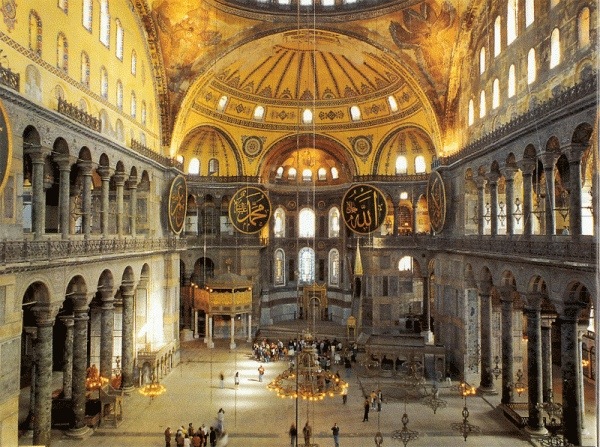
Two weeks ago, a bill was introduced in Turkish parliament to convert Hagia Sophia into a mosque

20131120-122923.jpg

Source: http://hellenicleaders.com/HagiaSophia

A few days ago, deputy prime minister of Turkey Bulent Arinc stood next to Hagia Sophia and made a shocking declaration: he declared to his audience that “[w]e currently stand next to the Hagia Sophia Mosque […] we are looking at a sad Hagia Sophia, but hopefully we will see it smiling again soon.”

The Greek government has released a response:

“The repeated statements from Turkish officials regarding the conversion of Byzantine Christian churches into mosques are an insult to the religious sensibilities of millions of Christians and are actions that are anachronistic and incomprehensible from a state that declares it wants to participate as a full member in the European Union, a fundamental principle of which is respect for religious freedom. Byzantine Christian churches are an intrinsic element of world cultural and religious heritage, and they should receive the necessary respect and protection.”

Of course, the Turkish government couldn’t care less about the reaction of Greeks or Christians. The movement within Turkey to turn Hagia Sophia into a mosque has gained steam as of late, and earlier this year, a petition was submitted to a parliamentary commission to accomplish the conversion.

Less than two weeks ago, a bill was introduced in Turkish parliament to convert Hagia Sophia into a mosque, laughably claiming that its conversion into the museum it is today was somehow “illegal.” This is what the bill’s sponsor had to say about the matter:

“This bill has been prepared aiming to open the Hagia Sophia – which is the symbol of the Conquest of Istanbul and which has been resounding with the sounds of the call to prayer for 481 years – as a mosque for prayers.”

And there you have it. For millions around the world, Hagia Sophia symbolizes the history of Christianity, the glorious grandeur of Byzantine architecture, or the stunning ability of man to sculpt faith into a creation that stirs the hearts of onlookers to this very day.

For the bill’s sponsor and many others in Turkey? Hagia Sophia is simply “the symbol of the Conquest of Istanbul,” a passive representation of the height of Ottoman power. For them, Hagia Sophia has no intrinsic value but is instead a means to an end. Its conversation into a mosque would be yet another “conquest,” a victorious notch in the proverbial belt of an re-ascendent Ottomanism.

The “Blue Mosque” – located just a over a kilometer away from Hagia Sophia.

After all, it’s not like the city needs another mosque. Just one kilometer away from Hagia Sophia is Turkey’s famous Blue Mosque, completed in 1616 and still used to this day as a mosque for prayers.

Still, the relentless pursuit of converting historical Christian sites to mosques marches on in Turkey. One other Hagia Sophia, a smaller church-turned-museum in Trabzon, Turkey, has already been turned into a mosque this year. A court ruled that its conversion into a museum was “illegal.” It’s a case that sets a dangerous precedent.

We need your help to stand up for Hagia Sophia. Add your voice to the international petition in opposition to converting Hagia Sophia into a mosque:

http://hellenicleaders.com/HagiaSophia

20131120-123002.jpg

Ange Postecoglou keen to build a bubble of belief after first up win

Source: TheRoar

While the quality of the opponents in Costa Rica wasn’t particularly high, the Socceroos rounded off what has been a positive first week under Ange Postecoglou with a performance that gives them a building base and a bit of belief.

While the manager was upbeat in his praise post-match, no doubt keen to build a positive air around a squad that doesn’t have a lot of time before Brazil, Ange Postecoglou also recognised there is still plenty to do.
But he says he is happy for the nation to get carried away with the effort at the SFS last night.

Little doubt he wants to build belief among the Socceroos and in the Socceroos.

He says we shouldn’t fear anyone.

It’s an interesting strategy, and a first up win and positive showing certainly provides at least some fuel for a nation to get behind the team.

While it wasn’t World Cup class by any means, certainly there looked a foundation that at least gives us a chance of being more competitive than we have been.

While Costa Rica came here with an experimental squad and what looked a negative back five, you can only control what’s in front of you, and the Roos deserve credit for doing that.

This was a performance a world away from some of the recent regressive showings that brought an end to the Holger Osieck years.

Here was a team playing on the front foot, stepping up to press the opponents across the pitch.

Defensive pressure was the foundation of this first-up effort, suffocating the Ticos, not allowing them to gain any control of the match, let alone a strike.

‘Control of the opposition’ and ‘control across all the thirds’ were buzz phrases under Guus Hiddink and while there might have been a little more control of the final third at times, certainly there were plenty of good signs across the pitch.

Primarily, it was the squeezing of the opponents as a unit that gave the Roos the space to start stringing their passes.

Coming from a team that looked afraid to play under Osieck, there were some good signs that this team will have a crack and try to play under Postecoglou.

Certainly he is encouraging them to, and you could see a few smiles return, not that the skipper Lucas Neill was smiling when heckled by some of the fans in the eastern terrace.

While it will take Postecoglou time to build the confidence in possession, one of the most pleasing aspects, as he said post-match, was that even if there was an error in distribution and a lost ball, the team would work hard, and collectively, to win it back quickly.

Setting the pressing tempo were the two midfield anchors, the imposing Mile Jedinak and and composed Mark Milligan, who protected their back five with distinction.

This was Jedinak’s best game in green and gold for what seems an eternity and he reminded many, including this correspondent, he’s not giving up his spot under Postecoglou without a fight.

After a very nervy start on the ball, he started to stroke it around with more confidence.

Milligan continued his recent high standards, and is still, to my mind, the man for the armband.

There were encouraging signs also from right fullback Ivan Franjic, striker Mat Leckie, right sided attacker Robbie Kruse and substitute number 10 Tom Rogic.

Overall, there was a real hunger and enthusiasm about this camp, and the challenge for Postecoglou is to bottle that desire and take it to Brazil and beyond.

There is little room for complacency, and Postecoglou would do well to maintain a healthy and objective distance from his players, keeping everyone on their toes, assessing them and others in detail.

For example, the nervy start among the new look back five might have been punished by a team more in tune with their strategy.

While we shouldn’t get too carried away with last night, as greater challenges lie ahead, you can understand Postecoglou’s want to create a snowball.

Unlike Osieck’s empty rhetoric, there was enough to suggest Postecoglou has turned the corner and started trending the Roos in the right direction.