Prime Minister Tony Abbott in talks to keep Toyota in Australia after Holden closure

Source: Yahoonews

Prime Minister Tony Abbott says the Federal Government is holding talks with Toyota aimed at keeping the carmaker in Australia, amid union claims the company is seeing to use Holden’s closure to reduce pay and conditions for thousands of workers.

Toyota has warned that Holden’s decision to stop manufacturing by 2017 puts “unprecedented pressure” on its ability to continue building cars in Australia.

Mr Abbott has revealed that he spoke to Toyota’s Australian boss Max Yasuda last night.

“Obviously the Government will be talking to Toyota,” he told Channel Nine this morning.

“We want Toyota to continue.

“They are in a slightly different position to Holden,” he added. “Much more of their local production has been for export. Toyota locally have been much more integrated into the global operations of the company, it seems, than with Holden.”

The Federal Court will decide today whether Toyota can put a new pay deal to its 2,500 strong workforce, a move that would slash costs at its Altona production plant by $17 million.

But the Australian Council of Trade Unions (ACTU) has advised Toyota workers not to accept poorer work conditions.

ACTU secretary Dave Oliver says Toyota is putting unfair pressure on workers, who will vote on the agreement tomorrow if it gets Federal Court approval.

“The problem with Toyota is that they’ve approached their workers to reduce wages and conditions without any plan of future investment,” he said.

“It’s not the wages and conditions that are going to decide the future of Toyota, it’s going to be the knock-on effect of what happens in the auto components sector and what kind of support the Government is going to do.”

Victorian Premier Denis Napthine says it is vital Toyota does not close its Altona factory.

“It is important in terms of jobs, but its also vital for manufacturing capacity, for skills capacity, for the future of these areas in our economy in Victoria,” he said.

“I’ll seize that opportunity to talk to Mr Abbott about the future of Toyota and how the Federal Government can work with the State Government and Toyota and the entire automotive supply chain industry to secure the future of Toyota.”

Toyota worker Phil Hird, who has been employed with the carmaker for 25 years, says he is not confident that his job is safe and that he will be looking for work elsewhere.

“If it’s got to happen, it’s got to happen. [I’m] just seeing what’s out there now and finding out what’s going on,” he said.

“Very shocked and gutted … [I’ve] been here 25 years and the feeling is very empty. It’s been a very very bad 24 hours.”

Political storm erupts over Holden pullout

Source: News.com.au

GENERAL Motors blamed a “perfect storm”, but Labor threw responsibility squarely at the federal government for Holden’s decision to stop making vehicles in Australia.

Prime Minister Tony Abbott called it a “sad, bad day” for Australian manufacturing and pledged a strategic response to help workers affected by Holden’s decision to stop making cars in Australia from 2017.

The government will in coming days release a “considered package” of measures to rebuild confidence in the long-term future of manufacturing and the regions of Adelaide and Melbourne where Holden operates, he told parliament.

“I don’t want to pretend to the parliament that this is anything other than a dark day for Australian manufacturing,” Mr Abbott said.

But there had been hard times before and Australian industrial centres had come through, he urged.

“It is not the time to play politics, it’s not the time to indulge in the blame game, it’s not the time to peddle false hope,” he said.

But Opposition leader Bill Shorten didn’t hold back in blaming the government for losing a high stakes game of poker.

“A major company who has been building motor cars in this country since after the Second World War has effectively been goaded to give up on this country,” he told parliament.

The opposition was “appalled” by the government’s handling of the crisis.

Something had changed between Holden and the government in 24 hours, Mr Shorten said.

“They were told by the federal government of Australia, who were elected to govern for all, that there would be no more support, no more investment, and I believe, that Holden were pushed,” he said.

Mr Shorten called on Mr Abbott to urgently deal with the mess and chaos that has occurred while both leaders were in South Africa for Nelson Mandela’s memorial service.

“We understand that structural change happens in the Australian economy, what we don’t understand is when the Australian government tries to sabotage its own industry,” Mr Shorten said, prompting Treasurer Joe Hockey to storm out of the parliament.

Earlier, parliament erupted during question time with Labor blaming the Abbott government for the loss of the 2900 jobs in Victoria and South Australia by 2017, while Mr Hockey angrily rejected Labor’s “confected anger”.

An emotional Acting Opposition Leader Tanya Plibersek later castigated the coalition for withdrawing $500 million of car industry support and not properly engaging with Holden’s US owner General Motors since it won the September election.

“It was Joseph Benedict Chifley who watched the first car roll off the production line at Fishermans Bend and it will be Joseph Benedict Hockey who sees the last car roll off the production line,” she told reporters.

She said Mr Hockey has got his way after “goading and daring” Holden to withdraw from Australia.

Acting Prime Minister Warren Truss rejected the claims, saying he had been told by Holden the government’s actions had little influence on GM’s decision.

Mr Hockey said GM was right when it cited a “perfect storm” of “the sustained strength of the Australian dollar, high cost of production, small domestic market and arguably the most competitive and fragmented auto market in the world”.

But he did add the former Labor government’s carbon tax, its now scrapped plan to alter the fringe benefits tax arrangements on cars and high labour costs to the mix.

Αυστραλία: Ελληνίδα δώρισε ένα εκατομμύριο δολάρια στο Νοσοκομείο της Καμπέρας

Το ποσό του ενός εκατομμυρίου δολαρίων, το οποίο θα δοθεί σταδιά στα επόμενα πέντε χρόνια, δώρισε στο Νοσοκομείο Παίδων και Γυναικών της Καμπέρας, μια Ελληνίδα φιλάνθρωπος, η Σωτηρία Λιάγκη.

Η οικογένειά της είναι γνωστή στην Καμπέρα για το φιλανθρωπικό της έργο αλλά η ίδια δεν θέλει να μιλά για αυτό.

Η κ. Λιάγκη, με τον αείμνηστο σύζυγό της, μετανάστευσαν στην Αυστραλία από την Ελλάδα στην δεκαετία του ’60. Ε
κείνος ήταν υποδηματοποιός, αλλά αργότερα έκανε επενδύσεις σε ακίνητα. Μετά το θάνατό του την εταιρεία ανέλαβε η σύζυγό του με τον γιο τους Γιάννη.

World-first Melbourne-led clinical trial reports stunning results in people with advanced leukaemia

Source: PeterMac

Researchers and clinicians from the Peter MacCallum Cancer Centre, The Royal Melbourne Hospital and the Walter and Eliza Hall Institute for Medical Research are leading an international trial of a new therapy, for people with advanced leukaemia for whom no conventional treatment options are available, which has completely cleared cancer in 23 per cent of patients.

Reporting preliminary results of the ongoing first-in-human clinical trial of the novel compound to treat chronic lymphocytic leukaemia (CLL) at the American Society of Hematology Annual Meeting in New Orleans today, Professor John Seymour: Chair of the Haematology Service at Peter Mac, revealed 84 per cent of patients experienced remission, despite participants’ disease having failed an average of four prior treatment regimes.

Professor Seymour says the results of the trial are unprecedented in the quality of the disease responses.

‘Patients on the trial were typically incurable, with an average life expectancy of up to 18 months, so to see complete clearance of cancer in nearly one quarter of these patients, after taking this single therapy, is incredibly encouraging.’

‘By comparison, the phase I study of ibrutinib, now hailed as a game-changer in CLL, reported cleared disease in only two per cent of a similar group of patients.’

Professor Andrew Roberts: head of clinical translation at the Walter and Eliza Hall Institute and the Metcalf Chair of Leukaemia Research at The University of Melbourne and The Royal Melbourne Hospital, says the therapy works by overcoming the action of a key survival signal within leukaemia cells which allows them to avoid dying.

‘Although CLL cells are slow to proliferate, they accumulate inexorably because they fail to die, creating large tumours that standard treatments have not been able to adequately combat.

‘This novel compound selectively targets the protein-to-protein interaction responsible for keeping the leukaemia cells alive and, in many cases, we’ve seen the number of cancerous lymphocytes simply melt away.’

To date, the phase I study has involved 67 patients, whose cancer was resistant to up to eleven cancer treatment regimens.

Professor Seymour says a further promising aspect of the phase I results is the presence of the same survival instinct in malignant cells of other cancer types.

‘Pre-clinical studies at Peter Mac and the Walter and Eliza Hall Institute have shown this protein interaction can keep cancer cells alive in other haematological malignancies and breast, lung and prostate cancers — and we have already seen extremely exciting effectiveness of this compound in laboratory models, when combined with other anti-cancer treatments.

‘We certainly feel there is potential for therapies similar to this to enter clinical development as complementary therapies for these diseases.’

The final phase of this study in leukaemia is expected to complete accrual around the end of the year.

Great Barrier Reef could be dead by 2100: study

Source: News.com.au

RISING sea temperatures could kill off the Great Barrier Reef by the end of the century, a scientist claims in a new book.

The coral would have to move 4000km southwards over 100 years to survive scientists’ worst-case scenario of a 4C degree rise in sea temperatures by 2100, Professor Ove Hoegh-Guldberg says.

In his book, Four Degrees of Global Warming: Australia in a hot world, the University of Queensland reef specialist says the outlook for the reef is bleak.

“In a four-degree world, the Great Barrier Reef will be great no longer. It would bear little resemblance to the reef we know today,” he wrote.

“There is little evidence that marine resources like the Great Barrier Reef possess the resilience to withstand the impacts of a dramatically warming world.”

Even a more conservative 2C temperature rise estimate would likely be too much for the reef to handle, he wrote.

The death of the almost 2300km-long reef would destroy its $6 billion tourism industry as well as other areas like fishing.

The book looks at how Australia will adapt to a warmer and drier climate in the next 100 years.

Warmer and more acidic seawater is a knock-on effect of increased atmospheric carbon levels.

Prof Hoegh-Guldberg wrote that sea temperatures rose by 0.5C in the 20th century but the effect is expected to speed up this century.

The result is that coral cannot move fast enough to cooler southern seas or genetically adapt fast enough to stay where they are.

“Unless we dramatically reduce carbon dioxide emissions which are acidifying our oceans and leading to their warming, we will face the destruction of the Great Barrier Reef and serious decline in our marine resources,” he wrote.

Religious tensions flare again at Istanbul landmark Hagia Sophia

Perched on the tip of Istanbul’s historic peninsula, Hagia Sophia ― with its spectacular dome, elegant curves and towering minarets ― is an iconic sight for millions of tourists visiting the city each year.

But should it be a mosque, a church or a museum?

The 1,500-year-old complex overlooking the Bosphorus is at the heart of a bitter dispute over its fate after Turkey’s Deputy Prime Minister Bulent Arinc called for it to be converted back into a Muslim place of worship.
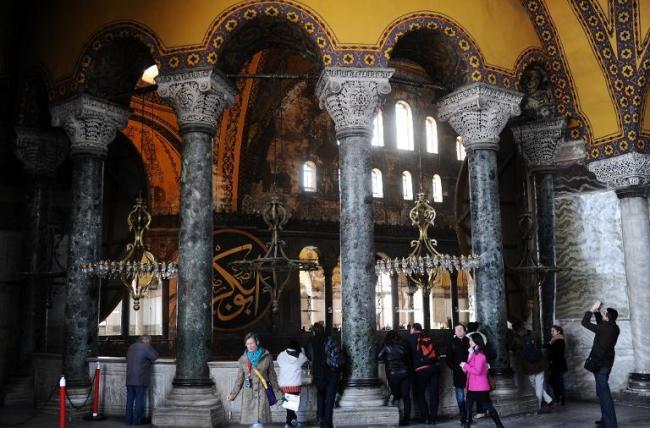
People visit the Hagia Sophia, at Sultanahmet in Istanbul. (AFP)

His comments, though not official policy, have added to concerns over what critics say is the government’s increasing efforts to impose Islamic values on secular Turkish society.

And the Byzantine monument could become a political hot potato for Prime Minister Recep Tayyip Erdogan, who is seeking to shore up flagging support among conservative Muslims ahead of elections next year.

Hagia Sophia, which in Greek means “Holy Wisdom,” was built in the sixth century and served as an Orthodox church for centuries ― and as the seat of the Patriarchate of Constantinople ― before being converted to a mosque by the Ottomans in the 1400s.

Mustafa Kemal Ataturk, the founder of the modern Turkish republic, declared it a museum in 1934 and it opened the following year.

“We are looking at a sad Hagia Sophia, but hopefully we will see it smiling again soon,” Arinc said earlier this month.

Greece, whose territory was once part of the Ottoman empire and is often at odds with Turkey over religious issues, reacted furiously, saying such comments offended the religious feelings of millions of Christians.

Mihail Vasiliadis, editor-in-chief of Istanbul-based Greek daily Apoyevmatini, says Hagia Sophia is an important symbol for the entire Orthodox Christian community.

“There are some who have been seeing a sad Hagia Sophia for more than 500 years and they are the ones who want to see it returned as a church,” he told AFP.

Istanbul’s tiny Greek community, which numbers just a few thousand, is already irked over the issue of Ankara’s insistence on reciprocal steps from Athens to improve their religious rights.

“There is no need to add salt to the wound,” Vasiliadis said.

Last month, Greece flatly rejected the idea of reviving two mosques in Athens in return for the reopening of an Orthodox clergy school in Turkey.

Two other churches that also bear the name Hagia Sophia have recently been turned into mosques in Turkey.

There are already an estimated 83,000 mosques across the country ― up around seven percent since Erdogan took office 11 years ago.

Istanbul itself has around 3,000, including the stunning 17th century Blue Mosque just a short distance from Hagia Sophia.

For devout Muslims, however, opening Hagia Sophia for worship is also about paying a homage to Fatih Sultan Mehmet, the Ottoman emperor who turned it into a mosque following the conquest of Constantinople and joined the first prayers in 1453.

The nationalist Islamist Great Union Party (BBP) has staged several demonstrations to seek a repeal of the ban on Muslim prayers in Hagia Sophia, part of a UNESCO World Heritage site encompassing the Byzantine and Ottoman treasures of old Istanbul.

Armed with a land registry certificate dated 1936 that describes the complex as a mosque, BBP deputy leader Bayram Karacan claimed that its conversion into a museum was illegal.

“The fact that Hagia Sophia is a museum has never been accepted by the Turkish people … restoring it as a mosque would be akin to reclaiming sovereignty over it,” Karacan said.

Outside Hagia Sophia, visitors and local residents were divided over the possible conversion of the monument, described by UNESCO as one of the historic quarter’s “unique architectural masterpieces.”

“We have plenty of mosques here and many of them are empty. Who will fill all these mosques if it is converted? Tourists will not come here anymore,” said 52-year-old shop owner Fehmi Simsek.

Emerging from Hagia Sophia, 23-year-old German tourist Tamara said the complex was a testament to Istanbul’s historical and religious importance throughout the centuries.

“Why would you want to change such a remarkable building?”

Historian Ahmet Kuyas of Galatasaray University in Istanbul said the debate could be linked to Turkey’s upcoming elections, with local polls in March, a presidential ballot in August and parliamentary elections in 2015.

Erdogan, nicknamed the “Sultan,” has frequently touched a nerve over his conservative religious policies, including crackdowns on the sale and advertising of alcohol and allowing women working in the public service to wear Islamic headscarves.

“Turning Hagia Sophia into a mosque would be another blow to secular Turkey,” Kuyas said, describing the site as “a symbol of universal peace, peace between nations, between religions.”

Sevda, a veiled Turkish woman, said it would be more accessible to all as a mosque, as currently there was a fee to enter the museum.

“It belongs to us and therefore it should be a mosque,” added her companion Kubra.

A visitor from Spain who gave his name only as Alex said he did not object to a change in the status as long as people could still visit.

“It is a beautiful place that everyone should see,” he added.

STUDY SAYS MANY LUNG CANCER TUMORS PROVE HARMLESS

Source: Bigstory.ap.org

Harmless lung cancer? A provocative study found that nearly 1 in 5 lung tumors detected on CT scans are probably so slow-growing that they would never cause problems.

The analysis suggests the world’s No. 1 cause of cancer deaths isn’t as lethal as doctors once thought.

In the study, these were not false-positives — suspicious results that turn out upon further testing not to be cancer. These were indeed cancerous tumors, but ones that caused no symptoms and were unlikely ever to become deadly, the researchers said.

Still, the results are not likely to change how doctors treat lung cancer.

For one thing, the disease is usually diagnosed after symptoms develop, when tumors show up on an ordinary chest X-ray and are potentially life-threatening.

Also, doctors don’t know yet how to determine which symptomless tumors found on CT scans might become dangerous, so they automatically treat the cancer aggressively.

The findings underscore the need to identify biological markers that would help doctors determine which tumors are harmless and which ones require treatment, said Dr. Edward Patz, Jr., lead author and a radiologist at Duke University Medical Center. He is among researchers working to do just that.

Patz said patients who seek lung cancer screening should be told about the study results.

“People have to understand that we’re going to find some cancers which if we’d never looked, we never would have had to treat,” he said. Among patients and even many doctors, “it’s not something that is commonly known with lung cancer.”

A leader of an influential government-appointed health panel agreed.

“Putting the word ‘harmless’ next to cancer is such a foreign concept to people,” said Dr. Michael LeFevre, co-chairman of the U.S. Preventive Services Task Force.

The panel recently issued a draft proposal recommending annual CT scans for high-risk current and former heavy smokers — echoing advice from the American Cancer Society. A final recommendation is pending, but LeFevre said the panel had already assumed that screening might lead to overdiagnosis.

“The more we bring public awareness of this, then the more informed decisions might be when people decide to screen or not,” LeFevre said. He called the study “a very important contribution,” but said doctors will face a challenge in trying to explain the results to patients.

In testimonials, patients often say lung cancer screening via CT scans cured them, but the study suggests that in many cases, “we cured them of a disease we didn’t need to find in the first place,” LeFevre said.

The study was published Monday in the journal JAMA Internal Medicine.

More than 200,000 Americans are diagnosed with lung cancer each year, and more than half of them die. Worldwide, there are about 1.5 million lung cancer deaths annually.

The new study is an analysis of data from the National Lung Cancer Screening Trial — National Cancer Institute research involving 53,452 people at high risk for lung cancer who were followed for about six years.

Half of them got three annual low-dose CT scans — a type of X-ray that is much more sensitive than the ordinary variety — and half got three annual conventional chest X-rays. During six years of follow-up, 1,089 lung cancers were diagnosed in CT scan patients, versus 969 in those who got chest X-rays.

That would suggest CT scans are finding many early cases of lung cancer that may never advance to the point where they could be spotted on an ordinary chest X-ray.

An earlier report on the study found that 320 patients would need to get CT screening to prevent one lung cancer death.

The new analysis suggests that for every 10 lives saved by CT lung cancer screening, almost 14 people will have been diagnosed with a lung cancer that would never have caused any harm, said Dr. Len Lichtenfeld, the cancer society’s deputy chief medical officer.

He said that is a higher rate of overdiagnosis than he would have predicted, but that the study shows how much understanding of cancer has evolved. Decades ago, “every cancer was a bad cancer,” he said.

Now it’s known that certain cancers, including many prostate cancers, grow so slowly that they never need treatment.

The American College of Radiology said in statement Monday that the earlier study showed lung cancer screening significantly reduces lung cancer deaths in high-risk patients and that the benefit “significantly outweighs the comparatively modest rate of overdiagnosis” found in the new analysis.

Low-dose CT scans are the only test shown to reduce lung cancer deaths in high-risk smokers, the radiology group said, adding, “Overdiagnosis is an expected part of any screening program and does not alter these facts.”

Famagusta church ‘re-opens’

Source: incyprus.philenews.com

Hundreds flocked to the mediaeval Ayios Georgios Eksorinos church in occupied Famagusta yesterday, for the first Greek Orthodox service in 56 years, described as the largest gathering of Greek-Cypriot faithful in a service held in the occupied territories since 1974.

Ayios Georgios Eksorinos, situated within the walled city, had been abandoned from 1957 because of an outbreak of inter-communal violence.
Officiating was Constantia-Famagusta Bishop Vasilios, with Mayor Alexis Galanos and the municipal council attending.

In his sermon, Vasilios made extensive reference to a famous work by mediaeval writer Leontios Machairas, who had provided ample evidence of the city’s leading role in the strengthening of the Greek Orthodox Church in Cyprus.

Famagusta, the Bishop said, is referred to as the city ‘of one church for every day’, with 365 temples built within its boundaries.

It was, Vasilios stressed, a financial and commercial hub for the region and became an axis of political developments on the island for a long period, during and beyond mediaeval times.

Given the line of succeeding conquests of Cyprus by Christians of different dogmas, Famagusta is marked with many architectural gems of historic significance, such as St John’s Cathedral where the kings of Cyprus and Jerusalem were crowned, as well as Saint George of the Greeks.

The Famagusta Bishop congratulated organisers for their initiative to reopen the church for the first time since 1957 and said that ‘this is the first but not the last service that will be held’.

On a practical basis and in spite of the political difficulties, Famagusta Municipality and a Church committee have taken up the responsibility of holding services on a regular basis, with voluntary input from locals who want to see another rare piece of cultural heritage preserved and brought to religious life.

Ayios Georgios Eksorinos, an imposing structure of clear architectural influence, was built in the 14th century, during Venetian rule and has been turned into a concert hall.

It’s one of the better preserved churches in the occupied north but does however require extensive conservation work, due to humidity damage to the icons and frescoes.

Alex Perry dumped from David Jones, replaced by Martin Grant

Source: News.com.au

Designer Alex Perry

Designer Alex Perry Source: Supplied

DAVID Jones has celebrated the signing of designer Martin Grant after having “deleted” high-profile designer Alex Perry.

David Jones has held an intimate fashion parade at its Elizabeth Street Sydney flagship store, showcasing a collection of elegant, black outfits and modern geometric patterned dresses, created by Melbourne-born Paris-based designer Martin Grant.

Outfits by Martin Grant, who designed the new Qantas uniforms, will be available at the department store from February, while the Alex Perry brand will be “exited” from August.

Alex Perry joined David Jones after defecting from Myer in 2007, but a David Jones spokeswoman said sales of the brand have declined over the past three years.

“The deletion of this brand enables David Jones to reallocate this floorspace to new brand Martin Grant and to high performing brands such as Camilla World and Rachel Gilbert,” group executive merchandise Donna Player said on Monday.

Meanwhile, Martin Grant, who attended the launch event, said he was honoured to have secured representation in his home market, adding that he is “excited that my collections will be available locally in Australia.”

Martin Grant’s designs are worn by actors and celebrities, such as Cate Blanchett, Juliette Binoche, Blake Lively and Kate Hudson and are stocked in high-end department stores around the world, including US stores Barneys and Saks Fifth Avenue.

Greek Parliament approves budget for 2014

Source: Ekathimerini

The Greek Parliament early on Sunday voted a budget for 2014 into law with 153 MPs in the 300-seat House voting in favor despite reservations among many in the coalition to backing further austerity.

The budget was backed by all but one of the coalition’s 154 MPs — Aris Spiliotopoulos of conservative New Democracy was absent — with 142 MPs voting against the bill and one present.

Speaking before the vote, Prime Minister Antonis Samaras said that economic recovery was in sight, referring to a primary surplus predicted in the budget, and accused the leftist opposition SYRIZA of undermining the government’s efforts toward recovery. “For the first time after many years, we will not need to borrow for our needs,” Samaras said, adding that unemployment was set to drop from next year. The premier even quoted the late Nelson Mandela toward the end of his speech, declaring, “It always seems impossible until it’s done.”

Earlier leftist SYRIZA leader Alexis Tsipras said that approving the blueprint was the “road to the continuation of destruction for Greece” and said that it would not be revised by Greece’s troika of foreign lenders but by SYRIZA which would come to power and “get rid of the troika.” He said a writedown to Greece’s debt was the only solution.

In his speech Finance Minister Yannis Stournaras said SYRIZA’s alternative economic plan — which would involve the nationalization of Greek banks — was a “nightmare scenario.”

The budget, which foresees a 0.6 percent growth rate for next year and sets out 5.6 billion euros in spending cuts and projected tax revenue, received the backing of coalition MPs though many indicated, over several days of debate in Parliament, that they would not lend the same support to other reforms in the works, chiefly a controversial unified property tax which is to be submitted in Parliament on Tuesday.

However, the budget still lacks the approval of Greece’s troika of foreign creditors, the European Commission, European Central Bank and International Monetary Fund, who left Athens last month after failing to reach an agreement with government officials on reforms and on a fiscal gap for next year. EC spokesman Simon O’Connor said in a Twitter posting on Saturday night that “a full negotiating team” would return to Athens in January once the government has made further progress in implementing reforms. “Technical discussions” would continue next week,” he said.

Greece’s parliament has approved a tough budget for next year, including further spending cuts of €3.1 billion ($A4.71 billion), aimed at ending the country’s deep recession.

The coalition government, which enjoys a narrow majority in the 300-seat chamber, scraped through with 153 deputies backing the 2014 budget in a late evening vote.

The move came as Greece’s troika of international creditors – the European Union, the European Central Bank and the International Monetary Fund – announced they had delayed until January their next trip to Athens.

Senior auditors from the so-called creditor troika had been expected to return to Athens on Monday to resume an evaluation of pledged Greek reforms.

The EU-ECB-IMF decision means talks on unblocking €1 billion in bailout funds are postponed.

The budget approved by parliament foresees a return to growth for the embattled Greek economy.

But earlier on Saturday a spokesman for EU Economic Affairs Commissioner Olli Rehn said the international negotiating team would not return to Athens until next month “after the authorities have made further progress in implementation” of reforms demanded by Greece’s creditors.

An agreement with the troika is necessary to unblock the €1 billion instalment of financial aid pending since the summer.

Athens has been keen to wrap up the talks before it assumes the rotating EU presidency in January.

The creditors and Athens disagree on the level of a forecasted financing gap for 2014 and the measures that need to be taken to cover it.

Discussions are reportedly stumbling on the issue of a new property tax, debtor property auctions, layoffs in the state sector and the slow pace of privatisation.

The government is under pressure from the troika to loosen a moratorium on home foreclosures but such a measure is likely to be opposed by several ruling party MPs and could risk the cohesion of the conservative-socialist coalition.

Greek Prime Minister Antonis Samaras stressed in parliament that the country had “achieved a number of reforms which many had considered impossible”.

The changes made are “enormous,” he said, citing fresh competitiveness and a drastic reduction in the budget deficit.

Greece’s budget for 2014 has not yet been approved by the troika and could yet be amended in the coming months with new austerity measures that the Greek government has thus far rigorously opposed.

As it stands the budget foresees a 0.6 per cent growth in GDP for next year after six consecutive years of recession. A four per cent contraction is expected this year.