Will Turkey drive the Greeks ‘into the sea’ again?

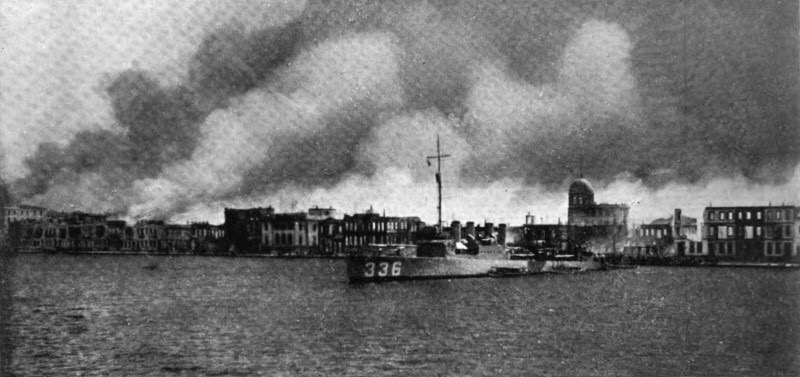
The Great Fire of Smyrna, that drove the Greek population into the sea.

Tension is running high between Greece and Turkey. The cause? Turkish Chief of the General Staff Gen. Hulusi Akar paid a visit to Imia, a pair of two small, uninhabited Greek islets in the Aegean Sea, on January 29. He was accompanied by the commanders of the Turkish land, naval and air forces.

Imia – which Turkey calls “Kardak” – was a subject of yet another crisis in 1996 that brought Greece and Turkey to the brink of war. Although armed conflict was ultimately averted, Turkey still claims that the islands are Turkish, even though the islands in the Aegean are historically and legally Greek.

Greek President Prokopios Pavlopoulos and Deputy Foreign Minister Ioannis Amanatidis have criticized Akar’s recent visit to the Greek island, describing it as a “serious violation” and a “show for Turkey’s domestic audience.”

Since then, Turkish government officials and politicians have continued to bring the issue of Kardak to the attention of the Turkish public in a tone that calls on Greece to “know its place.” 

The latest Turkish political leader who offered his opinions on the issue was Devlet Bahçeli, chairman of Turkey’s Nationalist Movement Party, the third-largest party in Turkey’s parliament.

“If the Greeks want to fall in the sea again, the Turkish nation is ready,” Bahceli said in his parliamentary speech on February 28.

Bahceli was referring to incidents that occurred in September 1922, when the armed forces of Greece – together with Christian residents of the city of Smyrna, on the Aegean shore in Ottoman Turkey – were literally thrown into the sea by Turkish forces. The current Turkish name of that city is Izmir.

Smyrna: A Historical Background

Christians in Turkey and the rest of the Middle East are often thought of as immigrants or communities that have always been minorities in the region. But nothing could be further from the truth.

Asia Minor and Smyrna have enormous importance for Christianity. The Metropolis of Smyrna, an ecclesiastical territory (diocese) of the Ecumenical Patriarchate of Constantinople, retained its ecclesiastical autonomy until 1922. Smyrna was also one of the Seven Churches spoken of by St. John in the biblical book of Revelation. Janene Keeth, a scholar of Christian education, wrote that “Smyrna has been described as the most beautiful of the seven cities. Presumably, this church was founded during Paul’s ministry in Ephesus (Acts 19:10).”

Greek culture has never been some foreign way of life in Anatolia. On the contrary, the region was predominantly Greek before Turkic people began to invade it in the 11th century.

According to the International Dictionary of Historic Places: Southern Europe, ancient Greeks were the ones “who raised Smyrna to heights of power and glory in the seventh century B.C. Smyrna passed into the hands of the Christianized, Greek-speaking Byzantine realm following the formal division of the Roman Empire.”

Smyrna was ruled by Christians for centuries. The Eastern Roman (or Byzantine) Empire fought fierce defense wars against Arabic, Seljuk and Ottoman Islamic armies. Riding from the steppes of Central Asia, the Seljuk Turks targeted Asia Minor by combining their long-held “tradition of invasion” with newfound Islamic zeal. The Islamic invasion of Asia Minor was completed by the Ottomans.

During the Middle Ages, Smyrna was the scene of many struggles, the fiercest of which was directed by Timur against the Christians. Timur – historically known as Tamerlane – a Turco-Mongol conqueror, stormed and sacked Smyrna in 1402 (then held by the Knights of St. John, who had recaptured it from the Ottoman Turks in 1344). A mass beheading was carried out in Smyrna by Timur’s soldiers. The city was then captured by the Ottomans in 1424.

The 1922 Great Fire of Smyrna

The events surrounding the Greek landing at Smyrna in 1919 and the great fire in the city in 1922 could be better understood if analyzed as part of the systematic campaign against Christians by Ottoman Turkey.

During World War I, the decaying Ottoman Empire adopted a policy that many scholars have called “the forced Turkification of Asia Minor.” Author George Makredes described the period as follows:

Imagine a life where it’s a crime to celebrate or reveal your ethnic heritage; where the law requires you to abandon your ways and culture and meld invisibly into one indistinguishable mass with the majority, or suffer the consequences. And woe to anyone caught reading, speaking, dressing as, or playing music of another culture.

Welcome to Asia Minor during the early part of the 20th century. It was during this grim period when over 1.5 million Armenians were systematically exterminated. Whether you were an Armenian man, woman or infant, you were fair game to be cut down on sight, per order of the state. Unarmed and powerless, Greeks witnessed this horror, terrorized with the fear that they were next.

What they feared soon became a reality.

Greeks also fell victim to the same Ottoman campaign of systematic extermination of Christians before, during and after World War I (1914–1923). According to the Greek Genocide Research Center, atrocities against Greek people during that period “included massacres, forced deportations and death marches, summary expulsions, boycotts, rape, forced conversion to Islam, conscription into labor battalions, arbitrary executions, and destruction of Christian Orthodox cultural, historical and religious monuments.”

At the end of World War I and with the Armistice of Mudros that ended the Ottoman front in the war, the allies launched a series of peace talks that focused on the future of the Ottoman Empire. According to James Marketos, an American Hellenic Institute board member,

By 1919, the allied winners of World War I – England, France, Italy and the U.S. – were still arguing over how to divide up the defunct Ottoman Empire, which had sided with Germany. In May that year, the Greek army was permitted to land at Smyrna and establish an administrative zone.

Scholars Evangelia Boubougiatzi, Ifigenia Vamvakidou and Argyris Kyridis write in Greeks’ Identities in Smyrna, 19th – 20th Century Local and Global Parameters that “In that society, Greeks had the dominant position, both in a demographic and economic level.” Smyrna was also one of the centers of Greek enlightenment culture, with several schools erected, such as the Evangelical School and the Philological Gymnasium.

“From ancient times, and through the Roman, Byzantine and Ottoman ages, the city remained essentially Greek,” Marketos said. “The later centuries saw the advent of Armenian, Turkish, Jewish, European and American influences, but through it all, the predominant spirit remained Greek.”

But this ended when Turkish military forces attempted to take back Smyrna from Greek administration on September 9, 1922.The military attacks against the Greeks and Armenians of Smyrna began with looting, rape and murder.
Marketos wrote,

They started in the Armenian quarter and then spread through the Greek portion of the city. This drove even more people to the narrow seafront. Then, on September 13, a fire started in the Armenian part of the city. A strong breeze blew the fire away from the Turkish quarter and quickly spread it to the rest of the city, driving still more horrified thousands of Greeks and Armenians to the harbor where they were now trapped between the raging flames at their backs and the harbor in front. And still the Allied warships watched as the refugees on the seafront were subjected to unspeakable atrocities by Turkish soldiers and residents.

After four days, the fire burned itself out. Beautiful Smyrna lay in ruins. Thousands of Greeks and Armenians had perished, either in the fire, or through slaughter in one form or another, or through simple exposure. Hundreds of thousands of others were eventually evacuated. But either way, the 20th century’s first holocaust effectively ended the Christian presence in Asia Minor.

And all the while, Allied warships, pledged to neutrality, watched from their anchorages as an immense humanitarian tragedy rapidly unfolded a few hundred yards away.

Sadly, this dark page of history remains mostly forgotten or ignored. Only a handful of scholars have shed light on and exposed the persecution of Christians in Smyrna in 1922. One is Lou Ureneck, Boston University professor and journalist, who penned The Great Fire: One American’s Mission to Rescue Victims of the 20th Century’s First Genocide. In it, he described the harrowing story of an American Methodist minister – Asa Kent Jennings – and an American naval officer – Arthur J. Hepburn – who helped rescue more than 250,000 Christian refugees during the burning of Smyrna by Turkish forces.

“A half a million people, packed into a narrow strip of pavement, maybe a mile and a half, two miles long, as a giant fire comes at them, basically pushing them into the sea,” Ureneck said in an interview with the Bostonia magazine. “And many of them did jump into the sea, either trying to swim to ships, or committing suicide, or their clothes and packages had caught on fire.”

Turkish soldiers burned and plundered Smyrna’s Christian neighborhoods, murdering defenseless residents. According to the statistics of the church, of the 459 bishops, metropolitans and clergy of Smyrna, some 347 were murdered in an atrocities manner. Scholar Speros Vryonis reported that among them was Chrysostomos, the last metropolitan of Smyrna.

Men, women and children – none were spared. Turkish soldiers forced Greek men to join labor battalions. Some were sent on death marches to the interior. The “lucky” ones were able to flee their homes in the city to seek shelter in Greece and other states.

Ureneck wrote,

This was no ordinary city fire. Huge even by the standards of history’s giant fires, it would reduce to ashes the richest and most cosmopolitan city in the Ottoman Empire. The fire would ultimately claim an even more infamous distinction. It was the last violent episode in a 10-year holocaust that had killed 3 million people – Armenians, Greeks and Assyrians, all Christian minorities – on the Turkish subcontinent between 1912 and 1922.

Before it burned itself out, the fire would destroy 13,100 buildings – homes, hospitals, school, warehouses, businesses, churches and factories – and cause $250 million in damage, billions of dollars in today’s terms. Only the Turkish and small Jewish quarters of the city and a few patches at the perimeter would remain unburned. The number of dead would never be firmly established, though some would place it on this night in the tens of thousands.

Due to the persecution of the Christians, Anatolia was almost completely cleansed of its Christian population by the time the Turkish republic was founded in 1923.

Journalist Ioanna Zikakou wrote that “the great fire of Smyrna was the peak of the Asia Minor catastrophe, bringing an end to the 3,000-year Greek presence on Anatolia’s Aegean shore and shifting the population ratio between Muslims and non-Muslims.”

But discrimination against the tiny minorities of Greeks, Armenians, Assyrians/Syriacs and Jews who remained has continued up until the present day.

In addition, the Turkish government has been trying to cover up its role in the fire and the slaughter of Greek and Armenian Christians. For decades, the Turkish official state ideology has glorified September 1922. “We have buried the Greeks in the sea” is a common and proudly used expression in Turkey.

“If they [the Greeks] want to fall into the sea again – if they feel like being chased after again – they are welcome. The Turkish nation is ready and has the faith to do it again. Someone must explain to the Greek government what happened in 1921 and 1922. If there is no one to explain it to them, we know how to stick like a bullet on the Aegean, rain from the sky like a blessed victory, and teach history to the couriers of ahl al-salib [the people of the cross] all over again,” the MHP leader, Bahceli, said in his parliamentary speech.

Even 95 years after the unspeakable crime committed in Smyrna, many Turks – including state authorities, politicians and academics – not only distort the facts surrounding the fire and other genocidal attacks against Ottoman Christians, but they also take pride in and attempt to justify them. And some openly threaten Greece with a repeat of the atrocities that the Turks perpetrated on hundreds of thousands of innocent people.

Uzay Bulut is is a Turkish journalist and political analyst based in Washington, D.C. This article was first published by the Philos Project, a hub positive Christian engagement in the Middle East. 

How the Ancient Greeks Did Math With Letters, Not Numbers

The ancient Greeks were incredibly talented mathematicians—but they rarely used numbers in their math. Their particular specialty, geometry, dances around actual quantities, focusing on higher-level logic and constant relationships. Even Pythagoras, whose triangles we navigate with easy examples like “3, 4, 5,” or “5, 12, 13,” was way more interested in diagrams than in specific situations.

But the ancient Greeks certainly had numbers. In fact, they had what was in some ways a much more elegant system than the clunky Roman numerals—like I, II, III—that we still occasionally adopt today. Like Roman numerals, their system borrowed letters; like the Arabic numerals we still use, it only needed one symbol for each decimal place.

In the 6th century BCE, the Greek alphabet used 24 letters. To make numbers, the Greeks added three more symbols (accounts differ as to whether these were resurrected older letters or newly designed characters), then doled them out nine at a time to account for the ones, tens, and hundreds columns. Hence:

1–9: Α, Β, Γ, Δ, Ε, [digamma], Ζ, Η, Θ

10–90: Ι, Κ, Λ, Μ, Ν, Ξ, Ο, Π, [qoppa]

100–900: Ρ, Σ, Τ, Υ, Φ, Χ, Ψ, Ω, [sampi]

These were combined to create individual numbers—for example, MA meant 41, and PNE meant 155. After they ran out of alphabet, a small comma-like tail at the lower left of a letter between Α and Θ signified thousands—so ,BTKZ meant 2327. An M with a small letter or set of letters above it stood for tens of thousands and higher. (Confusingly, in this instance the M represented the Greek ancestor of “myriad,” not the number 40.)

All together, that got a Greek up to 99,999,999—a much bigger number than they ever really needed, either for daily life or complex mathematics. They could accommodate fractions, too: A tick mark to the upper right of a number meant one divided by that number, and they developed special symbols for common fractions like 1/2.

Like any system, it had its pros and cons. Using different symbols for different magnitudes tidily got around the Greeks’ lack of a symbol for zero. Where we use 0 as a placeholder in writing numbers of different magnitudes (1 versus 10, for example), they used different symbols entirely—but that meant they needed more symbols. In certain cases, like abbreviation-prone inscriptions, figuring out whether a character was a number or a letter might have taken a second glance, but numerology gave a deeper meaning to letters and words [PDF].

This alphabetic counting system first arose as a local phenomenon on Greek islands in the Aegean during the 6th century BCE, likely adopted from the Egyptians through trade. At about the same time, Pythagoras was revolutionizing math with his theorem just a few islands away, on Samos (although we don’t have any clear evidence he used alphabetic numerals). It was one of many local number systems that varied across the Greek-speaking world and presaged the Roman system of focusing on repeating ones and fives.

Even locally, alphabetic numerals fell out of popularity for about 150 years, only to come rushing back on the scene during the late 4th century BCE—just in time for Archimedes to discover the joy of applied mathematics and for Ptolemy to calculate the latitude of thousands of places.

The timing isn’t a coincidence: the system benefited from Alexander the Great’s contemporary imperial conquests. Greek-speaking territories were suddenly more politically unified than ever before, and using similar but not quite identical systems across the land was simply not going to work. 

The alphabetic system shone in comparison because it didn’t cause miscommunication, and that geographic mobility gave it domination over the other systems. It also gave it staying power: the system remained in use in Greek texts and Greek-speaking territories—even as the Roman numerals still seen today were born—into the 15th century CE, when Greek letters finally lost out to Arabic numerals.

Arabic numerals aren’t going anywhere, but if you’re a little bored with balancing your checkbook or tallying your fantasy baseball score with twos, sevens, and fives, brush off those Bs and Zs and imagine yourself in ancient Greece. 

An Encounter with the Greeks of Chile

There has been a community of Greeks in Chile since the sixteenth century. According to official figures there are between 90,000 and 120,000 Chileans of Greek origin.[citation needed] Most reside either in the Santiago area or in the Antofagasta area.

The first immigrants arrived during the sixteenth century from Crete, so named “Candia” in honor of the island’s capital, the current Heraklion. The surname, although at present, is very disconnected from its ancient origins. 

The majority of Greek immigrants arrived in Chile at the beginning of century, some as part of their spirit of adventure and escape from the rigors of the World War and the catastrophe of Smyrna in Asia Minor, although many Greeks had already settled in Antofagasta, including crews of the ships commanded by Arturo Prat for the Pacific War (1879–1883) in naval battle of Iquique (boatswain Constantine Micalvi).

Amid this flood of foreigners who populated northern Chilean appeared the Greeks. There were numerous Collectivité Hellenic whose records were listed in two sources. 

One of these was the extensive collaboration that gave the Chilean press through its pages in the newspaper El Mercurio. The other end of the fire under the rubble of the first home that housed the proto-Hellenes of Chile.

According to El Mercurio of Antofagasta, between the years 1920 and 1935 there were about 4,000 Greeks in the city and other 3,000 in saltpeter offices.

In 1926 the first women’s association for excellence, filóptoxos (friends of the poor) which was chaired by Xrisí Almallotis. Since then to date there have been about four or five generations of descendants of Greeks. 

Some have moved south and are grouped mainly in Santiago and Valparaíso. Others returned to the motherland after the first war but most of the immigrants stayed in their new country and founded numerous Greek-Chilean families.

The main member of this community the employer is Don Constantino Kochifas Carcamo, owner of the ships Skorpios at Cruceros Skorpios in Puerto Montt.

Antofagasta is a community in Latin America established in 1890, notable for a town anniversary on the 14th of February, in which foreign communities present a stand. Many of the original families moved to Santiago and Valparaíso, however there are still an estimated seventy current residents who were born in Greece.

 Notable people

Mónica de Calixto, TV journalist.

Giakumis Kodogiannis, footballer.

Uranía Haltenhoff Nikiforos, model.

Alexandros Jusakos, public figure.

Constantino Kochifas, public figure.

Miguel Littín Cucumides, film director and writer.

Demetrio Marinakis, public figure.

Diana Massis, political.

Patricio Mekis Spikin, public figure.

Federico Mekis, political.

Gabriel Orphanopoulos Barker, Sportsmanship.

Arístides Progulakis, TV journalist.

Stavros Mosjos, CNN journalist and radio host.

Víctor Tevah Tellias, public figure.

Leonor Varela, actress.

Alex Zisis, actor.

A Eulogy for Dawson, New Mexico Where Greek Miners Worked and Died

Rubble is all that marks what was once Dawson, NM. As such, there is too little there to even call it a “ghost town.” Yet, what does remain aside from the odd mound of debris is the town’s cemetery, known both as Dawson Cemetery and Evergreen Cemetery.

Two terrible events led to the cemetery, not the town, being listed in 1992 on the National Register of Historical Places. Today, the Dawson Cemetery can be found at (approximately) four miles Northwest of junction US 64 and Dawson Road. The Dawson Cemetery is as much a part of Greek-American history as it is American labor movement or the history of New Mexico.

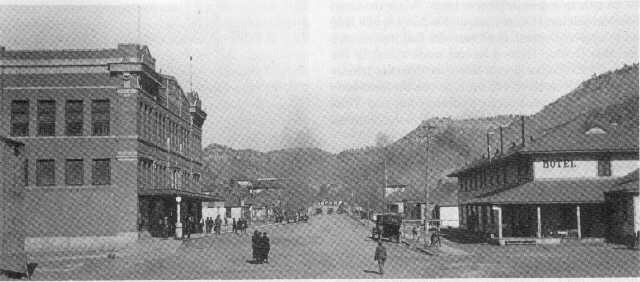
By 1869, coal had been discovered on the land that would become Dawson. After a series of owners, the Phelps-Dodge Corporation (PD) bought the area’s mines in 1906. To its credit, PD spared no expense in their efforts to make Dawson a model mining community. In time “the company built spacious homes for its miners, supplied with water from the company’s water system. They also built a four-story brick building which housed PD’s Mercantile Department Store, which sold virtually anything the townfolk might need: food, clothing, shoes, hardware, furniture, drugs, jewelry, baked goods and ice from its own plant.

A modern hospital was built which maintained a staff of five doctors and was complete with a laboratory, surgery, and X-ray equipment. For leisure, the miners enjoyed the use of the company-built movie theater, swimming pool, bowling alley, baseball park, pool hall, golf course, lodge hall, and even an opera house. PD also supported two churches, one Catholic and one Protestant.

Children attended either the Central Elementary School in Downtown Dawson or the Douglas Elementary School on Captain Hill. A large high school building was built that eventually employed 40 teachers, and their athletic teams won many state championships. The company also built a steam-powered electric plant, which powered not only Dawson, but also the nearby towns of Walsenburg, Colorado, and Raton. Providing good-paying jobs for the residents, the extra features of the company town helped keep the employment stable, and under the new management Dawson’s population grew quickly to 3,500 (legendsofamerica.com).” All seemed well and the town grew into approximately 9,000 residents supporting ten coal mines.

Then, on October 22, 1913, an incorrectly set dynamite charge resulted in an enormous explosion in Stag Canon Mine No. 2 that set a tongue of fire one hundred feet out of the tunnel mouth. It was later determined that the explosion was caused by a dynamite charge set off while the mine was in general operation, igniting coal dust in the mine. This was in violation of mining safety laws. Rescue efforts were well-organized and exhaustive, but only a few miners could be rescued. Two hundred and sixty three died in the second-worst mining disaster in American history. Only the December 6, 1907, Monongah Mining disaster was worse. In that underground explosion, 362 workers were killed in a in a Monongah, WV mine.

Of the Dawson 1913 catastrophe worker casualties tolled, 146 were Italians, 35 Greeks, and two rescuers. Despite the fact that they were specially equipped ‘helmet-men’ outfitted with airtanks during their rescue effort James Lurdi and William Poisa inexplicably died. The 35 identified dead Greek miners were: Amargiotu, John; Anastasakis, John; Andres, John; Andres, Pavlo; Andrios, Thelfno; Anezakis, Milos; Anezakis, Stilen; Arkotas, Nick; Bouzakis, Nick; Castenagus, Magus; Colonintres, John; Cotrules, George; Cotrules, Mak; Fanarakis, Michael; Gelas, George; Iconome, Demetrius; Katis, Gust; Ladis, Vassilias; Lopakis, Magus; Magglis, Vassos; Makris, Cost; Makris, George; Michelei, Agostino; Mifinigan, Tones; Minotatis, Emm; Nicolocci, Nick; Papas, Cost; Papas, Nakis; Papas, Strat; Paperi, Mike; Parashas, Manon; Pino, Kros; Sexot, John; Stavakis, Polikronis and Vidalakis, Antonios.

The Phelps-Dodge Corporation paid for all funeral costs for all the victims. In addition the company gave each widow $1,000 dead benefit and $200 to each child.

Given the technological advancements of the 1913-era a Pathe newsreel of the Dawson disaster toured the nation. A 17-minute silent film held by the Prelinger Archives on the Dawson disaster can be seen on YouTube. It is difficult to assess the Prelinger footage, since it seems to be the victim of an array of editorial cuttings. Sources suggest that this newsreel may in fact be a reenactment. It seems likely, then, that the helmeted mine rescue units, seen so prominently in this newsreel, arrived several days after the actual disaster (Salt Lake Tribune October 25, 1913).

Then, on February 8, 1923, yet another explosive disaster struck the Dawson mines in which 123 men died. At the time of that disaster, women who had run in 1913 to the mines to see about their husbands’ safety in 1923 ran to learn of their sons’ safety. From 1880 to 1910, mine accidents claimed thousands of fatalities all across the United States. Annual mining deaths had numbered more than 1,000 a year, during the early part of the 20th century. In addition to deaths, many thousands more miners were injured (an average of 21,351 injuries per year between 1991 and 1999). For the 1923 The Dawson Cemetery Inscriptions and Other Vital Records I can only find the following Greek individuals identified Nick Arvas; Evangelos P. Chiboukis, Evangelos P.; Scopelitis, Criss; Scopelitis; and Paul Stamos among the dead (chuckspeed.com/Dawson_Association/Dawson_Cemetery.pdf).

As anyone visiting can see, prominent in the center of the Dawson Cemetery is a large section of white trefoil crosses composed solely of the collective graves of miners killed both in 1913 and 1923. With so many miners coming from other countries, these tragedies were truly international incidents. In recognition of the importance of this overall site, the cemetery has been placed on the National Register of Historic Places.

In 2013, Greeks in New Mexico observed the “100 Year Anniversary Day of Remembrance” for all who perished in the mine explosions in Dawson. A coalition from Albuquerque St George Greek Orthodox Church and St Elias the Prophet of Santa Fe held memorial services first at the individual churches and then graveside services at the Dawson Cemetery. Greek-American event organizers such as Georgia Maryol and Nicolette Psyllas-Panagopoulos sought to alert the general New Mexican public about this day of observance to much success. Other events included the October 20th commemorative observance at the Raton Museum shared by historians and miner’s descendants.

Then, in 2014, the YouTube video “The Dawson Mines – 100 Years” was aired. The focus of that documentary is on the six Greek miners who died in the tragedy who were all from the village of Volada on the island of Karpathos: Vasilios Manglis, Polihronis Stavrakis, Alex Kritikos, Costas Makris, George Makris, Vasilios Ladis. Ladis had arrived in Dawson only two weeks before the 1913 disaster. This film was produced for the Pan-Karpathian Foundation’s 2014 annual ‘Mnimosino’ memorial service.

Clearly, the Dawson Cemetery is a part of Greek-American history as well as the American labor movement. Therefore, the Dawson Cemetery historical marker must be added to the ever growing list of Greek-American monuments and historic sites.

It is exactly in this manner that we are collectively creating a Greek-American Historical Commons, one location, one person, one event at a time.

Source: Thenationalherald

This 3,500-Year-Old Greek Tomb Upended What We Thought We Knew About the Roots of Western Civilization

The recent discovery of the grave of an ancient soldier is challenging accepted wisdom among archaeologists

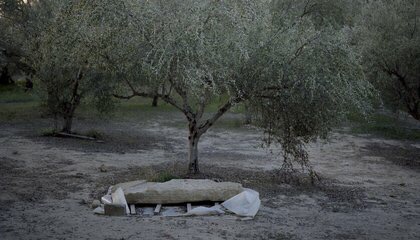
The warrior was buried in an olive grove outside the acropolis of Pylos. Though archaeologist Carl Blegen explored the olive grove in the 1960s, he did not find anything. (Myrto Papadopoulos)

They had been digging for days, shaded from the Greek sun by a square of green tarpaulin slung between olive trees. The archaeologists used picks to break the cream-colored clay, baked as hard as rock, until what began as a cluster of stones just visible in the dirt became four walls in a neat rectangle, sinking down into the earth. Little more than the occasional animal bone, however, came from the soil itself. On the morning of May 28, 2015, the sun gave way to an unseasonable drizzle. The pair digging that day, Flint Dibble and Alison Fields, waited for the rain to clear, then stepped down into their meter-deep hole and got to work. Dibble looked at Fields. “It’s got to be soon,” he said.

The season had not started well. The archaeologists were part of a group of close to three dozen researchers digging near the ancient Palace of Nestor, on a hilltop near Pylos on the southwest coast of Greece. The palace was built in the Bronze Age by the Mycenaeans—the heroes described in Homer’s epic poems—and was first excavated in the 1930s. The dig’s leaders, Jack Davis and Sharon Stocker, husband-and-wife archaeologists from the University of Cincinnati, in Ohio, had hoped to excavate in a currant field just downslope from the palace, but Greek bureaucracy and a lawyers’ strike kept them from obtaining the necessary permits. So they settled, disappointed, on a neighboring olive grove. They cleared the land of weeds and snakes and selected a few spots to investigate, including three stones that appeared to form a corner. As the trench around the stones sank deeper, the researchers allowed themselves to grow eager: The shaft’s dimensions, two meters by one meter, suggested a grave, and Mycenaean burials are famous for their breathtakingly rich contents, able to reveal volumes about the culture that produced them. Still, there was no proof that this structure was even ancient, the archaeologists reminded themselves, and it might simply be a small cellar or shed.

Dibble was clearing earth from around a large stone slab when his pick hit something hard and the monotony of the clay was broken by a vivid flash of green: bronze.

The pair immediately put down their picks, and after placing an excited call to Davis and Stocker they began to carefully sweep up the soil and dust. They knew they were standing atop something substantial, but even then they did not imagine just how rich the discovery would turn out to be.“It was amazing,” says Stocker, a small woman in her 50s with dangling earrings and blue-gray eyes. “People had been walking across this field for three-and-a-half-thousand years.”

Over the next six months, the archaeologists uncovered bronze basins, weapons and armor, but also a tumble of even more precious items, including gold and silver cups; hundreds of beads made of carnelian, amethyst, amber and gold; more than 50 stone seals intricately carved with goddesses, lions and bulls; and four stunning gold rings. This was indeed an ancient grave, among the most spectacular archaeological discoveries in Greece in more than half a century—and the researchers were the first to open it since the day it was filled in.

“It’s incredible luck,” says John Bennet, director of the British School at Athens. “The fact that it hadn’t been discovered before now is astonishing.” The spectacular find of priceless treasures made headlines around the globe, but what really intrigues scholars, says Stocker, is the “bigger world picture.” The very first organized Greek society belonged to the Mycenaeans, whose kingdoms exploded out of nowhere on the Greek mainland around 1600 B.C. Although they disappeared equally dramatically a few hundred years later, giving way to several centuries known as the Greek Dark Ages, before the rise of “classical” Greece, the Mycenaeans sowed the seeds of our common traditions, including art and architecture, language, philosophy and literature, even democracy and religion. “This was a crucial time in the development of what would become Western civilization,” Stocker says.

Yet remarkably little is known of the beginnings of Mycenaean culture. The Pylos grave, with its wealth of undisturbed burial objects and, at its bottom, a largely intact skeleton, offers a nearly unprecedented window into this time—and what it reveals is calling into question our most basic ideas about the roots of Western civilization.


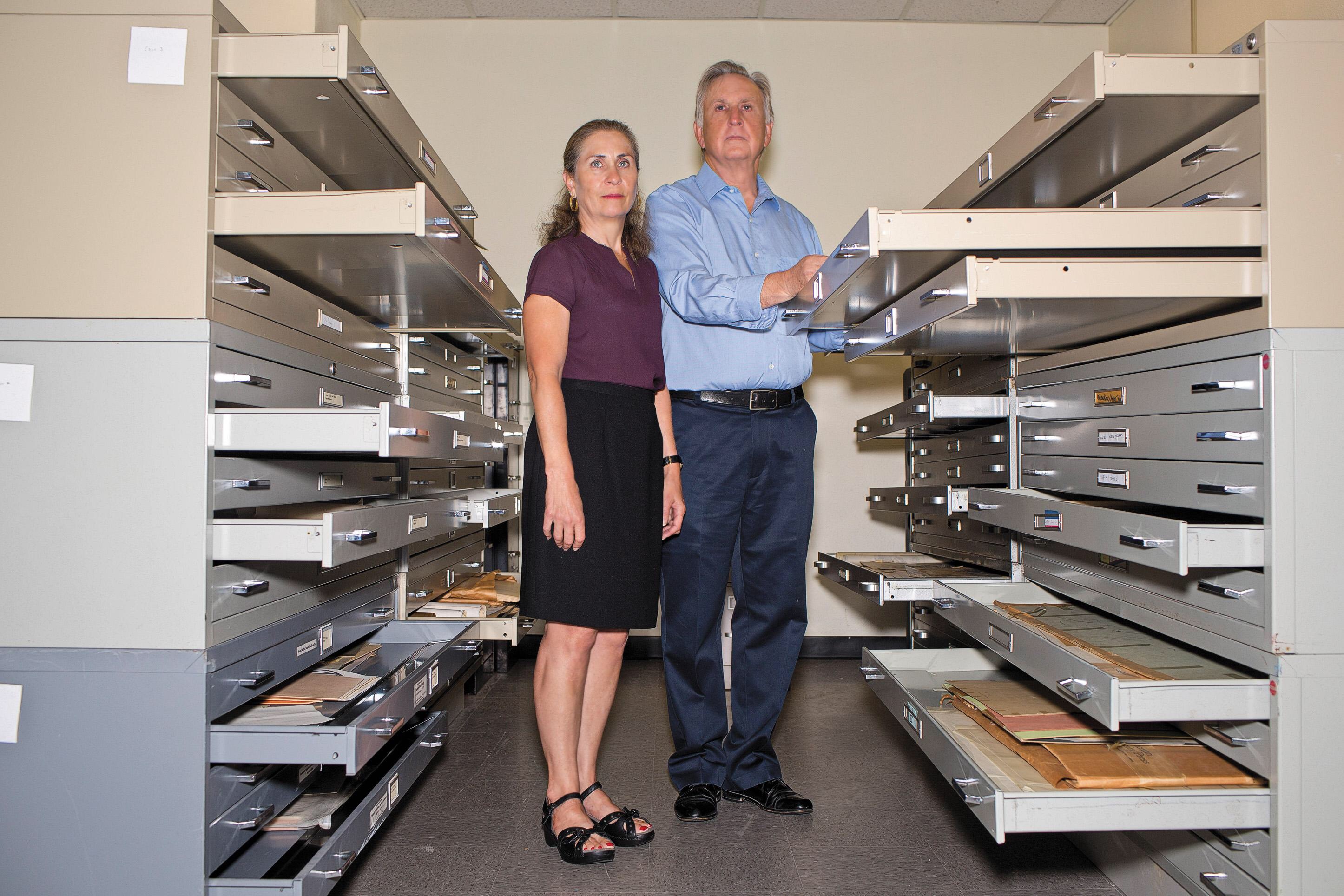
Jack Davis and Sharon Stocker, husband-and-wife archaeologists from the University of Cincinnati, discovered the warrior’s grave. (Andrew Spear)

In The Iliad, Homer tells of how Agamemnon, king of Mycenae, led a fleet of a thousand ships to besiege the city of Troy. Classical Greeks (and Romans, who traced their heritage to the Trojan hero Aeneas) accepted the stories in The Iliad and The Odyssey as a part of their national histories, but in later centuries scholars insisted that the epic battles fought between the Trojan and Mycenaean kingdoms were nothing more than myth and romantic fantasy. Before the eighth century B.C., archaeologists argued, societies on the Greek mainland were scattered and disorganized.

At the end of the 19th century, a German-born businessman named Heinrich Schliemann was determined to prove otherwise. He used clues in Homer’s epic poems to locate the remains of Troy, buried in a hillside at Hissarlik in Turkey. He then turned his attention to the Greek mainland, hoping to find the palace of Agamemnon. Near the ruins of the great walls at Mycenae, in the Argolid Peninsula, Schliemann found a circle of graves containing the remains of 19 men, women and children, all dripping with gold and other riches. He hadn’t found Agamemnon—the graves, nearly 3,500 years old, dated to several centuries before the battles of Troy—but he had unearthed a great, lost civilization, which he called the Mycenaean, after the sovereign city of the powerful mythic king.

Homer describes other palaces, too, notably that of King Nestor, at Pylos. The Iliad says Nestor contributed 90 ships to Agamemnon’s fleet, second only to the great leader himself. Schliemann searched in vain for Nestor’s palace; in modern Pylos, a sleepy coastal town in the southwest Peloponnese, there was no hint of ancient architecture, unlike at Mycenae. But in the 1920s, a landowner noticed old stone blocks near the summit of a hill near Pylos, and Konstantinos Kourouniotis, director of the National Archaeological Museum in Athens, invited his friend and collaborator Carl Blegen, of the University of Cincinnati, to investigate.

Blegen began excavations in April 1939. On his very first day, he uncovered a hoard of clay tablets, filled with an unreadable script known as Linear B, which had also been found on Crete, the largest of the Aegean islands. He had dug straight into the archive room of King Nestor’s palace. After World War II, Blegen went on to discover a grid of rooms and courtyards that rivals Mycenae in size and is now the best-preserved Bronze Age palace on the Greek mainland, not to mention a significant tourist attraction.

Today, Blegen’s work at Pylos is continued by Stocker and Davis (his official title is the Carl W. Blegen professor of Greek archaeology). Davis walks with me to the hilltop, and we pause to enjoy the gorgeous view of olive groves and cypress trees rolling down to a jewel-blue sea. Davis has white-blond hair, freckles and a dry sense of humor, and he is steeped in the history of the place: Alongside Stocker, he has been working in this area for 25 years. As we look out to sea, he points out the island of Sphacteria, where the Athenians beat the Spartans during a fifth-century B.C. battle of the Peloponnesian War.

Behind us, Nestor’s palace is surrounded by flowering oleander trees and is covered with an impressive new metal roof, completed just in time for the site’s reopening to the public in June 2016 after a three-year, multimillion-euro restoration. The roof’s graceful white curves protect the ruins from the elements, while a raised walkway allows visitors to admire the floor plan. The stone walls of the palace now rise just a meter from the ground, but it was originally a vast two-story complex, built around 1450 B.C., that covered more than 15,000 square feet and was visible for miles. Visitors would have passed through an open courtyard into a large throne room, Davis explains, with a central hearth for offerings and decorated with elaborately painted scenes including lions, griffins and a bard playing a lyre.

The Linear B tablets found by Blegen, deciphered in the 1950s, revealed that the palace was an administrative center that supported more than 50,000 people in an area covering all of modern-day Messenia in western Greece. Davis points out storerooms and pantries in which thousands of unused ceramic wine cups were found, as well as workshops for the production of leather and perfumed oils.

Echoes of Homer are everywhere. In The Odyssey, when Odysseus’ son Telemachus visits Pylos, he finds the inhabitants on the shore sacrificing bulls to the god Poseidon, before traveling to the palace to receive a bath from one of Nestor’s daughters. Tablets and animal bones that Blegen found in the archives room recall a feast in which 11 cattle were sacrificed to Poseidon, while on the other side of the building is a perfectly preserved terra-cotta bathtub, its interior painted with a repeating spiral motif.

Source: smithsonianmag

THE WORLD’S 50 BEST RESTAURANTS


The pears and maidenii dish at Melbourne’s Attica restaurant, which has made the World’s 50 Best Restaurants list.


50 Hof Van Cleve, Kruishoutem, Belgium RE-ENTRY
49. Tegui, Buenos Aires, Argentina NEW ENTRY
48. Restaurant Tim Raue, Berlin, Germany
47. Vendôme, Bergisch Gladbach, Germany
46. L’Astrance, Paris, France RE-ENTRY
45. Den, Tokyo, Japan NEW ENTRY
44. Brae, Birregurra, Australia NEW ENTRY
43. Reale, Castel Di Sangro, Italy NEW ENTRY
42. Boragó, Santiago, Chile
41. Ultraviolet by Paul Pairet, Shanghai, China
40. Cosme, New York, USA NEW ENTRY
39. Relae, Copenhagen, Denmark
38. Azurmendi, Larrabetzu, Spain
37. Saison, San Francisco, USA
36. Dinner By Heston Blumenthal, London, UK
35. Septime, Paris, France
34. De Librije, Zwolle, Netherlands
33. Astrid y Gastón, Lima, Peru
32 Attica, Melbourne, Australia
31. Alléno Paris au Pavillon Ledoyen, Paris, France NEW ENTRY
30. Arzak, San Sebastian, Spain
29. Le Calandre, Rubano, Italy
28. Nahm, Bangkok, Thailand
27. The Ledbury, London, UK
26. The Clove Club, London, UK
25. Tickets, Barcelona, Spain
24. Amber, Hong Kong, China
23. White Rabbit, Moscow, Russia
22. Quintonil, Mexico City, Mexico
21. Alinea, Chicago, USA
20. Pujol, Mexico City, Mexico
19. Geranium, Copenhagen, Denmark
18. Narisawa, Tokyo, Japan
17. Le Bernardin, New York, USA
16. D.O.M., São Paulo, Brazil
15. Piazza Duomo, Alba, Italy
14. Restaurant André, Singapore
13. Alain Ducasse au Plaza Athénée, Paris, France RE-ENTRY
12. Arpège, Paris, France
11. Blue Hill at Stone Barns, New York, USA
10. Steirereck, Vienna, Austria
9. Mugaritz, San Sebastian, Spain
8. Maido, Lima, Peru
7. Gaggan, Bangkok, Thailand
6. Asador Etxebarri, Axpe, Spain
5. Central, Lima, Peru
4. Mirazur, Menton, France
3. El Celler de Can Roca, Girona, Spain
2. Osteria Francescana, Modena, Italy
1. Eleven Madison Park, New York, USA

Open Seminar: Metaphors for Political Power from the Sumerian to the Seleucids

PRESS RELEASE ​​                           

28/3/2017

Greek History and Culture Seminars

In the Garden of Gods: Metaphors for Political Power from the Sumerian to the Seleucedes

Eva Anagnostou-Laoutides, senior lecturer in Classical Studies at Monash, will present a lecture entitled “In the Garden of Gods: Metaphors for Political Power from the Sumerian to the Seleucedes”, at the Ithacan Philanthropic Society, on Thursday 6 April 2017 at 7:00pm, as a part of the Greek History and Culture Seminars offered by the Greek Community of Melbourne.

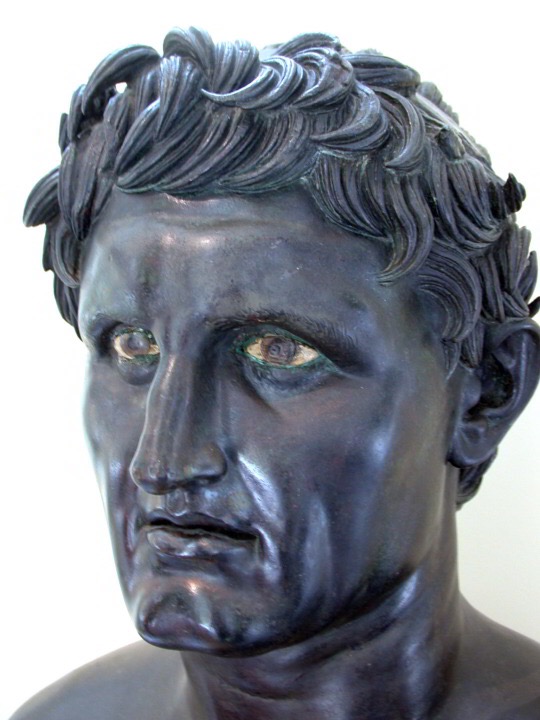
“My presentation, drawing on chapter four of my recent book In the Garden of the Gods, discusses the appropriation of eastern cults by Seleucus I Nicator and his son Antiochus in their struggle to establish their dynasty,” says Ms Anagnostou-Laoutides. “I examine the roles of Zeus and Apollo, the foremost divine protectors of the Seleucids, against near eastern royal traditions. I argue that the founding members of the dynasty had an intimate knowledge of Babylonian traditions that celebrated Šamaš, the Sun god, as protector of royal legitimacy and Marduk as warrantor of military supremacy and that they employed these traditions meticulously to promote their claim to kingship.”

By encouraging the identification of Marduk and Nabû with Zeus and Apollo respectively, Seleucus and Antiochus mirrored the father-son relationship of the gods.

She will also examines the importance of royal gardens under the Seleucids in connection with “sacred marriage” and akītu (New Year) ceremonies which the Hellenistic kings embraced enthusiastically.    

Eva Anagnostou-Laoutides holds degrees in Classical Studies from Aristotle University, the University of Leeds and the University of Kent at Canterbury as well as in Ancient History from Macquarie University. She has published extensively on various aspects of ancient mythology and religion and their appropriation in ancient political agendas. Her most recent book is In the Garden of the Gods: Models of Kingship from the Sumerians to the Seleucids (London and New York: Routledge, 2017). Recently she was awarded an ARC Future Fellowship on a project that examines Platonic inebriation and its reception in late antiquity and the Middle Ages.  

———————————

When: Thursday, 6 April 2017 at 7.00pm

Where: Ithacan Philanthropic Society (Level 2, 329 Elizabeth Street, Melbourne)

FREE Admission

More info: greekcommunity.com.au/seminars or +61 3 9662 2722

__________________________

More information: 9662 2722

Level 3, 168 Lonsdale St., Melbourne, Vic. 3000

Phone: +61 3 9662 2722, Email: info@greekcommunity.com.au, 

A Surprise City in Thessaly


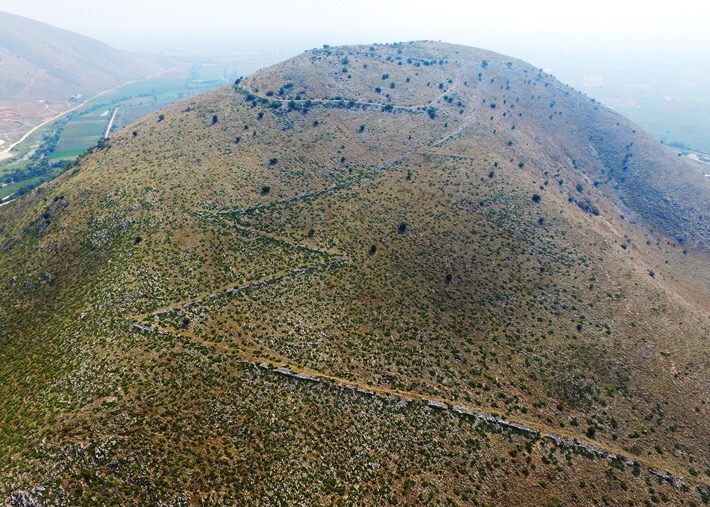
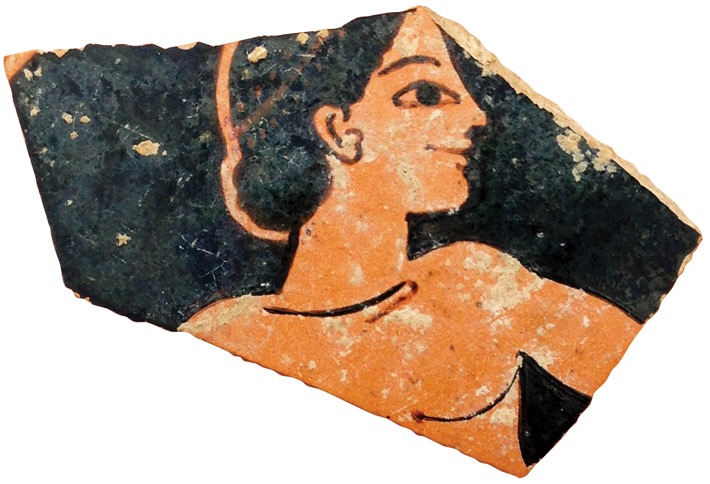
Trenches Greece Vlochos siteTrenches Greece Vlochos potsherd(SIA/EFAK/YPPOA)

Top: Site of Vlochos, Greece; Above: Potsherd Archaeologists have identified the unexpected remains of a large, 2,500-year-old Greek settlement in western Thessaly.
The existence of the hilltop site, near the modern village of Vlochos, had been known for more than two centuries, but had never been systematically investigated. 

Although large defensive walls were visible in some places, experts had long believed that the ancient settlement was fairly insignificant. This opinion changed when a Greek-Swedish team recently discovered the existence of a complex urban center. 

The team was stunned when the results of their geophysical survey indicated that the ancient site is spread across 100 acres and boasts an organized, orthogonal, or gridded street plan. 

Scholars believe that the town flourished in the fourth and third centuries B.C. before being abandoned. 

“The work at Vlochos gives a rare insight into the development and outline of a typical Thessalian city,” says University of Gothenburg archaeologist Robin Rönnlund.

“It shows that even midsize settlements of this region were quite sophisticated in their spatial outline.”

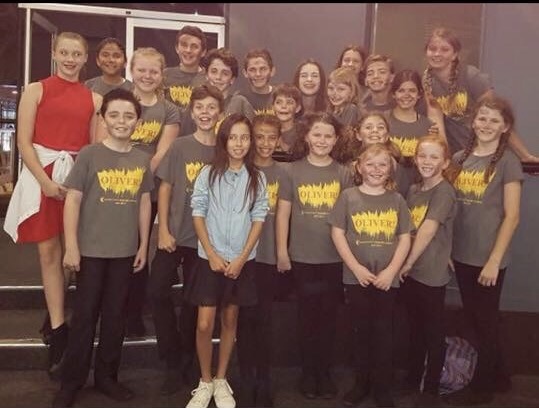
Bringing Charles Dickens’ beloved novel to life OLIVER on the 21, 22, 23, 28, 29, 30 July, 2017


BRYAN BROWN THEATRE

BOOK ONLINE HERE

PHONE BOOKINGS:  0481 869 858

Bringing Charles Dickens’ beloved novel to life, Lionel Bart’s Oliver! takes audiences on a wild adventure through Victorian England. 

Join young, orphaned Oliver Twist as he navigates the London’s underworld of theft and violence, searching for a home, a family, and – most importantly – for love.

When Oliver is picked up on the street by a boy named the Artful Dodger, he is welcomed into a gang of child pickpockets led by the conniving, but charismatic, Fagin. 

When Oliver is falsely accused of a theft he didn’t commit, he is rescued by a kind and wealthy gentleman, to the dismay of Fagin’s violent sidekick, Bill Sykes.

Caught in the middle is the warm-hearted Nancy, who is trapped under Bill’s thumb, but desperate to help Oliver, with tragic results. 

With spirited, timeless songs like “As Long as He Needs Me,” “Food, Glorious Food,” and “Where is Love,” Oliver! is a musical classic.


DIRECTOR
: Glen Stelzer

MUSICAL DIRECTOR: Belinda Robinson

CHOREOGRAPHER: Wendy Lindsay

CAST:

Oliver 

Ryan Yeates 

Nicholas Cradock

Dodger 

Jayden Clarke 

Jeremy Salmon

Charley 

Bates Flynn 

Crewes Vincent D’Astoli

Bet 

Annie Henderson 

Sophie Andrews


Fagin Paul Adderley

Nancy Jessica Green

Bill Sikes Stuart Prime

Mr Bumble Peter Watson

Widow Corney Dale Selsby

Mr Sowerberry Mark Roberts

Mrs Sowerberry Kathy Crispin

Charlotte Laura Bucci

Noah Michael McNab-Kwiatek

Mr Brownlow Phil Plunkett

Dr Grimwig Scott Henderson

Mrs Bedwin Amanda Griffiths

Rose Seller Amy Weir

Strawberry Seller Rhiannon Garrett

Milk Lady Renee Cowper

Knife Grinder Michael McNab-Kwiatek


Fagin’s Gang          Ronan Vella                          

                                  Cameron Roberts               

                                  Lewis Crispin

                                  Alex Alkhair                           

                                  Liam Carr                                          

                                  Blake O’Mara                       

                                  Max Fernandez

                                  Nicholas Otomancek

                                  Lewis Wall                                        

                                  Stephanie Swords              

                                  Talena Saumaitoga              

                                  Aimee Crispin                                  

                                  Alissandra Alvarez               

                                  Keira Blackmore                   

                                  Gabrielle Daggar                  

                                  Izzy McFarlane

                                  Emily Blackmore

                                  Wendy Jneid


Girls’ Ensemble     Isabella Perez Ruz     

                                   Lucy Griffiths                                                                        

                                   Ruby Lindsay                      

                                   Tahlia O’Mara


Ensemble Michelle Bridekirk                  

                                    Hannah Bentley                   

                                    Kay Taylor                                        

                                    Sarah Whitehead                 

                                    Karen Breeden                                 

                                    Gabby Caruso                    

                                    Courtney Emmas                

                                    Viviana Jneid

                                    John Cane                

    http://www.bankstowntheatrecompany.com
/

Secrets of Hanging Rock: Eerie location of haunting tale about schoolgirls who vanished on St Valentines Day 1900

Strange things happened when Picnic at Hanging Rock producer Pat Lovell visiting the actual rock in Victoria.

FIFTY years ago this week a writer called Joan Lindsay published a mystery book about a group of schoolgirls who vanished on St Valentines Day 1900.

The place where the girls disappeared was one of Australia’s most eerie locations, Hanging Rock.

Often shrouded in mist, it’s also shrouded in mystery with baffling and unexplained incidents happening close to the rock.

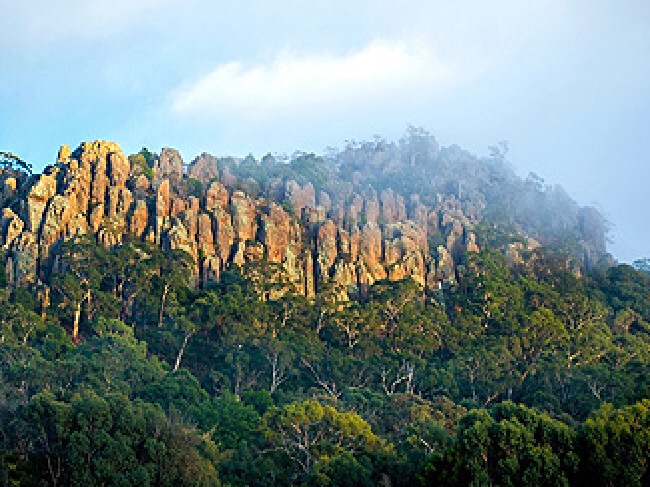
The six million year old rare volcanic formation rises up on a plain between two tiny townships 70km northwest of Melbourne.

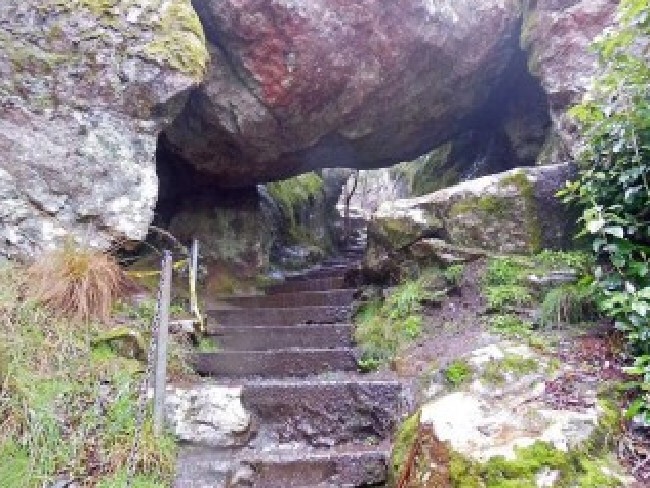
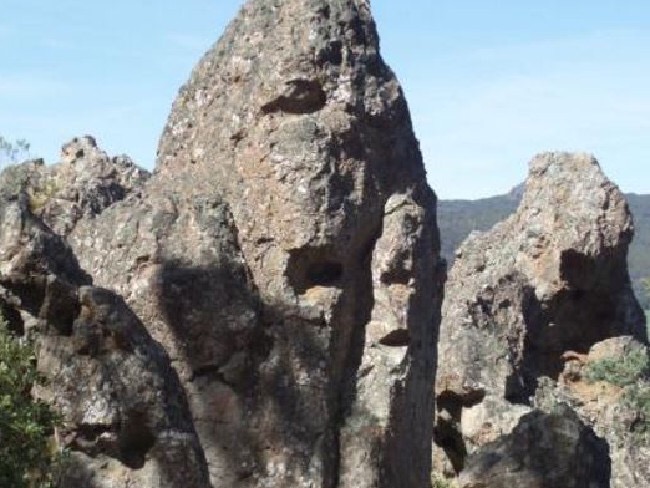
Less commonly known as Mount Diogenes, it comprises several distinctive outcrops including the ‘Hanging Rock’, a boulder suspended between other boulders under which is the main entrance path. Close by are other rock formations — the Colonnade, the Eagle and the UFO.

It was a sacred Aboriginal site for the Wurundjeri people and well-known to Lindsay who reportedly felt it had a mystical power.

Her book Picnic at Hanging Rock was published on April 3, 1967, and was made into Peter Weir’s award-winning 1975 film.

According to a new book to be published this week to mark the 50th anniversary of Lindsay’s novel, when Weir’s crew went to the rock to shoot the film strange things happened.

An edited extract of Beyond the Rock, by Janelle McCullough published in Good Weekend describes Weir and producer Pat Lovell meeting Joan Lindsay in 1973 and buying her book’s film rights for $100.


Strange things happened when Picnic at Hanging Rock producer Pat Lovell visiting the actual rock in Victoria.Source:Supplied


The actual ‘Hanging Rock’ among the formations on Mount Diogenes northwest of Melbourne.Source:Supplied


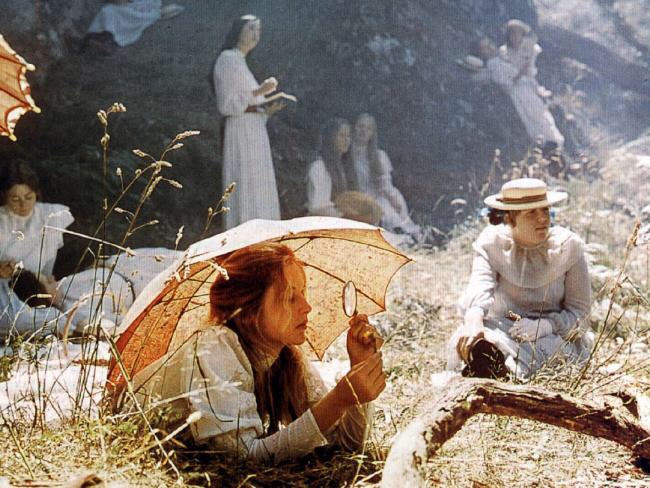
Anne Louise Lambert (foreground) as Miranda in the 1975 mystery film Picnic At Hanging Rock.Source:News Corp Australia


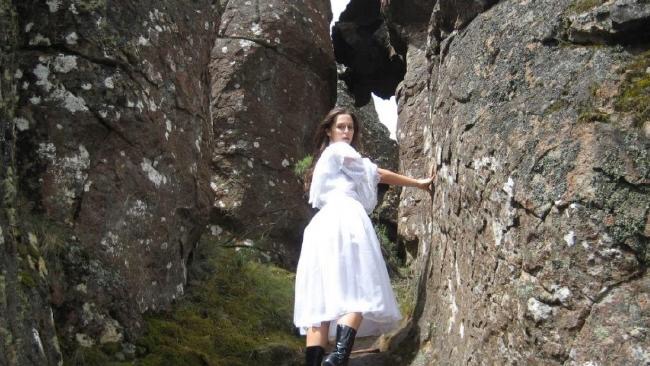
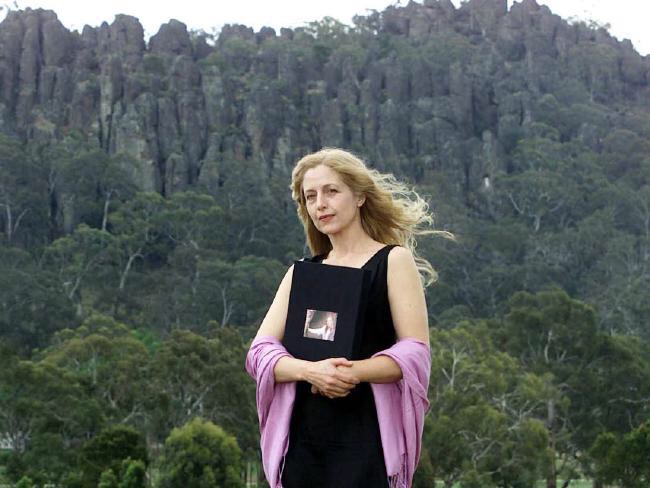
Lambert revisits the rock in 2002, 27 years after starring in the film Picnic at Hanging Rock. Picture: Shaney Balcombe. Source:News Corp Australia

The next day they travelled to Hanging Rock, getting lost en route and approaching from the wrong side where the formation loomed in front of them beneath a cloud.

“Immediately, they sensed the eeriness of the place,” McCullough writes. “Lovell was immediately uneasy.

“The rock ‘seemed so alien to the rest of the countryside’.

“At the picnic grounds at the base of the rock, her watch inexplicably stopped.

“It was the first of many times this would happen, either at Hanging Rock or around Joan herself.”

A place known locally in the town of Woodend, near Hanging Rock, as “Anti-Gravity Hill” purports to feature a strange and baffling phenomenon.

Mountmacedon.org.au claims that if a person stands on Straws Lane facing up the hill and tips water onto the road it flows “up the hill” not downhill A ball placed on the road will do the same thing and roll up the hill.

During filming at Hanging Rock itself, Weir described the effect where the light that streamed down through the trees was only visible for one hour of the day, when the sun was in the exact spot.


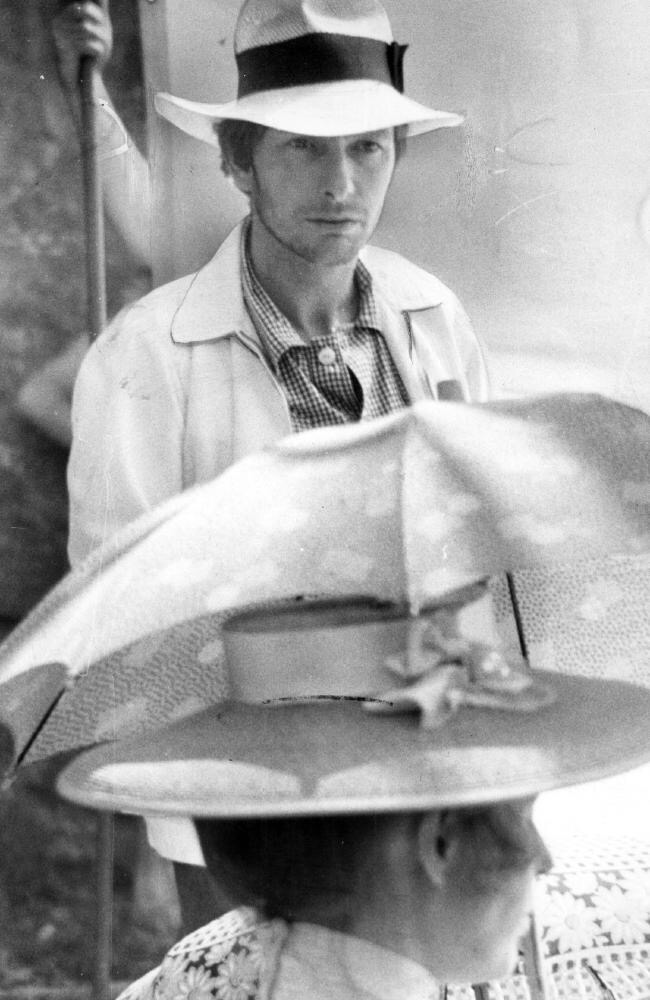
Picnic at Hanging Rock director Peter Weir on set making the film in 1975. Picture: Archive News Corp.Source:News Limited


One of the ‘faces’ among the formations at Hanging Rock which rises up from the plains northwest of Melbourne. Picture: tripadvisor.com.au.Source:Supplied


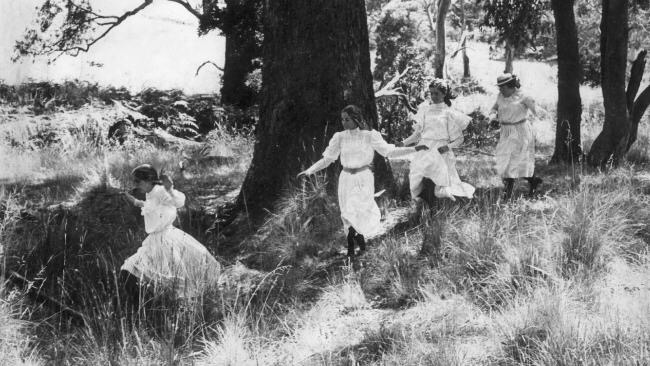
The scene where the four girls take off to explore Hanging Rock and things turn weird.Source:News Limited


Lindsay, who was occasionally on set during filming, would only say when asked about her book’s plot, “some of it is true and some of it isn’t”.

Despite many attempts to find a historic account of the disappearing schoolgirls, no-one has succeeded and it seems that only the locations are real.

There is one record of a young man falling and dying from Hanging Rock in the early 1900s, but this was recorded and solved and had no connection to the Hanging Rock story.

In 1907, a 19-year-old man murdered another man near the rock and was caught by police.

Joan Lindsay’s Picnic at Hanging Rock is the story of schoolgirls from the fictional Appleyard College for Young Ladies’ school near the real town of Woodend.

In the film, the formidable actor Rachel Roberts plays Miss Appleyard, with Anne Louise Lambert in the leading role of the ethereal schoolgirl Miranda.

On February 14, 1900 the girls prepare for a picnic at nearby Hanging Rock with their mathematics mistress Greta McCraw, and French mistress Mlle. de Poitiers played by Helen Morse.


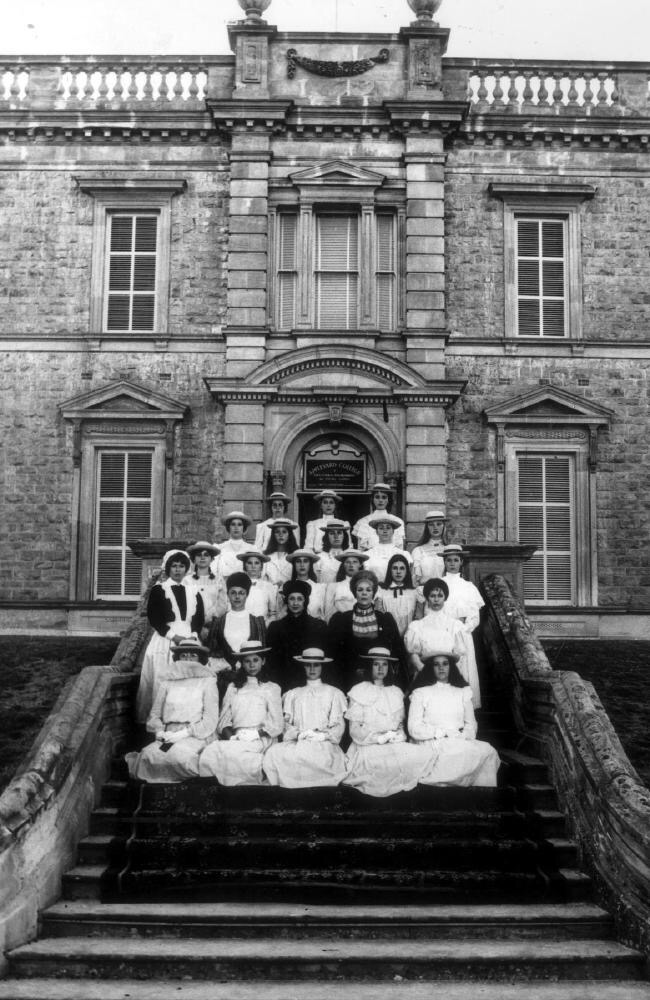
Miss Appleyard and the schoolgirls at Appleyard College aka Martindale Hall, in Mintaro, South Australia where scenes from Picnic at Hanging Rock was filmed. Source:News Limited


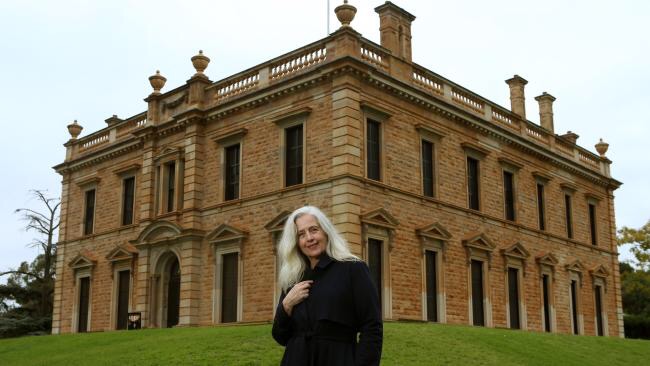
Anne-Louise Lambert at Martindale Hall in South Australia last year. Picture: Kelly BarnesSource:News Corp Australia


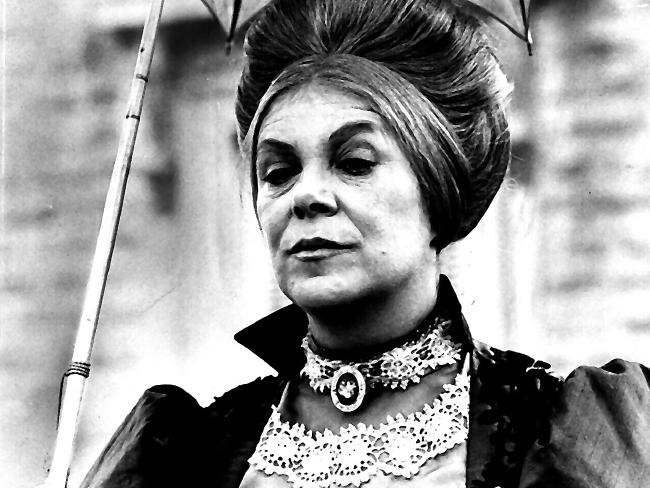
The formidable Miss Appleyard played by Rachel Roberts in Peter Weir’s film.Source:News Limited


As their buggy gets closer to the rock, the driver’s watch stops on the stroke of twelve.

At the rock Miranda and three other girls, Irma, Mario and Edith, decide to explore.

They are observed by picnicking English tourist Michael Fitzhubert to lie dazed on the ground before moving, in a trance, into a recess in the rock face.

One of the girls, Edith screams and flees down the rock and a depleted and hysterical group returns to Appleyard College.

Missing are Miss McCraw, Miranda, Marion and Irma.

A police search party fails to find them, a Miranda-obsessed Fitzhubert sets out but is found near-delirious and clutching a piece of lace from Miranda’s dress.

Only Irma is found, unconscious and missing her corset but alive. She cannot remember what happened.

The incident spooks Woodend and Appleyard College, two more die and the girls’ disappearance is never solved.

Weir’s film is set to haunting pan flute music and was a critical success before being nominated for a raft of awards, but winning only a BAFTA for Best Cinematography.

The film created renewed interest by visitors to Hanging Rock, which is now a popular tourist destination and retains its reputation for being a “haunted” site.

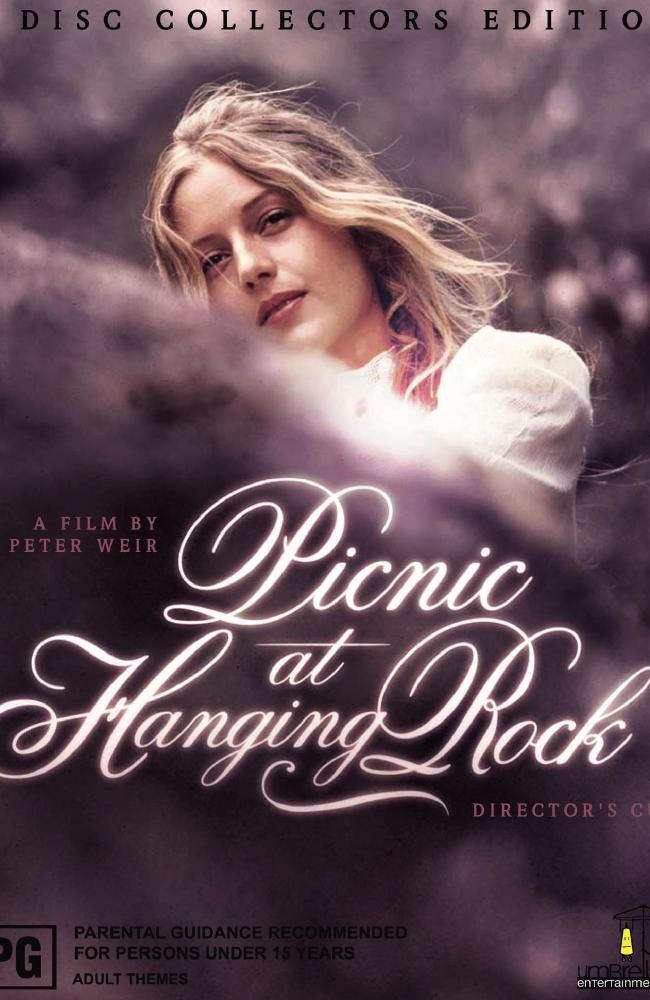
DVD cover of the 1975 film Picnic at Hanging Rock with Anne Louise Lambert as Miranda.Source:News Corp Australia