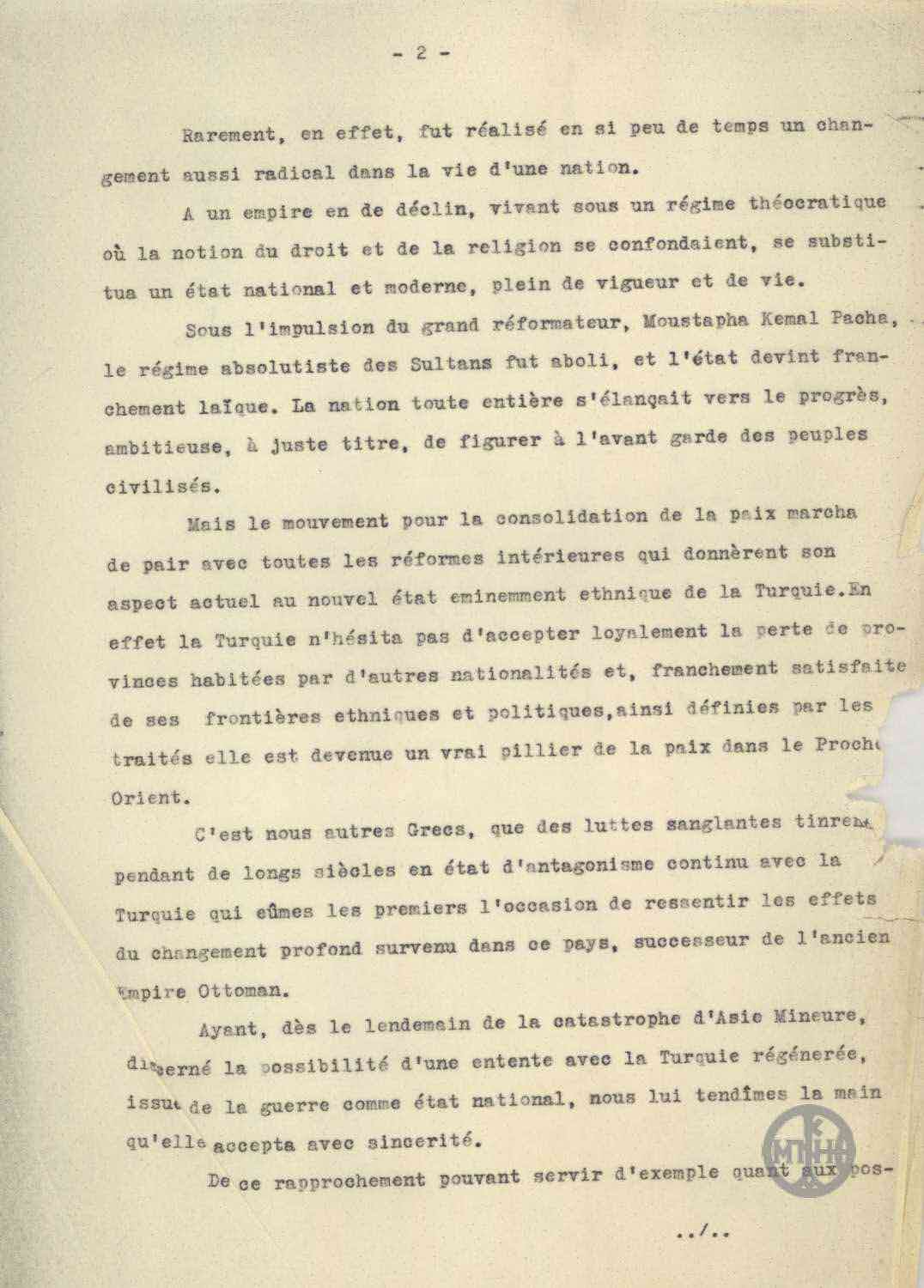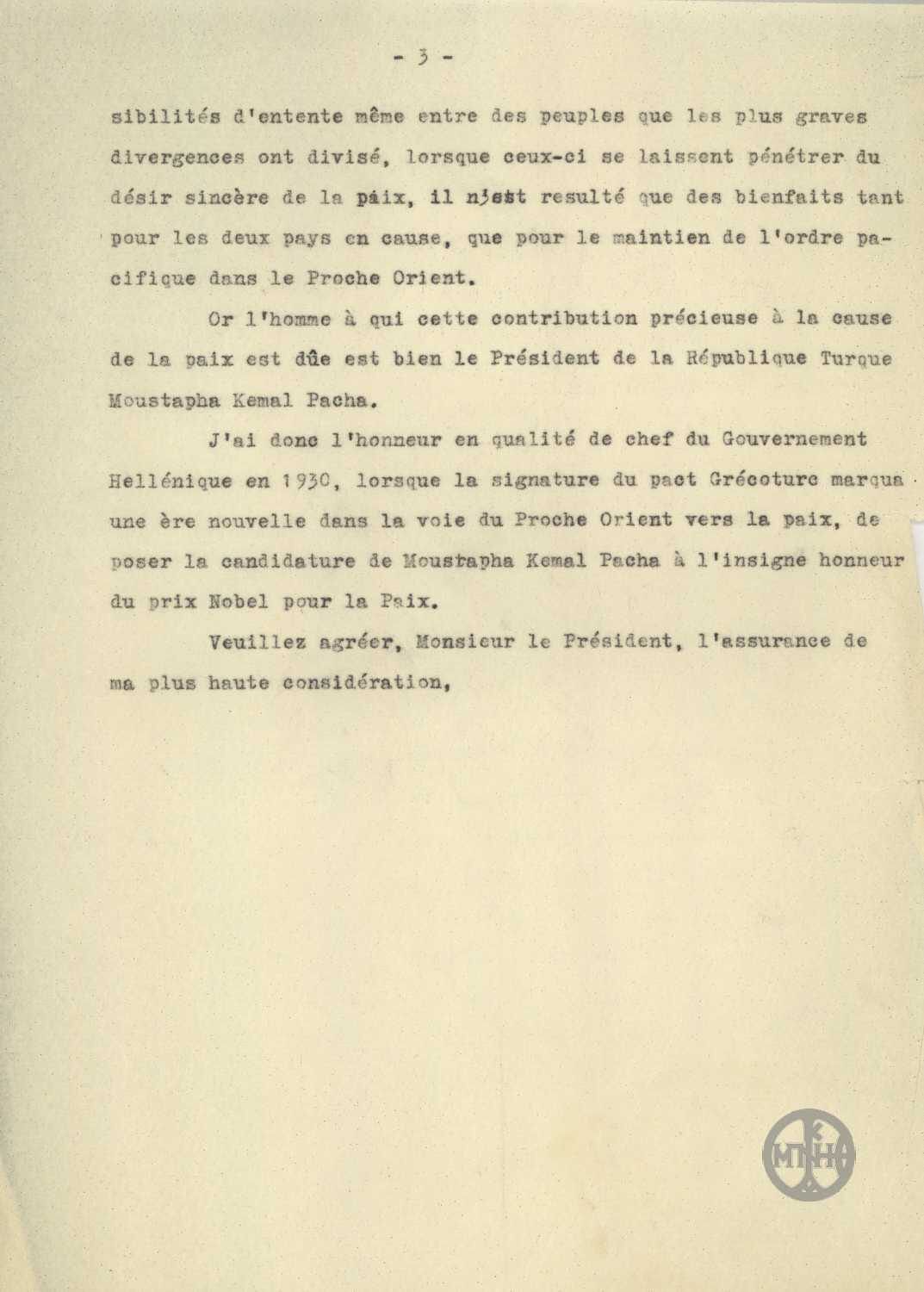
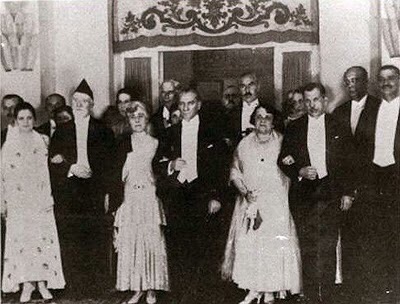
Nomination letter by Eleftherios K. Venizelos for the conferral of the Nobel Peace Prize upon Mustafa Kemal Pasha (Ataturk)

(Translation from French into English by Stella Colston) 

Athens, January 12, 1934

Mister President,

For almost seven centuries the whole of the Near East and a large part of Central Europe was a theatre for bloody wars. The main cause of this was the Ottoman Empire and the absolutist regime of the Sultans.

The subjugation of Christian peoples, the religious wars of the Cross against the Crescent which inevitably followed, and the successive resurgences of all the peoples who aspired to their liberation, created a situation which remained a permanent source of danger as long as the Ottoman Empire retained the imprint of the Sultans.

The foundation of the Turkish Republic in 1922, when the national movement of Moustafa Kemal Pasha triumphed over its adversaries, put a definitive end to that state of instability and intolerance.

Indeed, very rarely has such a radical change been achieved in so short a time in the life of a nation.

An empire in decline, living under a theocratic regime where the notions of law and religion intermingled, was turned into a modern nation state, full of vigour and life.

Through the impetus given by the great reformer Moustafa Kemal Pasha, the absolutist regime of the Sultans was abolished, and the state became truly secular. The whole nation embraced progress, rightly ambitious to be present at the forefront of civilized peoples.

But the consolidation of peace went hand in hand with all the internal reforms which gave the new, predominantlyethnic Turkish state the image it has nowadays. Indeed, Turkey did not hesitate to accept legally the loss of provinces inhabited by other nationalities and, satisfied with the ethnic and political borders defined by the treaties, she became a true pillar for peace in the Near East.

We, the Greeks, who had been driven for centuries of bloody battles into continuous confrontation with Turkey, were the first to feel the effects of the deep change which occurred in that country, the successor of the old Ottoman Empire.

Having discerned, very soon after the catastrophe in Asia Minor, the opportunity of an understanding with reborn Turkey – which came out of the war as a national state-we offered her our hand which she took with sincerity.

This rapprochement, which shows that even peoples divided by the most serious differences can come closer to each otherwhen they become filled with the sincere desire for peace, was beneficial both for the two countries involved and for keeping the peace in the Near East.

The man to whom this invaluable contribution to the cause of peace is due is, of course, the President of the Turkish Republic, Moustafa Kemal Pasha.

Thus, I have the honour, as the leader of the Hellenic Government in 1930, when the signature of the Greek-Turkishpact marked a new era in the march of the Near East towards peace, to propose Moustafa Kemal Pasha as a candidate for the distinguished honour of the Nobel Peace Prize.

Yours sincerely,

E. K. Venizelos 


————————————-


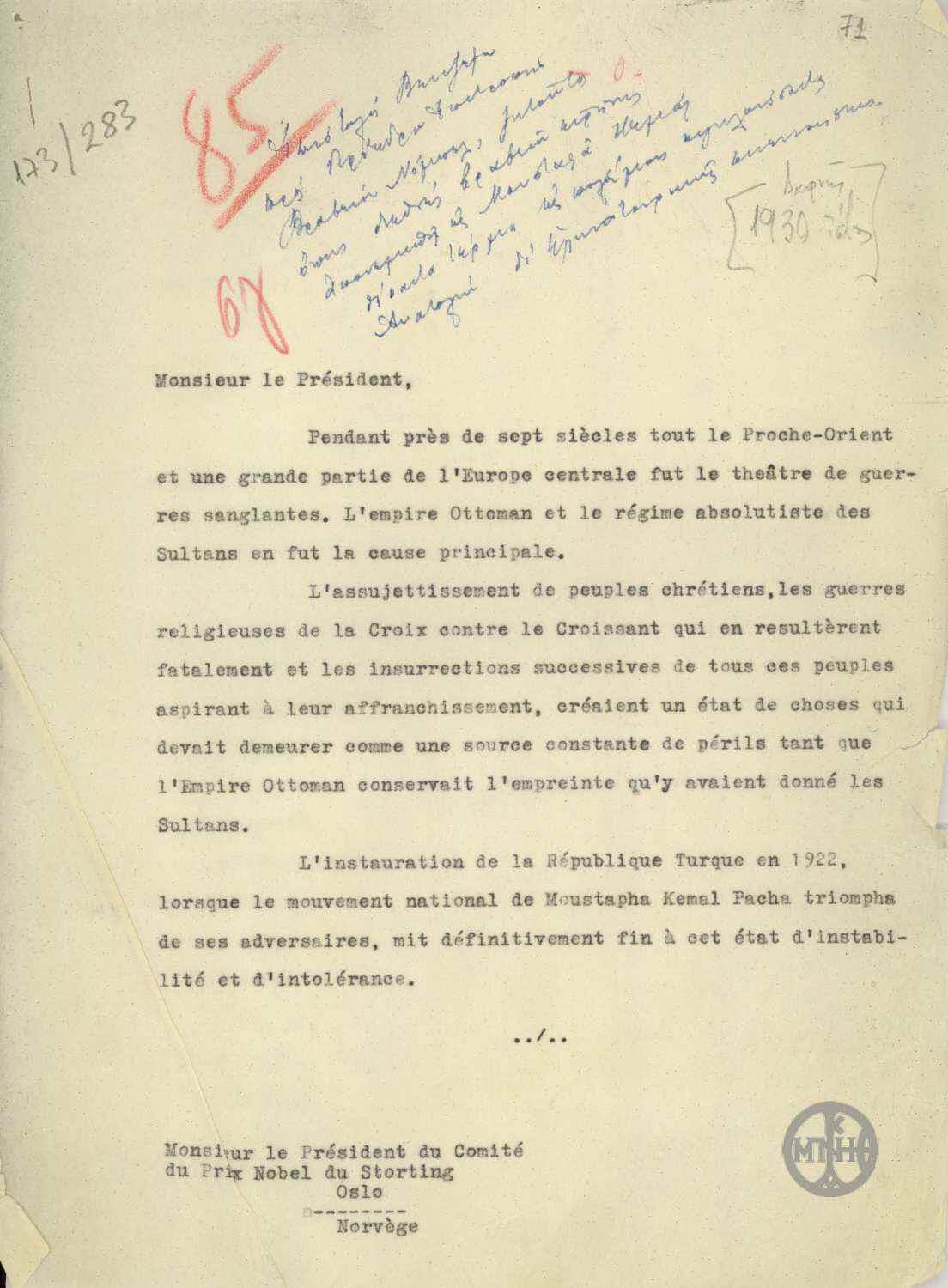
Στις 12 Ιανουαρίου 1934, ο Ελευθέριος Βενιζέλος με επιστολή του στην Σουηδική Ακαδημία, πρότεινε τον Κεμάλ Ατατούρκ για το βραβείο Νόμπελ Ειρήνης. Την αυθεντική επιστολή μπορείτε να δείτε στο τέλος του κειμένου.


Η επιστολή

Αθήνα, 12 Ιανουαρίου 1934

Κύριε Πρόεδρε,

Για περίπου επτά αιώνες ολόκληρη η Μέση Ανατολή και μεγάλο τμήμα της Κεντρικής Ευρώπης αποτέλεσαν θέατρο αιματηρών πολέμων. Κύρια αιτία γι αυτούς ήταν η Οθωμανική Αυτοκρατορία και το απολυταρχικό καθεστώς των Σουλτάνων.

Η υποδούλωση χριστιανικών λαών, οι θρησκευτικοί πόλεμοι του Σταυρού εναντίον της Ημισελήνου που μοιραία επακολούθησαν και οι διαδοχικές εξεγέρσεις όλων αυτών των λαών που προσέβλεπαν στην απελευθέρωσή τους δημιουργούσαν μια κατάσταση πραγμάτων που θα παρέμενε μόνιμη πηγή κινδύνων όσο η Οθωμανική Αυτοκρατορία διατηρούσε τα ίχνη που της είχαν αφήσει οι Σουλτάνοι.

Η εγκαθίδρυση της Τουρκικής Δημοκρατίας το 1922, όταν το εθνικό κίνημα του Μουσταφά Κεμάλ Πασά θριάμβευσε επί των αντιπάλων του, έθεσε οριστικά τέλος σ’ αυτή την κατάσταση αστάθειας και μισαλλοδοξίας.

Πράγματι, σπάνια στη ζωή ενός έθνους πραγματοποιήθηκε σε τόσο λίγο χρόνο μια αλλαγή τόσο ριζική. Μια παρακμάζουσα αυτοκρατορία που ζούσε υπό θεοκρατικό καθεστώς στο οποίο οι έννοιες του δικαίου και της θρησκείας συγχέονταν μετατράπηκε σ`ένα εθνικό και σύγχρονο κράτος, γεμάτο ενέργεια και ζωή.

Με την ώθηση του μεγάλου μεταρρυθμιστή Μουσταφά Κεμάλ το απολυταρχικό καθεστώς των Σουλτάνων καταλύθηκε και το κράτος κατέστη αληθινά κοσμικό. Το έθνος ολόκληρο στράφηκε προς την πρόοδο, με την θεμιτή φιλοδοξία να ενταχθεί στην πρωτοπορία των πολιτισμένων λαών.

Όμως το κίνημα για την εδραίωση της ειρήνης προχώρησε από κοινού με όλες εκείνες τις εσωτερικές μεταρρυθμίσεις που προσέδωσαν στο νέο κυρίως εθνικό κράτος της Τουρκίας τη σημερινή του μορφή. Πράγματι η Τουρκία δεν δίστασε να αποδεχθεί ειλικρινά την απώλεια επαρχιών όπου κατοικούσαν άλλες εθνότητες και, ικανοποιημένη πραγματικά με τα εθνικά και πολιτικά της σύνορα όπως καθορίστηκαν από τις Συνθήκες, έγινε αληθινός στυλοβάτης της ειρήνης στην Εγγύς Ανατολή.

Είμαστε εμείς οι Έλληνες που αιματηροί αγώνες αιώνων μας είχαν φέρει σε κατάσταση διαρκούς ανταγωνισμού με την Τουρκία οι πρώτοι που είχαμε την ευκαιρία να αισθανθούμε τις συνέπειες αυτής της βαθιάς αλλαγής στη χώρα αυτή, διάδοχο της παλιάς Οθωμανικής Αυτοκρατορίας.

Από την επόμενη μέρα της Μικρασιατικής καταστροφής, διαβλέποντας την δυνατότητα συνεννόησης με την αναγεννημένη Τουρκία, που προέκυψε από τον πόλεμο ως εθνικό κράτος, της απλώσαμε το χέρι και το δέχτηκε με ειλικρίνεια.  

Από αυτήν την προσέγγιση, που μπορεί να χρησιμεύσει ως παράδειγμα για τη δυνατότητα συνεννόησης ακόμη και μεταξύ λαών που τους χώρισαν οι πιο σοβαρές διαφορές, όταν αυτοί διαποτιστούν με την ειλικρινή επιθυμία για ειρήνη, προέκυψαν μόνο καλά, τόσο για τις δύο ενδιαφερόμενες χώρες όσο και για τη διατήρηση της ειρήνης στην Εγγύς Ανατολή. Ο άνθρωπος στον οποίο οφείλεται αυτή η πολύτιμη συμβολή στην ειρήνη δεν είναι άλλος από τον Πρόεδρο της Τουρκικής Δημοκρατίας Μουσταφά Κεμάλ Πασά. 

Έχω λοιπόν την τιμή ως αρχηγός της Ελληνικής Κυβέρνησης το 1930, όταν η υπογραφή του Ελληνοτουρκικού συμφώνου σηματοδότησε μια νέα εποχή στην πορεία της Εγγύς Ανατολής προς την ειρήνη, να υποβάλλω την υποψηφιότητα του Μουσταφά Κεμάλ Πασά για την διακεκριμένη τιμή του βραβείου Νόμπελ για την Ειρήνη.

Με βαθύτατη εκτίμηση

Ε. Κ. Βενιζέλος

(Translation from French into Greek by Penny Pouliou)

Source: http://infognomonpolitics.blogspot.gr/

WOMEN OF PASSION – WOMEN OF GREECE

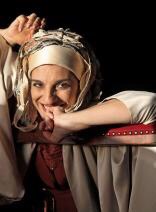
The theatrical production “Women of Passion, Women of Greece”, that moved a wide variety of different audiences thanks to the distinctive directorial approach, accompanied by a powerful play, great acting as well as exceptional live music and impressive video design.


Three mythical female figures, tragic Medea and the two contemporary Greek “priestesses”, Maria Callas and Melina Mercouri, make a symbolic train tour from ancient to modern Greece. 

Three legends of art and life whose paths are different but share the same common characteristic: they are passionate women, incorporating the temperament and values of Greek spirit: passion for life, passion for love, passion for art and creativity, passion for freedom and democracy. 

Medea, the tragic figure of ancient Greek drama, blinded by her deep love for her husband, murdered her own children. 

Maria Callas, the internationally celebrated opera diva, devoted her life to music and let her fate be sealed by a “fatal” romance. 

Μelina Mercouri, one of the most beloved Greek actresses, singer and politician, who starred in the most well-known international films, fought for culture and democracy. 

An actress and a musician meet on stage to bring to life significant historical moments and guide us through this imaginary voyage, where Greece is its departure and arrival at the same time with stops in the hearts of people around the world. 

Eugenia Arsenis writing / dramaturgy Tatiana Ligari direction / stage design Dora Lelouda costume design Fotis Mylonas music composition Spyros Rasidakis video design Sakis Birbilis lighting design Danae Koureta headdresses Evelina Arapidi actress Fotis Mylonas musician (vocals, guitar, mandolin, bansuri, percussion instruments).
Price: $35 + Booking Fees

Bookings (02) 9550 3666

Tickets: On sale now @ The Factory Theatre

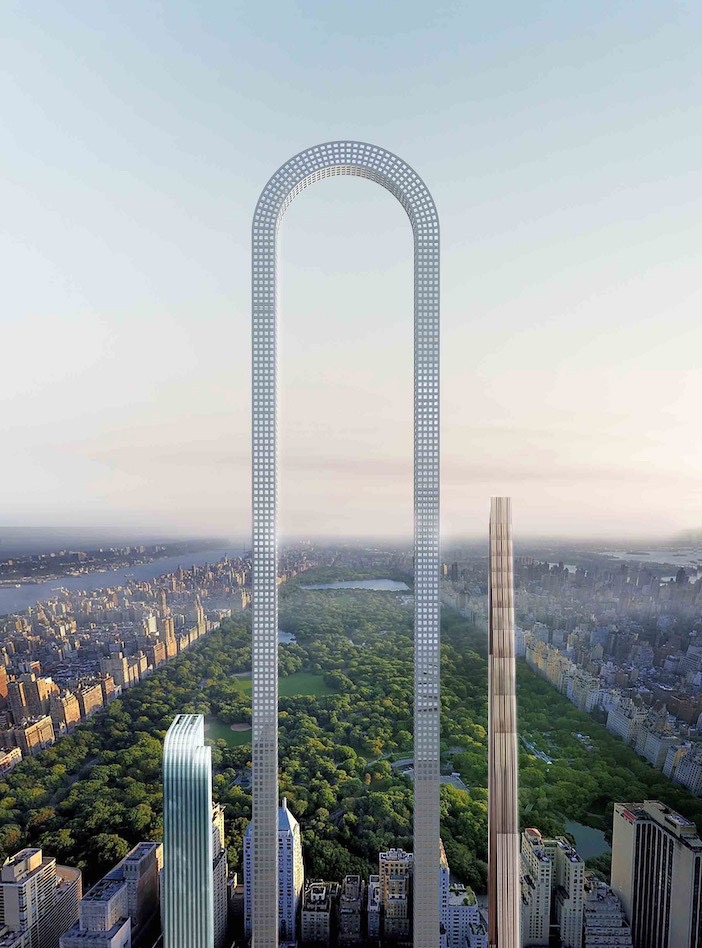
A Greek Architect Wants to Twist Up the Famed NYC Skyline with his “Big Bend” Concept


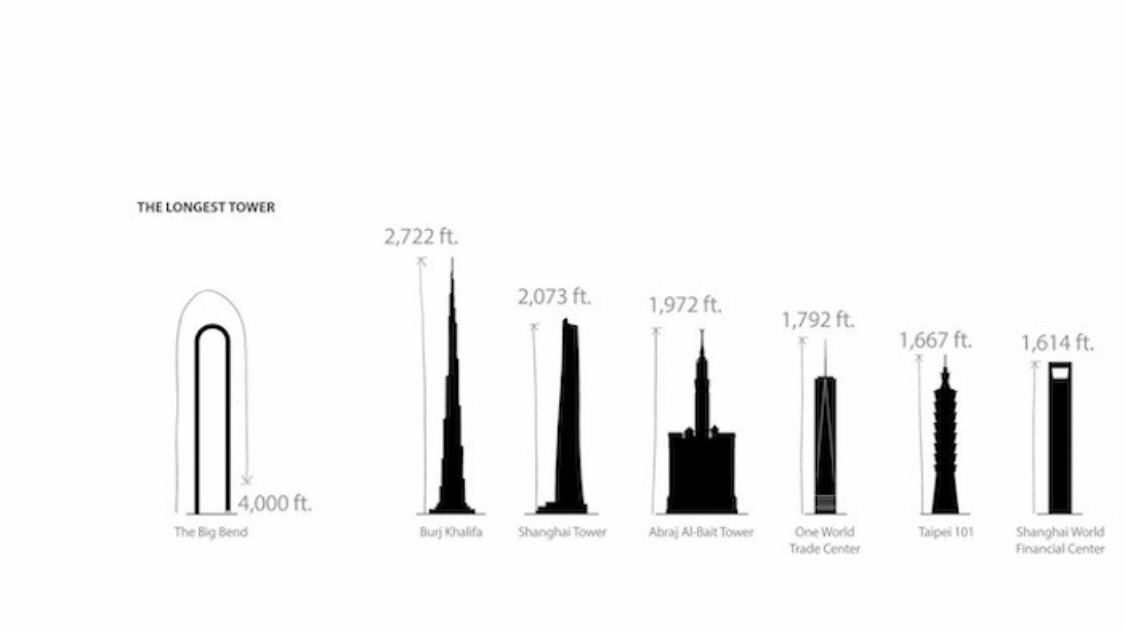
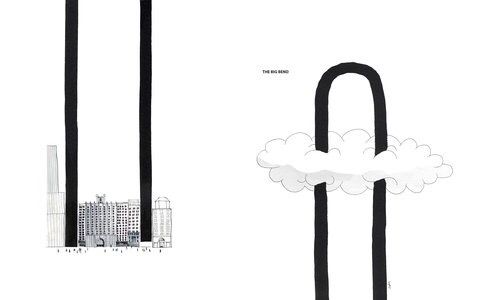
A Greek architect wants to twist up the famed New York City skyline with a building that will be not only amongst the world’s tallest— but also the world’s longest.

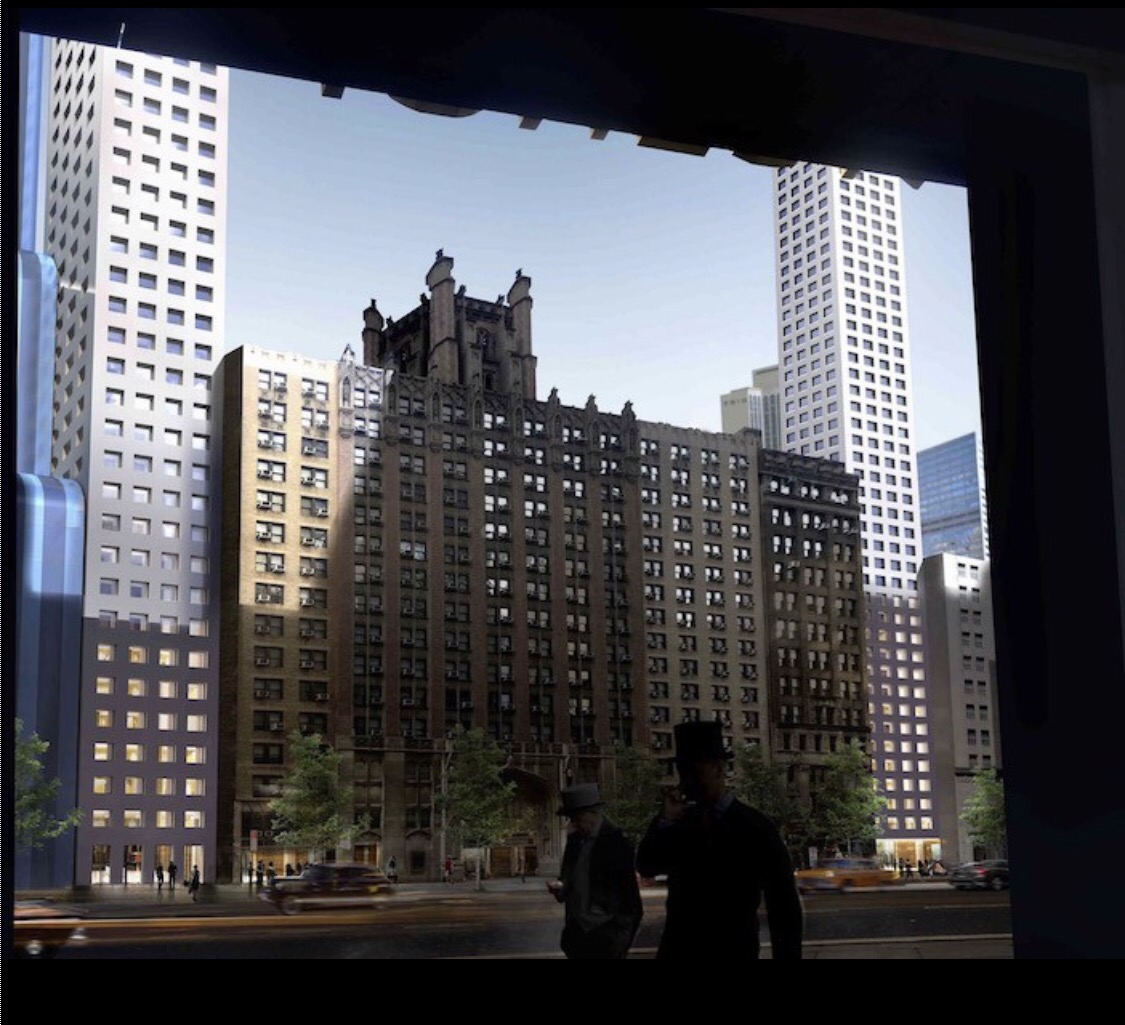
A firm called Oiio, run by Yiannis Oikonomou with offices in New York City and Athens has proposed The Big Bend, an inverted U-shaped structure that would twist in the sky, forever reshaping the skyline just south of Central Park, known as “Billionaire’s Row” and the entire cityscape.

We have become familiar with building height measurements. We usually learn about the latest tallest building and we are always impressed by it’s price per square foot. It seems that a property’s height operates as a license for it to be expensive.

New York city’s zoning laws have created a peculiar set of tricks trough which developers try to maximize their property’s height in order to infuse it with the prestige of a high rise structure. But what if we substituted height with length? What if our buildings were long instead of tall?

If we manage to bend our structure instead of bending the zoning rules of New York we would be able to create one of the most prestigious buildings in Manhattan. The longest building in the world. The Big Bend can become a modest architectural solution to the height limitations of Manhattan. We can now provide our structures with the measurements that will make them stand out without worrying about the limits of the sky.

It all sounds like an interesting concept, right?

And that, it remains: a concept. It seems highly unlikely that a project like this would ever get off the ground.

The politicians, community leaders and preservation groups have already condemned the rise of supertall structures that are currently rising along Central Park South, so adding another one to the mix wouldn’t possibly go over well with them— especially one as radical as Oikonomou’s Big Bend.

Alexander the Great Documentary video

https://youtu.be/khO0eQnp2pw

Alexander III of Macedon (20/21 July 356 BC – 10/11 June 323 BC), commonly known as Alexander the Great (Greek: Ἀλέξανδρος ὁ Μέγας, Aléxandros ho Mégas Koine Greek: [a.lék.san.dros ho mé.gas]), was a king (basileus) of the Ancient Greek kingdom of Macedon[a] and a member of the Argead dynasty. 

He was born in Pella in 356 BC and succeeded his father Philip II to the throne at the age of twenty. 

He spent most of his ruling years on an unprecedented military campaign through Asia and northeast Africa, and he had created one of the largest empires of the ancient world by the age of thirty, stretching from Greece to northwestern India. 

He was undefeated in battle and is widely considered one of history’s most successful military commanders. During his youth, Alexander was tutored by Aristotle until the age of 16. After Philip’s assassination in 336 BC, he succeeded his father to the throne and inherited a strong kingdom and an experienced army. 

Alexander was awarded the generalship of Greece and used this authority to launch his father’s Panhellenic project to lead the Greeks in the conquest of Persia.

In 334 BC, he invaded the Achaemenid Empire (Persian Empire) and began a series of campaigns that lasted ten years. Following the conquest of Anatolia, Alexander broke the power of Persia in a series of decisive battles, most notably the battles of Issus and Gaugamela. 

He subsequently overthrew Persian King Darius III and conquered the Achaemenid Empire in its entirety. At that point, his empire stretched from the Adriatic Sea to the Indus River. 

He sought to reach the “ends of the world and the Great Outer Sea” and invaded India in 326 BC, winning an important victory over the Pauravas at the Battle of the Hydaspes. He eventually turned back at the demand of his homesick troops. 

Alexander died in Babylon in 323 BC, the city that he planned to establish as his capital, without executing a series of planned campaigns that would have begun with an invasion of Arabia. 

In the years following his death, a series of civil wars tore his empire apart, resulting in the establishment of several states ruled by the Diadochi, Alexander’s surviving generals and heirs.

RECAP: Semi-Final 1 and 2 – Eurovision Song Contest 2017

The second Semi-Final of the 2017 Eurovision Song Contest will take place on the 11th of May live from the International Exhibition Centre in Kyiv.

THE BATTLE OF MARATHON 490 BC

https://youtu.be/-C1SP-EMUB0
https://youtu.be/Cx-XB2eh-pQ

Battle of Thermopylae Greece vs Persia

https://youtu.be/vPbWqN_3JxQ

The Battle of Thermopylae was fought between an alliance of Greek city-states, led by King Leonidas of Sparta, and the Persian Empire of Xerxes I over the course of three days, during the second Persian invasion of Greece. It took place simultaneously with the naval battle at Artemisium, in August or September 480 BC, at the narrow coastal pass of Thermopylae (“The Hot Gates”). 

The Persian invasion was a delayed response to the defeat of the first Persian invasion of Greece, which had been ended by the Athenian victory at the Battle of Marathon in 490 BC. Xerxes had amassed a huge army and navy, and set out to conquer all of Greece. 

The Athenian general Themistocles had proposed that the allied Greeks block the advance of the Persian army at the pass of Thermopylae, and simultaneously block the Persian navy at the Straits of Artemisium. A Greek force of approximately 7,000 men marched north to block the pass in the middle of 480 BC. 

The Persian army, alleged by the ancient sources to have numbered over one million, but today considered to have been much smaller (various figures are given by scholars, ranging between about 100,000 and 150,000),[8][9] arrived at the pass in late August or early September. The vastly outnumbered Greeks held off the Persians for seven days (including three of battle) before the rear-guard was annihilated in one of history’s most famous last stands. During two full days of battle, the small force led by Leonidas blocked the only road by which the massive Persian army could pass. 

After the second day, a local resident named Ephialtes betrayed the Greeks by revealing that a small path led behind the Greek lines. Leonidas, aware that his force was being outflanked, dismissed the bulk of the Greek army and remained to guard their retreat with 300 Spartans, 700 Thespians, 400 Thebans, and perhaps a few hundred others, most of whom were killed.

At Artemisium, the Greek navy, under the command of the Athenian politician Themistocles, received news of the defeat. Since the Greek strategy required both Thermopylae and Artemisium to be held, and given their losses, it was decided to withdraw to Salamis. The Persians overran Boeotia and then captured the evacuated Athens. The Greek fleet—seeking a decisive victory over the Persian armada—attacked and defeated the invaders at the Battle of Salamis in late 480 BC. 

Fearful of being trapped in Europe, Xerxes withdrew with much of his army to Asia (losing most to starvation and disease), leaving Mardonius to attempt to complete the conquest of Greece. However, the following year saw a Greek army decisively defeat the Persians at the Battle of Plataea, thereby ending the Persian invasion. 

Both ancient and modern writers have used the Battle of Thermopylae as an example of the power of a patriotic army defending its native soil. The performance of the defenders is also used as an example of the advantages of training, equipment, and good use of terrain as force multipliers and has become a symbol of courage against overwhelming odds.

ARCHAEOLOGIST BELIEVES CHILDHOOD HOME OF JESUS HAS BEEN FOUND


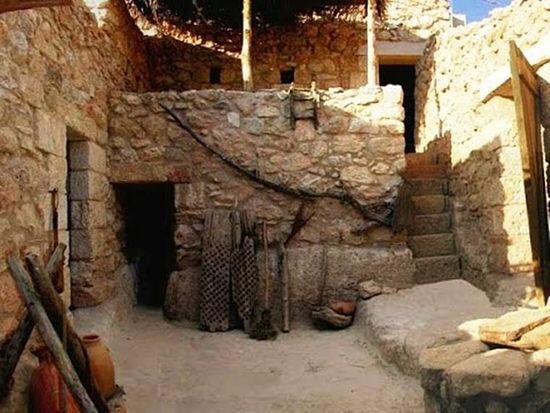
British archaeologist Dr. Ken Dark of the University of Reading believes that a house first discovered in the 1880s is in fact the childhood home of the Lord Jesus Christ Himself.
Although discovered in the nineteenth century, the modest Nazareth home in northern Israel, discovered by nuns from the Sisters of Nazareth Convent, was not dated to the first century until 2006, reports Express. Dr. Dark argues in a recent article in the Biblical Archaeological Review that there is “no good reason” why the home should not be that of Christ.


Holy site: An exterior view of the house believed to be where Jesus lived as a young boy

Merely dating to the first century in Nazareth of its own seems a weak argument, but the expert further notes that “Great efforts had been made to encompass the remains of this building within the vaulted cellars of both the Byzantine and Crusader churches, so that it was thereafter protected,” proving that the home bore some kind of significance for early Christians.

Dr. Dark further points to textual evidence of a tradition of early Christians having preserved the childhood home of the Son of God, forgotten at some point in the ensuing centuries. In 670 AD St. Adomnan of the Scottish monastery of Iona offered a written description of Frankish bishop Arculf’s pilgrimage to Nazareth in which is mentioned a church “where once there was the house in which the Lord was nourished in His infancy.”

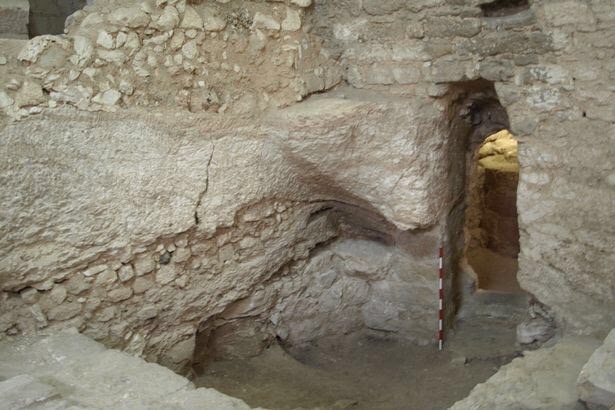
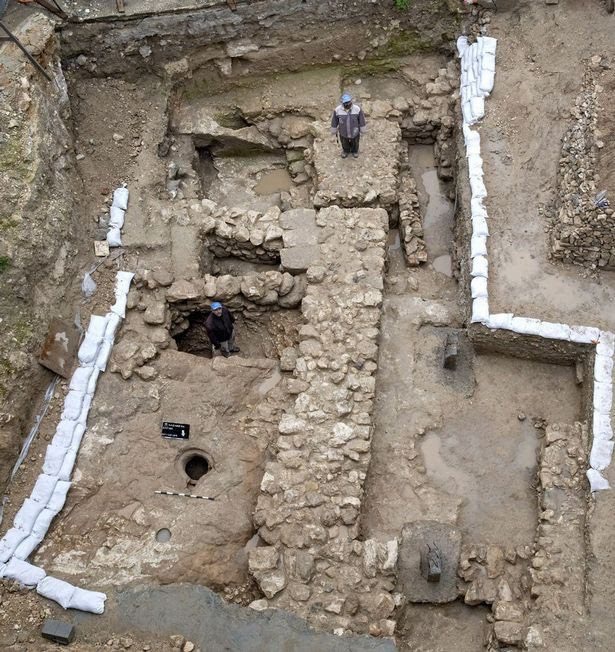
The house, found beneath the Sisters of Nazareth Convent, is cut out of limestone, with a series of rooms and a stairway. According to the archaeologist’s article, the house is located between two tombs at a Nazareth church built near a vault.


Dig: The archaeological excavation near the Church of the Annunciation

More light is expected to be shed on Jesus’ childhood home in one of the upcoming episodes of CNN’s “Finding Jesus” documentary series, whose second season premiered on Sunday.

Where Australia’s immigrants were born in rollover map

This map reveals the top three birthplaces for immigrants in suburbs and towns across Australia.

You can also access a map revealing birthplaces excluding English and New Zealand immigrants.

Rollover suburbs with your mouse for detailed info.

Zoom and drag for a view of other cities and the nation as a whole, or click on the following links:


https://a.tiles.mapbox.com/v4/sbsonline.ie9aojc4.html?access_token=pk.eyJ1Ijoic2Jzb25saW5lIiwiYSI6IklRMkRCVVEifQ.ldQz-kg5lTylBG6J4HoXbg


The Antikythera Mechanism – 2DAntikythera 

More than 21 centuries ago, a mechanism of fabulous ingenuity was created in Greece, a device capable of indicating exactly how the sky would look for decades to come — the position of the moon and sun, lunar phases and even eclipses. But this incredible invention would be drowned in the sea and its secret forgotten for two thousand years. 

This video is a tribute from Swiss clock-maker Hublot and film-maker Philippe Nicolet to this device, known as the Antikythera Mechanism, or the world’s “first computer”. 

The fragments of the Mechanism were discovered in 1901 by sponge divers near the island of Antikythera. 

It is kept since then at the National Archaeological Museum in Athens, Greece. For more than a century, researchers were trying to understand its functions. 

Since 2005, a pluridisciplinary research team, the “Antikythera Mechanism Research Project”, is studying the Mechanism with the latest high tech available. 

The results of this ongoing research has enabled the construction of many models. Amongst them, the unique mechanism of a watch, designed by Hublot as a tribute to the Mechanism, is incorporating the known functions of this mysterious and fascinating ancient Mechanism. 

A model of the Antikythera Mechanism, built by the Aristotle University in Greece, together with the mechanism of the watch and this film in 3D are featuring in an exhibition about the Mechanism that is taking place in Paris, at the Musée des Arts et Métiers. 

The original fragments of the Mechanism, its main models and the watch designed by Hublot are on display at the National Archaeological Museum in Athens, Greece.